Solved Problem: Why Do Bond Prices and Bond Yields Move Inversely?

Supports: Money, Banking, and the Financial System, Chapter 3, and Microeconomics, Chapter 8, Appendix.

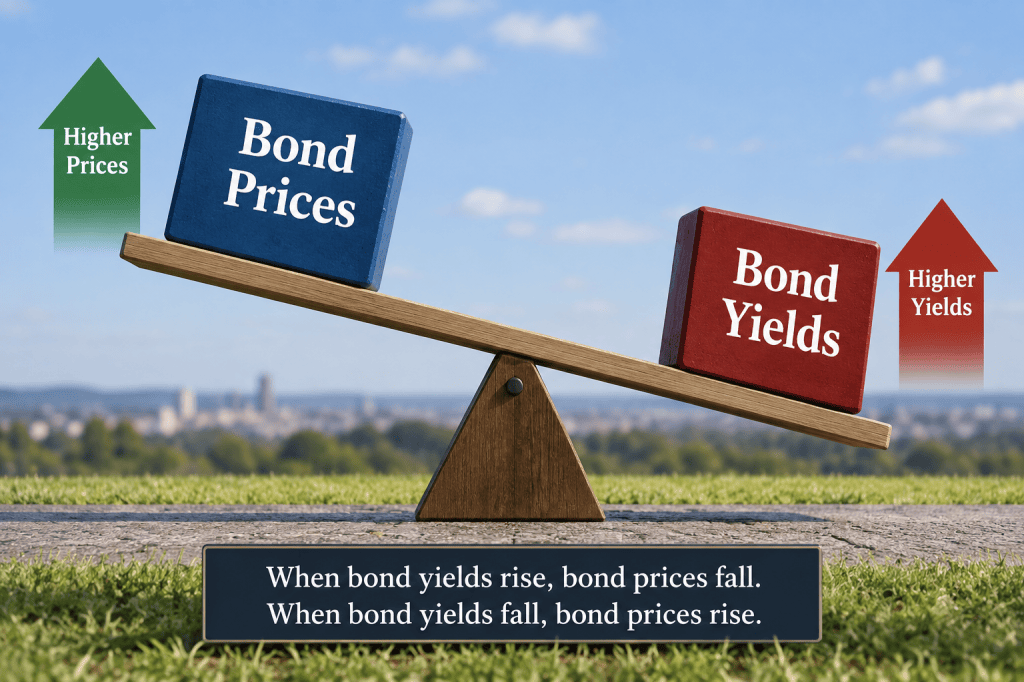
Image created by ChatGPT

A recent article in the Wall Street Journal was titled “A Primer on Why Bond Prices Fall When Yields Rise.” A student reading the title of the article asks, “How can that be right? Investors would prefer to own bonds that have higher yields, so when the yields on bonds rise, investors should demand more of them. When the demand for something goes up, the price increases. Therefore, bond yields and bond prices should go up (or down) together.” Briefly explain the error in this student’s reasoning.

Solving the Problem
Step 1: Review the chapter material. This problem is about the relationship between bond yields and bond prices, so you may want to review Money, Banking, and the Financial System, Chapter 3 (for a complete discussion) or Microeconomics, Chapter 8, Appendix (for a brief discussion).

Step 2: Solve the problem by explaining what is wrong with the argument that if bond yields increase, so will bond prices, and if bond yields decrease, so will bond prices. In solving the problem, we should first consider the sometimes confusing number of “interest rates” on a coupon bonds. Coupon bonds pay interest in the form of coupons, which are usually quoted on an annual basis although typically paid twice per year. For example, Apple may issue a bond that pays a coupon of $47.50. The coupon rate on this bond is quoted per $1,000 of face value, or par value, which in this case would be 4.750%.

Bonds, like other financial assets such as shares of stock, are bought and sold in financial markets. A key point is that in financial markets, bonds with similar characteristics—including the same level of default risk, the same liquidity, and the same tax treatment of the bonds’ coupons—should provide investors with the same expected return. If this condition didn’t hold—for instance, if a bond issued by Apple was expected to provide a higher return than comparable bonds—then investors would increase their demand for the Apple bond, forcing up its price until its yield fell by enough to make its expected return the same as on other comparable bonds.

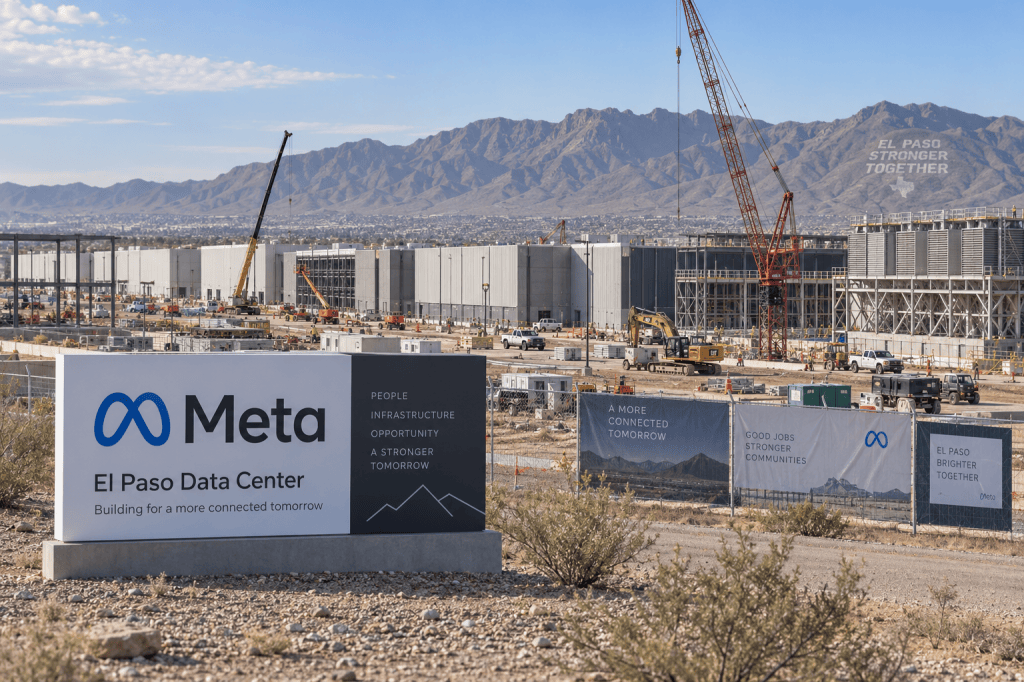
The price of a bond can fluctuate depending on how its coupon rate compares to the coupon rates on newly issued bonds, changes in investors’ expectations of future inflation, changes in investors’ expectations of the default risk of the bond, and other factors. For example, an article in the Wall Street Journal reported that, “Lenders on Monday demanded higher yields on bonds from a new data-center project in El Paso, Texas, leased by Meta compared with a similar project last year.” According to the article, the reason for the higher yields was that investors had raised their estimates of the default risk on bonds issued to fund data centers. Investors needed higher yields on bonds to compensate them for the higher default risk.

An image created by ChatGPT of Meta’s data-center complex under construction in El Paso, Texas.

What happens to the prices of existing bonds when newly issued bonds have higher coupon rates? Keeping in mind that, because the coupon rate on a bond is fixed and won’t change after the bond has been issued, the only way that the yield on a bond can change is if the price of the bond declines. By “yield” we are here referring to the yield to maturity, which is the best way of calculating the yield on a bond and which is ordinarily what economists and investors mean when they refer to the interest rate on a bond.

Formally, the yield to maturity is defined as the interest rate that makes the present value of the payments from the bond equal to the bond’s current price. In the following expression, where C is the coupon on the bond, FV is the face value of the bond, and n is the number of years until the bond matures, i is the yield to maturity.

The arithmetic of this expressions shows that if the yield to maturity increases, because, for example, the coupon rate on similar newly issued bonds are higher than the coupon rate on this bond, the price of the bond must decline. The economics of this expression is that an increase in the yield to maturity reduces the present value of a bond’s coupon payments and face value.

The reverse happens if the yield to maturity on a bond falls: The price of the bond will rise as a matter of arithmetic. As a matter of economics, a lower yield to maturity increases the present value of a bond’s coupon payments and face value.

So, although the student’s assertion seems logical, the economics of bond prices shows that the prices and yields on bonds move inversely.

What’s Going on in the Bond Market?

Image created by ChatGPT

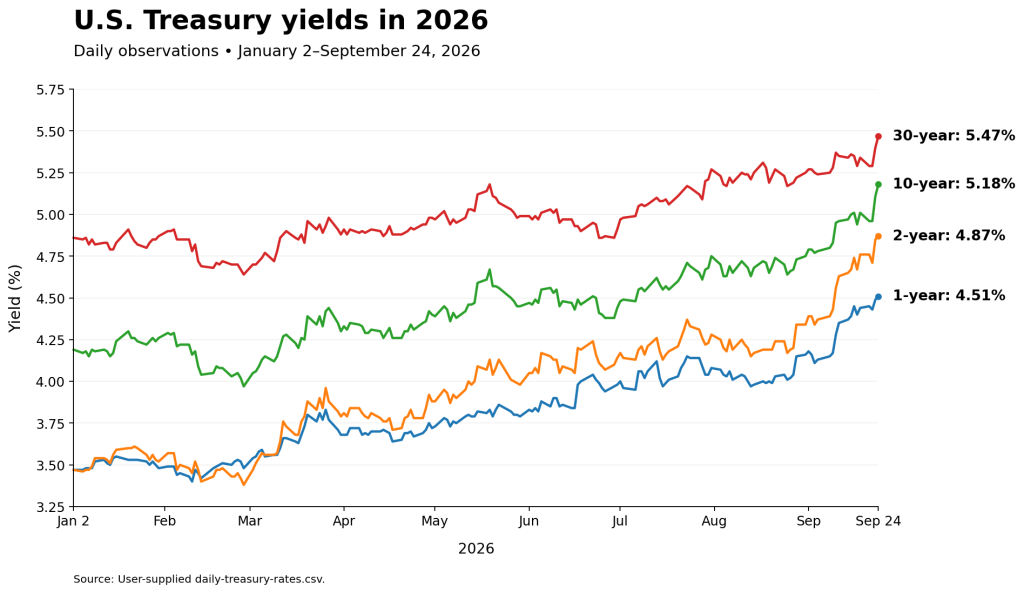
As the following figure show, as of yesterday, the yield on the 30-year U.S. Treasury bond is the highest it’s been since 2004, before the Global Financial Crisis.

The following figure (created by ChatGPT using data from this Treasury website) shows that Treasury bonds at all maturities have risen this year. Recall that the maturity of a bond is the amount of time until the seller of the bond repays the principal to the buyer of the bond. Formally, a Treasury security with a maturity of 1 year or less is a Treasury bill, a Treasury security with with a maturity of 2 years to 10 years is a Treasury note, and a Treasury security with of more than 10 years is a Treasury bond. For simplicity, in this post we’ll usually refer to all Treasury securities as bonds. We’ll refer interchangeably to the interest rate on a bond and the yield on the bond. Formally, the relevant interest rate in this post is the yield to maturity. (We discuss the bond market in Money, Banking, and the Financial System, Chapters 3-5. A new edition is available now.)

Rising yields on Treasury securities have a substantial effect on the economy. On most days, nearly all of the buying and selling in the Treasury bond market is of existing bonds that the U.S. Treasury may have issued decades earlier. Because the federal government has been running large budget deficits, the Treasury has to issue billions of new Treasury bonds each year. Investors will only buy newly issued Treasury bonds if their yields are competitive with the yields on existing bonds. As a result, interest payments have been a rising fraction of total federal spending, which contributes to the federal budget deficit.

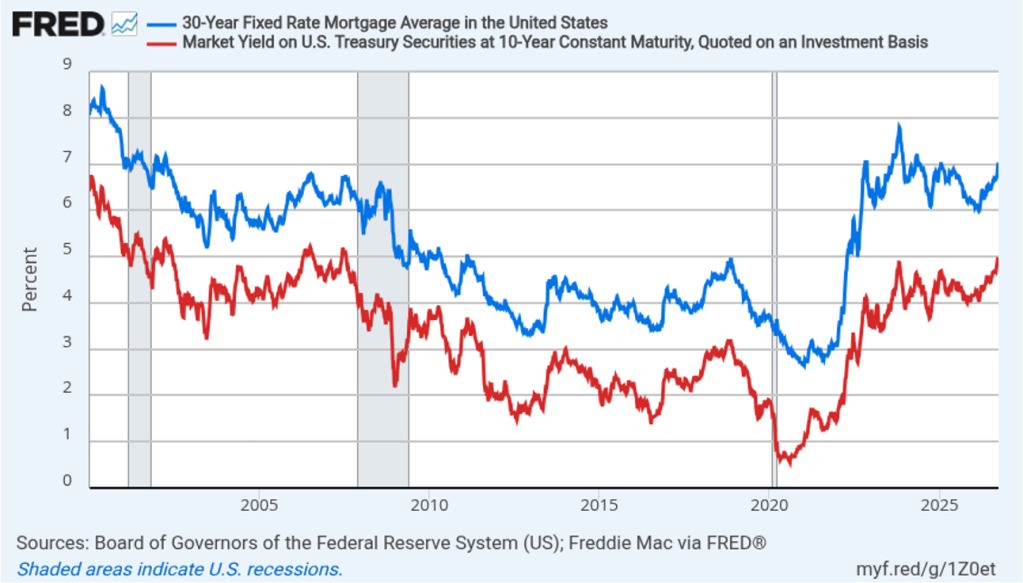
Firms that grant mortgage loans typically adjust the interest rates they charge as the yield on the 10-year Treasury changes. The difference between the interest rate on mortgages and the interest rate on the 10-year Treasury is called the mortgage spread. The following figure shows the close relationship between movements in the mortgage interest rate (the blue line) and movements in the interest rate on 10-year Treasurys (the red line). The recent increase in the yields on 10-year Treasurys has caused an increase in the mortgage interest rate.

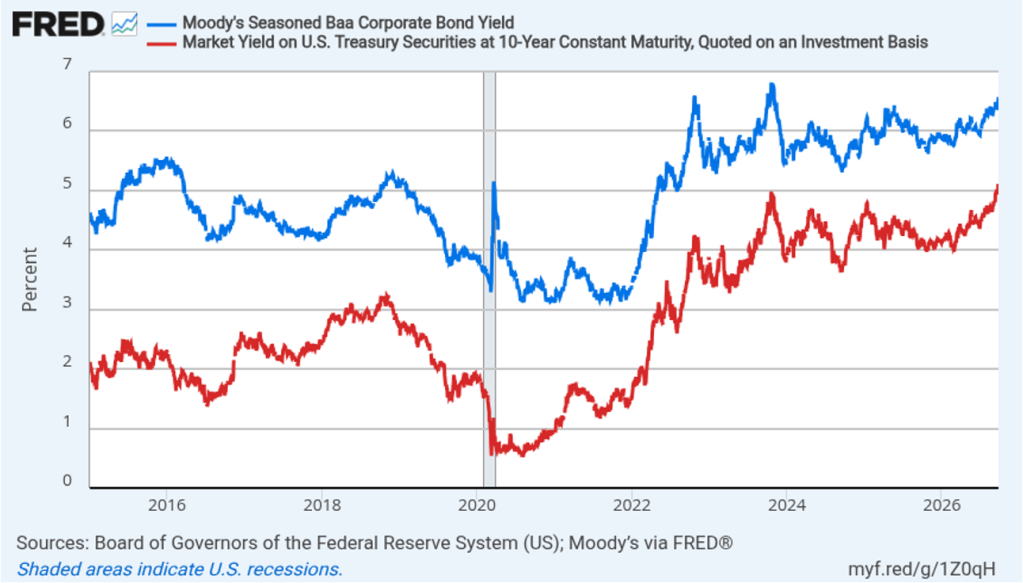
Many investors hold both Treasury bonds and bonds issued by corporations. If the yields on Treasury bonds rise, to attract investors the yields on corporate bonds also have to rise. The following figure shows that there is a close relationship between the yield on 10-year Treasurys and the yield on corporate bonds. The interest rate on corporate bonds is higher than the interest rate on Treasurys for two key reasons: First, corporate bonds have a higher default risk, which is the risk that a bond issuer will fail to make payments of interest or principal. Second., corporate bonds are less liquid than Treasurys, which means that because the market for Treasurys is much larger than the market for any corporate bond, an investor can more easily sell a Treasury bond. Investors need to be compensated with a higher interest rate on corporate bonds for the greater default risk and lower liquidity of these bonds.

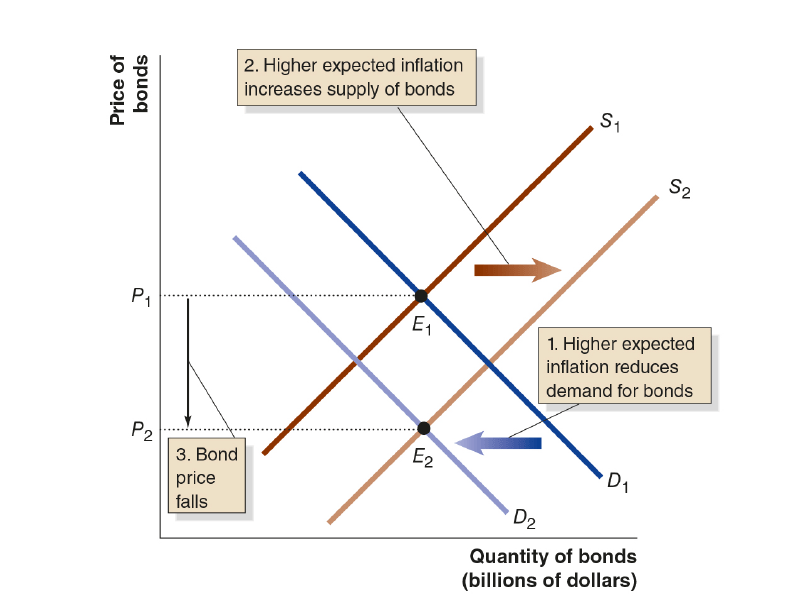
What’s caused the increases in interest rates? Several factors are involved. First, in part because of rising oil prices resulting from conflict in the Middle East, since the middle of 2026 there has been an increase in the inflation rate that investors in bond markets expect to prevail over the next few years. Inflation reduces the purchasing power of the payments investors receive from owning a bond. The Fisher effect refers to the argument by Irving Fisher, who was an economist at Yale University, that the nominal interest rate on a bond will rise point-for-point with changes in the expected inflation rate. (Recall from Macroeconomics, Chapter 9 (Economics, Chapter 19) that the nominal interest rate is the stated interest rate on a bond. We can approximate the real interest rate by subtracting the expected inflation rate from the nominal interest rate.) The following figure from Chapter 4 of Money, Banking, and the Financial System, illustrates the Fisher effect.

A higher expected inflation rate increases the quantity of bonds supplied at any given bond price because inflation reduces the real value of the payments that bond issuers have to make. In the figure, the supply curve for bonds shifts to the right from S1 to S2. A higher expected inflation rate decreases the quantity of bonds demand at any given bond price because inflation reduces the real value of the payments that bond buyers receive. The demand curve for bonds shift to the left from D1 to D2. Note that because the equilibrium price of bonds declines from P1 to P2, the interest rate—which moves inversely with the price—increases. In practice, economists have found that various real-world frictions result in nominal interest rates not always increasing or decreasing by exactly the amount of a change in expected inflation. But the basic point holds that changes in the expected inflation rate lead to changes in the interest rates on bonds.

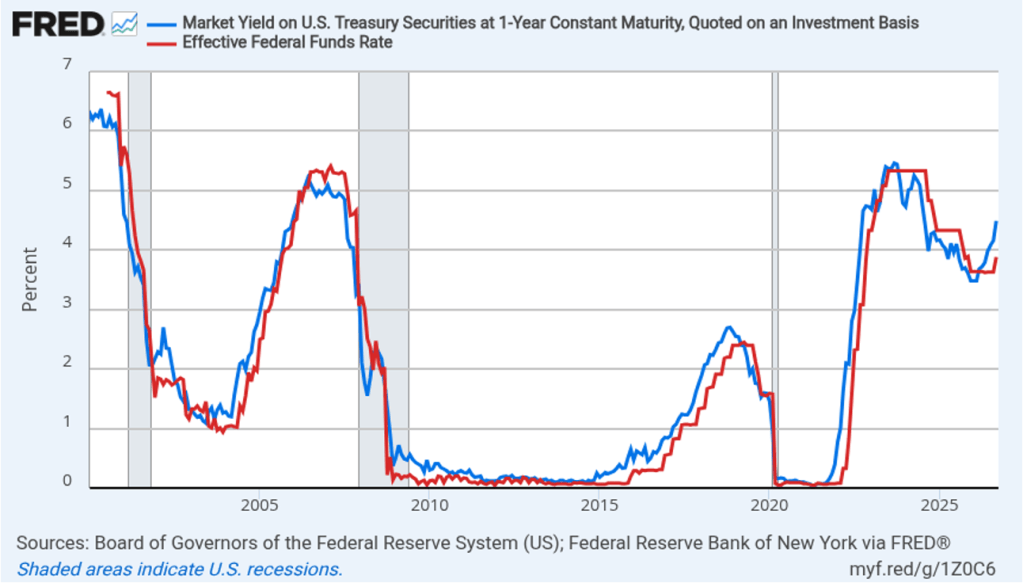
The second reason that interest rates have been rising is related to the first reason. As we discuss in this blog post, because the inflation rate has been running persistently higher than the Federal Reserve’s 2 percent annual target, at its September meeting the Fed’s Federal Open Market Committee (FOMC) raised its target for the federal funds rate. Investors in the federal funds futures market expect that the committee will raise its federal funds rate target further in coming meetings. The following figure shows that the interest rate on 1-year Treasury bills tracks closely movements in the federal funds rate.

Changes in expected future short-term interest rates, such as the expected interest rate on the 1-year Treasury bill one year from now, can affect longer-term interest rates. For example, someone who wants to invest in Treasurys for two years could either buy a 2-year Treasury or buy a 1-year Treasury today and another 1-year Treasury in a year. We would expect that buying and selling in the bond market would make the return from these two ways of investing equal—a process called arbitrage. If investors expect that the FOMC will raise its target for the federal funds rate in the future, the expected interest on the 1-year Treasury bill a year from now will increase, which will also increase the interest rate today on a 2-year Treasury. The same process will also cause interest rates on longer-maturity bonds to increase.

Third, the supply of bonds has been increasing rapidly. As we’ve seen, high federal government budget deficits will cause the Treasury to issue close to $2 trillion in bonds this year. In addition, technology firms, such as as Meta, Alphabet (the parent company of Google), Amazon, and Oracle, have been increasing their bond sales to obtain the funds to build out the infrastructure, such as data centers, necessary to power the AI build out. According to data from the Securities Industry and Financial Markets Association, through August of 2026, corporate bond issuance was nearly 30 percent greater than in 2025.

(Note that most other high income countries, including Japan, Canada, and the countries of Western Europe, have also been running large government budget deficits and issuing large quantities of bonds. Because investors can buy and sell bonds across countries, higher interest rates in one country can put upward pressure on interest rates in other countries.)

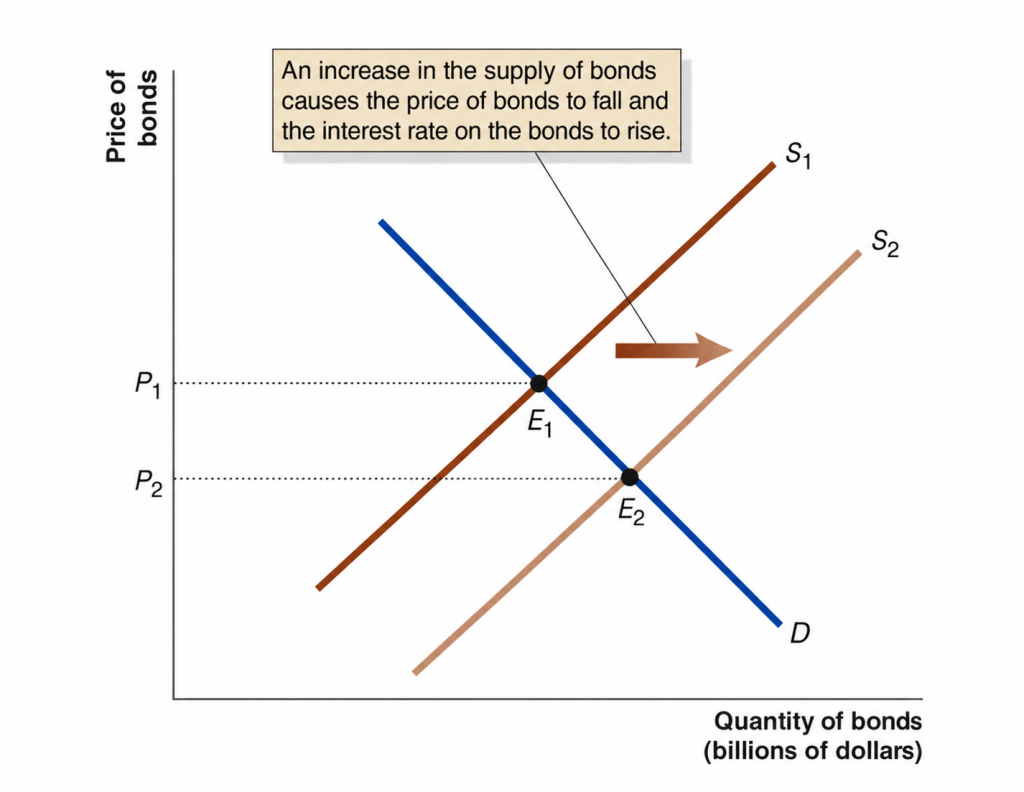
As the following figure shows, an increase in the supply of bonds, holding other factors that can affect the demand or supply of bonds constant, causes the price of bonds to fall and, therefore, the interest rate on bonds to rise.

Following the Global Financial Crisis of 2007–2009, low inflation rates and a federal funds rate close to zero resulted in low interest rates on most bonds. For example, the 10-year Treasury note was below 4 percent—and typically below 3 percent—from late 2008 to late 2022. Some economists believed that interest rates would remain low for the foreseeable future. But the sharp increase in inflation rates that began in the spring of 2021, following the Covid pandemic, continuing high federal budget deficits, and tech firms demand for funds to build data centers and other AI infrastructure has led to the highest interest rates in more than 20 years. Whether these high interest rates will persist depends primarily on future inflation rates and future federal budget deficits.

What Explains the Rise in 30-Year Treasury Yields?

Image created by ChatGPT

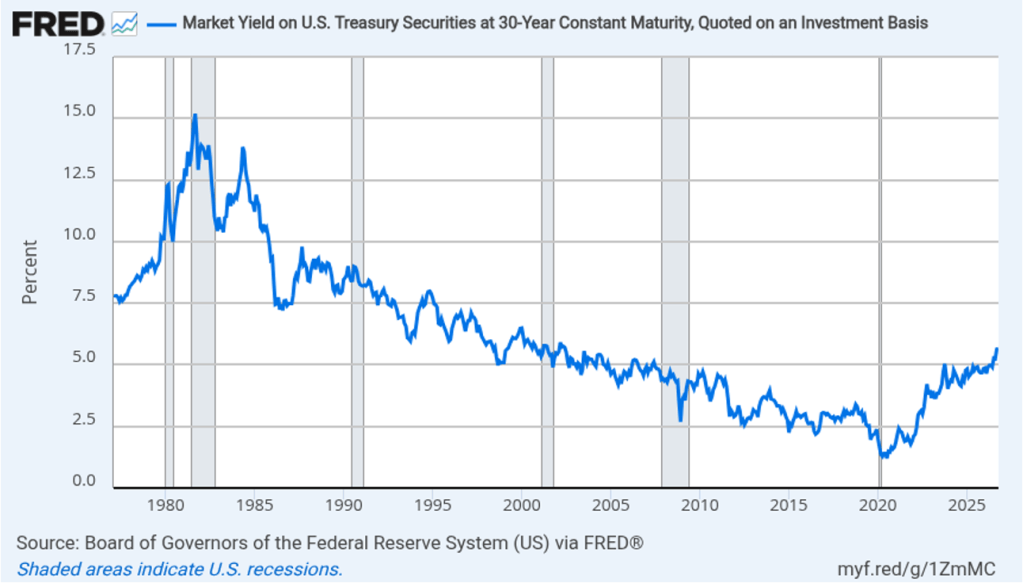
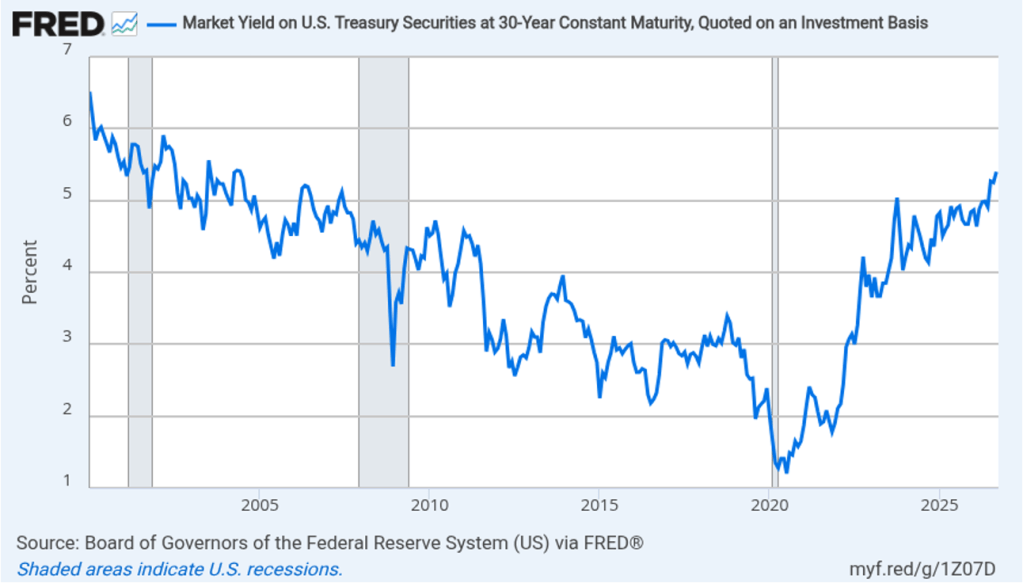
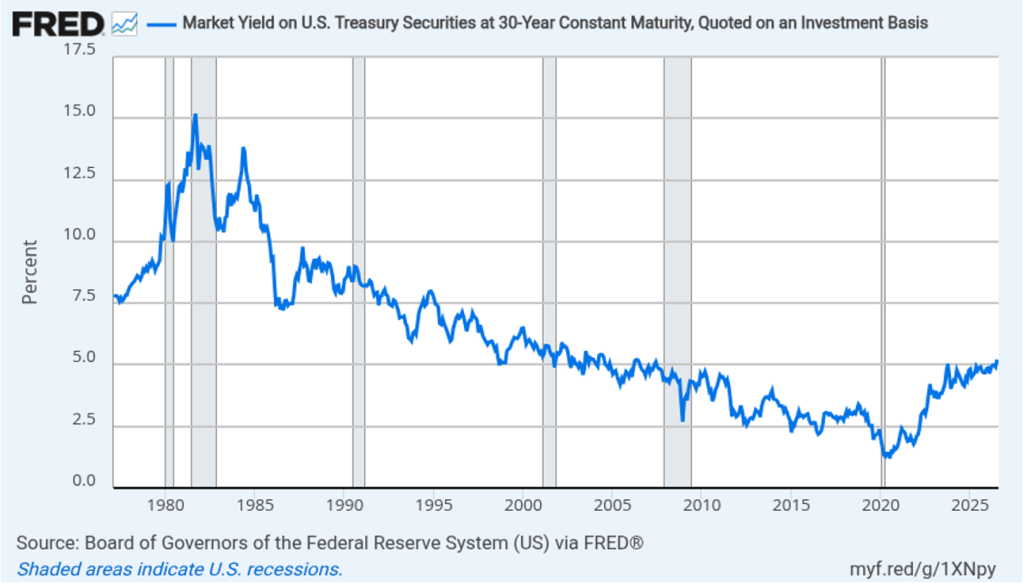
At the close of trading on Friday, July 31, the yield on the 30-year Treasury bond was 5.28 percent. As the following figure shows, that yield was the highest since July 2007, before the Global Financial Crisis and the Great Recession of 2007–2009.

Note: As we discuss in Money, Banking, and the Financial System, Chapter 3, when economists refer to the interest rate on a bond, they are referring to the bond’s yield to maturity. (A new edition of our textbook is now available.)

The figure shows the nominal yields on the 30-year Treasury bond—the yield not corrected for the effects of inflation.  What factors can cause the nominal yield on Treasury bonds to increase? Because investors are interested in the real yield on Treasury bonds—the yield corrected for the effects of inflation—an increase in the expected inflation rate will cause the nominal yield to rise. The Fisher effect refers to the assertion by Yale economist Irving Fisher that the nominal interest rate on a bond rises point-for-point with increases in the expected inflation rate. Although the pure Fisher effect doesn’t typically hold, there’s no doubt that changes in the expected inflation rate are a key driver of changes in nominal bond yields.

The other main driver of nominal bond yields is changes in the demand for credit. The Congressional Budget Office forecasts that, because of continuing federal government budget deficits, the value of publicly held Treasury securities will rise “from 101 percent of GDP in 2026 to 120 percent in 2036, well above the previous record of 106 percent just after World War II.” Such substantial increases in the supply of Treasury bonds will lower their prices, raising their nominal yields.

The market for Treasury bonds is linked to the market for corporate bonds. Although not all investors who buy Treasury bonds also buy corporate bonds and vice versa, many investors participate in both markets. As a result, a surge in the supply of corporate bonds will raise both their yields and the yields on Treasury bonds. As the following figure shows, the yields on high-quality corporate bonds (those rated A, AA, or AAA), have moved roughly in synch with Treasury yields, with recent increases in corporate yields mirroring the increases in Treasury yields.

The surge in the supply of corporate bonds has been driven by so-called hyperscalers, such as Amazon, Google, Oracle, and Microsoft, who have been raising hundreds of billions of dollars to fund the building of data centers to power AI programs.

In recent days, there has been much discussion as to whether the increased supply of bonds or rising expectations of future inflation have been behind the surge in Treasury yields. Following the latest meeting of the Federal Open Market Committee (FOMC) on Wednesday, July 29, Fed Chair Kevin Warsh’s press conference left many industry analysts believing that Warsh would be willing to tolerate higher rates of inflation. If, on the other hand, Warsh had been interpreted as willing to raise the FOMC’s target for the federal funds rate in the near future, that may have reassured investors that future rates of inflation would be lower, which would have brought down Treasury yields. An article in the Wall Street Journal quoted Mark Cabana, head of U.S. rates strategy at Bank of America as saying: “If you actually want to get long-end rates down, there’s an argument that you need to raise front-end rates [that is, the target for the federal funds rate] right now in order to establish that credibility.”

The following figure from the Wall Street Journal shows that during Warsh’s press conference, the yield on the 30-year Treasury bond rose sharply.

Despite the immediate reaction of bond investors to Warsh’s press conference, there isn’t much indication that in recent weeks a significant rise in investors’ expectations of inflation has been the key driver of increases in the Treasury bond rate.

In January 1997, the U.S. Treasury started issuing indexed bonds to address investors’ concerns about the effects of inflation on real interest rates. With these bonds, called TIPS (Treasury Inflation-Protected Securities), the Treasury increases the principal, or face value, as the price level increases, as measured by the CP. The stated interest rate on a TIPS remains fixed once issued, but because it is applied to a principal amount that increases with inflation, the effective interest rate increases with inflation. For example, suppose that when issued, a 30-year TIPS has a principal of $1,000 and a coupon rate of 3%. (The coupon rate equals the coupon payment divided by the face value, or par value, of a bond.) If the inflation rate during the year is 2%, then the principal increases to $1,020. So, the investor would receive the coupon rate of 3% plus the 2% increase in the principal, or 5%. In the rare case in which the economy experiences deflation, with the price level falling, the principal of a TIPS will decrease.

If we compare the yield on a TIPS of a given maturity to the yield on a non-TIPS Treasury security of the same maturity, we have an estimate of the annual inflation rate investors expect over that time period. For example, if the yield on a non-TIPS 30-Year Treasury bond is 5% and the yield on a 30-year TIPS is 2%, investors expect an annual inflation rate of 3% over the next 30 years. The difference between the yield on the non-TIPS 30-year Treasury bond and the yield on the 30-year TIPS is called the 30-year breakeven inflation rate because at that inflation rate, an investor would expect the same real yield from buying either the TIPS or the non-TIPS bond.

The following figure shows, for the period beginning in January 2022, the daily yield to maturity on the 30-year Treasury bond (the blue line), the yield on the 30-year TIPS (the orange line), and the implied 30-year breakeven inflation rate (the green line). Note that values for the green line are usually close to 2%, which is the Fed’s long-run inflation target. Even during 2022, when inflation as measured by the CPI reached 9%, this measure of expected inflation never rose above 2.7%. When the expected inflation rate changes relatively little during a period when the actual inflation rate is fluctuating, expectations of inflation are said to be well anchored.


A reasonable conclusion is that, to this point, the rise in long-term bond yields appears to be driven more by the increasing supply of Treasury and corporate bonds than by higher expected inflation.

(We should note that some economists question the accuracy of using breakeven inflation as a measure of expected inflation for two reasons: (1) An investor buying a TIPS is protected against the possibility that the inflation rate might turn out to be higher than expected. As a result, investors may be willing to accept a slightly lower interest rate on TIPS, which would lead to an
overestimate of the expected inflation rate. (2) The volume of TIPS traded on any given day is much smaller than volume of non-TIPS Treasury securities traded, which make TIPS slightly less liquid—meaning they are slightly more difficult to sell. Investors typically require a higher interest rate to buy a less liquid asset. So, this outcome might have the opposite effect of the first one—an underestimate of the expected inflation rate.)