What’s Going on in the Bond Market?

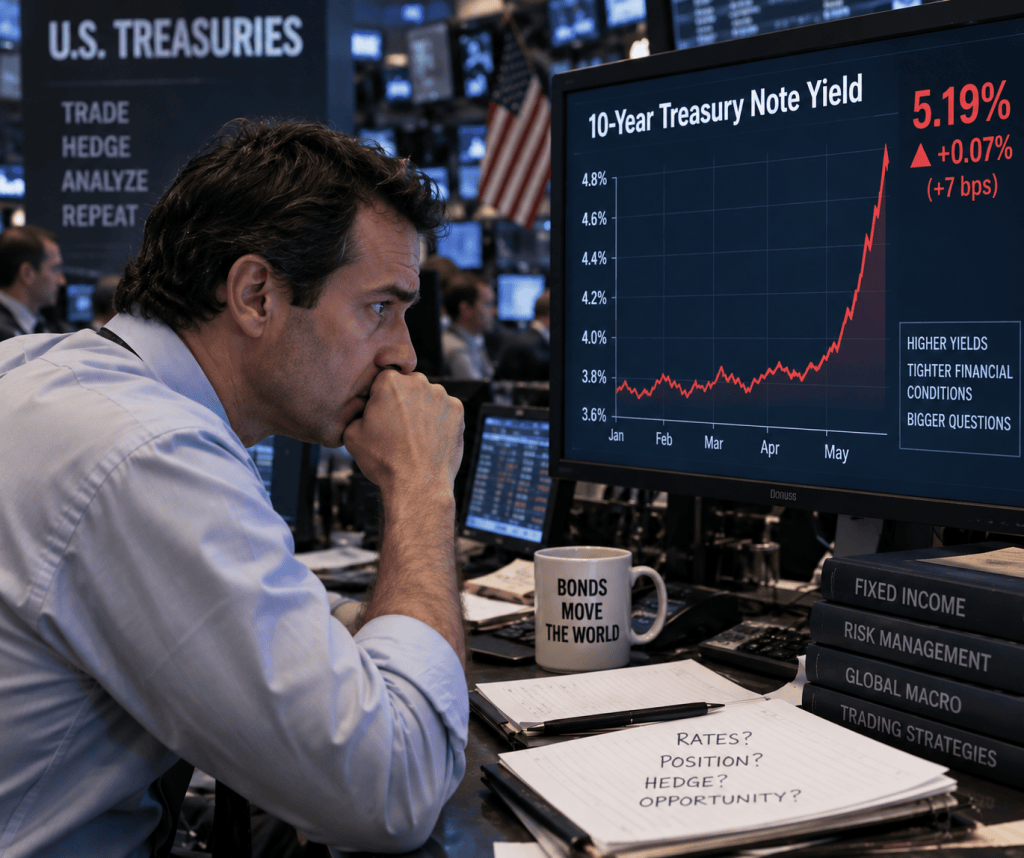
Image created by ChatGPT

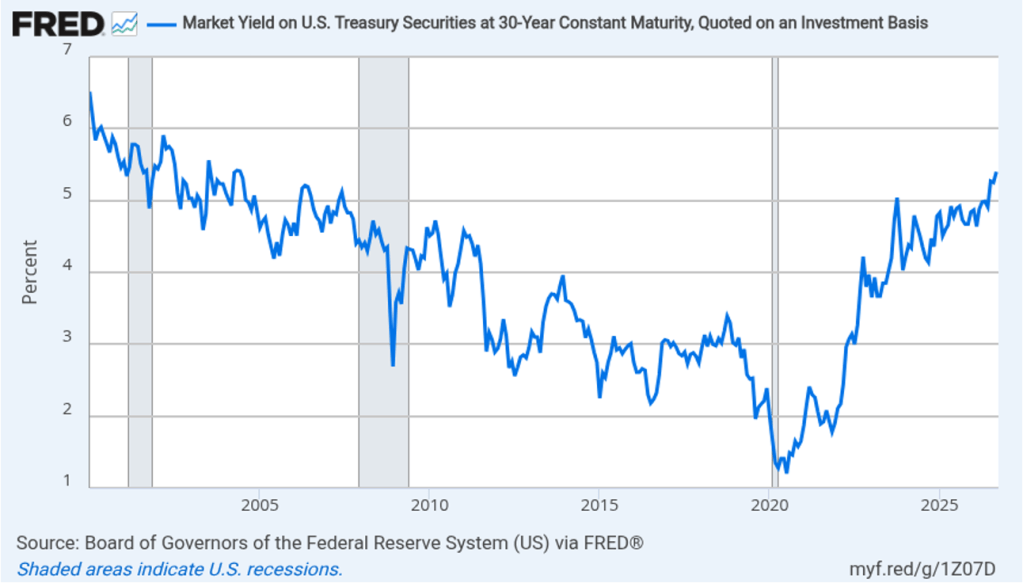
As the following figure show, as of yesterday, the yield on the 30-year U.S. Treasury bond is the highest it’s been since 2004, before the Global Financial Crisis.
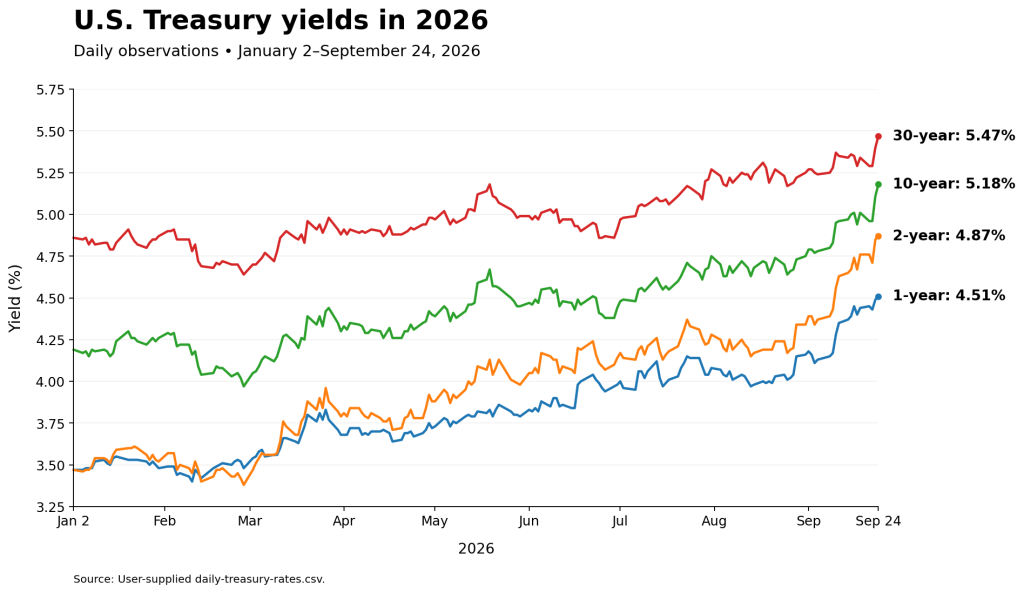
The following figure (created by ChatGPT using data from this Treasury website) shows that Treasury bonds at all maturities have risen this year. Recall that the maturity of a bond is the amount of time until the seller of the bond repays the principal to the buyer of the bond. Formally, a Treasury security with a maturity of 1 year or less is a Treasury bill, a Treasury security with with a maturity of 2 years to 10 years is a Treasury note, and a Treasury security with of more than 10 years is a Treasury bond. For simplicity, in this post we’ll usually refer to all Treasury securities as bonds. We’ll refer interchangeably to the interest rate on a bond and the yield on the bond. Formally, the relevant interest rate in this post is the yield to maturity. (We discuss the bond market in Money, Banking, and the Financial System, Chapters 3-5. A new edition is available now.)
Rising yields on Treasury securities have a substantial effect on the economy. On most days, nearly all of the buying and selling in the Treasury bond market is of existing bonds that the U.S. Treasury may have issued decades earlier. Because the federal government has been running large budget deficits, the Treasury has to issue billions of new Treasury bonds each year. Investors will only buy newly issued Treasury bonds if their yields are competitive with the yields on existing bonds. As a result, interest payments have been a rising fraction of total federal spending, which contributes to the federal budget deficit.

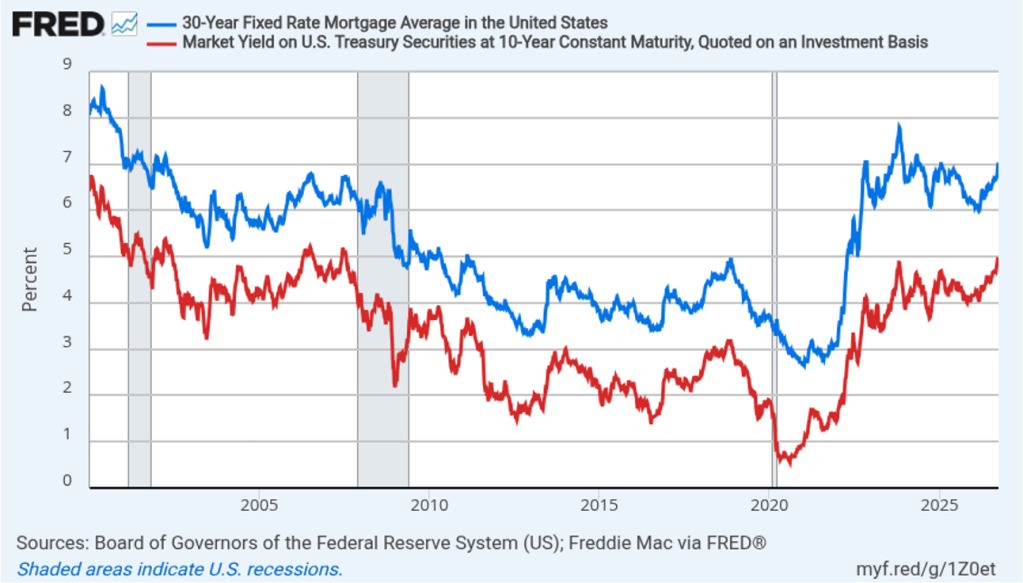
Firms that grant mortgage loans typically adjust the interest rates they charge as the yield on the 10-year Treasury changes. The difference between the interest rate on mortgages and the interest rate on the 10-year Treasury is called the mortgage spread. The following figure shows the close relationship between movements in the mortgage interest rate (the blue line) and movements in the interest rate on 10-year Treasurys (the red line). The recent increase in the yields on 10-year Treasurys has caused an increase in the mortgage interest rate.
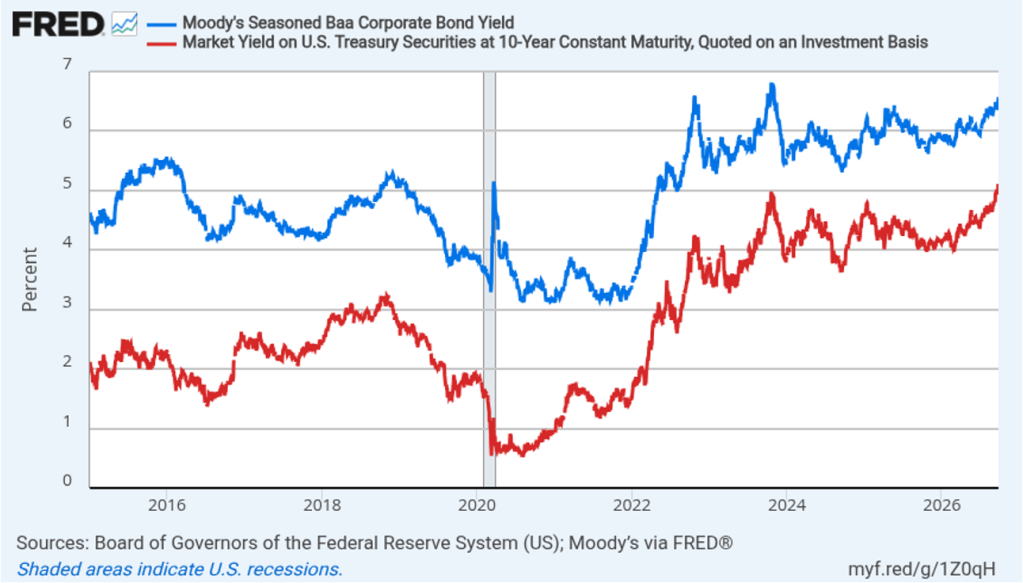
Many investors hold both Treasury bonds and bonds issued by corporations. If the yields on Treasury bonds rise, to attract investors the yields on corporate bonds also have to rise. The following figure shows that there is a close relationship between the yield on 10-year Treasurys and the yield on corporate bonds. The interest rate on corporate bonds is higher than the interest rate on Treasurys for two key reasons: First, corporate bonds have a higher default risk, which is the risk that a bond issuer will fail to make payments of interest or principal. Second., corporate bonds are less liquid than Treasurys, which means that because the market for Treasurys is much larger than the market for any corporate bond, an investor can more easily sell a Treasury bond. Investors need to be compensated with a higher interest rate on corporate bonds for the greater default risk and lower liquidity of these bonds.
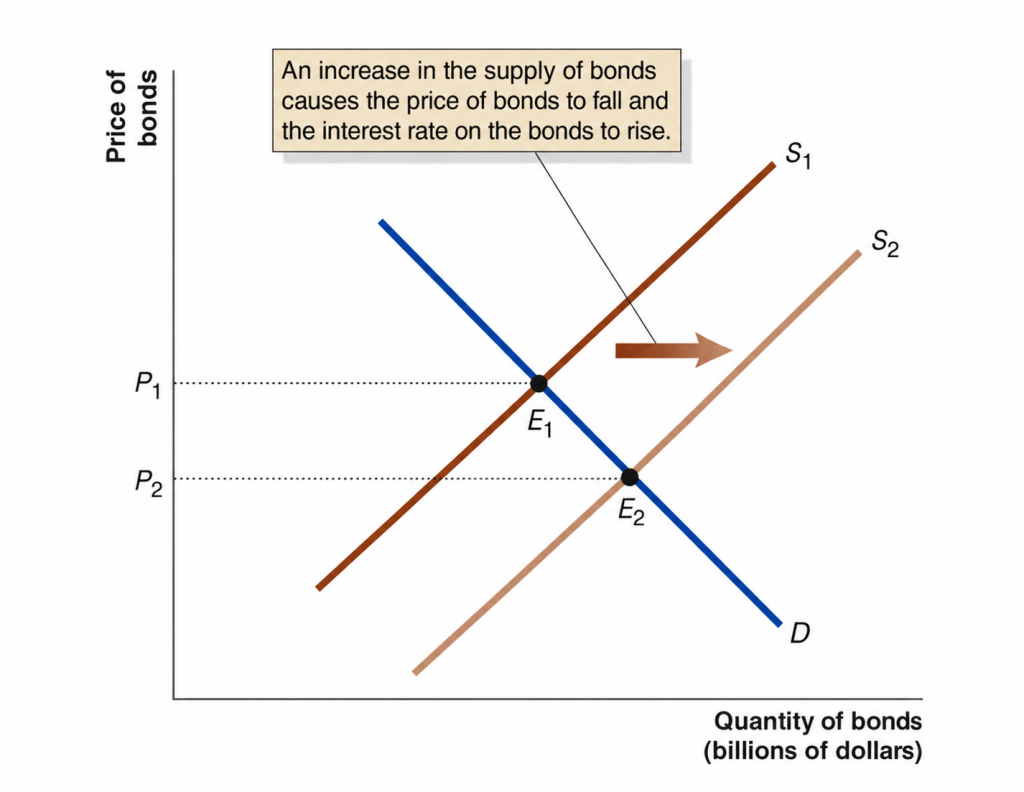
What’s caused the increases in interest rates? Several factors are involved. First, in part because of rising oil prices resulting from conflict in the Middle East, since the middle of 2026 there has been an increase in the inflation rate that investors in bond markets expect to prevail over the next few years. Inflation reduces the purchasing power of the payments investors receive from owning a bond. The Fisher effect refers to the argument by Irving Fisher, who was an economist at Yale University, that the nominal interest rate on a bond will rise point-for-point with changes in the expected inflation rate. (Recall from Macroeconomics, Chapter 9 (Economics, Chapter 19) that the nominal interest rate is the stated interest rate on a bond. We can approximate the real interest rate by subtracting the expected inflation rate from the nominal interest rate.) The following figure from Chapter 4 of Money, Banking, and the Financial System, illustrates the Fisher effect.
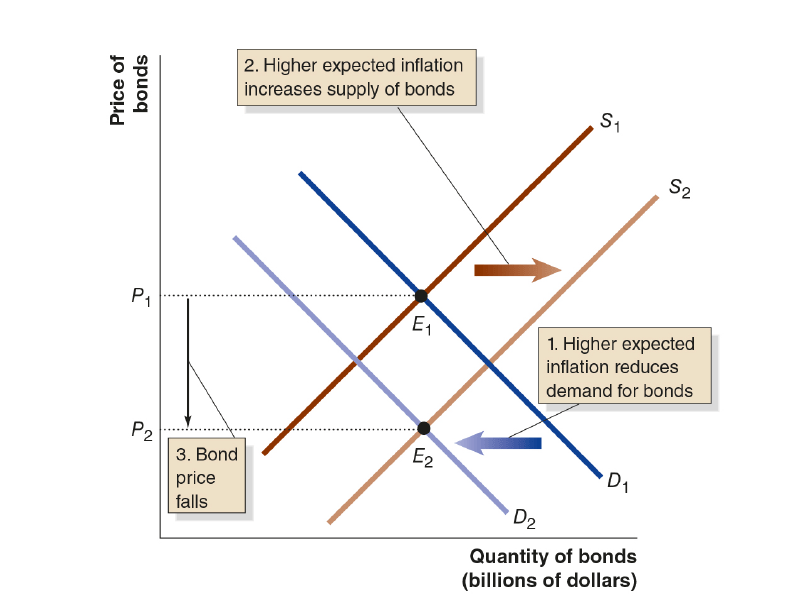
A higher expected inflation rate increases the quantity of bonds supplied at any given bond price because inflation reduces the real value of the payments that bond issuers have to make. In the figure, the supply curve for bonds shifts to the right from S1 to S2. A higher expected inflation rate decreases the quantity of bonds demand at any given bond price because inflation reduces the real value of the payments that bond buyers receive. The demand curve for bonds shift to the left from D1 to D2. Note that because the equilibrium price of bonds declines from P1 to P2, the interest rate—which moves inversely with the price—increases. In practice, economists have found that various real-world frictions result in nominal interest rates not always increasing or decreasing by exactly the amount of a change in expected inflation. But the basic point holds that changes in the expected inflation rate lead to changes in the interest rates on bonds.

The second reason that interest rates have been rising is related to the first reason. As we discuss in this blog post, because the inflation rate has been running persistently higher than the Federal Reserve’s 2 percent annual target, at its September meeting the Fed’s Federal Open Market Committee (FOMC) raised its target for the federal funds rate. Investors in the federal funds futures market expect that the committee will raise its federal funds rate target further in coming meetings. The following figure shows that the interest rate on 1-year Treasury bills tracks closely movements in the federal funds rate.
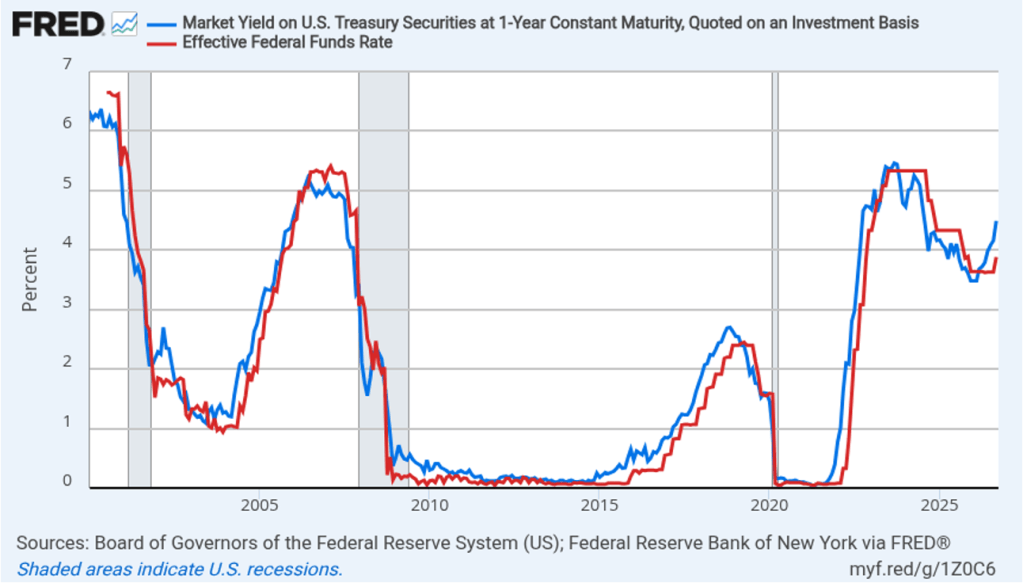
Changes in expected future short-term interest rates, such as the expected interest rate on the 1-year Treasury bill one year from now, can affect longer-term interest rates. For example, someone who wants to invest in Treasurys for two years could either buy a 2-year Treasury or buy a 1-year Treasury today and another 1-year Treasury in a year. We would expect that buying and selling in the bond market would make the return from these two ways of investing equal—a process called arbitrage. If investors expect that the FOMC will raise its target for the federal funds rate in the future, the expected interest on the 1-year Treasury bill a year from now will increase, which will also increase the interest rate today on a 2-year Treasury. The same process will also cause interest rates on longer-maturity bonds to increase.

Third, the supply of bonds has been increasing rapidly. As we’ve seen, high federal government budget deficits will cause the Treasury to issue close to $2 trillion in bonds this year. In addition, technology firms, such as as Meta, Alphabet (the parent company of Google), Amazon, and Oracle, have been increasing their bond sales to obtain the funds to build out the infrastructure, such as data centers, necessary to power the AI build out. According to data from the Securities Industry and Financial Markets Association, through August of 2026, corporate bond issuance was nearly 30 percent greater than in 2025.

(Note that most other high income countries, including Japan, Canada, and the countries of Western Europe, have also been running large government budget deficits and issuing large quantities of bonds. Because investors can buy and sell bonds across countries, higher interest rates in one country can put upward pressure on interest rates in other countries.)

As the following figure shows, an increase in the supply of bonds, holding other factors that can affect the demand or supply of bonds constant, causes the price of bonds to fall and, therefore, the interest rate on bonds to rise.
Following the Global Financial Crisis of 2007–2009, low inflation rates and a federal funds rate close to zero resulted in low interest rates on most bonds. For example, the 10-year Treasury note was below 4 percent—and typically below 3 percent—from late 2008 to late 2022. Some economists believed that interest rates would remain low for the foreseeable future. But the sharp increase in inflation rates that began in the spring of 2021, following the Covid pandemic, continuing high federal budget deficits, and tech firms demand for funds to build data centers and other AI infrastructure has led to the highest interest rates in more than 20 years. Whether these high interest rates will persist depends primarily on future inflation rates and future federal budget deficits.
Inflation, Interest Rates, and Stock Prices

Caution: Long post!

An article in the Wall Street Journal quoted an economist at a financial services firm as noting that strong growth in wages could lead to sustained inflation. The article stated that as a result “the yield on the 10-year U.S. Treasury note [rose to] within reach of 2%” and that: “Rising [bond] yields this year have rattled markets and hurt tech stocks in particular ….”

What are the links between wage inflation and price inflation, inflation and bond yields, and bond yields and stock prices—particularly the prices of tech stocks?

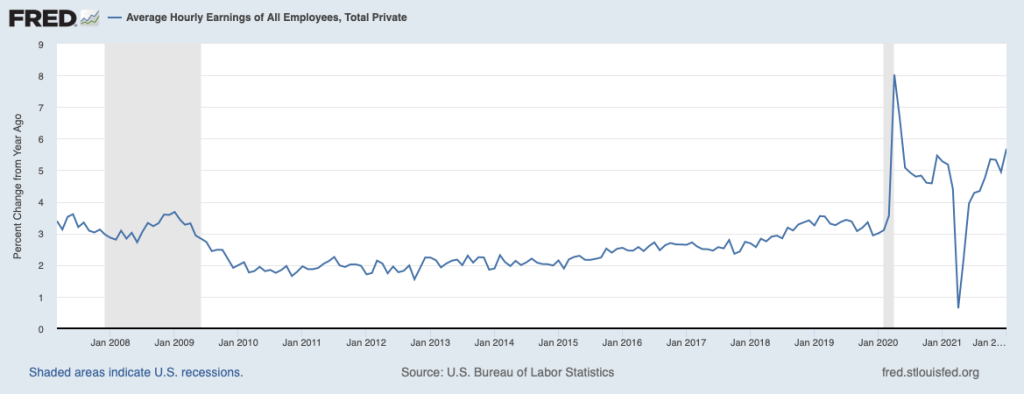
The link between wage inflation and price inflation. The monthly “Employment Situation” reports from the Bureau of Labor Statistics (BLS), in addition to providing data on payroll employment and the unemployment rate, also provide data on average hourly earnings (AHE). AHE are the wages and salaries per hour worked that private, nonfarm business pay workers. AHE don’t include the value of benefits that firms provide workers, such as contributions to 401(k) retirement accounts or health insurance. The following figure shows changes in AHE from the same month in the previous year. The figure shows that since the Covid-19 pandemic first began to affect the U.S. economy in March 2020, AHE have moved erratically. But since the fall of 2021, growth in AHE has been consistently above the 2 percent to 4 percent range that prevailed in the years after the end of the Great Recession of 2007–2009.

Employee compensation is the largest cost for most firms.  For the economy as whole, employee compensation is about 80 percent of total costs. When firms pay higher wages per hour, their costs per unit of output don’t rise unless the wage increases are greater than the rate of growth of labor productivity, or output per hour worked. Increases in wages in the range of 5 percent to 6 percent are well above the rate of growth of labor productivity and, so, firms are likely to pass through the wage increases by raising prices. Note that the higher prices may prompt workers to push for higher wage increases to offset the decline in the real purchasing power of their wages, potentially setting off a wage-price spiral. (We discussed the possibility of a wage-price spiral in a recent post here.)

The link between inflation and bond yields.  When investors lend money by, for instance, buying a bond, they are concerned with the interest rate they will receive after correcting for the effects of inflation. In other words, they focus on the real interest rate, which is equal to the nominal interest rate, or the stated interest rate on the loan or bond, minus the expected inflation rate:

            Real interest rate = Nominal interest rate – Expected inflation rate.

We can rewrite this relationship as:

            Nominal interest rate = Real interest rate + Expected inflation rate.

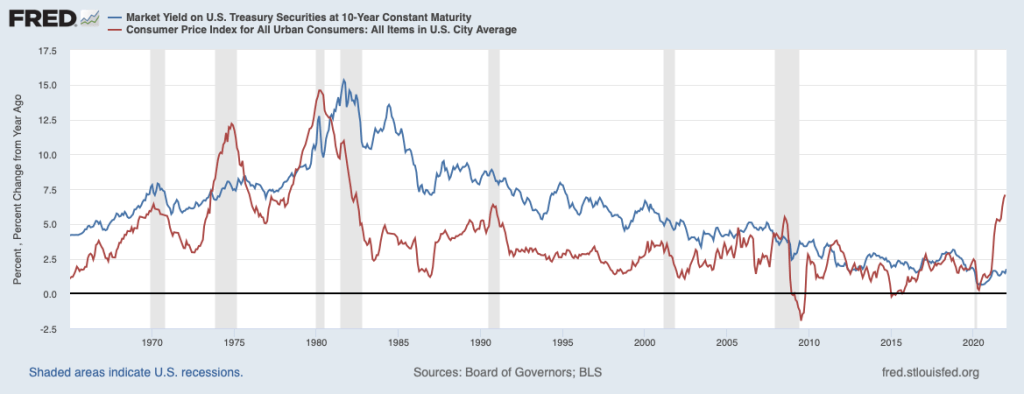
The second equation indicates that if investors expect the inflation rate to increase, then, unless the real interest rate changes, the nominal interest rate will increase.  The Fisher effect is the idea associated with Yale economist Irving Fisher that the nominal interest rate rises or falls by the same number of percentage points as the expected inflation rate. So, for instance, if investors expect that the inflation rate will increase from 3 percent to 5 percent, then the nominal interest rate will also increase by two percentage points.

Because of real-world frictions, such as the broker fees that investors pay when buying and selling bonds and the taxes investors pay when they sell a bond that has increased in price, the Fisher effect doesn’t hold exactly. Still, most economists agree that an increase in the expected inflation rate will cause an increase in nominal interest rates. The following figure shows movements in the interest rate on 10-year Treasury notes (blue line) and in inflation (red line). Note that, roughly speaking, the interest rate on the 10-year Treasury note is higher when inflation is higher and lower when inflation is lower.  (We discuss real and nominal interest rates in Macroeconomics, Chapter 9, Section 9.6 and in Economics, Chapter 19, Section 19.6. We discuss the Fisher effect in Money, Banking, and the Financial System, Chapter 4, Section 4.3.)

The link between bond yields and stock prices. As wage inflation leads to price inflation and price inflation leads to higher interest rates on bonds—particularly U.S. Treasury bonds—why might stock prices be affected? First, investors consider U.S. Treasury bonds to be default risk free, which means that investors are certain that the Treasury will make the interest and principal payments on the bonds. Stock investments are much riskier because they depend on the future profits of the firms issuing the stocks and those profits may fluctuate in ways that are difficult for investors to anticipate. So as interest rates on Treasury bonds increase, some investors will decide to sell stocks and buy bonds, which will cause a decline in stock prices. 

Second, most people value funds they will receive now or soon more highly than funds they will receive in the more distant future. For instance, if someone offered to pay you $1,000 today or $1,000 one year from now, you will prefer to receive the money today.  In other words, the present value, or value today, of a payment you won’t receive until the future is worth less than the face value of the payment. For instance, the present value of $1,000 you won’t receive for a year is worth less than $1,000 in present value. The higher the interest rate is, the lower the present value of payments, such as dividends, that you will receive in the future. 

Economists believe that price of a financial investment, like a bond or a stock, is equal to the present value of the payments you will receive from owning the asset. If you own a bond, you will receive interest payments and payment of the bond’s principal when the bond matures. If you own a stock, you will receive dividends, which are the payments that firms make to shareholders from the firms’ profits. Therefore stock prices should reflect the present value of the dividends that investors expect to receive from owning the stock. (We discuss present value and the relationship between interest rates and stock and bond prices in Macroeconomics, Chapter 6, Appendix, in Economics, Chapter 8, Appendix, and, more completely, in Money, Banking, and the Financial System, Chapter 3, Section 3.2 and Chapter 6, Section 6.2.)

The Wall Street Journal article we quoted above notes that the rising interest rate on the 10-year Treasury note was causing price declines in tech stocks in particular. The explanation is that tech firms often go through an initial period in which they may make very low profits or even suffer losses. Investors may still be willing to buy stock in tech firms because they expect the firms eventually to increase their profits and the dividends they pay. But because those profits will be earned in the future—often after a period of losses that may stretch for years—the present value of the profits and, therefore, the price of the stock depends more on the interest rate than would be true of a firm making breakfast cereal or frozen pizza that will be steadily earning profits through the years. Therefore, we would expect, as the article indicates, that the prices of tech firms are more likely to decline—or to decline more—when interest rates rise than is true of other firms. 

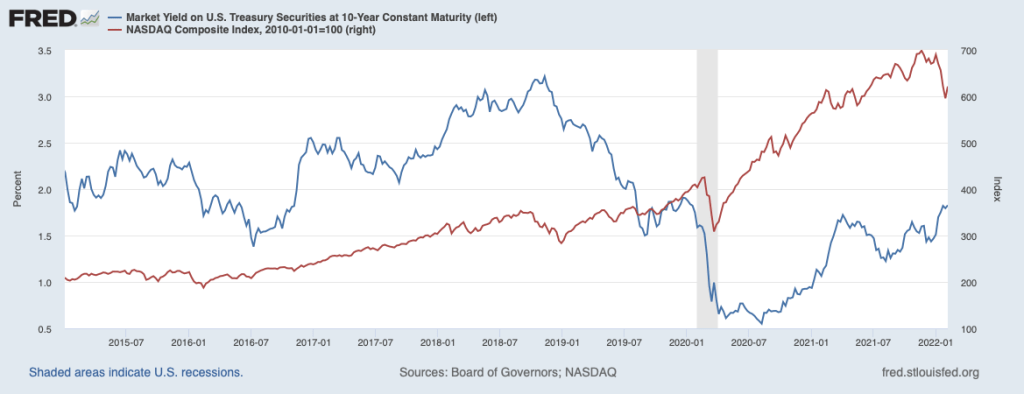
The following figure shows the interest rate on the 10-year Treasury note (blue line with scale given on the left) and the values of the Nasdaq composite stock index (red line with the value for January 1, 2010 set equal to 100 and the scale given on the right). The Nasdaq includes the stocks of more tech firms than is true of the other widely followed stock market indexes—the S&P 500 and the Dow Jones Industrial Average. The figure shows that the declining interest rate on 10-year Treasury notes that began in late 2018 and continued through mid-2020 coincided with increases in the prices of the stocks in the Nasdaq index—apart from the spring of 2020 during the beginning of the Covid-19 pandemic.  The most recent period shows that increases in the interest rate on the 10-year Treasury note have corresponded with a decline in the Nasdaq, as noted in the article.

Source: Sam Goldfarb, “Elevated Bond Yields Approach Key Milestone,” Wall Street Journal, February 7, 2022; U.S. Bureau of Economic Analysis, “Prices, Costs, and Profit per Unit of Real Gross Value Added of Nonfinancial Domestic Corporate Business,” January 27, 2022; and Federal Reserve Bank of St. Louis.