
Join authors Glenn Hubbard & Tony O’Brien as they discuss rising long-term bond yields and their economic implications. Topics discussed include the federal government’s large budget deficit, concerns about fiscal credibility, and the Federal Reserve’s inability to meet its inflation target. The discussion also touched on the connection between federal budget deficits and trade imbalances, highlighting how large deficits require the U.S. to borrow from foreign investors.
Tag: economy
Glenn on Adam Smith and the Midterm Elections
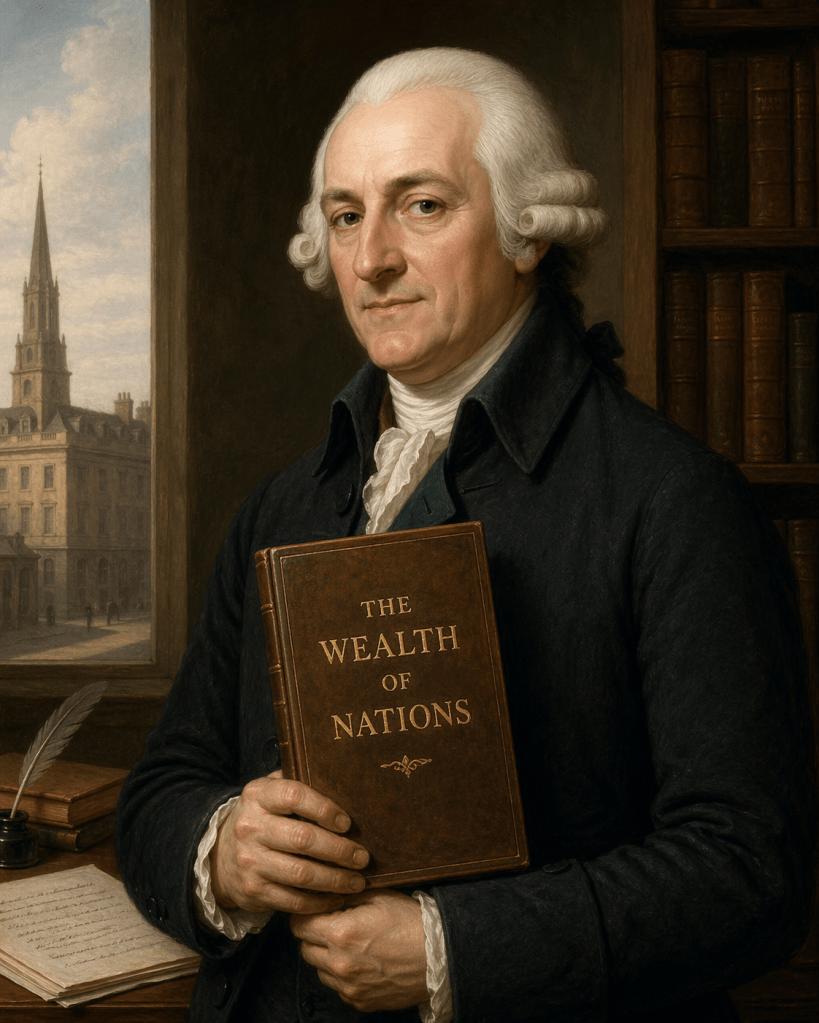
Image created by ChatGPT
This opinion column was first published on Project Syndicate.
Adam Smith on the U.S. Midterms
The Wealth of Nations offers a useful lens for understanding why US President Donald Trump’s mercantilist agenda has fallen short of its own stated goals. It also points to a better path, combining competitive markets with policies that help workers and communities build skills and keep pace with economic change.
November’s midterm elections pose a serious challenge for US President Donald Trump. Key components of his economic agenda, especially its protectionist measures, have raised concerns about the rising cost of living, prompted a rare rebuke from the Supreme Court, and cast doubt on the legal basis for his tariffs. Fortunately for Trump and the Republicans, they still have time to pivot to a pro-growth agenda that better addresses voter anxieties before the midterms.
Trump’s agenda is rooted in voter concerns about economic disruption driven by technological change and globalization. Breaking with the bipartisan embrace of market-friendly policies, his administration has sought to shield US producers from competition. While Treasury Secretary Scott Bessent has hinted that a pivot to a pro-growth strategy is in the works, reconciling it with the administration’s mercantilist approach will be difficult.
There is, however, an alternative path that better aligns with Trump’s stated goal of helping people and communities buffeted by economic change. For guidance, it is worth turning to Adam Smith. The Wealth of Nations, published 250 years ago, grappled with many of the same tensions and pointed to a pragmatic middle ground.
At first glance, Smith may seem at odds with Trump’s approach. After all, The Wealth of Nations centers on Smith’s critique of the mercantilist order of his day. Mercantilism prizes trade surpluses and the accumulation of national wealth in the hands of the state. To work, it requires extensive government intervention in commerce, trade, and labor markets. But that expansive role invites rent-seeking and excessive control, a key concern for Smith.
Smith’s treatise turned this system on its head by posing a radical question: Where does national wealth come from? For Smith, the answer stood in contrast to mercantilism. A competitive economy, with limited government intervention, would be accompanied by openness and specialization, in turn raising living standards.
While Smith did not develop a formal theory of growth, his intuition about the importance of openness to markets and innovation is consistent with modern growth models and stands in contrast to Trump-era policymaking. As Nobel laureate economist Joel Mokyr has noted, science, practical knowledge, and openness to change are key drivers of long-term prosperity.
But Trump has also identified an important tension. Modern growth models are like a coin. The “heads” side is growth and its benefits for living standards; the “tails” side is disruption—the upending of existing investments, firms, jobs, and even communities. It is here that Trump’s mercantilism, with its focus on minimizing the effects of disruption on voters’ lives, gains political traction.
Smith challenges this perspective in two ways. First, he reminds us of the limits mercantilism places on living standards. Second, in The Theory of Moral Sentiments, which he considered his finest work, he emphasizes empathy and what my Columbia colleague Edmund S. Phelps calls “mass flourishing,” which aims to ensure that everyone benefits from economic progress, including those disrupted by its forward march.
Here, then, is the policy alternative to both Trumpian mercantilism and market orthodoxy: augmenting Smith’s concept of “competition” with the “ability to compete.” Such an agenda would center on preparation and reconnection, both vital for participation in—and support for—an open economy.
One place to begin is workforce development. In the United States, community colleges are well positioned to serve as training grounds for skill development and career transitions, often working closely with local employers to create quality jobs. While support for community colleges has declined in many states, a federal block grant focused on completion and skill development would significantly enhance their impact.
Similarly, a more generous Earned Income Tax Credit could boost labor-force participation and attachment. Increased funding for basic research, alongside support for applied research centers across the country, could raise productivity by bringing cutting-edge tools to businesses, much as land-grant colleges have historically done in agriculture and manufacturing.
To reconnect displaced workers, personal re-employment accounts—combining funds for training with re-employment bonuses—could help reduce the duration of joblessness. For communities affected by structural economic change, more effective place-based aid could support productivity-enhancing business services in lower-income areas with higher unemployment.
Such measures, along with a growth-oriented agenda, could reshape the electoral landscape. Investments in AI and electricity generation could be accelerated through regulatory reform, particularly by easing permitting rules under the National Environmental Policy Act. To increase the housing supply, a prerequisite for mobility and growth, the administration could propose incentives for state and local governments to scale back restrictive construction regulations.
Going further, the administration would need to abandon its nativist immigration policies. Increasing the number of high-skilled immigrants, particularly in STEM fields, would boost growth, as immigrants have been shown to drive technological innovation, leading to more patents, higher productivity, and rising incomes.
Likewise, expanding federal support for research and development would yield high returns. Some estimates suggest that the returns are so large that the net cost to taxpayers may be zero or even negative, as higher productivity generates enough additional tax revenue to offset the cost. Combined with a stable macroeconomic environment and pro-investment policies of the kind Trump has championed, these changes could significantly accelerate growth.
A more constructive approach to economic disruption would shift away from broad tariffs and protectionism, which tend to raise consumer prices and erode the competitiveness of US manufacturing by increasing input costs. The Supreme Court’s recent reversal of many tariffs imposed by Trump under the International Emergency Economic Powers Act has created an opportunity—and underscored the need—for a course correction.
Trump has rightly raised questions about the economic consequences of technological change and globalization. Two and a half centuries after its publication, The Wealth of Nations points toward a necessary pivot away from mercantilism and toward a more balanced, pro-growth framework.
Glenn’s Advice for Kevin Warsh
The Marriner S. Eccles building, headquarters of the Federal Reserve in Washington, DC. Image from federalreserve.gov.
The following opinion column appeared in the Financial Times.
What Warsh Should Do at the Fed
Donald Trump’s nomination of Kevin Warsh as chair of the Federal Reserve comes at a pivotal time for the American economy and for the US central bank. A pall has been cast by the administration’s unforced error of trumped-up charges against Jay Powell, the current Fed chair, and the president’s renewed threats to fire him if he does not leave by the end of his term. But the nominee’s credentials and experience ought to ensure a smooth confirmation. The question now should be what happens next.
The Fed faces three challenges. In the short term, the potential impact of the Iran war on employment calls for a careful assessment of the direction of the US economy. In the medium term, inflation continuing to run above the 2 per
cent target will limit the central bank’s room for maneuver, and also call its
credibility into question. In the longer term, questions remain about the
effectiveness of quantitative easing, the size of the Fed’s balance sheet, errors
made in the aftermath of the Covid pandemic, and the central bank’s forays
into areas better left to fiscal or regulatory policy.
All of which means that when Warsh eventually takes up the post, he should
launch an evaluation of the purpose, strategy and structure of the Fed straight
away.
First, purpose. The Federal Reserve was established as a lender of last resort
designed to mitigate financial crises. After it struggled to discharge that role
during the Great Depression, it turned to managing aggregate demand and
inflation. In 1978, Congress used the Humphrey-Hawkins Act to codify its
focus on inflation and employment, while giving the Fed leeway on how to
achieve those objectives. It also required the Fed chair to report to Congress on
its outcomes and outlook.
Warsh should now offer justifications for each of these objectives, set out
clearly what trade-offs they entail and how progress will be communicated.
This clarity focuses markets and elected officials on the importance of low and
steady inflation for US economic performance. And the advent of a new chair
provides an opportunity to make the Fed’s lender-of-last-resort decision-making clearer. Such explanations would be helpful in the present
environment of economic and public policy uncertainty.
Next comes strategy. This is about choosing a set of activities that deliver
objectives consistently. For the Fed, independence in monetary policy and the
ability to flex its balance sheet enable it to keep inflation low and manage
financial turmoil. Political assaults on its independence, of the type we have
recently seen, or restrictions on its balance sheet as a lender of last resort put
these strategic advantages at risk.
To deliver on purpose and strategy, the incoming chair should optimize the
Fed’s structure. The arrangement of a board of governors in Washington,
district banks led by district presidents, a Federal Open Market Committee of
the board and (a rotation of) five district presidents is set by law. But there are
three practical steps Warsh could take to improve the effectiveness of this setup.
First, the central bank should cast a wider net to gather insights from
economists, business leaders and financial market participants, with Fed
conferences reopened to members of these communities. Second, decisions
and direction should be communicated to financial markets and the public
consistently by the chair and by other officials.
Third, replace the notorious “dot plots”, which map FOMC members’
projections for the federal funds rate, with scenarios. Dot plots can be
misinterpreted as signals about the future path of interest rates. By contrast,
scenario analysis models how policy would respond to important changes, such
as shifts in AI investment, supply constraints, the natural rate of
unemployment, and medium-run effects on inflation, the dollar and US
economic activity from the conflict in Iran.
Such a comprehensive evaluation of purpose, strategy and structure would give
Warsh and the Fed both renewed organizational cohesion—and, more
importantly, a game plan.
On the perennial question of interest rates, the US economy’s near-term
momentum and elevated inflation are likely to tilt the balance of risks against
further cuts, despite Trump’s enthusiasm for an immediate cut. And while
Warsh is right to point out that the Fed should learn more about the economic
effects of AI, over the medium run a high-productivity-growth economy is
associated with a higher, not lower, real rate of interest.
Over this crucial period, the ability of the new chair to communicate clearly to
the public the value of low and steady inflation will be vital. The rules
governing the Fed’s role as lender of last resort should also be made clearer.
Finally, Warsh is correct that the Fed should take care to avoid engaging in the
kind of backdoor fiscal policy it has practiced in recent years.
Warsh is smart, informed, experienced in crisis management and an excellent
communicator. If the president allows him a free hand as chair, the American
economy should reap the benefits. Stay tuned.
4-11-26 Podcast – Glenn Hubbard & Tony O’Brien discuss Fed transition, inflation, and AI security!
What happens when the Fed chair’s seat is about to change hands—and inflation still won’t behave? In this episode of the Hubbard & O’Brien Economics Podcast, Tony O’Brien and Glenn Hubbard break down the looming transition from Jerome Powell to Kevin Warsh, what the latest inflation and energy-price pressures mean for interest rates, and why navigating the FOMC could be Warsh’s toughest test yet. They also unpack the Fed’s massive balance sheet, the regulatory constraints around shrinking it, and a surprising new risk on the horizon: AI-driven security threats that could expose vulnerabilities across the financial system. If you want a clear, candid take on where monetary policy may be headed next, this is the listen.
2-28-26 Podcast – Glenn Hubbard & Tony O’Brien revisit Tariffs and AI!
Join authors Glenn Hubbard and Tony O’Brien as they discuss how core economic principles illuminate two of the most pressing policy debates facing the economy today: tariffs and artificial intelligence. Drawing on a recent Supreme Court decision striking down broad tariff increases, Hubbard and O’Brien explain why economists view tariffs as taxes, who ultimately bears their burden, and how trade policy uncertainty shapes business decisions, inflation, and economic growth—bringing textbook concepts like tax incidence, intermediate goods, and GDP measurement vividly to life. The conversation then turns to AI, where they cut through market hype and dire predictions to place generative AI in historical context as a general‑purpose technology, comparing it to past innovations that transformed jobs without eliminating work. Along the way, they explore how AI can both substitute for and complement labor, why fears of mass unemployment are likely overstated, and what economists can—and cannot yet—say about AI’s long‑run effects on productivity, profits, and the labor market.
11-07-25- Podcast – Authors Glenn Hubbard & Tony O’Brien discuss Tariffs, AI, and the Economy
Glenn Hubbard and Tony O’Brien begin by examining the challenges facing the Federal Reserve due to incomplete economic data, a result of federal agency shutdowns. Despite limited information, they note that growth remains steady but inflation is above target, creating a conundrum for policymakers. The discussion turns to the upcoming appointment of a new Fed chair and the broader questions of central bank independence and the evolving role of monetary policy. They also address the uncertainty surrounding AI-driven layoffs, referencing contrasting academic views on whether artificial intelligence will complement existing jobs or lead to significant displacement. Both agree that the full impact of AI on productivity and employment will take time to materialize, drawing parallels to the slow adoption of the internet in the 1990s.
The podcast further explores the recent volatility in stock prices of AI-related firms, comparing the current environment to the dot-com bubble and questioning the sustainability of high valuations. Hubbard and O’Brien discuss the effects of tariffs, noting that price increases have been less dramatic than expected due to factors like inventory buffers and contractual delays. They highlight the tension between tariffs as tools for protection and revenue, and the broader implications for manufacturing, agriculture, and consumer prices. The episode concludes with reflections on the importance of ongoing observation and analysis as these economic trends evolve.
Pearson Economics · Hubbard OBrien Economics Podcast – 11-06-25 – Economy, AI, & Tariffs
08-16-25- Podcast – Authors Glenn Hubbard & Tony O’Brien discuss tariffs, Fed independence, & the controversies at the BLS.
In today’s episode, Glenn Hubbard and Tony O’Brien take on three timely topics that are shaping economic conversations across the country. They begin with a discussion on tariffs, exploring how recent trade policies are influencing prices, production decisions, and global relationships. From there, they turn to the independence of the Federal Reserve Bank, explaining why central bank autonomy is essential for sound monetary policy and what risks arise when political pressures creep in. Finally, they shed light on the Bureau of Labor Statistics (BLS), unpacking how its data collection and reporting play a vital role in guiding both public understanding and policymaking.
It’s a lively and informative conversation that brings clarity to complex issues—and it’s perfect for students, instructors, and anyone interested in how economics connects to the real world.
03/29/25 Podcast – Authors Glenn Hubbard & Tony O’Brien discuss the impact of tariffs on monetary policy & the Fed.
Please listen to a podcast discussion recorded just this past Friday between Glenn Hubbard and Tony O’Brien as they discuss tariffs and it’s impact on monetary policy. Also, check out the regular blog posts while on the site! So much has been happening and these posts helps both instructors and students integrate this discussion into their classroom.
Join authors Glenn Hubbard and Tony O’Brien as they discuss the impact of new tariff policies on trade but also on the larger economy. They delve into the Fed, monetary policy, and the impact on inflation. They also discuss some of the history back to when tariffs used to be a high proportion of government revenue and analyze the mix of products that are imported & exported by the US. Should the Fed change its current behavior due to the tariff environment?
https://on.soundcloud.com/PNi5sLLkC4GikoX1AA Brief Overview of Tariffs

Image generated by GTP-4o
A tariff is a tax a government imposes on imports. Since the end of World War II, high-income countries have only occasionally used tariffs as an important policy tool. The following figure shows how the average U.S. tariff rate, expressed as a percentage of the value of total imports, has changed in the years since 1790. The ups and downs in tariff rates reflect in part political disa-greements in Congress. Generally speaking, through the early twentieth century, members of Congress who represented areas in the Midwest and Northeast that were home to many manufacturing firms favored high tariffs to protect those industries from foreign competition. Members of Congress from rural areas opposed tariffs, because farmers were primarily exporters who feared that foreign governments would respond to U.S. tariffs by imposing tariffs on U.S. agricultural exports. From the pre-Civil War period until after World War II the Republicans Party generally favored high tariffs and the Democratic Party generally favored low tariffs, reflecting the economic interests of the areas the parties represented in Congress. (Note: Because the tariffs that the Trump Administration will end up imposing are still in flux, the value for 2025 in the figure is only a rough estimate.)

By the end of World War II in 1945, government officials in the United States and Europe were looking for a way to reduce tariffs and revive international trade. To help achieve this goal, they set up the General Agreement on Tariffs and Trade (GATT) in 1948. Countries that joined the GATT agreed not to impose new tariffs or import quotas. In addition, a series of multilateral negotiations, called trade rounds, took place, in which countries agreed to reduce tariffs from the very high levels of the 1930s. The GATT primarily covered trade in goods. A new agreement to cover services and intellectual property, as well as goods, was eventually negotiated, and in January 1995, the GATT was replaced by the World Trade Organization (WTO). In 2025, 166 countries are members of the WTO.
As a result of U.S. participation in the GATT and WTO, the average U.S. tariff rate declined from nearly 20% in the early 1930s to 1.8% in 2018. The first Trump Administration increased tariffs beginning in 2018, raising the average tariff rate to 2.5%. (The Biden Administration continued most of the increases.) In 2025, the second Trump Administration’s substantial increases in tariffs raised the average tariff rate to the highest level since the 1940s.
Until the enactment in 1913 of the 16th Amendment to the U.S. Constitution, which allowed for a federal income tax, tariffs were an important source of revenue to the federal government. As the following figure shows, in the early years of the United States, more than 90% of federal government revenues came from the tariff. As tariff rates declined and federal income and payroll taxes increased, tariffs declined to only 2% of federal government revenue. It’s unclear yet how much tariff’s share of federal government revenue will rise as a result of the Trump Administration’s tariff increases.
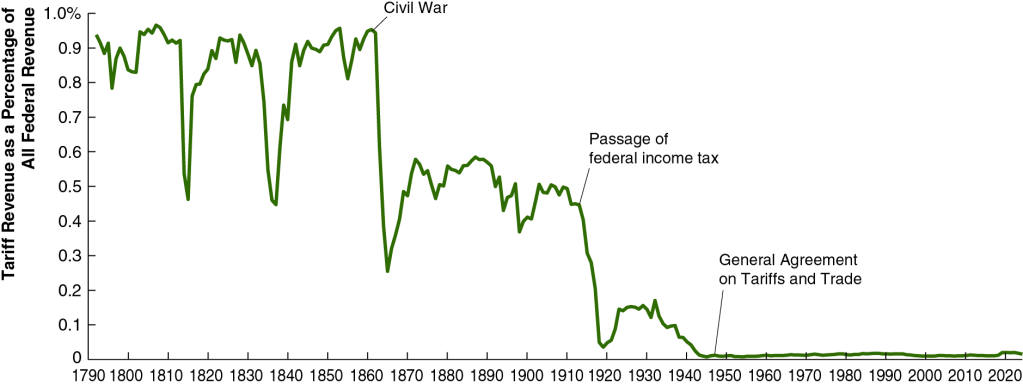
The effect of tariff increases on the U.S. economy are complex and depend on the details of which tariffs are increased, by how much they are increased, and whether foreign governments raise their tariffs on U.S. exports in response to U.S. tariff increases. We can analyze some of the effects of tariffs using the basic aggregate demand and aggregate supply model that we discuss in Macroeconomics, Chapter 13 (Economics, Chapter 23). We need to keep in mind in the following discussion that small increases in tariffs rates—such as those enacted in 2018—will likely have only small effects on the economy given that net exports are only about 3% or U.S. GDP.
An increase in tariffs intended to protect domestic industries can cause the aggregate demand curve to shift to the right if consumers switch spending from imports to domestically produced goods, thereby increasing net exports. But this effect can be partially or wholly offset if trading partners retaliate by increasing tariffs on U.S. exports. When Congress passed the Smoot-Hawley Tariff in 1930, which raised tariff rates to historically high levels, retaliation by U.S. trading partners contributed to a sharp decline in U.S. exports during the early 1930s.
International trade can increase a country’s production and income by allowing a country to specialize in the goods and services in which it has a comparative advantage. Tariffs shift a country’s allocation of labor, capital, and other resources away from producing the goods and services it can produce most efficiently and toward producing goods and services that other countries can produce more efficiently. The result of this misallocation of resources is to reduce the productive capacity of the country, shifting the long-run aggregate supply curve (LRAS) to the left.
Tariffs raise the prices of U.S. imports. This effect can be partially offset because tariffs increase the demand for U.S. dollars relative to trading partners’ currencies, increasing the dollar exchange rate. Because a tariff effectively acts as a tax on imports, like other taxes its incidence—the division of the burden of the tax between sellers and buyers—depends partly on the price elasticity of demand and the price elasticity of supply, which vary across the goods and services on which tariffs are imposed. (We discuss the effects of demand and supply elasticity on the incidence of a tax in Microeconomics, Chapter 17, Section 17.3.)
About two-thirds of U.S. imports are raw materials, intermediate goods, or capital goods, all of which are used as inputs by U.S. firms. For example, many cars assembled in the United States contain imported parts. The popular Ford F-Series pickup trucks are assembled in the United States, but more than two-thirds of the parts are imported from other countries. That fact indicates that the automobile industry is one of many U.S. industries that depend on global supply chains that can be disrupted by tariffs. Because tariffs on imported raw materials, parts and other intermediate goods, and capital goods increase the production costs of U.S. firms, tariffs reduce the quantity of goods these firms will produce at any given price. In terms of the aggregate demand and aggregate supply model , a large unexpected increase in tariffs results in an aggregate supply shock to the economy, shifting the short-run aggregate supply curve (SRAS) to the left.
Our thanks to Fernando Quijano for preparing the two figures.
1/17/25 Podcast – Authors Glenn Hubbard & Tony O’Brien discuss the pros/cons of tariffs and the impact of AI on the economy.
Welcome to the first podcast for the Spring 2025 semester from the Hubbard/O’Brien Economics author team. Check back for Blog updates & future podcasts which will happen every few weeks throughout the semester.
Join authors Glenn Hubbard & Tony O’Brien as they offer thoughts on tariffs in advance of the beginning of the new administration. They discuss the positive and negative impacts of tariffs -and some of the intended consequences. They also look at the AI landscape and how its reshaping the US economy. Is AI responsible for recent increased productivity – or maybe just the impact of other factors. It should be looked at closely as AI becomes more ingrained in our economy.
https://on.soundcloud.com/8ePL8SkHeSZGwEbm8
