
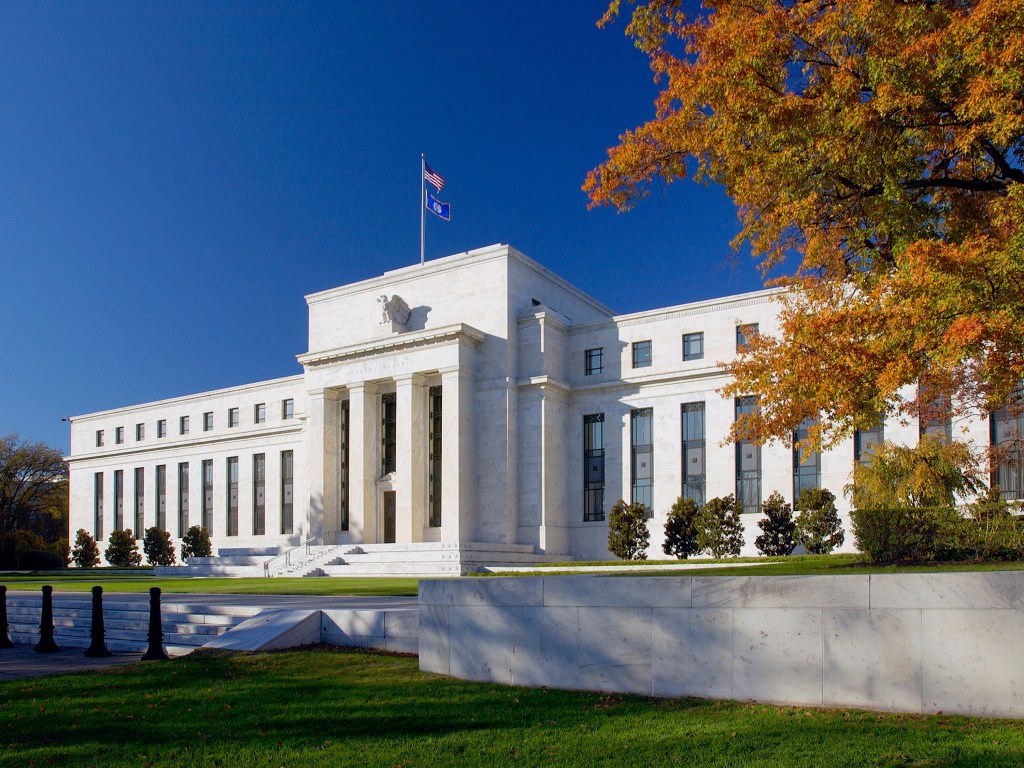
The Marriner S. Eccles building, headquarters of the Federal Reserve in Washington, DC. Image from federalreserve.gov.
The following opinion column appeared in the Financial Times.
What Warsh Should Do at the Fed
Donald Trump’s nomination of Kevin Warsh as chair of the Federal Reserve comes at a pivotal time for the American economy and for the US central bank. A pall has been cast by the administration’s unforced error of trumped-up charges against Jay Powell, the current Fed chair, and the president’s renewed threats to fire him if he does not leave by the end of his term. But the nominee’s credentials and experience ought to ensure a smooth confirmation. The question now should be what happens next.
The Fed faces three challenges. In the short term, the potential impact of the Iran war on employment calls for a careful assessment of the direction of the US economy. In the medium term, inflation continuing to run above the 2 per
cent target will limit the central bank’s room for maneuver, and also call its
credibility into question. In the longer term, questions remain about the
effectiveness of quantitative easing, the size of the Fed’s balance sheet, errors
made in the aftermath of the Covid pandemic, and the central bank’s forays
into areas better left to fiscal or regulatory policy.
All of which means that when Warsh eventually takes up the post, he should
launch an evaluation of the purpose, strategy and structure of the Fed straight
away.
First, purpose. The Federal Reserve was established as a lender of last resort
designed to mitigate financial crises. After it struggled to discharge that role
during the Great Depression, it turned to managing aggregate demand and
inflation. In 1978, Congress used the Humphrey-Hawkins Act to codify its
focus on inflation and employment, while giving the Fed leeway on how to
achieve those objectives. It also required the Fed chair to report to Congress on
its outcomes and outlook.
Warsh should now offer justifications for each of these objectives, set out
clearly what trade-offs they entail and how progress will be communicated.
This clarity focuses markets and elected officials on the importance of low and
steady inflation for US economic performance. And the advent of a new chair
provides an opportunity to make the Fed’s lender-of-last-resort decision-making clearer. Such explanations would be helpful in the present
environment of economic and public policy uncertainty.
Next comes strategy. This is about choosing a set of activities that deliver
objectives consistently. For the Fed, independence in monetary policy and the
ability to flex its balance sheet enable it to keep inflation low and manage
financial turmoil. Political assaults on its independence, of the type we have
recently seen, or restrictions on its balance sheet as a lender of last resort put
these strategic advantages at risk.
To deliver on purpose and strategy, the incoming chair should optimize the
Fed’s structure. The arrangement of a board of governors in Washington,
district banks led by district presidents, a Federal Open Market Committee of
the board and (a rotation of) five district presidents is set by law. But there are
three practical steps Warsh could take to improve the effectiveness of this setup.
First, the central bank should cast a wider net to gather insights from
economists, business leaders and financial market participants, with Fed
conferences reopened to members of these communities. Second, decisions
and direction should be communicated to financial markets and the public
consistently by the chair and by other officials.
Third, replace the notorious “dot plots”, which map FOMC members’
projections for the federal funds rate, with scenarios. Dot plots can be
misinterpreted as signals about the future path of interest rates. By contrast,
scenario analysis models how policy would respond to important changes, such
as shifts in AI investment, supply constraints, the natural rate of
unemployment, and medium-run effects on inflation, the dollar and US
economic activity from the conflict in Iran.
Such a comprehensive evaluation of purpose, strategy and structure would give
Warsh and the Fed both renewed organizational cohesion—and, more
importantly, a game plan.
On the perennial question of interest rates, the US economy’s near-term
momentum and elevated inflation are likely to tilt the balance of risks against
further cuts, despite Trump’s enthusiasm for an immediate cut. And while
Warsh is right to point out that the Fed should learn more about the economic
effects of AI, over the medium run a high-productivity-growth economy is
associated with a higher, not lower, real rate of interest.
Over this crucial period, the ability of the new chair to communicate clearly to
the public the value of low and steady inflation will be vital. The rules
governing the Fed’s role as lender of last resort should also be made clearer.
Finally, Warsh is correct that the Fed should take care to avoid engaging in the
kind of backdoor fiscal policy it has practiced in recent years.
Warsh is smart, informed, experienced in crisis management and an excellent
communicator. If the president allows him a free hand as chair, the American
economy should reap the benefits. Stay tuned.

