
Many thanks to Matt O’Brien for producing this comic!
Tag: Glenn Hubbard
Glenn on Adam Smith and the Midterm Elections

Image created by ChatGPT
This opinion column was first published on Project Syndicate.
Adam Smith on the U.S. Midterms
The Wealth of Nations offers a useful lens for understanding why US President Donald Trump’s mercantilist agenda has fallen short of its own stated goals. It also points to a better path, combining competitive markets with policies that help workers and communities build skills and keep pace with economic change.
November’s midterm elections pose a serious challenge for US President Donald Trump. Key components of his economic agenda, especially its protectionist measures, have raised concerns about the rising cost of living, prompted a rare rebuke from the Supreme Court, and cast doubt on the legal basis for his tariffs. Fortunately for Trump and the Republicans, they still have time to pivot to a pro-growth agenda that better addresses voter anxieties before the midterms.
Trump’s agenda is rooted in voter concerns about economic disruption driven by technological change and globalization. Breaking with the bipartisan embrace of market-friendly policies, his administration has sought to shield US producers from competition. While Treasury Secretary Scott Bessent has hinted that a pivot to a pro-growth strategy is in the works, reconciling it with the administration’s mercantilist approach will be difficult.
There is, however, an alternative path that better aligns with Trump’s stated goal of helping people and communities buffeted by economic change. For guidance, it is worth turning to Adam Smith. The Wealth of Nations, published 250 years ago, grappled with many of the same tensions and pointed to a pragmatic middle ground.
At first glance, Smith may seem at odds with Trump’s approach. After all, The Wealth of Nations centers on Smith’s critique of the mercantilist order of his day. Mercantilism prizes trade surpluses and the accumulation of national wealth in the hands of the state. To work, it requires extensive government intervention in commerce, trade, and labor markets. But that expansive role invites rent-seeking and excessive control, a key concern for Smith.
Smith’s treatise turned this system on its head by posing a radical question: Where does national wealth come from? For Smith, the answer stood in contrast to mercantilism. A competitive economy, with limited government intervention, would be accompanied by openness and specialization, in turn raising living standards.
While Smith did not develop a formal theory of growth, his intuition about the importance of openness to markets and innovation is consistent with modern growth models and stands in contrast to Trump-era policymaking. As Nobel laureate economist Joel Mokyr has noted, science, practical knowledge, and openness to change are key drivers of long-term prosperity.
But Trump has also identified an important tension. Modern growth models are like a coin. The “heads” side is growth and its benefits for living standards; the “tails” side is disruption—the upending of existing investments, firms, jobs, and even communities. It is here that Trump’s mercantilism, with its focus on minimizing the effects of disruption on voters’ lives, gains political traction.
Smith challenges this perspective in two ways. First, he reminds us of the limits mercantilism places on living standards. Second, in The Theory of Moral Sentiments, which he considered his finest work, he emphasizes empathy and what my Columbia colleague Edmund S. Phelps calls “mass flourishing,” which aims to ensure that everyone benefits from economic progress, including those disrupted by its forward march.
Here, then, is the policy alternative to both Trumpian mercantilism and market orthodoxy: augmenting Smith’s concept of “competition” with the “ability to compete.” Such an agenda would center on preparation and reconnection, both vital for participation in—and support for—an open economy.
One place to begin is workforce development. In the United States, community colleges are well positioned to serve as training grounds for skill development and career transitions, often working closely with local employers to create quality jobs. While support for community colleges has declined in many states, a federal block grant focused on completion and skill development would significantly enhance their impact.
Similarly, a more generous Earned Income Tax Credit could boost labor-force participation and attachment. Increased funding for basic research, alongside support for applied research centers across the country, could raise productivity by bringing cutting-edge tools to businesses, much as land-grant colleges have historically done in agriculture and manufacturing.
To reconnect displaced workers, personal re-employment accounts—combining funds for training with re-employment bonuses—could help reduce the duration of joblessness. For communities affected by structural economic change, more effective place-based aid could support productivity-enhancing business services in lower-income areas with higher unemployment.
Such measures, along with a growth-oriented agenda, could reshape the electoral landscape. Investments in AI and electricity generation could be accelerated through regulatory reform, particularly by easing permitting rules under the National Environmental Policy Act. To increase the housing supply, a prerequisite for mobility and growth, the administration could propose incentives for state and local governments to scale back restrictive construction regulations.
Going further, the administration would need to abandon its nativist immigration policies. Increasing the number of high-skilled immigrants, particularly in STEM fields, would boost growth, as immigrants have been shown to drive technological innovation, leading to more patents, higher productivity, and rising incomes.
Likewise, expanding federal support for research and development would yield high returns. Some estimates suggest that the returns are so large that the net cost to taxpayers may be zero or even negative, as higher productivity generates enough additional tax revenue to offset the cost. Combined with a stable macroeconomic environment and pro-investment policies of the kind Trump has championed, these changes could significantly accelerate growth.
A more constructive approach to economic disruption would shift away from broad tariffs and protectionism, which tend to raise consumer prices and erode the competitiveness of US manufacturing by increasing input costs. The Supreme Court’s recent reversal of many tariffs imposed by Trump under the International Emergency Economic Powers Act has created an opportunity—and underscored the need—for a course correction.
Trump has rightly raised questions about the economic consequences of technological change and globalization. Two and a half centuries after its publication, The Wealth of Nations points toward a necessary pivot away from mercantilism and toward a more balanced, pro-growth framework.
Glenn’s Advice for Kevin Warsh

The Marriner S. Eccles building, headquarters of the Federal Reserve in Washington, DC. Image from federalreserve.gov.
The following opinion column appeared in the Financial Times.
What Warsh Should Do at the Fed
Donald Trump’s nomination of Kevin Warsh as chair of the Federal Reserve comes at a pivotal time for the American economy and for the US central bank. A pall has been cast by the administration’s unforced error of trumped-up charges against Jay Powell, the current Fed chair, and the president’s renewed threats to fire him if he does not leave by the end of his term. But the nominee’s credentials and experience ought to ensure a smooth confirmation. The question now should be what happens next.
The Fed faces three challenges. In the short term, the potential impact of the Iran war on employment calls for a careful assessment of the direction of the US economy. In the medium term, inflation continuing to run above the 2 per
cent target will limit the central bank’s room for maneuver, and also call its
credibility into question. In the longer term, questions remain about the
effectiveness of quantitative easing, the size of the Fed’s balance sheet, errors
made in the aftermath of the Covid pandemic, and the central bank’s forays
into areas better left to fiscal or regulatory policy.
All of which means that when Warsh eventually takes up the post, he should
launch an evaluation of the purpose, strategy and structure of the Fed straight
away.
First, purpose. The Federal Reserve was established as a lender of last resort
designed to mitigate financial crises. After it struggled to discharge that role
during the Great Depression, it turned to managing aggregate demand and
inflation. In 1978, Congress used the Humphrey-Hawkins Act to codify its
focus on inflation and employment, while giving the Fed leeway on how to
achieve those objectives. It also required the Fed chair to report to Congress on
its outcomes and outlook.
Warsh should now offer justifications for each of these objectives, set out
clearly what trade-offs they entail and how progress will be communicated.
This clarity focuses markets and elected officials on the importance of low and
steady inflation for US economic performance. And the advent of a new chair
provides an opportunity to make the Fed’s lender-of-last-resort decision-making clearer. Such explanations would be helpful in the present
environment of economic and public policy uncertainty.
Next comes strategy. This is about choosing a set of activities that deliver
objectives consistently. For the Fed, independence in monetary policy and the
ability to flex its balance sheet enable it to keep inflation low and manage
financial turmoil. Political assaults on its independence, of the type we have
recently seen, or restrictions on its balance sheet as a lender of last resort put
these strategic advantages at risk.
To deliver on purpose and strategy, the incoming chair should optimize the
Fed’s structure. The arrangement of a board of governors in Washington,
district banks led by district presidents, a Federal Open Market Committee of
the board and (a rotation of) five district presidents is set by law. But there are
three practical steps Warsh could take to improve the effectiveness of this setup.
First, the central bank should cast a wider net to gather insights from
economists, business leaders and financial market participants, with Fed
conferences reopened to members of these communities. Second, decisions
and direction should be communicated to financial markets and the public
consistently by the chair and by other officials.
Third, replace the notorious “dot plots”, which map FOMC members’
projections for the federal funds rate, with scenarios. Dot plots can be
misinterpreted as signals about the future path of interest rates. By contrast,
scenario analysis models how policy would respond to important changes, such
as shifts in AI investment, supply constraints, the natural rate of
unemployment, and medium-run effects on inflation, the dollar and US
economic activity from the conflict in Iran.
Such a comprehensive evaluation of purpose, strategy and structure would give
Warsh and the Fed both renewed organizational cohesion—and, more
importantly, a game plan.
On the perennial question of interest rates, the US economy’s near-term
momentum and elevated inflation are likely to tilt the balance of risks against
further cuts, despite Trump’s enthusiasm for an immediate cut. And while
Warsh is right to point out that the Fed should learn more about the economic
effects of AI, over the medium run a high-productivity-growth economy is
associated with a higher, not lower, real rate of interest.
Over this crucial period, the ability of the new chair to communicate clearly to
the public the value of low and steady inflation will be vital. The rules
governing the Fed’s role as lender of last resort should also be made clearer.
Finally, Warsh is correct that the Fed should take care to avoid engaging in the
kind of backdoor fiscal policy it has practiced in recent years.
Warsh is smart, informed, experienced in crisis management and an excellent
communicator. If the president allows him a free hand as chair, the American
economy should reap the benefits. Stay tuned.
What Will the U.S. Economy Be Like in 50 Years? Glenn Predicts!
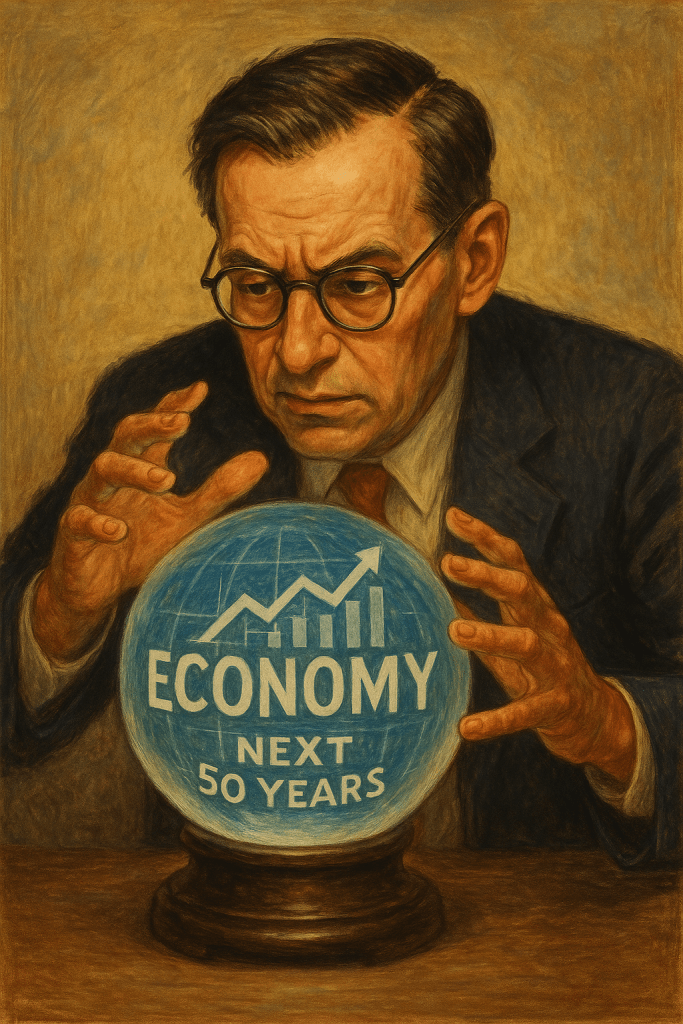
Image generated by ChatGPT
A Stronger Safety Net
Modern industrial capitalism’s bounty has been breathtaking globally and especially in the U.S. It’s tempting, then, to look at critics in the crowd in Monty Python’s “Life of Brian” as they ask, “What have the Romans ever do for us?,” only to be confronted with a large list of contributions. But, in fact, over time, American capitalism has been saved by adapting to big economic changes.
We’re at another turning point, and the pattern of American capitalism’s keeping its innovative and disruptive core by responding, if sometimes slowly, to structural shocks will play out as follows.
The magnitude, scope and speed of technological change surrounding generative artificial intelligence will bring forth a new social insurance aimed at long-term, not just cyclical, impacts of disruption. For individuals, it will include support for work, community colleges and training, and wage insurance for older workers. For places, it will include block grants to communities and areas with high structural unemployment to stimulate new business and job opportunities. Such efforts are a needed departure from a focus on cyclical protection from short-term unemployment toward a longer-term bridge of reconnecting to a changing economy.
These ideas, like America’s historical big responses in land-grant colleges and the GI Bill, combine federal funding support with local approaches (allowing variation in responses to local business and employment opportunities), another hallmark of past U.S. economic policy.
With a stronger economic safety net, the current push toward higher tariffs and protectionism will gradually fade. Protectionism is a wall against change, but it is one that insulates us from progress, too.
A growing budget deficit and strains on public finances will lead to a reliance on consumption taxes to replace the current income tax system; continuing to raise taxes on saving and investment will arrest growth prospects. For instance, a tax on business cash flow, which places a levy on a firm’s revenue minus all expenses including investment, would replace taxes on business income. Domestic production would be enhanced by adding a border adjustment to business taxes—exports would be exempt from taxation, but companies can’t claim a deduction for the cost of imports.
That reform allows a shift from helter-skelter tariffs to tax reform that boosts investment and offers U.S. and foreign firms alike an incentive to invest in the U.S.
These ideas to retain opportunity amid creative destruction will also refresh American capitalism as the nation celebrates its 250th anniversary. They also celebrate the classical liberal ideas of Adam Smith, whose treatise “The Wealth of Nations” appeared the same year. This refresh marries competition’s role in “The Wealth of Nations” and American capitalism with the ability to compete, again a feature of turning points in capitalism in the U.S.
Decades down the road, this “Project 2026” will have preserved the bounty and mass prosperity of American capitalism.
These observations first appeared in the Wall Street Journal, along with predictions from six other economists and economic historians.
Glenn Proposes Tax Reforms to Aid Economic Growth

Photo of the Internal Revenue Service building in Washington, DC from the Associated Press via the Wall Street Journal
The following op-ed by Glenn first appeared in the Wall Street Journal.
The GOP Tax Bill Could Solve the Tariff Problem
The economy and financial markets nervously await the July 8 end of the 90-day pause of the Trump administration’s “reciprocal” tariffs. But four days earlier, Republicans can allay those fears with a pro-growth policy that advances President Trump’s Made in America agenda without tariffs. The fix: tax reform.
July 4 is the date that Treasury Secretary Bessent has predicted Congress and the White House will have ready a 2.0 version of the landmark Tax Cut and Jobs Act of 2017, or TCJA. Without congressional action, some of these reforms will expire at the end of 2025, killing changes that still benefit the economy. Corporate tax changes, in particular, boosted investment and growth. These should remain the focal point of this next tax bill—for many reasons. Done right, corporate tax reform could advance President Trump’s goal to bring investment to American production without using economy-roiling tariffs. Call it TCJA+.
Renewing some parts of the original TCJA will help investment in the U.S. The 2017 reform offered incentives for investment in new businesses by allowing them to expense the cost of assets, rather than writing them off over time. But these benefits were set to be phased out from 2023 to 2026, removing a key pro-growth element of the earlier law.
Then there are two new provisions Republicans should add to secure Mr. Trump’s goal to have more made in America. Both were in the original 2016 House Republican tax reform blueprint.
First, Congress should change business taxation from the current income tax to a cash-flow tax, which taxes a firm’s revenue, minus all its expenses, including investment. Long championed by economists and tax-law experts, a cash-flow tax would allow businesses to expense investment immediately. It would also disallow nonfinancial companies from making interest deductions, because unlike an income tax, a cash-flow tax treats debt and equity the same. This removes an important tax incentive for firms to allow themselves to be leveraged. A cash-flow tax is also much simpler than a corporate income tax, which requires complex depreciation schedules. Most important, the reform would stimulate business investment.
Second, legislators should add a border adjustment to corporate taxes. That would deny companies a tax deduction for expenses of inputs imported from abroad, while exempting U.S. exports from taxation. As the Trump administration has observed, other countries already use border adjustments in their value-added taxes on consumption. America uses a similar mechanism in state and local retail taxes, too. If you buy a kitchen appliance in New York, you pay New York sales tax, even if it was made in Ohio. Sales tax applies only where the good is sold, not where it originates.
Though distinct from tariffs, border adjustments can promote domestic production. Adding a border adjustment to the federal corporate tax would eliminate any extra tax businesses suffer now simply as a consequence of producing in the U.S. Though the 2017 law made the U.S. tax system more globally competitive by lowering the corporate income tax rate from 35% to 21%, it’s still higher than in many other countries, which attract production with low cost. A border adjustment would remove this incentive for American firms to locate profits or activities abroad, while increasing incentives for non-U.S. firms to locate activities within our borders.
As with the original pro-investment features in the 2017 law, this TCJA+ reform would increase investment and incomes—and thereby revenue. For the original TCJA, when the Congressional Budget Office included the macroeconomic effects of higher incomes buoyed by the reforms’ pro-growth elements, the CBO reduced the estimated revenue loss from the tax cuts by almost 30%. Changing the corporate income tax to a cash-flow levy would similarly increase revenue by removing taxes on what economists call the “normal return” on investment, or the cost of capital. Companies would instead pay only on profits above this amount. A border adjustment can likewise raise substantial revenue over the next decade because imports (which would receive no deduction) are larger than exports (which would no longer be taxed).
The higher revenue these two TCJA+ provisions promise could be used to lower the tax rate on business cash flow or to fund other tax-policy objectives. Importantly, that revenue can replace revenue raised from the tariffs the Trump administration had planned to implement on July 8. These two tax provisions would accomplish the president’s America-first and revenue objectives without destabilizing businesses with whipsawing tariffs.
Finally, TCJA+ would offer another big benefit: It would move the U.S. toward independence from political meddling in the economy via targeted protection or subsidies. This added predictability and breathing room for investment would be one more reason to produce in America. Pluses indeed.
Glenn on How the Trump Administration Can Hit Its Growth Target
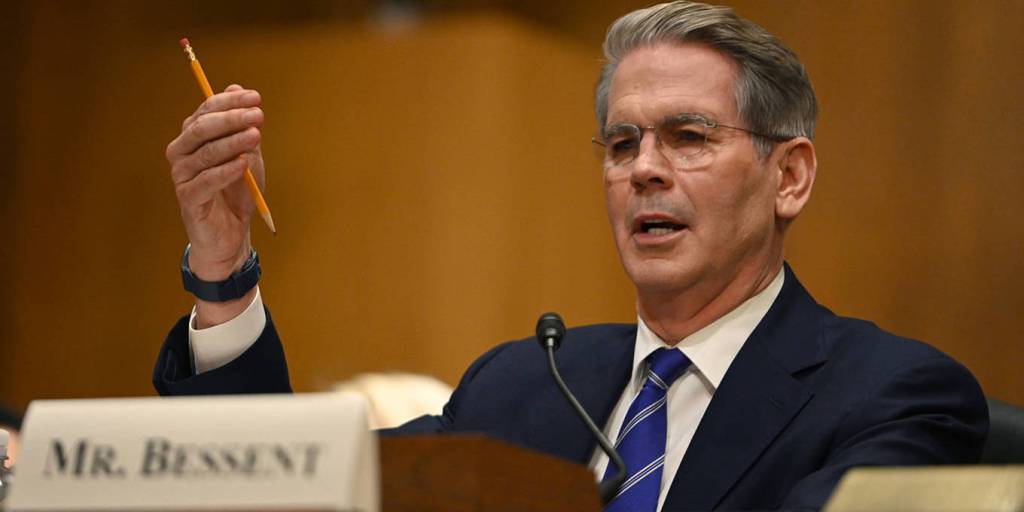
Treasury Secretary nominee Scott Bessent. (Photo from Progect Syndicate.)
By setting an ambitious 3% growth target, U.S. Treasury Secretary nominee Scott Bessent has provided the Trump administration a North Star to follow in devising its economic policies. The task now is to focus on productivity growth and avoiding any unforced errors that would threaten output.
U.S. Treasury Secretary nominee Scott Bessent is right to emphasize faster economic growth as a touchstone of Donald Trump’s second presidency. More robust growth not only implies higher incomes and living standards—surely the basic objective of economic policy—but also can reduce America’s yawning federal budget deficit and debt-to-GDP ratio, and ease the sometimes difficult trade-offs across defense, social, and education and research spending.
But faster growth must be more than just a wish. Achieving it calls for a carefully constructed agenda, based on a recognition of the channels through which economic policies can raise or reduce output. While a pro-investment tax policy might boost capital accumulation, productivity, and GDP, higher interest rates from deficit-financed tax or spending changes might have the opposite effect. Similarly, since growth in hours worked is a component of growth in output or GDP, the new administration should avoid anti-work policies that hinder full labor-force participation, as well as sudden adverse changes to legal immigration.
While recognizing that some policy shifts that increase output might adversely affect other areas of social interest (such as the distribution of income) or even national security, policymakers should focus squarely on increasing productivity. The three pillars of any productivity policy are support for research, investment-friendly tax provisions, and more efficient regulation.
Ideas drive prospects in modern economies. Basic research in the sciences, engineering, and medicine power the innovation that advances technology, improvements in business organization, and gains in health and well-being. It makes perfect sense for the federal government to support such research. Since private firms cannot appropriate all the gains from their own outlays for basic research, they have less of an incentive to invest in it. Moreover, government support in this area produces valuable spillovers, as demonstrated by the earlier Defense Department research expenditures that became catalysts for today’s digital revolution.
This being the case, cuts in federal support for basic research are inconsistent with a growth agenda. Still, policymakers should review how research funds are distributed to ensure scientific merit, and they should encourage a healthy dose of risk-taking on newer ideas and researchers.
In addition to encouraging commercialization of spillovers from basic research and defense programs, federal support for applied research centers around the country would accelerate the dissemination of new productivity-enhancing technologies and ideas. Such centers also tend to distribute the economy’s prosperity more widely, by making new ideas broadly accessible—as agricultural- and manufacturing-extension services have done historically.
To address the second pillar of productivity growth, the administration should seek to extend the pro-investment provisions of the Tax Cuts and Jobs Act that Trump signed into law in 2017. While the TCJA’s lower tax rates on corporate profits remain in place, the expensing of business investment – a potent tool for boosting capital accumulation, productivity, and incomes – was set to be phased out over the 2023-26 period. This provision could be restored and made permanent by reducing spending on credits under the Inflation Reduction Act, or by rolling back the spending – such as $175 billion to forgive student loans – associated with outgoing President Joe Biden’s executive orders.
If the new administration wanted to go further with tax policy, it could build on the 2016 House Republican blueprint for tax reform that shifted the business tax regime from an income tax to a cashflow tax. By permitting immediate expensing of investment, but not interest deductions for nonfinancial firms, this reform would stimulate investment and growth, remove tax incentives that favor debt over equity, and simplify the tax system.
That brings us to the third pillar of a successful growth strategy: efficient regulation. The issue is not “more” versus “less.” What really matters for growth is how changes in regulation can improve the prospects for growth through innovation, investment, and capital allocation, while focusing on trade-offs in risks. Those shaping the agenda should start with basic questions like: Why can’t we build better infrastructure faster? Why can’t capital markets and bank lending be nimbler? Not only do such questions identify a specific goal; they also require one to identify trade-offs.
Fortunately, financial regulation under the new administration is likely to improve capital allocation and the prospects for growth, given the leadership appointments already announced at the Securities and Exchange Commission and the Federal Reserve. But policymakers also will need to improve the climate for building infrastructure and enhancing the country’s electricity grids to support the data centers needed for generative artificial intelligence. This will require a sharper focus on cost-benefit analysis at the federal level, as well as better coordination with state and local authorities on permitting. Using federal financial support programs as carrots or sticks can be part of such a strategy.
Bessent’s emphasis on economic growth is spot on. By setting an ambitious 3% target for annual growth, he has provided the new administration a North Star to follow in devising its economic policies.
This commentary first appeared on Project Syndicate.
Glenn on the Economic Policies Necessary to Increase Growth

Image showing scientific research generated by GTP-4o
Note: The following op-ed first appeared in the Wall Street Journal.
The Trump Economic Awakening
Traditional policies like tax cuts, targeted aid and responsible spending can deliver stronger growth.
Political scientists will debate the forces that shaped Donald Trump’s victory, but one thing is clear: Americans yearn for a change in economic policy. Voters have rejected the interventionist policies that brought inflation and high deficits. They want an economic awakening, a new way forward that uses traditional economic policies to achieve Mr. Trump’s goal of more jobs for Americans whose fortunes have been harmed by technological change and globalization.
Any economic path to a successful awakening begins with growth: the engine that powers individual income and our collective ability to support the nation’s defense, economy, education and healthcare industry. To pursue this growth, the new administration should consider at least three measures:
First, by working with Congress, it should build on the successes of the Tax Cuts and Jobs Act of 2017 to make permanent the expensing of business investment. Second, it should increase support for science and defense research, which would have significant spillover to the commercial sector, particularly in space exploration. Third, it should build on this research by constructing applied research centers around the country, linked to regional university and city hubs. Like the land-grant colleges of the 19th century, these centers would generate and distribute knowledge, improving local capabilities in manufacturing and services.
Opportunity is also a pillar of the awakening. Community colleges are an underfunded source of skill-building and mobility. As Austan Goolsbee, Amy Ganz and I proposed in a 2019 report, a modest federal block grant to support community colleges on the supply side—rather than a demand-side emphasis on financial aid—can help these schools push more Americans toward better jobs by working with local employers on skill needs and curriculum development. Targeted aid to places with depressed economic activity can help distribute opportunity to communities better than one-size-fits-all Washington-directed programs.
Corporate tax reform can play a role, too, by improving incentives for companies to settle and invest in the U.S. This can magnify opportunities for Americans, all without having to rely on costly tariffs.
Working a job doesn’t merely generate income; it also promotes human dignity. Enlisting more people into the workforce is thus another element of the economic-policy awakening. While growth and opportunity policies can boost labor-force participation, strengthening the earned-income tax credit to boost the incomes of childless workers can help attract younger people to the workforce. Maintaining the child tax credit can also provide parents with easier pathways toward economic participation.
These ideas share several important themes with Mr. Trump’s campaign and the traditional conservative playbook. They emphasize that policy ideas should be practical and workable, not merely rhetorical. Each makes use of America’s federalist system and innovative ethos. Making a priority of strong local involvement in applied research centers and community colleges and as tailoring place-based aid are more effective approaches than Washington diktats. Programs need to be held accountable for results, not simply allocated money.
This economic-policy awakening requires a clear-eyed assessment of budget trade-offs. Profligate spending with little regard for debt and inflation—à la the American Rescue Plan—contributed to Mr. Trump’s victory. It is possible to accomplish the steps above in a fiscally responsible way by offsetting spending and tax changes.
Organizing for the policy awakening’s success will be essential. Lack of communication among cabinet agencies can stymie creative ideas for expanding the economic pie for American workers. Like the president’s Working Group on Financial Markets, created by Ronald Reagan in 1988 to convene disparate agencies, the new administration would benefit from a senior executive team that can coordinate economic ideas and learn from leaders in business, labor and social services. Such a body, unlike the National Economic Council, could more adeptly cut across silos related to tax, trade, regulatory and industrial policy.
Voters have signaled they’re ready for an economic awakening. The president-elect, equipped with a new playbook and vision, should seize the opportunity.
Continue reading “Glenn on the Economic Policies Necessary to Increase Growth”
