
Photo from federalreserve.gov
Today, the Federal Open Market Committee (FOMC) met expectation by raising its target range for the federal funds rate by 0.25 percentage points (25 basis points) from the range of 3.50 percent to 3.75 percent that had prevailed since December 10 of last year. As of yesterday, trading in the federal funds rate futures market had implied a 93.5 percent probability of a 25 basis point increase. Financial markets had been convinced that a rate increase was coming since Fed Chair Kevin Warsh’s speech at the Federal Reserve Bank of Kansas City’s economic policy symposium in Jackson Hole, Wyoming in late August. (We discussed Warsh’s speech in this blog post.) There had been some speculation in the business press that one or more committee members would dissent from a rate increase, but the vote turned out to be unanimous. Today was the first time the committee had increased the target range since July 2023.
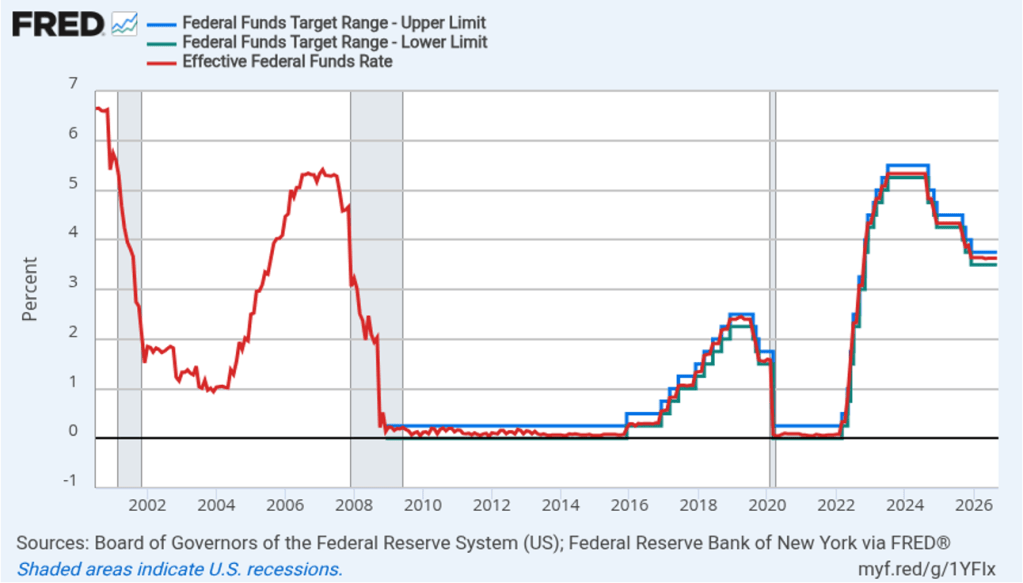
The following figure shows for the period from 2001 through yesterday, the upper bound (the blue line) and the lower bound (the green line) for the FOMC’s target range for the federal funds rate, as well as the actual values for the federal funds rate (the red line). Before December 2008, the Fed announced a single numerical target for the federal funds rate, rather than a target range. Note that the Fed has been successful in keeping the value of the federal funds rate in its target range. (We discuss the monetary policy tools the FOMC uses to maintain the federal funds rate within its target range in Macroeconomics, Chapter 15, Section 15.2 (Economics, Chapter 25, Section 25.2).)
As with the policy statements issued following Warsh’s previous two FOMC meetings, today’s policy statement was short and did not include any discussion of the circumstances under which further target rate increases might occur—so-called forward guidance. We discuss forward guidance in Macroeconomics, Chapter 15 (Economics, Chapter 25).
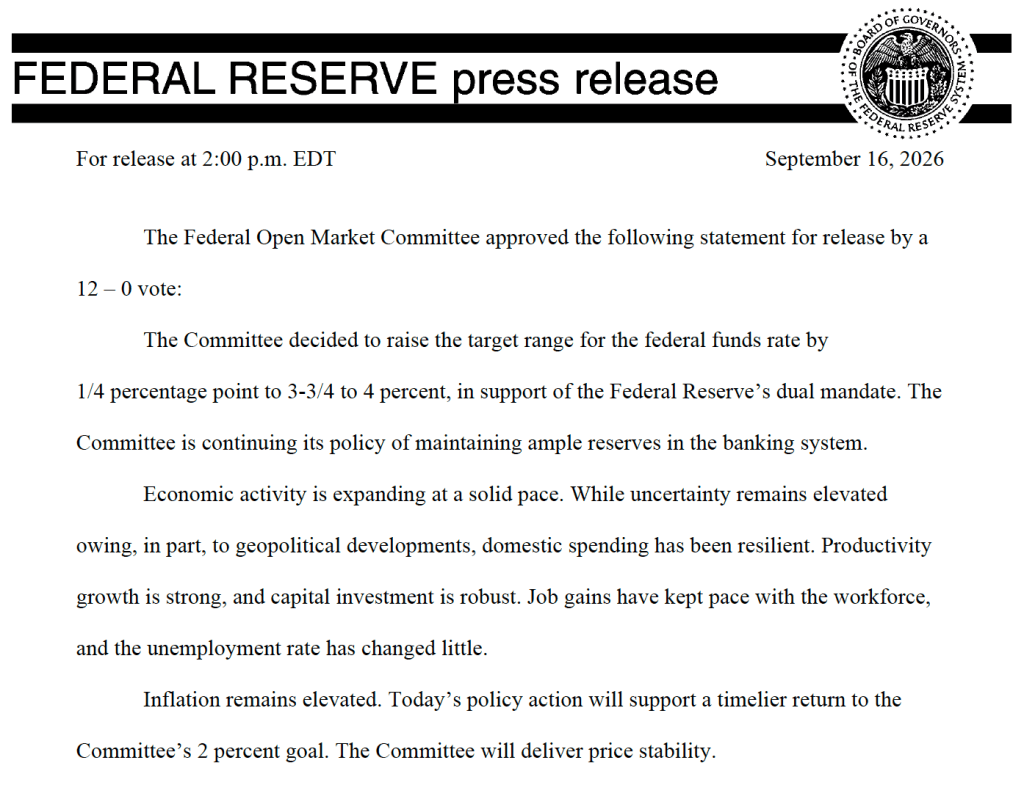
After the meeting, the committee also released a “Summary of Economic Projections” (SEP)—as it typically does at its March, June, September, and December meetings. The SEP presents median values of the, typically, 19 committee members’ forecasts of key economic variables. In a press conference following the meeting, Warsh indicated that he didn’t submit forecasts, just as he hadn’t submitted forecasts for the SEP released after the June meeting. He indicated that the future of the SEP is one of the issues to be considered by his new committee on Fed communications.
The forecasts of key economic variables from the SEP are summarized in the following table, reproduced from the release. (Note that only 5 of the district bank presidents vote at FOMC meetings, although all 12 presidents participate in the discussions and prepare forecasts for the SEP.)
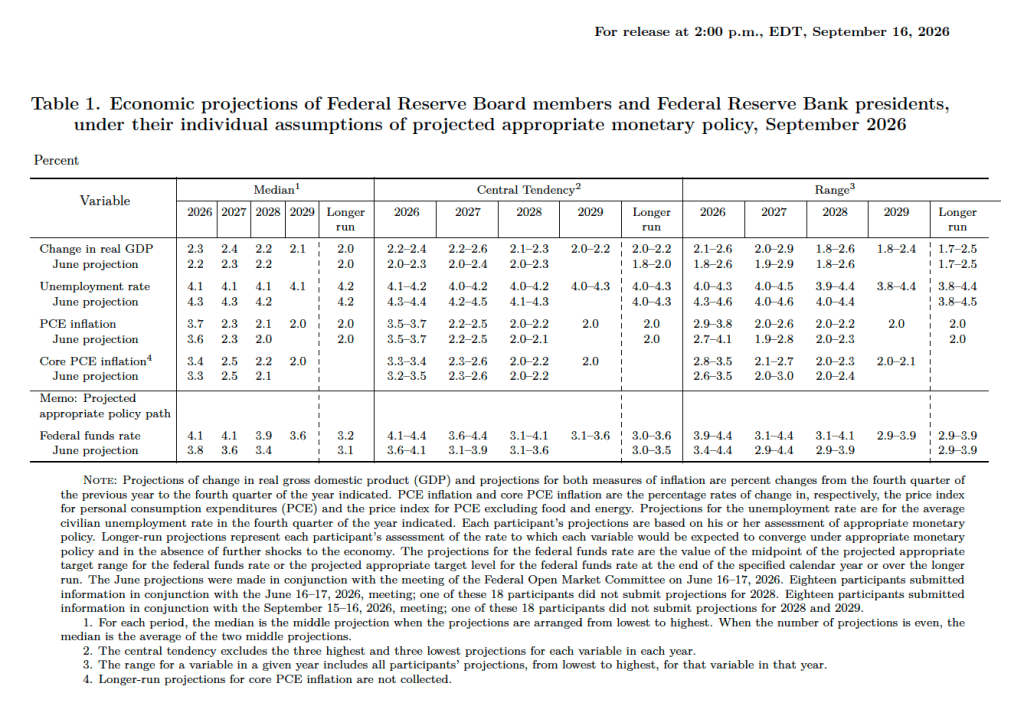
There are several aspects of these forecasts worth noting:
- Compared with the previous SEP in June, the committee members raised their forecast of real GDP growth in 2026 slightly from 2.2 percent to 2.3 percent. The committee members left unchanged their forecast of long-run growth in real GDP at 2.0 percent. The unchanged long-range forecast indicates that the committee members are not anticipating a large, sustained increase in economic growth caused by increased use of artificial intelligence (AI). Consistent with raising their forecast of real GDP growth in 2026, the committee lowered its forecast of the unemployment rate in the fourth quarter of 2026 from 4.3 percent to 4.1 percent. The committee members left their forecast of the long-run rate of unemployment, often called the natural rate of unemployment, unchanged at 4.2 percent.
- Committee members raised their forecast of personal consumption expenditures (PCE) price inflation in 2026 to 3.7 percent from 3.6 percent in June. They left their forecast of inflation in 2027 unchanged at 2.3 percent and forecast that PCE inflation would not decline to the Fed’s 2.0 percent annual target until 2029.
- The committee’s forecasts of the federal funds rate at the end of each year from 2026 through 2028 were increased, indicating that the committee sees the federal funds rate as likely to be “higher for longer.” The forecast for the long-run federal funds rate was raised from 3.1 percent to 3.2 percent.
There is always much discussion in the business press and among investment analysts about the dot plot, shown below. Each dot in the plot represents the projection of an individual committee member. (The committee doesn’t disclose which member is associated with which dot.) Note that there are 18 dots, representing the 6 members of the Fed’s Board of Governors who provided forecasts and all 12 presidents of the Fed’s district banks.
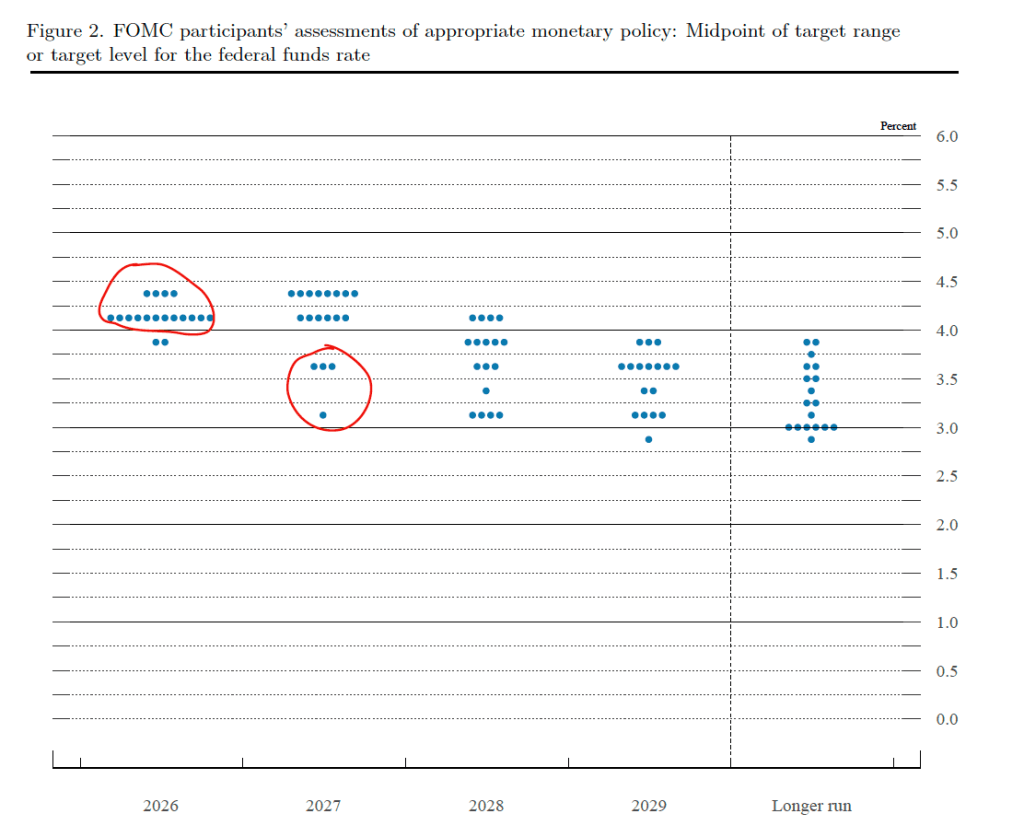
The dots plotted on the far left of the figure represent the projections by the 18 members of the value of the federal funds rate at the end of 2026. The plots indicate that, at this point, 16 members of the committee (circled in red) forecast at least one additional 25 basis point increase in the target range for the federal funds rate before the end of the year, with only 2 members expecting that there will be no further increases this year. For 2027, four members (circled in red) expect that the target range will be cut during the year, with the rest expecting either that the rate increases made this year will be maintained or that there will be one additional 25 basis point increase. The dots plotted on the far right of the figure indicate that there is substantial disagreement among committee members as to what the long-run value of the federal funds rate—the so-called neutral rate—should be. Of course, the plots only represent the forecasts of the committee members and individual committee members are likely to adjust their forecasts as additional macroeconomic data become available in the coming months.
At his press conference following the meeting, Warsh resisted attempts by reporters to get him to expand on the circumstances under which the committee might implement further increases in the target range. He characterized today’s rate increase as removing “a dose of accommodation” from the economy, which reflected the committee’s belief that the economy was experiencing full employment with persistently high inflation. The closest he came to engaging in forward guidance was the statement that “We must be confident that underlying inflation is moving towards our objective. This has not been satisfied.”
Warsh was asked what had changed since the July meeting at which the committee had kept the target range unchanged. in reply, he indicated that the committee believed that since July the economy had strengthened, inflation had continued to above target, and “geopolitical” factors had contributed to higher prices.


One thought on “As Expected, the FOMC Raises Its Federal Funds Rate Target”