Supports: Money, Banking, and the Financial System, Chapter 3, and Microeconomics, Chapter 8, Appendix.
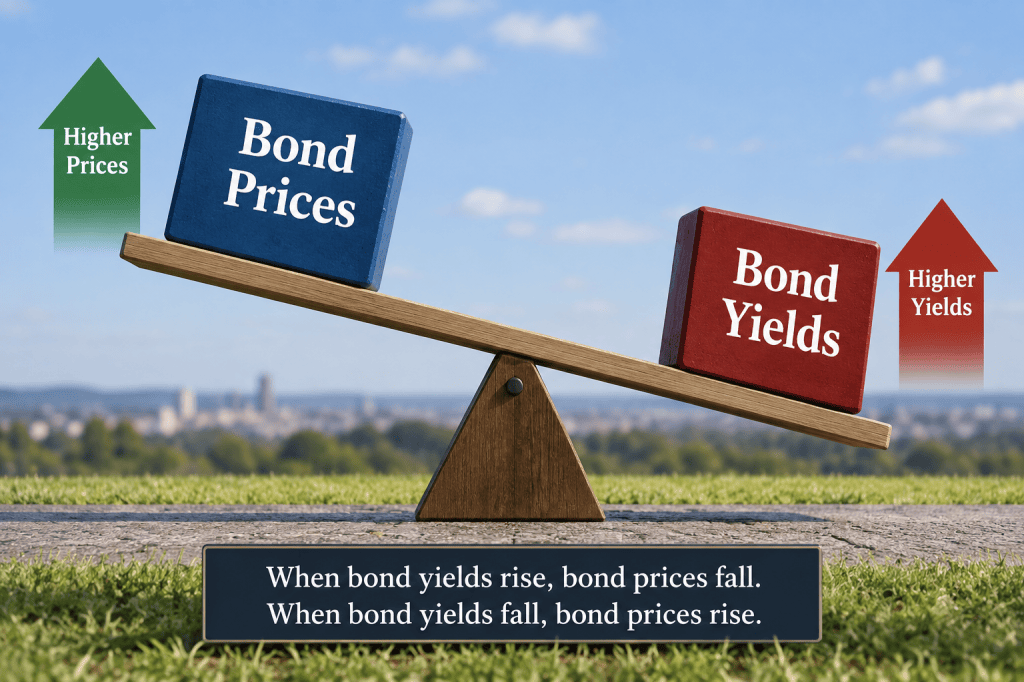
Image created by ChatGPT
A recent article in the Wall Street Journal was titled “A Primer on Why Bond Prices Fall When Yields Rise.” A student reading the title of the article asks, “How can that be right? Investors would prefer to own bonds that have higher yields, so when the yields on bonds rise, investors should demand more of them. When the demand for something goes up, the price increases. Therefore, bond yields and bond prices should go up (or down) together.” Briefly explain the error in this student’s reasoning.
Solving the Problem
Step 1: Review the chapter material. This problem is about the relationship between bond yields and bond prices, so you may want to review Money, Banking, and the Financial System, Chapter 3 (for a complete discussion) or Microeconomics, Chapter 8, Appendix (for a brief discussion).
Step 2: Solve the problem by explaining what is wrong with the argument that if bond yields increase, so will bond prices, and if bond yields decrease, so will bond prices. In solving the problem, we should first consider the sometimes confusing number of “interest rates” on a coupon bonds. Coupon bonds pay interest in the form of coupons, which are usually quoted on an annual basis although typically paid twice per year. For example, Apple may issue a bond that pays a coupon of $47.50. The coupon rate on this bond is quoted per $1,000 of face value, or par value, which in this case would be 4.750%.
Bonds, like other financial assets such as shares of stock, are bought and sold in financial markets. A key point is that in financial markets, bonds with similar characteristics—including the same level of default risk, the same liquidity, and the same tax treatment of the bonds’ coupons—should provide investors with the same expected return. If this condition didn’t hold—for instance, if a bond issued by Apple was expected to provide a higher return than comparable bonds—then investors would increase their demand for the Apple bond, forcing up its price until its yield fell by enough to make its expected return the same as on other comparable bonds.
The price of a bond can fluctuate depending on how its coupon rate compares to the coupon rates on newly issued bonds, changes in investors’ expectations of future inflation, changes in investors’ expectations of the default risk of the bond, and other factors. For example, an article in the Wall Street Journal reported that, “Lenders on Monday demanded higher yields on bonds from a new data-center project in El Paso, Texas, leased by Meta compared with a similar project last year.” According to the article, the reason for the higher yields was that investors had raised their estimates of the default risk on bonds issued to fund data centers. Investors needed higher yields on bonds to compensate them for the higher default risk.

An image created by ChatGPT of Meta’s data-center complex under construction in El Paso, Texas.
What happens to the prices of existing bonds when newly issued bonds have higher coupon rates? Keeping in mind that, because the coupon rate on a bond is fixed and won’t change after the bond has been issued, the only way that the yield on a bond can change is if the price of the bond declines. By “yield” we are here referring to the yield to maturity, which is the best way of calculating the yield on a bond and which is ordinarily what economists and investors mean when they refer to the interest rate on a bond.
Formally, the yield to maturity is defined as the interest rate that makes the present value of the payments from the bond equal to the bond’s current price. In the following expression, where C is the coupon on the bond, FV is the face value of the bond, and n is the number of years until the bond matures, i is the yield to maturity.

The arithmetic of this expressions shows that if the yield to maturity increases, because, for example, the coupon rate on similar newly issued bonds are higher than the coupon rate on this bond, the price of the bond must decline. The economics of this expression is that an increase in the yield to maturity reduces the present value of a bond’s coupon payments and face value.
The reverse happens if the yield to maturity on a bond falls: The price of the bond will rise as a matter of arithmetic. As a matter of economics, a lower yield to maturity increases the present value of a bond’s coupon payments and face value.
So, although the student’s assertion seems logical, the economics of bond prices shows that the prices and yields on bonds move inversely.