you can bid for Paul Samuelson’s Nobel Prize Medal here. Note that at the time of posting the minimum bid required was $495,000.
You can read a brief biography of Samuelson on the Nobel site here. You can read the lecture Samuelson delivered on the occasion of being awarded the price here. (Note that the lecture contains technical material.)
In the Apply the Concept “Trying to Use the Apple Approach to Save J.C. Penney” in Chapter 10, Section 10.4 in both Microeconomics and Economics, we discussed how Ron Johnson had been successful as head of Apple’s retail stores but failed when he was hired as CEO of J. C. Penney. Insights from behavioral economics indicate that Johnson made a mistake in eliminating Penney’s previous strategy of keeping prices high but running frequent sales. Although Penney’s “every day prices” under Johnson were lower than they had been under the previous management, many consumers failed to recognize that fact and began shopping elsewhere.
Johnson’s experience may indicate the dangers of changing a firm’s long-standing business model. Customers at brick-and-mortar retail stores fall into several categories: Some people shop in a number of stores, depending on which store has the lowest price on the particular product they’re looking for; some shop only for products such as televisions or appliances that they hesitate to buy from Amazon or other online sites; while others shop primarily in the store that typically meets their needs with respect to location, selection of products, and pricing. It’s the last category of customer that was most likely to stop shopping at Penney because of Johnson’s new pricing policy because they were accustomed to primarily buying products that were on sale.
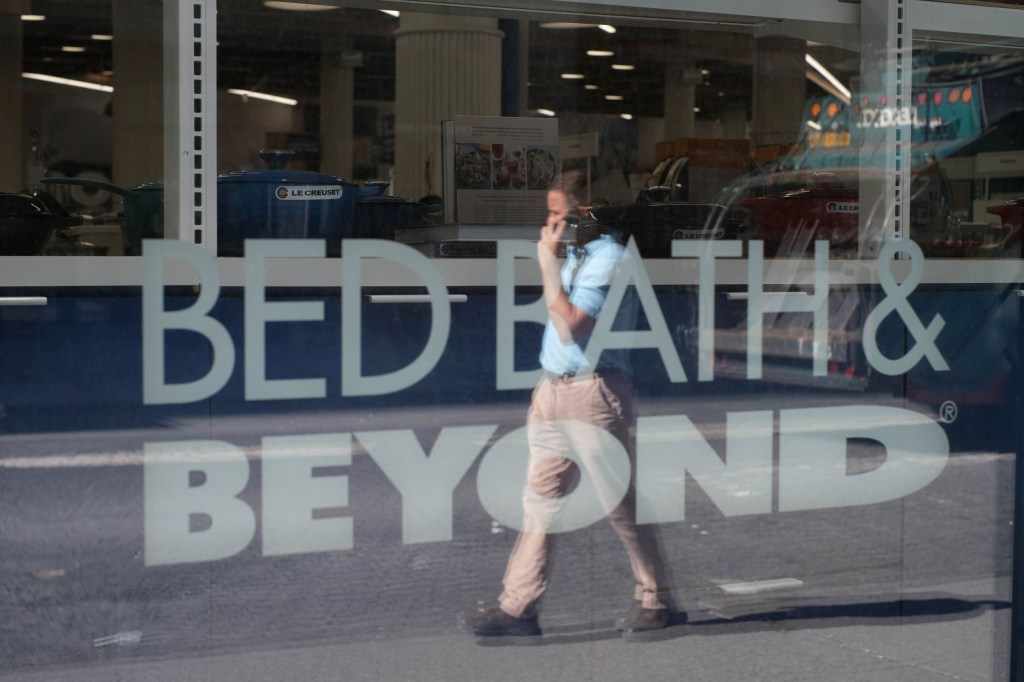
Bed Bath & Beyond was founded in 1971 by Warren Eisenberg and Leonard Feinstein. As the name indicates, it has focused on selling household goods—sometimes called “home goods”—such as small appliances, towels, and sheets. It was perhaps best known for mailing massive numbers of 20 percent off coupons, printed on thin blue cardboard and nicknamed Big Blue, to households nationwide. Although by 2019, the firm was operating more than 1,500 stores in the United States, some investors were concerned that Bed Bath & Beyond could be run more profitably. In March 2019, the firm’s board of directors replaced the current CEO with Mark Tritton who had helped make Target stores very profitable.
In an approach similar to the one Ron Johnson had used at J.C. Penney, Tritton cut back on the number of coupons sent out, reorganized the stores to reduce the number of different products available for sale, and replaced some name brand goods with so-called private-label brands produced by Bed Bath & Beyond. Unfortunately, Tritton’s strategy was a failure and the firm, which had been profitable in 2018, suffered losses each year between 2019 and 2022. The losses totaled almost $1.5 billion. In June 2022, the firm’s board of directors replaced Tritton with Sue Grove who had been serving on the board.
Why did Tritton’s strategy fail? Partly because in March 2020, the effects of the Covid-19 pandemic forced the closure of many Bed Bath & Beyond stores. Unlike some other chains, Bed Bath & Beyond’s web site struggled to fulfill online orders. The firm also never developed a system that would have made it easy for customers to order goods online and pick them up at the curb of their retail stores. That approach helped many competitors maintain sales during the pandemic. Covid-19 also disrupted the supply chains that Tritton was depending on to produce the private-label brands he was hoping to sell in large quantities.
But the larger problems with Tritton’s strategy would likely have hurt Bed Bath & Beyond even if there had been no pandemic. Tritton thought the stores were too cluttered, particularly in comparison with Target stores, so he reduced the number of products for sale. It turned out, though, that many of Bed Bath & Beyond’s most loyal customers liked searching through the piles of goods on the shelves. One customer was quoted as saying, “I used to find so many things that I didn’t need, that I’d end up buying anyway, like July 4th-themed corn holders.” Customers who preferred to shop in less cluttered stores were likely to already be shopping elsewhere. And it turned out that many Bed Bath & Beyond customers preferred national brands and switched to shopping elsewhere when Tritton replaced those brands with private-label brands. Finally, many customers were accustomed to shopping at Bed Bath & Beyond shortly after receiving a Big Blue 20 percent off coupon. Sending out fewer coupons meant fewer trips to Bed Bath & Beyond by those customers.
In a manner similar to what happened to Johnson in his overhaul of the Penney department stores, Tritton’s changes to Bed Bath & Beyond’s business model caused many existing customer to shop elsewhere while attracting relatively few new customers. An article in the Wall Street Journal quoted an industry analyst as concluding: “Mark Tritton entered the business and ripped up its playbook. But the strategy he replaced it with was not tested and nowhere near sharp enough to compensate for the loss of traditional customers.”
Sources: Jeanette Neumann, “Bed Bath & Beyond Traced an Erratic Path to Its Current Crisis,” bloomberg.com, September 29, 2022; Kelly Tyko, “What to expect at Bed Bath & Beyond closing store sales,” axios.com September 22, 2022; Inti Pacheco and Jodi Xu Klein, “Bed Bath & Beyond to Close 150 Stores, Cut Staff, Sell Shares to Raise Cash,” Wall Street Journal, August 31, 2022; Suzanne Kapner and Dean Seal, “Bed Bath & Beyond CEO Mark Tritton Exits as Sales Plunge,” Wall Street Journal, June 29, 2022; Suzanne Kapner, “Bed Bath & Beyond Followed a Winning Playbook—and Lost,” Wall Street Journal, July 23, 2022; and Ron Lieber, “An Oral History of the World’s Biggest Coupon,” New York Times, November 3, 2021.
As we discuss in Microeconomics and Economics, Chapter 5, Section 5.3, carbon dioxide (CO2) emissions contribute to climate change, including the increases in temperatures that have been experienced worldwide. We’ve found that students are interested in seeing U.S. CO2 emissions in a global context.
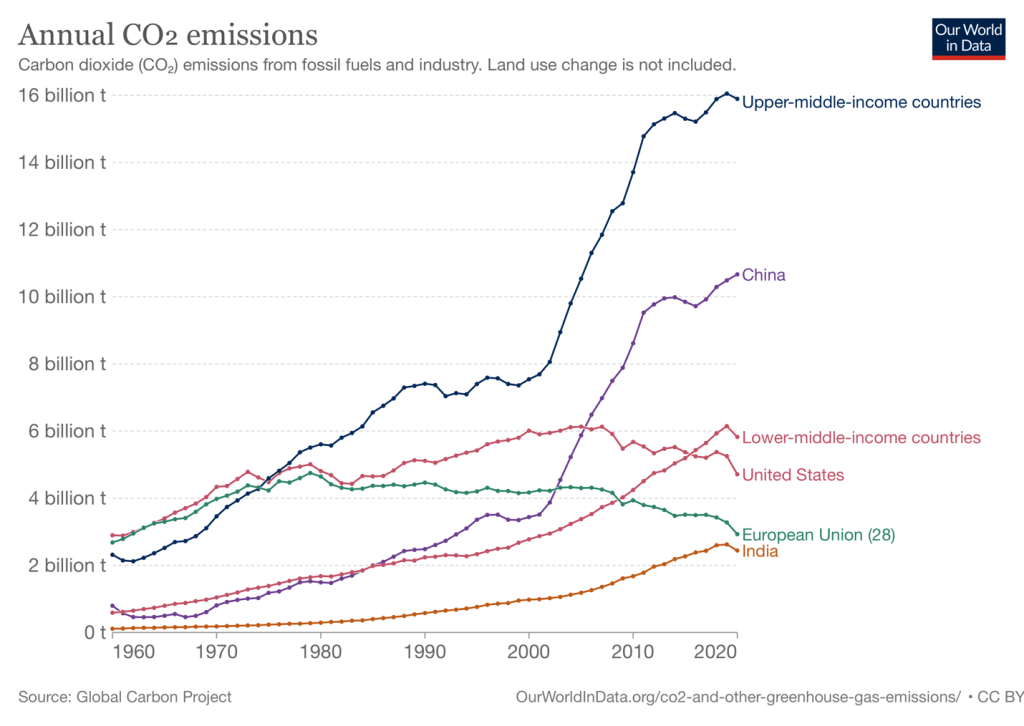
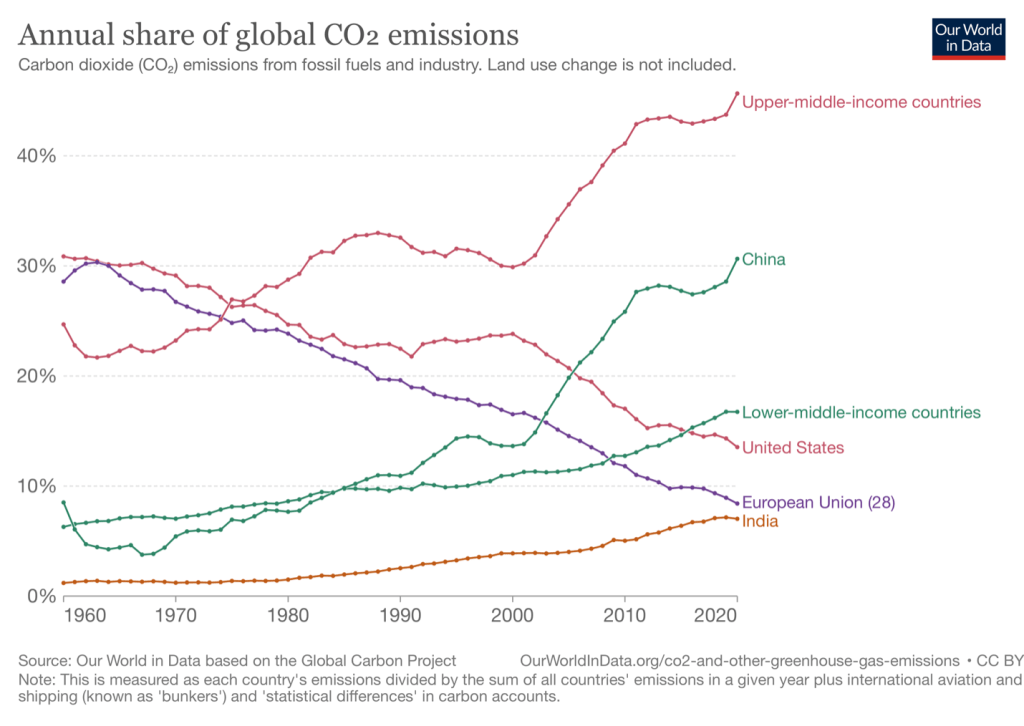
The first of the following figures shows for the years 1960 to 2020, the total amount of CO2 emissions by the United States, China, India, the 28 countries in the European Union, lower-middle-income countries (including India, Nigeria, and Vietnam), and upper-middle-income countries (including China, Brazil, and Argentina). The second of the figures shows the percentage of total world CO2 accounted for by each of the three individual countries and by the indicated groups of countries. in the United States and in the countries of the European Union both total emissions and the percentage of total world emissions have been declining over the past 15 years. Emissions have been increasing in China, India, and in middle-income countries. The figures are from the Our World in Data website (ourworldindata.org). (Note that the reductions in emissions during 2020 largely reflect the effects of the slowdown in economic activity as a result of the Covid-19 pandemic rather than long-term trends in emissions.)
Governments in many countries have attempted to slow the pace of climate change by enacting policies to reduce CO2emissions. (According to estimates by the U.S. Environmental Protection Agency, CO2 accounts for about 76 percent of all emissions worldwide of greenhouse gases that contribute to climate change. Methane and nitrous oxide, mainly from agricultural activity, make up most of the rest of greenhouse gas emissions.) In August 2022, Congress and President Biden enacted additional measures aimed at slowing climate change. Included among these measures were government subsidies to firms and households to use renewable energy such as rooftop solar panels, tax rebates for some buyers of certain electric vehicles, and funds for utilities to develop power sources such as wind and solar that don’t emit CO2. The measures have been estimated to reduce U.S. greenhouse gas emissions by somewhere between 6 percent and 15 percent. Because the United States is responsible for only about 14 percent of annual global greenhouse gas emissions, the measures would likely reduce global emissions by only about 2 percent.
The figures shown above make this result unsurprising. Because the United States is the source of only a relatively small percentage of global greenhouse emissions, reductions in U.S. emissions can result in only small reductions in global emissions. Although many policymakers and economists believe that the marginal benefit from these reductions in U.S. emissions exceed their marginal cost, the reductions can’t by themselves do more than slow the rate of climate change. A key reason that India, China, and other middle income countries have accounted for increasing quantities of greenhouse gases is that they rely much more heavily on burning coal than do the United States, the countries in the European Union, and other high-income countries. Utilities switching to generating electricity by burning coal rather than by burning natural gas has been a key source of reductions in greenhouse gas emissions in the United States.
The two figures above measure a country’s contribution to CO2 emissions by looking at the quantity of emissions generated by production within the country. But suppose instead that we look at the quantity of CO2 emitted during the production of the goods consumed within the country? In that case, we would allocate to the United States CO2 emitted during the product of a good, such as a television or a shirt, that was produced in China or another foreign country but consumed in the United States.
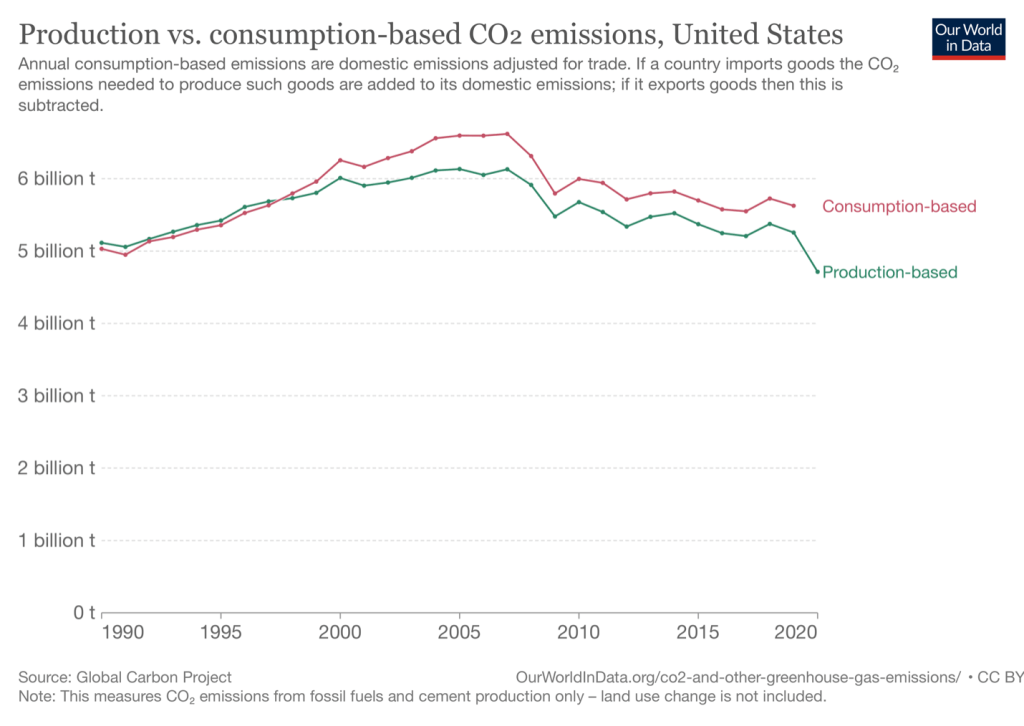
For the United States, as the following figure shows it makes only a small difference whether we measure CO2emissions on the basis of production of goods and services or on the basis of consumption of goods and services. U.S. emissions of CO2 are about 7 percent higher when measured on a consumption basis rather than on a production basis. By both measures, U.S. emissions of CO2 have been generally declining since about 2007. (1990 is the first year that these two measures are available.)
Sources: Hannah Ritchie, Max Roser and Pablo Rosado, “CO₂ and Greenhouse Gas Emissions,” OurWorldInData.org, https://ourworldindata.org/co2-and-other-greenhouse-gas-emissions; Greg Ip, “Inflation Reduction Act’s Real Climate Impact Is a Decade Away,” Wall Street Journal, August 24, 2022; Lisa Friedman, “Democrats Designed the Climate Law to Be a Game Changer. Here’s How,” New York Times, August 22, 2022; Hannah Ritchie, “How Do CO2 Emissions Compare When We Adjust for Trade?” ourworldindata.org, October 7, 2019; and United States Environmental Protection Agency, “Global Greenhouse Gas Emissions Data,” epa.gov, February 22, 2022.
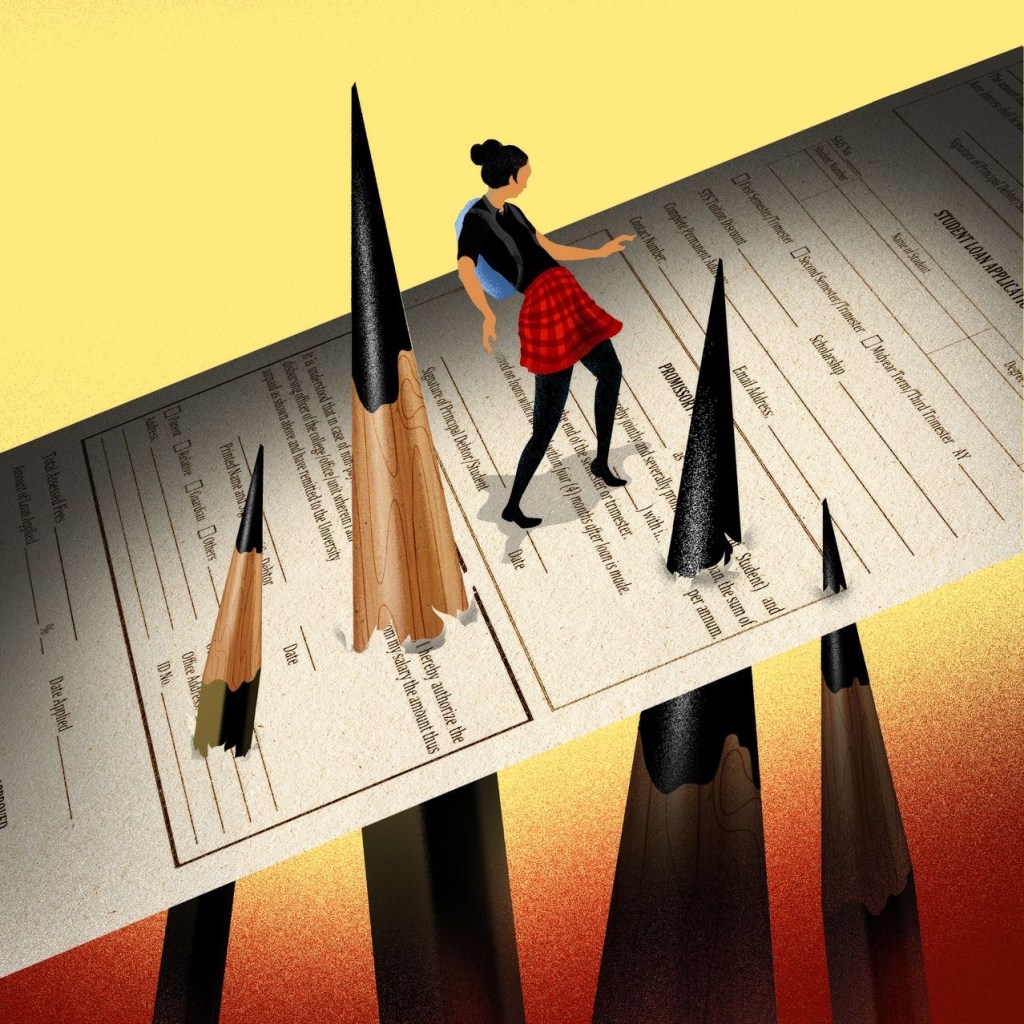
In Chapter 1, Section 1.1, one of our three key economic ideas is that people respond to economic incentives. Government policy can change the economic incentives that people face. Sometimes a government policy can have unintended consequences because it changes economic incentives in a way that policymakers didn’t anticipate. Some economists argue that this was the case with the Biden administration’s decision to change the federal student loan program.
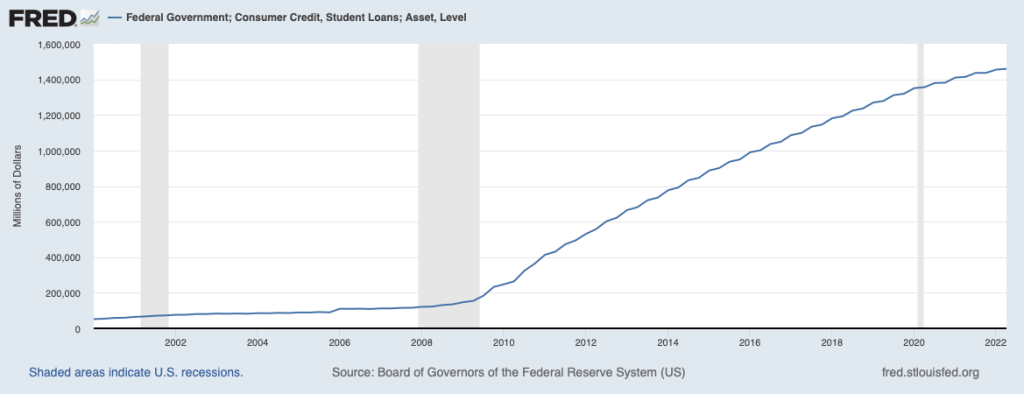
In recent years, college students and their parents have rapidly increased their loan debt. The following figure shows the total value of outstanding student loans beginning in 2000. Student loan debt increased from about $52 billion in 2000 to about $1.6 trillion in 2022. Or, put another way, for every dollar of loan debt students and their parents owed in 2000, they owed more than 27 dollars of debt in 2022. In 2022, the average borrower owed about $37,000.
During the Covid–19 pandemic, the Trump and Biden administrations allowed people with student loans to suspend making payments on them. The payment moratorium began March 31, 2020 and is scheduled to end on December 31, 2022. Student loan payments are often the largest item in the budgets of recent college graduates. Some economists argue that the need to make student loan payments has made it harder for young adults to accumulate the down payments necessary to buy homes. As a result, young adults are likely to delay forming families, thereby reducing their need to move from an apartment to a house. In 1967, about 83 percent of people aged 25 to 34 lived with a spouse or partner, while in 2021 only about 54 percent did.
Some economists doubt that student loan debt explains the delay in young adults forming families and buying houses. But many policymakers have seen reducing the burden of student loan debt on young adults as an important issue. In August 2022, President Joe Biden announced a plan under which individuals earning less than $125,000 per year would have up to $10,000 in student loan debt cancelled. Borrowers with Pell grants would have up to another $10,000 cancelled. A second part of the plan involved changes to the federal government’s income-driven repayment (IDR) program. As a result of these changes, lower and middle-income student loan borrowers will be able to more easily have their loan balances canceled. With some exceptions, borrowers who have loans of $12,000 or less will have their loans canceled after making payments for 10 years, rather than the current 20 years. The annual payments for most borrowers using the IDR program will be lowered to 5 percent of their income above about $33,000 per year, rather than the previous 10 percent.
Some policymakers objected to President Biden’s plan, arguing that it was unconstitutional because it was the result of a presidential executive order rather than the result of Congressional legislation. Many economists focused on a different potential problem with the plan: the economic incentives that might result from the changes to the IDR program. The intention of these changes was to reduce the burden on people who currently have student loans, but the changes also affected the economic incentives facing students applying for loans and colleges in deciding the level of tuition to charge.
In an article on the Brookings Institution website, Adam Looney, a professor of finance at the University of Utah, argued that because of the changes to the IDR program, the typical college student could expect to pay back only about 50 percent of the amount borrowed. Before the changes, the Congressional Budget Office had estimated that the typical student would end up paying more than 100 percent of the amount borrowed because the student would have to pay interest on the loan amount. Looney argues that students and their parents will have an incentive to borrow more because they will expect to pay back only half of the amount borrowed. In particular, he notes:
“A large share of student debt is not used to pay tuition, but is given to students in cash for rent, food, and other expenses…. While students certainly need to pay rent and buy food while in school, under the administration proposal a student can borrow significant amounts for ‘living expenses,’ deposit the check in a bank account, and not pay it all back…. Some people will use loans like an ATM, which will be costly for taxpayers and is certainly not the intended use of the loans.”
Sylvain Catherine, a professor of finance at the University of Pennsylvania’s Wharton School, makes a similar argument: “How can we not anticipate the distortionary effects of such a policy? Student will be encouraged to take more debt since they will not have to repay the marginal dollar, and colleges will have an incentive to further increase tuition.” An article in the New York Times noted that taxpayers will be responsible for the value of student loans that aren’t paid back: “By offering more-generous educational subsidies, the government may be creating a perverse incentive for both schools and borrowers, who could begin to pay even less attention to the actual price tag of their education—and taxpayers could be left footing more of the bill.”
It’s too early to judge the extent to which students, their families, and colleges will react to the changed incentives in President Biden’s student debt relief plan. But because the plan changes economic incentives, it may result in consequences not intended by President Biden and his advisers. (Note that the lawsuits challenging the plan’s constitutionality have also not yet been resolved.)
Sources: Adam Looney, “Biden’s Income-Driven Repayment Plan Would Turn Student Loans into Untargeted Grants,” brookings.edu, September 15, 2022; Gabriel T. Rubin and Amara Omeokwe, “Biden’s Student-Debt-Forgiveness Plan May Cost Up to $1 Trillion, Challenging Deficit Goals,” Wall Street Journal, September 5, 2022; Stacey Cowley, “Student Loan Subsidies Could Have Dangerous, Unintended Side Effects,” New York Times, September 19, 2022; Ron Lieber, “Why Aren’t Student Loans Simple? Because This Is America,” New York Times, September 3, 2022; Congressional Budget Office, “Federal Student Loan Programs, Baseline Projections,” May 2022; U.S. Census Bureau, “Historical Living Arrangements of Adults,” Table AD-3, November 2021; and Federal Reserve Bank of St. Louis FRED data set.
Supports: Microeconomics, Chapter 6, Section 6.3 and Chapter 10, Section 10.3, Economics Chapter 6, Section 6.3 and Chapter 10, Section 10.3, and Essentials of Economics, Chapter 7, Section 7.4 and Section 7.7.
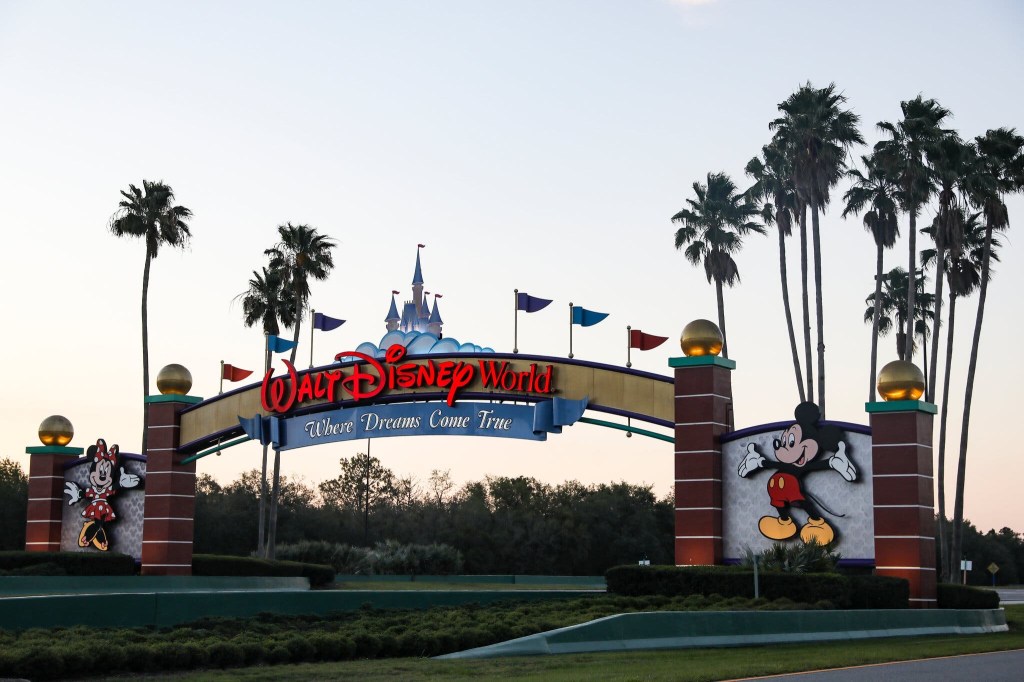
In August 2022, an article in the Wall Street Journal discussed the Disney Company increasing the prices it charges for admission to its Disneyland and Walt Disney World theme parks. As a result of the price increases, “For the quarter that ended July 2 [2022], the business unit that includes the theme parks … posted record revenue of $5.42 billion and record operating income of $1.65 billion.” The increase in revenue occurred even though “attendance at Disney’s U.S. parks fell by 17% compared with the previous year….”
The article also contains the following observations about Disney’s ticket price increases:
“Disney’s theme-park pricing is determined by ‘pure supply and demand,’ said a company spokeswoman.”
“[T]he changes driving the increases in revenue and profit have drawn the ire of what Disney calls ‘legacy fans,’ or longtime parks loyalists.”
Briefly explain what must be true of the demand for tickets to Disney’s theme parks if its revenue from ticket sales increased even though 17 percent fewer tickets were sold. [For the sake of simplicity, ignore any other sources of revenue Disney earns from its theme parks apart from ticket sales.]
In Chapter 10, Section 10.3 the textbook discusses social influences on decision making, in particular, the business implications of fairness. Briefly discuss whether the analysis in that section is relevant as Disney determines the prices for tickets to its theme parks.
Solving the Problem
Step 1: Review the chapter material. This problem is about the effects of price increases on firms’ revenues and on whether firms should pay attention the possibility that consumers might be concerned about fairness when making their consumption decisions, so you may want to review Chapter 6, Section 6.3, “The Relationship between Price Elasticity of Demand and Total Revenue” and Chapter 10, Section 10.3, “Social Influences on Decision Making,” particularly the topic “Business Implications of Fairness.”
Step 2: Answer part a. by explaining what must be true of the demand for tickets to Disney’s theme parks if revenue from ticket sales increased even though Disney sold fewer tickets. Assuming that the demand curve for tickets to Disney’s theme parks is unchanged, a decline in the quantity of tickets sold will result in a move up along the demand curve for tickets, raising the price of tickets. Only if the demand curve for theme park tickets is price inelastic will the revenue Disney receives from ticket sales increase when the price of tickets increases. Revenue increases in this situation because with an inelastic demand curve, the percentage increase in price is greater than the percentage decrease in quantity demanded.
Step 3: Answer part b. by explaining whether the textbook’s discussion of the business implications of fairness is relevant as Disney as determines ticket prices. Section 10.3 may be relevant to Disney’s decisions because the section discusses that firms sometimes take consumer perceptions of fairness into account when deciding what prices to charge. Note that ordinarily economists assume that the utility consumers receive from a good or service depends only on the attributes of the good or service and is not affected by the price of the good or service. Of course, in making decisions on which goods and services to buy with their available income, consumers take price into account. But consumers take price into account by comparing the marginal utilities of products realtive to their prices, with the marginal utilities assumed not to be affected by the prices.
In other words, a consumer considering buying a ticket to Disney World will compare the marginal utility of visiting Disney World relative to the price of the ticket to the marginal utility of other goods and services relative to their prices. The consumer’s marginal utility from spending a day in Disney World will not be affected by whether he or she considers the price of the ticket to be unfairly high.
The textbook gives examples, though, of cases where a business may fail to charge the price that would maximize short-run profit because the business believes consumers would see the price as unfair, which might cause them to be unwilling to buy the product in the future. For instance, restaurants frequently don’t increase their prices during a particularly busy night, even though doing so would increase the profit they earn on that night. They are afraid that if they do so, some customers will consider the restaurants to have acted unfairly and will stop eating in the restaurants. Similarly, the National Football League doesn’t charge a price that would cause the quantity of Super Bowl tickets demanded to be equal to the fixed supply of seats available at the game because it believes that football fans would consider it unfair to do so.
The Wall Street Journal article quotes a Disney spokeswomen as saying that the company sets the price of tickets according to demand and supply. That statement seems to indicate that Disney is charging the price that will maximize the short-run profit the company earns from selling theme park tickets. But the article also indicates that many of Disney’s long-time ticket buyers are apparently upset at the higher prices Disney has been charging. If these buyers consider Disney’s prices to be unfair, they may in the future stop buying tickets.
In other words, it’s possible that Disney might find itself in a situation in which it has increased its profit in the short run at the expense of its profit in the long run. The managers at Disney might consider sacrificing some profit in the long run to increase profit in the short run an acceptable trade-off, particularly because it’s difficult for the company to know whether in fact many of its customers will in the future stop buying admission tickets because they believe current ticket prices to be unfairly high.
Sources: Robbie Whelan and Jacob Passy, “Disney’s New Pricing Magic: More Profit From Fewer Park Visitors,” Wall Street Journal, August 27, 2022.
As we discuss in Microeconomics and Economics, Chapter 15, Section 15.6, the U.S. Department of Justice’s Antitrust Division and the Federal Trade Commission have merger guidelines that they typically follow when deciding whether to oppose a merger between two firms in the same industry—these mergers are called horizontal mergers. The guidelines are focused on the effect a potential merger would have on market price of the industry’s output. We know that if the price in a market increases, holding everything else constant, consumer surplus will decline and the deadweight loss in the market will increase. But, as we note in Chapter 15, if a merger increases the efficiency of the merged firms, the result can be a decrease in costs that will lower the price, increase consumer surplus, and reduce the deadweight loss.
The merger guidelines focus on the effect of two firms combining on the merged firms’ market power in the output market. For example, if two book publishers merge, what will be the effect on the price of books? But what if the newly merged firm gains increased market power in input markets and uses that power to force its suppliers to accept lower prices? For example, if two book publishers merge will they be able to use their market power to reduce the royalties they pay to writers? The federal antitrust authorities have traditionally considered market power in the output market—sometimes called monopoly power—but rarely considered market power in the input market—sometimes called monopsony power.
In Chapter 16, Section 16.6, we note that a pure monopsony is the sole buyer of an input, a rare situation that might occur in, for example, a small town in which a lumber mill is the sole employer. A monopoly in an output market in which a single firm is the sole seller of a good is also rare, but many firms have some monopoly power because they have the ability to charge a price higher than marginal cost. Similarly, although monopsonies in input markets are rare, some firms may have monopsony power because they have the ability to pay less than the competitive equilibrium price for an input. For example, as we noted in Chapter 14, Section 14.4, Walmart is large enough in the market for some products, such as detergent and toothpaste, that it is able to insist that suppliers give it discounts below what would otherwise be the competitive price.
Monopsony power was the key issue involved in November 2021 when the Justice Department filed an antitrust lawsuit to keep the book publisher Penguin Random House from buying Simon & Schuster, another one of the five largest publishers. The merged firm would account for 31 percent of books published in the U.S. market. The lawsuit alleged that buying Simon & Schuster would allow “Penguin Random House, which is already the largest book publisher in the world, to exert outsized influence over which books are published in the United States and how much authors are paid for their work.”
We’ve seen that when two large firms propose a merger, they often argue that the merger will allow efficiency gains large enough to result in lower prices despite the merged firm having increased monopoly power. In August 2022, during the antitrust trial over the Penguin–Simon & Schuster merger, Markus Dohle, the CEO of Penguin made a similar argument, but this time in respect to an input market—payments to book authors. He argued that because Penguin had a much better distribution network, sales of Simon & Schuster books would increase, which would lead to increased payments to authors. Authors would be made better off by the merger even though the newly merged firm would have greater monopsony power. Penguin’s attorneys also argued that the market for book publishing was larger than the Justice Department believed. They argued that the relevant book market included not just the five largest publishers but also included Amazon and many medium and small publishers “all capable of competing for [the right to publish] future titles from established and emerging authors.” The CEO of Hachette Book Group, another large book publisher, disagreed, arguing at the trial that the merger between Penguin and Simon & Schuster would result in lower payments to authors.
The antitrust lawsuit against Penguin and Simon & Schuster was an example of the more aggressive antitrust policy being pursued by the Biden administration. (We discussed the Biden administration’s approach to antitrust policy in this earlier blog post.) An article in the New York Times quoted a lawyer for a legal firm that specializes in antitrust cases as arguing that the lawsuit against Penguin and Simon & Schuster was unusual in that the lawsuit “declines to even allege the historically key antitrust harm—increased prices.” The outcome of the Justice Department’s lawsuit against Penguin and Simon & Schuster may provide insight into whether federal courts will look favorably on the Biden administration’s more aggressive approach to antitrust policy.
Sources: Jan Wolfe, “Penguin Random House CEO Defends Publishing Merger at Antitrust Trial,” Wall Street Journal, August 4, 2022; David McCabe, “Justice Dept. and Penguin Random House’s Sparring over Merger Has Begun,” New York Times, August 1, 2022; Eduardo Porter, “A New Legal Tactic to Protect Workers’ Pay,” New York Times, April 14, 2022; Janet H. Cho and Karishma Vanjani, “Justice Department Seeks to Block Penguin Random House Buy of Viacom’s Simon & Schuster,” barrons.com, November 2, 2021; United States Department of Justice, “Justice Department Sues to Block Penguin Random House’s Acquisition of Rival Publisher Simon & Schuster,” justice.gov, November 2, 2021;
Buying athletic shoes and reselling them for a higher price has become a popular way for some people to make money. The mostly young entrepreneurs involved in this business are often called sneakerheads. Note that economists call buying a product at a low price and reselling it at a high price arbitrage. The profits received from engaging in arbitrage are called arbitrage profits. One estimate puts the total value of sneakers being resold at $2 billion per year.
Why would anybody buy sneakers from a sneakerhead that they could buy at a lower price online or from a retail store? Most people wouldn’t, which is why most sneakerheads resell only shoes that shoe manufacturers like Nike or Adidas produce in limited quantities—typically fewer than 50,000 pairs. To obtain the shoes, shoe resellers use two main strategies: (1) waiting in line at retail stores on the day that a new limited quantity shoe will be introduced, or (2) buying shoes online using a software application called a bot. A bot speeds up a buyer’s checkout process for an online sale. Typical customers buying at an online shoe site take a few minutes to choose a size, fill in their addresses, and provide their credit card information. But a few minutes is enough time for shoe resellers using bots to buy all of the newly-released shoes available on the site.
In addition to reselling shoes on their own sites, many sneakerheads use dedicated resale sites like StockX and GOAT. These sites have greatly increased the liquidity of sneakers, or the ease with which sneakers can be resold. In effect, limited-edition sneakers have become an asset like stocks, bonds, or gold because they can be bought and sold in the secondary market that exists on the online resale sites. (We discuss the concepts of primary and secondary markets for assets in Macroeconomics, Chapter 6, Section 6.2 and in Microeconomics and Economics, Chapter 8, Section 8.2.)
An article in the New York Times gives an example of the problems that bots can cause for retail shoe stores. Bodega, a shoe store in Boston, offered the limited-edition New Balance 997S sneaker on its online site. Ten minutes later, the shoe was sold out. One of the store’s owner was quoted as saying: “We got destroyed by bots. It was making it impossible for our average customers to even have a shot at the shoes.” Although the store had a policy of allowing customers to buy a maximum of three pairs of shoes, shoe resellers were able to get around the policy by having shoes shipped to their friends’ addresses or by having a group of people coordinate their purchases. An article on bloomberg.com described how one reseller along with 15 of his friends used bots to buy 600 pairs of Adidas’s Yeezy sneakers from an online site on the morning the sneakers were released. Adidas has a rule that each customer can buy only one pair of its limited-edition shoes, but the company has trouble enforcing the rule.
Shopify and other firms have developed software that retailers can use to make it difficult for resellers to use bots on the retailers’ sites. But the developers of bot software have often been able to modify the bots to get around the defenses used by the anti-bot software.
In contrast with owners of retail stores, Nike, Adidas, New Balance, and the other shoe manufacturers have a more mixed reaction to sneakerheads using bots scooping up most pairs of limited-edition shoes shortly after the shoes are released. Like the owners of retail stores, the shoe manufacturers know that they risk upsetting the typical customer if the customer can only buy hot new shoe releases from resellers at prices well above the original retail price. But an active resale market increases the demand for shoes, just as individual investors increased their demand for individual stocks when it became possible to easily buy and sell stocks online using sites like TD Ameritrade, E*Trade, and Fidelity. So manufacturers benefit from knowing that most of their limited-edition shoes will sell out. One industry analyst singled out “The durability of Nike’s … ability to fuel the sneaker resale ecosystem ….” as a particular strength of the company. In addition, manufacturers may believe that the publicity about limited edition shoes rapidly selling out may spill over to increased demand for other shoes the manufacturers sell. (In Microeconomics and Economics, Chapter 10, Section 10.3 we note that some consumers may receive utility from buying goods that are widely seen as popular and fashionable.)
In the long run, is it possible for sneakerheads to make a profit reselling shoes? It seems unlikely for the reasons we discuss in Microeconomics and Economics, Chapter 12, Section 12.5. The barriers to entry in reselling sneakers are very low. Anyone can list shoes for sale on StockX or one of the other resale sites. Waiting in line in front of a retail store on the day a new shoe is released is something that anyone who is willing to accept the opportunity cost of the time lost can do. Similarly, bots that can be used to scoop up newly released shoes from online sites are widely available for sale. So, we would expect that in the long run entry into sneaker reselling will compete away any economic profit that sneakerheads were earning.
In fact, by the summer of 2022, prices on reselling sites were falling. In just the month of June, the average price of sneakers listed on StockX declined by 20 percent. Resellers who had stockpiled shoes waiting for prices to increase were instead selling them because they feared that prices would go even lower. And new limited-edition shoes were taking longer to sell out. According to an article in the Wall Street Journal, “A pair of Air Jordans released on July 13 [2022] that might have once vanished in minutes took days to sell out from Nike Inc.’s virtual shelves.” One reseller quoted in the Wall Street Journal article indicated that entry was the reason that prices were falling: “You don’t want prices to go down, but they’re going down anyways, just because of how many people are selling in general.”
Although a seemingly unusual market, sneaker reselling is subject to the same rules of competition that we see in other markets.
Sources: Inti Pacheco, “Flipping Air Jordans Is No Longer a Slam Dunk,” Wall Street Journal, July 23, 2022; Shoshy Ciment, “Sneaker Reselling Side Hustle: Your Guide to Making Thousands Flipping Hyped Pairs of Dunks, Jordans, and Yeezys,” businessinsider.com, May 3, 2022; Teresa Rivas, “A Strong Sneaker-Resale Market Is Another Boon for Nike,” barrons.com, May 24, 2022; Curtis Bunn, “Sneakers Are So Hot, Resellers Are Making a Living Off of Coveted Models,” nbcnews.com, October 23, 2021; Daisuke Wakabayashi, “The Fight for Sneakers,” New York Times, October 15, 2021; and Joshua Hunt, “Sneakerheads Have Turned Jordans and Yeezys Into a Bona Fide Asset Class,” bloomberg.com, February 15, 2021.
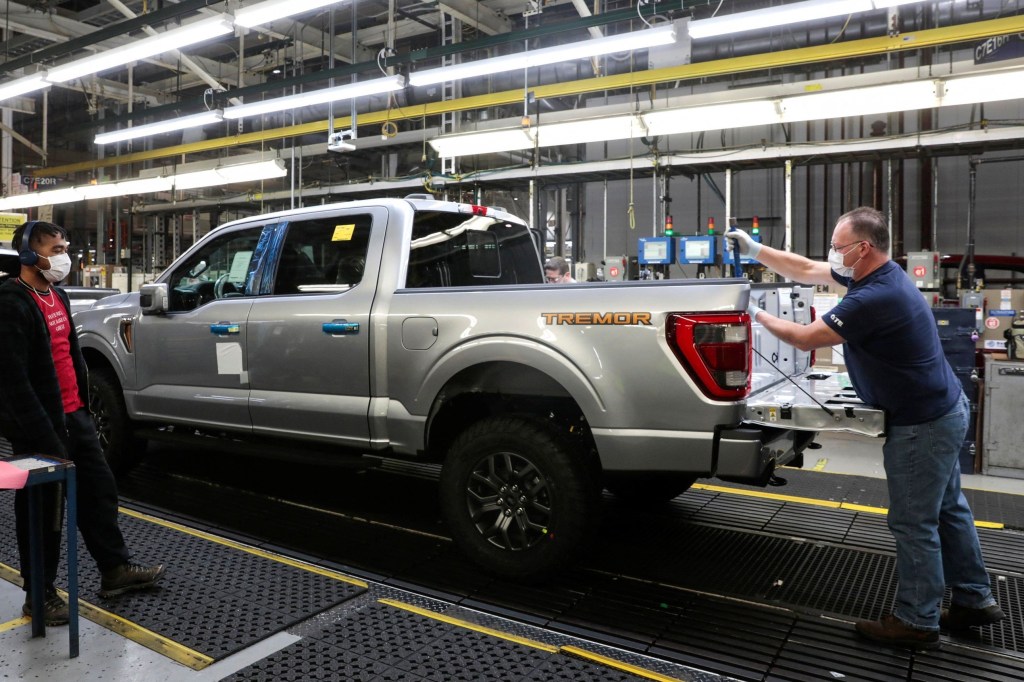
Production line for Ford F-series trucks. Photo from the Wall Street Journal.
Supports: Microeconomics, Chapter 6, Section 6.3 and Chapter 15, Section 15.6,Economics Chapter 6, Section 6.3 and Chapter 15, Section 15.6, and Essentials of Economics, Chapter 7, Section 7.7 and Chapter 10, Section 10.5.
In July 2022, an article in the Wall Street Journal noted that “The chip shortage and broader supply constraints have hampered vehicle production … Many major car companies on Friday reported U.S. sales declines of 15% or more for the first half of the year.” But the Wall Street Journal also reported that car makers were experiencing increases in revenues. For example, Ford Motor Company reported an increase in revenue even though it had sold fewer cars than during the same period in 2021.
Briefly explain what must be true of the demand for new cars if car makers can sell 15 percent fewer cars while increasing their revenue.
Eventually, the chip shortage and other supply problems facing car makers will end. At that point, would we expect that car makers will expand production to prepandemic levels or will they continue to produce fewer cars in order to maintain higher levels of profits? Briefly explain.
Solving the Problem
Step 1: Review the chapter material. This problem is about the effects of price increases on firms’ revenues and on the ability of firms to restrict output in order increase profits, so you may want to review Chapter 6, Section 6.3, “The Relationship between Price Elasticity of Demand and Total Revenue” and Chapter 15, Section 15.6, “Government Policy toward Monopoly.”
Step 2: Answer part a. by explaining what must be true of the demand for new cars if car makers are increasing their profits while selling fewer cars. Assuming that the demand curve for cars is unchanged, a decline in the quantity of cars sold will result in a move up along the demand curve for cars, raising the price of cars. Only if the demand curve for new cars is price inelastic will the revenue car markers receive increase when the price increases. Revenue increases in this situation because with an inelastic demand curve, the percentage increase in price is greater than the percentage decrease in quantity demanded.
Step 3: Answer part b. by explaining whether we should expect that once the car industry’s supply problems are resolved, car makers will continue to produce fewer cars. Although as a group car makers would be better off if they could continue to reduce the supply of cars, they are unlikely to be able to do so. Any one car maker that decided to keep producing fewer cars would lose sales to other car makers who increased their production to prepandemic levels. Because this increased production would result in a movement down along the demand curve for new cars, the price would fall. So a car maker that reduced output would receive a lower price on its reduced output, causing its profit to decline. (Note that this situation is effectively a prisoner’s dilemma as discussed in Chapter 14, Section 14.2.)
The firms could attempt to keep output of new cars at a low level by explicitly agreeing to do so. But colluding in this way would violate the antitrust laws, and executives at the firms would risk being fined or even imprisoned. The firms could attempt to implicitly collude by producing lower levels of output without explicitly agreeing to do so. (We discus implicit collusion in Chapter 14, Section 14.2.) But implicit collusion is unlikely to succeed because firms have an incentive to break an implicit agreement by increasing output.
We can conclude that once the chip and other supply problems facing car makers are resolved, production of cars is likely to increase.
Sources: Mike Colias and Nora Eckert, “GM Says Unfinished Cars to Hurt Quarterly Results,” Wall Street Journal, July 1, 2022; and Nora Eckert, “Ford’s U.S. Sales Increase 32% in June, Outpacing Broader Industry,” Wall Street Journal, July 5, 2022.
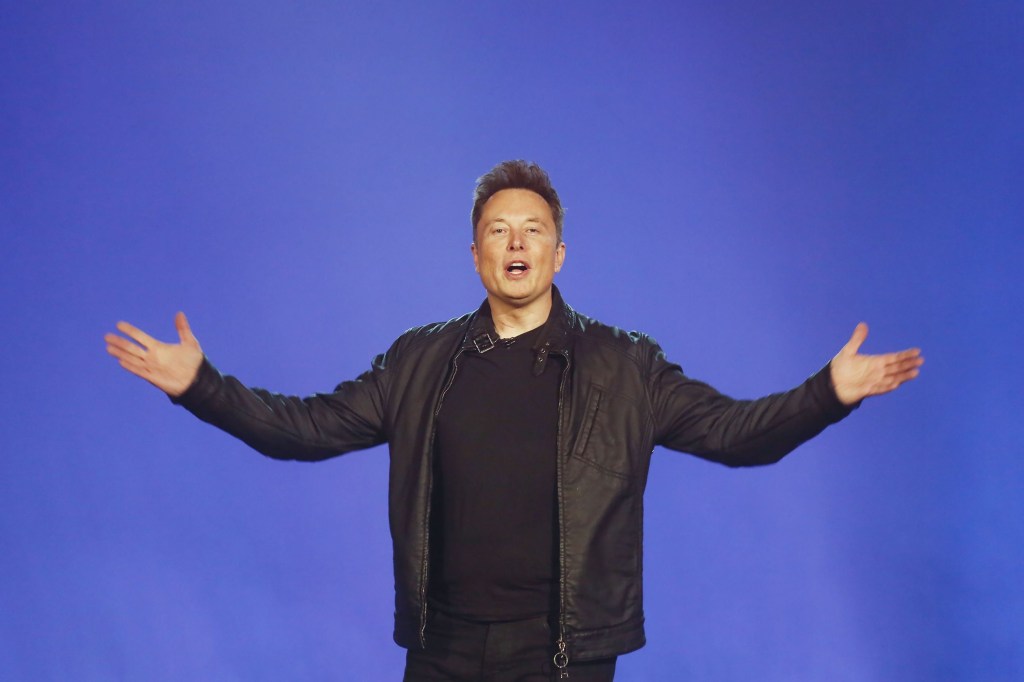
That’s what Elon Musk did in April 2022. In early April, Musk purchased about 9% of Twitter’s shares. On April 25, he became the owner of Twitter by buying the roughly 90% remaining shares for $54.20 per share. The total he paid for these remaining shares came to $44 billion. Following his often unorthodox style, Musk announced his plans in a tweet on Twitter. Where did he get the money to fund such a large purchase?
According to Forbes magazine, in March 2022, Musk was by far the richest person in the world with total wealth of about $270 billion—nearly $100 billion more than Amazon founder Jeff Bezos, who is the second-richest person. While it appears that Musk could afford to buy Twitter without having to borrow any money, Bloomberg estimated that in April 2022 Musk had only $3 billion in cash. Much of his wealth was in Tesla stock or his ownership shares in SpaceX and the Boring Company, both of which are private companies that, therefore, don’t have publicly traded stock. Musk was reluctant to fund all of his offer for Twitter by selling Tesla stock or finding investors willing to buy into SpaceX and Boring.
Musk turned to investment banks to help him raise the necessary funds. Investment banks, such as Goldman Sachs, differ from commercial banks in that they don’t accept deposits, and they rarely lend directly to households. Instead, investment banks have traditionally concentrated on providing advice to firms issuing stocks and bonds or to firms (and billionaires!) who are looking for ways to finance mergers or acquisitions. A syndicate of investment banks, including Morgan Stanley (which served as Musk’s lead adviser), Bank of America, Barclays, and what an article in the Wall Street Journal described as “nearly every global blue-chip investment bank aside from the two [Goldman Sachs and JP Morgan Chase] advising Twitter,” put together the following financing package. Initially, Musk wanted to raise $46.5 billion in financing—more than in the end he needed. Of that amount, Musk would provide $21 billion and the investment banks would provide loans for the remaining $25.5 billion. As collateral for the loans, Musk pledged $60 billion of his Tesla stock.
Musk’s financing was a combination of equity—the $21 billion in cash—and debt—the $25.5 billion in loans from investment banks. To fund his equity investment, he was considering selling some of his stock in Tesla but hoped to attract other equity investors who would put up cash in exchange for part ownership of Twitter. According to press reports, Apollo Global Management, a private equity firm was considering becoming an equity investor. (As we saw in Chapter 9, Section 9.2, private equity firms raise equity capital to invest in other firms.) Musk’s purchase is called a leveraged buyout (LBO) because (1) he relied on borrowing for a substantial part of his purchase of Twitter and (2) he intended to take the company private—the company would no longer have publicly traded stock.
Why would Musk want to buy Twitter? He shared the view of some industry analysts that Twitter’s management had failed to take advantage of opportunities to increase the firm’s profit. The actions of Musk and the investment banks were part of the market for corporate control. As we discuss in Microeconomics, Chapter 8, Section 8.1 (Macroeconomics, Chapter 6, Section 6.1), in large corporations there is often a separation of ownership from control. Although the shareholders legally own the firm, the firm’s top management controls the firm’s day-to-day operations. The result can be a principal-agent problem with the management of a large firm failing to act in the best interests of the firm’s shareholders. The existence of a market for corporate control in which outsiders buy stakes in firms that appear to be poorly managed can make firms more efficient by overcoming these moral hazard problems.
But Musk had another reason for buying Twitter. As he stated in an interview, “Having a public platform that is maximally trusted and broadly inclusive is extremely important to the future of civilization.” It was unclear whether this and similar statements meant that after gaining control of Twitter he might take actions that won’t necessarily increase the firm’s profitability.
Elon Musk’s purchase of Twitter is a high profile example of the role that investment banks can play in determining control of large corporations.
Sources: Kurt Wagner, “Elon Musk Lands Deal to Take Twitter Private for $44 Billion,” bloomberg.com, April 25, 2022; Cara Lombardo and Liz Hoffman, “How Elon Musk Won Twitter,” Wall Street Journal, April 25, 2022; Michele F. Davis, “Elon Musk Vets Potential Equity Partners for Twitter Bid,” bloomberg.com, April 21, 2022; Sabrina Escobar, “Elon Musk Isn’t Twitter’s Only Problem. It Faces a Number of Short-Term Headwinds,” barrons.com, April 21, 2022; Cara Lombardo and Liz Hoffman, “Elon Musk Says He Has $46.5 Billion in Funding for Twitter Bid,” Wall Street Journal, April 21, 2022; Andrew Ross Sorkin, Jason Karaian, Vivian Giang, Stephen Gandel, Lauren Hirsch, Ephrat Livni, and Anna Schaverien, “Elon Musk Wants All of Twitter,” New York Times, April 14, 2022; Rob Copeland, Rebecca Elliott, and Cara Lombardo, “Elon Musk Makes $43 Billion Bid for Twitter, Says ‘Civilization’ At Stake,” Wall Street Journal, April 14, 2022; “The World’s Real-Time Billionaires,” forbes.com, April 24, 2022; Musk’s tweet announcing his offer to buy Twitter can be found here.