Congress has given the Federal Reserve a dual mandate of high employment and price stability. In addition, though, as we discuss in Macroeconomics, Chapter 15, Section 15.1 (Economics, Chapter 25, Section 25.1) and at greater length in Money, Banking, and the Financial System, Chapter 15, Section 15.1, the Fed has other goals, including the stability of financial markets and institutions.
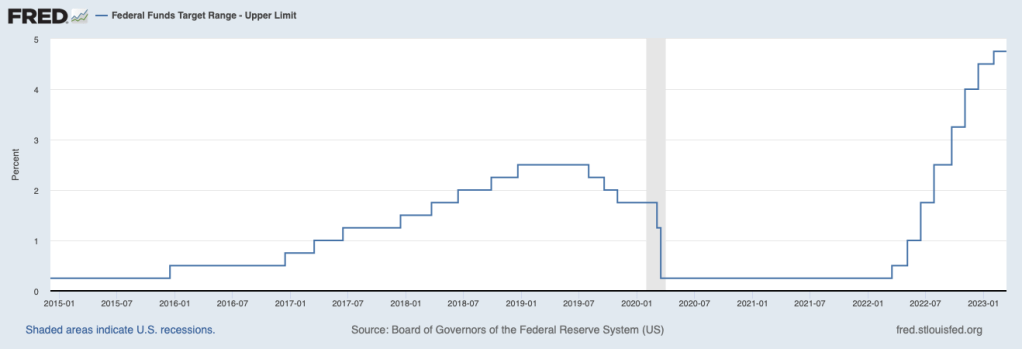
Since March 2022, the Fed has been rapidly increasing its target for the federal funds rate in order to slow the growth in aggregate demand and bring down the inflation rate, which has been well above the Fed’s target of 2 percent. (We discuss monetary policy in a number of earlier blog posts, including here and here, and in podcasts, the most recent of which (from February) can be found here.) The target federal funds rate has increased from a range of 0 percent to 0.25 percent in March 2022 to a range of 4.5 percent to 4.75 percent. The following figure shows the upper range of the target for the federal funds rate from January 2015 through March 14, 2023.
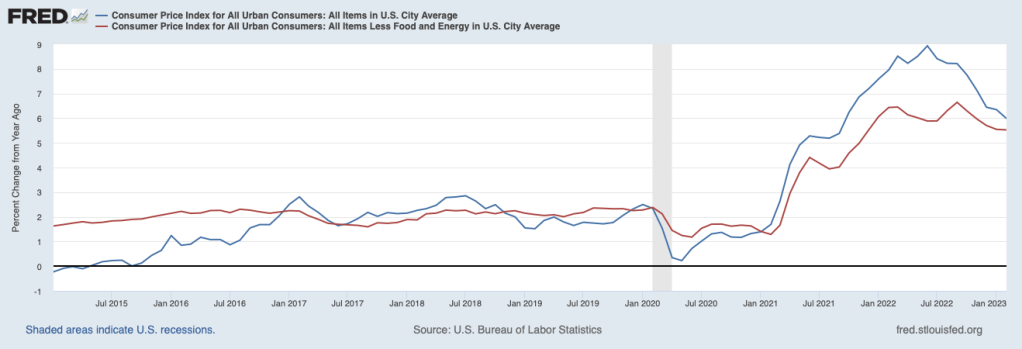
This morning (Tuesday, March 14, 2023), the Bureau of Labor Statistics (BLS) released its data on the consumer price index for February. The following figure show inflation as measured by the percentage change in the CPI from the same month in the previous year (which is the inflation measurement we use most places in the text) and as the percentage change in core CPI, which excludes prices of food and energy. (The inflation rate computed by the percentage change in the CPI is sometimes referred to as headline inflation.) The figure shows that although inflation has slowed somewhat it is still well above the Fed’s 2 percent target. (Note that, formally, the Fed assesses whether it has achieved its inflation target using changes in the personal consumption expenditures (PCE) price index rather than using changes in the CPI. We discuss issues in measuring inflation in several blog posts, including here and here.)
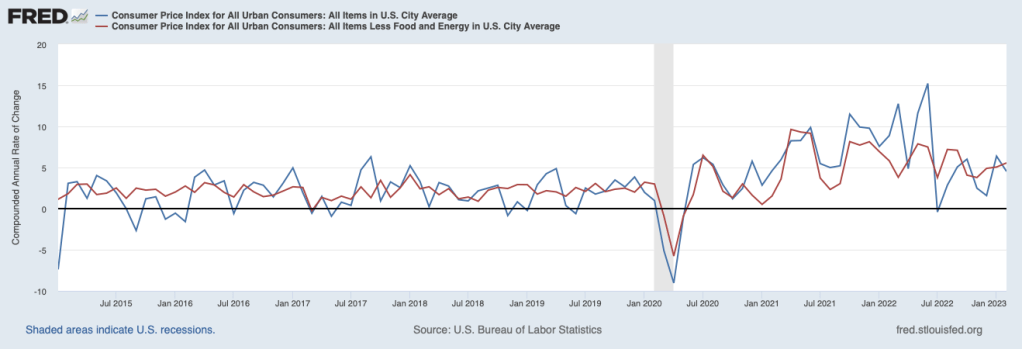
One drawback to using the percentage change in the CPI from the same month in the previous year is that it reduces the weight of the most recent observations. In the figure below, we show the inflation rate measured by the compounded annual rate of change, which is the value we would get for the inflation rate if that month’s percentage change continued for the following 12 months. Calculated this way, we get a somewhat different picture of inflation. Although headline inflation declines from January to February, core inflation is actually increasing each month from November 2022 when, it equaled 3.8 percent, through February 2023, when it equaled 5.6 percent. Core inflation is generally seen as a better indicator of future inflation than is headline inflation.
The February CPI data are consistent with recent data on PCE inflation, employment growth, and growth in consumer spending in that they show that the Fed’s increases in the target for the federal funds rate haven’t yet caused a slowing of the growth in aggregate demand sufficient to bring the inflation back to the Fed’s target of 2 percent. Until last week, many economists and Wall Street analysts had been expecting that at the next meeting of the Fed’s Federal Open Market Committee (FOMC) on March 21 and 22, the FOMC would raise its target for the federal funds rate by 0.5 percentage points to a range of 5.0 percent to 5.25 percent.
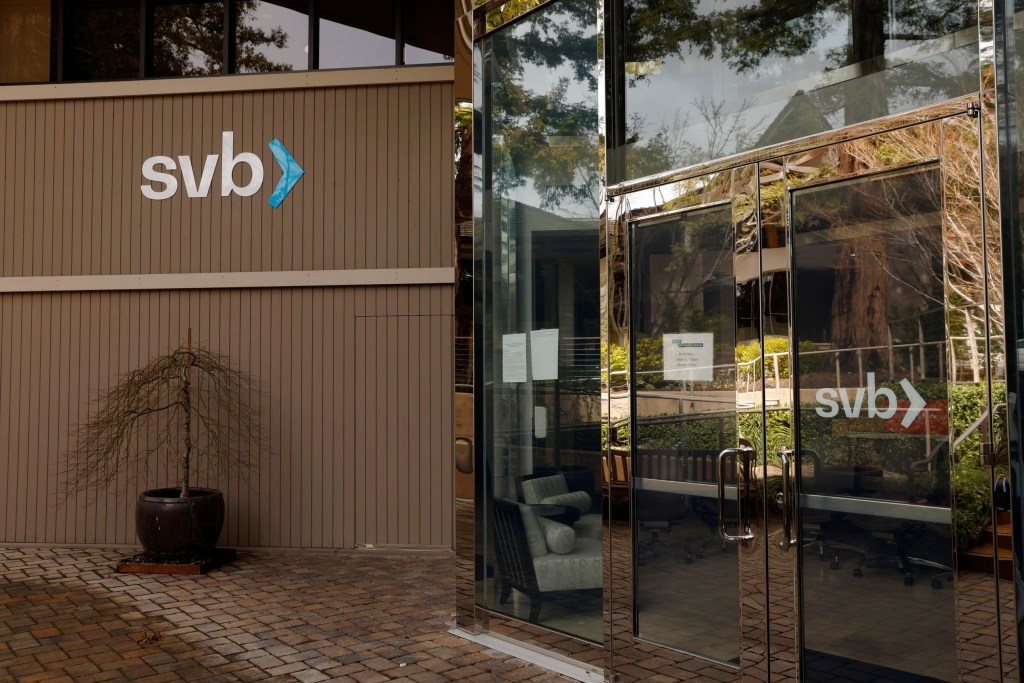
Then on Friday, the Federal Deposit Insurance Corporation (FDIC) was forced to close the Silicon Valley Bank (SVB). As the headline on a column in the Wall Street Journal put it “Fed’s Tightening Plans Collide With SVB Fallout.” That is, the Fed’s focus on price stability would lead it to continue its increases in the target for the federal funds rate. But, as we discuss in this post from Sunday, increases in the federal funds rate lead to increases in other interest rates, including the interests rates on the Treasury securities, mortgage-backed securities, and other securities that most banks own. As interest rates rise, the prices of long-term securities decline. The run on SVB was triggered in part by the bank taking a loss on the Treasury securities it sold to raise the funds needed to cover deposit withdrawals.
Further increases in the target for the federal funds rate could lead to further declines in the prices of long-term securities that banks own, which might make it difficult for banks to meet deposit withdrawals without taking losses on the securities–losses that have the potential to make the banks insolvent, which would cause the FDIC to seize them as it did SVB. The FOMC’s dilemma is whether to keep the target for the federal funds rate unchanged at its next meeting on March 21 and 22, thereby keeping banks from suffering further losses on their bond holdings, or to continue raising the target in pursuit of its mandate to restore price stability.
Some economists were urging the FOMC to pause its increases in the target federal funds rate, others suggested that the FOMC increase the target by only 0.25 percent points rather than by 0.50 percentage points, while others argued that the FOMC should implement a 0.50 increase in order to make further progress toward its mandate of price stability.
Forecasting monetary policy is a risky business, but as of Tuesday afternoon, the likeliest outcome was that the FOMC would opt for a 0.25 percentage point increase. Although on Monday the prices of the stocks of many regional banks had fallen, during Tuesday the prices had rebounded as investors appeared to be concluding that those banks were not likely to experience runs like the one that led to SVB’s closure. Most of these regional banks have many more retail deposits–deposits made be households and small local businesses–than did SVB. Retail depositors are less likely to withdraw funds if they become worried about the solvency of a bank because the depositors have much less than $250,000 in their accounts, which is the maximum covered by the FDIC’s deposit insurance. In addition, on Sunday, the Fed established the Bank Term Funding Program (BTFP), which allows banks to borrow against the holdings of Treasury and mortgage-back securities. The program allows banks to meet deposit withdrawals by borrowing against these securities rather than by having to sell them–as SVB did–and experience losses.
On March 22, we’ll find out how the Fed reacts to the latest dilemma facing monetary policy.
Join authors Glenn Hubbard and Tony O’Brien as they review the collapse of Silicon Valley Bank (SVB) in the context of a classic bank run. What lessons can be learned to avoid other bank collapses in this unchartered economic territory? Will this become a contagion? Or, is it simply an example of a bank searching for additional return in an uncertain economic world? Our discussion covers these points but you can also check for updates on our blog post that can be found HERE.
Rumors spread about the financial state of a bank. Some depositors begin to withdraw funds from their accounts. Suddenly a wave of withdrawals occurs and regulators step in and close the bank. A description of a run on a bank in New York City in the fall of 1930? No. This happened to Silicon Valley Bank, headquartered in Santa Clara, California and the sixteenth largest bank in the United States, on Friday, March 10, 2023.
Background on Bank Runs
In Macroeconomics, Chapter 14, Section 14.4 (Economics, Chapter 24, Section 24.4) we describe the basic reasons why a run on a bank may occur. We describe bank runs in greater detail in Money, Banking, and the Financial System, Chapter 12. We reproduce here a key paragraph on the underlying fragility of commercial banking from Chapter 12 of the money and banking text:
The basic activities of commercial banks are to accept short-term deposits, such as checking account deposits, and use the funds to make loans—including car loans, mortgages, and business loans—and to buy long-term securities, such as municipal bonds. In other words, banks borrow short term from depositors and lend, often long term, to households, firms, and governments. As a result, banks have a maturity mismatch because the maturity of their liabilities—primarily deposits—is much shorter than the maturity of their assets—primarily loans and securities. Banks are relatively illiquid because depositors can demand their money back at any time, while banks may have difficulty selling the loans in which they have invested depositors’ money. Banks, therefore, face liquidity risk because they can have difficulty meeting their depositors’ demands to withdraw their money. If more depositors ask to withdraw their money than a bank has money on hand, the bank has to borrow money, usually from other banks. If banks are unable to borrow to meet deposit withdrawals, then they have to sell assets to raise the funds. If a bank has made loans and bought securities that have declined in value, the bank may be insolvent, which means that the value of its assets is less than the value of its liabilities, so its net worth, or capital, is negative. An insolvent bank may be unable to meet its obligations to pay off its depositors.
The Founding of the Fed and the Establishment of the FDIC as a Response to Bank Runs
The instability of the banking system led to a number of financial crises during the 1800s and early 1900s, culminating in the Panic of 1907. Congress responded by passing the Federal Reserve Act in 1913, establishing the Federal Reserve System. The Fed was given the role of lender of last resort, making discount loans to banks that were experiencing deposit runs but that remained solvent. The failure of the Fed to stop the bank panics of the early 1930s led Congress to establish the Federal Deposit Insurance Corporation (FDIC) to ensure deposits in commercial banks, originally up to a limit of $2,500 per deposit, per bank. The current limit is $250,000.
Deposit insurance reduced the likelihood of runs but increased moral hazard in the banking system by eliminating the incentive insured depositors had to monitor the actions of bank managers. In principle, bank managers still have an incentive to avoid making risky loans and other investments for fear of withdrawals by households and firms with deposits that exceed the dollar deposit limit.
Contagion, Moral Hazard, and the Too-Big-to-Fail Policy
But if these depositors fail to monitor risk taking by bank managers or if a bank’s loans and investments decline in price even though they weren’t excessively risky at the time they were made, the FDIC and the Fed face a dilemma. Allowing banks to fail and large depositors to be only partially paid back may set off a process of contagion that results in runs spreading to other banks. Problems in the banking system can affect the wider economy by making it more difficult for households and firms that depend on bank loans to finance their spending. (We discuss the process of contagion in this post on the Diamond-Dybvig model.)
The Fed and the FDIC can stop the process of contagion if they are willing to ensure that large depositors don’t suffer losses. One mechanism to achieve this result is facilitating a merger between an insolvent bank and another bank that agrees to assume responsibility for meeting depositors withdrawals from the insolvent bank. But stopping contagion in this manner with no depositors suffering losses can be interpreted as amounting to deposit insurance having no dollar limit. The result is a further increase in moral hazard in the banking system. When the federal government does not allow large financial firms to fail for fear of damaging the financial system, it is said to be following a too-big-to-fail policy.
Silicon Valley Bank and VCs
Runs on commercial banks have been rare in recent decades, which is why the run on Silicon Valley Bank (SVB) took many people by surprise. As its name indicates, SVB is located in the heart of California’s Silicon Valley and the bank played an important role in the financing of many startups in the area. As such, SVB provided banking services to many venture capital (VC) firms. As we note in Chapter 9, Section 9.2 of the money and banking text, venture capital firms play an important role in providing funding to startup firms:
VCs such as Sequoia Capital, Accel, and Andreessen Horowitz raise funds from investors and invest in small startup firms, often in high-technology industries. In recent years, VCs have raised large amounts from institutional investors, such as pension funds and university endowments. A VC frequently takes a large ownership stake in a startup firm, often placing its own employees on the board of directors or even having them serve as managers. These steps can reduce principal–agent problems because the VC has a greater ability to closely monitor the managers of the firm it’s investing in. The firm’s managers are likely to be attentive to the wishes of a large investor because having a large investor sell its stake in the firm may make it difficult to raise funds from new investors. In addition, a VC avoids the free-rider problem when investing in a firm that is not publicly traded because other investors cannot copy the VC’s investment strategy.
An article on bloomberg.com summarized SVB’s role in Silicon Valley. SVB is
the single most critical financial institution for the nascent tech scene, serving half of all venture-backed companies in the US and 44% of the venture-backed technology and health-care companies that went public last year. And its offerings were vast — ranging from standard checking accounts, to VC investment, to loans, to currency risk management.
Note from this description that SVB acted as a VC—that is, it made investments in startup firms—as well as engaging in conventional commercial banking activities, such as making loans and accepting deposits. The CEO of one startup was quoted in an article in the Wall Street Journal as saying, “For startups, all roads lead to Silicon Valley Bank.” (The Wall Street Journal article describing the run on SVB can be found here. A subscription may be required.)
SVB’s Vulnerability to a Run
As with any commercial bank, the bulk of SVB’s liabilities were short-term deposits whereas the bulk of its assets were long-term loans and other investments. We’ve discussed above that this maturity mismatch means that SVB—like other commercial banks—was vulnerable to a run if depositors withdraw their funds. We’ve also seen that in practice bank runs are very rare in the United States. Why then did SVB experience a run? SVB was particularly vulnerable to a run for two related reasons:
1. Its deposits are more concentrated than is true of a typical bank. Many startups and VCs maintain large checking account balances with SVB. According to the Wall Street Journal, at the end of 2022, SVB had $157 billion in deposits, the bulk of which were in just 37,000 accounts. Startups often initially generate little or no revenue and rely on VC funding to meet their expenses. Most Silicon Valley VCs advised the startups they were invested in to establish checking accounts with SVB.
2. Accordingly, the bulk of the value of deposits at SVB was greater than the $250,000 FDIC insurance limit. Apparently 93 percent to 97 percent of deposits were above the deposit limit as opposed to about 50 percent for most commercial banks.
Economics writer Noah Smith notes that SVB required that startups it was lending to keep their deposits with SVB as a condition for receiving a loan. (Smith’s discussion of SVB can be found on his Substack blog here. A subscription may be required.)
The Reasons for the Run on SVB
When the Fed began increasing its target for the federal funds rate in March 2022 in response to a sharp increase in inflation, longer term interest rates, including interest rates on U.S. Treasury securities, also increased. For example the interest rate on the 10-year Treasury note increased from less than 2 percent in March 2022 to more than 4 percent in March 2023. The interest rate on the 2-year Treasury note increased even more, from 1.5 percent in March 2022 to around 5 percent in March 2023.
As we discuss in the appendix to Macroeconomics, Chapter 6 (Economics, Chapter 8) and in greater detail in Money, Banking, and the Financial System, Chapter 3, the price of a bond or other security equals the present value of the payments the owner of the security will receive. When market interest rates rise, as happened during 2022 and early 2023, the value of the payments received on existing securities—and therefore the prices of these securities—fall. Treasury securities are free from default risk, which is the risk that the Treasury won’t make the interest and principal payments on the security, but are subject to interest-rate risk, which is the risk that the price of security will decrease as market interest rates rise.
As interest rates rose, the value of bonds and other long-term assets that SVB owned fell. The price of an asset on the balance sheet of a firm is said to be marked to market if the price is adjusted to reflect fluctuations in the asset’s market price. However, banking law allows a bank to keep constant the prices of bonds on its balance sheets if it intends to hold the bonds until they mature, at which point the bank will receive a payment equal to the principal of the bond. But if a bank needs to sell bonds, perhaps to meet its liquidity needs as depositors make withdrawals, then the losses on the bonds have to be reflected on the bank’s balance sheet.
SVB’s problems began on Wednesday, March 8 when it surprised Wall Street analysts and the bank’s Silicon Valley clients by announcing that to raise funds it had sold $21 billion in securities at a loss of $1.8 billion. It also announced that it was selling stock to raise additional funds. (SVB’s announcement can be found here.) SVB’s CEO also announced that the bank would borrow an additional $15 billion. Although the CEO stated that the bank was solvent, as an article on fortune.com put it, “Investors didn’t buy it.” In addition to the news that SVB had suffered a loss on its bond sales and had to raise funds, some analysts raised the further concern that the downturn in the technology sector meant that some of the firms that SVB had made loans to might default on the loans.
Problems for SVB compounded the next day, Thursday, March 9, when Peter Theil, a co-founder of PayPal and Founders Fund, a leading VC, advised firms Founders Fund was invested in to withdraw their deposits from SVB. Other VCs began to pull their money from SVB and advised their firms to do the same and a classic bank run was on. Because commercial banks lack the funds to pay off a significant fraction of their depositors over a short period of time, in a run, depositors with funds above the $250,000 deposit insurance limit know that they need to withdraw their funds before other depositors do and the bank is forced to close. This fact makes it difficult for a bank to stop a run once it gets started.
According to an article in the Wall Street Journal, by the end of business on Thursday, depositors had attempted to withdraw $42 billion from SVB. The FDIC took control of SVB the next day, Friday, March 10, before the bank could open for business.
The Government Response to the Collapse of SVB
The FDIC generally handles bank failures in one of two ways: (1) It closes the bank and pays off depositors, or (2) it purchases and assumes control of the bank while finding another bank that is willing to purchase the failed bank. If the FDIC closes a bank, it pays off the insured depositors immediately, using the bank’s assets. If those funds are insufficient, the FDIC makes up the difference from its insurance reserves, which come from payments insured banks make to the FDIC. After the FDIC has compensated insured depositors, any remaining funds are paid to uninsured depositors.
As we write this on Sunday, March 12, leaders of the Fed, the FDIC, and the Treasury Department, were considering what steps to take to avoid a process of contagion that would cause the failure of SVB to lead to deposit withdrawals and potential failures of other banks—in other words, a bank panic like the one that crippled the U.S. economy in the early 1930s, worsening the severity of the Great Depression. These agencies hoped to find another bank that would purchase SVB and assume responsibility for meeting further deposit withdrawals.
Another possibility was that the FDIC would declare that closing SVB, selling the bank’s assets, and forcing depositors above the $250,000 deposit limit to suffer losses would pose a systemic risk to the financial system. In that circumstance, the FDIC could provide insurance to all depositors however large their deposits might be. As discussed earlier, this approach would increase moral hazard in the banking system because it would, in effect, waive the limit on deposit insurance. Although the waiver would apply directly only to this particular case, large depositors in other banks might conclude that if their bank failed, the FDIC would waive the deposit limit again. Under current law, the FDIC could only announce they were waiving the deposit limit if two-thirds of the FDIC’s Board of Directors, two-thirds of the Fed’s Board of Governors, and Treasury Secretary Janet Yellen agreed that failure of SVB would pose a systemic risk to the financial system.
According to an article on wsj.com posted at 4 pm on Sunday afternoon, bank regulators were conducting an auction for SVB in the hopes that a buyer could be found that would assume responsibility for the bank’s uninsured deposits. [Update evening of Monday March 13: The Sunday auction failed when no U.S. banks entered a bid. Late Monday, the FDIC was planning on holding another auction, with potentially better terms available for the acquiring bank.]
Update: At 6:15 pm Sunday, the Treasury, the Fed, and the FDIC issued a statement (you can read it here). As we noted might occur above, by invoking a situation of systemic risk, the FDIC was authorized to allow all depositors–including those with funds above the deposit limit of $250,000–to access their funds on Monday morning. Here is an excerpt from the statement:
“After receiving a recommendation from the boards of the FDIC and the Federal Reserve, and consulting with the President, Secretary Yellen approved actions enabling the FDIC to complete its resolution of Silicon Valley Bank, Santa Clara, California, in a manner that fully protects all depositors. Depositors will have access to all of their money starting Monday, March 13. No losses associated with the resolution of Silicon Valley Bank will be borne by the taxpayer.”
[Update Monday morning March 13] As we discussed above, one of the problems SVB faced was a decline in the prices of its bond holdings. As a result, when it sold bonds to help meet deposit outflows, it suffered a $2.1 billion loss. Most commercial banks have invested some of their deposits in Treasury bonds and so potentially face the same problem of having to suffer losses if they need to sell the bonds to meet deposit outflows.
To deal with this issue, Sunday night the Fed announced that it was establishing the Bank Term Funding Program (BTFP). Banks and other depository institutions, such as savings and loans and credit unions, can use the BTFP to borrow against their holdings of Treasury and mortgage-backed securities and agency debt. (Agency debt consists of bonds issued by any federal government agency other than the U.S. Treasury. Most agency debt is bonds issued by the Government Sponsored Agencies (GSEs) involved in the mortgage market: Federal National Mortgage Association (Fannie Mae), Government National Mortgage Association (Ginnie Mae), and the Federal Home Loan Mortgage (Freddie Mac).) The Fed explained its reasons for setting up the BTFP: “The BTFP will be an additional source of liquidity against high-quality securities, eliminating an institution’s need to quickly sell those securities in times of stress.” You can read the Fed’s statement here.
On Sunday, Signature Bank was closed by New York state banking officials and the FDIC. As with SVB, the Fed, FDIC, and Treasury announced that all depositors, including those whose deposits were above the $250,000 deposit limit, would be able to withdraw the full amount of their deposits.
Shareholders in SVB and Signature Bank lost their investments when the FDIC took control of the banks. On Monday morning, investors were selling shares of a number of regional banks who might also face runs, fearing that their investments would be lost if the FDIC were to seize these banks.
President Biden, speaking from the White House, attempted to reassure the public that the banking system was safe. He stated that he would ask Congress to explore changes in banking regulations to reduce the likelihood of future bank failures.
Supports: Microeconomics, Chapter 11, Section 11.5; Economics, Chapter 11, Section 11.5; and Essentials of Economics, Chapter 8, Section 8.5
Photo from the Wall Street Journal.
Imani owns a firm that sells payroll services to companies in the Atlanta area. Her largest cost is for labor. She employs workers who use software to prepare payroll reports and to handle texts and calls from client firms. She decides to begin using a generative AI program, like ChatGPT, which is capable of quickly composing thorough answers to many questions and write computer code. She will use the program to write the additional computer code needed to adapt the payroll software to individual client’s needs and to respond to clients seeking advice on payroll questions. Once the AI program is in place, she will need only half as many workers. The number of additional workers she needs to hire for every 20 additional firms that buy her service will fall from 5 to 1. She will have to pay a flat monthly licensing fee for the AI program; the fee will not change with the number of firms she sells her services to. Imani determines that making these changes will reduce her total cost of providing services to her current 2,000 clients from $2,000,000 per month to $1,600,000 per month
In answering the following questions, assume that, apart from the number of workers, none of the other inputs—such as the size of her firm’s office, the number of computers, or other software—change as a result of her leasing the AI program.
a. Briefly explain whether each of the following statements about the cost situation at Imani’s firm after she begins using the AI program is correct or incorrect.
Her firm’s average total cost, average variable cost, and average fixed cost curves will shift down, while her firm’s marginal cost curve will shift up.
Her firm’s average total cost, average variable cost, average fixed cost and marginal cost curves will all shift up.
Her firm’s average total cost, average variable cost, and marginal cost curves will shift down, while her average fixed cost curve will shift up.
Her firm’s average total cost, average variable cost, average fixed cost, and marginal cost curves will all shift down.
Her firm’s average fixed cost curve will shift up, but her other cost curves will be unchanged.
b. Draw a graph illustrating your answer to part a. Be sure to show the original average total cost, average variable cost, average fixed cost, and marginal cost curves. Also show the shifts—if any—in the curves after Imani begins using the AI program.
Solving the Problem
Step 1: Review the chapter material. This problem requires you to understand definitions of costs, so you may want to review the sections “The Difference between Fixed Costs and Variable Costs,” “Marginal Costs,” and “Graphing Cost Curves”
Step 2: Answer part (a) by explaining whether each of the five listed statements is correct or incorrect. The cost of the AI program is fixed because it doesn’t change with the quantity of her services that Imani sells. Her firm will have greater fixed costs after licensing the AI program but she will have lower variable costs because she is able to produce the same level of output with fewer workers. Her marginal cost will also decline because she needs to hire fewer workers as the quantity of services she sells increases. We know that the average total cost per month of providing her service to 2,000 clients has decreased because we are given the information that it changed from ($2,000,000/2,000) = $1,000 to ($1,600,000/2,000) = $800.
This statement is incorrect because her average fixed cost curve will shift up as a result of her total fixed cost having increased by the amount of the AI program license and because her marginal cost curve will shift down, not up.
This statement is incorrect because all of her cost curves, except for average fixed cost, will shift down, not up.
This statement is correct because it describes the actual shifts in her cost curves.
This statement is incorrect because her average fixed cost curve will shift up, not down.
This statement is incorrect because her rather than being unaffected, her average total cost, average variable cost, and marginal cost curves will shift down.
Step 3: Answer part (b) by drawing the cost curves for Imani’s firm before and after she begins using the AI program. Your graph should look like the following, where the curves representing the firm’s costs before Imani begins leasing the AI program are in blue and the costs after leasing the program are in red.
During the recovery from the Covid–19 pandemic, inflation as measured by the personal consumption expenditures (PCE) price index, first rose above the Federal Reserve’s target annual inflation rate of 2 percent in March 2021. Many economists inside and outside of the Fed believed the increase in inflation would be transitory because it was thought to be mainly the result of supply chain problems and an initial burst of spending as business lockdowns were ended or mitigated in most areas.
Accordingly, the Federal Open Market Committee (FOMC) kept its target for the federal funds rate at effectively zero (a range of 0 to 0.25 percent) until March 2022 and continued its quantitative easing (QE) program of buying long-term Treasury bonds and mortgage-backed securities (MBS) until that same month.
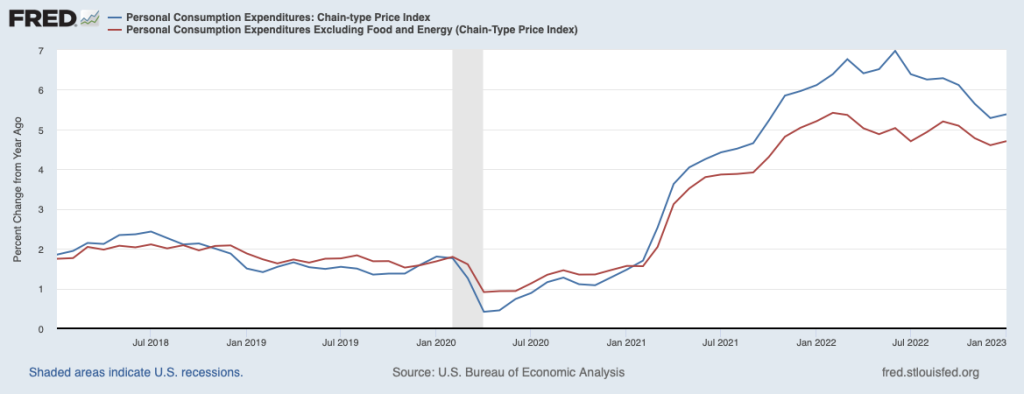
As the following figure shows, by March 2022 inflation had been well above the FOMC’s target for a year. The Fed responded by raising its target for the federal funds rate and switched from QE to quantitative tightening (QT). Although some supply chain problems were still contributing to the high inflation rate during the spring of 2022, the main driver appeared to be very expansionary monetary and fiscal policies. (This blog post from May 2021 has links to contributions to the debate over macro policy at the time. Glenn’s interview that month with the Financial Times can be found here. In November 2022, Glenn argued that overly expansionary fiscal policy was the main driver of inflation in this op-ed in the Financial Times (subscription or registration may be required).We discuss inconsistencies in the Fed’s forecasts of unemployment and inflation here. And in this post we discuss the question of whether the Fed made a mistake in not attempting to preempt inflation before it accelerated.)
Since March 2022, the FOMC has raised its target for the federal funds rate multiple times. In February 2023, the target was a range of 4.50 to 4.75 percent. Longer-term interest rates have also increased. In particular, the average interest rate on residential mortgage loans increased from 3 percent in March 2022 to 7 percent in November 2022, before falling back to around 6 percent in February 2023. In the fall of 2022, there was optimism among some economists that the Fed had succeeded in slowing the economy enough to put inflation on a path back to its 2 percent target. Although many economists had expected that inflation would only return to the target if the U.S. economy experienced a recession—labeled a hard landing—the probability that inflation could be reduced without a recession—labeled a soft landing—appeared to be increasing.
Economic data for January 2023 made a soft landing seem less likely. Consumer spending remained above its trend from before the pandemic, employment increases were unexpectedly high, and inflation reversed its downward trend. A continuation of low rates of unemployment and high rates of inflation wasn’t consistent with either a hard landing or a soft landing. Some observers, particularly in Wall Street financial firms, began describing the situation as no landing. But given the Fed’s strong commitment to returning to its 2 percent target, the no landing scenario couldn’t persist indefinitely.
Many investors had anticipated that the FOMC would end its increases in the federal funds target by mid-2023 and would have made one or more cuts to the target by the end of the year, but that outcome now seems unlikely. The FOMC had increased the federal funds target by only 0.25 percent at its February meeting but many economists now expected that it would announce a 0.50 percent increase at its next meeting on March 21 and 22. Unfortunately, the odds of a hard landing seem to be increasing.
A couple of notes: Although there are multiple ways of measuring inflation, the percentage increase in the PCE is the formal way in which the FOMC determines whether it is hitting its inflation target. To judge what the underlying inflation is—in other words, the inflation rate likely to persist in at least the near future—many economists look at core inflation. In the earlier figure we show movements in core inflation as measured by the PCE excluding prices of food and energy. Note that over the period shown PCE and core PCE follow the same pattern, although core PCE inflation begins to moderate earlier than does core PCE.
Some economists use other adjustments to PCE or to the consumer price index (CPI) in an attempt to better measure underlying inflation. For instance, housing rents and new and used car prices have been particularly volatile since early 2020, so some economists calculate PCE or CPI excluding those prices, as well as food and energy prices. As we discuss in this blog post from last September some economists prefer median CPI as the best measure of underlying inflation. (We discuss some of the alternative ways of measuring inflation in Macroeconomics, Chapter 15, Section 15.5 and Economics, Chapter 25, Section 25.5.) Nearly all these alternative measures of inflation indicated that the moderation in inflation that began in the summer of 2022 had ended in January 2023. So, choosing among measures of underlying inflation wasn’t critical to understanding the current path of inflation.
Finally, the inflation, employment, and output measures that in January seemed to show that the U.S. economy was still in a strong expansion and that the inflation rate may have ticked up are all seasonally adjusted. Seasonal adjustment factors are applied to the raw (unadjusted) data to account for regular seasonal fluctuations in the series. For instance, unadjusted employment declined in January as measured by both the household and establishment series. Applying the seasonal adjustment factors to the data resulted in the actual decline in employment from December to January turning into an adjusted increase. In other words, employment declined by less than it typically does, so on a seasonally adjusted basis, the Bureau of Labor Statistics reported that it had increased. Seasonal adjustments for the holiday season may be distorted, however, because the 2020–2021 and 2021–2022 holiday seasons occurred during upsurges in Covid. Whether the reported data for January 2023 will be subject to significant revisions when the seasonal adjustments factors are subsequently revised remains to be seen. The latest BLS employment report, showing seasonally adjusted and not seasonally adjusted data, can be found here.
Join author Glenn Hubbard & Tony O’Brien in their first Sprint 2023 podcast where they revisit inflation as the major topic facing our country, our economy, and our classrooms. Glenn & Tony discuss the Federal Reserve response and the outlook for the economy. While rates have continued to move up, is a soft-landing still possible?
In 1974, Congress created the Congressional Budget Office (CBO). The CBO was given the responsibility of providing Congress with impartial economic analysis as it makes decisions about the federal government’s budget. One of the most widely discussed reports the CBO issues is the Budget and Economic Outlook. The report provides forecasts of future federal budget deficits and changes in the federal government’s debt that the budget deficits will cause. The CBO’s budget and debt forecasts rely on the agency’s forecasts of future economic conditions and assumes that Congress will make no changes to current laws regarding taxing and spending. (We discuss this assumption further below.)
On February 15, the CBO issued its latest forecasts. The forecasts showed a deterioration in the federal government’s financial situation compared with the forecasts the CBO had issued in May 2022. (You can find the full report here.) Last year, the CBO forecast that the federal government’s cumulative budget deficit from 2023 through 2032 would be $15.7 trillion. The CBO is now forecasting the cumulative deficit over the same period will be $18.8 trillion. The three main reason for the increase in the forecast deficits are:
1. Congress has increased spending—particularly on benefits for military veterans.
2) Cost-of-living adjustments for Social Security and other government programs have increased as a result of higher inflation.
3) Interest rates on Treasury debt have increased as a result of higher inflation.
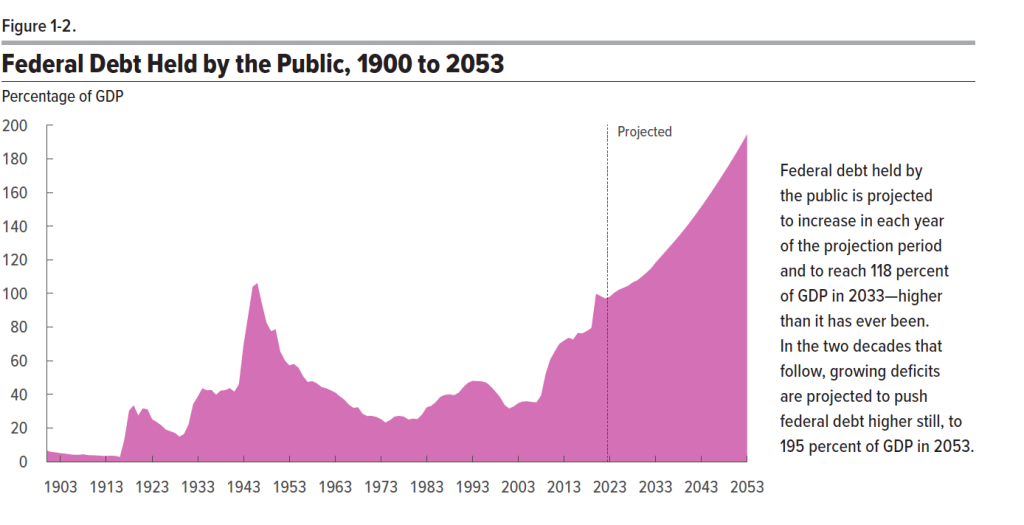
The CBO forecasts that federal debt held by the public will increase from 98 percent of GDP in 2023 to 118 percent in 2033 and eventually to 198 percent in 2053. Note that economists prefer to measure the size of the debt relative to GDP rather than in as absolute dollar amounts for two main reasons: First, measuring debt relative to GDP makes it easier to see how debt has changed over time in relation to the growth of the economy. Second, the size of debt relative to GDP makes it easier to gauge the burden that the debt imposes on the economy. When debt grows more slowly than the economy, as measured by GDP, crowding effects are likely to be relatively small. We discuss crowding out in Macroeconomics, Chapter 10, Section 10.2 and Chapter 16, Section 16. 5 (Economics, Chapter 20, Section 20.2 and Chapter 26, Section 26.5). The two most important factors driving increases in the ratio of debt to GDP are increased spending on Social Security, Medicare, and Medicaid, and increased interest payments on the debt.
The following figure is reproduced from the CBO report. It shows the ratio of debt to GDP with actual values for the period 1900-2022 and projected values for the period 2023-2053. Note that the only other time the ratio of debt to GDP rose above 100 percent was in 1945 and 1946 as a result of the large increases in federal government spending required to fight World War II.
The increased deficits and debt over the next 10 years are being driven by government spending increasing as a percentage of GDP, while government revenues (which are mainly taxes) are roughly stable as a percentage of GDP. The following figure from the report shows actual federal outlays and revenues as a percentage of GDP for the period 1973-2022 and projected outlays and revenues for the period 2023-2033. Note that from 1973 to 2022, outlays averaged 21.0 percent of GDP and revenues averaged 17.4 percent of GDP, resulting in an average deficit of 3.6 percent of GDP. By 2033, outlays are forecast to rise to 24.9 percent of GDP–well above the 1973-2022 average–whereas revenues are forecast to be only 18.1 percent, for a forecast deficit of 6.8 percent of GDP.
The increase in outlays is driven primarily by increases in mandatory spending, mainly spending on Social Security, Medicare, Medicaid, and veterans’ benefits and increases in interest payments on the debt. The CBO’s forecast assumes that discretionary spending will gradually decline over the next 10 years as percentage of GDP. Discretionary spending includes federal spending on defense and all other government programs apart from those, like Social Security, where spending is mandated by law.
To avoid the persistent deficits, and increasing debt that results, Congress would need to do one (or a combination) of the following:
1. Reduce the currently scheduled increases in mandatory spending (in political discussions this alternative is referred to as entitlement reform because entitlements is another name for manadatory spending).
2. Decrease discretionary spending, the largest component of which is defense spending.
3. Increases taxes.
There doesn’t appear to be majority support in Congress for taking any of these steps.
The CBO’s latest forecast seems gloomy, but may actually understate the likely future increases in the federal budget deficit and federal debt. The CBO’s forecast assumes that future outlays and taxes will occur as indicated in current law. For example, the forecast assumes that many of the tax cuts Congress passed in 2017 will expire in 2025 as stated in current law. Many political observers doubt that Congress will allow the tax cuts to expire as scheduled because to do so would result in increases in individual income taxes for most people. (Here is a recent article in the Washington Post that discusses this point. A subscription may be required to access the full article.) The CBO also assumes that defense spending will not increase beyond what is indicated by current law. Many political observers believe that, in fact, Congress may feel compelled to substantially increase defense spending as a result of Russia’s invasion of Ukraine in February 2022 and the potential military threat posed by China.
The CBO forecast also assumes that the U.S. economy won’t experience a recession between 2023 and 2033, which is possible but unlikely. If the economy does experience a recession, federal outlays for unemployment insurance and other programs will increase and federal personal and corporate income tax revenues will fall. The CBO’s forecast also assumes that the interest rate on the 10-year Treasury note will be under 4 percent and that the federal funds rate will be under 3 percent (interest rates on short-term Treasury debt move closely with changes in the federal funds rate). If interest rates turn out to be higher than these forecasts, the federal government’s interest payments will increase, further increasing the deficit and the debt.
In short, the federal government is clearly facing the most difficult budgetary situation since World War II.
In October 2021, Facebook founder Mark Zuckerberg did something unusual–he changed the name of the company from Facebook, Inc. to Meta Platforms, Inc. According to Zuckerberg, he did so because he said, “Over time I hope our company will be seen as a metaverse company.” What is the metaverse? Definitions differ, but it typically refers to software programs that allow people to access either augmented reality (AR) or virtual reality (VR) images and information.
In both AR and VR, people wear headsets, goggles, or glasses to see images and information displayed. In VR, you wear goggles and have to remain stationary because your whole field of vision is a digital projection, so if you walk around you run the risk of tripping over furniture or other obstacles. With AR, you can walk through the physical world because your goggles display only limited amounts of information.
For example, Peggy Johnson, CEO of Magic Leap describes the device her firm sells this way: “You wear it over your eyes. You can actually think of it as a computer on your eyes. And you still see your physical world around you, but we place digital content very smartly in that physical world.” Among other uses, Magic Leap’s device can help to train a worker to use a new piece of equipment by overlaying a virtual version of the equipment over the actual piece of equipment. The virtual version would place instructions in the worker’s field of view. That worker would be in the metaverse.
While Meta has been selling Oculus AR headsets, Zuckerberg has focused more on VR than on AR. An article in the Wall Street Journal described the VR metaverse that Zuckerberg is hoping to help build: “Eventually, the idea is that people will be able to do almost anything in the metaverse: go shopping, attend school, participate in work meetings.” They would do these things while sitting at their desk or armchair. Meta’s first significant VR product was Horizon Worlds. On Horizon, after choosing an avatar, or virtual figure that represents you, you can shop, play games, or hang out with other people. You enter Horizon by using Meta’s Quest VR headset, which has a price of $400 to $700, depending on the headset’s configuration. Meta set a goal of having 500,000 monthly users of Horizon by the end of 2022 but ended the year with only around 200,000 active users.
Horizon’s main problem seems to have been that the app was subject to large network externalities. As we discuss in Chapter 10, Section 10.3 of Economics and Microeconomics, network externalities describe the situation in which the usefulness of a product increases with the number of consumers who use it. The Horizon app is enjoyable to use only if many other people are using it. But because few people regularly use the app, many new users don’t find it enjoyable and soon stop using it. According to an article in the Wall Street Journal, in late 2022, “Most visitors to Horizon generally don’t return to the app after the first month … there are rarely any girls in the Hot Girl Summer Rooftop Pool Party, and in Murder Village there is often no one to kill. Even the company’s showcase worlds… are mostly barren of users.” Reality Labs, the division of Meta in charge of Horizon, the Quest headset, and other metaverse projects, had total losses of $27 billion by the end of 2022. The losses were partly the result of Meta selling Quest headsets for a price below the cost of producing them in an attempt to get more people to use Horizon.
Zuckerberg peisists in believing that the firm’s future lies with the metaverse and continues to spend billions on metaverse projects. Investors aren’t convinced that this strategy will work because, as an article on economist.com put it in early 2023: “Few people are burning to migrate to the metaverse.” As investors’ became more skeptical of Zuckerberg’s strategy, Meta’s stock price declined by more than half between the fall of 2021 and early 2023. To be successful in its metaverse strategy, Meta will eventually have to attract enough buyers of its Quest headsets and users of its Horizon app to begin taking advantage of network externalities.
Source: Dylan Croll, “Magic Leap CEO Peggy Johnson on the AR revolution,” news.yahoo. com, January 4, 2023; “Things Are Looking Up for Meta,” economist.com, February 3, 2023; “How Much Trouble Is Mark Zuckerberg In?” economist.com, October 16, 2022; Jeff Horwitz, Salvador Rodriguez, and Meghan Bobrowsky, “Company Documents Show Meta’s Flagship Metaverse Falling Short,” Wall Street Journal, October 15, 2022; Sarah E. Needleman, “Facebook Changes Company Name to Meta in Focus on Metaverse,” Wall Street Journal, October 28, 2021; Meghan Bobrowsky and Sarah E. Needleman, “What is the Metaverse? The Future Vision for the Internet,” Wall Street Journal, April 28, 2022.
you can bid for Paul Samuelson’s Nobel Prize Medal here. Note that at the time of posting the minimum bid required was $495,000.
You can read a brief biography of Samuelson on the Nobel site here. You can read the lecture Samuelson delivered on the occasion of being awarded the price here. (Note that the lecture contains technical material.)