Solved Problem: The German Tobacco Tax and Price Elasticity

(Photo from Reuters via the Wall Street Journal)

Supports: Microeconomics, Chapter 6, Section 6.3, Economics, Chapter 6, Section 6.3, and Essentials of Economics, Chapter 7, Section 7.7.

In August 2023, an article in the Wall Street Journal discussed the effort of the German government to reduce tobacco use. As part of the effort, the government increased the tax on tobacco products, including cigars and cigarettes. The tax increase took effect on January 1, 2022. According to German government data, during 2022 the quantity of cigars and cigarettes sold declined by 8.3 percent. At the same time, the tax revenue the government collected from the tobacco tax declined from €14.7 billion to €14.2 billion.

  1. From this information, can you determine whether the tobacco tax raised the price of cigars and cigarettes by more or less than 8.3 percent? Can you determine whether the demand for cigars and cigarettes in Germany is price elastic or price inelastic? Briefly explain.
  2. According to the Wall Street Journal article, in addition to increasing the tax on tobacco products, the German government took other steps, including banning outdoor advertising of tobacco products, to discourage smoking. Does this additional information affect your answer to parts a.? Briefly explain. 

Solving the Problem

Step 1:  Review the chapter material. This problem is about the effect of price changes on revenue, so you may want to review Microeconomics, Chapter 6, Section 6.3, “The Relationship between Price Elasticity of Demand and Total Revenue,” or the corresponding sections in Economics, Chapter 6 or Essentials of Economics, Chapter 7.

Step 2: Answer part a. by explaining whether you can tell if the tobacco tax raised the price of cigars and cigarettes by more than 8.3 percent and whether the demand for cigars and cigarettes in Germany is price elastic or price inelastic. We have two pieces of information: (1) In 2022, the quantity of cigars and cigarettes sold in Germany fell by 8.3 percent, and (2) the revenue the German government collected from the tobacco tax fell. We know that if a company increases the price of its product and the total revenue it earns falls, then the demand for the product must be price elastic. We can apply that same reasoning to a government increasing a tax. If the tax increase leads to a fall in revenue we can conclude that the demand for the good being taxed (in this case cigars and cigarettes) is price elastic.  When the demand for a good is price elastic, the percentage change in the quantity demanded resulting from a price increase will be greater than the percentage change in the price.  Therefore, the percentage change in price resulting from the tax must be less than 8.3 percent. An important qualification to this conclusion is that it holds only if no variable, other than the increase in the tax, affected the demand for cigars and cigarettes during 2022.

Step 3: Answer part b. by explaining how the German government’s banning of outdoor advertising of tobacco products affects your answer to part a. Banning outdoor advertising of tobacco products may have reduced the demand for cigars and cigarettes. If the demand curve for cigars and cigarettes shifted to left, then some of the 8.3 percent decline in the quantity sold may have been the result of the shift in demand rather than the result of the increase in the tax. In other words, the German market for cigars and cigarettes in 2022 may have experienced both a decrease in demand—as the demand curve shifted to the left—and a decrease in the quantity demanded—as the tax increase raised the price of cigars and cigarettes. Given this new information, we can’t be sure that our conclusions in part a.—that the demand for cigars and cigarettes is price elastic and that the tax resulted in an increase in the price of less than 8.3 percent—are correct.  

Extra credit:  This discussion indicates that in practice economists have to use statistical methods when they estimate the price elasticity of demand for a good or service. The statistical methods make it possible to distinguish the effect of a movement along a demand curve as the price changes from a shift in the demand curve caused by changes in other economic variables.  

Sources:  Jimmy Vielkind, “Smoking Is a Dying Habit. Not in Germany,” Wall Street Journal, August 31, 2023; and Statistisches Bundesamt, “Taxation of Tobacco Products (Cigarettes, Cigars/Cigarillos, Fine-Cut Tobacco, Pipe Tobacco): Germany, Years, Tax Stamps,” September 10, 2023.

Solved Problem: The Mexican “Super Peso”

A food market in Mexico. (Photo from mexperience.com)

Supports: Macroeconomics, Chapter 18, Economics, Chapter 28, and Essentials of Economics, Chapter 19.

In September 2023, an article in the Los Angeles Times discussed the effects on Mexico of the “’super-peso,’ as the Mexican currency has been dubbed since steadily gaining 18% on the dollar during the last 12 months.” The article focused on the effects of the rising value of the peso on people in Mexico who receive U.S. dollars from relatives and friends working in the United States. Many of the people who receive these payments rely on them to buy basic necessities, such as food and clothing. An article in the Wall Street Journal on the effects of the rising value of the peso noted that: “The peso’s strength has helped curtail inflation ….” 

  1. Briefly explain what the Los Angeles Times article means by the peso “gaining” on the U.S. dollar? Does the peso gaining on the dollar mean that someone exchanging dollars for pesos would receive more pesos or fewer pesos? 
  2. As a result of the rising value of the peso would people in Mexico receiving dollar payments from relatives in the United States be better off or worse off? Briefly explain. 
  3. Why would the increasing strength of the peso reduce the inflation rate in Mexico?
  4. The Los Angeles Times article also noted that: “The Bank of Mexico’s benchmark interest rate of 11.25% is more than double the U.S. Federal Reserve target …” Does this fact have anything to do with the increase in the value of the peso in exchange for the dollar? Briefly explain. 

Solving the Problem

Step 1:  Review the chapter material. This problem is about the effect of fluctuations in the exchange rate and the relationship between interest rates and exchange rates, so you may want to review Macroeconomics, Chapter 18, Section 8.2, “The Foreign Exchange Market and Exchange Rates,” or the corresponding sections in Economics, Chapter 28 or Essentials of Economics, Chapter 19.

Step 2: Answer part a. by explaining what it means for the peso to be “gaining” on the U.S. dollar. The peso gaining on the dollar means that someone can exchange fewer pesos to receive a dollar. Or, alternatively, someone exchanging dollars for pesos will receive fewer pesos. 

Step 3: Answer part b. by explaining why people in Mexico receiving dollar payments from relatives in the United States will be worse off because of the rising value of the peso. People living in Mexico needs pesos to buy food and clothing from Mexican stores. Because people will receive fewer pesos in exchange for the dollars they receive from relatives in the United States, these people will have been made worse off by the rising value of the peso. 

Step 4: Answer part c. by explaining why the increasing strength of the peso will reduce inflation in Mexico. A country’s inflation rate includes the prices of imported goods as well as the prices of domestically produced goods.  A stronger peso means that fewer pesos are needed to buy the same quantity of a foreign currency, which reduces the peso price of imports from that country. For example, a stronger peso reduces the number of pesos Mexican consumers pay to buy $10 worth of cucumbers imported from the United States. Falling prices of imported goods will reduce the inflation rate in Mexico. 

Step 5: Answer part d. by explaining why higher interest rates in Mexico relative to interest rates in the United States will increase the value of the peso in exchange for the U.S. dollar. If interest rates in Mexico rise relative to interest rates in the United States, Mexican financial assets, such as Mexican government bonds, will be more desirable, causing investors to increase their demand for the pesos they need to buy Mexican financial assets. The resulting shift to the right in the demand curve for pesos will cause the equilibrium exchange rate between the peso and the dollar to increase. 

Sources:  Patrick J. McDonnell, “Mexico’s Peso Is Soaring. That’s Bad News for People Who Rely on Dollars Sent from the U.S.,” Los Angeles Times, September 5, 2023; and Anthony Harrup, “Mexico’s Peso Surges to Strongest Level Since 2015,” Wall Street Journal, July 13, 2023.

What Explains the Surprising Surge in the Federal Budget Deficit?

Figure from CBO’s monthly budget report.

During 2023, GDP and employment have continued to expand. Between the second quarter of 2022 and the second quarter of 2023, nominal GDP increased by 6.1 percent. From July 2022 to July 2023, total employment increased by 3.3 million as measured by the establishment (or payroll) survey and by 3.0 as measured by the household survey. (In this post, we discuss the differences between the employment measures in the two surveys.)

We would expect that with an expanding economy, federal tax revenues would rise and federal expenditures on unemployment insurance and other transfer programs would decline, reducing the federal budget deficit. (We discuss the effects of the business cycle on the federal budget deficit in Macroeconomics, Chapter 16, Section 16.6, Economics, Chapter 26, Section 26.6, and Essentials of Economics, Chapter 18, Section 18.6.) In fact, though, as the figure from the Congressional Budget Office (CBO) at the top of this post shows, the federal budget deficit actually increased substantially during 2023 in comparison with 2022. The federal budget deficit from the beginning of government’s fiscal year on October 1, 2022 through July 2023 was $1,617 billion, more than double the $726 billion deficit during the same period in fiscal 2022.

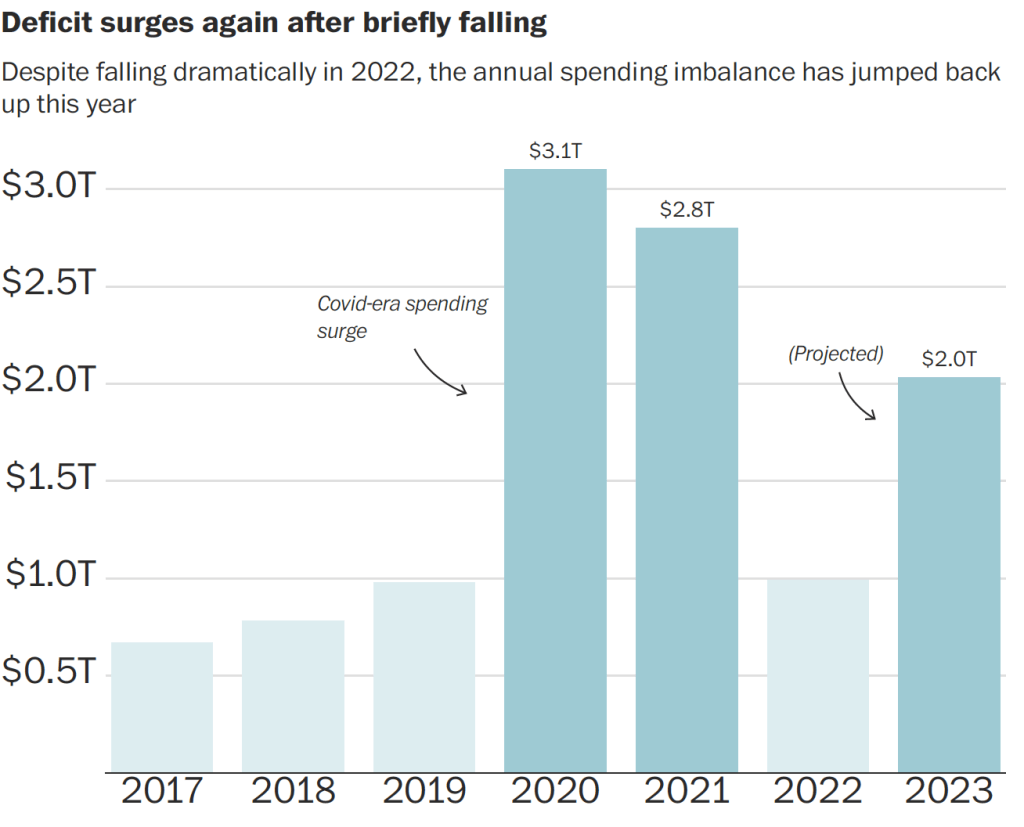
The following figure from an article in the Washington Post uses data from the Committee for a Responsible Federal Budget to illustrate changes in the federal budget deficit in recent years. The figure shows the sharp decline in the federal budget deficit in 2022 as the economic recovery from the Covid–19 pandemic increased federal tax receipts and reduced federal expenditures as emergency spending programs ended. Given the continuing economic recovery, the surge in the deficit during 2023 was unexpected.

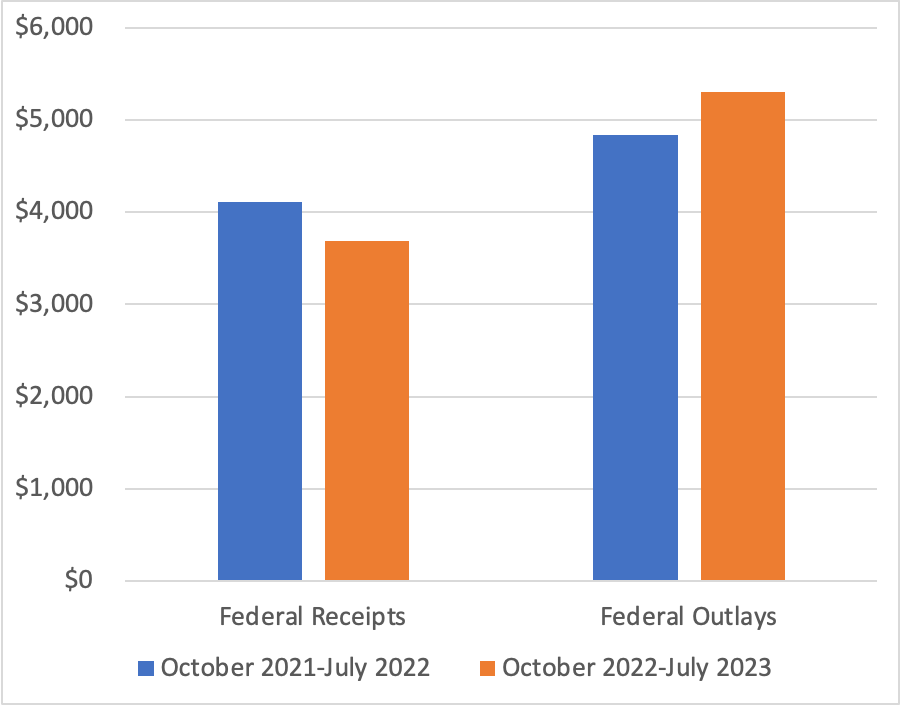
As the following figure shows, using CBO data, federal receipts—mainly taxes—are 10 percent lower this year than last year, and federal outlays—including transfer payments—are 11 percent higher. For receipts to fall and outlays to increase during an economic expansion is very unusual. As an article in the Wall Street Journal put it: “Something strange is happening with the federal budget this year.”

Note: The values on the vertical axis are in billions of dollars.

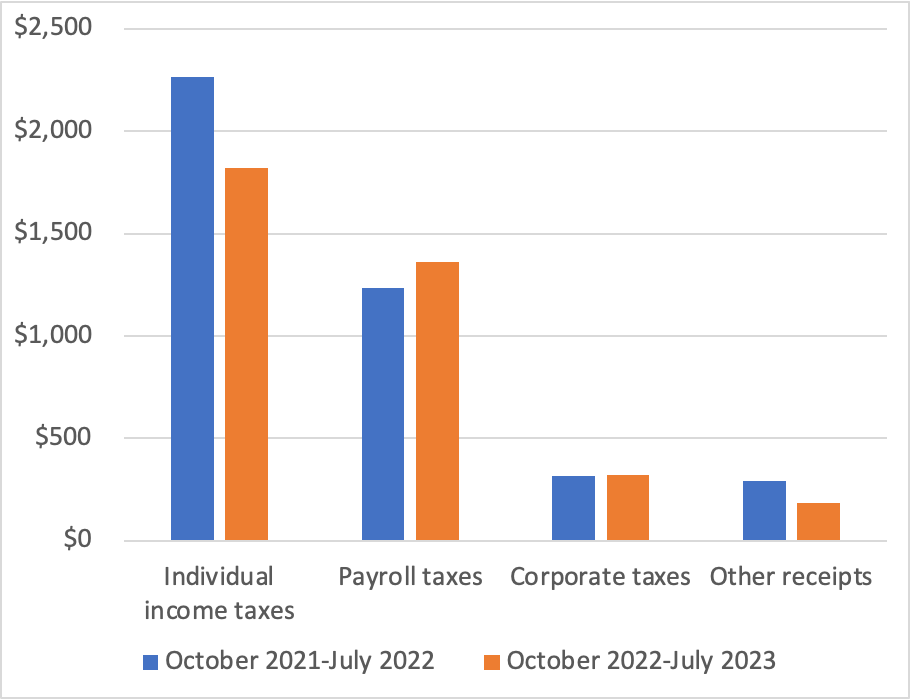
The following figure shows a breakdown of the decline in federal receipts. While corporate taxes and payroll taxes (primarily used to fund the Social Security and Medicare systems) increased, personal income tax receipts fell by 20 percent, and “other receipts” fell by 37 percent. The decline in other receipts is largely the result of a decline in payments from the Federal Reserve to the U.S. Treasury from $99 billion in 2022 to $1 billion in 2023. As we discuss in Macroeconomics, Chapter 17, Section 17.4 (Economics, Chapter 27, Section 27.4), Congress intended the Federal Reserve to be independent of the rest of the government. Unlike other federal agencies and departments, the Fed is self-financing rather than being financed by Congressional appropriations. Typically, the Fed makes a profit because the interest it earns on its holdings of Treasury securities is more than the interest it pays banks on their reserve deposits. After paying its operating costs, the Fed pays the rest of its profit to the Treasury. But as the Fed increased its target for the federal funds rate beginning in March 2022, it also increased the interest rate it pays banks on their reserve deposits. Because most of the securities it holds pay low interest rates, the Fed has begun running a deficit, reducing the payments it makes to the Treasury.

Note: The values on the vertical axis are in billions of dollars.

The reasons for the sharp decline in individual income taxes are less clear. The decline was in the “nonwithheld category” of individual income taxes; federal income taxes withheld from worker paychecks increased. People who are self-employed or who receive substantial income from sources such as capital gains from selling stocks, make quarterly estimated income tax payments. It’s these types of personal income taxes that have been unexpectedly low. Accordingly, smaller capital gains may be one explanation for the shortfall in federal revenues, but a more complete explanation won’t be possible until more data become available later in the year.

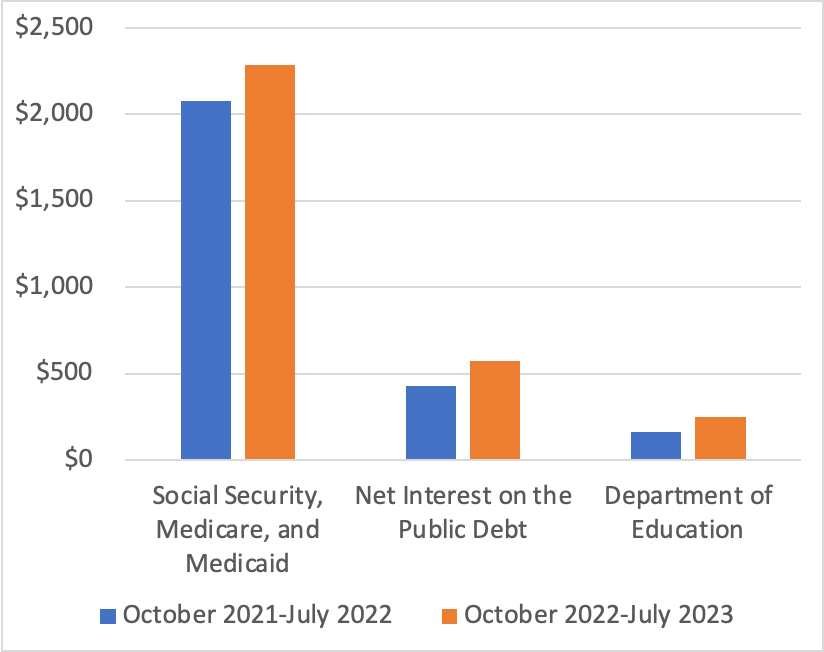
The following figure shows the categories of federal outlays that have increased the most from 2022 to 2023. The largest increase is in spending on Social Security, Medicare, and Medicaid, with spending on Social Security alone increasing by $111 billion. This increase is due partly to an increase in the number of retired workers receiving benefits and partly to the sharp rise in inflation, because Social Security is indexed to changes in the consumer price index (CPI). Spending on Medicare increased by $66 billion or a surprisingly large 18 percent. Interest payments on the public debt (also called the federal government debt or the national debt) increased by $146 billion or 34 percent because interest rates on newly issued Treasury securities rose as nominal interest rates adjusted to the increase in inflation and because the public debt had increased significantly as a result of the large budget deficits of 2020 and 2021. The increase in spending by the Department of Education reflects the effects of the changes the Biden administration made to student loans eligible for the income-driven repayment plan. (We discuss the income-driven repayment plan for student loans in this blog post.)

Note: The values on the vertical axis are in billions of dollars.

The surge in federal government outlays occurred despite a $120 billion decline in refundable tax credits, largely due to the expiration of the expansion of the child tax credit Congress enacted during the pandemic, a $98 billion decline in Treasury payments to state and local governments to help offset the financial effects of the pandemic, and $59 billion decline in federal payments to hospitals and other medical facilities to offset increased costs due to the pandemic.

In this blog post from February, we discussed the challenges posed to Congress and the president by the CBO’s forecasts of rising federal budget deficits and corresponding increases in the federal government’s debt. The unexpected expansion in the size of the federal budget deficit for the current fiscal year significantly adds to the task of putting the federal government’s finances on a sound basis.

The Labor Market Continues to Cool  

As we discussed in this post, most recent data are consistent with the labor market having cooled, which should reduce upward pressure on wages and prices. On Friday morning, the Bureau of Labor Statistics (BLS) released its employment report for August 2023. (The report can be found here.) On balance, the data in the report are consistent with the labor market continuing to cool.

Data from the establishment survey showed an increase in payroll employment of 187,000, which is close to the increase of 170,000 economists surveyed by the Wall Street Journal had forecast. The following figure shows monthly changes in payroll employment since January 2021.

Although the month-to-month changes have been particularly volatile during this period as the U.S. economy recovered from the Covid–19 recession, the general trend in job creation has been downward. The following table shows average monthly increases in payroll employment for 2021, 2022, and 2023 through August. In the most recent three-month period, the average monthly increase in employment was 150,000.

PeriodAverage Monthly Increases in Employment
2021606,000
2022399,000
Jan.-Aug. 2023236,000

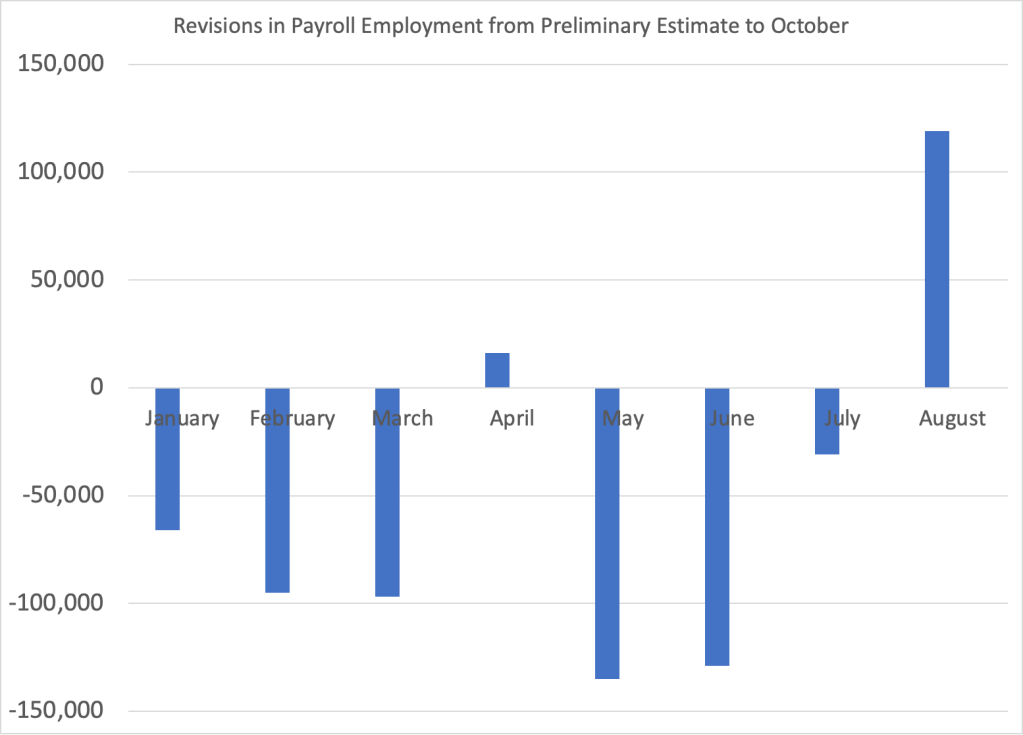
The BLS revised downward its previous estimates of employment increases in June and July by a combined 110,000. The changes to the estimate of the employment increase for June are particularly notable. As the following graph shows, on July 7, the BLS initially estimated the increase as 209,000. The BLS’s first revision on August 4, lowered the estimate to an increase of 187,000. The BLS’s second revision on September 1, lowered the estimate further to 105,000. In other words, the BLS now estimates that employment increased by only half as much in June as it initially reported. As we discuss in Macroeconomics, Chapter 9, Section 9.1 (Economics, Chapter 19, Section 19.1 and Essentials of Economics, Chapter 13, Section 13.1), the revisions that the BLS makes to its employment estimates are likely to be particularly large when the economy is about to enter a period of significantly lower or higher growth. So, the large revisions to the June employment estimate may indicate that during the summer economic growth slowed and labor market conditions eased.

Data from the household survey showed the unemployment rate increasing from 3.5 percent in July to 3.8 percent in August. The following figure shows that the unemployment rate has fluctuated in a narrow range since March 2022. Employment as estimated from the household survey increased by 222,000. The seeming paradox of the number of people employed and the unemployment rate both increasing is accounted for by the substantial 736,000 increase in the labor force.

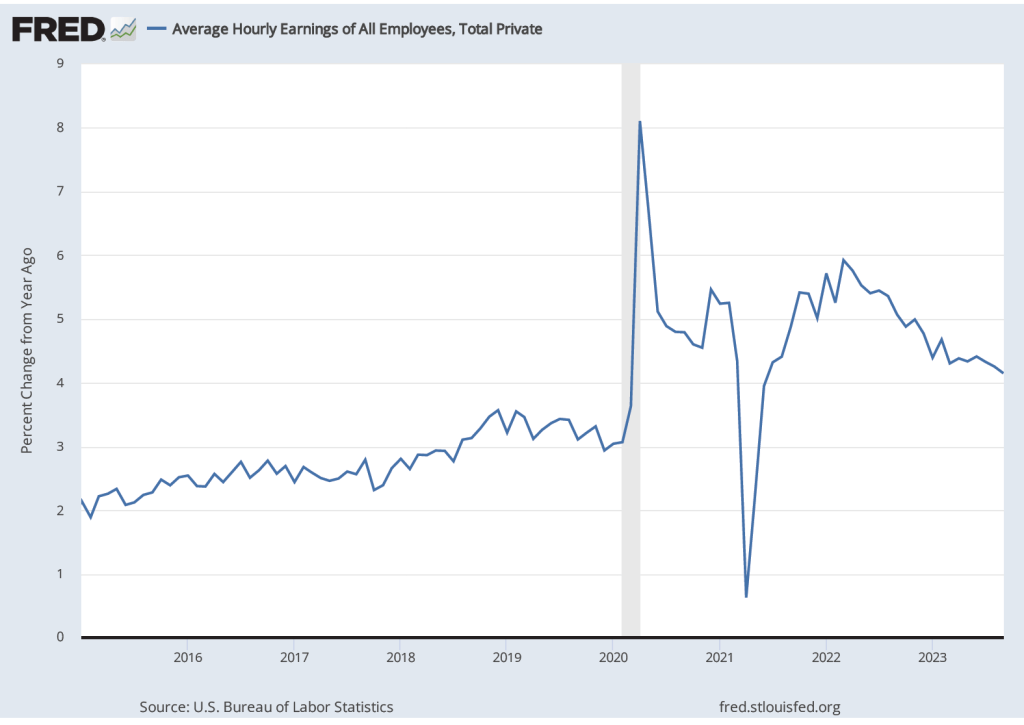
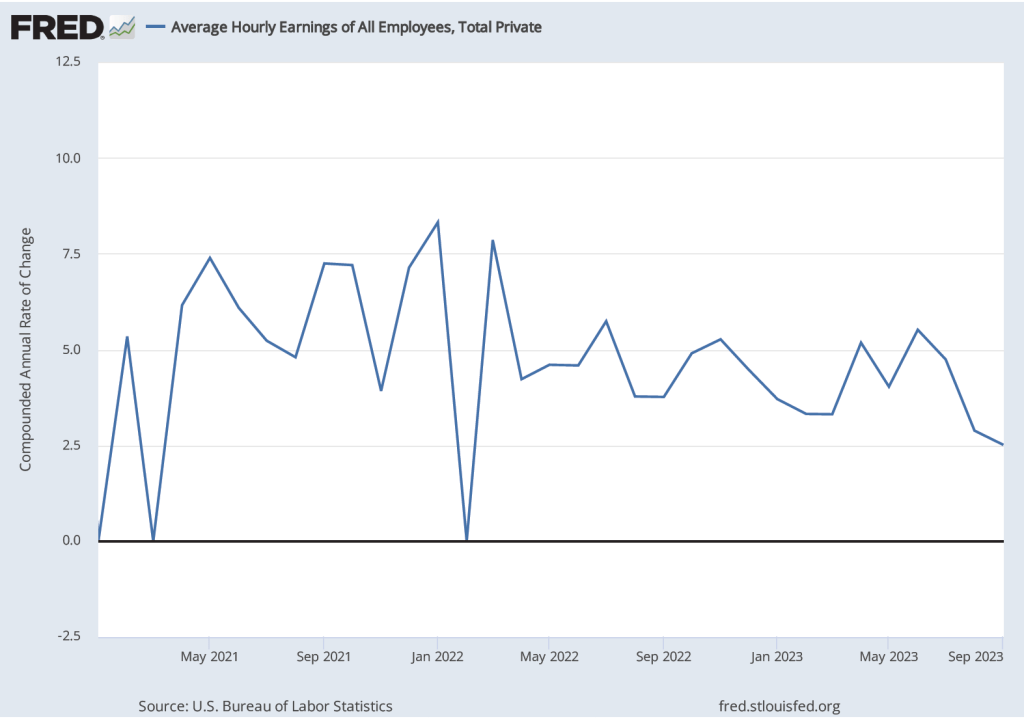
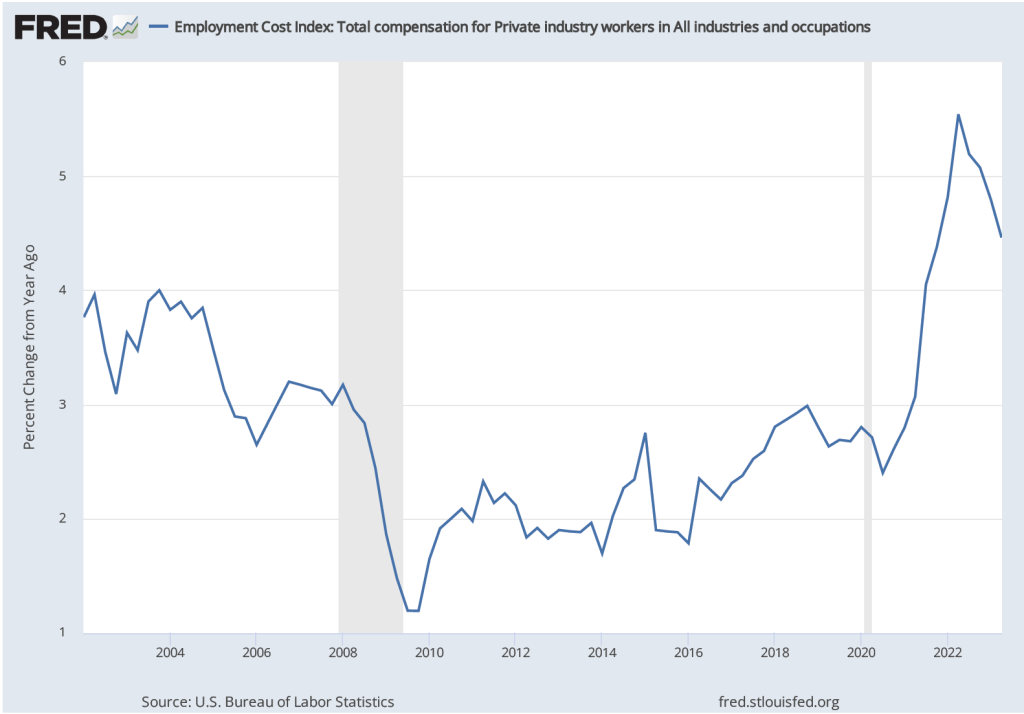
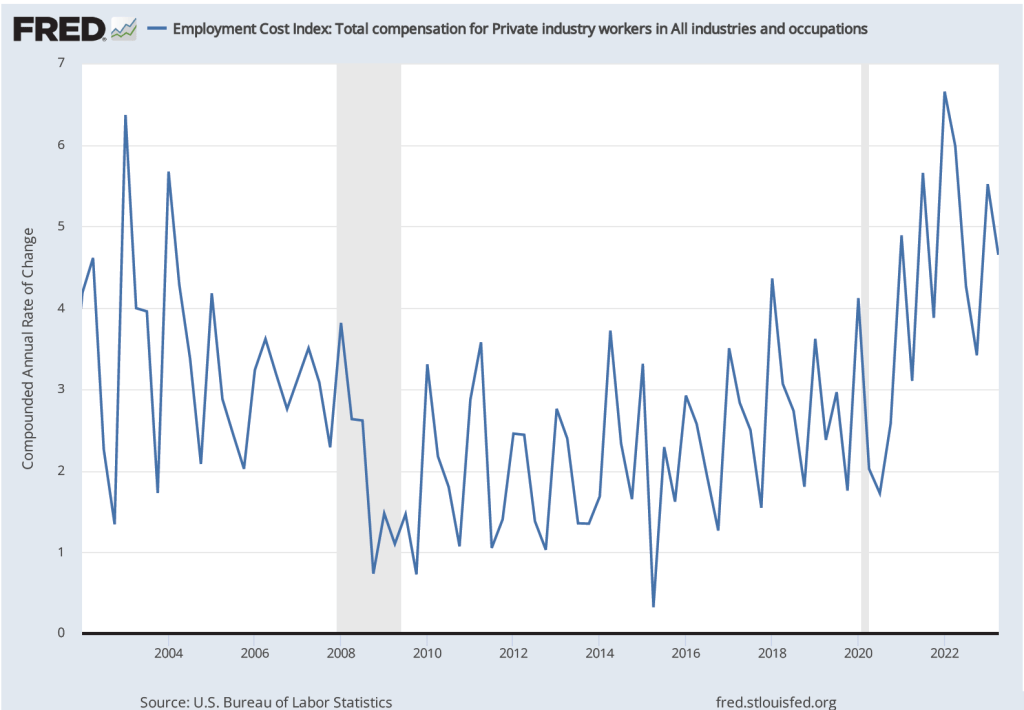
Finally, as the first of the following figures shows, measured as the percentage change from the same month in the previous year, the increase in average hourly earnings (AHE) remained in its recent range of between 4.25 and 4.50 percent. That rate is down from its peak in mid-2022 but still above the rate of increase in 2019, before the pandemic. But, as the second figure shows, if we look at the compound rate of increase in AHE—that is the rate at which AHE would increase for the year if the current rate of monthly increase persisted over the following 11 months—we can see a significant cooling in the rate at which wages are increasing.

As a reminder, AHE are the wages and salaries per hour worked that private, nonfarm businesses pay workers. AHE don’t include the value of benefits that firms provide workers, such as contributions to 401(k) retirement accounts or health insurance. As an economy-wide average they suffer from a composition effect during periods in which employment either increases or decreases substantially because the mix of high-wage and low-wage workers may change. AHE are also subject to significant revisions. Therefore, short-range changes in AHE can sometimes be misleading indicators of the state of the labor market.

Data Indicate Continued Labor Market Easing

A job fair in Albuquerque, New Mexico earlier this year. (Photo from Zuma Press via the Wall Street Journal.)

In his speech at the Kansas City Fed’s Jackson Hole, Wyoming symposium, Fed Chair Jerome Powell noted that: “Getting inflation back down to 2 percent is expected to require a period of below-trend economic growth as well as some softening in labor market conditions.” To this point, there isn’t much indication that the U.S. economy is experiencing slower economic growth. The Atlanta Fed’s widely followed GDPNow forecast has real GDP increasing at a rapid 5.3 percent during the third quarter of 2023.

But the labor market does appear to be softening. The most familiar measure of the state of the labor market is the unemployment rate. As the following figure shows, the unemployment rate remains very low.

But, as we noted in this earlier post, an alternative way of gauging the strength of the labor market is to look at the ratio of the number of job openings to the number of unemployed workers. The Bureau of Labor Statistics (BLS) defines a job opening as a full-time or part-time job that a firm is advertising and that will start within 30 days. The higher the ratio of job openings to unemployed workers, the more difficulty firms have in filling jobs, and the tighter the labor market is. As indicated by the earlier quote from Powell, the Fed is concerned that in a very tight labor market, wages will increase more rapidly, which will likely lead firms to increase prices. The following figure shows that in July the ratio of job openings to unemployed workers has declined from the very high level of around 2.0 that was reached in several months between March 2022 and December 2022. The July 2023 value of 1.5, though, was still well above the level of 1.2 that prevailed from mid-2018 to February 2022, just before the beginning of the Covid–19 pandemic. These data indicate that labor market conditions continue to ease, although they remain tighter than they were just before the pandemic.

The following figure shows movements in the quit rate. The BLS calculates job quit rates by dividing the number of people quitting jobs by total employment. When the labor market is tight and competition among firms for workers is high, workers are more likely to quit to take another job that may be offering higher wages. The quit rate in July 2023 had fallen to 2.3 percent of total employment from a high of 3.0 percent, reached in both November 2021 and April 2022. The quit rate was back to its value just before the pandemic. The quit rate data are consistent with easing conditions in the labor market. (The data on job openings and quits are from the BLS report Job Openings and Labor Turnover—July 2023—the JOLTS report—released on August 29. The report can be found here.)

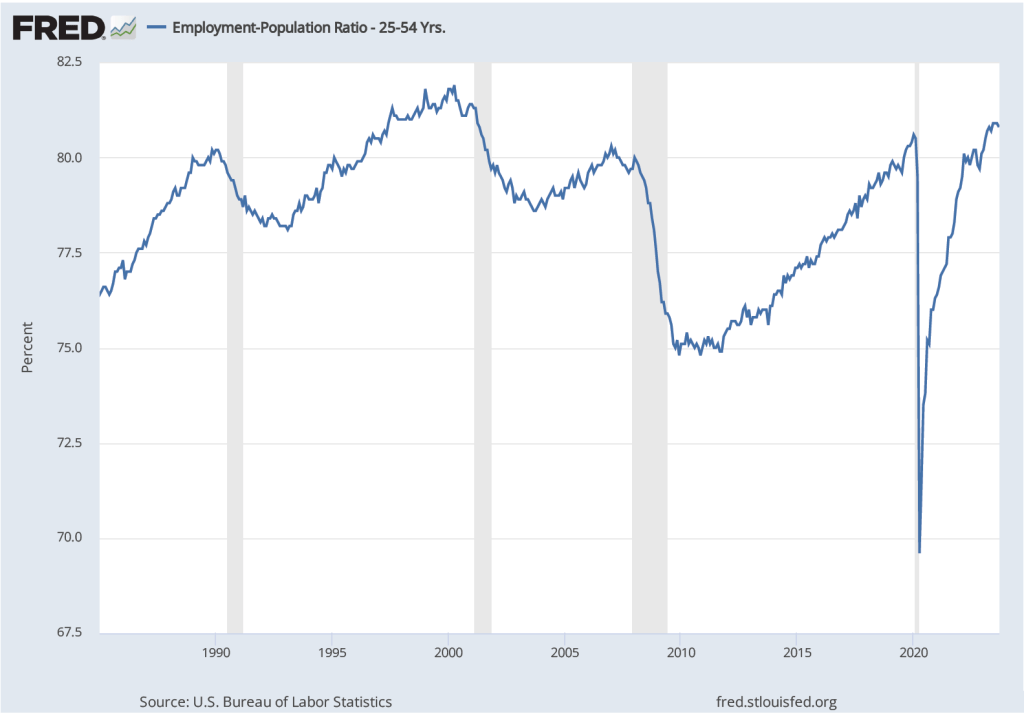
In his Jackson Hole speech, Powell noted that: “Labor supply has improved, driven by stronger participation among workers aged 25 to 54 and by an increase in immigration back toward pre-pandemic levels.” The following figure shows the employment-population ratio for people aged 25 to to 54—so-called prime-age workers. In July 2023, 80.9 percent of people in this age group were employed, actually above the ratio of 80.5 percent just before the pandemic. This increase in labor supply is another indication that the labor market disruptions caused by the pandemic has continued to ease, allowing for an increase in labor supply.

Taken together, these data indicate that labor market conditions are easing, likely reducing upward pressure on wages, and aiding the continuing decline in the inflation rate towards the Fed’s 2 percent target. Unless the data for August show an acceleration in inflation or a tightening of labor market conditions—which is certainly possible given what appears to be a strong expansion of real GDP during the third quarter—at its September meeting the Federal Open Market Committee is likely to keep its target for the federal funds rate unchanged.

Powell at Jackson Hole: No Change to Fed’s Inflation Target

Federal Reserve Chair Jerome Powell at Jackson Hole, Wyoming, August 2023 (Photo from the Associated Press.)

Congress has given the Federal Reserve a dual mandate to achieve price stability and high employment. To reach its goal of price stability, the Fed has set an inflation target of 2 percent, with inflation being measured by the percentage change in the personal consumption expenditures (PCE) price index.

It’s reasonable to ask whether “price stability” is achieved only when the price level is constant—that is, at a zero inflation rate. In practice, Congress has given the Fed wide latitude in deciding when price stability and high employment has been achieved.  The Fed didn’t announce a formal inflation target of 2 percent until 2012. But the members of the Federal Open Market Committee (FOMC) had agreed to set a 2 percent inflation target much earlier—in 1996—although they didn’t publicly announce it at the time. (The transcript of the FOMC’s July 2-3, 1996 meeting includes a discussion of the FOMC’s decision to adopt an inflation target.) Implicitly, the FOMC had been acting as if it had a 2 percent target since at least the mid–1980s.

But why did the Fed decide on an inflation target of 2 percent rather than 0 percent, 1 percent, 3 percent, or some other rate? There are three key reasons:

  1. As we discuss in Macroeconomics, Chapter 9, Section 9.4 (Economics, Chapter 19, Section 29.4 and Essentials of Economics, Chapter 13, Section 13.4), price indexes overstate the actual inflation rate by 0.5 percentage point to 1 percentage point. So, a measured inflation of 2 percent corresponds to an actual inflation rate of 1 to 1.5 percent.
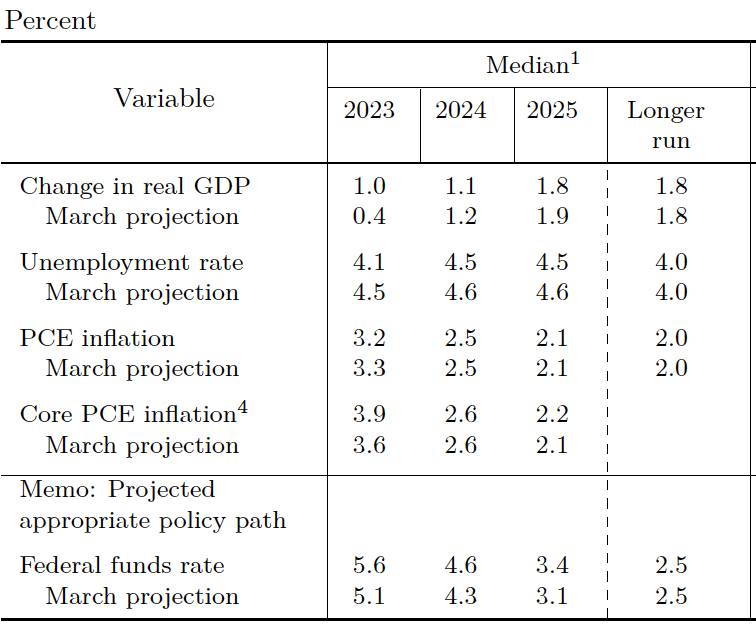
  2. As we discuss in Macroeconomics, Chapter 15, Section 15.5 (Economics, Chapter 25, Section 25.5), the FOMC has a target for the long-run real federal funds rate. Although the target has been as high as 2 percent, in recent years it has been 0.5 percent.  With an inflation target of 2 percent, the long-run nominal federal funds rate target is 2.5 percent. (The FOMC’s long-run target federall funds target can be found in the Summary of Economic Projections here.) As the Fed notes, with an inflation target of less than 2 percent “there would be less room to cut interest rates to boost employment during an economic downturn.”
  3. An inflation target of less than 2 percent would make it more likely that during recessions, the U.S. economy might experience deflation, or a period during which the price level is falling.  Deflation can be damaging if falling prices cause consumers to postpone purchases in the hope of being able to buy goods and services at lower prices in the future. The resulting decline in aggregate demand can make a recession worse. In addition, deflation increases the real interest rate associated with a given nominal interest rate, imposing costs on borrowers, particularly if the deflation is unexpected.

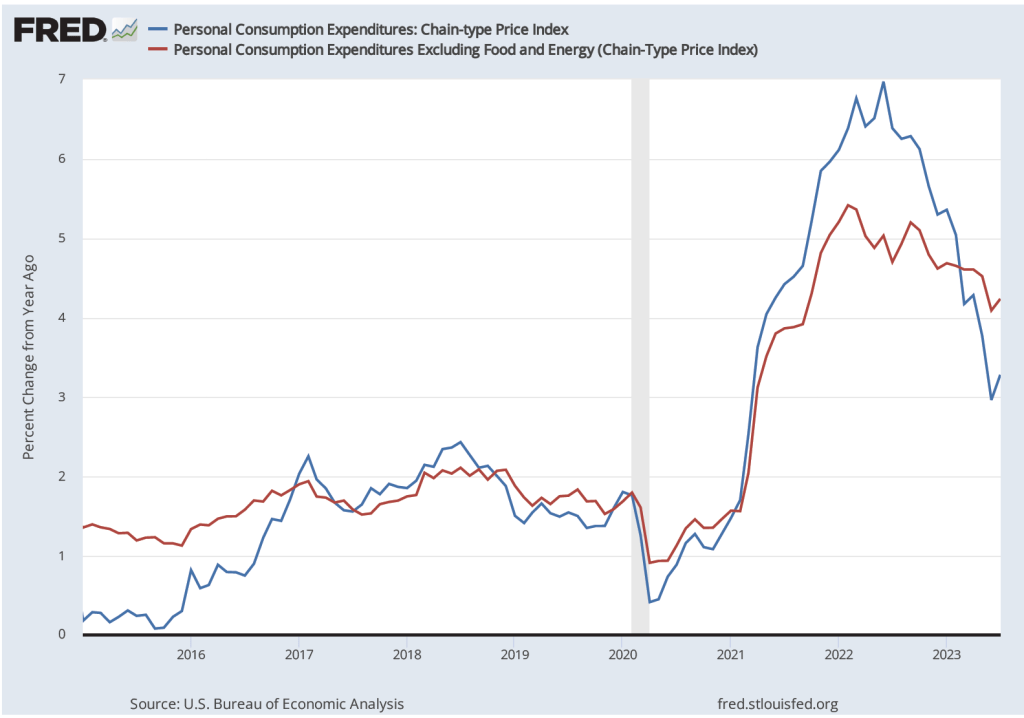
The following figure shows that for most of the period from late 2008 until the spring of 2021, the inflation rate as measured by the PCE was below the Fed’s 2 percent target. Beginning in the spring of 2021, inflation soared, reaching a peak of 7.0 percent in June 2022. Inflation declined over the following year, falling to 3.0 in June 2023. 

On August 25, at the Fed’s annual monetary policy symposium in Jackson Hole, Wyoming, Fed Chair Jerome Powell made clear that the Fed intended to continue a restrictive monetary policy until the inflation rate had returned to 2 percent: “It is the Fed’s job to bring inflation down to our 2 percent goal, and we will do so.” (The text of Powell’s speech can be found here.) Some economists have been arguing that once the Fed had succeeded in pushing the inflation rate back to 2 percent it should, in the future, consider raising its inflation target to 3 percent. At Jackson Hole, Powell appeared to rule out this possibility: “Two percent is and will remain our inflation target.”

Why might a 3 percent inflation target be preferrable to a 2 percent inflation target? Proponents of the change point to two key advantages:

  1. Reducing the likelihood of monetary policy being constrained by the zero lower bound. Because the federal funds rate can’t be negative, zero provides a lower bound on how much the FOMC can cut its federal funds rate target in a recession. Monetary policy was constrained by the zero lower bound during both the Great Recession of 2007–2009 and the Covid recession of 2020. Because an inflation target of 3 percent could likely be achieved with a federal funds rate that is higher than the FOMC’s current long-run target of 2.5 percent, the FOMC should have more room to cut its target during a recession.
  2. During a recession, firms attempting to reduce costs can do so by cutting workers’ nominal wages. But, as we discuss in Macroeconomics, Chapter 13, Section 13.2 (Economics, Chapter 23, Section 23.2 and Essentials of Economics, Chapter 15, Section 15.2), most workers dislike wage cuts. Some workers will quit rather than accept a wage cut and the productivity of workers who remain may decline. As a result, firms often use a policy of freezing wages rather than cutting them. Freezing nominal wages when inflation is occurring results in cuts to real wages.  The higher the inflation rate, the greater the decline in real wages and the more firms can reduce their labor costs without laying off workers.

Why would Powell rule out increasing the Fed’s target for the inflation rate? Although he didn’t spell out the reasons in his Jackson Hole speech, these are two main points usually raised by those who favor keeping the target at 2 percent:

  1. A target rate above 2 percent would be inconsistent with the price stability component of the Fed’s dual mandate. During the years between 2008 and 2021 when the inflation rate was usually at or below 2 percent, most consumers, workers, and firms found the inflation rate to be low enough that it could be safely ignored. A rate of 3 percent, though, causes money to lose its purchasing power more quickly and makes it less likely that people will ignore it. To reduce the effects of inflation people are likely to spend resources in ways such as firms reprinting menus or price lists more frequently or labor unions negotiating for higher wages in multiyear wage contracts. The resources devoted to avoiding the negative effects of inflation represent an efficiency loss to the economy.
  2. Raising the target for the inflation rate might undermine the Fed’s credibility in fighting inflation. One of the reasons that the Fed was able to bring down the inflation rate without causing a recession—at least through August 2023—was that the expectations of workers, firms, and investors remained firmly anchored. That is, there was a general expectation that the Fed would ultimately succeed in bringing the inflation back down to 2 percent. If expectations of inflation become unanchored, fighting inflation becomes harder because workers, firms, and investors are more likely to take actions that contribute to inflation. For instance, lenders won’t assume that inflation will be 2 percent in the future and so will require higher nominal interest rates on loans. Workers will press for higher nominal wages to protect themselves from the effects of higher inflation, thereby raising firms’ costs. Raising its inflation target to 3 percent may also cause workers, firms, and investors to question whether during a future period of high inflation the Fed will raise its target to an even higher rate. If that happens, inflation may be more persistent than it was during 2022 and 2023.

It seems unlikely that the Fed will raise its target for the inflation rate in the near future. But the Fed is scheduled to review its current monetary policy strategy in 2025. It’s possible that as part of that review, the Fed may revisit the issue of its inflation target.  

How Did the United States Reduce the Debt-to-GDP Ratio after World War II?

Main Gun Mount Assembly Plant, Northern Pump Co. Plant, Fridley, Minnesota, 1942. (Photo from the Franklin D. Roosevelt Presidential Library & Museum.)

To fight World War II, the federal government had to dramatically increase spending. As the following figure shows, total federal spending rose from $6.8 billion in 1940 to a peak of $100.1 billion in 1944. National defense spending made up most of the increase, rising from $2.8 billion in 1940 to $97.3 billion in 1944.

Part of the increased spending was paid for by increases in taxes. Total federal tax receipts rose from $6.2 billion in 1940 to $35.8 billion in 1945. Individual income taxes rose from $1.0 billion in 1940 to 18.6 billion in 1945. Tax rates were raised and the minimum income at which people had to pay tax on their income was reduced. From the introduction of the federal individual income tax in 1913 until 1940, only people who had at least upper middle class incomes paid any federal income taxes. Following the passage by Congress of the Revenue Act of 1942, most workers had to pay federal income taxes. In 1940, 7.4 million people had to pay federal individual income taxes. In 1945, 42.7 million people had to. For the first time, the federal government withheld taxes from workers paychecks. Previously, all taxes were due on March 15th of the year following the year being taxed. Milton Friedman, who in the 1970s won the Nobel Prize in Economics, was part of the team at the U.S. Treasury that designed and implemented the system of withholding income taxes. Withholding of individual income taxes has continued to the present day.

Although large, the increases in federal taxes were insufficient to fund the massive military spending required to win the war. As a result, the U.S. Treasury had to greatly increase its sales of Treasury bonds. Recall from Macroeconomics, Chapter 16, Section 16.6 (Economics, Chapter 26, Section 26.6 and Essentials of Economics, Chapter 18, Section 18.6) that the total value of outstanding Treasury bonds is called the federal government debt, sometimes called the national debt. The part of federal government debt held by the public rather than by government agencies, such as the Social Security Trust Funds, is call the public debt. In order to gauge the effects of the debt on the economy, economists typically look at the size of the public debt relative to GDP. The following figure shows the public debt as a percentage of GDP for the years from 1929 to 2022.

The figure shows that the ratio of debt to GDP increased sharply from 1929 to the mid-1930s, reflecting the federal budget deficits resulting from the Great Depression, and then soared beginning in 1940. Debt peaked at 113 percent of GDP in 1945 and then began a long decline that lasted until 1974, when debt had fallen to 23 percent of GDP. The ratio of debt to GDP then fluctuated until the Great Recession of 2007-2009 when it began a steady increase that turned into a surge during and after the Covid-19 pandemic. (We discuss the causes of the recent surge in debt in this blog post.)

What caused the long decline in the ratio of debt to GDP that began in 1946 and continued until 1974? The usual explanation is that the decline was not primarily due to the federal government paying off a signficiant portion of the debt. The public debt did decline from a peak of $241.9 billion in 1946 to $214.3 billion in 1949 but there were no significant declines in the level of the public debt after 1949. Instead the ratio of debt to GDP declined because GDP grew faster than did the debt.

Recently in a National Bureau of Economic Research Working Paper, “Did the U.S. Really Grow Out of Its World War II Debt?” Julien Acalin and Laurence M. Ball of Johns Hopkins University have analyzed the issue more closely. They conclude that economic growth played a smaller role in reducing the debt-to-GDP ratio than has previously been thought. In particular, they highlight the fact that for significant periods through the 1970s, the Treasury was able to pay a real interest rate on the debt that was lower than market rates. Lower real interest rates reduced the amount by which the debt might otherwise have grown.

As we discuss in Money, Banking, and the Financial System, Chapter 13, Section 13.2, in April 1942, to support the war effort, the Federal Reserve announced that it would fix interest rates on Treasury securities at low levels: 0.375 percent on Treasury bills and 2.5 percent on Tresaury bonds. This policy continued after the end of the war in 1945 until the Fed was allowed to abandon the policy of pegging the interest rates on Treasury securities following the March 1951 Treasury-Federal Reserve Accord. Acalin and Ball also note that even after the Accord, there were periods in which actual inflation was well above expected inflation, causing the real interest rate the Treasury was paying on debt to be below the expected real interest rate. In other words, part of the falling debt-to-GDP ratio was financed by investors receiving lower returns on their purchases of Treasury securities than they had expected to.

Acalin and Ball conclude that if the Treasury had not done the relatively small amount of debt repayment mentioned earlier and if it had had to pay market real interest rates on the debt, debt would have declined to only 74 percent of GDP in 1974, rather than to 23 percent.

Sources: The debt and GDP data are from the Congressional Budget Office, which can be found here, and from the Office of Management and the Budget, which can be found here.

The Surprising Effect of Weight-Loss Drugs on Monetary Policy in Denmark

Novo Nordisk production facility in Denmark (Photo from Bloomberg News via the Wall Street Journal.)

Like most other small European countries, imports and exports are more important in the Danish economy than in the U.S. economy.  In 2022, imports were 59 percent of Danish GDP and exports were 70 percent. In contrast, in 2022 imports were only 16 percent of U.S. GDP and exports were only 12 percent.

The Danish company Novo Nordisk makes the weight-loss prescription injections Ozempic and Wegovy. Because these and related pharmaceuticals are the first to result in significant weight loss among patients, demand for them has been very strong. (Note that some researchers believe that is not yet clear whether long-term use of these drugs might have side effects.) Demand has been so strong that Novo Nordisk’s market cap—the total value of its outstanding shares of stock—is now larger than Denmark’s GDP. According to the Wall Street Journal, Novo Nordisk now has the second largest market cap in Europe, behind only luxury good manufacturer LVMH Moët Hennessy Louis Vuitton

Most of Novo Nordisk’s customers are outside of Denmark, so to buy Ozempic or Wegovy, these customers much exchange their domestic currency—for example, euros, U.S. dollars, pounds, or yen—for Danish kroner. This increase in demand, increases the value of kroner relative to dollars, euros, and other currencies. (We discuss the effects of changes in demand and supply of a currency relative other currencies in Macroeconomics, Chapter 18, Section 18.2, Economics, Chapter 28, Section 28.2, and Essentials of Economics, Chapter 19, Section 19.6.)

Denmark has been a member of the European Union (EU), since the EU’s formation in 1991. But it is one of two EU countries (Sweden is the other) that has retained its own currency rather than using the euro. Because most of Denmark’s trade has traditionally been with other countries in the EU, the Danmarks Nationalbank, Denmark’s central bank, has pegged the value of the krone to the euro. Pegging makes it easier for Danish firms to plan because they know the prices their goods and services will sell for in eurozone countries. In addition, Danish firms that borrow in euros know how much in interest they will be paying in kroner. Finally, if the krone rises in value against other currencies, prices of imported goods and services will increase, raising the Danish inflation rate. (We discuss currency pegs in Macroeconomics, Chapter 18, Section 18.3, and Economics, Chapter 28, Section 28.3.) Inflation is a significant concern in Denmark because, as the following figure shows, the inflation rate reached 10.1 percent in October 2022. Although by July 2023, the inflation rate had decline to 3.1 percent, that rate was still above the Nationalbank’s inflation target of 2 percent.

Source: Statistics Denmark, dst.dk.

To keep the the krone pegged against the euro, the Nationalbank has to reduce the demand for the krone. The key tool that a central bank has to reduce demand for its country’s currency is interest rates. If the Nationalbank keeps interest rates in Denmark below interest rates in eurozone countries, investors will demand fewer kroner in exchange for euros. Accordingly, the Nationalbank as kept its key monetary policy rate below the corresponding rate set by the European Central Bank. In August the ECB’s policy rate was 3.75 percent, whereas the Nationalbank’s corresponding policy rate was 3.35 percent.

It’s unusual even for a small country that its central bank has to take steps to respond to a surge in demand for a single product. But that was the situation of the Danish central bank in 2023.

Sources: Joseph Walker, Dominic Chopping, and Sune Engel Rasmussen Wall Street Journal, August 17, 2023; Matthew Fox, “America’s Favorite Weight Loss Drugs Are Impacting Denmark’s Currency and Interest Rates,” finance.yahoo.com, August 18, 2023; Christian Weinberg, “Novo’s Value Surpasses Denmark GDP After Obesity Drug Boost,” bloomberg.com, August 9, 2023; Tom Fairless, “European Central Bank Raises Rates, Says Pausing Is an Option” Wall Street Journal, July 27, 2023; and “Official Interest Rates,” nationalbanken.dk.

The Price Elasticity of Demand for Subway and Bus Rides

Supports: Microeconomics, Chapter 6, Section 6.3, Economics, Chapter 6, Section 6.3, and Essentials of Economics, Chapter 7, Section 7.7.

New York City subway. (Photo from the New York Times.)

An article on Crain’s New York Business noted that the Metropolitan Transit Authority (MTA), which runs New York City’s public transportation system was increasing the fare for a bus or subway ride from $2.75 to $2.90. The article noted that: “Revenue generated by the fare increase is expected to cover the [MTA’s] operating expenses and help keep up with inflation.”

a.  What is the MTA assuming about the price elasticity of demand for subway and bus rides in New York City? How plausible do you find this assumption? Briefly explain.

b. What is the largest percentage decline in subway and bus rides that the MTA can experience and still meet its revenue expectations?

Solving the Problem

Step 1:  Review the chapter material. This problem is about the relationship between a price increase on quantity demanded and revenue, so you may want to review the section “The Relationship between Price Elasticity of Demand and Total Revenue.”

Step 2:  Answer part (a) by explaining what the MTA is assuming about the price elasticity of demand for subway and bus rides, and comment on the plausibility of this assumption. If the MTA is expecting that an increase in the price of a subway and bus ride will increase the total revenue it earns from these rides, it must be assuming that the demand for subway and bus rides is price inelastic. If the demand were price elastic, the MTA would earn less revenue following the price increase.

 As we saw in Chapter 6, Section 6.2, the most important determinant of elasticity is the existence of substitutes. In a big city, the most important substitutes to taking public transportation are: (1) people walking, (2) people driving their own cars, or (3) people using a ride-hailing service, such as Uber and Lyft.  People who live close to their destination and who were indifferent between walking and taking public transportation before the price increase, are likely to switch to walking. Given the size of a city like New York, we might expect the number of these people to be relatively small. Driving your own car in a big city has the drawback that heavy traffic may mean it takes longer to drive than to take the bus or subway and paying for parking can be expensive. Using Uber or Lyft is also much more expensive than taking public transportation and may also be slow. It seems likely that current users of public transportation in New York City don’t see these alternatives as close substitutes for the bus or subway. So, it’s plausible for the MTA to assume that the demand for subway and bus rides is price inelastic. 

Step 3:  Answer part (b) by calculating the largest percentage decline in bus and subway rides that the MTA can experience and still meet its revenue expectations. The MTA is increasing the price of subway and bus rides from $2.75 to $2.90 per ride. That is a ($0.15/$2.75) × 100 = 5.5 percent increase. (Note that we would get a somewhat different result if we used the midpoint formula described in Section 6.1.) For the MTA’s revenue to increase as a result of the price increase, the percentage decrease in the quantity demanded of subway rides must be less than the percentage increase in the price. Therefore, the price increase can’t result in a decline of more than 5.5 percent. 

Source:  Caroline Spivak, “Subway and Bus Fares Will Increase Starting Sunday,” crainesnewyork.com, August 18, 2023.