
Image created by ChatGPT
Today’s report on the consumer price index (CPI) from the Bureau of Labor Statistics (BLS) provided mixed news about inflation. The rate of inflation slowed in October as energy inflation eased, but food inflation accelerated and inflation in other goods and services remained high. The report makes it likely that members of the Federal Reserve’s policymaking Federal Open Market Committee (FOMC) will raise the committee’s target for the federal funds rate at its next meeting on December 8–9.
The following figure compares headline CPI inflation (the blue line) and core CPI inflation (the red line).
- Normally, we measure the headline inflation rate by the percentage change in the CPI from the same month in the previous. But, because of a federal government shutdown, there is no CPI data for October 2025. Instead, the figure shows the percentage change in the CPI from the previous month. The CPI increased by 0.35 percent in October, which was down from 0.65 percent in September.
- The core inflation rate, which excludes the prices of food and energy, was 0.30 percent in October, down from 0.33 percent in September.
Headline inflation and core inflation were both higher than the forecasts of economists surveyed by FactSet.
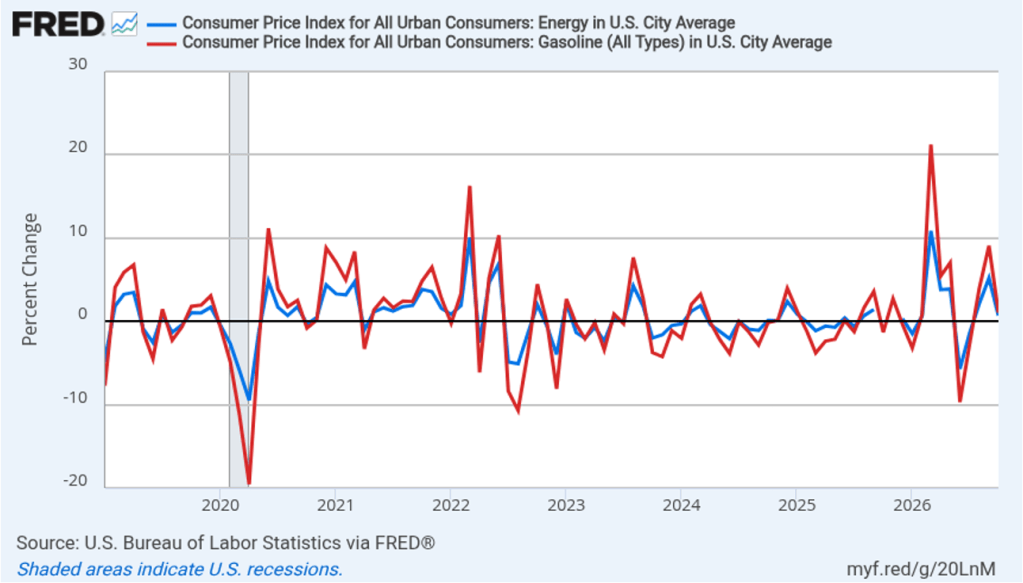
In the following figure, we look at the 1-month inflation rate for headline and core inflation—that is the annual inflation rate calculated by compounding the current month’s rate over an entire year. Calculated as the 1-month inflation rate, headline inflation (the blue line) declined from a very high 8.1 percent in September to a still high 4.3 percent in October. Core inflation (the red line) declined from 4.1 percent in September to 3.6 percent in October.
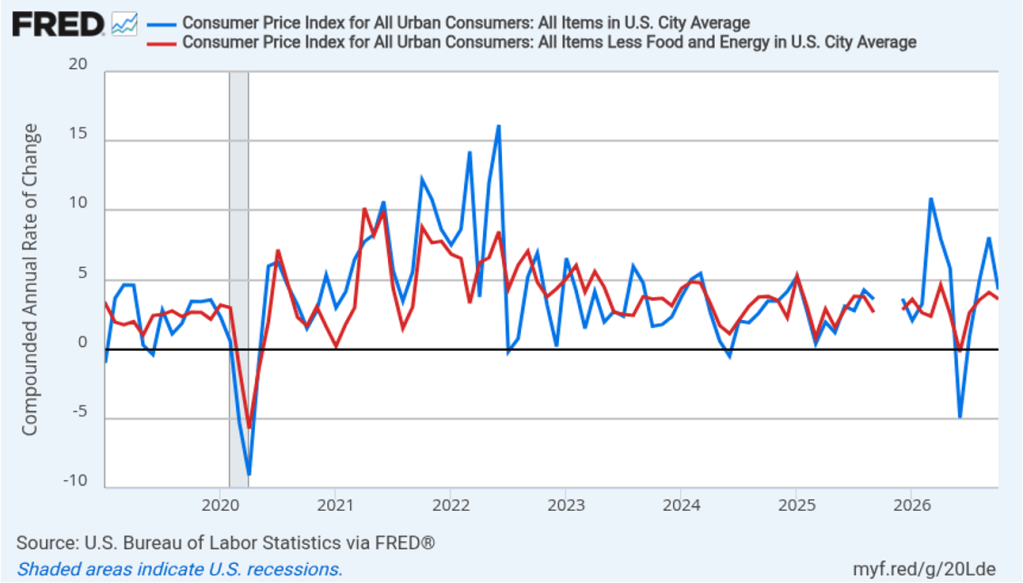
We can also look at 3-month Inflation—that is the inflation rate over the three months prior to the current month, expressed as an annual rate. The following figure shows the 3-month inflation rate for each month since January 2019. The 3-month headline inflation rate in October was 5.7 percent, up from 4.6 percent in September. The 3-month core inflation in October was 3.7 percent, up from 3.4 percent in September. So inflation over the last three months has been well above the Fed’s 2 percent annual inflation target.
Note, though, that the Fed uses the 12-month change in the personal consumption expenditures (PCE) price index, not the change in the CPI, when gauging whether it is meeting its 2 percent annual inflation target. Historically, PCE inflation has been about 0.4 percentage points to 0.5 percentage points lower than CPI inflation. The Bureau of Economic Analysis (BEA) won’t release its estimate of October PCE inflation until November 25.
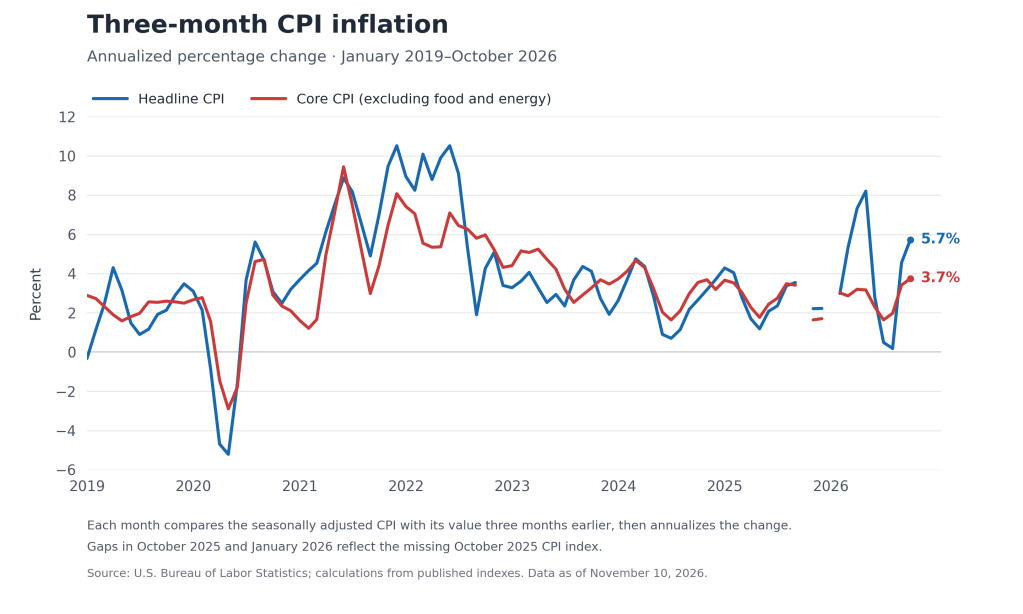
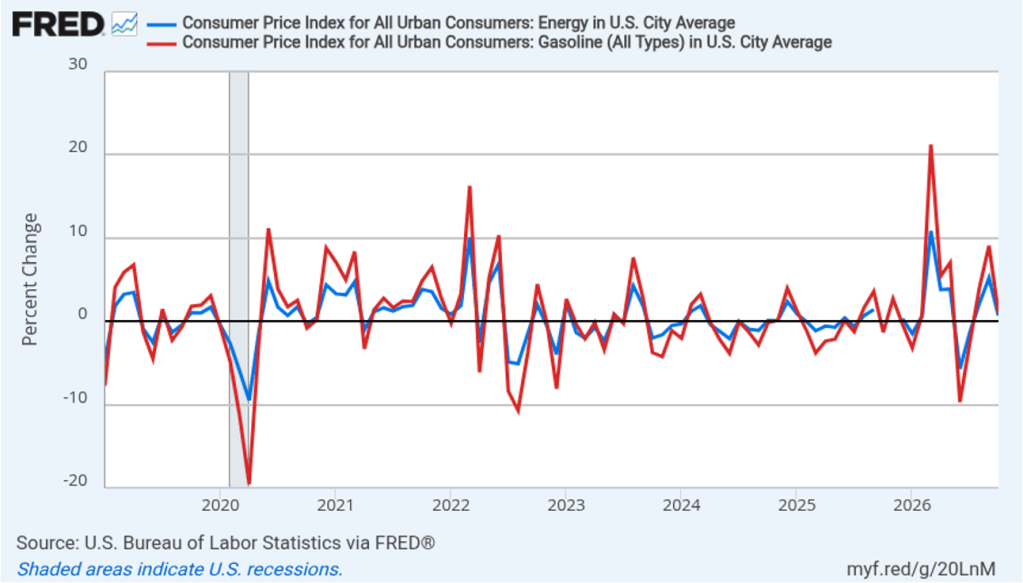
The fact that the gap between headline and core inflation narrowed in October compared with September is explained by a sharp decline in the rate of increase in energy prices. In the following figure, the red line shows the inflation rate in all energy prices included in the CPI, measured as the percentage change from the previous month. Inflation in energy prices was 1.0 percent in October, down from 5.2 percent in September. The blue line shows the monthly inflation rate in gasoline prices, which was also 1.0 percent in October, down from 9.1 percent in September.
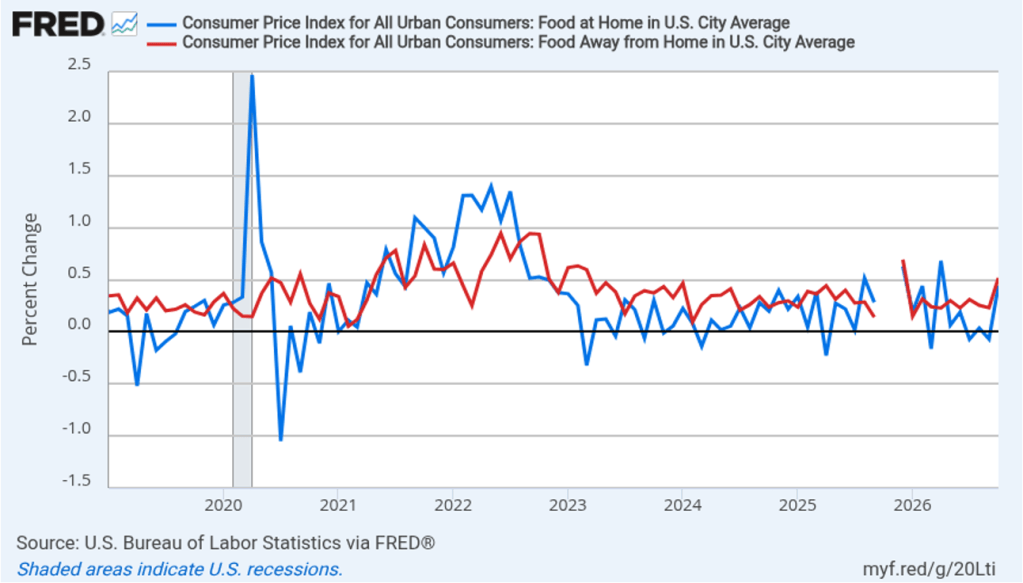
In October, while inflation in energy prices slowed, inflation in food prices increased. The following figure shows inflation, measured as the percentage change from the previous month, in the CPI category “food at home” (the blue bar)—primarily food purchased at grocery stores—and in the category “food away from home” (the red bar)—primarily food purchased at restaurants. Grocery prices increased 0.52 percent in October, up from –0.07 percent in September (when grocery prices slightly declined). Restaurant prices also increased 0.52 percent October, up from 0.23 percent in September.
Today’s report showing that inflation remains persistently above the Fed’s 2 percent annual target has made it more likely that Federal Reserve policymakers will increase their target range for the federal funds rate from the current 3.75 percent to 4.00 percent by o.25 percentage points (or 25 basis points) at the next meeting of the FOMC on December 8–9. The inflation report has also increased speculation that the committee may increase its target range by 50 basis points. In recent speeches, both Fed Governor Christopher Waller and Federal Reserve Bank of Dallas President Lorie Logan have raised that possibility.
Trading in the federal funds futures market this afternoon indicates that investors assign an 88.2 percent probability to the FOMC raising its target range by 25 basis points at its December meeting, which is up from an 84.0 percent probability yesterday. Trading indicated that investors assign an 11.8 percent probability to the committee increasing its target range by 50 basis points at that meeting, up from 0 percent yesterday.

