Image created by ChatGPT
In Macroeconomics, Chapter 16 (Economics, Chapter 26), we discuss the problems facing the Social Security system. In this opinion column, which first appeared on the website of the Economist, Glenn discusses a new approach to discovering the views of the public on possible reforms to the system.
America Needs a Citizens’ Assembly to Reform Social Security
Of the various fiscal challenges faced by America, the one the public feels most keenly is the looming crisis in Social Security. It also presents an opportunity for a bold reform process outside the polarised and dysfunctional electoral process, built around consulting a sample of voters directly in a citizens’ assembly. This would have the twin benefits of bypassing both voters’ mistrust of politicians and politicians’ incomplete understanding of voters’ attitudes towards reform.
Voters are clearly ready for reform. Recent polling of swing-state voters by the Peterson Foundation, an organisation launched to promote fiscal responsibility, revealed broad opposition to inaction and support for reforms including raising the earnings cap subject to the payroll tax and capping Social Security benefits for better-off households. Only 17% of voters said they were likely to support a candidate in the upcoming midterms who promised not to touch the current system.
Social Security pays retirement benefits to 62m Americans and disability benefits to another 8m. But the 2026 Social Security Trustees Report (sstr) predicts that the system’s trust funds will be exhausted in 2032, and if no action is taken by Congress, benefits will need to be cut across the board by 22% at that time.
Elected officials have responded in a now-familiar way, with a proposal for a 13-member commission of members of Congress and experts. Historically, a commission held promise: one assembled in 1981 and commonly known as the Greenspan Commission after its chairman, Alan Greenspan, offered a sensible roadmap for gradual reforms in 1983. Today, such an approach, however well intentioned, is likely to fail, given how out-of-balance the system is. According to the sstr, it faces an actuarial deficit of 4.4% of payroll annually for the next 75 years. Tackling that via a commission would have been extremely difficult in the 1980s. Doing so today, with public trust in government and experts a lot lower, looks impossible. According to the Pew Research Centre, just 17% of Americans trust the federal government to do “what is right” always or most of the time, down from around 40% in the early 1980s.
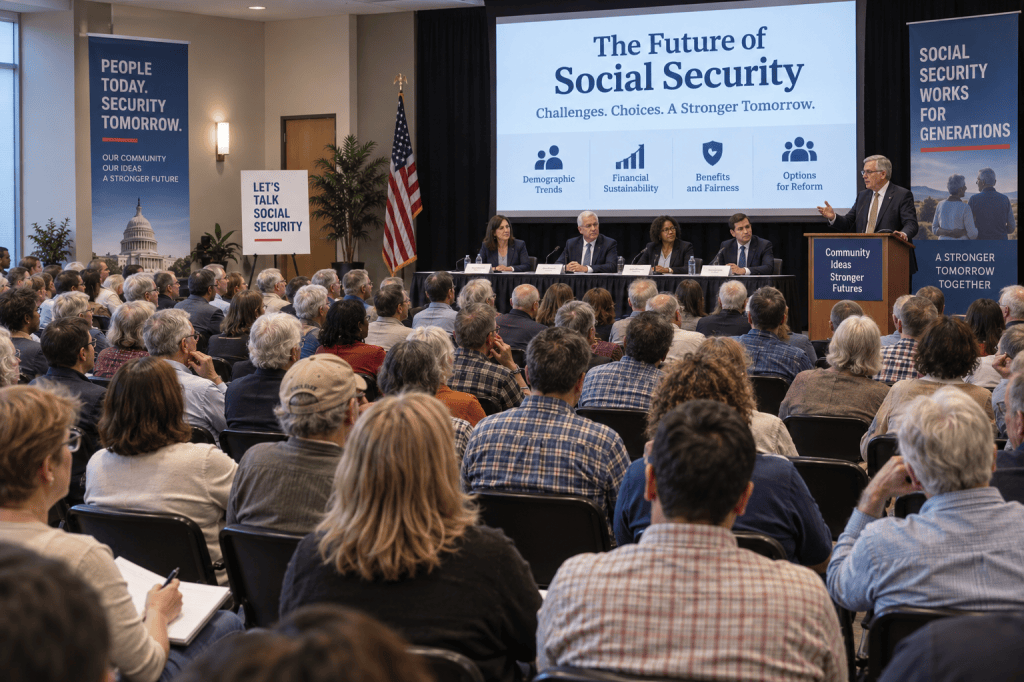
America needs to experiment more boldly this time by entrusting the big decisions to voters, via a citizens’ assembly tasked with presenting clear options to elected officials. Social Security reform offers a logical use case for such an approach because the areas where change is needed are clearly delineated: retirement age, benefit formulas and the level and structure of taxation. And it can give insight to politicians about voters’ real views about the thorny economic and political trade-offs that will need to be made.
Citizens’ assemblies date back to ancient Athens as a way to inform democracy. In the modern era they have been used in several countries, including Belgium, France and Ireland, to develop policy. In Ireland, for example, recent citizens’ assemblies illustrated to politicians that attitudes towards abortion and same-sex marriage had changed more than legislators had realised.
A citizens’ assembly can help to break through policy gridlock by allowing ideas to be developed and debated in a higher-trust environment than a commission drawn from politicians and experts in whom the public has declining faith. Moreover, the ideas emerging from an assembly can sometimes reveal the “Overton window”—the range of reforms that the public can live with at that particular time—better than elected leaders can alone, as seen in the Irish case.
Three steps are critical to the success of any citizens’ assembly. The first concerns its composition. Its members, typically 50-100, should be chosen by lot, as with candidates for a jury. It should be an electorate in miniature, representative of the nation’s social strata and demography. Towards this end, sampling should be random to avoid simply selecting volunteers with particular upfront points of view. Those selected should be compensated for their time and expenses. Structured in this way, the citizens’ assembly can channel mistrust of politicians towards a reclaimed populism of actual voters’ input, not slogans.
Second, per the advice of William McChesney Martin, a former chair of the Federal Reserve, experts should be on tap, not on top. In contrast to the typical commission, experts’ role would be to provide information, not to suggest prescriptions. That would allow an assembly to develop reform options that reveal genuine voter sentiment, while neutralising populist mistrust of experts.
Third, politicians and their existing institutions need to support the work of the assembly. Congress should signal strongly that it will give serious consideration to proposals coming out of an assembly—and commit to an up-or-down vote on them, as with the process for military-base closures in 1988. Elected officials should not need reminding about the large benefit reductions that will kick in as a result of a failure to act by 2032.
Selection, expert input and politicians’ commitment map well into Social Security reform. Over multiple sessions (the Irish deliberation on abortion unfolded over several weekends in a six-month period) the assembly would agree upon objectives and principles, a menu of reform options and a recommendation for formal consideration by Congress. Outside experts would provide background information on design choices (say, refining the current system or moving, for example, to a system with a flat benefit for all) and the budget and individual tax-and-benefit consequences of options (say, changes in the retirement age, payroll tax, and benefit level and structure). With this input, the assembly would evaluate options with both principles and political feasibility in mind.
Such an assembly offers an opportunity for meaningful action before the 2032 deadline. Were it successful, that would also provide momentum in related areas, such as the need for budget consolidation and policies towards artificial intelligence.
Social Security reform is stuck in deep political mud. A citizens’ assembly might just be the way to free it. It’s surely worth a tr