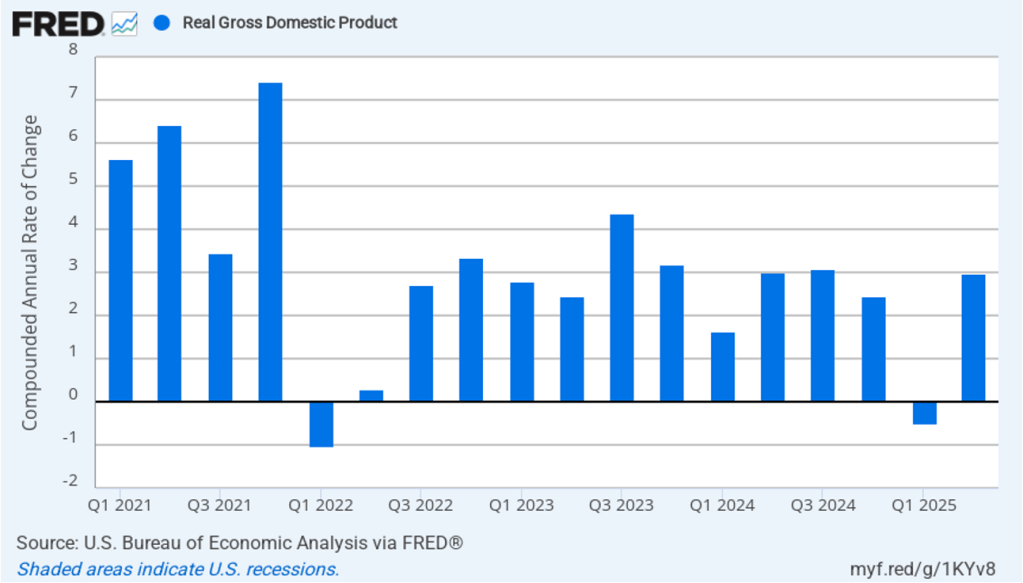
This morning (July 30), the Bureau of Economic Analysis (BEA) released its advance estimate of real GDP for the first quarter of 2025. (The report can be found here.) The BEA estimates that real GDP increased by 3.0 percent, measured at an annual rate, in the second quarter—April through June. Economists surveyed had expected a 2.4 percent increase. Real GDP declined by an estimated 0.5 percent in the first quarter of 2025, so the increase in the second quarter represents a strong rebound in economic growth. The following figure shows the estimated rates of GDP growth in each quarter beginning with the first quarter of 2021.
As the following figure—taken from the BEA report—shows, the decrease in imports in the second quarter was the most important factor contributing to the increase in real GDP. During the first quarter, imports had soared as businesses tried to stay ahead of what were expected to be large tariff increases implement by the Trump Administration. Consumption spending increased in the second quarter, while investment spending and exports decreased.
It’s notable that real private inventories declined by $29.6 billion in the second quarter after having increased by $2070 billion in the first quarter. Again, it’s likely that the large swings in inventories represented firms stockpiling goods in the first quarter in anticipation of the tariff increases and then drawing down those stockpiles in the second quarter.
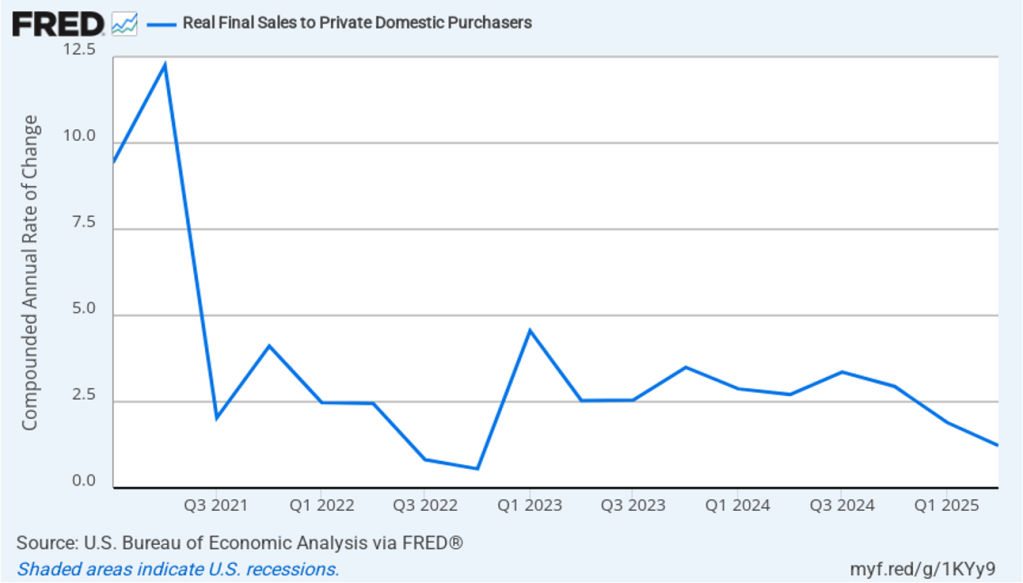
One way to strip out the effects of imports, inventory investment, and government purchases—which can also be volatile—is to look at real final sales to domestic purchasers, which includes only spending by U.S. households and firms on domestic production. As the following figure shows, real final sales to domestic purchasers increased by 1.2 percent in the second quarter of 2025, which was a decrease from the 1.9 percent increase in the first quarter. The large difference between the change in real GDP and the change in real final sales to domestic purchasers is an indication of how strongly the data on national income in the first two quarters of 2025 were affected by businesses anticipating tariff increases. Compared with data on real GDP, data on real final sales to domestic purchasers shows the economy doing significantly better in the first quarter and significantly worse in the second quarter.
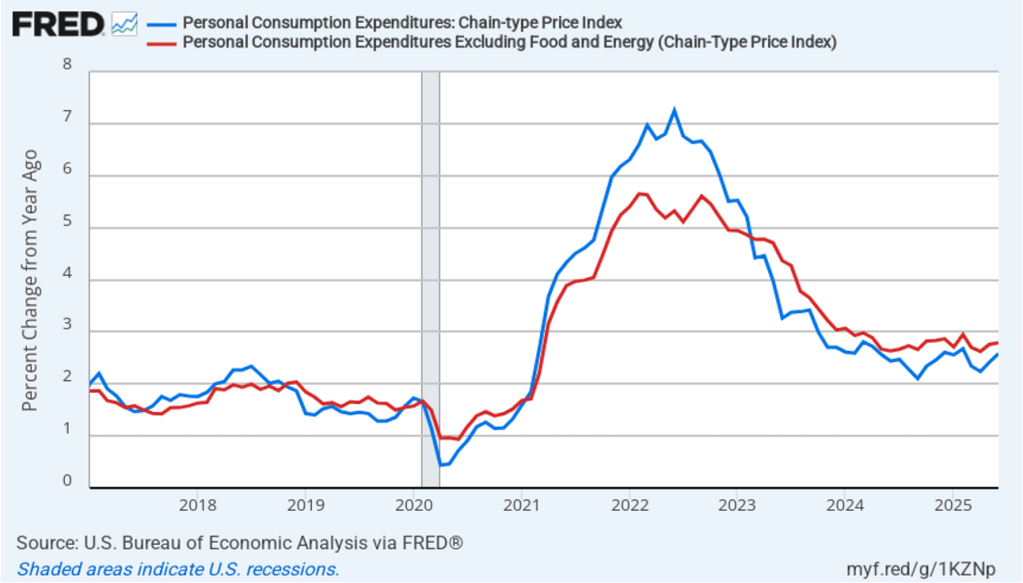
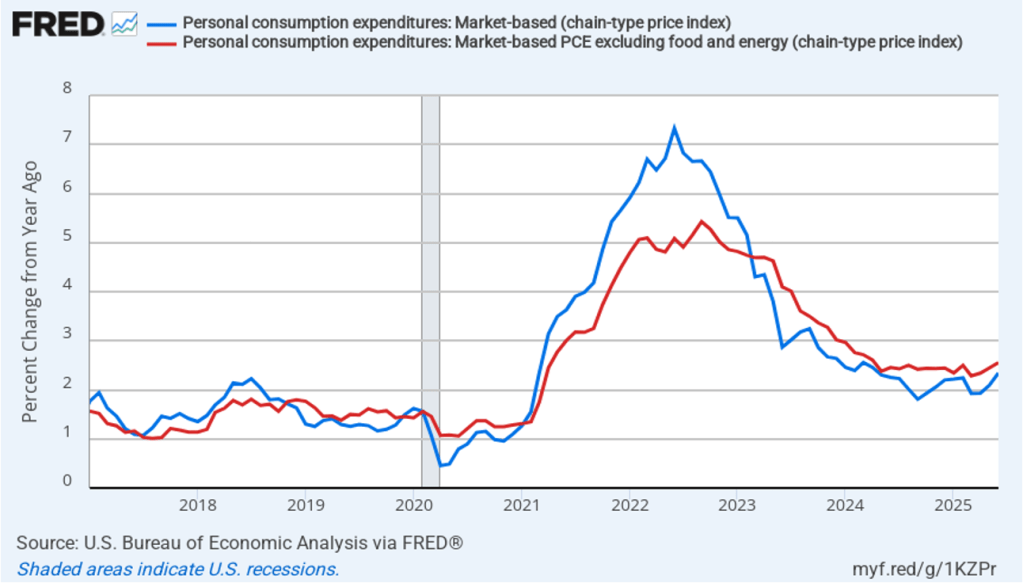
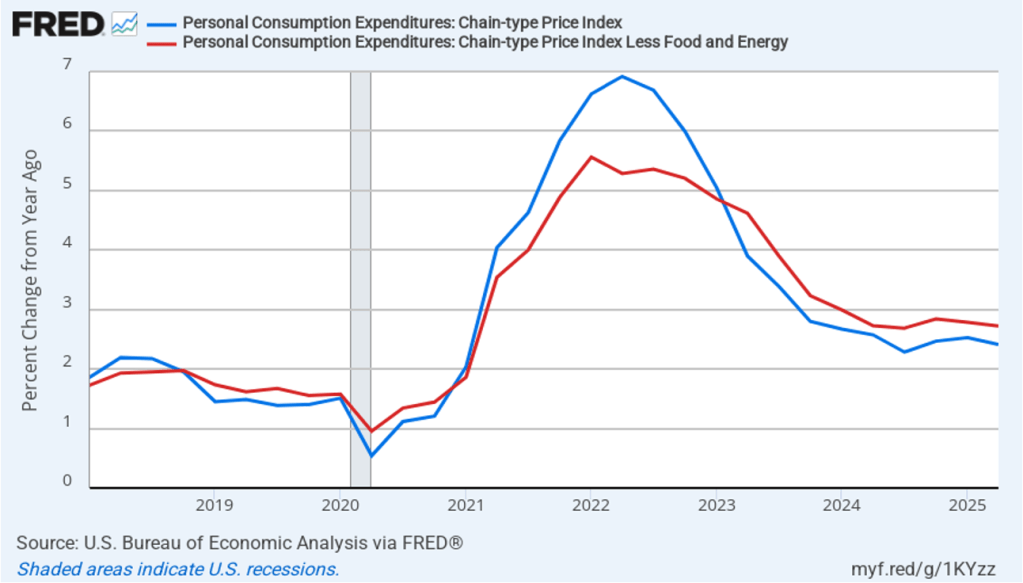
The BEA report this morning included quarterly data on the personal consumption expenditures (PCE) price index. The Fed relies on annual changes in the PCE price index to evaluate whether it’s meeting its 2 percent annual inflation target. The following figure shows headline PCE inflation (the blue line) and core PCE inflation (the red line)—which excludes energy and food prices—for the period since the first quarter of 2018, with inflation measured as the percentage change in the PCE from the same quarter in the previous year. In the second quarter, headline PCE inflation was 2.4 percent, down slightly from 2.5 percent in the first quarter. Core PCE inflation in the second quarter was 2.7 percent, down from 2.8 percent in the first quarter. Both headline PCE inflation and core PCE inflation remained above the Fed’s 2 percent annual inflation target.
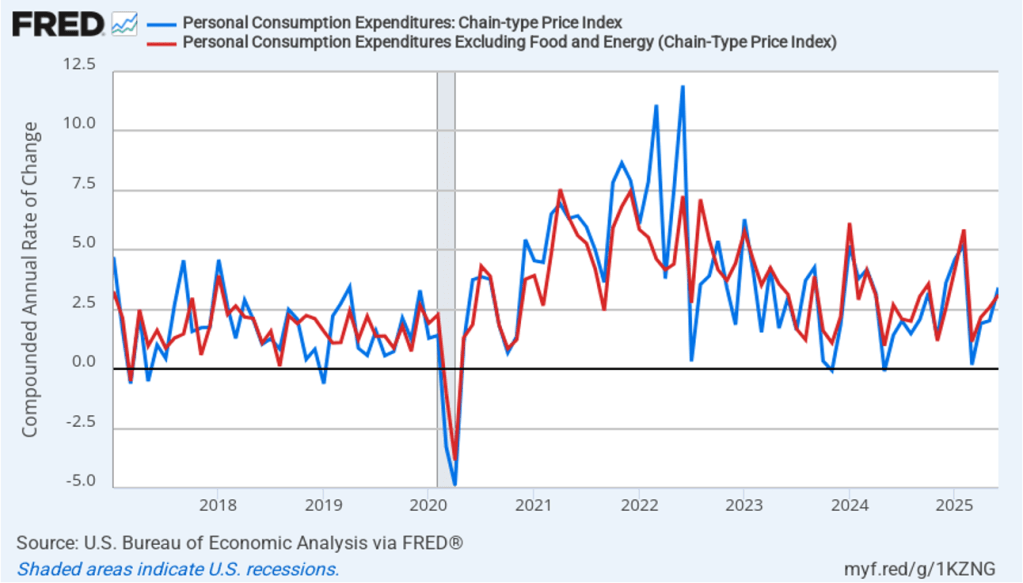
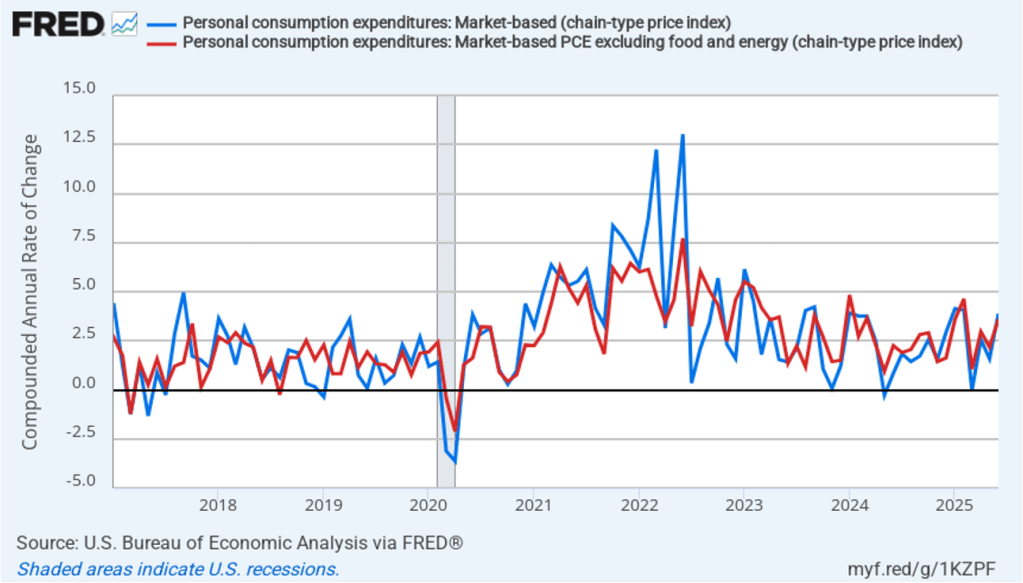
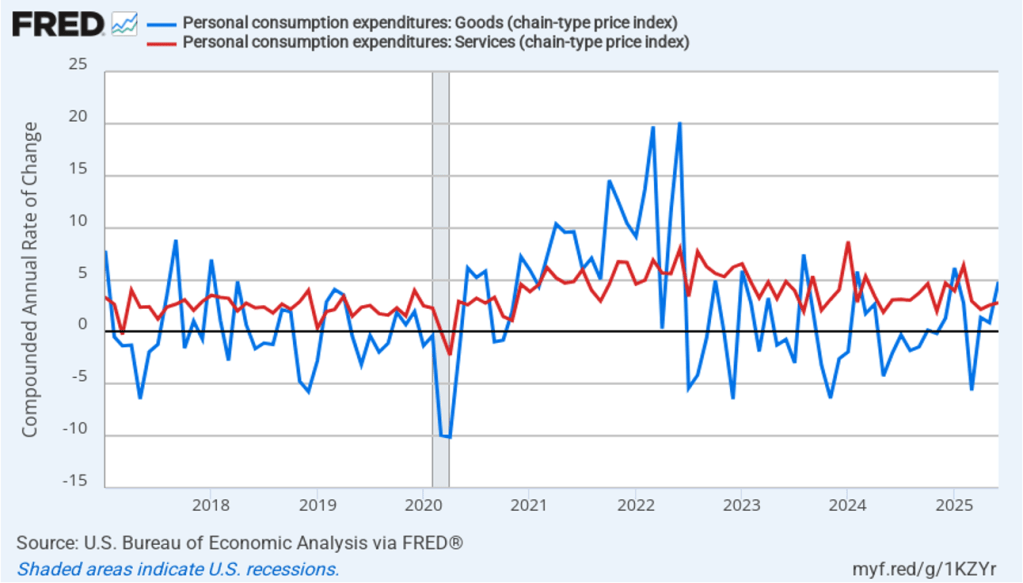
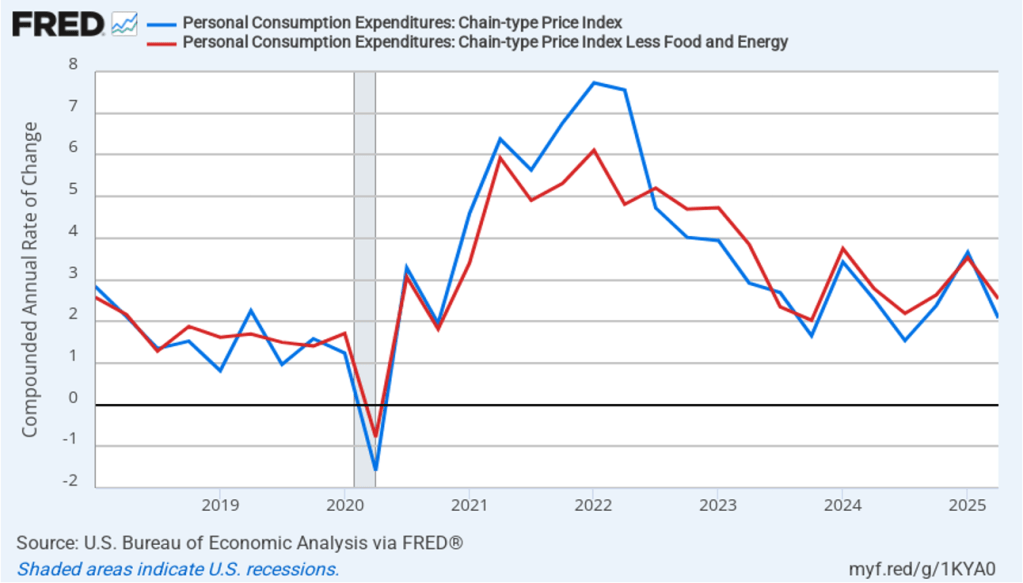
The following figure shows quarterly PCE inflation and quarterly core PCE inflation calculated by compounding the current quarter’s rate over an entire year. Measured this way, headline PCE inflation decreased from 3.7 percent in the first quarter of 2025 to 2.1 percent in the second quarter. Core PCE inflation decreased from 3.5 percent in the first quarter of 2025 to 2.5 percent in the secondt quarter. Measured this way, headline PCE inflation in the second quarter was close to the Fed’s target, while core PCE was well above the target. As we discuss in this blog post, tariff increases result in an aggregate supply shock to the economy. As a result, we may see a significant increase in inflation in the coming months as the higher tariff rates that have been negotiated recently begin to be implemented.
Supports:Microeconomics and Economics, Chapter 15, Section 15.5, and Essentials of Economics, Chapter 10, Section 10.5
Image generated by ChatGTP 03
According to a recent article in the Economist, some U.S. airlines have “started charging higher per-person fares for single-passenger bookings than for identical itineraries with two people.” However, the difference in fares held only for round-trip tickets that included a weekday return flight. For round-trip tickets with a return flight on Saturday, the per-ticket price was the same whether booking for two people or for one person. Briefly explain why an airline might expect to increase its profit using this pricing strategy.
Step 1: Review the chapter material. This problem is about firms using price discrimination, so you may want to review Chapter 15, Sections 15.5
Step 2: Answer the question by explaining why an airline might expect to increase its profit by charging people traveling alone a higher ticket price than the price it charges per ticket to two people traveling together. The airline is attempting to increase its profit by using price discrimination. Price discrimination involves charging different prices to different customers for the same good or service when the price difference isn’t due to differences in cost. Firms who able to price discriminate increase their profits by doing so.
In Chapter 15, Section 15.5, we call the airlines the “kings of price discrimination” because they often charge many different prices for tickets on the same flight. One key way that airlines practice price discrimination is by charging higher prices to business travelers—who are likely to have a lower price elasticity of demand—than to leisure travelers—who are likely to have a higher price elasticity of demand. To employ this strategy, airlines have to successfully identify which flyers are business travelers. Someone flying alone is more likely than someone flying in a group of two or more people to be a business traveler. In addition, business travelers often attempt to complete their trips before the weekend. Therefore, people returning from a trip on a Saturday or Sunday are more likely to be leisure travelers.
We can conclude that an airline can expect to increase its profit using the pricing strategy discussed in the Economist article because the strategy helps the airline to better identify business travelers.
A number of news stories have highlighted the struggles some recent college graduates have had in finding a job. A report earlier this year by economists Jaison Abel and Richard Deitz at the Federal Reserve Bank of New York noted that: “The labor market for recent college graduates deteriorated noticeably in the first quarter of 2025. The unemployment rate jumped to 5.8 percent—the highest reading since 2021—and the underemployment rate rose sharply to 41.2 percent.” The authors define “underemployment” as “A college graduate working in a job that typically does not require a college degree is considered underemployed.”
The following figure shows data on the unemployment rate for people ages 20 to 24 years (red line) with a bachelor’s degree, the unemployment rate for people ages 25 to 34 years (blue line) with a bachelor’s degree, and the unemployment rate for the whole population (green line) whatever their age and level of education. (Note that the values for college graduates are for those people who have a bachelor’s degree but no advanced degree, such as a Ph.D. or an M.D.)
The figure shows that unemployment rates are more volatile for both categories of college graduates than the unemployment rate for the population as a whole. The same is true for the unemployment rates for nearly any sub-category of the unemployed lagely because the number of people included the sub-categories in the Bureau of Labor Statistics (BLS) household survey is much smaller than for the population as a whole. The figure shows that, over time, the unemployment rates for the youngest college graduates is nearly always above the unemployment rate for the population as a whole, while the unemployment rate for college graduates 25 to 34 years old is nearly always below the unemployment rate for the population as a whole. In June of this year, the unemployment rate for the population as a whole was 4.1 percent, while the unemployment for the youngest college graduates was 7.3 percent.
Why is the unemployment rate for the youngest college graduates so high? An article in the Wall Street Journal offers one explanation: “The culprit, economists say, is a general slowdown in hiring. That hasn’t really hurt people who already have jobs, because layoffs, too, have remained low, but it has made it much harder for people who don’t have work to find employment.” The following figure shows that the hiring rate—defined as the number of hires during a month divided by total employment in that month—has been falling. The hiring rate in June was 3.4 per cent, which—apart from two months at the beginning of the Covid pandemic—is the lowest rate since February 2014.
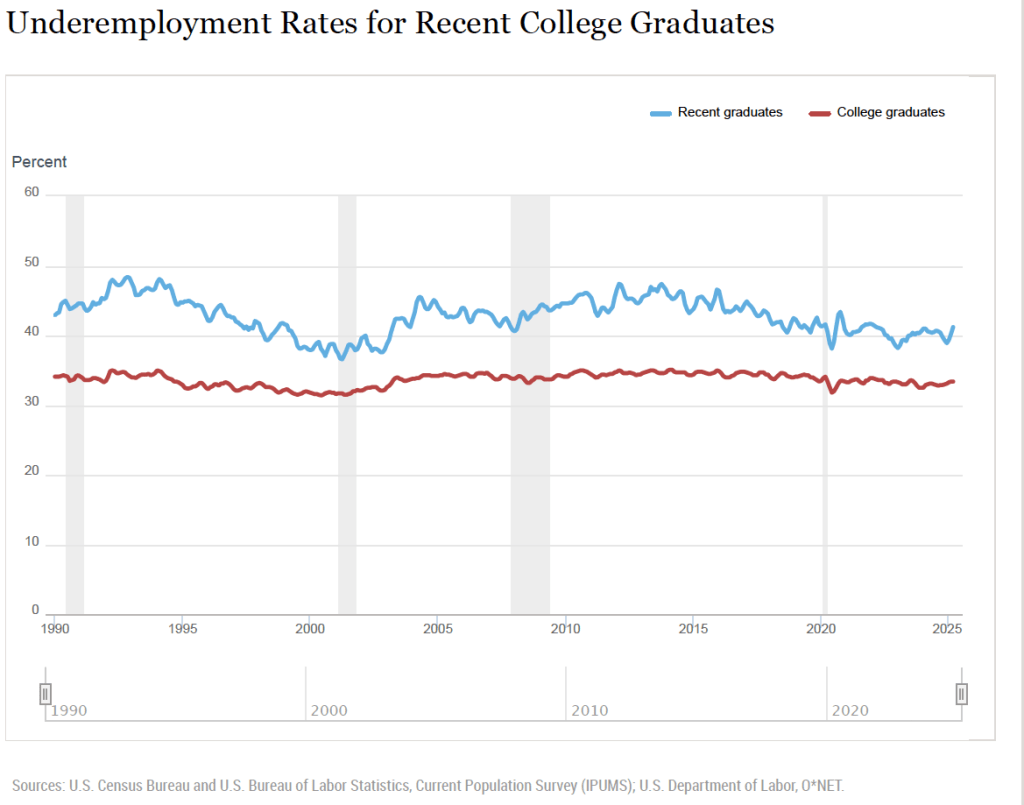
Abel and Deitz, of the New York Fed, have calculated the underemployment for new college graduates and for all college graduates. These data are shown in the following figure from the New York Fed site. The definitions used are somewhat different from the ones in the earlier figures. The definition of college graduates includes people who have advanced degrees and the definition of young college graduates includes people aged 22 years to 27 years. The data are three-month moving averages.
The data show that the underemployment rate for both recent graduates and all graduates are relatively high for the whole period shown. Typically, more than 30 percent of all college graduates and more than 40 percent of recent college graduates work in jobs in which more than 50 percent of employees don’t have college degrees. The latest underemployment rate for recent graduates is the highest since March 2022. It’s lower, though, than the rate for most of the period between the Great Recession of 2007–2009 and the Covid recession of 2020.
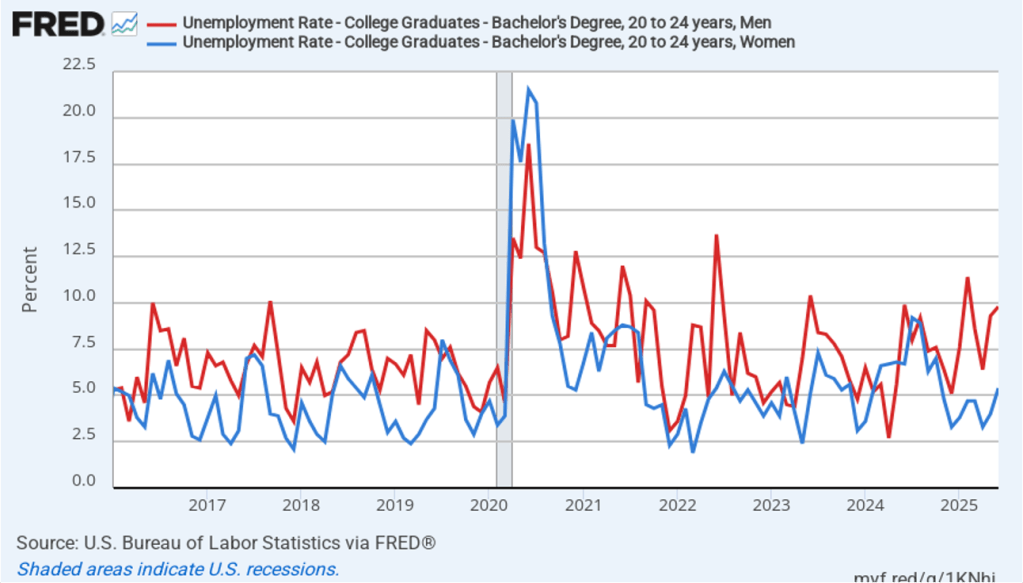
In a recent article, John Burn-Murdoch, a data journalist for the Financial Times, has made the point that the high unemployment rates of recent college graduates are concentrated among males. As the following figure shows, in recent months, unemployment rates among male college graduates 20 to 24 years old have been significantly higher than the unemployment rates among female college graduates. In June 2025, the unemployment rate for male recent college graduates was 9.8 percent, well above the 5.4 percent unemployment for female recent college graduates.
What explains the rise in male unemployment relative to female unemployment? Burn-Murdoch notes that, contrary to some media reports, the answer doesn’t seem to be that AI has resulted in a contraction in entry-level software coding jobs that have traditionally been held disproportionately by males. He presents data showing that “early-career coding employment is now tracking ahead of the [U.S.] economy.”
Instead he believes that the key is the continuing strong growth in healthcare jobs, which have traditionally been held disproportionately by females. The availability of these jobs has allowed women to fare better than men in an economy in which hiring rates have been relatively low.
Like most short-run trends, it’s possible that the relatively high unemployment rates experienced by recent college graduates may not continue in the long run.
Supports:Microeconomics, Macroeconomics, Economics, and Essentials of Economics, Chapter 4, Section 4.3
Image generated by ChatGTP-40 of a street in a Dutch city.
An article on bloomberg.com has the headline “How Rent Controls Are Deepening the Dutch Housing Crisis.” The article’s subheadline states that: “A law designed to make homes more affordable ended up aggravating an apartment shortage.” According to the article, the Dutch government passed a law that increased the number of apartments subject to rent control from 80% of all apartments to 96%.
Why might the Dutch government have seen expanding rent control as a way to make apartments more affordable?
Why might the law have aggravated the shortage of apartments in Holland?
Solving the Problem Step 1: Review the chapter material. This problem is about the effects of rent control, so you may want to review Chapter 4, Section 4.3, “Government Intervention in the Market: Price Floors and Price Ceilings.”
Step 2: Answer part a. by explaining why the Dutch government may have seen expanding rent control as a way to make apartments more affordable. Figure 4.10 from the textbook shows the effects of rent control. In the example illustrated in the figure, after the government imposes rent control, the 1,900,000 people who are still able to rent an apartment pay $1,500 per month rather than $2,500 per month. For these people, rent control has made apartments more affordable.
Step 3: Answer part b. by explaining why rent control laws can make an apartment shortage worse. As Figure 4.10 shows, rent control laws impose a price ceiling below the equilibrium market rent. The result is that the quantity of apartments supplied is less than the quantity of apartments demanded, causing a shortage of apartments. In the case of the Dutch law discussed in the article, existing rent controls were expanded to cover more apartments, forcing the rents charged by landlords for these apartments to fall below what had been the equilibrium market rent, thereby adding to the shortage of apartments in Holland.
Extra credit: The article notes that as a result of the law, some owners of apartments that had previously not been subject to rent control had decided to sell their apartments, taking them off the rental market. That result is common when governments impose rent control or expand the scope of an existing rent control law. One important aspect of rent control is that a shortage of apartments gives landlords a greater opportunity to pick and choose the tenants they prefer. The article notes that a provision of the new law requires that rental contracts be open-ended, rather than for only one or two years, as is more common. As a result, landlords have more difficulty evicting tenants who might be noisy or causing other problems. The law thereby gives landlords an incentive to rent to foreign tenants who would be more likely to give up their apartments voluntarily after a year or two. The result is even fewer apartments available for Dutch residents to rent.
A recent article on bloomberg.com notes that the negative consequences of the law expanding rent control has led the Dutch government to propose modifying the law to allow landlords to charge higher rents on at least some apartments. If passed by the Dutch parliment, the changes would go into effect January 1, 2026.
Supports:Microeconomics and Economics, Chapter 15, Section 15.5, and Essentials of Economics, Chapter 10, Section 10.5
Image generated by ChatGTP-4o
A national provider of cable television and internet service has been frequently criticized by customers on social media for using the following business strategy: The company raises its prices every six to nine months. Any subscriber who calls to complain is offered a discount off of the price increase. Analyze how this strategy can be profit mazimizing for the company.
Step 1: Review the chapter material. This problem is about firms using price discrimination, so you may want to review Chapter 15, Sections 15.5
Step 2: Answer the question by explaining how the cable company is using price discrimination to increase its profit. Price discrimination involves charging different prices to different customers for the same good or service when the price difference isn’t due to differences in cost. Firms who able to price discriminate increase their profits by doing so.
We’ve seen that there are three requirements for a firm to practice price discrimination: 1) The firm must possess market power, 2) some of the firm’s customers much have a greater willingness to pay for the product than do other customers, and 3) the firm must be able to segment the market to keep customers who buy the product at the low price from reselling it. Cable companies can meet all three requirements. Cable firms possess market power—they aren’t perfect competitors. Some customers have a higher willingness than other customers to pay for cable service. In fact, many people have become cable cutters and prefer to stream content rather than watch programs on cable. Finally, someone who receives a lower-priced cable subscription can’t resell it.
To increase profit by price discrimination, a firm needs to charger a higher price to customers with a lower price elasticity of demand, and a lower price to customers with a higher price elasticity of demand. People who call up to complain about an increase in the price of a cable subscription are likely to be more price sensitive—and, therefore, more likely to switch to a competing cable company or to cut the cable and switch to streaming—than are people who don’t complain about the increase in the price of a subscription. In other words, the complainers have a higher price elasticity of demand than do the non-complainers and receive a lower price. We can conclude that this business strategy is an example of price discrimination and will increase the profit of the cable company that uses it.
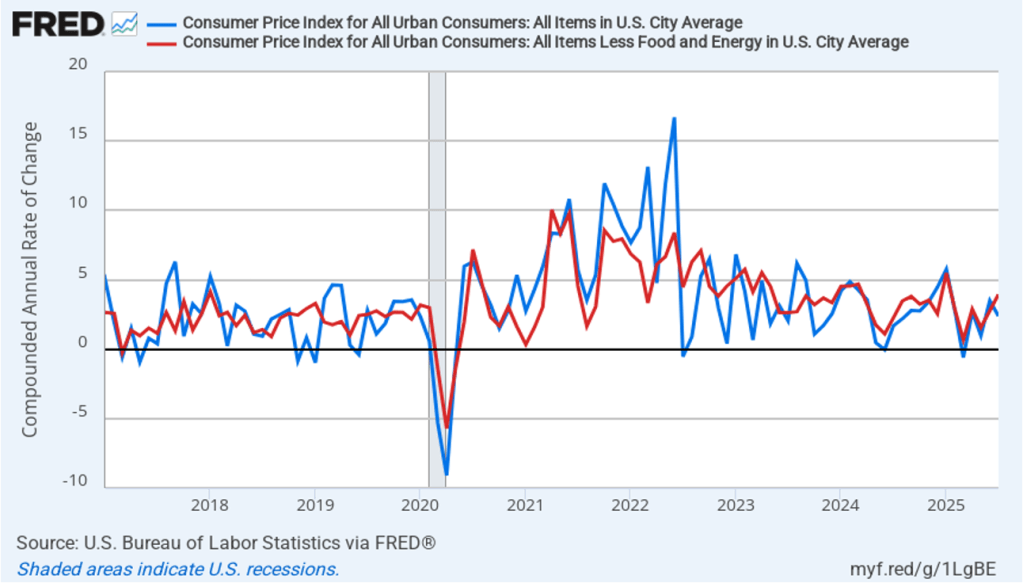
Today (July 15), the Bureau of Labor Statistics (BLS) released its report on the consumer price index (CPI) for June. The following figure compares headline CPI inflation (the blue line) and core CPI inflation (the red line).
The headline inflation rate, which is measured by the percentage change in the CPI from the same month in the previous year, was 2.7 percent in June—up from 2.4 percent in May.
The core inflation rate,which excludes the prices of food and energy, was 2.9 percent in June—up slightly from 2.8 percent in May.
Headline inflation was slightly higher and core inflation was slightly lower than what economists surveyed had expected.
In the following figure, we look at the 1-month inflation rate for headline and core inflation—that is the annual inflation rate calculated by compounding the current month’s rate over an entire year. Calculated as the 1-month inflation rate, headline inflation (the blue line) surged from 1.0 percent in May to 3.5 percent in June. Core inflation (the red line) also increased sharply from 1.6 percent in May to 2.8 percent in June.
The 1-month and 12-month inflation rates are telling different stories, with 12-month inflation indicating that the rate of price increase is running moderately above the Fed’s 2 percent inflation target. The 1-month inflation rate indicates more clearly that inflation increased significantly during June.
Of course, it’s important not to overinterpret the data from a single month. The figure shows that the 1-month inflation rate is particularly volatile. Also note that the Fed uses the personal consumption expenditures (PCE) price index, rather than the CPI, to evaluate whether it is hitting its 2 percent annual inflation target.
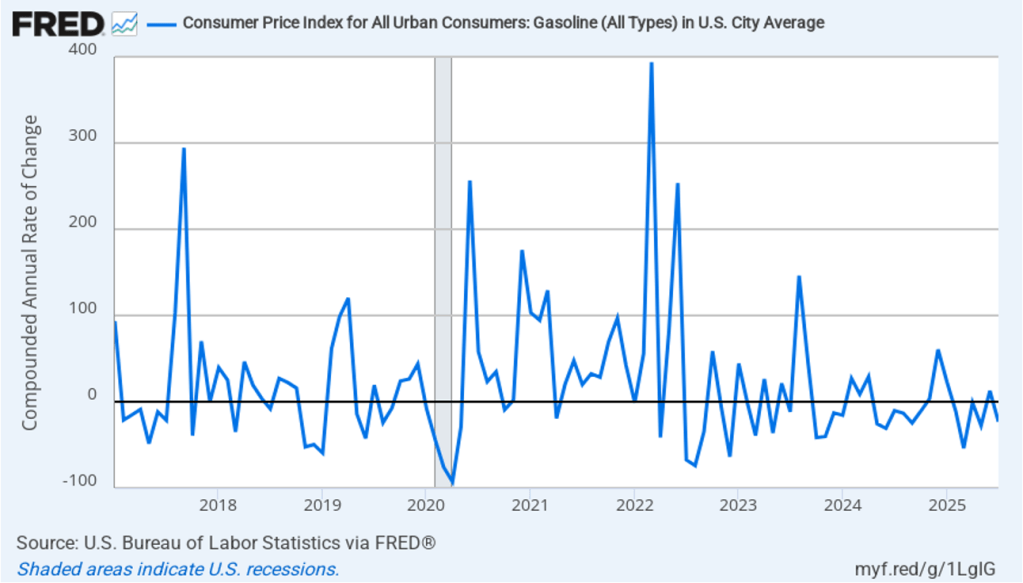
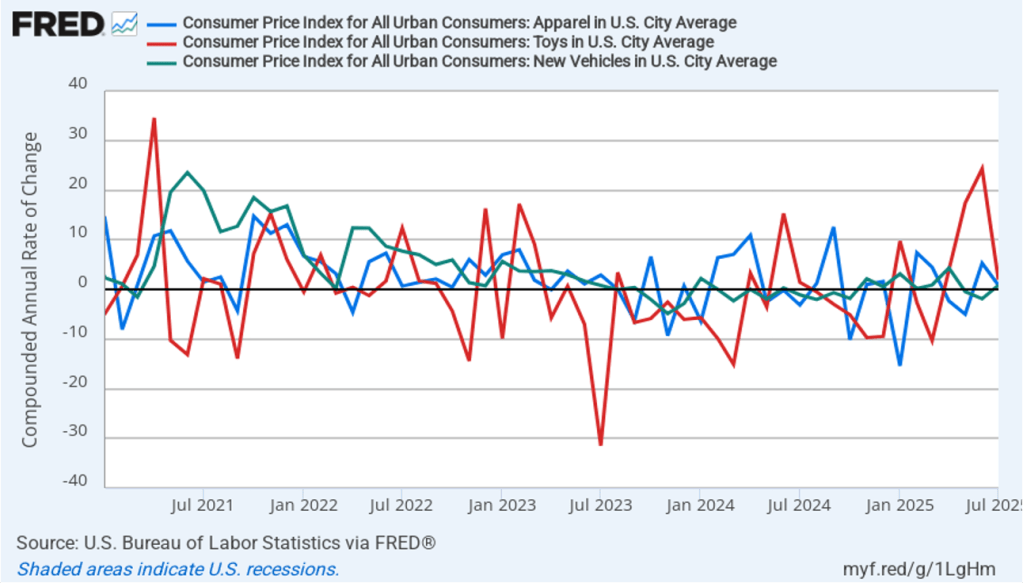
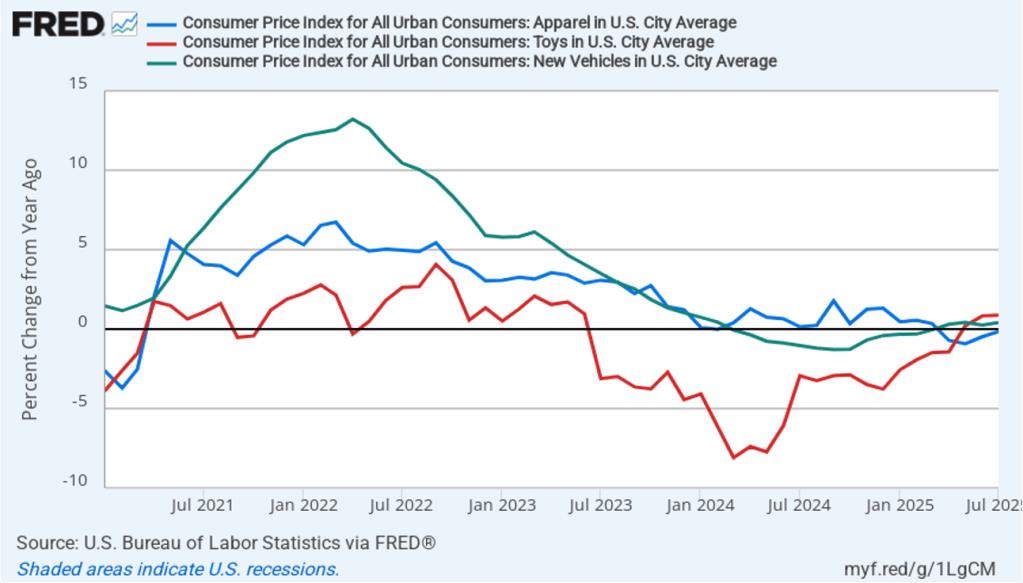
Does the increase in inflation represent the effects of the increases in tariffs that the Trump administration announced on April 2? (Note that some of the tariff increases announced on April 2 have since been reduced) The following figure shows 12-month inflation in three categories of products whose prices are thought to be particularly vulnerable to the effects of tariffs: apparel (the blue line), toys (the red line), and motor vehicles (the green line). To make recent changes clearer, we look only at the months since January 2021. In June, prices of apparel fell, while the prices of toys and motor vehicles rose by less than 1.0 percent.
The following figure shows 1-month inflation in these prices of these products. In June, the motor vehicles prices fell, while apparel prices increased 5.3 percent and the prices of toys soared by 24.3 percent, which was the second month in a row of very large increases in toy prices.
The 1-month inflation data for these three products are a mixed bag with two of the products showing significant increases and one showing a decline. It’s likely that some of the effects of the tariffs are still being cushioned by firms increasing their inventories earlier in the year in anticipation of price increases resulting from the tariffs. As firms draw down their inventories, we may see tariff-related increases in the prices of more goods later in the year.
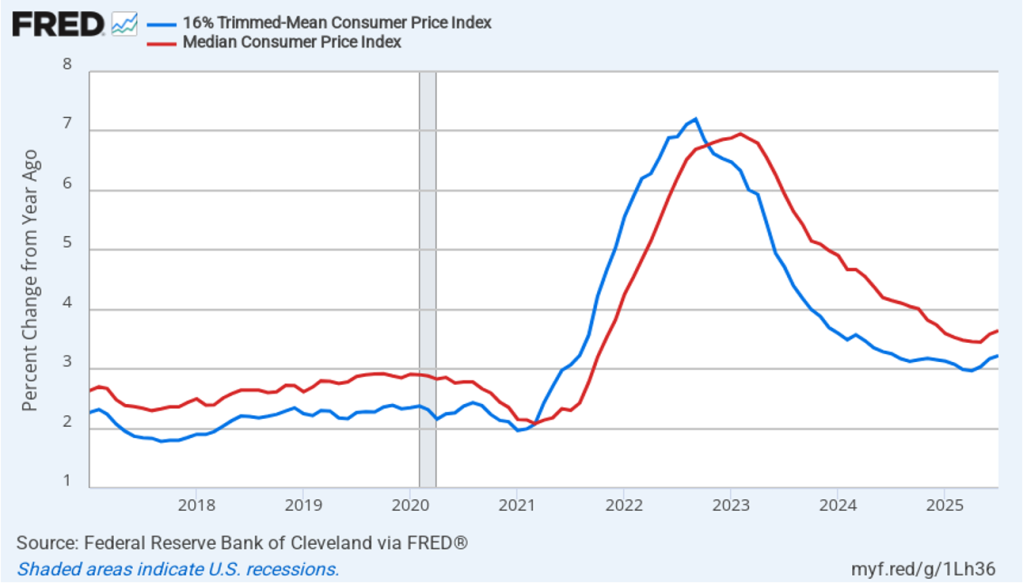
To better estimate the underlying trend in inflation, some economists look at median inflation and trimmed mean inflation.
Median inflation is calculated by economists at the Federal Reserve Bank of Cleveland and Ohio State University. If we listed the inflation rate in each individual good or service in the CPI, median inflation is the inflation rate of the good or service that is in the middle of the list—that is, the inflation rate in the price of the good or service that has an equal number of higher and lower inflation rates.
Trimmed-mean inflation drops the 8 percent of goods and services with the highest inflation rates and the 8 percent of goods and services with the lowest inflation rates.
The following figure shows that 12-month trimmed-mean inflation (the blue line) was 3.2 percent in June, up from 3.0 percent in May. Twelve-month median inflation (the red line) 3.6 percent in June, up from 3.5 percent in May.
The following figure shows 1-month trimmed-mean and median inflation. One-month trimmed-mean inflation rose sharply from 2.2 percent in May to 3.9 percent in June. One-month median inflation also rose sharply from 2.7 percent in May to 4.1 percent in June. These data provide some confirmation that inflation likely rose from May to June.
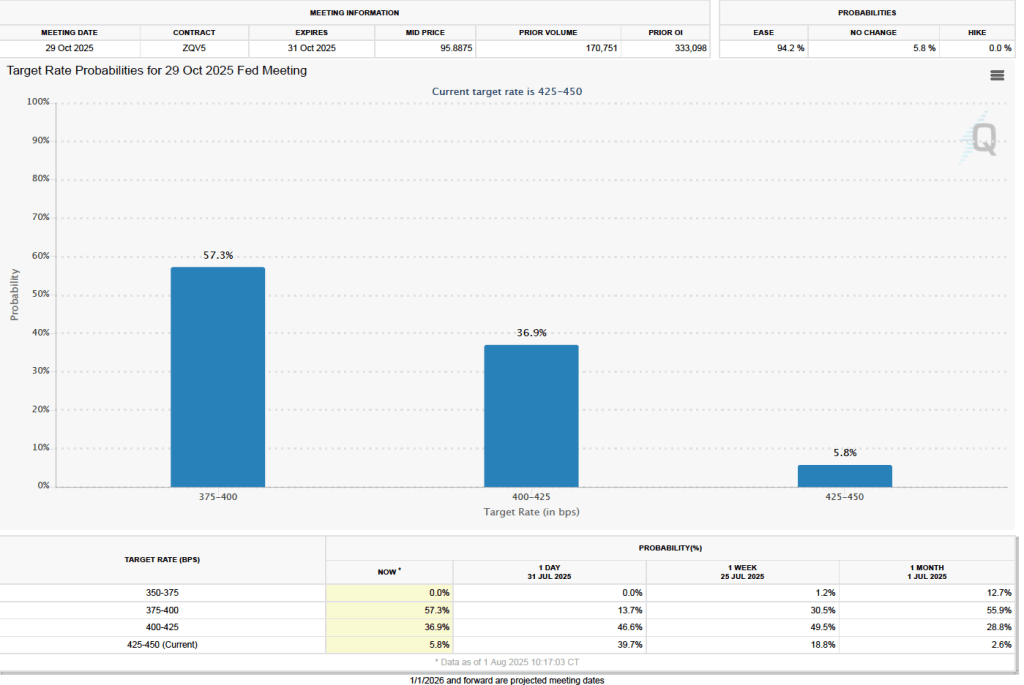
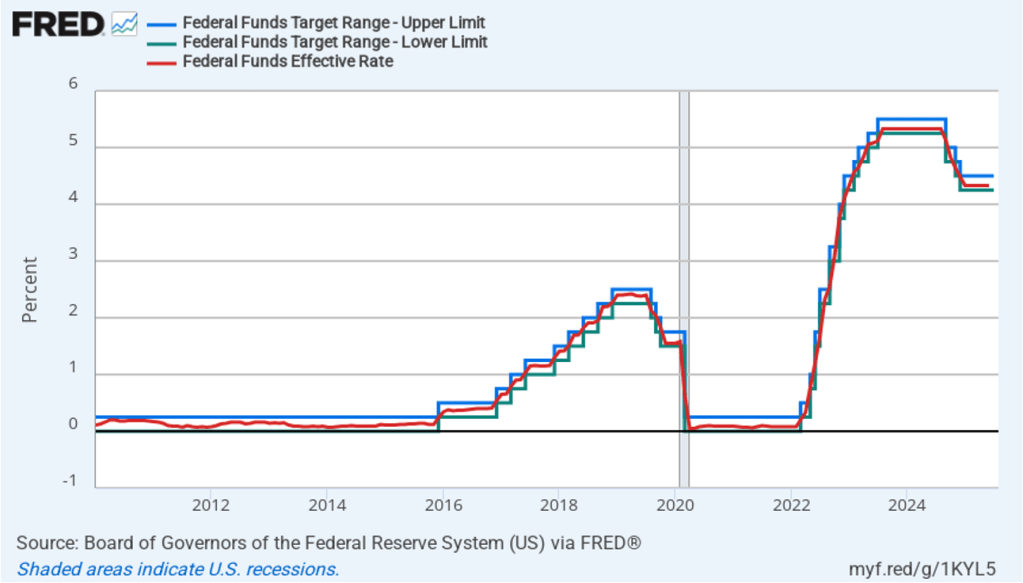
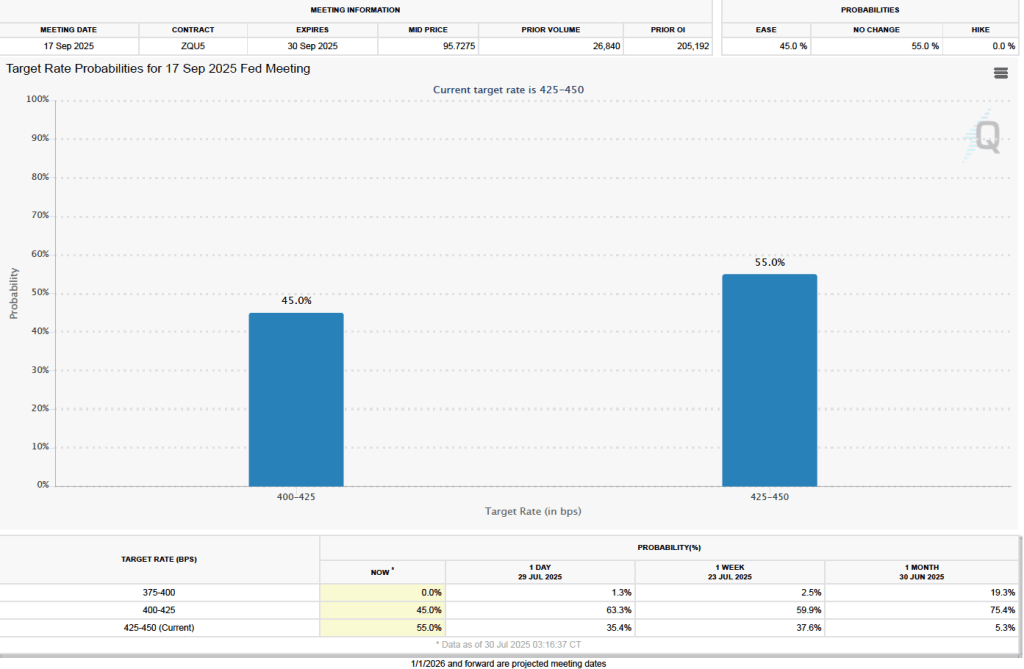
What are the implications of this CPI report for the actions the Federal Reserve’s policymaking Federal Open Market Committee (FOMC) may take at its next meetings? Investors who buy and sell federal funds futures contracts still expect that the FOMC will leave its target for the federal funds rate unchanged at its July 29–30 meeting before cutting its target by 0.25 (25 basis points) from its current target range of 4.25 percent to 4.50 percent at its September 16–17 meeting. (We discuss the futures market for federal funds in this blog post.) The FOMC’s actions will likely depend in part on the effect of the tariff increases on the inflation rate during the coming months. If inflation were to increase significantly, it’s possible that the committee would decide to raise, rather than lower, its target range.
How does the number of people who majored in economics in college compare with the number of people who pursued other majors? How do the earnings of economics majors compare with the earnings of other majors? Recent data released by the Census Bureau provides some interesting answers to these and other questions about the economics major.
Each year the Census Bureau conducts the American Community Survey (ACS) by mailing a questionnaire to about 3.5 million households. The questionnaire contains 100 questions that ask about, among other things, the race, sex, age, educational attainment, employment, earnings, and health status of each person in the household. Responses are collected online, by mail, by telephone, or by a personal visit from a census employee.
Although the Census Bureau releases some data about 1 year after the data is collected, it typically takes longer to publish detailed studies of specific topics. The ACS report on Field of Bachelor’s Degree in the United States: 2022 was released this month, although it’s based on data collected during 2022. Anyone interested in the subject will find the whole report to be worthwhile reading, but we can summarize a few of the results.
According to the census, in 2022, there were 81.9 million people in the United States aged 25 and older who had graduated from college with a bachelor’s degree. The report includes economics, along with several other social sciences—psychology, political science, and sociology—in the category of “Engineering and Science Degrees.” The following figure shows the leading majors in this category ranked by the percentage of all holders of a bachelor’s degree. (Sociology is included for comparison with the other three social sciences listed.) Psychology has the largest share of majors at 4.6 percent. Economics accounts for 2.0 percent of majors.
We can conclude that among social science majors, economics is less than half as popular as psychology, slightly less popular than political science, and significantly more popular than sociology.
Economics departments are sometimes located in undergraduate business colleges. The following figure compares economics to other majors listed in the “Business Degrees” category of the report. At nearly 6 percent of all majors, “business management and administration” is the most popular of business majors, followed by general business and accounting. “Other business,” marketing, finance, and economics are all about equally popular with around 2 percent of all majors.
The figure below shows the median annual earnings for people aged 25 years to 64 years—prime-age workers—who majored in each of fields used in the first figure above, as well as for all holders of a bachelor’s degree. People who majored in economics earn significantly more than people who majored in the other social sciences listed and 35 percent more than people in all majors.
The next figure shows median annual earnings for economics majors compared with majors in other business fields. Perhaps surprisingly—although not to people who know the many benefits from majoring in economics!—economics majors earn more on average than do majors in other business fields.
The following figure shows how many people with bacherlor’s degrees in economics majors fall into each age group. People aged 25 years to 34 years make up 22 percent of all economics majors, the most of any of the age groups. This result indicates that the economics major has gained in popularity (although note that the age groups don’t have equal numbers of people in them).
Finally, we can look at the demographic characteristics of economics majors. The next figure shows the percentage of degree holders in some popular majors who are women. Although women hold 53 percent of all bachelor’s degrees, they hold only 33 percent of bachelor’s degrees in economics. The share for economics is lower than for the other social sciences shown, the same as for finance majors, and more than for computer science and mechanical engineering majors.
The next figure shows bachelor’s degrees in economics by race and Hispanic origin. Non-Hispanic whites and non-Hispanic Asians are overrepresented among economics majors compared with the percentages they make up of all bachelor’s degree holders. Non-Hispanic Blacks and Hispanics are underrepresented among economics majors compared with the percentages they make up of all bachelor’s degree holders. People who are multiracial or of another race hold the same percentage of economics degrees as of degrees in other subjects.
This morning (July 3), the Bureau of Labor Statistics (BLS) released its “Employment Situation” report (often called the “jobs report”) for June. The data in the report show that the labor market was stronger than expected in June. There have been many stories in the media about businesspeople becoming pessimistic as a result of the large tariff increases the Trump Administration announced on April 2—some of which have since been reduced—and some large firms—including Microsoft and Walt Disney—have announced layoffs. In addition, yesterday payroll processing firm ADP estimated that private sector employment had declined by 33,000 in June. But despite these signs of weakness in the labor market, as the headline in the Wall Street Journal put it “Hiring Defied Expectations in June.”
The jobs report has two estimates of the change in employment during the month: one estimate from the establishment survey, often referred to as the payroll survey, and one from the household survey. As we discuss in Macroeconomics, Chapter 9, Section 9.1 (Economics, Chapter 19, Section 19.1), many economists and Federal Reserve policymakers believe that employment data from the establishment survey provide a more accurate indicator of the state of the labor market than do the household survey’s employment data and unemployment data. (The groups included in the employment estimates from the two surveys are somewhat different, as we discuss in this post.)
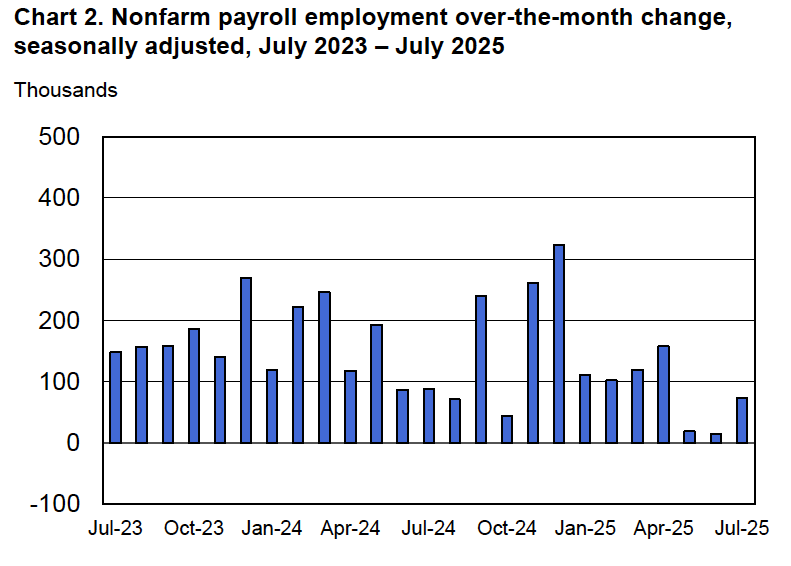
According to the establishment survey, there was a net increase of 147,000 nonfarm jobs during June. This increase was above the increase of 1115,000 that economists surveyed had forecast. In addition, the BLS revised upward its previous estimates of employment in April and May by a combined 16,000 jobs. (The BLS notes that: “Monthly revisions result from additional reports received from businesses and government agencies since the last published estimates and from the recalculation of seasonal factors.”) The following figure from the jobs report shows the net change in nonfarm payroll employment for each month in the last two years.
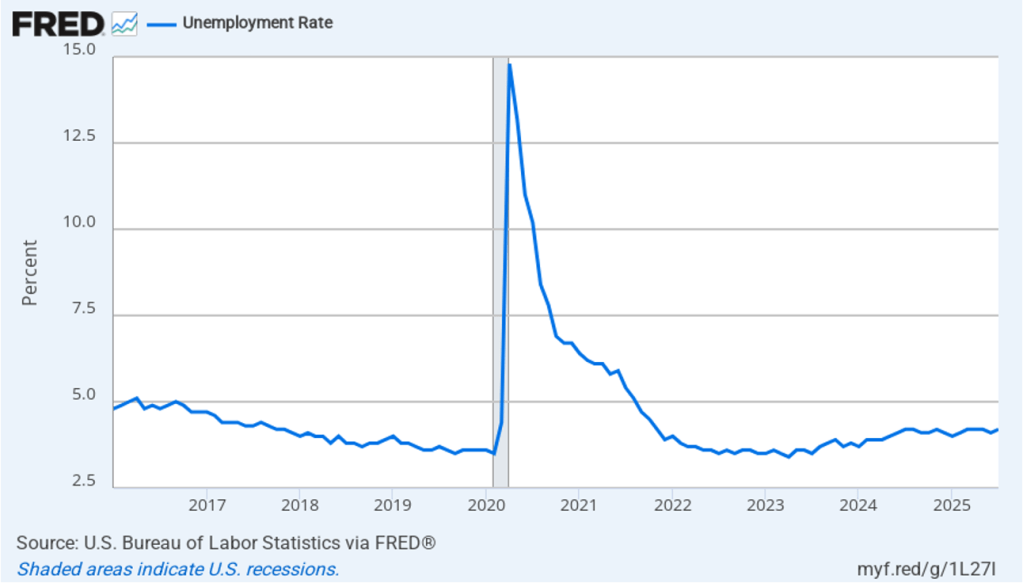
The unemployment rate declined from 4.2 in May to 4.1 percent in June. Economists surveyed had forecast an increase in the unemployment rate to 4.3 percent. As the following figure shows, the unemployment rate has been remarkably stable over the past year, staying between 4.0 percent and 4.2 percent in each month since May 2024. In June, the members of the Federal Open Market Committee (FOMC) forecast that the unemployment rate for 2025 would average 4.5 percent. The unemployment rate would have to rise significantly in the second half of the year for that forecast to be accurate.
Each month, the Federal Reserve Bank of Atlanta estimates how many net new jobs are required to keep the unemployment rate stable. Given a slowing in the growth of the working-age population due the aging of the U.S. population and a sharp decline in immigration, the Atlanta Fed currently estimates that the economy would have to create 113,500 net new jobs each month to keep the unemployment rate stable at 4.1 percent.
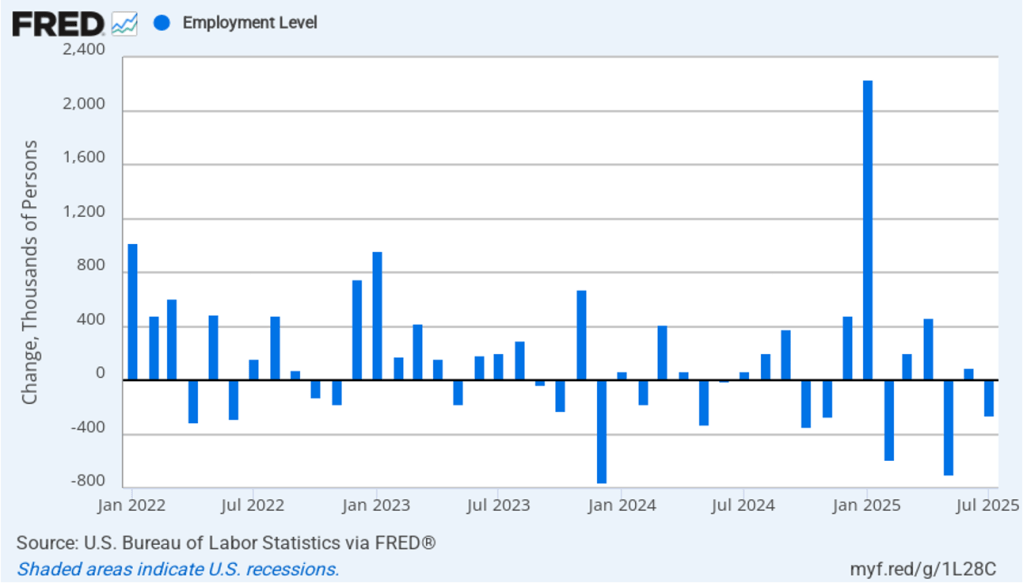
As the following figure shows, the monthly net change in jobs from the household survey moves much more erratically than does the net change in jobs from the establishment survey. As measured by the household survey, there was a net increase of 93,000 jobs in June, following a decrease of 696,000 jobs in May. As an indication of the volatility in the employment changes in the household survey note the very large swings in net new jobs in January and February. In any particular month, the story told by the two surveys can be inconsistent with employment increasing in one survey while falling in the other. This month, the two surveys were consistent in both showing a net increase in employment. (In this blog post, we discuss the differences between the employment estimates in the two surveys.)
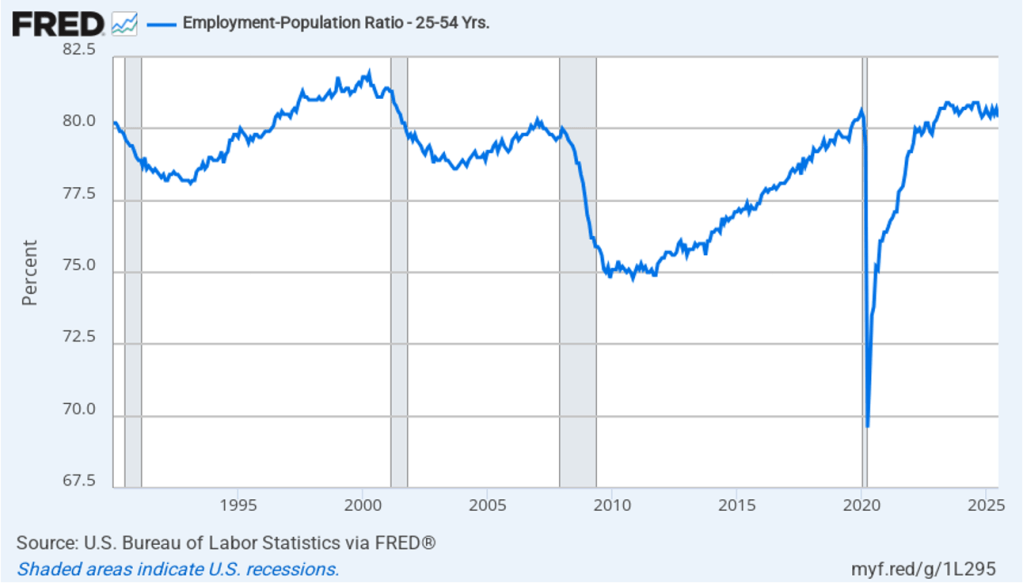
The household survey has another important labor market indicator. The employment-population ratio forprime age workers—those aged 25 to 54—rose from 80.5 percent in May to 80.7 percent in June. The prime-age employment-population ratio is somewhat below the high of 80.9 percent in mid-2024, but is above what the ratio was in any month during the period from January 2008 to January 2020.
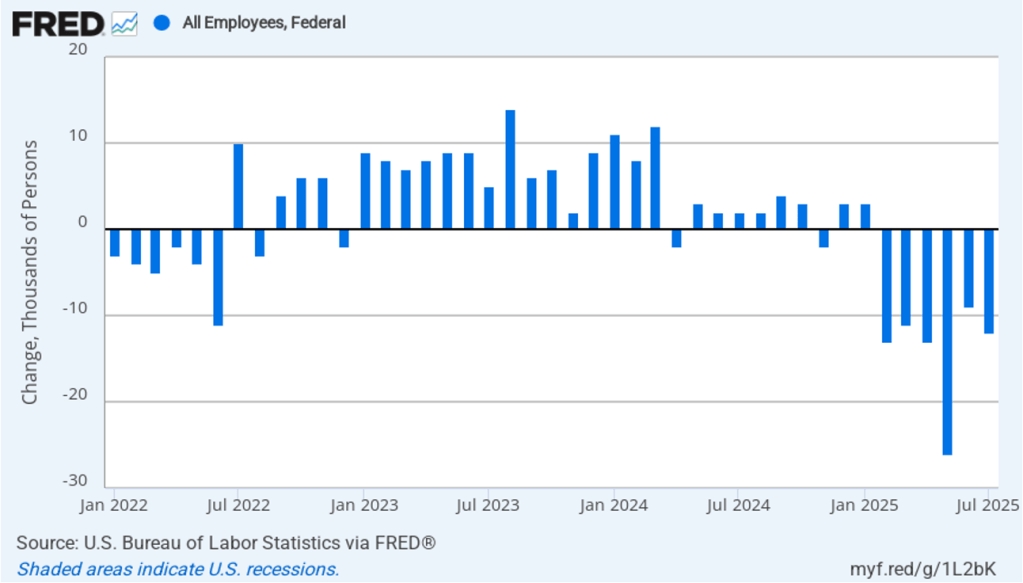
It is still unclear how many federal workers have been laid off since the Trump Administration took office. The establishment survey shows a decline in total federal government employment of 7,000 in June and a total decline of 69,000 since the beginning of February. However, the BLS notes that: “Employees on paid leave or receiving ongoing severance pay are counted as employed in the establishment survey.” It’s possible that as more federal employees end their period of receiving severance pay, future jobs reports may report a larger decline in federal employment. To this point, the decline in federal employment has been too small to have a significant effect on the overall labor market.
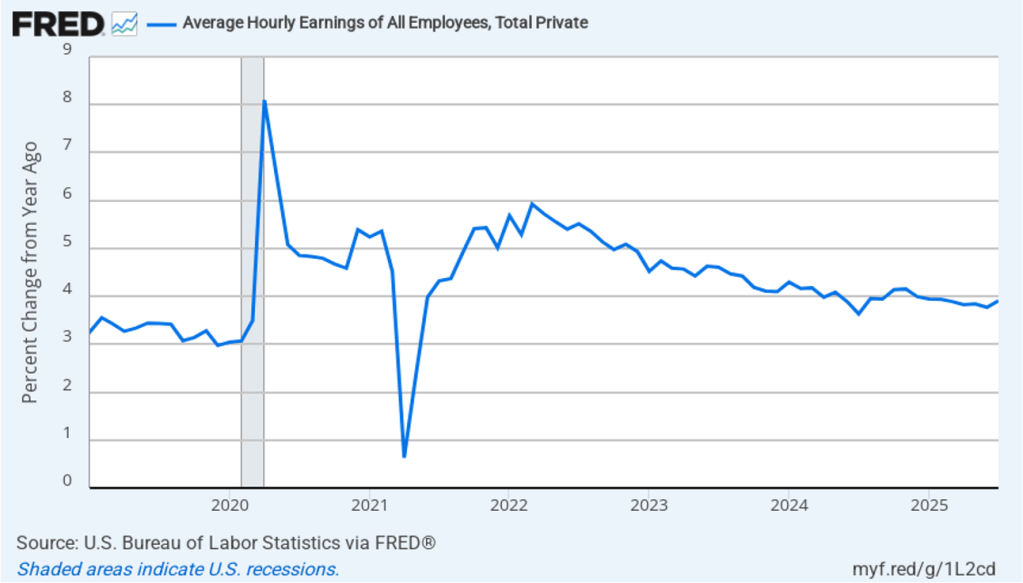
The establishment survey also includes data on average hourly earnings (AHE). As we noted in this post, many economists and policymakers believe the employment cost index (ECI) is a better measure of wage pressures in the economy than is the AHE. The AHE does have the important advantage of being available monthly, whereas the ECI is only available quarterly. The following figure shows the percentage change in the AHE from the same month in the previous year. The AHE increased 3.7 percent in June, down from an increase of 3.8 percent in May.
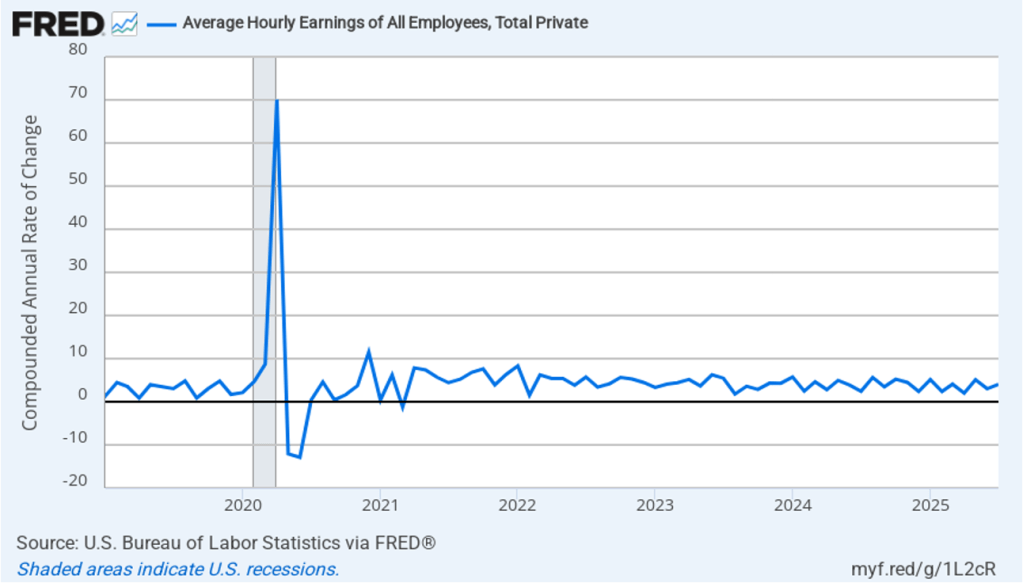
The following figure shows wage inflation calculated by compounding the current month’s rate over an entire year. (The figure above shows what is sometimes called 12-month wage inflation, whereas this figure shows 1-month wage inflation.) One-month wage inflation is much more volatile than 12-month wage inflation—note the very large swings in 1-month wage inflation in April and May 2020 during the business closures caused by the Covid pandemic. In June, the 1-month rate of wage inflation was 2.7 percent, down significantly from 4.8 percent in May. If the 1-month increase in AHE is sustained, it would indicate that the Fed may have an easier time achieving its 2 percent target rate of price inflation. But one month’s data from such a volatile series may not accurately reflect longer-run trends in wage inflation.
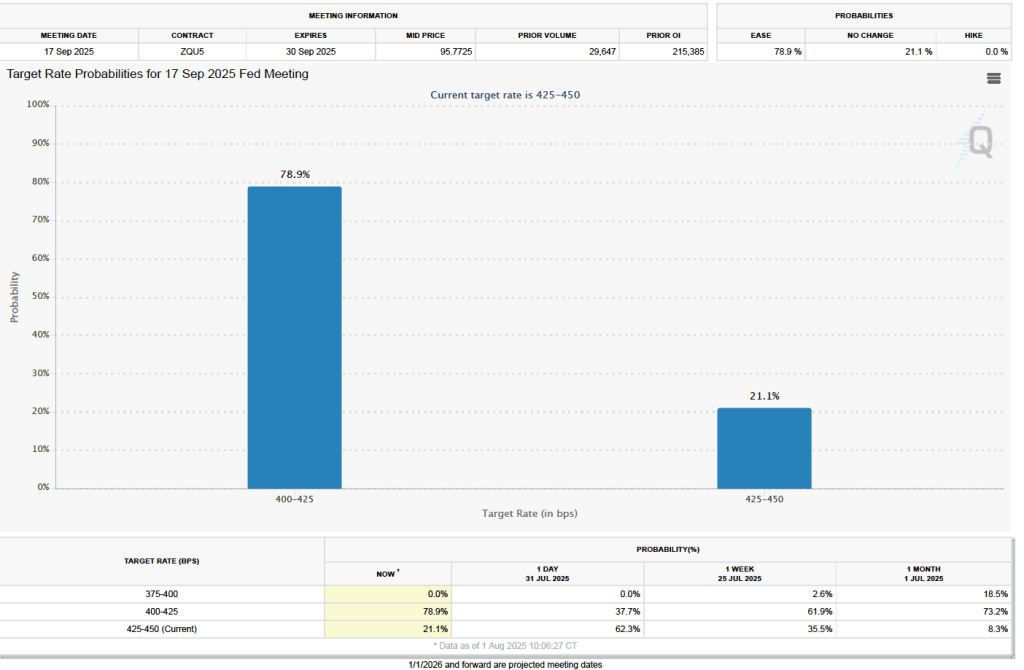
Before today’s jobs reports the signs that the labor market was weakening, which we discussed earlier, had led some economists and policymakers to speculate that a weak jobs report would lead the FOMC to cut its target range for the federal funds rate at its next meeting on July 29–30. That now seems very unlikely.
One indication of expectations of future changes in the FOMC’s target for the federal funds rate comes from investors who buy and sell federal funds futures contracts. (We discuss the futures market for federal funds in this blog post.) As shown in the following figure, today investors assign a 95.3 percent probability to the committee keeping its target unchanged at 4.25 percent to 4.50 percent at the July meeting.
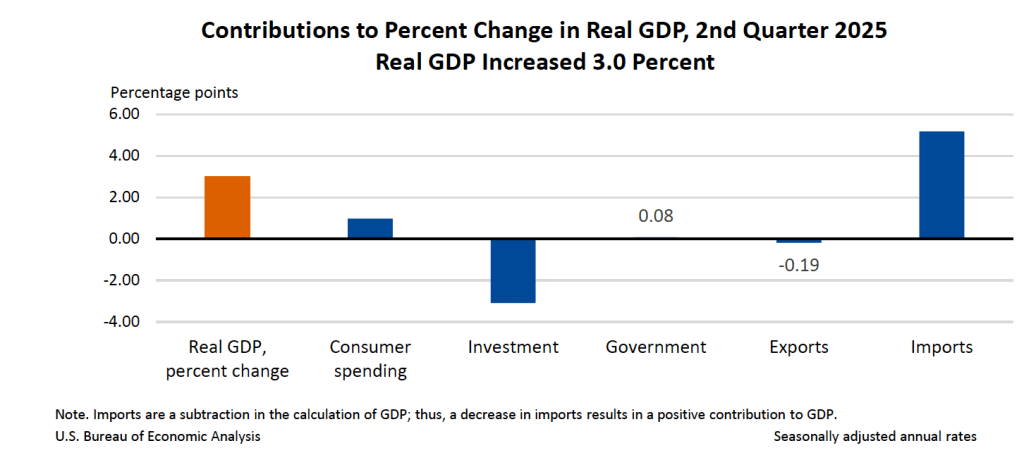
Photo of Caitlin Clark when she played for the University of Iowa from Reuters via the Wall Street Journal.
Caitlin Clark’s ability to hit three-point shots made her a star at the University of Iowa. Since she joined the Indiana Fever of the Women’s National Basketball Association (WNBA) in 2024, she’s been, arguably, the league’s biggest star. An article on theathletic.com discussing Clark’s effect on the league includes the following chart:
Clark’s popularity has resulted in substantially increased revenue for her team and for the WNBA. Should that fact affect the salary she receives from the Indiana Fever? The article states that: “Clark will almost assuredly never receive in salary what she is worth to the WNBA. In that regard, she’s a lot like [former men’s basketball star Michael] Jordan, and other all-time greats across sports.” Why won’t Clark be paid a salary equal to her worth to the WNBA?
In Microeconomics, Chapter 16, we show that in a competitive labor market, workers receive the value of their maginal products. The value of a basketball player’s marginal product is the additional revenue the player’s team earns from employing the player. We note that the marginal product of an athlete is the additional number of games the athlete’s team wins by employing the player. The value of a player’s marginal product is the additional revenue the team earns from those additional wins. Teams that win more games attract more fans to watch the teams play—both in person and on television or online. Teams earn revenue from selling tickets, as well as concessions and souvenirs sold in the area. Teams are paid for the rights to broadcast or stream their games. And, as the chart above shows, a player as popular as Clark will increase the game jerseys and other merchandise a team can sell.
We note in Chapter 16 that, once their inital contracts with their teams expire, the best professional athletes tend to sign contracts with teams in larger cities. Although an athlete’s marginal product may be no larger in a big city than in a smaller city, the revenue a team earns from the additional games the team wins from employing a star athlete depends in part on the population of the city the team plays in. Clark’s 2025 salary is only $78,066, far below the value of her marginal product, which is likely at least several million dollars. Her current contract with the Fever lasts through the 2027 season. But even after the contract expires, by league rules, she can’t be paid more than $294,244 by whichever team signs her. (It’s possible that amount may have increased by the time her current contract expires.)
The ceiling on WBNA salaries is far below the average salary in most U.S. men’s professional leagues. For instance, the average salary in the men’s National Basketball Association (NBA) during the 2024–2025 year was nearly $12 million. A low salary cap is common in leagues that are relatively new or that aren’t popular enough to receive large payments for the rights to broadcast or stream their games. For example, men’s Major League Soccer (MLS) has a salary limit of about $6 million per team. The WNBA was founded in 1996 (the NBA was founded in 1946) and, although the broadcast and online viewership for its games has increased, its viewership remains well below the NBA’s viewership.
Clark has been earning millions of dollars from endorisng Nike, Gatoade, and other products. But unless the factors just discussed change, it seems unlikely that she will receive a salary equal to the value of her marginal product to the Fever or any WNBA team she might play for in the future. The excerpt from theathletic.com article that we quoted above, though, compares her salary not to the value of her marginal product to the Fever but to the WNBA as a whole. Are there any circumstances under which we might expect a major sports star to be paid a salary equal to the additional revenue he or she is generating for a league as a whole?
The quotation from the article notes that no “all-time great” players, inclduing Michael Jordan of the NBA, have received salaries equal to the value of their marginal product to the leagues they played in. This outcome shouldn’t be surprising. Returns that entrepreneurs or workers earn in a market system are typically well below the total value they provide to society. For example, in a classic academic paper Nobel laureate William Nordhaus of Yale University estimated that entrepreneurs keep just 2.2 percent of the economic surplus they create by founding new firms. (We discuss the concept of economic surplus in Microeconomics, Chapter 4.) Leaving aside the monetary value of Clark to her team and her league, she has provided substantial consumer surplus to viewers of her games that is not captured by arena ticket prices or cable or streaming subscriptions. As we discuss in Chapter 4, the same is true of most goods and services in competitive markets.

Caitlin Clark, like Amazon founder Jeff Bezos, has only received a small fraction of the economic surplus she has created. (Photo from the Wall Street Journal)
So, although Caitlin Clark is a millionaire as a result of the money she has been paid to endorse products, the actual additional value she has created for her team, her league, and the economy is far greater than the income she earns.
“Clark will almost assuredly never receive in salary what she is worth to the WNBA. In that regard, she’s a lot like [Michael] Jordan, and other all-time greats across sports.”
Image illustrating stablecoins generated by ChatGTP4-o
Recently, U.S. Treasury Secretary Scott Bessent testified before Congress that the value of stablecoins could reach $2 trillion. In a post on X (formerly Twitter) he stated that “that stablecoins could grow into a $3.7 trillion market by the end of the decade.” Those amounts are far above the $250 billion estimated value of stablecoins in June 2025, yet still small relative to the value of M2—currently $21.9 trillion. But if the value of stablecoins were to rise to $2 trillion, that would be large enough to have a noticeable effect on the U.S. financial system.
As we discuss in Macroeconomics, Chapter 24 and in Money, Banking, and the Financial System, Chapter 2, stablecoins are a type of cryptocurrency—bitcoin is the best-known cryptocurrency—that can be bought and sold for a constant number of units of a currency, usually U.S. dollars. Typically, one stablecoin can be exchanged for one dollar.
Tether CEO Paolo Ardoino (photo from Bloomberg news via the Wall Street Journal)
Firms that issue stablecoins will redeem them in the underlying currency, which—as already noted—is nearly always the U.S. dollar. To make the promise to redeem stablecoins in dollars credible, firms that issue stablecoins hold reserve assets that are safe and highly liquid, such as U.S. Treasury bills or U.S. dollar bank deposits. Tether, which is headquartered in El Salvador, is the largest issuer of stablecoins, with about two-thirds of the market. As with bitcoins and other cryptocurrencies, stablecoins are stored and traded on public blockchains, which are decentralized networks of ledgers that record transactions. This system avoids the use of financial intermediaries—such as banks—which advocates for cryptocurrencies see as a key advantage because it eliminates the possibility that the intermediary might reject the transaction. But it also increases the appeal of stablecoins to people engaged in illegal activities.
Advocates for stablecoins believe that they can become a digital medium of exchange, which is a role that initially bitcoin was intended to play. The swings in the value of bitcoin turned out to be much larger than most people expected and made that crypto currency unsuitable for use as a medium of exchange. Stablecoins avoid this problem by keeping the value of the stablecoins fixed at one dollar. To this point, though, stablecoins have been primarily used to buy and sell bitcoin and other crypto currencies. As Federal Reserve Governor Christopher Waller put it in a speech earlier this year: “By their tie to the dollar, stablecoins are the medium of exchange and unit of account in the crypto ecosystem.” According to Waller, more than 80 percent of trading in cryptocurrencies is conducted using stablecoins.
One drawback to stablecoins is that firms that issue them charge a fee to redeem them. For instance, Tether requires that a minimum of $100,000 of stablecoins be redeemed and charges a fee of 0.1 percent of the amount redeemed with a minimum charge of $1,000. The redemption fee would be less important if stablecoins are used in large dollar transactions, such as occur in international trade. Advocates for stablecoins believe that they are particularly well suited for use in cross-border transactions because they don’t involve banks, as typically is necessary when firms buy or sell goods or services in foreign countries. The fees stablecoin issuers charge are generally lower than the fees banks charge for foreign exchange transactions.
The main source of profit for firms issuing stablecoins is the interest they earn on the assets they use to back the stablecoins they issue. Note, though, that firms issuing stablecoins have an incentive to buy riskier assets in order to increase the return on the stablecoins they issue. The incentives are similar to those banks face in investing depositors’ funds in assets that are riskier than the depositors would prefer. However, the risk that commercial banks take on is limited by bank regulations, which don’t yet apply to firms issuing stablecoins, although they may soon.
On June 17, the U.S. Senate moved to provide a regulatory framework for stablecoins by passing the Guiding and Establishing National Innovation for U.S. Stablecoins Act (Genius Act). The act requires that firms issuing stablecoins in the United States back them 100 percent with a limited number of reserve assets: dollar deposits in banks, Treasury securities that mature in 93 days or less, repurchase agreements backed by Treasuries (we discuss repurchase agreements in Macroeconomics, Chapter 15; Economics, Chapter 25; and Money, Banking, and the Financial System, Chapter 10), and money market funds that invest in eligible Treasury securities and repurchase agreements. Issuers of stablecoins will be subject to audits by U.S. federal regulators. To become law, the Genius Act must also be passed by the U.S. House and signed by President Trump.
Passage of the Genius Act would potentially provide a regulatory framework that would reassure users that the stablecoins they hold can be readily redeemed for dollars. Passage is also expected to lead some large retail firms, such as Walmart and Amazon, to issue stablecoins that could be used to make purchases on their sites. If enough consumers are willing to use stablecoins, these large retailers could save the fees they currently pay to credit card companies. In addition, stablecoin transactions can be cleared instantly, as opposed to the several days it can take for credit card payments to clear. Why would a consumer want to use stablecoin rather than a credit card to pay for something? Apart from the familiarity of using credit cards, the cards often provide rewards, such as points that can be redeemed for airline tickets or hotel stays. To attract consumers, stablecoin issuers would likely have to offer similar rewards to consumers who use stablecoins to make purchases.
As Waller notes, it will likely take years before consumers and firms routinely use stablecoins for day-to-day transactions. Today, very few retail firms are equipped to accept stablecoins and very few consumers own stablecoins.
Passage of the Genius Act would pose potential problems for Tether. Tether has held a wide range of reserve assets to back its stablecoins, including bitcoin and precious metals. It has also not been willing to be fully audited. Either Tether would have to change its business model to fit the requirements of the Genius Act or it would have to issue a separate stablecoin that would be used only in the United States and would meet the Genius Act requirements.
We noted earlier that Treasury Secretary Bessent believes that over the next few years, the value of stablecoins could increase to several trillions dollars. If that happens, the demand for Treasury securities would increase substantially as firms issuing stablecoins accumulated reserve assets. The result could be higher prices on Treasury securities and lower interest rates, which would eventually reduce the interest payments the Treasury makes on the federal government’s debt.
Finally, as we note in the text, Barry Eichengreen of the University of California, Berkeley as been a notable skeptic of stablecoins. As he wrote back in 2018, when the idea of stablecoins was just beginning to be widely discussed, when someone exchanges a dollar for a stablecoin, “one of us then will have traded a perfectly liquid dollar, supported by the full faith and credit of the U.S. government, for a cryptocurrency with questionable backing that is awkward to use. This exchange may be attractive to money launderers and tax evaders, but not to others.”
Could issuers of stablecoins be subject to runs like the one that led to the failure of Silicon Valley Bank in the spring of 2023?
In a recent opinion column in the New York Times, Eichengreen wrote that he is concerned about the possibility of runs on stablecoins. As we discuss in Macroeconomics, Chapter 14, and in Money, Banking, and the Financial Systems, Chapter 10, a commercial bank can be subject to a run if the bank’s depositors believe that the value of the bank’s assets are no longer sufficient to pay off the bank’s depositors. As we discuss in this blog post, Silocon Valley Bank experienced a run in the spring of 2023 that affected several other banks. Runs on commercial banks are unusual in the United States because of deposit insurance and the willingness of the Federal Reserve to act as lender of last resort to banks suffering liquidity problems. Eichengreen raises the question of whether stablecoins could experience runs if holders of the stablecoins come to doubt that the value of issuers’ reserve assets is sufficient to redeem all the coins.
Although the Genius Act provides for regulation of stablecoin issuers, Eichengreen believes that if enough firms begin issuing stablecoins, it’s likely that at some point one of them will experience a decline in the value of its reserve assets, which will cause a run. If the run spreads from one issuer to many in a process called contagion, stablecoin issuers will have to sell reserve assets, including Treasury securities. The result could be a sharp fall in the prices of those asset and an increase in interest rates. It’s possible that the outcome could be a wider financial panic and a deep recession. To head off that possibility, the Federal Reserve might feel obliged to intervene to save some, possibly many, stablecoin issuers from failing. The result could be that taxpayer dollars would flow to firms issuing stablecoins, which would likely cause a significant political backlash.
Many people see stablecoins as an exciting development in the financial system. But, as we’ve noted, there still remain some substantial roadblocks in the way of stablecoins becoming an important means of transacting business in the U.S. economy.