
Many thanks to Matt O’Brien for producing this comic!
Glenn on Adam Smith and the Midterm Elections

Image created by ChatGPT
This opinion column was first published on Project Syndicate.
Adam Smith on the U.S. Midterms
The Wealth of Nations offers a useful lens for understanding why US President Donald Trump’s mercantilist agenda has fallen short of its own stated goals. It also points to a better path, combining competitive markets with policies that help workers and communities build skills and keep pace with economic change.
November’s midterm elections pose a serious challenge for US President Donald Trump. Key components of his economic agenda, especially its protectionist measures, have raised concerns about the rising cost of living, prompted a rare rebuke from the Supreme Court, and cast doubt on the legal basis for his tariffs. Fortunately for Trump and the Republicans, they still have time to pivot to a pro-growth agenda that better addresses voter anxieties before the midterms.
Trump’s agenda is rooted in voter concerns about economic disruption driven by technological change and globalization. Breaking with the bipartisan embrace of market-friendly policies, his administration has sought to shield US producers from competition. While Treasury Secretary Scott Bessent has hinted that a pivot to a pro-growth strategy is in the works, reconciling it with the administration’s mercantilist approach will be difficult.
There is, however, an alternative path that better aligns with Trump’s stated goal of helping people and communities buffeted by economic change. For guidance, it is worth turning to Adam Smith. The Wealth of Nations, published 250 years ago, grappled with many of the same tensions and pointed to a pragmatic middle ground.
At first glance, Smith may seem at odds with Trump’s approach. After all, The Wealth of Nations centers on Smith’s critique of the mercantilist order of his day. Mercantilism prizes trade surpluses and the accumulation of national wealth in the hands of the state. To work, it requires extensive government intervention in commerce, trade, and labor markets. But that expansive role invites rent-seeking and excessive control, a key concern for Smith.
Smith’s treatise turned this system on its head by posing a radical question: Where does national wealth come from? For Smith, the answer stood in contrast to mercantilism. A competitive economy, with limited government intervention, would be accompanied by openness and specialization, in turn raising living standards.
While Smith did not develop a formal theory of growth, his intuition about the importance of openness to markets and innovation is consistent with modern growth models and stands in contrast to Trump-era policymaking. As Nobel laureate economist Joel Mokyr has noted, science, practical knowledge, and openness to change are key drivers of long-term prosperity.
But Trump has also identified an important tension. Modern growth models are like a coin. The “heads” side is growth and its benefits for living standards; the “tails” side is disruption—the upending of existing investments, firms, jobs, and even communities. It is here that Trump’s mercantilism, with its focus on minimizing the effects of disruption on voters’ lives, gains political traction.
Smith challenges this perspective in two ways. First, he reminds us of the limits mercantilism places on living standards. Second, in The Theory of Moral Sentiments, which he considered his finest work, he emphasizes empathy and what my Columbia colleague Edmund S. Phelps calls “mass flourishing,” which aims to ensure that everyone benefits from economic progress, including those disrupted by its forward march.
Here, then, is the policy alternative to both Trumpian mercantilism and market orthodoxy: augmenting Smith’s concept of “competition” with the “ability to compete.” Such an agenda would center on preparation and reconnection, both vital for participation in—and support for—an open economy.
One place to begin is workforce development. In the United States, community colleges are well positioned to serve as training grounds for skill development and career transitions, often working closely with local employers to create quality jobs. While support for community colleges has declined in many states, a federal block grant focused on completion and skill development would significantly enhance their impact.
Similarly, a more generous Earned Income Tax Credit could boost labor-force participation and attachment. Increased funding for basic research, alongside support for applied research centers across the country, could raise productivity by bringing cutting-edge tools to businesses, much as land-grant colleges have historically done in agriculture and manufacturing.
To reconnect displaced workers, personal re-employment accounts—combining funds for training with re-employment bonuses—could help reduce the duration of joblessness. For communities affected by structural economic change, more effective place-based aid could support productivity-enhancing business services in lower-income areas with higher unemployment.
Such measures, along with a growth-oriented agenda, could reshape the electoral landscape. Investments in AI and electricity generation could be accelerated through regulatory reform, particularly by easing permitting rules under the National Environmental Policy Act. To increase the housing supply, a prerequisite for mobility and growth, the administration could propose incentives for state and local governments to scale back restrictive construction regulations.
Going further, the administration would need to abandon its nativist immigration policies. Increasing the number of high-skilled immigrants, particularly in STEM fields, would boost growth, as immigrants have been shown to drive technological innovation, leading to more patents, higher productivity, and rising incomes.
Likewise, expanding federal support for research and development would yield high returns. Some estimates suggest that the returns are so large that the net cost to taxpayers may be zero or even negative, as higher productivity generates enough additional tax revenue to offset the cost. Combined with a stable macroeconomic environment and pro-investment policies of the kind Trump has championed, these changes could significantly accelerate growth.
A more constructive approach to economic disruption would shift away from broad tariffs and protectionism, which tend to raise consumer prices and erode the competitiveness of US manufacturing by increasing input costs. The Supreme Court’s recent reversal of many tariffs imposed by Trump under the International Emergency Economic Powers Act has created an opportunity—and underscored the need—for a course correction.
Trump has rightly raised questions about the economic consequences of technological change and globalization. Two and a half centuries after its publication, The Wealth of Nations points toward a necessary pivot away from mercantilism and toward a more balanced, pro-growth framework.
Glenn’s Advice for Kevin Warsh
The Marriner S. Eccles building, headquarters of the Federal Reserve in Washington, DC. Image from federalreserve.gov.
The following opinion column appeared in the Financial Times.
What Warsh Should Do at the Fed
Donald Trump’s nomination of Kevin Warsh as chair of the Federal Reserve comes at a pivotal time for the American economy and for the US central bank. A pall has been cast by the administration’s unforced error of trumped-up charges against Jay Powell, the current Fed chair, and the president’s renewed threats to fire him if he does not leave by the end of his term. But the nominee’s credentials and experience ought to ensure a smooth confirmation. The question now should be what happens next.
The Fed faces three challenges. In the short term, the potential impact of the Iran war on employment calls for a careful assessment of the direction of the US economy. In the medium term, inflation continuing to run above the 2 per
cent target will limit the central bank’s room for maneuver, and also call its
credibility into question. In the longer term, questions remain about the
effectiveness of quantitative easing, the size of the Fed’s balance sheet, errors
made in the aftermath of the Covid pandemic, and the central bank’s forays
into areas better left to fiscal or regulatory policy.
All of which means that when Warsh eventually takes up the post, he should
launch an evaluation of the purpose, strategy and structure of the Fed straight
away.
First, purpose. The Federal Reserve was established as a lender of last resort
designed to mitigate financial crises. After it struggled to discharge that role
during the Great Depression, it turned to managing aggregate demand and
inflation. In 1978, Congress used the Humphrey-Hawkins Act to codify its
focus on inflation and employment, while giving the Fed leeway on how to
achieve those objectives. It also required the Fed chair to report to Congress on
its outcomes and outlook.
Warsh should now offer justifications for each of these objectives, set out
clearly what trade-offs they entail and how progress will be communicated.
This clarity focuses markets and elected officials on the importance of low and
steady inflation for US economic performance. And the advent of a new chair
provides an opportunity to make the Fed’s lender-of-last-resort decision-making clearer. Such explanations would be helpful in the present
environment of economic and public policy uncertainty.
Next comes strategy. This is about choosing a set of activities that deliver
objectives consistently. For the Fed, independence in monetary policy and the
ability to flex its balance sheet enable it to keep inflation low and manage
financial turmoil. Political assaults on its independence, of the type we have
recently seen, or restrictions on its balance sheet as a lender of last resort put
these strategic advantages at risk.
To deliver on purpose and strategy, the incoming chair should optimize the
Fed’s structure. The arrangement of a board of governors in Washington,
district banks led by district presidents, a Federal Open Market Committee of
the board and (a rotation of) five district presidents is set by law. But there are
three practical steps Warsh could take to improve the effectiveness of this setup.
First, the central bank should cast a wider net to gather insights from
economists, business leaders and financial market participants, with Fed
conferences reopened to members of these communities. Second, decisions
and direction should be communicated to financial markets and the public
consistently by the chair and by other officials.
Third, replace the notorious “dot plots”, which map FOMC members’
projections for the federal funds rate, with scenarios. Dot plots can be
misinterpreted as signals about the future path of interest rates. By contrast,
scenario analysis models how policy would respond to important changes, such
as shifts in AI investment, supply constraints, the natural rate of
unemployment, and medium-run effects on inflation, the dollar and US
economic activity from the conflict in Iran.
Such a comprehensive evaluation of purpose, strategy and structure would give
Warsh and the Fed both renewed organizational cohesion—and, more
importantly, a game plan.
On the perennial question of interest rates, the US economy’s near-term
momentum and elevated inflation are likely to tilt the balance of risks against
further cuts, despite Trump’s enthusiasm for an immediate cut. And while
Warsh is right to point out that the Fed should learn more about the economic
effects of AI, over the medium run a high-productivity-growth economy is
associated with a higher, not lower, real rate of interest.
Over this crucial period, the ability of the new chair to communicate clearly to
the public the value of low and steady inflation will be vital. The rules
governing the Fed’s role as lender of last resort should also be made clearer.
Finally, Warsh is correct that the Fed should take care to avoid engaging in the
kind of backdoor fiscal policy it has practiced in recent years.
Warsh is smart, informed, experienced in crisis management and an excellent
communicator. If the president allows him a free hand as chair, the American
economy should reap the benefits. Stay tuned.
4-11-26 Podcast – Glenn Hubbard & Tony O’Brien discuss Fed transition, inflation, and AI security!
What happens when the Fed chair’s seat is about to change hands—and inflation still won’t behave? In this episode of the Hubbard & O’Brien Economics Podcast, Tony O’Brien and Glenn Hubbard break down the looming transition from Jerome Powell to Kevin Warsh, what the latest inflation and energy-price pressures mean for interest rates, and why navigating the FOMC could be Warsh’s toughest test yet. They also unpack the Fed’s massive balance sheet, the regulatory constraints around shrinking it, and a surprising new risk on the horizon: AI-driven security threats that could expose vulnerabilities across the financial system. If you want a clear, candid take on where monetary policy may be headed next, this is the listen.
A Double Dose of Bad Inflation News
Image generated by ChatGPT
This morning, the Bureau of Labor Statistics (BLS) released its report on the consumer price index (CPI) for March. Yesterday, the Bureau of Economic Analysis (BEA) released monthly data on the personal consumption expenditures (PCE) price index for February as part of its “Personal Income and Outlays” report. Both reports showed that the inflation has worsened. Note that data for the PCE were collected before the beginning of the conflict with Iran.
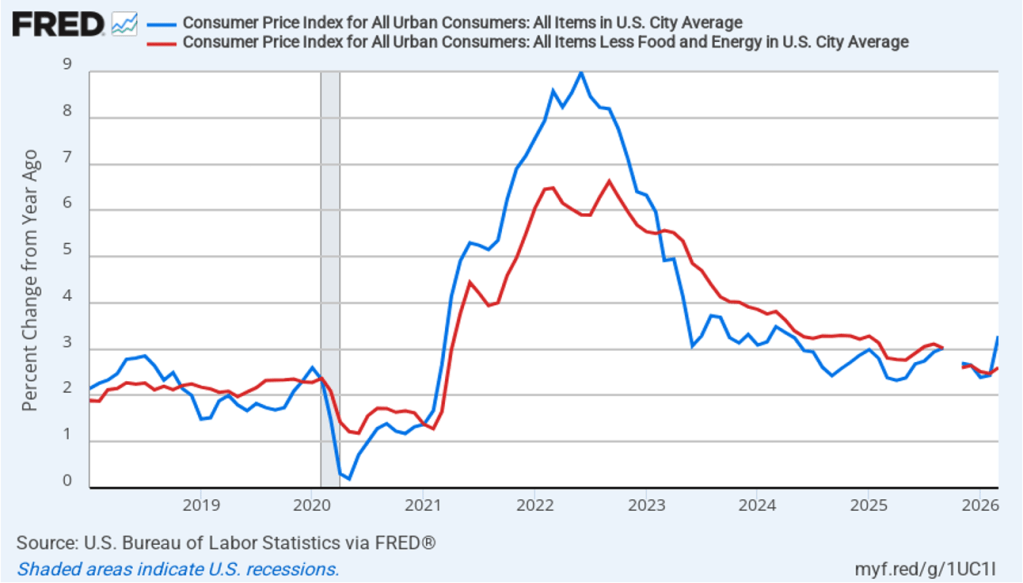
CPI Inflation jumped to a level well above the Federal Reserve’s 2 percent annual inflation target. The following figure compares headline CPI inflation (the blue line) and core CPI inflation (the red line). Because of the effects of the federal government shutdown, the BLS didn’t report inflation rates for October or November, so both lines show gaps for those months.
- The headline inflation rate, which is measured by the percentage change in the CPI from the same month in the previous year, was 3.3 percent in March, up from 2.4 percent in February.
- The core inflation rate, which excludes the prices of food and energy, was 2.6 percent in March, up only slightly from 2.5 percent in February.
Headline inflation was equal to the forecast of economists surveyed by the Wall Street Journal but well below the 3.7 percent rate forecast by economists surveyed by FactSet. Core inflation was slightly below the forecast of 2.7 percent in both surveys. Higher energy prices drove the jump in CPI inflation.
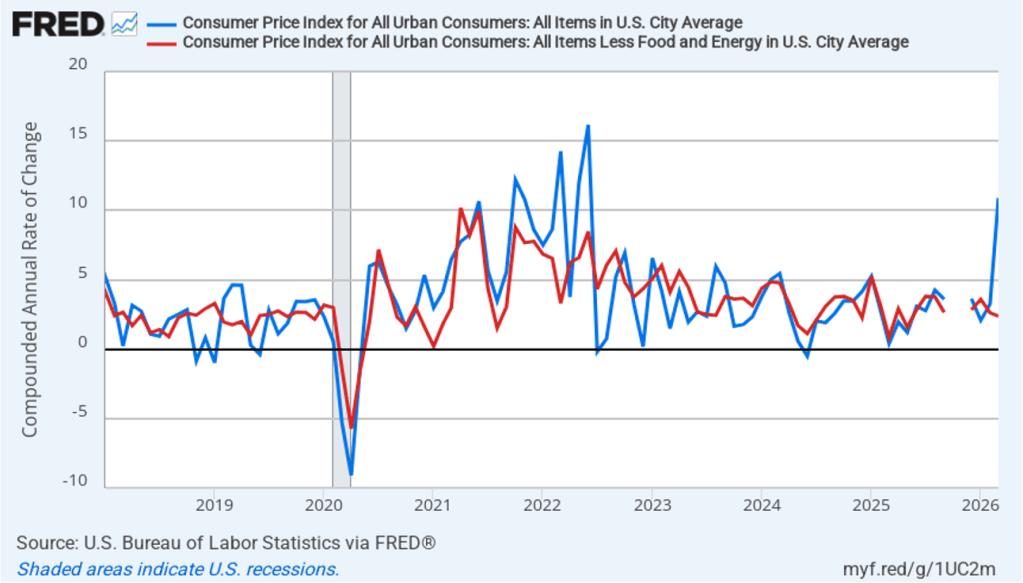
In the following figure, we look at the 1-month inflation rate for headline and core inflation—that is the annual inflation rate calculated by compounding the current month’s rate over an entire year. Calculated as the 1-month inflation rate, headline inflation (the blue line) was 10.9 percent in March, up from 3.2 percent in February. Core inflation (the red line) actually decreased to 2.4 in March from 2.6 percent in February.
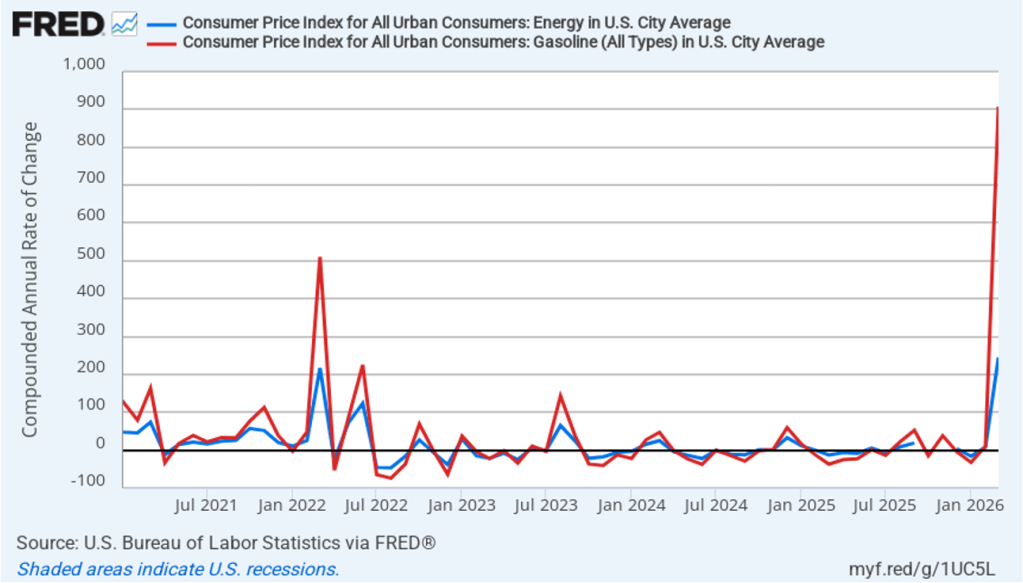
The following figure emphasizes the role paid by energy prices in causing the jump in inflation. The blue line shows the 1-month inflation rate in all energy prices included in the CPI. The red line shows the 1-month inflation rate in gasoline prices—which was an astounding 907.4 percent.
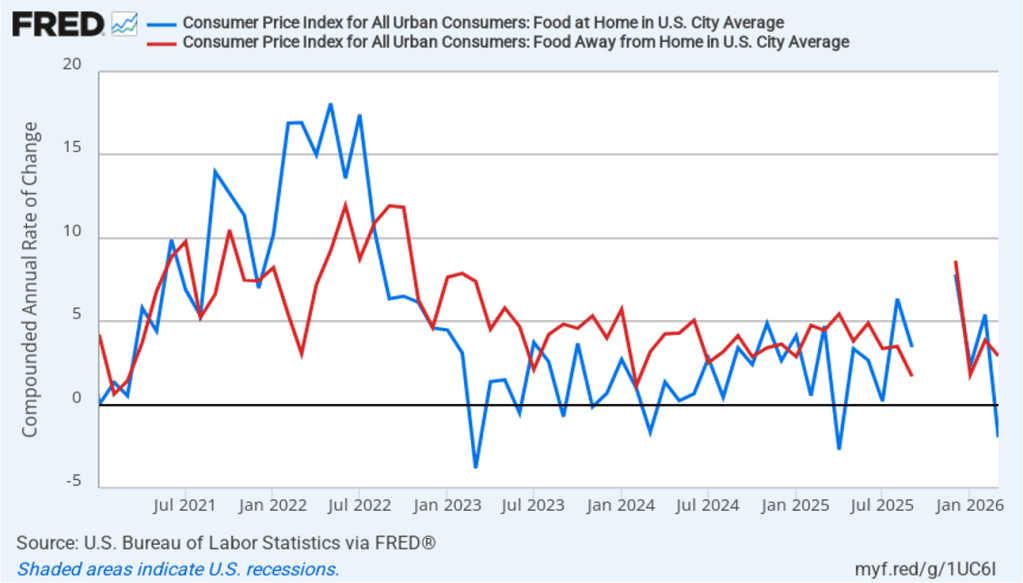
Did the jump in energy prices pass through to increases in food prices, which are a key concern for many consumers? The following figure shows 1-month inflation in the CPI category “food at home” (the blue bar)—primarily food purchased at grocery stores—and the category “food away from home” (the red bar)—primarily food purchased at restaurants. Inflation in both measures fell in March, indicating that they hadn’t (yet?) been affected by rising energy prices. Food at home actually decreased by 1.9 percent in March after increasing by 5.4 percent in February. Food away from home increased 2.9 percent in March, down from 3.9 percent in February.
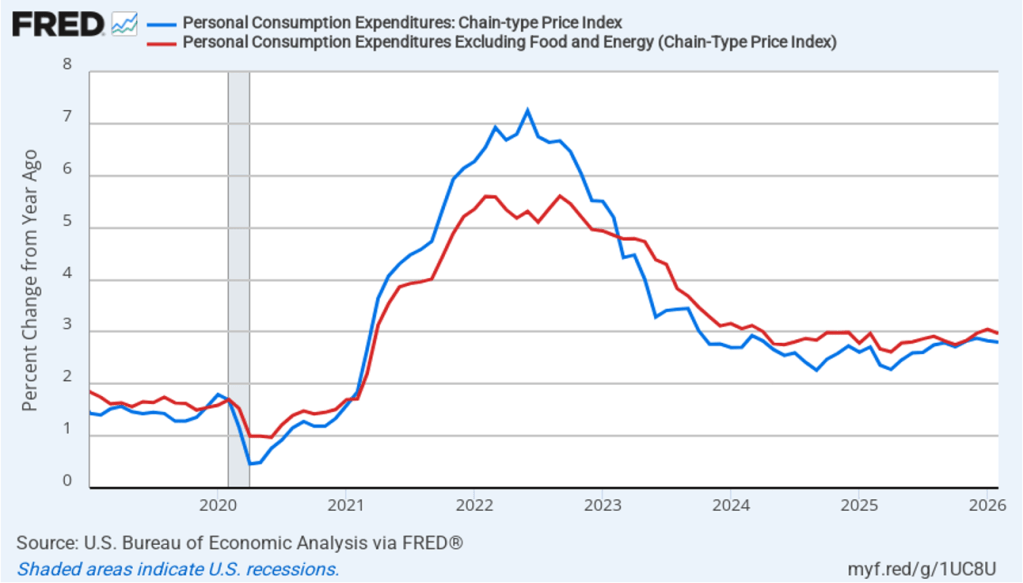
Turning now to PCE inflation for February. The following figure shows headline PCE inflation (the blue line) and core PCE inflation (the red line)—which excludes energy and food prices—with inflation measured as the percentage change in the PCE from the same month in the previous year. Headline PCE inflation was 2.8 percent in February, unchanged from January. Core PCE inflation was 3.0 percent in February, down slight from 3.1 percent in January . Headline inflation was slightly higher and core inflation was equal to the forecast of economists surveyed by FactSet.
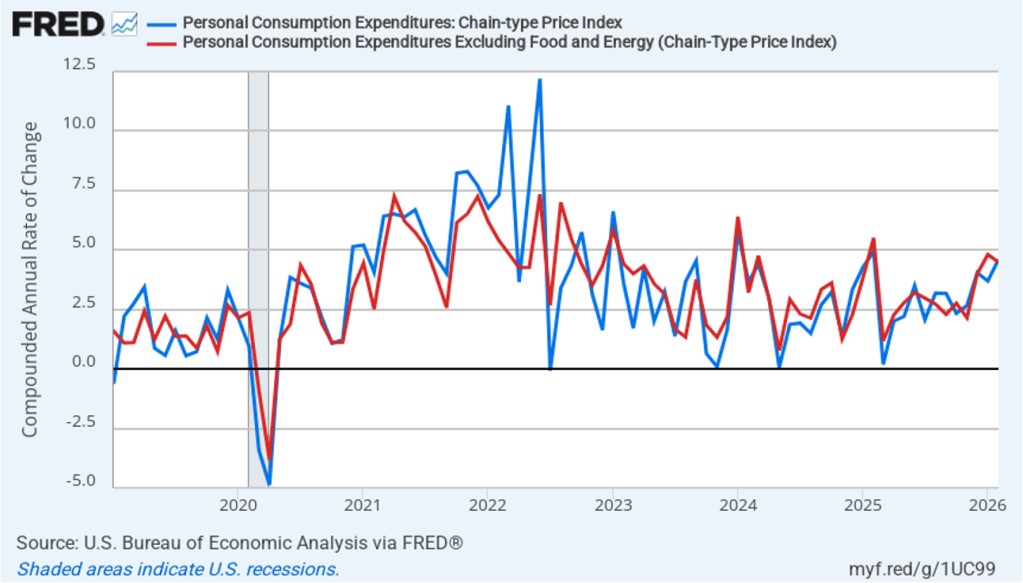
The following figure shows 1-month headline PCE inflation and core PCE. Measured this way, headline PCE inflation increased from 3.7 percent in January to 4.6 percent in February. Core PCE inflation declined from 4.8 percent in January to 4.5 percent in February. So, even before the effects of the escalation in energy prices, both 1-month and 12-month PCE inflation are telling the same story of inflation above the Fed’s target—well above in the case of 1-month inflation. These numbers raise significant concern about whether inflation was making progress toward the Fed’s 2 percent target even before the effects of the rise in energy prices.
Fed Chair Jerome Powell has frequently mentioned that inflation in non-market services can skew PCE inflation. Non-market services are services whose prices the BEA imputes rather than measures directly. For instance, the BEA assumes that prices of financial services—such as brokerage fees—vary with the prices of financial assets. So that if stock prices rise, the prices of financial services included in the PCE price index also rise. Powell has argued that these imputed prices “don’t really tell us much about … tightness in the economy. They don’t really reflect that.” The following figure shows 12-month headline inflation (the blue line) and 12-month core inflation (the red line) for market-based PCE. (The BEA explains the market-based PCE measure here.)
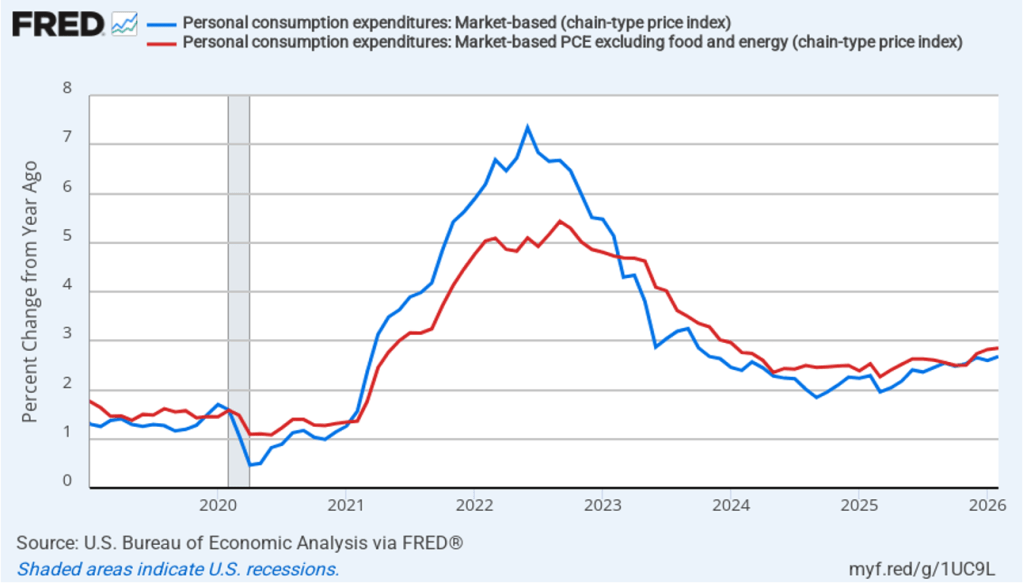
Headline market-based PCE inflation was 2.7 percent in February, up slightly from 2.6 percent in January. Core market-based PCE inflation was 2.9 percent in February, up slightly from 2.8 percent in January. So, both market-based measures show inflation as stable but well above the Fed’s 2 percent target.
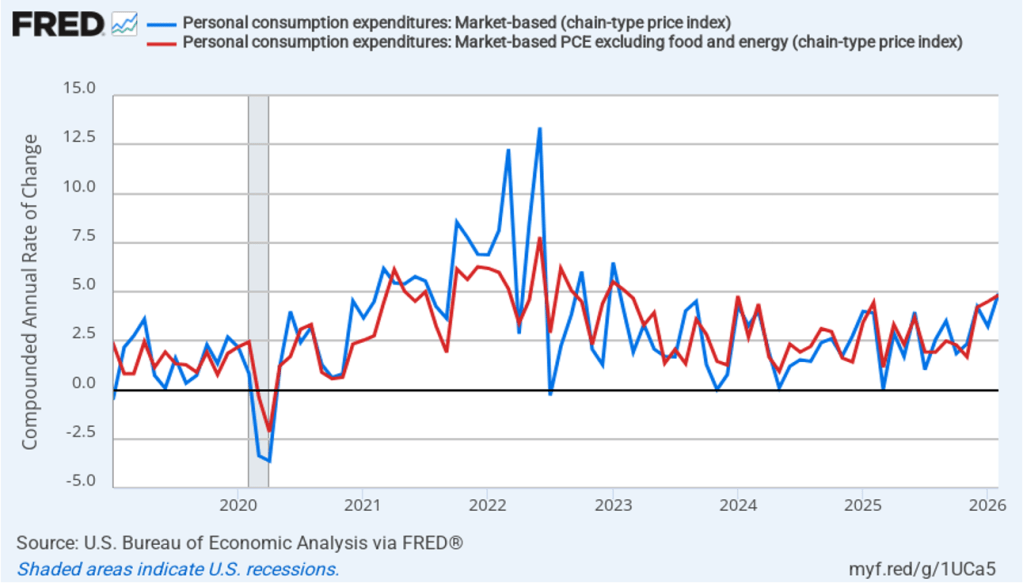
In the following figure, we look at 1-month inflation using these measures. One-month headline market-based inflation increased to 2.1 percent in November from 1.3 percent in October. One-month core market-based inflation fell to 1.3 percent in November from 2.0 percent in October. So, in November, 1-month market-based inflation was at or below the Fed’s annual inflation target. As the figure shows, the 1-month inflation rates are more volatile than the 12-month rates, which is why the Fed relies on the 12-month rates when gauging how close it is coming to hitting its target inflation rate.
What effect are these troubling inflation reports likely to have on the Fed’s policymaking Federal Open Market Committee (FOMC) at its next meeting on April 28–29—likely Jerome Powell’s last meeting as Fed chair? Economists generally recommend that central banks “look through”—that is, take no action—in response to a supply shock. A supply shock ordinarily results in a one-time increase in the price level, rather than a long-lasting increase in inflation. Fed policymakers, though, are aware that inflation has been running above their 2 percent target for more than five years. The possibility that even a temporary spike in inflation might result in a significant increase in the inflation rate that households and firms expect is a concern. At this point, investors in the federal funds futures market assign only a very small probability to the FOMC raising or lowering its target for the federal funds rate at the next several meetings. Following the next meeting, Powell will give his thoughts on these and other issues at a press conference.
Job Market Bounces Back from Weak Start to the Year

Image created by ChatGPT
This morning (April 3), the Bureau of Labor Statistics (BLS) released its “Employment Situation” report (often called the “jobs report”) for March. The report showed a stronger than expected increase in employment.
The jobs report has two estimates of the change in employment during the month: one estimate from the establishment survey, often referred to as the payroll survey, and one from the household survey. As we discuss in Macroeconomics, Chapter 9, Section 9.1 (Economics, Chapter 19, Section 19.1), many economists and Federal Reserve policymakers believe that employment data from the establishment survey provide a more accurate indicator of the state of the labor market than do the household survey’s employment data and unemployment data. (The groups included in the employment estimates from the two surveys are somewhat different, as we discuss in this post.)
According to the establishment survey, there was a net increase of 178,000 nonfarm jobs during March. Economists surveyed by the Wall Street Journal had forecast an increase of only 59,000 jobs. Economists surveyed by FactSet had a similar forecast of a net increase of 60,000 jobs. The BLS revised downward its previous estimates of employment in January and February by a combined 7,000 jobs. (The BLS notes that: “Monthly revisions result from additional reports received from businesses and government agencies since the last published estimates and from the recalculation of seasonal factors.”)
The following figure from the jobs report shows the net change in nonfarm payroll employment for each month in the last two years. The figure shows an unusual pattern in the job market since the middle of 2025 in which months of declining employment and months of increasing employment alternate.
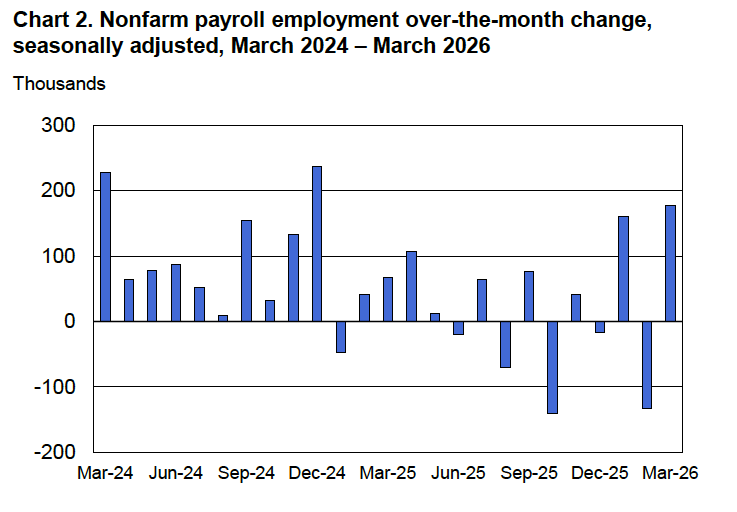
These fluctuations of net employment gains around zero are consistent with a recent analysis from economists at the Federal Reserve Bank of Dallas that estimates the break-even rate of employment growth—the rate of employment growth at which the unemployment rate remains constant. They note that “continued net outflows of unauthorized immigrants, together with shifts in labor force participation, have pushed the monthly break-even employment growth lower than previously thought.” They conclude that: “The break-even rate [of employment growth] peaked at about 250,000 jobs per month in 2023, fell to roughly 10,000 by July 2025, and declined to near zero thereafter, averaging about –3,000 jobs per month from August to December 2025, indicating, if anything, a modest net jobs loss over this period.” In other words, in the current labor market, the break-even rate of employment growth may actually be negative.
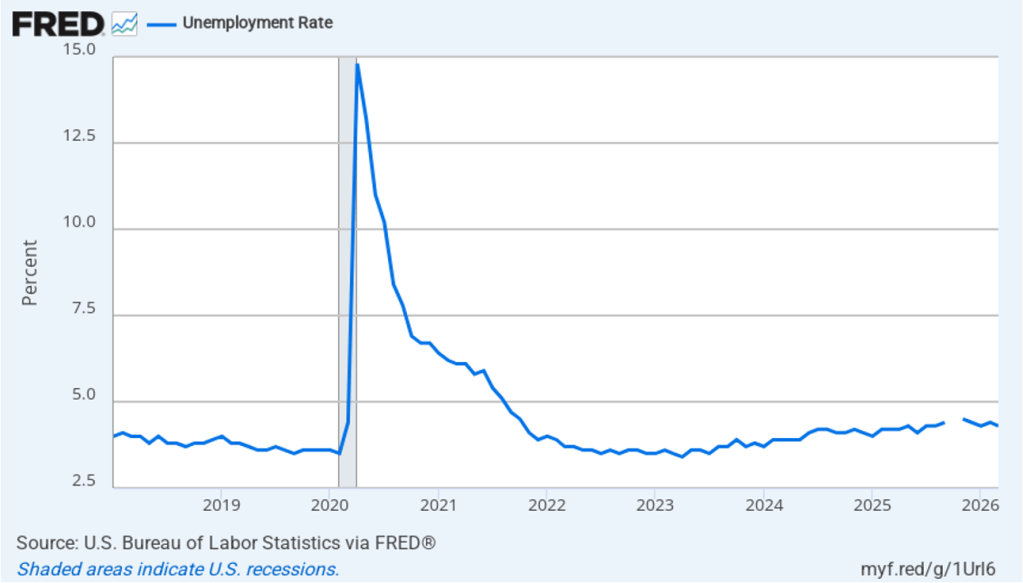
The unemployment rate, which is calculated from data in the household survey, declined from 4.4 percent in February for 4.3 percent in March. As the following figure shows, the unemployment rate has been remarkably stable over the past year and a half, staying between 4.0 percent and 4.4 percent in each month since May 2024. The Federal Open Market Committee’s current estimate of the natural rate of unemployment—the normal rate of unemployment over the long run—is 4.2 percent. So, unemployment is slightly above that estimate of the natural rate. (We discuss the natural rate of unemployment in Macroeconomics, Chapter 9 and Economics, Chapter 19.)
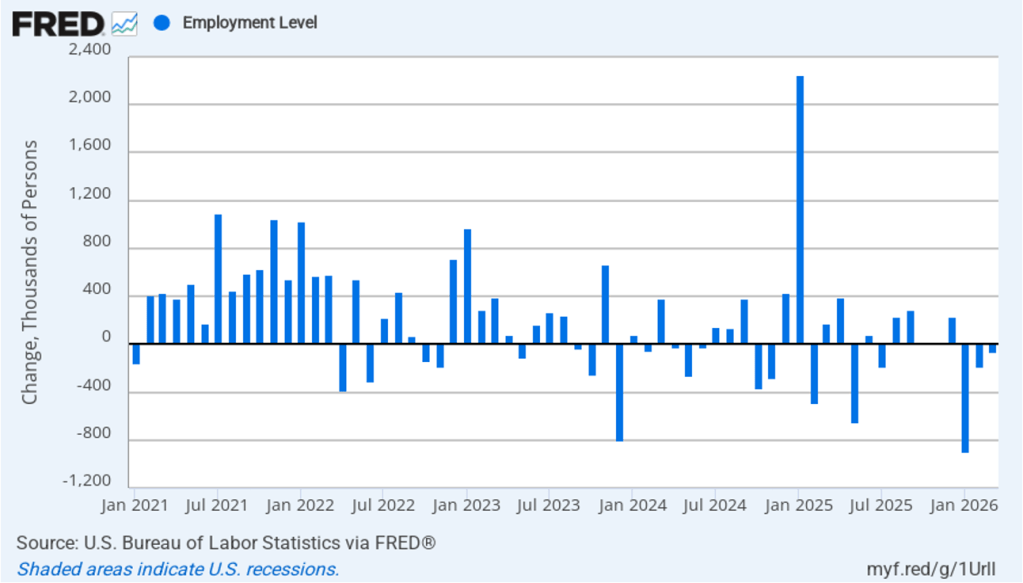
As the following figure shows, the monthly net change in jobs from the household survey moves much more erratically than does the net change in jobs from the establishment survey. As measured by the household survey, there was a net decrease of 64,000 in March. (Note that because of last year’s shutdown of the federal government, there are no data for October or November.) In any particular month, the story told by the two surveys can be inconsistent. In this case, the establishment survey shows a strong increase in net employment, while the household survey shows a decline. (In this blog post, we discuss the differences between the employment estimates in the two surveys.)
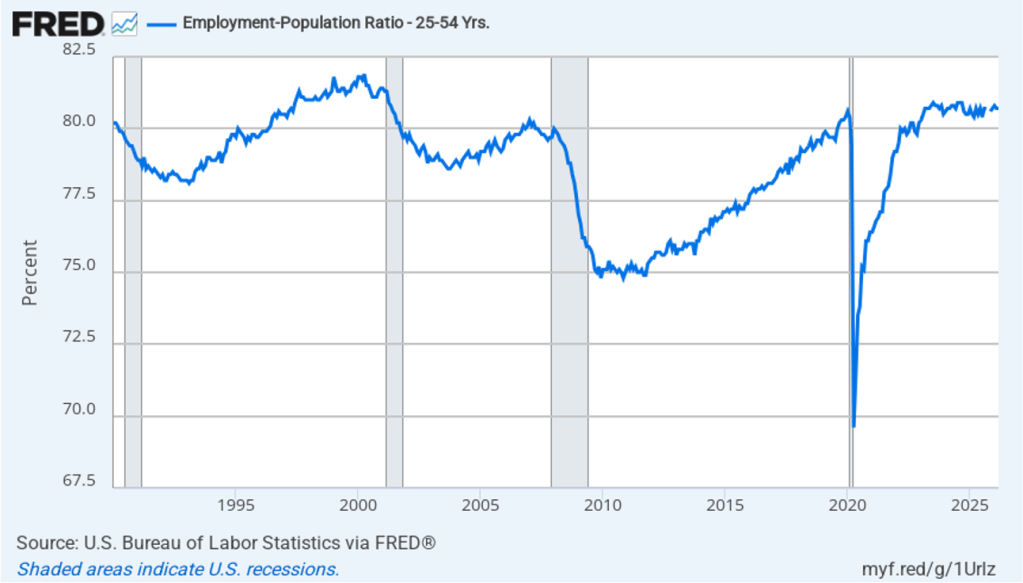
The household survey has another important labor market indicator: the employment-population ratio for prime age workers—those workers aged 25 to 54. In March the ratio was 80.7 percent, unchanged from February. The prime-age population ratio remains above its value for most of the period since 2001. The continued high levels of the prime-age employment-population ratio indicate some continuing strength in the labor market.
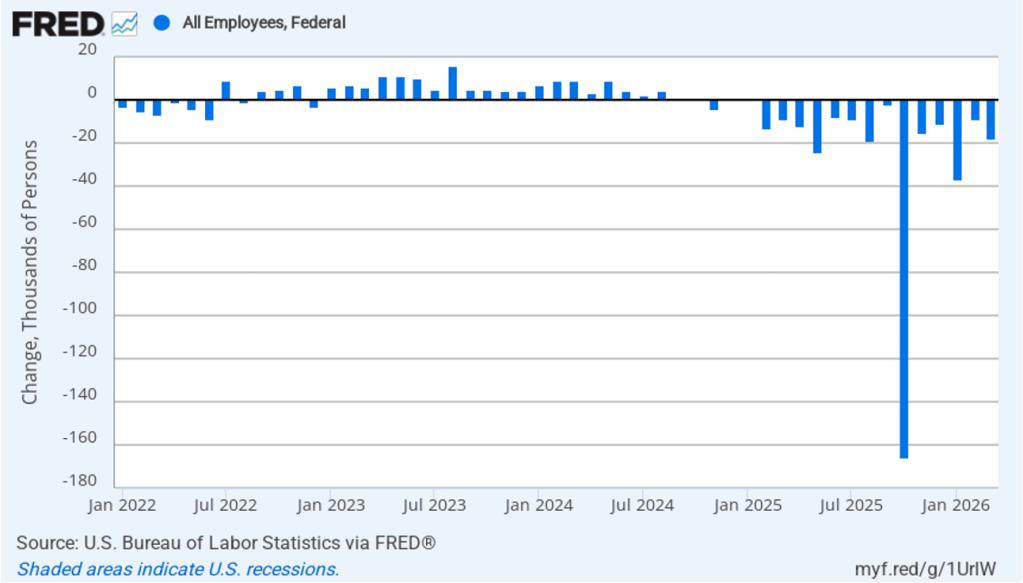
The Trump Administration’s layoffs of some federal government workers are clearly shown in the estimate of total federal employment for October, when many federal government employees exhausted their severance pay. (The BLS notes that: “Employees on paid leave or receiving ongoing severance pay are counted as employed in the establishment survey.”) As the following figure shows, there was a decline in federal government employment of 166,000 in October, with additional declines in the following five months. The total decline in federal government employment since the beginning of February 2025 is 352,000. But the decline has been slowing, with a net decrease of 18,000 jobs in March. So, the effect of layoffs of federal government workers is no longer a major factor in month-to-month changes in total employment.
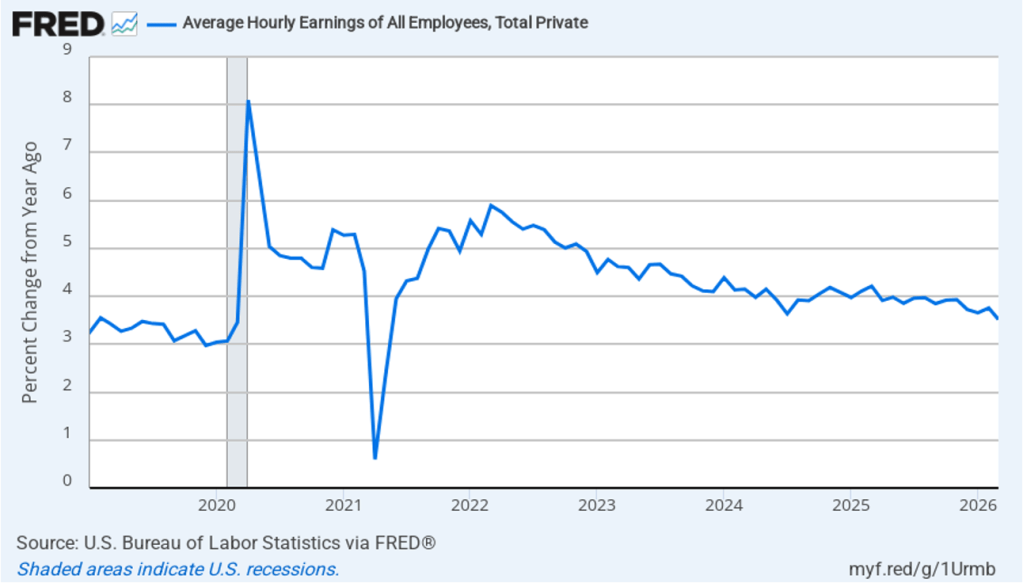
The establishment survey also includes data on average hourly earnings (AHE). As we noted in this post, many economists and policymakers believe the employment cost index (ECI) is a better measure of wage pressures in the economy than is the AHE. The AHE does have the important advantage of being available monthly, whereas the ECI is only available quarterly. The following figure shows the percentage change in the AHE from the same month in the previous year. The AHE increased 3.5 percent in March, down from 3.8 percent in February.
The following figure shows wage inflation calculated by compounding the current month’s rate over an entire year. (The figure above shows what is sometimes called 12-month wage inflation, whereas this figure shows 1-month wage inflation.) One-month wage inflation is much more volatile than 12-month wage inflation—note the very large swings in 1-month wage inflation in April and May 2020 during the business closures caused by the Covid pandemic. In March, the 1-month rate of wage inflation was 2.9 percent, down from 4.6 percen in February. So both 12-month and 1-month wage inflation show wages increasing slowing.
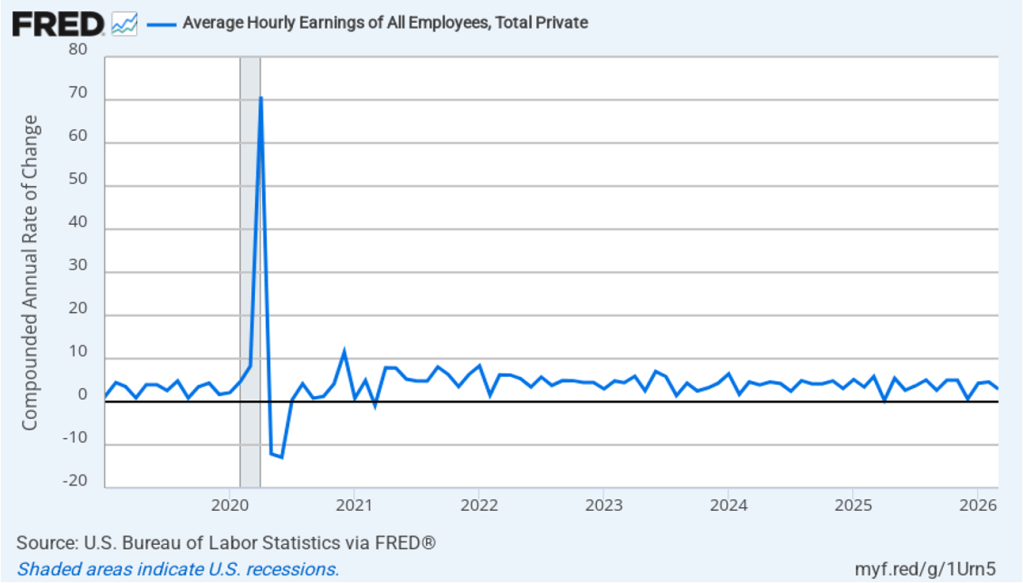
What effect is this jobs report likely to have on the decisions of the Federal Reserve’s policymaking Federal Open Market Committee at its next meeting on April 28–29? Although employment growth has been slow in recent months, as noted earlier, even that slow rate may be close to the break-even rate of employment growth. So, it’s unlikely that the FOMC will see current conditions in the job market as warranting a cut in the committee’s target range for the federal funds rate. In addition, disruptions to the world oil market as a result of the conflict in Iran have caused oil prices to rise, putting upward pressure on the price level. These factors make it likely that the committee will keep its target range for the federal funds rate unchanged at its next meeting.
The probability that investors in the federal funds futures market assign to the FOMC keeping its target rate unchanged at its April meeting was 99.5 percent this afternoon, only a slight decrease from 100.0 percent yesterday.
Disney Defeating Pirates? Dogs and Coffee the Keys to a Healthy Life?

Image generated by ChatGPT
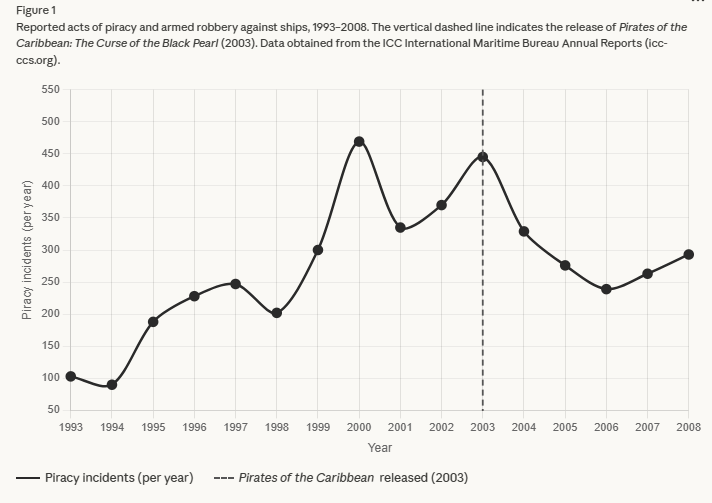
Recently, Rustam Jamilov of the University of Oxford posted the following figure to X, noting that: “A new paper shows that the release of Pirates of the Caribbean was associated with a 38% decline in real-world piracy incidents. The lives saved by Disney are staggering.”
A recent article in the New York Times had the headline “Get a Dog, Live Longer.” The article stated that: “Research dating back decades has found that people who own pets, especially dogs, tend to be healthier than people who don’t.” A “large review of studies published in 2019 found that owning a dog was associated with a 24 percent lower risk of dying from all causes over the course of 10 years.”
An article in the Washington Post had the headline “Drink Coffee to Prevent Dementia? It’s Not So Far-Fetched.” The article reports on a study in which “The researchers analyzed data from more than 131,000 people over multiple decades.” The key finding of the study was that “Those who regularly drank caffeinated coffee had an 18 percent lower risk [of developing dementia] compared to people who drank little or none. Regular coffee drinkers also performed better on some cognitive tests and were less likely to report mental decline.”
All three of these cases involve observational studies, rather than experiments. In experiments, researchers assign some randomly selected people to a treatment group and other people to a control group. If you wanted to test the effect of having a dog on a person’s health, you could give a dog to a randomly selected group of people—the treatment group—and assign another randomly selected group of people to remain without a dog—the control group. Then you would follow both groups for a period of years and see if there was any difference in health outcomes between the people with a dog and those without a dog.
As this example indicates, experiments can be an impractical way to test a hypothesis. So instead, researchers often follow a group of people over time and then look for correlations between their activities—having a dog or drinking coffee, for example—and their life outcomes: Are people who engage in these activities healthier, happier, more likely to be married, have higher incomes, and so on. Observational studies can generate correlations between two variables, but it’s not clear if they establish causation—does owning a dog cause you to be healthier.
Some correlations are obvious nonsense. Rustam Jamilov is joking when he pretends that, because a decline in piracy in the real world followed the release of the first Pirates of the Caribbean movie, releasing the movie reduced piracy. In Chapter 6 of Money, Banking, and the Financial System we discuss the nonsense correlation discovered by Leonard Koppett when he noticed that—for a period of 11 years—which conference the winner of the National Football League’s Super Bowl was from was correlated with the performance of the stock market in the following year.
The claims that owning a dog or drinking coffee might improve your health seem more plausible because you can think of reasonable causal mechanisms. For instance, if you own a dog you might be more likely to take long walks, which may improve your health. And there may be some attribute of caffeine that makes coffee drinkers less likely to suffer from dementia.
The problem is that because people in an observational study aren’t randomly assigned to engage in the activity being studied—owning a dog or drinking coffee—we can’t be sure if people engaging in these activities differ systematically from those who don’t. As the article on the health benefits of dogs points out: “Dog owners tend to be younger and richer than non-owners, characteristics that correspond with better health.” Observational studies generally fail to control for these confounding factors, making it more difficult to determine if the correlations they find are causal.

Image created by ChatGPT
A famous example of concluding that a correlation was causal when it likely wasn’t comes from the Nurses’ Health Study (NHS), which followed more than 30,000 postmenopausal nurses beginning in 1976. The nurses who used hormone therapies were more than 40 percent less likely to develop coronary heart disease. This correlation was believed to be causal, which resulted in many more postmenopausal women being proscribed hormone therapies.
This conclusion was reversed by the Women’s Health Initiative (WHI), which was conducted in the 1990s and randomly assigned women to receive hormone therapy or a placebo. The women receiving the hormone therapy turned out to be more likely to experience coronary problems. Part of the explanation appears to be that the nurses in the NHS who used the hormone therapy were already healthier in some respects, such as having lower weight and lower blood pressure, than the nurses who did not use the hormone therapy. (Note: The findings in this area complex and are still being debated, so don’t take our brief summary as a definitive account!)
Image created by ChatGTP
In recent years, economists have often used natural experiments to attempt to identify causal results from observational studies. With a natural experiment, economists identify some variable of interest—say, an increase in the minimum wage—that has changed for one group of people—say, fast-food workers in one state—while remaining unchanged for another similar group of people—say, fast-food workers in a neighboring state. Researchers can draw an inference about the effects of the change by looking at the difference between the outcomes for the two groups. In this example, the difference between changes in employment at fast-food restaurants in the two states can be used to measure the effect of an increase in the minimum wage.
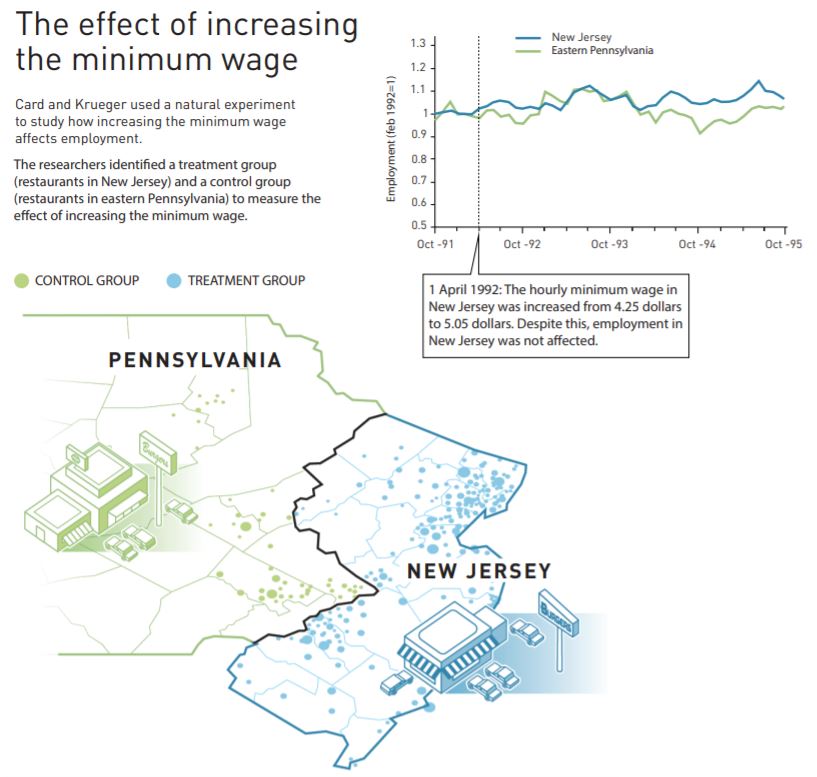
In a famous study of the effect of the minimum wage on employment in the fast food industry published in 1994 in the American Economic Review, David Card of the University of California, Berkeley and the late Alan Krueger of Princeton University pioneered the use of natural experiments. In that study, Card and Krueger analyzed the effect of the minimum wage on employment in fast-food restaurants by comparing what happened to employment in New Jersey when it raised the state minimum wage from $4.25 to $5.05 per hour with employment in eastern Pennsylvania where the minimum wage remained unchanged. They found that, contrary to the usual analysis that increases in the minimum wage lead to decreases in the employment of unskilled workers, employment of fast-food workers in New Jersey actually increased relative to employment of fast-food workers in Pennsylvania. Card shared the 2021 Nobel Prize in Economics with Joshua Angrist of the Massachusetts Institute of Technology; and Guido Imbens of Stanford University in part for his work using natural experiments.
The following graphic from Nobel Prize website summarizes the study. (Note that not all economists have accepted the results of Card and Krueger’s study. We briefly summarize the debate over the effects of the minimum wage in Microeconomics and Economics, Chapter 4, Section 4.3.)
So, attempting to draw causal inferences from observational studies is hard. Having a dog or drinking coffee may not actually improve your health.
But why take chances? Adopt a dog!

FOMC Holds Its Target for the Federal Funds Rate Steady at Powell’s Next-to-Last Meeting
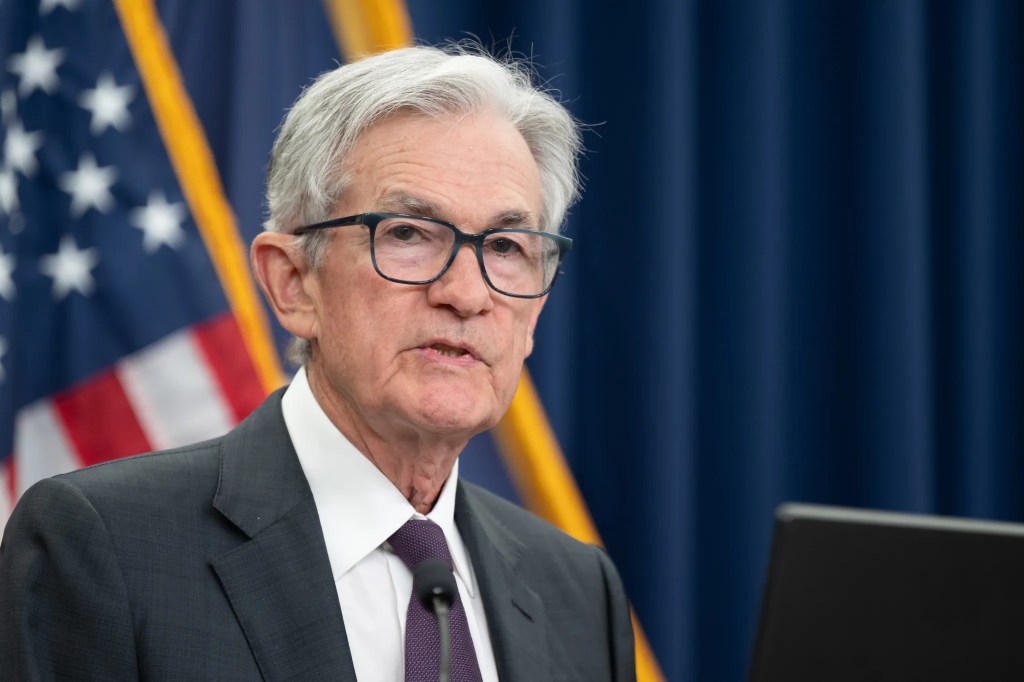
Photo from federalreserve.gov
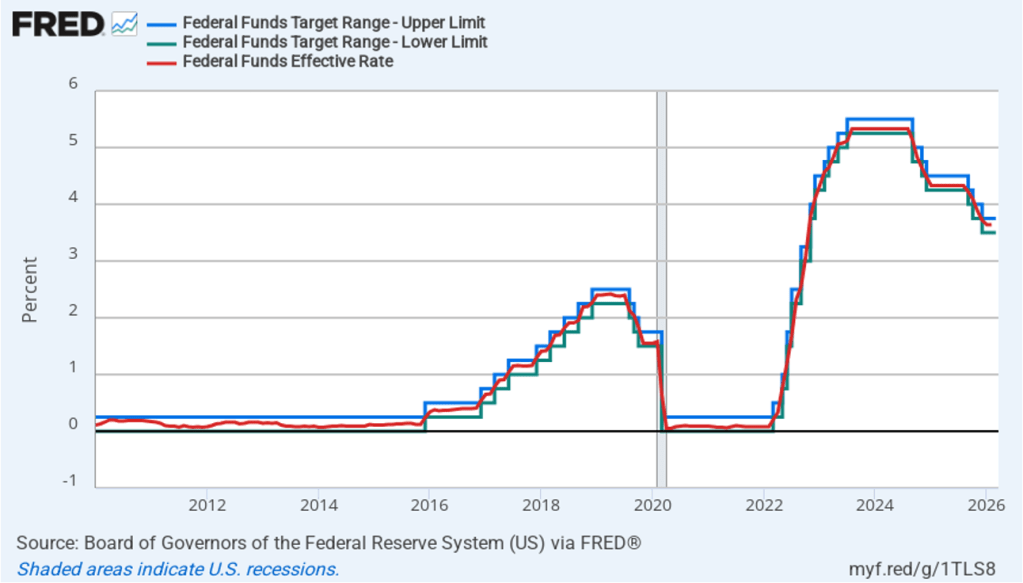
Today’s meeting of the Federal Reserve’s policymaking Federal Open Market Committee (FOMC) had the expected result with the committee deciding to leave unchanged its target for the federal funds rate at its current range of 3.50 percent to 3.75 percent. The members of the committee voted 11 to in favor of the decision. Fed Governor Stephen Miran voted against the decision, preferring to lower the target range for the federal funds rate by 0.25 percentage point (25 basis points).
The following figure shows for the period since January 2010, the upper bound (the blue line) and the lower bound (the green line) for the FOMC’s target range for the federal funds rate, as well as the actual values for the federal funds rate (the red line). Note that the Fed has been successful in keeping the value of the federal funds rate in its target range. (We discuss the monetary policy tools the FOMC uses to maintain the federal funds rate within its target range in Macroeconomics, Chapter 15, Section 15.2 (Economics, Chapter 25, Section 25.2).)
After the meeting, the committee also released a “Summary of Economic Projections” (SEP)—as it typically does after its March, June, September, and December meetings. The SEP presents median values of the 19 committee members’ forecasts of key economic variables. The values are summarized in the following table, reproduced from the release. (Note that only 5 of the district bank presidents vote at FOMC meetings, although all 12 presidents participate in the discussions and prepare forecasts for the SEP.)
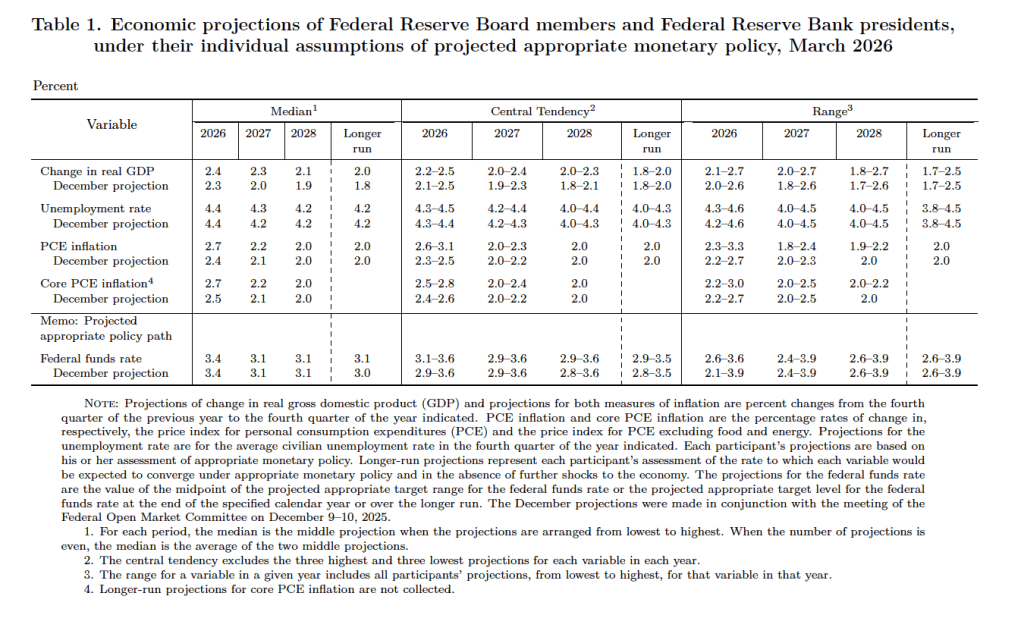
There are several aspects of these forecasts worth noting:
- Compared with December, the committee members increased their forecasts of real GDP growth for each year from 2025 through 2027. The committee members also increased their forecast of long-run growth in real GDP to 2.0 percent from 1.8 percent in December. Although that increase may seem small, as we discuss in Macroeconomics, Chapter 10, Section 10.1 (Economics, Chapter 20, Section 20.1), over time, small increases in growth rates in real GDP can result in substantial increases in the standard of living. Despite increasing their forecast of growth in real GDP, committee members left their forecasts of the unemployment rate unchanged.
- Committee members reduced their forecast for 2026 of personal consumption expenditures (PCE) price inflation significantly to 2.7 percent from 2.4 percent in December. They raised their forecast for inflation in 2027 slightly and continued to forecast that PCE inflation will decline to the Fed’s 2.0 percent annual target in 2028.
- The committee’s forecasts of the federal funds rate at the end of each year from 2026 through 2028 were unchanged but the forecast for the long-run federal funds rate was increased to 3.1 percent from 3.0 percent in December.
Prior to the meeting there was much discussion in the business press and among investment analysts about the dot plot, shown below. Each dot in the plot represents the projection of an individual committee member. (The committee doesn’t disclose which member is associated with which dot.) Note that there are 19 dots, representing the 7 members of the Fed’s Board of Governors and all 12 presidents of the Fed’s district banks.
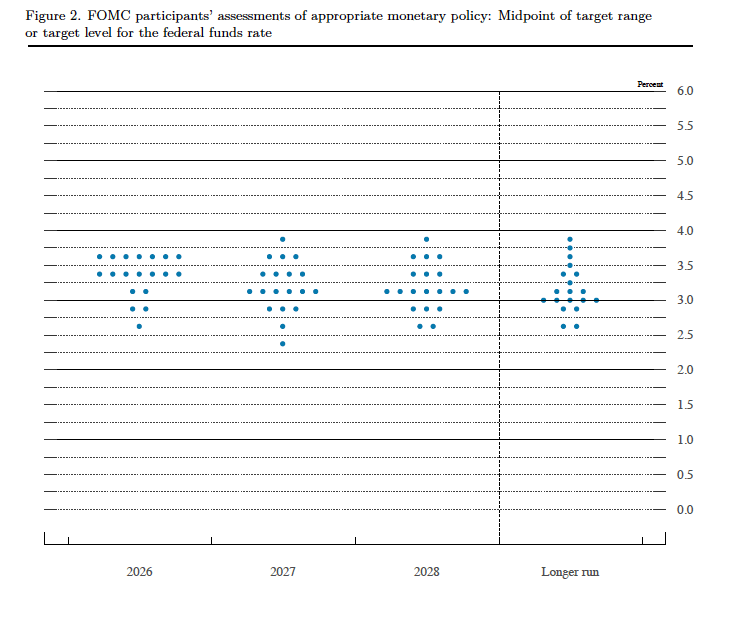
The plots on the far left of the figure represent the projections by the 19 members of the value of the federal funds rate at the end of 2026. The plots indicate that at this point there is majority support on the committee for one 25 basis point cut by the end of the year in the federal funds rate from its current range of 3.50 percent to 3.25 percent to a range of 3.25 percent to 3.00 percent. The plots on the far right of the figure indicate that there is substantial disagreement among committee members as to what the long-run value of the federal funds rate—the so-called neutral rate—should be. Of course, the plots only represent the forecasts of the committee members and individual committee members are likely to adjust their forecasts as additional macroeconomic data become available in the coming months.
During his press conference following the meeting, Powell indicated that the effects of the conflict in Iran on the U.S. economy were uncertain. He noted that traditionally central banks “look through” increases in oil prices because they result in only a one-time increase in the price level rather than in sustained inflation. He noted, though, that the committee might take steps to offset the effect of higher oil prices if there were an indication that the price increases were affecting long-run expectations of inflation.
He noted that the increase in inflation in recent months was largely due to the effects of the increase in tariffs on goods prices. Powell indicated that committee members expect that the tariff increases will have largely passed through the economy by the middle of the year. Powell attributed committee members increasing their forecast of long-run growth in real GDP to their expectation that recent increases in productivity growth would be sustained.
Finally, Powell discussed the end of his term as chair on May 15. (Powell will be chair for one more meeting of the FOMC on April 28–29.) He stated that if the Senate doesn’t confirm Kevin Warsh as his replacement as chair by May 15, he would follow the law and Fed tradition by continuing to serve as chair in a temporary capacity. Powell’s term as a member of the Board of Governors doesn’t end until January 31, 2028. He indicated that he will only step down from his position on the Board if the legal case the Department of Justice has opened against him for having given allegedly false testimony to Congress is “well and truly over, with transparency and finality.”
Real GDP Growth Revised Downward as PCE Inflation Is Slightly Lower than Expected

Image generated by ChatGPT
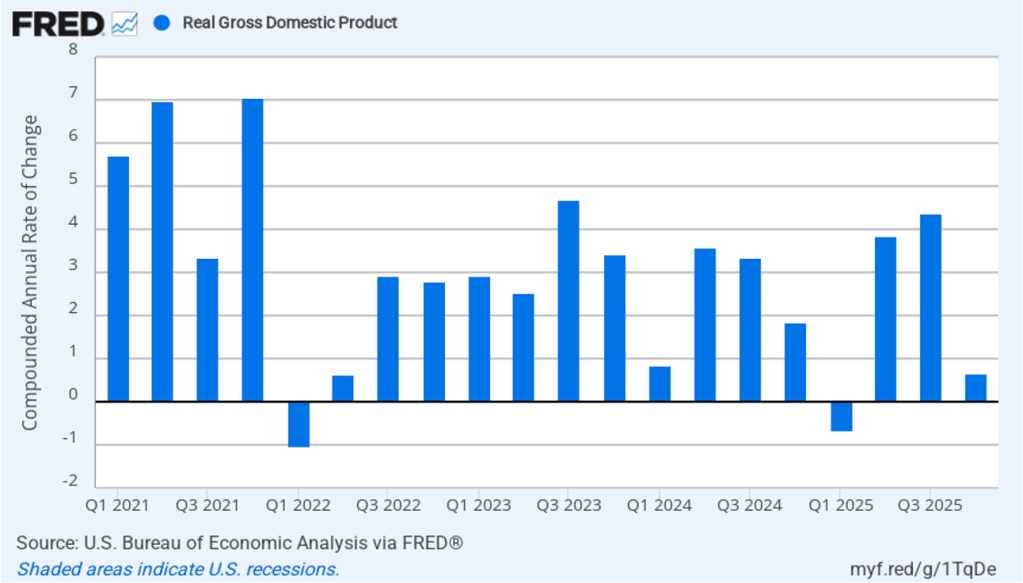
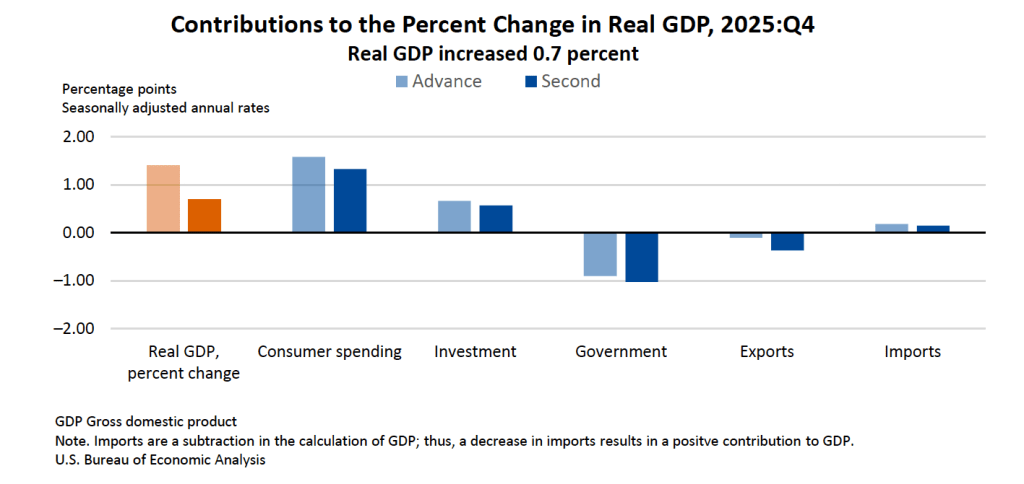
The Burea of Economic Analysis (BEA) released two reports this morning. One report included a revision of estimated growth in real GDP during the fourth quarter of 2025 from an advance estimate of 1.4 percent—which was already lower than had been expected—to 0.7 percent. Economists surveyed by the Wall Street Journal had expected that fourth quarter growth would be revised upward to 1.5 percent. The BEA’s “Personal Income and Outlays, January 2026” report indicated that the personal consumption expenditures (PCE) price index had increased 2.8 percent over the past year, slightly below the 2.9 percent that economists had expected.
The following figure shows the estimated rates of GDP growth in each quarter beginning with the first quarter of 2021.
As the following figure—taken from the BEA report—shows, consumer spending, investment spending, government spending, and net exports were all revised downward from the original advance estimates. The decline in real government expenditures of –1.0 percent at an annual rate—revised downward from –0.9 percent—was the most important factor contributing to the slowing growth in real GDP during the fourth quarter. The decline in government expenditures is largely attributable to the federal government shutdown, which lasted from October 1, 2025 to November 12, 2025.
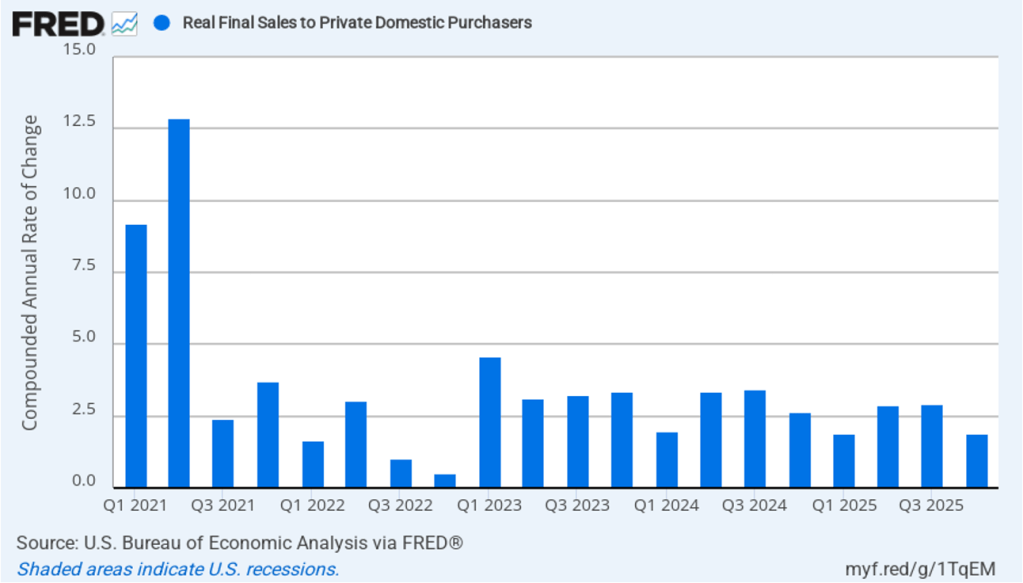
As we’ve discussed in previous blog posts, to better gauge the state of the economy, policymakers—including Fed Chair Jerome Powell—often prefer to strip out the effects of imports, inventory investment, and government expenditures—which can be volatile—by looking at real final sales to private domestic purchasers, which includes only spending by U.S. households and firms on domestic production. As the following figure shows, real final sales to domestic purchasers increased by 1.9 percent in the fourth quarter at an annual rate—revised downward from the advance estimate of 2.4 percent—which was well above the 0.9 percent increase in real GDP and slightly above the U.S. economy’s expected long-run annual real growth rate of 1.8 percent. Note also that real final sales to private domestic purchasers grew by 2.9 percent in the third quarter, during which real GDP grew by 4.4 percent, and by 1.9 percent in the first quarter of 2025, when real GDP declined by 0.6 percent. So this measure of output is more stable and likely is a better indicator of the underlying growth rate in the economy than is growth in real GDP.
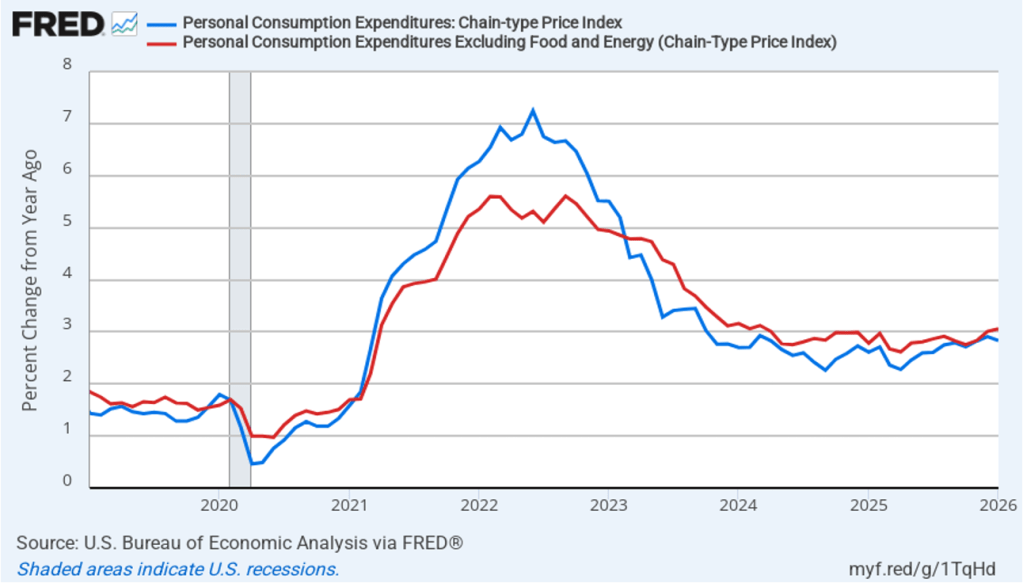
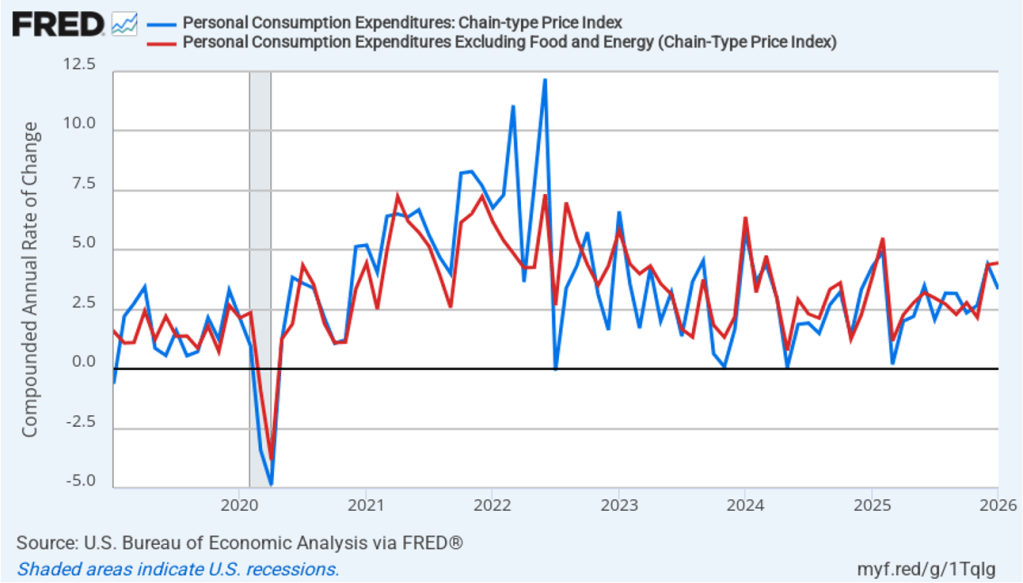
The second BEA report this morning included monthly data on the personal consumption expenditures (PCE) price index for January 2026. The Fed relies on annual changes in the PCE price index to evaluate whether it’s meeting its 2.0 percent annual inflation target. The following figure shows headline PCE inflation (the blue line) and core PCE inflation (the red line)—which excludes energy and food prices— with inflation measured as the percentage change in the PCE from the same month in the previous year. In January 2026, headline PCE inflation was 2.8 percent, down slightly from 2.9 percent in December 2025 (which was also the inflation rate economists had expected for January 2026). Core PCE inflation in January was 3.1 percent, up slightly from 3.0 in December. Both headline PCE inflation and core PCE inflation remained above the Fed’s 2.0 percent annual inflation target.
The following figure shows headline PCE inflation and core PCE inflation calculated by compounding the current month’s rate over an entire year. (The figure above shows what is sometimes called 12-month inflation, while the figure below shows 1-month inflation.) Measured this way, headline PCE inflation declined to 3.4 percent in January, from to 4.4 percent in December. Core PCE inflation fell to 4.4 percent in January from 4.5 percent in December. Measured this way, both core and headline PCE inflation were well above the Fed’s target.
Fed Chair Jerome Powell has frequently mentioned that inflation in non-market services can skew PCE inflation. Non-market services are services whose prices the BEA imputes rather than measures directly. For instance, the BEA assumes that prices of financial services—such as brokerage fees—vary with the prices of financial assets. So that if stock prices fall, the prices of financial services included in the PCE price index also fall. Powell has argued that these imputed prices “don’t really tell us much about … tightness in the economy. They don’t really reflect that.” The following figure shows 12-month headline inflation (the blue line) and 12-month core inflation (the red line) for market-based PCE. (The BEA explains the market-based PCE measure here.)
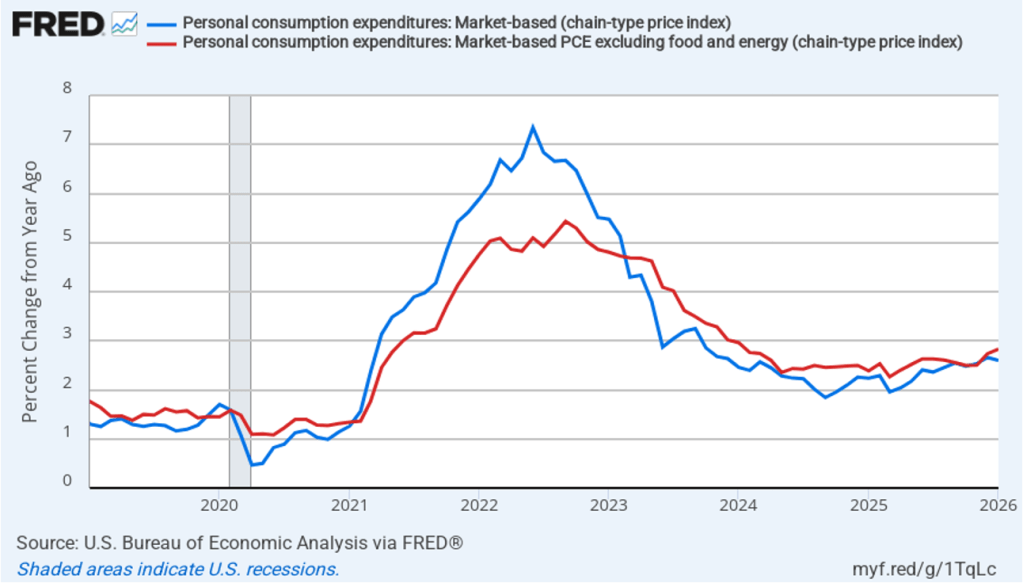
Headline market-based PCE inflation was 2.6 percent in January, down from 2.7 percent in December. Core market-based PCE inflation was 2.8 percent in January, up from 2.7 in December. So, both market-based measures show inflation as stable but above the Fed’s 2 percent target.
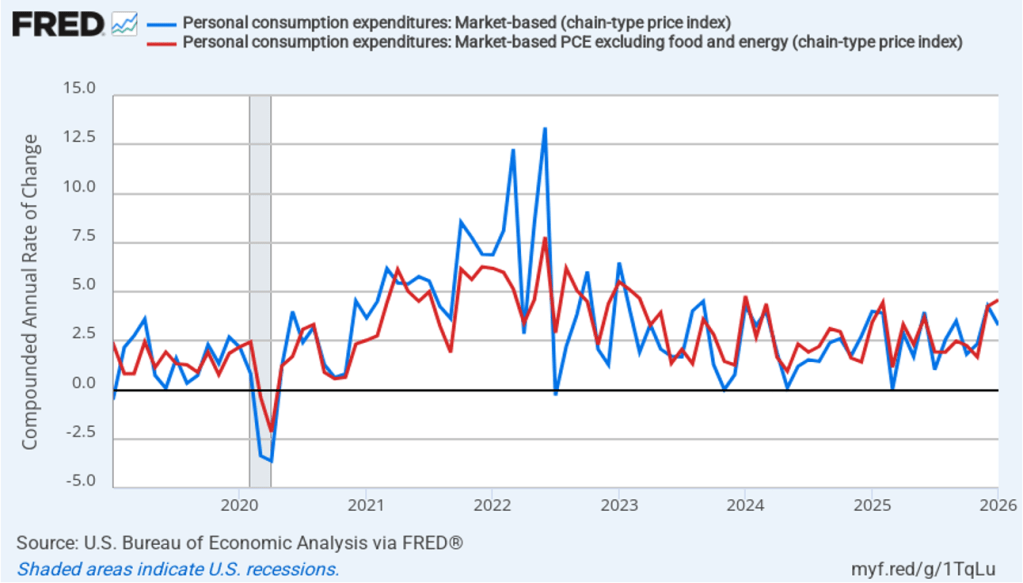
In the following figure, we look at 1-month inflation using these measures. One-month headline market-based inflation was 3.3 percent in January, down from 4.3 percent in December. One-month core market-based inflation increased to 4.6 percent in January from 4.4 percent in December. As the figure shows, the 1-month inflation rates are more volatile than the 12-month rates, which is why the Fed relies on the 12-month rates when gauging how close it is coming to hitting its target inflation rate.
Today’s data arrive against the backdrop of the conflict in Iran. According to the AAA, gasoline prices have risen to an average of $3.63 per gallon from $2.94 a month ago. Assuming that the conflict is resolved relatively soon, that increase should have only a transitory effect on inflation. Chair Powell as indicated that he believes that the upward pressure of tariffs on the price level is also still working its way through the economy.
Recent macroeconomic data, along with the effects of tariffs and the conflict in Iran, make it unlikely that members of the Fed’s policymaking Federal Open Market Committee (FOMC) will reduce their target range for the federal funds rate any time soon. The probability that investors in the federal funds futures market assign to the FOMC keeping its target rate unchanged at its March 17–18 meeting decreased only slightly this afternoon to 99.1 percent from rom 99.9 percent yesterday. Investors don’t assign a greater than 50 percent probability to the FOMC cutting its federal funds rate target at any meeting before the meeting on October 27–28.
CPI Inflation Comes in about as Expected

Image created by ChatGPT
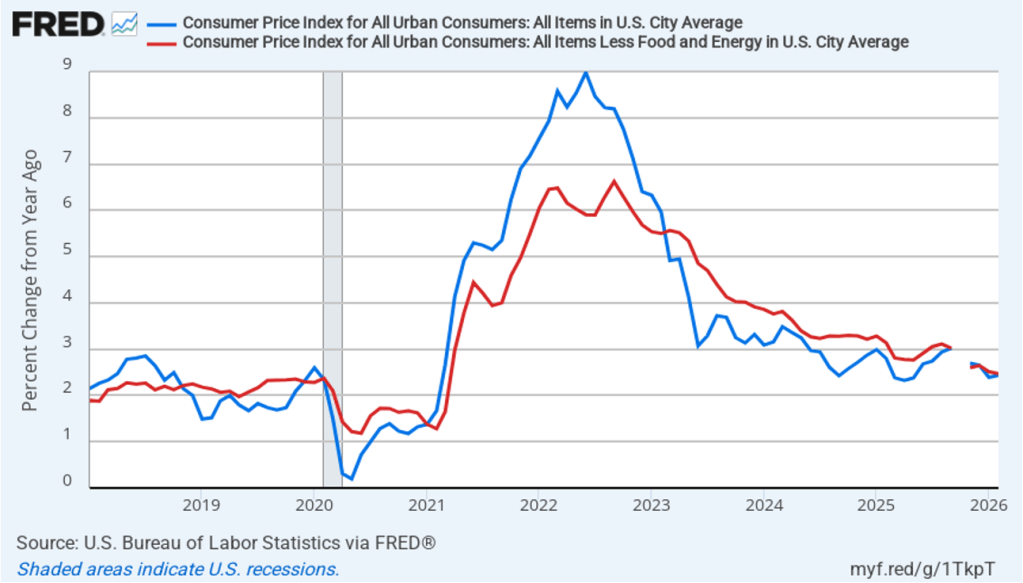
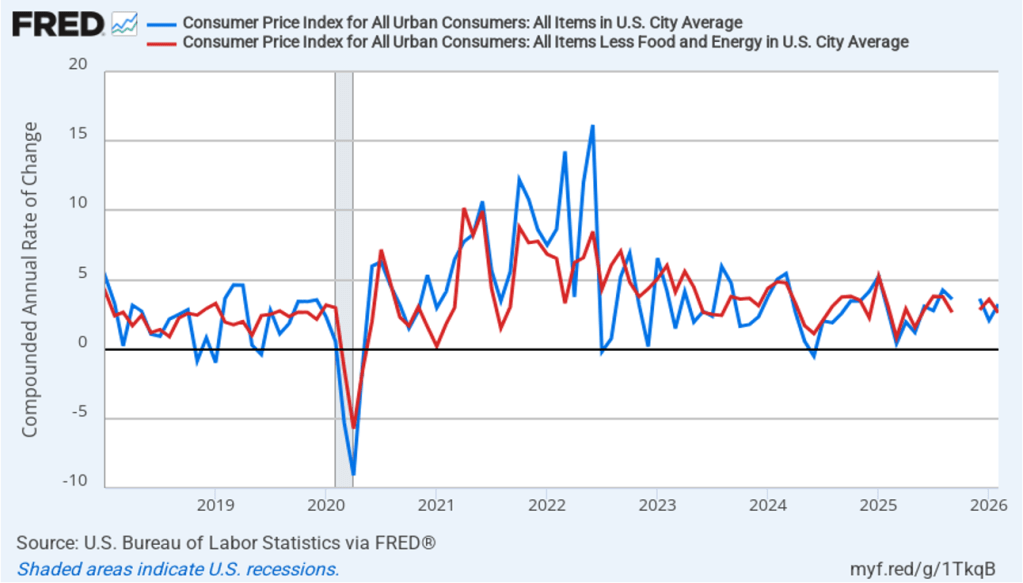
The news this morning on inflation was ho-hum. The Bureau of Labor Statistics (BLS) released its report on the consumer price index (CPI) for February. Inflation was about as expected and remained moderately above the Federal Reserve’s 2 percent annual inflation target. The following figure compares headline CPI inflation (the blue line) and core CPI inflation (the red line). Because of the effects of the federal government shutdown, the BLS didn’t report inflation rates for October or November, so both lines show gaps for those months.
- The headline inflation rate, which is measured by the percentage change in the CPI from the same month in the previous year, was 2.4 percent in February, unchanged from January.
- The core inflation rate, which excludes the prices of food and energy, was 2.5 percent in February, also unchanged from January.
Headline and core inflation were both equal to the forecasts of economists surveyed by the Wall Street Journal.
In the following figure, we look at the 1-month inflation rate for headline and core inflation—that is the annual inflation rate calculated by compounding the current month’s rate over an entire year. Calculated as the 1-month inflation rate, headline inflation (the blue line) was 3.2 percent in February, up from 2.1 percent in January. Core inflation (the red line) decreased to 2.6 percent in February from 3.6 percent in January.
The 1-month and 12-month headline and core inflation rates are telling similar stories, with both measures indicating that the rate of price increase is running somewhat above the Fed’s 2 percent inflation target.
Of course, it’s important not to overinterpret the data from a single month. The figure shows that the 1-month inflation rate is particularly volatile. Also note that the Fed uses the personal consumption expenditures (PCE) price index, rather than the CPI, to evaluate whether it is hitting its 2 percent annual inflation target. February data on the PCE will be released on Friday.
In recent months, there have been many media reports on how consumers are concerned about declining affordability. Affordability has no exact interpretation but typically means concern about inflation in goods and services that consumers buy frequently.
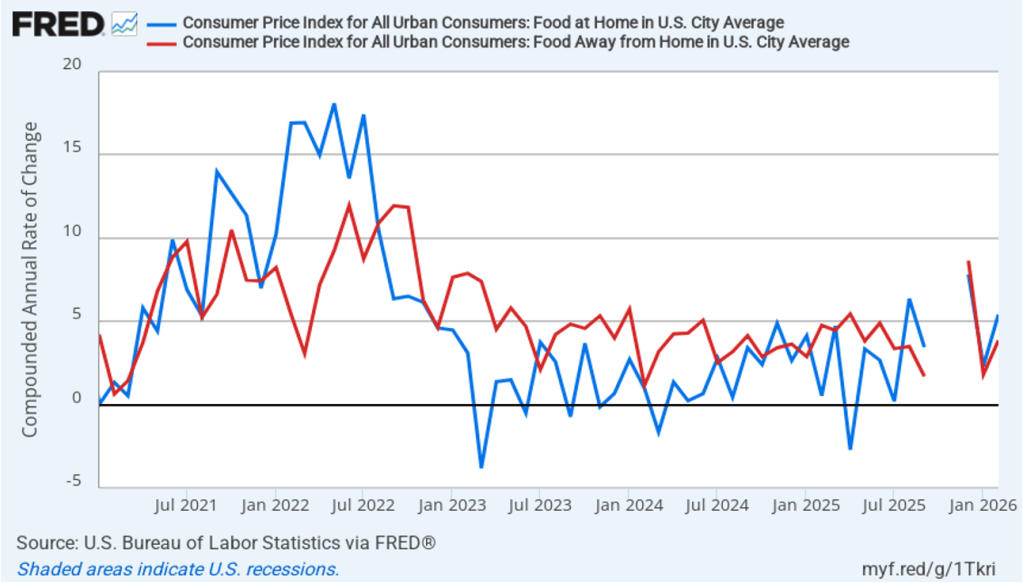
Many consumers seem worried about inflation in food prices. The following figure shows 1-month inflation in the CPI category “food at home” (the blue bar)—primarily food purchased at groceries stores—and the category “food away from home” (the red bar)—primarily food purchased at restaurants. Inflation in both measures rose in February. Food at home increased 5.4 percent in February, up from 2.3 percent in January. Food away from home increased 3.9 percent in February, up from 1.8 percent in January. Again, 1-month inflation rates can be volatile.
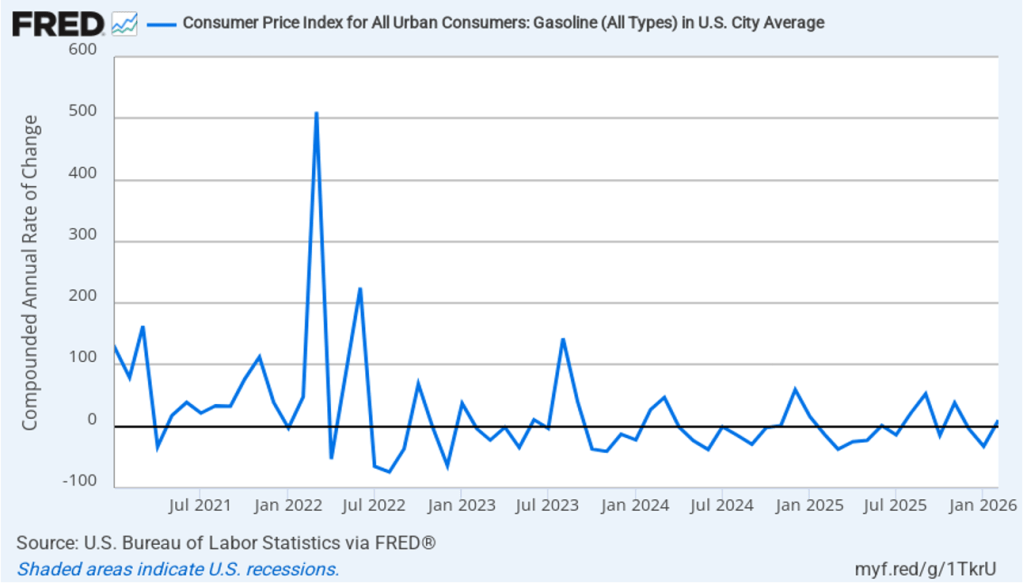
Gasoline prices, which bounce around a lot from month to month, were up in February. The following figure shows 1-month inflation in gasoline prices. In February the price of gasoline increase at an annual rate of 10.1 percent, after having fallen at an annual rate of 32.2 percent in January. These data were gathered before the increase in gasoline prices caused by the conflict in Iran. The increase in food and gasoline prices helped push headline inflation above core inflation in February.
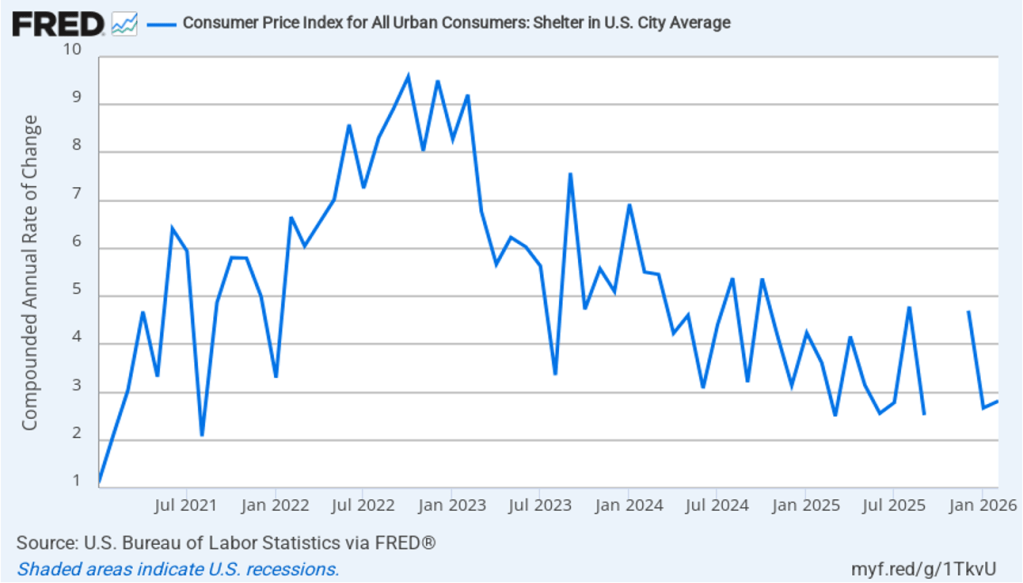
The affordability discussion has also focused on the cost of housing. The price of shelter in the CPI, as explained here, includes both rent paid for an apartment or a house and “owners’ equivalent rent of residences (OER),” which is an estimate of what a house (or apartment) would rent for if the owner were renting it out. OER is included in the CPI to account for the value of the services an owner receives from living in an apartment or house. The following figure shows 1-month inflation in shelter.
One-month inflation in shelter, which has been trending down since early 2023, increased slightly to 2.8 percent in February from 2.7 in January.
It’s unlikely that this inflation report will have much effect on the views of the members of the Federal Reserve’s policymaking Federal Open Market Committee (FOMC). The FOMC is unlikely to lower its target for the federal funds rate at its next meeting on March 17–18. The probability that investors in the federal funds futures market assign to the FOMC keeping its target rate unchanged at that meeting increased only slightly from 98.4 percent yesterday to 99.4 percent this afternoon.

