Will the United States Experience a Sustained Boom in the Growth Rate of Labor Productivity?

Blue Planet Studio/Shutterstock

Recent articles in the business press have discussed the possibility that the U.S. economy is entering a period of higher growth in labor productivity:

“Fed’s Goolsbee Says Strong Hiring Hints at Productivity Growth Burst” (link)

“US Productivity Is on the Upswing Again. Will AI Supercharge It?” (link)

“Can America Turn a Productivity Boomlet Into a Boom?” (link)

In Macroeconomics, Chapter 16, Section 16.7 (Economics, Chapter 26, Section 26.7), we highlighted  the role of growth in labor productivity in explaining the growth rate of real GDP using the following equations. First, an identity:

Real GDP = Number of hours worked x (Real GDP/Number of hours worked),

where (Real GDP/Number of hours worked) is labor productivity.

And because an equation in which variables are multiplied together is equal to an equation in which the growth rates of these variables are added together, we have:

Growth rate of real GDP = Growth rate of hours worked + Growth rate of labor productivity

From 1950 to 2023, real GDP grew at annual average rate of 3.1 percent. In recent years, real GDP has been growing more slowly. For example, it grew at a rate of only 2.0 percent from 2000 to 2023. In February 2024, the Congressional Budget Office (CBO) forecasts that real GDP would grow at 2.0 percent from 2024 to 2034. Although the difference between a growth rate of 3.1 percent and a growth rate of 2.0 percent may seem small, if real GDP were to return to growing at 3.1 percent per year, it would be $3.3 trillion larger in 2034 than if it grows at 2.0 percent per year. The additional $3.3 trillion in real GDP would result in higher incomes for U.S. residents and would make it easier for the federal government to reduce the size of the federal budget deficit and to better fund programs such as Social Security and Medicare. (We discuss the issues concerning the federal government’s budget deficit in this earlier blog post.)

Why has growth in real GDP slowed from a 3.1 percent rate to a 2.0 percent rate? The two expressions on the right-hand side of the equation for growth in real GDP—the growth in hours worked and the growth in labor productivity—have both slowed. Slowing population growth and a decline in the average number of hours worked per worker have resulted in the growth rate of hours worked to slow substantially from a rate of 2.0 percent per year from 1950 to 2023 to a forecast rate of only 0.4 percent per year from 2024 to 2034.

Falling birthrates explains most of the decline in population growth. Although lower birthrates have been partially offset by higher levels of immigration in recent years, it seems unlikely that birthrates will increase much even in the long run and levels of immigration also seem unlikely to increase substantially in the future. Therefore, for the growth rate of real GDP to increase significantly requires increases in the rate of growth of labor productivity.

The Bureau of Labor Statistics (BLS) publishes quarterly data on labor productivity. (Note that the BLS series is for labor productivity in the nonfarm business sector rather than for the whole economy. Output of the nonfarm business sector excludes output by government, nonprofit businesses, and households. Over long periods, growth in real GDP per hour worked and growth in real output of the nonfarm business sector per hour worked have similar trends.) The following figure is taken from the BLS report “Productivty and Costs,” which was released on February 1, 2024.
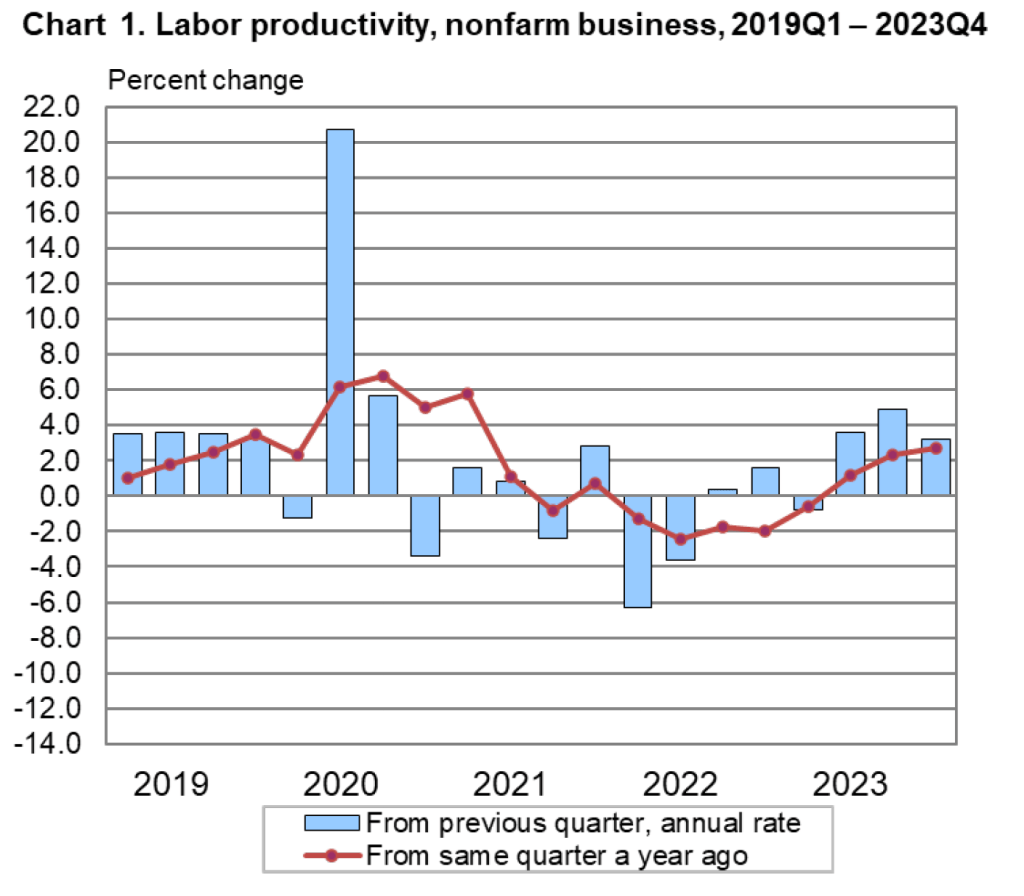
Note that the growth in labor productivity increased during the last three quarters of 2023, whether we measure the growth rate as the percentage change from the same quarter in the previous year or as growth in a particular quarter expressed as anual rate. It’s this increase in labor productivity during 2023 that has led to speculation that labor productivity might be entering a period of higher growth. The following figure shows labor productivity growth, measured as the percentage change from the same quarter in the previous year for the whole period from 1950 to 2023.

The figure indicates that labor productivity has fluctuated substantially over this period. We can note, in particular, productivity growth during two periods: First, from 2011 to 2018, labor productivity grew at the very slow rate of 0.9 percent per year. Some of this slowdown reflected the slow recovery of the U.S. economy from the Great Recession of 2007-2009, but the slowdown persisted long enough to cause concern that the U.S. economy might be entering a period of stagnation or very slow growth.

Second, from 2019 through 2023, labor productivity went through very large swings. Labor productivity experienced strong growth during 2019, then, as the Covid-19 pandemic began affecting the U.S. economy, labor productivity soared through the first half of 2021 before declining for five consecutive quarters from the first quarter of 2022 through the first quarter of 2023—the first time productivity had fallen for that long a period since the BLS first began collecting the data. Although these swings were particularly large, the figure shows that during and in the immediate aftermath of recessions labor productivity typically fluctuates dramatically. The reason for the fluctuations is that firms can be slow to lay workers off at the beginning of a recession—which causes labor productivity to fall—and slow to hire workers back during the beginning of an economy recovery—which causes labor productivity to rise. 

Does the recent increase in labor productivity growth represent a trend? Labor productivity, measured as the percentage change since the same quarter in the previous year, was 2.7 percent during the fourth quarter of 2023—higher than in any quarter since the first quarter of 2021. Measured as the percentage change from the previous quarter at an annual rate, labor productivity grew at a very high average rate of 3.9 during the last three quarters of 2023. It’s this high rate that some observers are pointing to when they wonder whether growth in labor productivity is on an upward trend.

As with any other economic data, you should use caution in interpreting changes in labor productivity over a short period. The productivity data may be subject to large revisions as the two underlying series—real output and hours worked—are revised in coming months. In addition, it’s not clear why the growth rate of labor productivity would be increasing in the long run. The most common reasons advanced are: 1) the productivity gains from the increase in the number of people working from home since the pandemic, 2) businesses’ increased use of artificial intelligence (AI), and 3) potential efficiencies that businesses discovered as they were forced to operate with a shortage of workers during and after the pandemic.

To this point it’s difficult to evaluate the long-run effects of any of these factors. Wconomists and business managers haven’t yet reached a consensus on whether working from home increases or decreases productivity. (The debate is summarized in this National Bureau of Economic Research Working Paper, written by Jose Maria Barrero of Instituto Tecnologico Autonomo de Mexico, and Steven Davis and Nicholas Bloom of Stanford. You may need to access the paper through your university library.)

Many economists believe that AI is a general purpose technology (GPT), which means that it may have broad effects throughout the economy. But to this point, AI hasn’t been adopted widely enough to be a plausible cause of an increase in labor productivity. In addition, as Erik Brynjolfsson and Daniel Rock of MIT and Chad Syverson of the University of Chicago argue in this paper, the introduction of a GPT may initially cause productivity to fall as firms attempt to use an unfamiliar technology. The third reason—efficiency gains resulting from the pandemic—is to this point mainly anecdotal. There are many cases of businesses that discovered efficiencies during and immediately after Covid as they struggled to operate with a smaller workforce, but we don’t yet know whether these cases are sufficiently common to have had a noticeable effect on labor productivity.

So, we’re left with the conclusion that if the high labor productivity growth rates of 2023 can be maintained, the growth rate of real GDP will correspondingly increase more than most economists are expecting. But it’s too early to know whether recent high rates of labor productivty growth are sustainable.


Shrinkflation in the Comic Book Industry

Action Comics No. 1, published in June 1938, is often consider the first superhero comic book. (Image from comics.org.)

In a political advertisement that ran before the broadcast of the Super Bowl, President Joe Biden discussed shrinkflation, which refers to firms reducing the quantity of a product in container while keeping the price unchanged. In this post from the summer of 2022, we discussed examples of shrinkflation—including Chobani reducing the quantity of yogurt in the package shown here from 5.3 ounces to 4.5 ounces—and noted that shrinkflation complicates the job of the Bureau of Labor Statistics when compiling the consumer price index. 

This yogurt remained the same price although the quantity of yogurt in the container shrank from 5.3 ounces to 4.5 ounces.

Shrinkflation isn’t new; firms have used the strategy for decades. Firms are particularly likely to use shrinkflation during periods of high inflation or during periods when the federal government implements price controls.  Firms also sometimes resort to shrinkflation when the the price of a product has remained constant for long enough that the firms fear that consumers will react strongly to the firms increasing the price.

Comic books provide an interesting historical example of shrinkflation. David Palmer, a professor of management at South Dakota State University published an article in 2010 in which he presented data on the price and number of pages in copies of Action Comics from 1938 to 2010. When DC Comics introduced Superman in the first issue of Action Comics in June 1938, it started the superhero genre of comic books. Action Comics No. 1 had a price of $0.10 and was 64 pages.

After the United States entered World War II in December 1941, the federal government imposed price controls to try to limit the inflation caused by the surge in spending to fight the war. Rising costs of producing comic books, combined with the difficulty in raising prices because of the controls, led comic book publishers to engage in shrinkflation. In 1943, the publishers reduced the number of pages in their comics from 64 to 56. In 1944, the publishers engaged in further shrinkflation, reducing the number of pages from 56 to 48.

In 1951, during the Korean War, the federal government again imposed price controls. Comic book publishers responded with further shrinkflation, keeping the price at $0.10, while reducing the number of pages from 48 to 40. In 1954, they shrank the number of pages to 36, which remains the most common number of pages in a comic book today. At that time, the publishers also slightly reduced the width of comics from 7 3/4 inches to 7 1/8 inches. (Today the typical comic book has a width of 6 7/8 inches.)

By the late 1950s, comic book publishers became convinced that they would be better off raising the prices of comic books rather than further shrinking the number of pages. But they were reluctant to raise their prices because they had been a constant $0.10 for more than 20 years, so children and their parents might react very negatively to a price increase, and because no firm wanted to be the first to raise its price for fear of losing sales to its competitors. They were caught in a prisoner’s dilemma: Comic book publishers would all have been better off if they had raised their prices but the antitrust laws kept them from colluding to raise prices and no individual firm had an incentive to raise prices alone. (We discuss collusion, prisoner’s dilemmas, and other aspects of oligopolistic firm behaviour in Chapter 14 of Microeconomics and Economics.)

The most successful publisher in the 1950s was Dell, which sold very popular comic books featuring Donald Duck, Uncle Scrooge, and other characters that particularly appealed to younger children. Because the prices of Dell’s comic books, like those of other publishers, been unchanged at $0.10 since the late 1930s, the firm didn’t have a clear idea of the price elasticity of demand for its comics. In 1957, the firm’s managers decided to use a market experiment to gather data on the price elasticity of demand. In most cities, Dell kept the price of its comics at $0.10, but in some cities it sold the identical comics at a price of $0.15.

The experiment lasted from March 1957 to August 1958 when the company discontinued it by reverting to selling all of its comics for $0.10. Although we lack the data necessary to compare the sales of Dell comics with a $0.15 price to the sales of Dell comics with a $0.10 price, the fact that no other publisher raised its prices during that period and that Dell abandoned the experiment indicates that the demand curve for Dell’s comics was price elastic—the percentage decline in the quantity sold was greater than the 50 percent increase in price—so Dell’s revenue from sales in the cities selling comics with a price of $0.15 likely declined. Dell’s strategy can be seen as a failed example of price leadership. (We discuss the relationship between the price elasticity of demand for a good and the total revenue a firm earns from selling the good in Chapter 6, Section 6.3 of Microeconomics and Economics. We discuss price leadership in Microeconomic and Economics, Chapter 14, Section 14.2.)

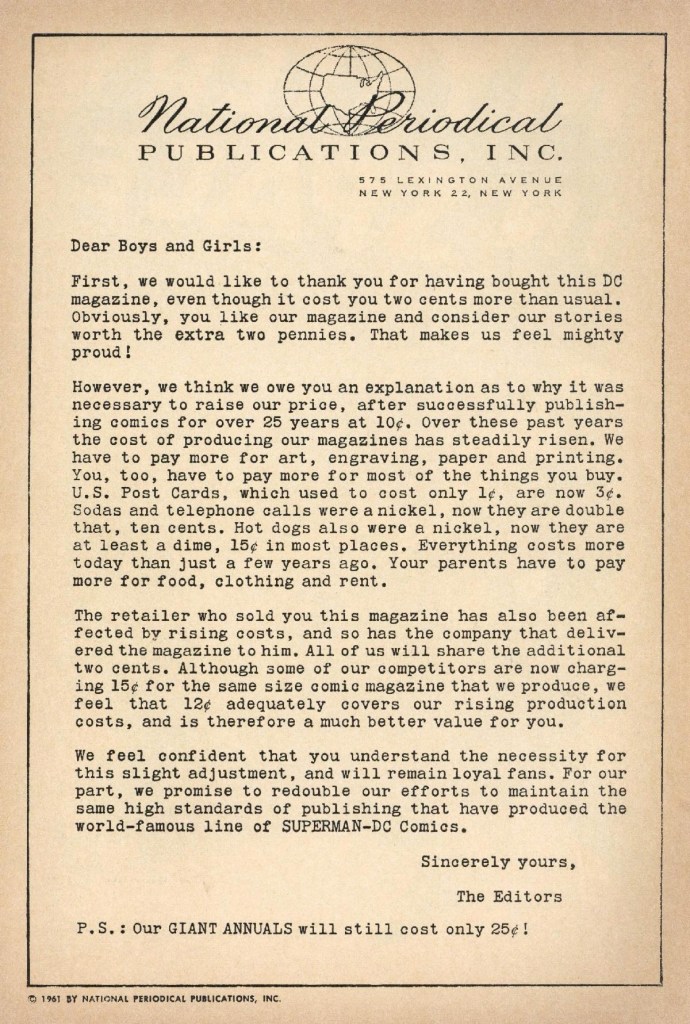
In March 1961, Dell increased the price of all of its comics from $0.10 to $0.15. At first, Dell’s competitors kept the prices of their comics at $0.10. As a result, in September 1961, Dell cut the price of its comics from $0.15 to $0.12. By early 1962, Dell’s competitors, including DC Comics, Marvel Comics—publishers of Spider-Man and the Fantastic Four—along with several smaller publishers, had increased the prices of their comics from $0.10 to $0.12. The managers at DC decided that raising the price of comics after having kept it constant for so long required an explantion. Accordingly, they printed the following letter in each of their comics.

H/T to Buddy Saunders for the image.

Comic book publishers have raised their prices many times since the early 1960s, with most comics currently having a price of $4.99. During the recent period of high inflation, comic publishers did not use a strategy of shrinkflation perhaps because they believe that 36 pages is the minimum number that buyers will accept.

The first 25 years of the comic book industry represents an interesting historical example of shrinkflation.

The Economics of Apple’s Vision Pro

Photo from apple.com.

On Friday, February 2, Apple released Vision Pro, its long-awaited, much discussed virtual reality (VR) headset. The Vision Pro headset allows users to experience either VR, in which the user sees only virtual objects, as for instance when the user sees only images from a video game; or augmented reality (AR), in which the user sees virtual objects, such as icon apps or web pages superimposed on the real world (as in the two photos below). Apple refers to people using the headsets as being engaged in “spatial computing” and sometimes refers to the headsets as “face computers.”

Photo from Apple via the Wall Street Journal.

Photo from Apple via the Wall Street Journal.

Vision Pro has a price of $3,499, which can increase to more than $4,000 when including the cost of the insert necessary for anyone who wears prescription eyeglasses or contact lenses and who chooses to buy additional storage capacity. The price is much higher than Meta’s Quest Pro VR headset (shown in the photo below), which has a price of $999.

Photo from meta.com.

In this post, we can briefly discuss some of the economic issues raised by the Vision Pro. First, why would Apple charge such a high price? In her review of the Vision Pro in the Wall Street Journal, Joanna Stern, the site’s personal technology writer, speculated that: “You’re probably not going to buy the $3,500 Apple Vision Pro. Unless you’re an app developer or an Apple die-hard ….”  

There are several reasons why Apple may believe that a price of $3,499 is profit maximizing. But we should bear in mind that pricing any new product is difficult because firms lack good data on the demand curve and are unsure how consumers will respond to changes in price. In our new ninth edition of Economics and Microeconomics, in Chapter 6 on price elasticity we discuss how Elon Musk and managers at Tesla experimented with the cutting the price of the Model 3 car as they attempted to discover the effect on price changes on the quantity demanded. Managers at Apple are in similar situation of lacking good data on how many headsets they are likely to sell at $3,499.

If Apple lacks good data on how consumers are likely to respond to different prices, why pick a price four times as high as Meta is charging for its Quest Pro VR headsets?

First, Apple expects to be able to clearly differentiate its headset from Meta’s headset. If consumers considered the two headsets to be close substitutes, the large price difference would make it unlikely that Apple would sell many headsets. Apple has several marketing advantages over Meta that make it likely that Apple can convince many consumers that the Meta headset is not a close substitute for the Vision Pro: 

  1. Apple has a history of selling popular electronic products, such as the iPhone, iPad, Air Pods, and the Apple Watch. It also owns the most popular app store. Apple has succeeded in seamlessly integrating these electronic products with each other and with use of the app store. As a result, a significant number of consumers have a strong preference for Apple products over competitors. Meta has a much more limited history of selling popular electronic products. For instance, it doesn’t produce its own smartphone.
  2. Apple has an extensive network of retail stores inside and outside of the United States. The stores have been successful in giving consumers a chance to try a new electronic product before buying it and to receive help at the stores’ Genius Bars with setting up the device or dealing with any later problems.  Meta operates few retail stores, relying instead on selling through other retailers, such as Best Buy, or through  its online site. For some consumers Meta’s approach is less desirable than Apple’s.

Second, as we discuss in Economics and Microeconomics, Chapter 15, Section 15.5, charging a high price for a new electronic product is common, partly because doing so allows firms to price discriminate across time. With this strategy, firms charge a higher price for a product when it is first introduced and a lower price later. Some consumers are early adopters who will pay a high price to be among the first to own certain new products. Early adopers are a particularly large segment of buyers of Apple products, with long lines often forming at Apple stores on the days when a new product is released. That firms price discriminate over time helps explain why products such as Blu-ray players and 4K televisions sold for very high prices when they were first introduced. After the demand of the early adopters was satisfied, the companies reduced prices to attract more price-sensitive customers. For example, the price of Blu-ray players dropped by 95 percent within five years of their introduction. Similarly, we can expect that Apple will cut the price of Vision Pro significantly over time.

Third, because Apple is initially producing a relatively small number of units, it is likely experiencing a high average cost of producing the Vision Pro. The production of the components of the headset and the final assembly are likely to be subject to large economies of scale. (We discuss economies of scale in Economics and Microeconomics, Chapter 11, Section 11.6.) Apple hasn’t released information on how many units of the headset it intends to produce during 2024, but estimates are that it will be fewer than 400,000 and perhaps as few as 180,000. (Estimates can be found here, here, and here.) Compare that number to the 235 million iPhones Apple sold during 2023. We would expect as Apple’s suppliers increase their production runs, the average cost of production will decline as Apple moves down its long-run average cost curve. As a result, over time Apple is likely to cut the price.

In addition, when producing a new good, firms often experience learning as managers better understand the most efficient way to produce and assemble the new good. For example, the best method of assembling iPhones may not be the best method of assembling headsets, but this fact may only become clear after assembling several thousand headsets. Apple is likely to experience a learning curve with the average cost of producing headsets declining as the total number of headsets produced increases. While economies of scale involve a movement down a static long-run average cost curve, learning results in the long-run average cost curve shifting down. This second reason why Apple’s average cost of producing headsets will decline contributes to the liklihood that Apple will cut the price of the Vision Pro over time.

Finally, we can discuss a key factor that will determine how successful Apple is in selling headsets. In Chapter 11 of the new ninth edition of Economics and Microeconomics, we have a new Apply the Concept, “Mark Zuckerberg … Alone in the Metaverse?” In that feature, we note that Meta CEO Mark Zuckerberg has invested heavily in the metaverse, a word that typically means software programs that allow people to access either AR or VR images and information. Zuckerberg believed so strongly in the importance of the metaverse that he changed the name of the company from Facebook to Meta. The metaverse, which is accessed using headsets likes Meta’s Quest Pro or Apple’s Vision Pro, is subject to large network externalities—the usefulness of the headsets increases with the number of consumers who use them. The network externalities arise because many software applications, such as Meta’s Horizon World, depend on interactions among users and so are not very useful when there aren’t many users.

Meta hasn’t sold as many headsets as they expected because they have had difficulty attracting enough users to make their existing software useful and the failure to have enough users has reduced the incentive for other firms to develop apps for Meta’s headsets. Initially, some reviewers made similar comments about Apple’s Vision Pro. For instance, even though streaming films in 3D is one of the uses that Apple promotes, some streaming services, including Netflix and YouTube, have not yet released apps for Vision Pro. Some important business related apps, such as FaceTime and Zoom, aren’t yet available. There are also currently no workout apps. As one reviewer put it “there are few great apps” for Vision Pro. Another reviewer wondered whether the lack of compelling software and apps might result in the Vision Pro headset suffering the fate of “every headset I test [which] ends up in my closet collecting dust.”

So, a key to the success of the Vision Pro will be the ability of Apple to attract enough users to exploit the network externalities that exist with VR/AR headsets. If successful, the Vision Pro may represent an important development in the transition to spatial computing.

FOMC Meeting: Steady as She Goes

Federal Reserve Chair Jerome Powell (Photo from the New York Times.)

This afternoon, Wednesday, January 31, the Federal Reserve’s Federal Open Market Committee (FOMC) held the first of its eight scheduled meetings during 2024. As we noted in a recent post, macroeconomic data have been indicating that the Fed is close to achieving its goal of bringing the U.S. economy in for a soft landing—reducing inflation down to the Fed’s 2 percent target without pushing the economy into a recession. But as we also noted in that post, it was unlikely that at this meeting Fed Chair Jerome Powell and the other members of the FOMC would declare victory in their fight to reduce inflation from the high levels it reached during 2022.

In fact, in Powell’s press conference following the meeting, when asked directly by a reporter whether he believed that the economy had made a safe landing, Powell said that he wasn’t yet willing to draw that conclusion. Accordingly, the committee kept its target range for the federal funds rate unchanged at 5.25 percent to 5.50 percent. This was the fifth meeting in a row at which the FOMC had left the target unchanged. Although some policy analysts expect that the FOMC might reduce its federal funds rate target at its next meeting in March, the committee’s policy statement made that seem unlikely:

“In considering any adjustments to the target range for the federal funds rate, the Committee will carefully assess incoming data, the evolving outlook, and the balance of risks. The Committee does not expect it will be appropriate to reduce the target range until it has gained greater confidence that inflation is moving sustainably toward 2 percent.”

Powell reinforced the point during his press conference by stating it was unlikely that the committee would cut the target rate at the next meeting. He noted that:

“The economy has surprised forecasters in many ways since the pandemic, and ongoing progress toward our 2 percent inflation objective is not assured. The economic outlook is uncertain, and we remain highly attentive to inflation risks. We are prepared to maintain the current target range for the federal funds rate for longer, if appropriate.”

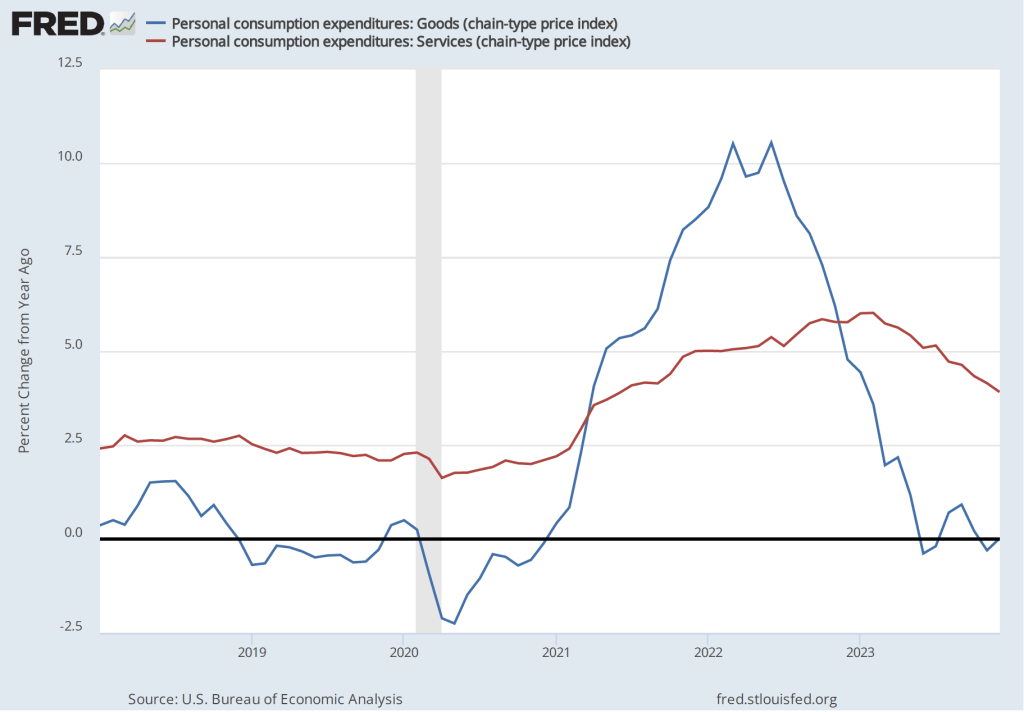
Powell highlighted a couple of areas of potential concern. The Fed gauges its progress towards achieving its 2 percent inflation goal using the percentage change in the personal consumption expenditures (PCE) price index. As we noted in a recent post, PCE inflation has declined from a high of 7.1 percent in June 2022 to 2.9 percent in December 2023. But Powell noted that PCE inflation in goods has followed a different path from PCE inflation in services, as the following figure shows.

Inflation during 2022 was much greater in the prices of goods than in the prices of services, reflecting the fact that supply chain disruptions caused by the pandemic had a greater effect on goods than on services. Inflation in goods has been less than 1 percent every month since June 2023 and has been negative in three of those months. Inflation in services peaked in February 2023 at 6.0 percent and has been declining since, but was still 3.9 percent in December. Powell noted that the very low rates of inflation in the prices of goods probably aren’t sustainable. If inflation in the prices of goods increases, the Fed may have difficulty achieving its 2 percent inflation target unless inflation in the prices of services slows.

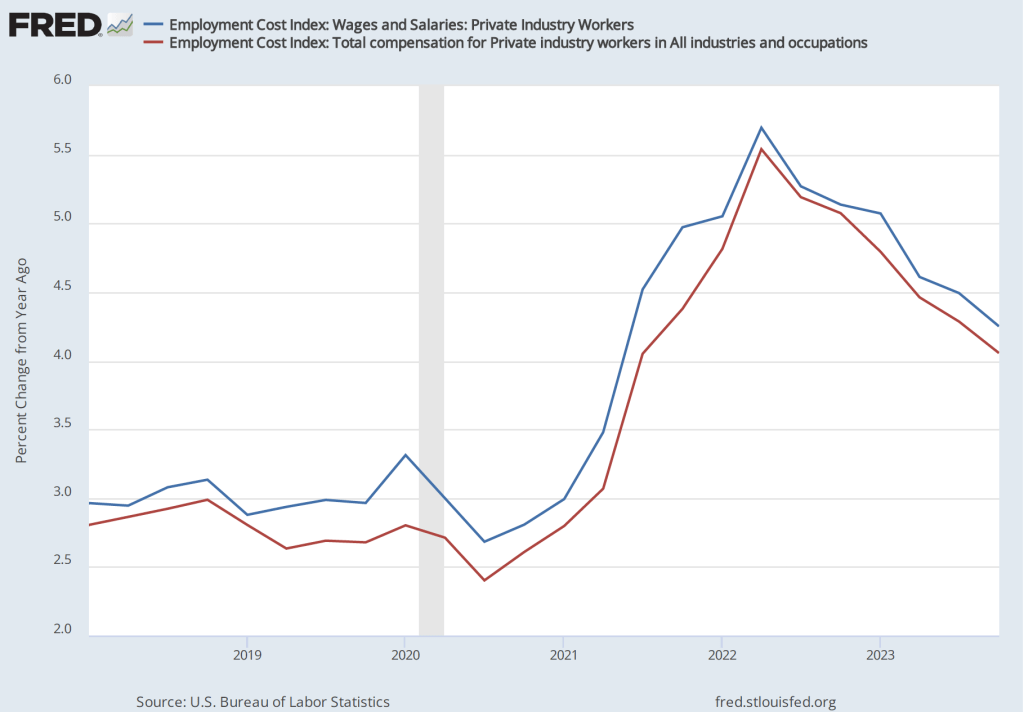
Powell also noted that the most recent data on the employment cost index (ECI) had been released the morning of the meeting. The ECI is compiled by the Bureau of Labor Statistics and is published quarterly. It measures the cost to employers per employee hour worked. The BLS publishes data that includes only wages and salaries and data that includes, in addition to wages and salaries, non-wage benefits—such as contributions to retirement accounts or health insurance—that firms pay workers. The figure below shows the percentage change from the same month in the previous year for the ECI including just wages and salaries (blue line) and for the ECI including all compensation (red line). Although ECI inflation has declined significantly from its peak in he second quarter of 2022, in the fourth quarter of 2023, both measures of ECI inflation were above 4 percent. Wages increasing at that pace may not be consistent with a 2 percent rate of price inflation.

Powell’s tone at his news conference (which can be watched here) was one of cautious optimism. He and the other committee members expect to be able to cut the target for the federal funds rate later this year but remain on guard for any indications that the inflation rate is increasing again.

Solved Problem: The Houthis and the Price Elasticity of Demand for Shipping

Map from the Wall Street Journal.

Supports: Microeconomics and Economics Chapter 6, Section 6.2 and Esstentials of Economics, Chapter 7, Section 7.6.

The Houthis, a rebel group based in Yemen, have been attacking shipping in the Red Sea, which freighters sail through after exiting the Suez Canal. About 30 percent of global shipping travels through the Suez Canal. An article in the Financial Times noted that maritime insurance firms have increased their charges for insuring freight passing through the Suez Canal by about $6,000 per container.” The article also noted that: “Freight demand is price inelastic in the short run and transport isn’t a big part of overall costs.” And that “the average container holds about $100,000 worth of goods wholesale, which will be sold at destination for $300,000.”  

  1. Is there a connection between the observation that freight demand is price inelastic and the observation that the charge for transporting goods isn’t a large fraction of the price of the goods shipped by container? Briefly explain.
  2. The article notes that the main alternative to transporting freight by ship is to transport it by air, but if only 1 percent of freight sent by ship were to be sent by air instead, all the available flight capacity would be filled. Does this fact also have relevance to explaining the price inelasticity of demand for transporting freight by ship? Briefly explain.

Solving the Problem

Step 1: Review the chapter material. This problem is about the determinants of the price elasticity of demand, so you may want to review Microeconomics and Economics, Chapter 6, Section 6.2 (Essentials of Economics, Chapter 7, Section 7.6), “The Determinants of the Price Elasticity of Demand and Total Revenue.”

Step 2: Answer part a. by explaining why the small fraction that transportation is of the total price of the goods in a container of freight makes it more likely that the demand for shipping is price inelastic in the short run.  This section of the chapter notes that goods and services that are only a small fraction of a consumer’s budget tend to have less elastic demand than do goods and services that are a large faction. In this case, the consumer is a firm shipping freight. Because the $6,000 increase per container in the cost of shipping freight makes up only 2 percent of the dollar amount the freight can be sold for, shippers are likely not to significantly reduce the quantity of shipping services they demand. Note, though, that the article refers to the price elasticity of freight demand “in the short run.” It’s possible that over a longer period of time the market for transporting freight by ship may adjust by, for instance, firms offering to ship freight by air increasing their capacity and lowering their prices. In that case, the price elasticity of demand for transporting freight by ship will be higher in the long run than in the short tun.

Step 3: Answer part b. by explaining whether the limited amount of available capacity for sending freight by air may help explain why the demand for sending freight by ship is price inelastic.  This section of the chapter notes that the most important determinant of the price elasticity of demand for a good or service is the availability of close substitutes. That there is only a small amount of unused capacity to transport goods by air indicates that transporting goods by air is not a close substitute for transporting goods by sea. Therefore, we would expect that this factor contributes to the demand for transporting goods by sea being price inelastic in the short run.

Information, Stock Prices, and Boeing

Agents from the National Transportation Safety Board inspect a piece of the Boeing jetliner found in a backyard in Portland, Oregon. (Photo from the AP via the New York Times.)

What causes movements in stock prices? As we explain in Economics and Microeconomics, Chapter 8, Section 8.2 (MacroeconomicsEssentials of Economics, and Money, Banking, and the Financial System, Chapter 6, Section 6.2):  “Shares of stock represent claims on the profits of the firms that issue them. As the fortunes of the firms change and they earn more or less profit, the prices of the stock the firms have issued should also change.” 

We also note that: “Many Wall Street investment professionals expend a great deal of effort gathering all possible information about the future profitability of firms, hoping to buy the stocks that are most likely to rise in the future. As a result of the actions of these professional investors, all of the information about a firm that is available on news and financial websites, cable TV business shows, and online discussion sites like X and Reddit is already reflected in the firm’s stock price.” As a consequence, the price of a firm’s stock will change only as a result of new information about the future profitability of the firm issuing the stock.

During the course of a typical week, the new information that becomes available about a large company, like Apple or General Motors, is likely to indicate only minor changes in the future profitability of the firm. Therefore, we wouldn’t expect that the firm’s stock price would change very much. Sometimes, though, investors receive important new information that causes them to significantly revise their expectations of the future profitability of a firm. That’s what happened to Boeing, the jetliner manufacturer, on Friday, January 5. An Alaska Air Boeing 737 Max 9 was taking off from Portland International Airport when a piece of the plane blew out. (A Wall Street Journal article gives the details of the incident.)

The accident caused some industry observers to question whether Boeing’s quality control during manufacturing had deficiencies that might lead to other problems being discovered on the firm’s jetliners. Boeing was particularly at risk of having its quality control methods questioned because in 2019 two slightly different models of the 737 Max airliner had crashed, causing the planes to be grounded for almost two years.

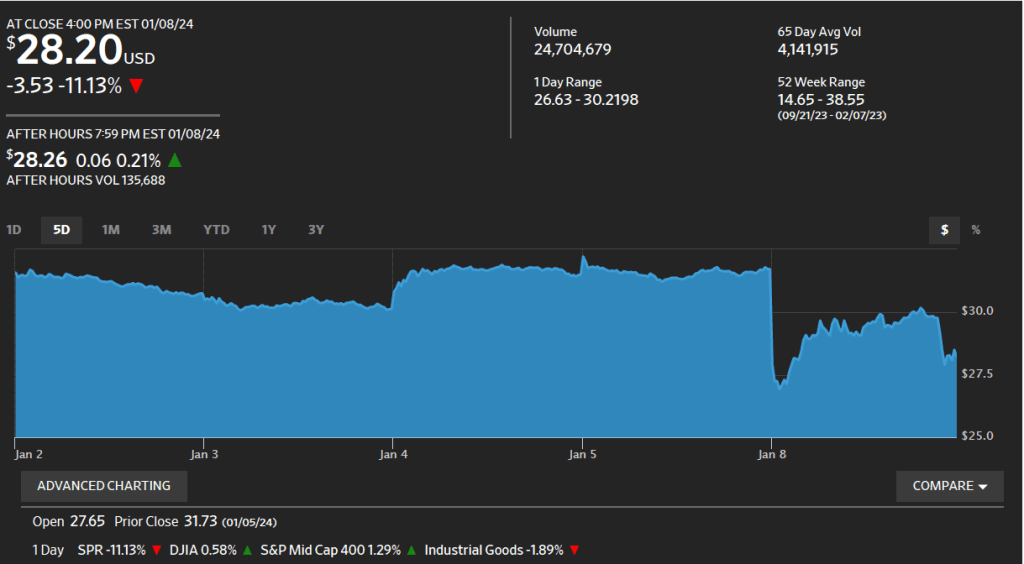
The effect of the Alaska Air incident on Boeing’s stock price can be seen in the following figure, reproduced from the Wall Street Journal. On Friday, January 5 at 4 pm eastern time—the time at which trading on the New York Stock Exchange (NYSE) closes for the day—the price of Boeing’s stock was $249.00 per share. The accident took place at around 7:40 pm eastern time, so it occurred after the close of trading on the NYSE. When trading on the NYSE resumed at 9:30 am on Monday, January 8, Boeing’s stock price had declined to $227.79 per share. The size of the drop in price indicated that investors believed that the Portland accident would have a significantly negative affect on Boeing’s future profitability. Boeing’s profits could fall if the accident leads airlines to reduce their future purchases of 737 Max airliners or if Boeing’s costs rise significantly as a result of making repairs on Max airliners currently in servide or as a result of having to spend more on quality control measures when manufacturing the planes.

The effect of the Portland accident on Boeing’s stock price is an example of the efficiency of the stock market in processing information about a firm’s future profitability.

Glenn’s Presentation at the ASSA Session on “Making Economics Relevant: Applications of Economic Principles in the Real World”

Glenn participated in this session hosted by the National Association of Economic Educators and moderated by Kim Holder of the University of West Georgia. Glenn thanks Kim for organizing the session and for inviting him to participate.

Here is the session abstract and the list of participants:

Glenn prepared some slides for his presentation. Note that “B01″ and B02” were the titles when he first taught principles of economics as an assistant professor at Northwestern. (We won’t mention how long ago that was!)

Economists vs. the Market in Predicting the First Cut in the Federal Funds Rate

The meeting room of the FOMC in the Federal Reserve building in Washington, DC.

As we’ve noted in several recent posts, the inflation rate has fallen significantly from its peak in mid-2022, as U.S. economic growth has been slowing and the labor market appears to be less tight, slowing the growth of wages. Some economists and policymakers now believe that by early 2024, inflation will approach the Fed Reserve’s 2 percent inflation target. At that point, the Fed’s Federal Open Market Committee (FOMC) is likely to turn its attention from inflation to making sure that the U.S. economy doesn’t slip into a recession.

Accordingly, both economists and financial market participants have begun to anticipate the point at which the FOMC will begin to cut its target for the federal funds rate. (One note of caution: Fed Chair Jerome Powell has made clear that the FOMC stands ready to further increase its target for the federal funds rate if the inflation rate shows signs of increasing. He made this point most recently on December 1 in a speech at Spelman College in Atlanta.)  There is currently an interesting disagreement between economists and investors over when the FOMC is likely to cut interest rates and by how much. We can see the views of investors reflected in the futures market for federal funds.

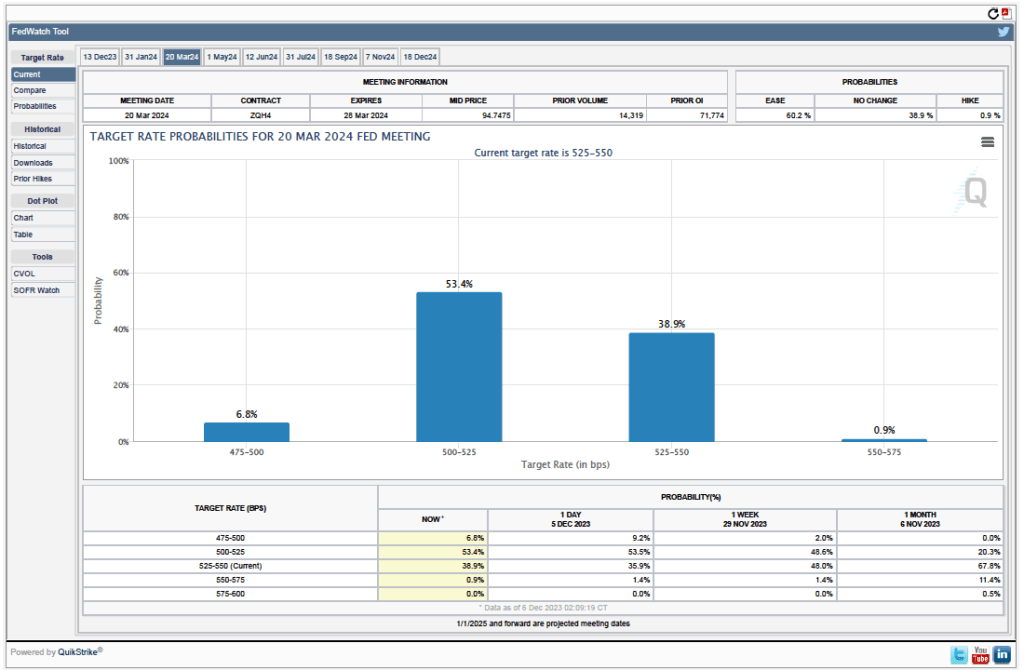
Futures markets allow investors to buy and sell futures contracts on commodities–such as wheat and oil–and on financial assets. Investors can use futures contracts both to hedge against risk—such as a sudden increase in oil prices or in interest rates—and to speculate by, in effect, betting on whether the price of a commodity or financial asset is likely to rise or fall. (We discuss the mechanics of futures markets in Chapter 7, Section 7.3 of Money, Banking, and the Financial System.) The CME Group was formed from several futures markets, including the Chicago Mercantile Exchange, and allows investors to trade federal funds futures contracts. The data that result from trading on the CME indicate what investors in financial markets expect future values of the federal funds rate to be. The following chart from the CME’s FedWatch Tool shows values after trading of federal funds futures on December 5, 2023.

The probabilities in the chart reflects investors’ predictions of what the FOMC’s target for the federal funds rate will be after the committee’s meeting on March 20, 2024. This meeting is the first after which investors currently expect that the target is likely to be lowered. The target range is currently 5.25 percent to 5.50 percent. The chart indicates that investors assign a probability of 60.2 percent to the FOMC making at least a 0.25 percentage cut in the target rate at the March meeting. 

Looking at the values for federal funds futures after the FOMC’s December 18, 2024 meeting, investors assign a 66.3 percent probability of the committee having reduced its target for the federal funds rate to 4.00 to 4.25 percent of lower. In other words, investors expect that during 2024, the FOMC will have cut its target for the federal funds rate by at least 1.25 percentage points.

Interesingly, according to a survey by the Financial Times, economists disagree with investors’ forecasts of the federal funds rate. According to the survey, which was conducted between December 1 and December 4, nearly two-thirds of economists believe that the FOMC won’t cut its target for the federal funds rate until July 2024 or later. Three-quarters of the economists surveyed believe that the FOMC will cut its target by 0.5 percent point or less during 2024. Fewer than 10 percent of the economists surveyed believe that during 2024 the FOMC will cut its target for the federal funds rate by 1.25 percent or more. (The Financial Times article describing the results of the survey can be found here. A subscription may be requred to read the article.)

So, at least among the economists surveyed by the Financial Times, the consensus is that the FOMC will cut its target for the federal funds rate later and by less than financial markets are indicating. What explains the discrepancy? The main explanation is that economists see inflation being persistently above the Fed’s 2 percent target for longer than do financial market participants. The economists surveyed are also more optimistic that the U.S. economy will avoid a recession in 2024. If a recession occurs, the FOMC is more likely to significantly cut its target than if the economy during 2024 experiences moderate growth in real GDP and the unemployment rate remains low.

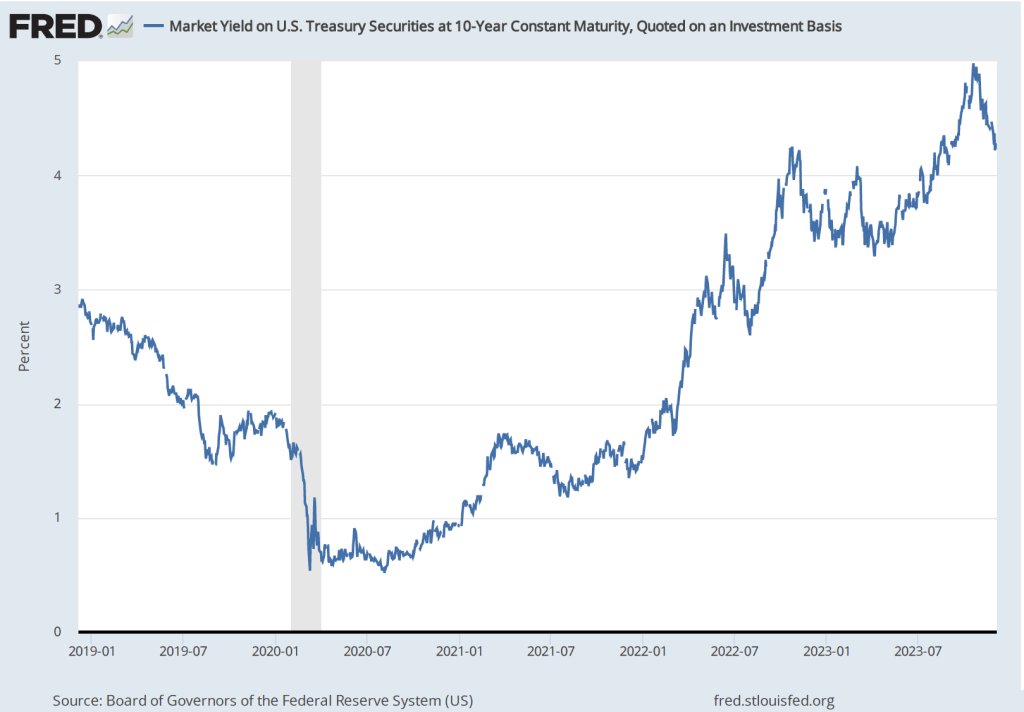
One other indication from financial markets that investors expect that the U.S. economy is likely to slow during 2024 is given by movements in the interest rate on the 10-year U.S. Treasury note. As shown in the following figure, from August to October of this year, the interest rate on the 10-year Treasury note rose from less than 4 percent to nearly 5  percent—an unusually large change in such a short period of time. Since then, most of that increase has been reversed with the interest rate on the 10-year Treasury note having fallen below 4.2 percent in early December

The movements in the interest rate on the 10-year Treasury note typically reflect investors’ expectations of future short-term interest rates. (We discuss the relationship between short-term and long-term interests rates—which economists call the term structure of interest rates—in Money, Banking, and the Financial System, Chapter 5, Section 5.2.) The increase in the 10-year interest rate between August and October reflected investors’ expectation that short-term interest rates were likely to remain persistently high for a considerable period—perhaps several years or more. The decline in the 10-year rate from late October to early December reflects investors changing their expectations toward future short-term interest rates being lower than they had previously thought. Again, as in the data on federal funds rate futures, investors seem to be expecting either slower economic growth or slower inflation than do economists.

One other complication about the interest rate on the 10-year Treasury note should be mentioned. Some of the increase in the rate from August to October may also have represented concern among investors that large federal budget deficit would cause the Treasury to issue more Treasury notes than investors would be willing to buy without the Treasury increasing the interest rate investors would receive on the newly issued notes. This concern may have been reinforced by data showing that foreign investors, particularly in China and Japan, appeared to have slowed or stopped adding to their holdings of Treasury notes. Part of the recent decline in the interest rate on the Treasury note may reflect investors becoming less concerned about these two factors.

The Roman Emperor Vespasian Fell Prey to the Lump-of-Labor Fallacy

Bust of the Roman Emperor Vespasian. (Photo from en.wikipedia.org.)

Some people worry that advances in artificial intelligence (AI), particularly the development of chatbots will permanently reduce the number of jobs available in the United States. Technological change is often disruptive, eliminating jobs and sometimes whole industries, but it also creates new industries and new jobs. For example, the development of mass-produced, low-priced automobiles in the early 1900s wiped out many jobs dependent on horse-drawn transportation, including wagon building and blacksmithing. But automobiles created many new jobs not only on automobile assembly lines, but in related industries, including repair shops and gas stations.

Over the long run, total employment in the United States has increased steadily with population growth, indicating that technological change doesn’t decrease the total amount of jobs available. As we discuss in Microeconomics, Chapter 16 (also Economics, Chapter 16), fears that firms will permanently reduce their demand for labor as they increase their use of the capital that embodies technological breakthroughs, date back at least to the late 1700s in England, when textile workers known as Luddites—after their leader Ned Ludd—smashed machinery in an attempt to save their jobs. Since that time, the term Luddite has described people who oppose firms increasing their use of machinery and other capital because they fear the increases will result in permanent job losses.

Economists believe that these fears often stem from the lump-of-labor fallacy, which holds that there is only a fixed amount of work to be performed in the economy. So the more work that machines perform, the less work that will be available for people to perform. As we’ve noted, though, machines are substitutes for labor in some uses—such as when chatbot software replace employees who currently write technical manuals or computer code—they are also complements to labor in other jobs—such as advising firms on how best to use chatbots. 

The lump-of-labor fallacy has a long history, probably because it seems like common sense to many people who see the existing jobs that a new technology destroys, without always being aware of the new jobs that the technology creates. There are historical examples of the lump-of-labor fallacy that predate even the original Luddites.

For instance, in his new book Pax: War and Peace in Rome’s Golden Age, the British historian Tom Holland (not to be confused with the actor of the same name, best known for portraying Spider-Man!), discusses an account by the ancient historian Suetonius of an event during the reign of Vespasian who was Roman emperor from 79 A.D. to 89 A.D. (p. 201):

“An engineer, so it was claimed, had invented a device that would enable columns to be transported to the summit of the [Roman] Capitol at minimal cost; but Vespasian, although intrigued by the invention, refused to employ it. His explanation was a telling one. ‘I have a duty to keep the masses fed.’”

Vespasian had fallen prey to the lump-of-labor fallacy by assuming that eliminating some of the jobs hauling construction materials would reduce the total number of jobs available in Rome. As a result, it would be harder for Roman workers to earn the income required to feed themselves.

Note that, as we discuss in Macroeconomics, Chapters 10 and 11 (also Economics, Chapter 20 and 21), over the long-run, in any economy technological change is the main source of rising incomes. Technological change increases the productivity of workers and the only way for the average worker to consume more output is for the average worker to produce more output. In other words, most economists agree that the main reason that the wages—and, therefore, the standard of living—of the average worker today are much higher than they were in the past is that workers today are much more productive because they have more and better capital to work with.

Although the Roman Empire controlled most of Southern and Western Europe, the Near East, and North Africa for more than 400 years, the living standard of the average citizen of the Empire was no higher at the end of the Empire than it had been at the beginning. Efforts by emperors such as Vespasian to stifle technological progress may be part of the reason why. 

Who Is Wealthier, Iron Man or Batman?

Photo from Paramount Pictures via britannica.com.

Photo from Warner Brothers Pictures via insider.com.

Income and wealth are often confused. Media accounts of the “wealthy” typically switch back and forth between referring to people with high incomes and referring to people with substantial wealth. It’s possible to have a high income, but not much wealth, if you spend most of your income. It’s also possible, although less common, for someone to have substantial wealth while having a relatively low income.

As we discuss in the Don’t Let This Happen to You feature in Macroeconomics, Chapter 14 (also Economics, Chapter 24), Your income is equal to your earnings during the year, while your wealth is equal to the value of the assets you own minus the value of any debts you have. It’s also worth keeping in mind that income is a flow variable that is measured over a period of time—such as a year—while wealth is a stock variable that is measured at a particular point in time—such as the first or last day of the year.

Both income and wealth can be difficult to accurately measure. Although we typically think of a person’s income as being equal to the salary and wages the person earns, income, properly measured, also includes changes in the value of the assets the person owns. For example, suppose that at the start of the year you own shares of Apple stock worth $5,000. If at the end of the year, the price on the stock market of your Apple shares has risen to $5,500, the $500 increase is part of your income for the year. (Note that this capital gain on your stock is included in your taxable income only if you sell the stock. Whether you sell the stock or not, though, the capital gain is part of your income.)

It can be difficult to measure the wealth of someone who owns significant assets that, unlike shares of stock, aren’t regularly bought and sold in a market. For instance, if someone owns a restaurant, determining what the price the restaurant would sell for—and, therefore, how wealthy the person is—can be difficult. Although other restaurants in the area may have sold recently, every restaurant is different, which makes it possible to determine only approximately what the sales price of a particular restaurant would be. As we discuss in the Apply the Concept feature “Should the Federal Government Begin to Tax Wealth?” in Microeconomics, Chapter 17 (also Economics, Chapter 17), the difficulty of valuing some types of wealth is one complication the federal government would face in enacting a tax on wealth. 

If measuring the wealth of someone in the real world is difficult, measuring the wealth of a fictional character is even more daunting. Some years ago, undergraduate students, most of whom were economics majors at Lehigh University, estimated the wealth of Bruce Wayne, the alter ego of Batman. To narrow the focus, the students based their estimate on only the information available in the three Batman films directed by Christopher Nolan. On the basis of that information, they estimate that Bruce Wayne’s wealth is $11.6 billion. At the time the films were produced, that would have made Bruce Wayne the seventy-third wealthiest person in the world—if, of course, he had been a real person! You can read the details of their estimate here

Bruce Wayne is apparently very wealthy, but is he as wealthy as Tony Stark, the alter ego of Iron Man? Apparently not, according to an estimate appearing on the business web site forbes.com. Although he doesn’t seem to give the details of how he arrived at the estimate, the author of the post values Tony Stark’s wealth at $9.3 billion, making him about 20 percent less wealthy than Bruce Wayne.  Score one for the Caped Crusader!