Guest Post from Bill Goffe of Penn State on Ways to Improve Your Teaching with Ideas Outside of Economics

Bill Goffe is a teaching professor at Penn State. Many instructors know Bill from his “Resources of Economists on the Internet,” which appears on the website of the American Economic Association and can be accessed HERE. Bill is also an associate editor of the Journal Economic Education. The journal’s website can be accessed HERE.

Last May, we interviewed Bill on our podcast. That podcast episode can be found HERE.

What follows is an essay from Bill on ideas on teaching from instructors in other disciplines that economics instructors might find useful.

Improve Your Teaching with Ideas from Outside Economics

According to “The Superiority of Economists” economists tend not to cite other social science disciplines. This is eminently sensible if the topic is monetary policy, welfare theory, or market structures. But, what about teaching? Might other disciplines have useful things to say on this topic that economists might use in their classrooms? As I think the reader will see from the following links to both websites and papers, I think that the clear answer is “yes.” Underlying this answer lie two reasons. First, some other disciplines have devoted substantially more resources to improving teaching than economists have. Second, their approaches are often based on findings from cognitive science.

Perhaps my favorite site for teaching ideas is the Carl Wieman Science Education Initiative at the University of British Columbia. One can think of Wieman as a peer of George Akerlof, Michael Spence, or Joseph Stiglitz as he too was awarded a Nobel Prize in 2001. In Wieman’s case, it was in physics. Before this prize he did some work in physics education research and after the prize all his research time has been devoted to this subject. As he describes in “Why Not Try a Scientific Approach to Science Education,” Wieman was in part puzzled why his “brilliantly clear explanations” led to very little learning by his students. To understand why, he started to read what cognitive science has to say about how humans learn, and he went on to apply these ideas to his teaching; all this is outlined in this paper.

Wieman is one of the most influential STEM education researchers; it is telling that of his ten most cited papers, two are in physics education research. He is still very active with 9 papers published in 2019 and 2020. While now at Stanford, his previous appointment was at the University of British Columbia and a website devoted to his and his group’s work is still actively maintained at the “Carl Wieman Science Education Initiative.” Under the “Resources” tab one will find guides for instructors, which range from classroom videos that illustrate “evidence-based teaching methods” to numerous easily digestible two-page guides. These range from how to write effective homeworks to motivating students to a description of how students think differently than faculty. It is the single most useful site for college teaching that I know of as its many suggestions are based on what is known about how humans learn.

Wieman’s most cited teaching paper is “Improved Learning in a Large Enrollment Physics Class.” Here, learning in two classes over one week is compared. One was taught by an experienced instructor with high student ratings and the other was taught by a novice instructor using evidence-based teaching methods. Students of the latter showed more than two standard deviations learning than students of the former. A particular form of active learning, “deliberate practice” was used by the novice instructor. The cognitive scientist Anders Ericsson coined deliberate practice when studying how novices were transformed into experts (an early collaborator of Ericsson was Herbert Simon).

Another resource from physics education researchers is PhysPort. Besides marveling at the 100+ assessments that STEM education researchers have developed for college classrooms, there are “expert recommendations” on selling active learning to students, on how one might create a community in a classroom, and on creating effective small groups.

While physics education researchers have developed an impressive body of work that economists can use in their classrooms, biology education researchers have also amassed a considerable literature. One of the leading biology education research groups is at the University of Washington. As one can see, their motto is “Ask, Don’t Tell.” That is, teach by asking carefully designed questions that students take seriously. Their “Teaching Resources” succinctly outline the classroom implications of their research. For instance, their video “Effective use of Clickers” demonstrates their use in a large class with frequent references to the relevant literature. The most recent publication of this group is “Active Learning Narrows Achievement Gaps for Underrepresented Students in Undergraduate Science, Technology, Engineering, and Math.” This metaanalysis included data from some 40,000 students.

Another favorite paper of mine by biology education researchers is “The Role of the Lecturer as Tutor: Doing What Effective Tutors Do in a Large Lecture Class.” It follows the theme of “Ask, Don’t Tell” by first reviewing the literature on how expert tutors work with students. The best tutors teach by largely asking questions and these authors extend this idea to teaching large classes. It might be worth pointing out that Wood is a leading lab biologist as he was elected to the National Academy of Sciences at the age of 34. Like Carl Wieman, he feels it is important to devote some of his research time to improving undergraduate education.

Finally, cognitive scientists have written works that economists might directly use. Most anyone who has taught has heard from a student that they studied for an exam, yet the student performed poorly and the student thought that they did better. A very thorough analysis of effective study methods is described in “Improving Students’ Learning With Effective Learning Techniques: Promising Directions From Cognitive and Educational Psychology.” It is a rather foreboding paper to read given its level of detail, but a very readable summary is “Strengthening the Student Toolbox: Study Strategies to Boost Learning.” With the study methods describe here, an economist can give evidence-based suggestions to their students on how to study better for the next exam.

Congress Agrees on a New Covid-19 Aid Package

In March 2020, as the effects of the Covid-19 pandemic on the U.S. economy became clear, Congress passed and President Donald Trump signed the Coronavirus Aid, Relief, and Economic Security (Cares) Act, which authorized more than $2 trillion in new spending. This fiscal policy action helped to cushion the effects on businesses and households of the job losses and reduced spending resulting directly from the pandemic and from the actions state and local governments took to contain the spread of the coronavirus, including restrictions on the operations of many businesses.

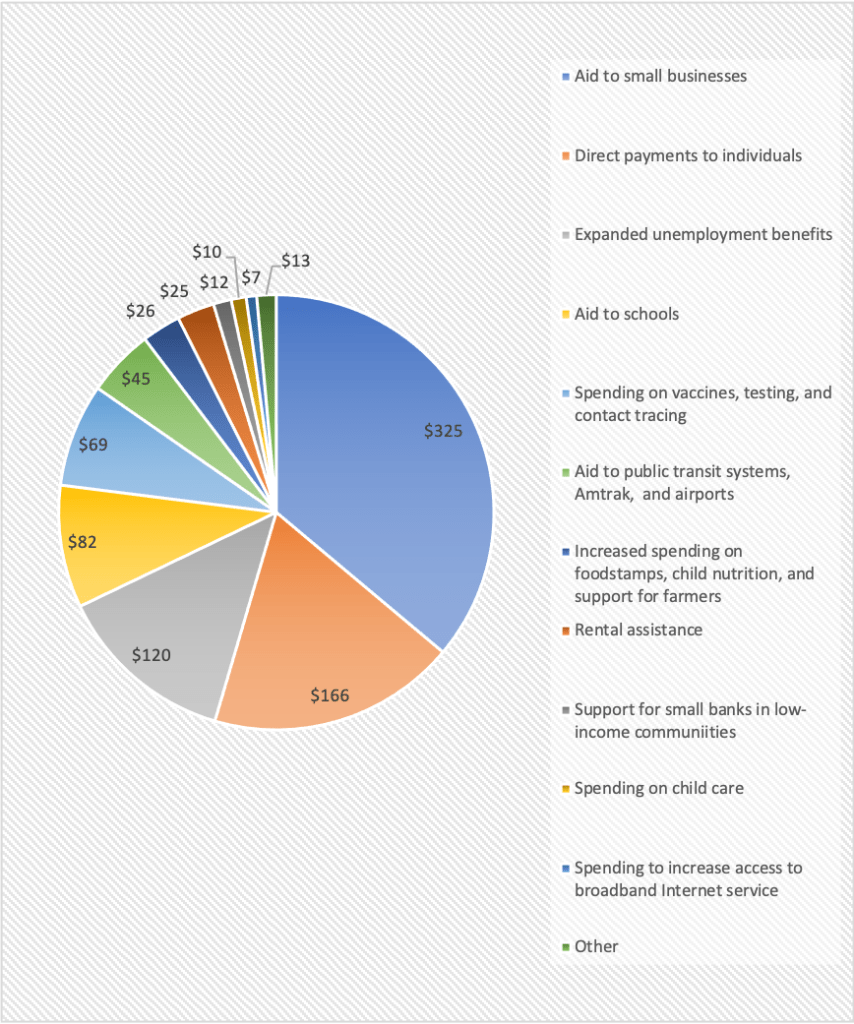
After a long debate over whether additional government aid would be required, in December 21, 2020, as hospitalizations and deaths from Covid-19 hit new highs in the United States, Congress agreed to a second fiscal policy action, totaling about $900 billion. On December 27, President Donald Trump signed the legislation. The components of the new spending are shown in the following pie chart, which is adapted from an article in the Wall Street Journal that can be found HERE. Note that the dollar values in the pie chart are in billions.

The largest component of the package is aid to small businesses, most of which takes the form of providing additional funds for the Paycheck Protection Plan. (We discuss the Paycheck Protection Plan in an earlier blog post that you can read HERE. An analysis by economists at the U.S. Department of the Treasury of the effectiveness of the original round of spending under the Paycheck Protection Plan can be found HERE.) The second largest component of the program involves direct payments of $600 per adult and $600 per child. The payments phase out for individuals with incomes over $75,000 and for couples with incomes over $150,000. The next largest component of the package is expanded unemployment benefits, followed by aid to schools, and increased spending on vaccines, testing, and contact tracing.

An article from the Associated Press describing the plan can be found HERE.

How the Effects of the Covid-19 Recession Differed Across Business Sectors and Income Groups

The recession that resulted from the Covid-19 pandemic affected most sectors of the U.S. economy, but some sectors of the economy fared better than others. As a broad generalization, we can say that online retailers, such as Amazon; delivery firms, such as FedEx and DoorDash; many manufacturers, including GM, Tesla, and other automobile firms; and firms, such as Zoom, that facilitate online meetings and lessons, have done well. Again, generalizing broadly, firms that supply a service, particularly if doing so requires in-person contact, have done poorly. Examples are restaurants, movie theaters, hotels, hair salons, and gyms.

The following figure uses data from the Federal Reserve Economic Data (FRED) website (fred.stlouisfed.org) on employment in several business sectors—note that the sectors shown in the figure do not account for all employment in the U.S. economy. For ease of comparison, total employment in each sector in February 2020 has been set equal to 100.

Employment in each sector dropped sharply between February and April as the pandemic began to spread throughout the United States, leading governors and mayors to order many businesses and schools closed. Even in areas where most businesses remained open, many people became reluctant to shop in stores, eat in restaurants, or exercise in gyms. From April to November, there were substantial employment gains in each sector, with employment in all goods-producing industries and employment in manufacturing (a subcategory of goods-producing industries) in November being just 5 percent less than in February. Employment in professional and business services (firms in this sector include legal, accounting, engineering, legal, consulting, and business software firms), rose to about the same level, but employment in all service industries was still 7 percent below its February level and employment in restaurants and bars was 17 percent below its February level.

Raj Chetty of Harvard University and colleagues have created the Opportunity Insights website that brings together data on a number of economic indicators that reflect employment, income, spending, and production in geographic areas down to the county or, for some cities, the ZIP code level. The Opportunity Insights website can be found HERE.

In a paper using these data, Chetty and colleagues find that during the pandemic “spending fell primarily because high-income households started spending much less.… Spending reductions were concentrated in services that require in-person physical interaction, such as hotels and restaurants …. These findings suggest that high-income households reduced spending primarily because of health concerns rather than a reduction in income or wealth, perhaps because they were able to self-isolate more easily than lower-income individuals (e.g., by substituting to remote work).”

As a result, “Small business revenues in the highest-income and highest-rent ZIP codes (e.g., the Upper East Side of Manhattan) fell by more than 65% between March and mid-April, compared with 30% in the least affluent ZIP codes. These reductions in revenue resulted in a much higher rate of small business closure in affluent areas within a given county than in less affluent areas.” As the revenues of small businesses declined, the businesses laid off workers and sometimes reduced the wages of workers they continued to employ. The employees of these small businesses, were typically lower- wage workers. The authors conclude from the data that: “Employment for high- wage workers also rebounded much more quickly: employment levels for workers in the top wage quartile [the top 20 percent of wages] were almost back to pre-COVID levels by the end of May, but remained 20% below baseline for low-wage workers even as of October 2020.”

The paper, which goes into much greater detail than the brief summary just given, can be found HERE.

Census Bureau Releases Results from the American Community Survey

Each year the U.S. Census Bureau conducts the American Community Survey (ACS) by surveying 3.5 million households on a wide range of questions including their income, their employment, their ethnicity, their marital status, how large their house or apartment is, and how many cars they own. The ACS is the most reliable source of data on these issues and is widely used by economists, business managers, and government policy makers. The data for 2019 and for the five-year period 2015-2019 were released on December 10. You can learn more about the survey and explore the data on the ACS website.

The ACS provides data on increases in income over time by different ethnic groups. This news article discusses the result that between 2005 and 2019, the incomes of Asian American grew the fastest, followed by the incomes of Hispanics, the incomes of non-Hispanic whites, and the incomes of African Americans.

Solved Problem: The Macroeconomic Effects of a Stronger Euro

Supports:  Economics: Chapter 28 – Macroeconomics in an Open Economy (Section 28.2); Macroeconomics: Chapter 12, Section 12.2; and Essentials: Chapter 19 – Comparative Advantage, International Trade, and Exchange Rates (Section 19.6)

Solved Problem: The Macroeconomic Effects of a Stronger Euro

In December 2020, an article in the Wall Street Journal discussed the effects of changes in the value of the euro in exchange for the U.S. dollar. The article noted that: “A stronger euro makes exports from the region less competitive overseas” and that a stronger euro would also “damp inflation” in countries using the euro as their currency.

a. What does the article mean by a “stronger euro”? Why would a stronger euro make European exports less competitive?

b. What does the article mean by “damp inflation”? Why would a stronger euro damp inflation in countries using the euro?

Source: Caitlin Ostroff, “Euro Rally Weighs on Inflation, Sapping Appetite for Stocks,” Wall Street Journal, December 9, 2020.

Solving the Problem

Step 1:   Review the chapter material. This problem is about the effect of changes in the exchange rate on a country’s (or region’s) imports and exports, so you may want to review Chapter 28, Section 28.2 “How Movements in Exchange Rates Affect Imports and Exports.”

Step 2:   Answer part a. by explaining what a “stronger euro” means and why a stronger euro would make European exports less competitive. A stronger euro is one that exchanges for more dollars or, which amounts to the same thing, requires fewer euros to exchange for a dollar. (You may want to review the Apply the Concept “Is a Strong Currency Good for a Country?”) A stronger euro results in U.S. consumers having to pay more dollars to buy goods and services imported from Europe. In other words, the prices of European exports to the United States will rise making the exports less competitive with U.S.-produced goods or with other countries exports to the United States. If the euro is also becoming stronger against currencies such as the British pound, Japanese yen, and Chinese yuan, then European exports will also be less competitive in those countries.

Step 3:   Answer part b. by explaining what “damp inflation” means and why a stronger euro would damp inflation in countries using the euro. To “damp inflation” is to reduce inflation. So the article is stating that a stronger euro will result in lower inflation in Europe. To understand why, remember that while a stronger euro will raise the dollar price of European exports to the United States, it will reduce the euro price of European imports from the United States (and from other countries if the euro is also becoming stronger against currencies such as the British pound, Japanese yen, and Chinese yuan). Inflation in a country is measured using the prices of goods and services that consumers purchase, whether those goods and services are produced domestically or are imported.

Christopher Waller Confirmed by Senate as Federal Reserve Governor

Christopher Waller

On Thursday, December 3, Christopher Waller, executive vice president and research director at the Federal Reserve Bank of St. Louis, was confirmed by the Senate as a member of the Federal Reserve’s Board of Governors.  The Board of Governors has seven members and, under the Federal Reserve Act, is responsible for the monetary policy of the United States and for overseeing the operation of the Federal Reserve System.

Board members are appointed by the president and confirmed by the Senate to 14-year nonrenewable terms. The terms are staggered so that one expires every other January 31. Members frequently leave the Board before their terms expire to return to their previous occupations or to accept other positions in the government. The following table shows the current Board members, when their terms will expire, and which president appointed them.  Note that one seat on the Board is vacant. President Trump nominated Judy Shelton to fill this seat but it appears unlikely that she will be confirmed by the Senate before the change in administration takes place on January 20.

NameYear Term EndsAppointed to the Board by
Jerome Powell, ChairAs Chair: 2022
As Board member: 2028
As Chair: President Trump
As Board member: President Obama
Richard Clarida, Vice ChairAs Vice Chair and as Board member: 2022President Trump
Randal Quarles, Vice Chair for SupervisionAs Vice Chair for Supervision: 2021; As Board member: 2032President Trump
Michelle Bowman2034President Trump
Lael Brainard2026President Obama
Christopher Waller2030President Trump
Vacant

Information on the history and structure of the Board of Governors and on the backgrounds of current members can be found HERE on the Fed’s website.  An announcement of Waller’s confirmation can be found HERE on the website of the St. Louis Fed. A news story discussing Waller’s confirmation and the likely outcome of Shelton’s nomination, as well as some of the politics involved with current Fed nominations can be found HERE (those with a subscription to the Wall Street Journal may also want to read the article HERE).

Janet Yellen Nominated to Be Treasury Secretary

Janet Yellen

President-elect Joe Biden has nominated Janet Yellen to be treasury secretary. If confirmed by the Senate, Yellen would be the first woman to hold that post. She would also be the first person to have been both Federal Reserve Chair and treasury secretary. Yellen also served as President of the Federal Reserve Bank of San Francisco and as Chair of the Council of Economic Advisers during the Clinton administration. Prior to entering government service, Yellen was on the economics faculties of Harvard University and the University of California, Berkeley. At the time of her nomination she was a Distinguished Fellow in Residence at the Brookings Institution.

A news story on her nomination can be read HERE. Her biography on the Brookings Institution web site is HERE (includes a video conversation from a few years ago with former Fed Chair Ben Bernanke). A speech she gave in 2018 reflecting on the 2007-2009 financial crisis can be read HERE.

Statement from the Economic Strategy Group Urging Congress to Provide Additional Spending in Response to the Covid-19 Pandemic

The Economic Strategy Group (ESG) is a program for discussing economic policy issues. On November 19, 2020, the ESG released a statement urging Congress to provide additional funding to deal with the Covid-19 pandemic. Glenn Hubbard joined economists from both political parties in signing the statement. You can read the statement HERE.

Does the U.S. Economy Need Another Government Stimulus Package?

In an opinion column on bloomberg.com, Michael Strain of the American Enterprise Institute argues that Congress should pass another stimulus package to supplement the $1.8 trillion Coronavirus Aid, Relief, and Economic Security Act that Congress passed and President Trump signed into law in March. His proposal would involve an additional $1 trillion in spending.

You can read the column HERE. Note that most bloomberg.com articles require a paid subscription, but you can read several articles per month for free.

Does Automation Lead to Permanent Job Losses?

This post on the Federal Reserve Bank of St. Louis’s Page One blog discusses how the belief that automation can lead to permanent job losses is an example of the “lump of labor” fallacy. Click HERE to read the article.

The post refers to the circular-flow diagram, which we discuss in Chapter 2 and in Chapter 18 in the textbook. We discuss the effects of automation and robots on the labor market in Chapter 16.