Sticker Shock in the Market for Used Cars

The term “sticker shock” was first used during the 1970s to describe the surprise car buyers experienced when seeing how much car prices had risen.  Because inflation during that decade was so high, anyone who hadn’t bought a car for several years was unprepared for the jump in car prices. During 2020 and 2021, sticker shock returned, particularly to the used car market. Prices were increasing so rapidly that even people who had purchased a car a year or two before were surprised by the increases. 

The following graph shows U.S. Bureau of Labor Statistics (BLS) data on inflation in the market for used cars in the months since January 2015. Inflation is measured as the percent change from the same month in the previous year in the used cars and trucks component of the Consumer Price Index (CPI). The CPI is the most widely used measure of inflation. Used car prices began rising in August 2020, peaking at a 45 percent increase in June 2021. Inflation at such rates over a period longer than a year is very unusual in any of components of the CPI. 
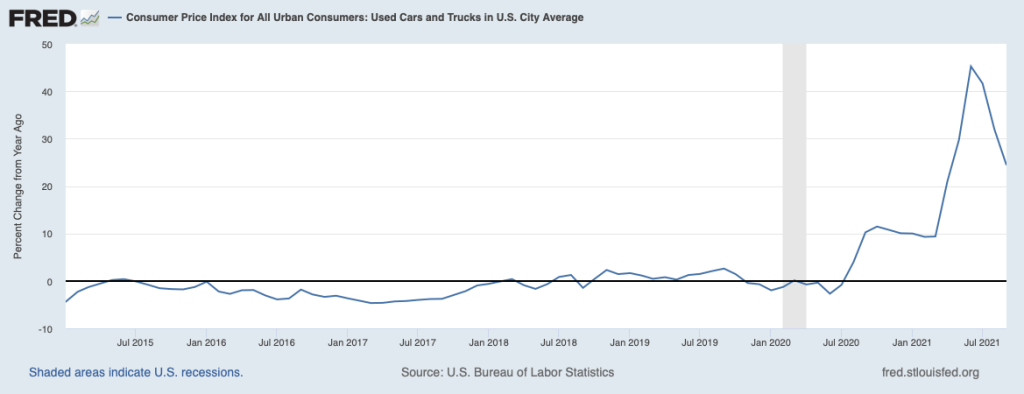
What explains the extraordinary burst of inflation in used car prices during 2020 and 2021? Three factors seem to have been of greatest importance:

  1. A decline in the supply of new cars resulting from a shortage in semiconductors caused an increase in new car prices. Rising new car prices led some consumers who would otherwise have bought a new car to enter the used car market, increasing the demand for used cars.
  2. Because of the Covid-19 pandemic, some people became reluctant to ride buses and other mass transit, increasing the demand for both new and used cars.
  3. As the pandemic increased in severity in the spring of 2020, most rental car companies decided to purchase fewer new cars for their fleets. After keeping a car in its fleet for one year, rental car companies typically sell the car to used car dealers for resale. Because rental car companies were selling them fewer cars, used car dealers had fewer cars on their lots. So the supply of used cars declined. 

We can use the demand and supply model to explain the jump in used car prices. As shown in the following figure, the demand curve for used cars shifted to the right from D1 to D2, as some consumers who would otherwise have bought new cars, bought used cars instead, and as some people swithced from public transportation to driving their cars to work. At the same time, the supply of used cars shifted to the left from S1 to S2 because used car dealers were able to buy fewer used cars from rental car companies. The result was that the price of used cars rose from P1 to P2 at the same time that the quantity of used cars sold fell from Q1 to Q2.

Sources: Yueqi Yang, “U.S. Used-Car Prices, Key Inflation Driver, Surge to Record,” bloomberg.com, October 7, 2021; Nora Naughton, “Looking to Buy a Used Car? Expect High Prices, Few Options,” wsj.com, May 10, 2021; Cox Automotive, “13-Month Rolling Used-Vehicle SAAR,” coxautoinc.com, October 15, 2021; and Federal Reserve Bank of St. Louis.

10/17/21 Podcast – Authors Glenn Hubbard & Tony O’Brien discuss economic impact of infrastructure spending & the supply-chain challenges.

Authors Glenn Hubbard and Tony O’Brien discuss the economic impact of the recent infrastructure bill and what role fiscal policy plays in determining shovel-ready projects. Also, they explore the vast impact of the economy-wide supply-chain issues and the challenges companies face. Until the pandemic, we had a very efficient supply chain but now we’re seeing companies employ the “just-in-case” inventory method vs. “just-in-time”!

Some links referenced in the podcast:

Here’s Alan Cole’s blog: https://fullstackeconomics.com/how-i-reluctantly-became-an-inflation-crank/

Neil Irwin wrote a column referencing Cole here:  https://www.nytimes.com/2021/10/10/upshot/shadow-inflation-analysis.html

Here’s a Times article on the inefficiency of subway construction in NYC:  https://www.nytimes.com/2017/12/28/nyregion/new-york-subway-construction-costs.html

A recent article on the state of CA’s bullet train:  https://www.kcra.com/article/california-bullet-trains-latest-woe-high-speed/37954851

A WSJ column on goods v. services: https://www.wsj.com/articles/at-times-like-these-inflation-isnt-all-bad-11634290202

Coming Attractions: Hubbard and O’Brien Principles of Economics Updated

It’s customary for textbook authors to note that “much has happened in the economy” since the last edition of their book appeared. To say that much has happened since we prepared our last edition in 2019 would be a major understatement. Never in the lifetimes of today’s students and instructors have events like those of 2020 and 2021 occurred. The U.S. and world economies had experienced nothing like the Covid-19 pandemic since the influenza pandemic of 1918. In the spring of 2020, the U.S. economy suffered an unprecedented decline in the supply of goods and services as a majority of businesses in the country shut down to reduce spread of the virus. Many businesses remained closed or operated at greatly reduced capacity well into 2021. Most schools, including most colleges, switched to remote learning, which disrupted the lives of many students and their parents.

During the worst of the pandemic, total spending in the economy declined as the unemployment rate soared to levels not seen since the Great Depression of the 1930s. Reduced spending and closed businesses resulted in by far the largest decline in total production in such a short period in the history of the U.S. economy. Congress, the Trump and Biden administrations, and the Federal Reserve responded with fiscal and monetary policies that were also unprecedented.

Our updated Eighth Edition covers all of these developments as well as the policy debates they initiated. As with previous editions, we rely on extensive digital resources, including: author-created application videos and audio recordings of the chapter openers and Apply the Concept features; figure animation videos; interactive real-time data graphs animations; and Solved Problem whiteboard videos.

Glenn and Tony discuss the updated edition in this video:

Sample chapters will be available by October 15.

The full Macroeconomics text will available in early to mid December.

The full Microeconomics text will be available in mid to late December.

If you would like to view the sample chapters or are considering adopting the updated Eighth Edition for the spring semester, please contact your local Pearson representative. You can use this LINK to find and contact your representative.

09/03/21 Podcast – Authors Glenn Hubbard & Tony O’Brien discuss the recent jobs report, Fed comments, and financial stability!

Authors Glenn Hubbard and Tony O’Brien discuss the recent jobs report falling short of expectations. They also discuss the comments of Fed Chairman Powell’s comments at the Federal Reserve’s recent Jackson Hole conference. They also get to some of the recommendations of a Brookings Task Force, co-chaired by Glenn Hubbard, on ways to address financial stability. Use the links below to see more information about these timely topics:
Powell’s Jackson Hole speech: 

https://www.federalreserve.gov/newsevents/speech/files/powell20210827a.pdf 

The report of Glenn’s task force: 

https://www.brookings.edu/wp-content/uploads/2021/06/financial-stability_report.pdf 

The most recent economic forecasts of the FOMC: 

https://www.federalreserve.gov/monetarypolicy/files/fomcprojtabl20210616.pdf

WELCOME BACK! New 08/20/21 Podcast – Authors Glenn Hubbard & Tony O’Brien return to discuss delta variant & inflation!

Join authors Glenn Hubbard and Tony O’Brien as they return for a new academic year! The issues have evolved but the importance of these issues has not waned. We discuss the impact of closures related to the delta variant has on the economy. The discussion extends to the active fiscal and monetary policy that has reintroduced inflation as a topic facing our economy. Many students have little or no experience with inflation so it is a learning opportunity. Check back regularly where Glenn & Tony will continue to wrestle with these important economic concepts and relate them to the classroom!