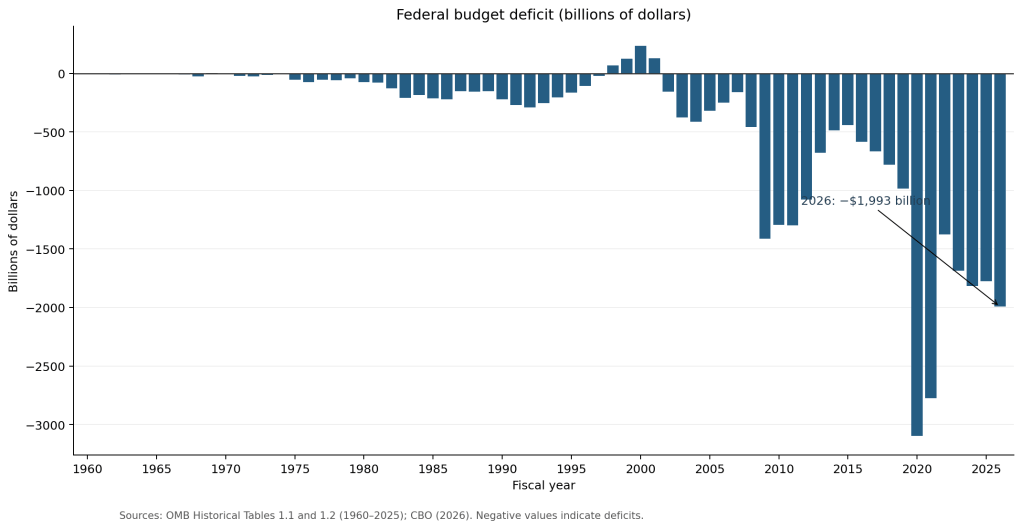
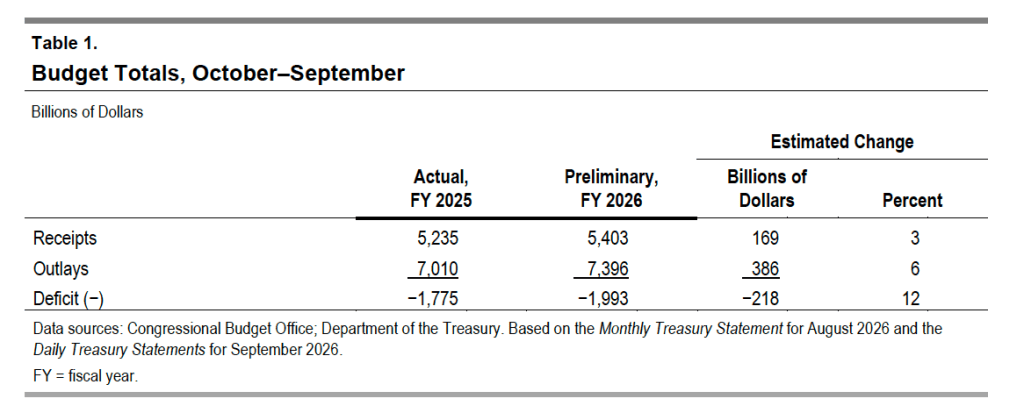
The federal government’s fiscal year runs from October 1 to September 30. The Congressional Budget Office (CBO) has released its estimate of the deficit for the 2026 fiscal year, which ended September 30, 2026. The deficit increased to $1,993 billion in 2026 from $1,775 billion in 2025. As the following figure shows, in the context of the period since 1960, the budget deficit in 2026 remains very large, particularly at a time when the U.S. economy is at or very close to full employment. The budget deficit in 2026 is well below the record deficit of $3,096 billion in 2020.
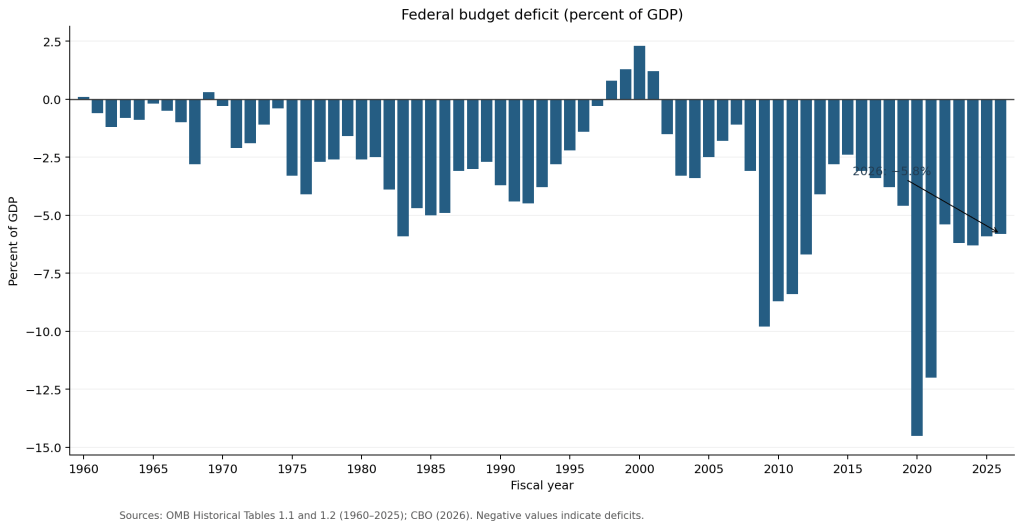
Economists typically focus more on the size of the budget deficit relative to the size of the economy, as measured by GDP. The following figure shows the federal budget deficit as a percentage of GDP was largest during and after the Great Recession of 2007–2009, and in 2020–2021, during and immediately after the Covid recession. In both those periods, federal tax revenues declined as production and employment fell. In addition, Congress passed legislation increasing government purchases and transfer payments. Although during the past few years the budget deficit as a percentage of GDP has declined from a high of 14.5 percent in 2020 (which was the largest deficit since World War II ended in 1945), it still remains very high for a period of close to full employment.
The following table from the CBO report shows that in 2026 federal receipts increased less than federal outlays, leading to a larger budget deficit.
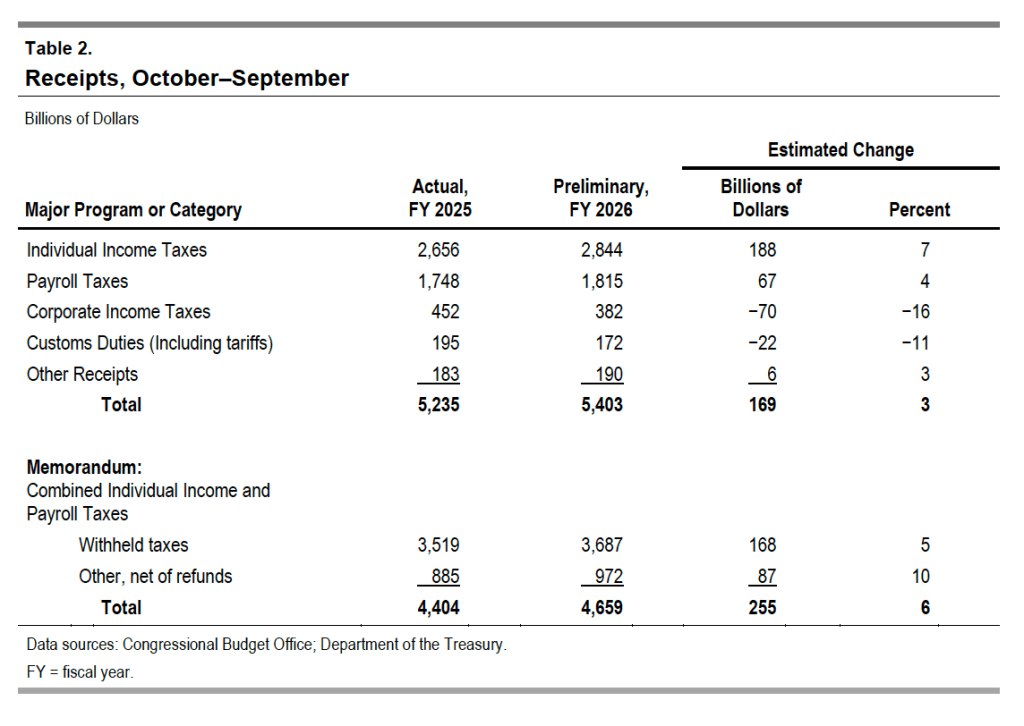
The next table shows the changes in the major categories of federal receipts. Individual income and payroll taxes—which fund the Social Security and Medicare programs, as well as the federal government’s contributions to state unemployment insurance plans—both increased, while corporate income tax receipts fell. Customs duties declined as the federal government refunded tariffs collected under higher tariff rates imposed by the Trump administration beginning in April 2025. The Supreme Court ruled in February 2026 that some of the tariff increases were not authorized by federal law.
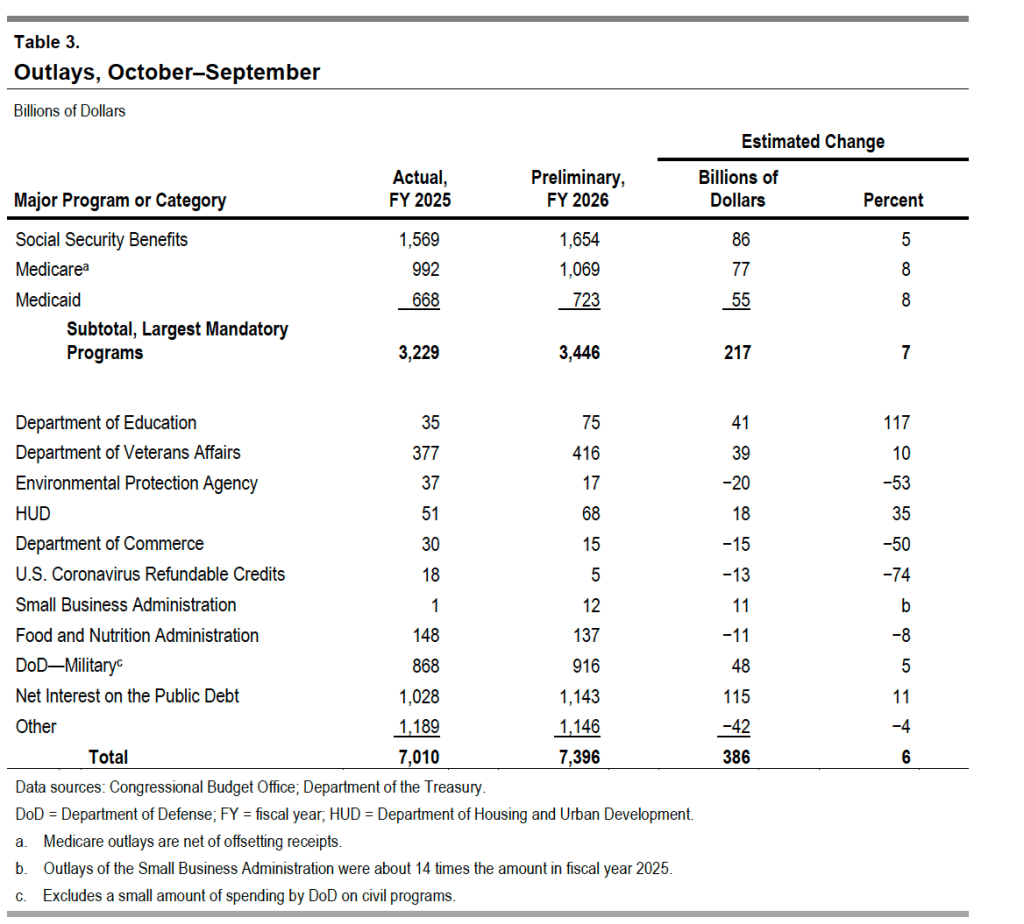
The next table shows the changes in the major categories of federal outlays. Spending on the Social Security, Medicare (health insurance for older people), and Medicaid (health insurance for lower-income people) programs continue to steadily increase. Spending on Medicare is now more than $150 billion greater than spending on defense. Interest on the public debt continues to increase as the debt grows and interest rates remain well above their pre-2021 levels.
In Microeconomics, Chapter 17, we discuss the tax system, including principles and goals policymakers can use to evaluate tax proposals. In this column, which first appeared on the website of the American Enterprise Institute, Glenn discusses the advantages of the federal government switching to using a cashflow tax, rather than the current personal and corporate income taxes.
The Case for a Cashflow Tax
In the context of the US economy, a cashflow tax would offer far-reaching benefits in promoting economic growth, taxing rents, and raising incremental revenue efficiently. Moreover, well-known concerns about complexity and fairness are easily addressed.
After the U.S. midterm election this November, Congress’s economic-policy focus will likely turn to growth, AI’s impact on the economy, and deficit concerns. Lawmakers therefore should recognize that one policy tool can help to address all three: a cashflow tax.
Attention to these issues is warranted. Because higher productivity is what boosts incomes, investment and growth remain the core drivers of rising living standards. Yet concerns over labor’s shrinking share of GDP relative to capital—a problem that could be magnified by developments in generative AI—have ignited debates about profit and wealth taxation. At the same time, growing alarm over the unsustainability of the U.S. fiscal position puts a premium on efficient ways of raising additional revenue.
That is where the cashflow tax comes in. Many economists (including me) have long championed the economic benefits of moving the tax system further toward a consumption tax. Relative to the current income tax, a broad-based consumption tax would raise saving and investment, leading to higher productivity and incomes.
Though the term “consumption tax” may call to mind a European credit-invoice value-added tax (VAT), the United States could implement such a policy in a simpler fashion by targeting accounts currently maintained for taxation. After all, a consumption tax at a given rate is arithmetically identical to the combination of a wage tax and a business cashflow tax at the same rate. As a tax on a firm’s revenue minus expenses, a cashflow tax would allow businesses to expense investment immediately, boosting outlays.
Such a shift would expand on reforms enacted in 2017 and 2025. It would also disallow nonfinancial companies from making interest deductions, because in contrast to an income tax, a cashflow tax treats debt and equity the same. It therefore eliminates an important tax incentive for firms to allow themselves to become leveraged. Finally, a cashflow tax is much simpler than a corporate-income tax, which requires complex depreciation schedules.
Cashflow taxation shifts the tax burden toward high rates of profit, which is useful in an environment of rising profit concentration in firms. This benefit arises because the cashflow tax removes taxes on what economists call the “normal return” on investment (or the cost of capital). Companies would instead be taxed only on profits above this amount, reflecting economic rents. Moreover, given that most large individual fortunes reflect economic rents in business ownership, a cashflow tax would be more effective than a wealth tax, which suffers from many complications relating to measurement, liquidity, and incentives.
Because a cashflow tax creates fewer distortions of saving and investment than the income tax, it is also a more efficient instrument for raising incremental revenue in any future fiscal consolidation. While the bulk of fiscal adjustment will require reductions in the growth of federal spending, higher revenue would almost surely be part of any politically viable package.
Moreover, additional revenue could be raised if Congress incorporated a border adjustment in the new cashflow tax. Doing so would deny companies a tax deduction for expenses abroad, while exempting U.S. exports from taxation. Other countries already use border adjustments in their VATs on consumption, and America uses a similar mechanism in state and local retail taxes. If you buy a kitchen appliance in New York, you pay New York sales tax even if it was made in Ohio. The sales tax applies only where the good is sold, not where it originates. Because the U.S. imports more than it exports, the border adjustment would raise revenue, remove tax incentives for U.S. firms to locate activities abroad, and strengthen the incentives for non-U.S. firms to locate activities in America.
To be sure, while a cashflow tax promises to promote economic growth, tax high profits, and raise incremental revenue efficiently, it does raise concerns about complexity and tax fairness. But these issues can be straightforwardly addressed.
Consider the possible concerns over tax complexity. The cashflow tax would use basic company accounts already used in the income tax, avoiding any new fundamental tax design or introduction of a European-styled VAT. It also would offer simplification within the income tax code by substituting permanent expensing of capital goods for more complicated and less generous depreciation allowances.
Yes, the combination of a wage tax and a cashflow tax at the same rate replicates a broad-based consumption tax, but without the progressivity of the current income tax, raising potential concerns about fairness. But this issue is also easily tackled. A graduated tax structure could be introduced along the lines of the “X-tax” that Princeton University economist David Bradford developed 40 years ago. Here, the individual wage tax would have graduated rates with a credit for low-wage individuals, and the business cashflow tax rate would be set as the highest individual tax rate. Or, as Treasury Secretary Nicholas F. Brady suggested in 1992, an alternative version would tax all income, including capital income, for very high-income individual taxpayers.
With elections looming, economic policies to promote growth, address structural changes in income and wealth inequality, and tackle ballooning budget deficits will be intensely debated. Building on recent tax changes to implement a cashflow tax offers the most promising path forward on all three issues.