Is Bitcoin the New Gold?

As we discuss in the chapter, initially, bitcoin was thought of as a way to buy and sell goods and services. Some stores accepted bitcoin and allowed customers to make payment by scanning a bar code with a phone. Some websites offered merchants a way to process purchases made with bitcoins in a manner similar to the way merchants process credit card payments.

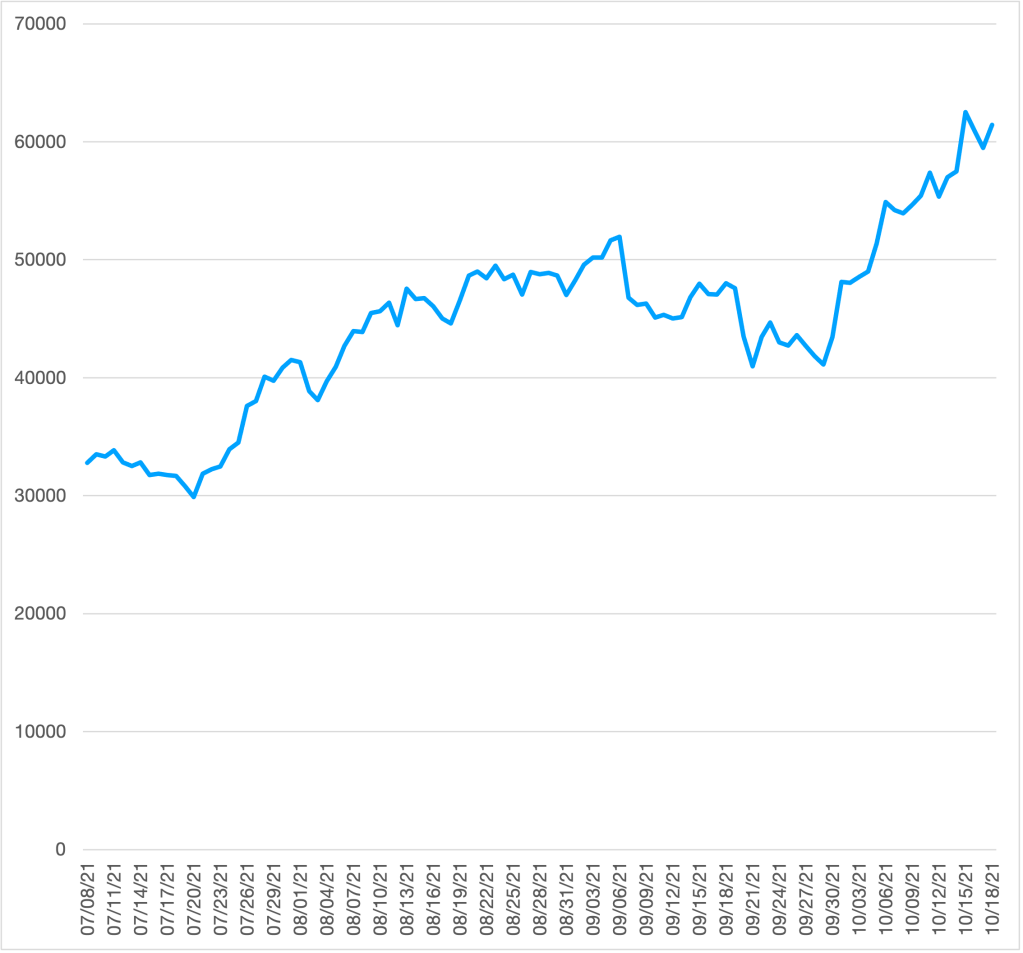
In practice, though, swings in the value of bitcoin have been much too large to make it a good substitute for cash, checks, or credit cards in everyday transactions. For instance, at the beginning of 2015, one bitcoin was worth about $300. Over the following five years, the price of bitcoin rose as high at $17,000 before falling to about $8,000 at the beginning of 2020. During 2021, the volatility of bitcoin prices increased, rising as high as $62,000 in April and falling as low as $30,000 in July before rising back above $60,000 in October. (The following chart shows movements in the price of bitcoin from early July to mid-October 2021; the vertical axis shows the price as dollars per bitcoin.)
Some economists have suggested that rather being a medium of exchange, like dollar bills, bitcoin has become a speculative asset, like gold. Bitcoin shares with gold the characteristic that ultimately its total supplied is limited. The supply of Bitcoin can’t increase beyond 21 million, a limit that is expected to be reached in 2030. The gold stock slowly increases as mines produce more gold, although the output of mines is small compared with the existing stock of gold. Some investors and speculators are reassured that, in contrast to the assets in M1 and M2 that can increase as much as the Fed chooses, gold and bitcoin have limits on how much they can increase.

Will Bitcoin Be a Good Hedge Against Inflation? Can It Be Useful in Diversifying a Portfolio?

Some investors and speculators believe that the limited quantities of gold and bitcoin available make them good hedges against inflation—that is, they believe that the prices of gold and bitcoin will reliably increase during periods of inflation.  In fact, though, gold has proven to be a poor hedge against inflation because in the long run the price of gold has not reliably increased faster than the inflation rate. There is no good economic reason to expect that over the long run bitcoin would be a good inflation hedge either.

From a broader perspective than as just an inflation hedge, some economists argue that gold has a role to play in an investor’s portfolio—which is the collection of assets, such as stocks and bonds, that an investor owns. Investors can reduce the financial risk they face through diversification, or spreading their wealth among different assets. For instance, an investor who only holds Apple stock in her portfolio is subject to more risk than an investor with the same dollar amount invested in a portfolio that holds the stocks of multiple firms as well as non-stock investments. An investor obtains the benefits of diversification best by adding assets to her portfolio that are not well correlated with the assets she already owns—that is the prices of the assets she adds to her portfolio don’t typically move in the same direction as the prices of the assets she already owns.

For instance, during a typical recession sales of consumer staples, like baby diapers and laundry detergent, hold up well, while sales of consumers durables, like automobiles, usually decline significantly. So adding shares of stock in Proctor & Gamble to a portfolio that already has many shares of General Motors achieves diversification and reduces financial risk because movements in the price of shares of Proctor & Gamble are likely not to be highly correlated with movements in the price of shares of General Motors.

Studies have shown that during some periods movements in gold prices are not correlated with movements in prices of stocks or bonds. In other words, gold prices may rise during a period when stock prices are declining. As a result, an investor may want to add gold to her portfolio to diversify it. To this point, bitcoin hasn’t been around long enough to draw firm conclusions about whether adding bitcoin to a portfolio provides significant diversification, although some investors believes that it does. 

Finance professionals are divided in their opinions on whether bitcoin is a good substitute for gold in a financial portfolio. In an interview, billionaire investor Ray Dalio, founder of Bridgewater Associates, the world’s hedge fund, noted that while he believes that bitcoin may serve as a hedge against inflation, but if he could only hold gold or bitcoin, “I would choose gold.” His preference for gold is due in part to his belief that the federal government may increase regulation of bitcoin and that regulators might eventually even decide to ban it. A businessinsider.com survey of 10 financial experts found them divided with five preferring gold as an investment and five preferring bitcoin.

Sources: Jade Scipioni, “Bitcoin vs. Gold: Here’s What Billionaire Ray Dalio Thinks,” cnbc.com, August 4, 2021; and Isabelle Lee and Will Daniel, “Bitcoin vs. Gold: 10 Experts Told Us Which Asset They’d Rather Hold for the Next 10 Years, and Why,” businessinsider.com, February 20, 2021.

New 10/17/21 Podcast – Authors Glenn Hubbard & Tony O’Brien discuss economic impact of infrastructure spending & the supply-chain challenges.

Authors Glenn Hubbard and Tony O’Brien discuss the economic impact of the recent infrastructure bill and what role fiscal policy plays in determining shovel-ready projects. Also, they explore the vast impact of the economy-wide supply-chain issues and the challenges companies face. Until the pandemic, we had a very efficient supply chain but now we’re seeing companies employ the “just-in-case” inventory method vs. “just-in-time”!

Some links referenced in the podcast:

Here’s Alan Cole’s blog: https://fullstackeconomics.com/how-i-reluctantly-became-an-inflation-crank/

Neil Irwin wrote a column referencing Cole here:  https://www.nytimes.com/2021/10/10/upshot/shadow-inflation-analysis.html

Here’s a Times article on the inefficiency of subway construction in NYC:  https://www.nytimes.com/2017/12/28/nyregion/new-york-subway-construction-costs.html

A recent article on the state of CA’s bullet train:  https://www.kcra.com/article/california-bullet-trains-latest-woe-high-speed/37954851

A WSJ column on goods v. services: https://www.wsj.com/articles/at-times-like-these-inflation-isnt-all-bad-11634290202

The Pandemic and Hidden Inflation

If the price of your meal is the same, but the service is slow and the menu is limited you have experienced hidden inflation.

Each month, hundreds of employees of the Bureau of Labor Statistics gather data on prices of goods and services from stores in 87 cities and from websites. The BLS constructs the consumer price index (CPI) by giving each price a weight equal to the fraction of a typical family’s budget spent on that good or service. (We discuss the construction of the CPI in Chapter 9, Section 9.4 of Macroeconomics and Chapter 19, Section 19.4 of Economics.) Ideally, the BLS tracks prices of the same product over time. But sometimes a particular brand and style of shirt, for example, is discontinued. In that case, the BLS will use instead the price of a shirt that is a very close substitute.

A more difficult problem arises when the price of a good increases at the same time that the quality of the good improves. For instance, a new model iPhone may have both a higher price and a better battery than the model it replaces, so the higher price partly reflects the improvement in the quality of the phone.  The BLS has long been aware of this problem and has developed statistical techniques that attempt to identify that part of price increases that are due to increases in quality. Economists differ in their views on how successfully the BLS has dealt with this quality bias to the measured inflation rate. Because of this bias in constructing the CPI, it’s possible that the published values of inflation may overstate the actual annual rate of inflation by 0.5 percentage point. So, for instance, the BLS might report an inflation rate of 3.5 percent when the actual inflation rate—if the BLS could determine it—was 4.0 percent.

During 2021, a number of observers pointed to a hidden type of inflation occurring, particularly in some service industries. For example, because many restaurants were having difficulty hiring servers, it was often taking longer for customers to have their orders taken and to have their food brought to the table.  Because restaurants were also having difficulty hiring enough cooks, they also limited the items available on their menus. In other words, the service these restaurants were offering was not as good as it had been prior to the pandemic. So even if the restaurants kept their prices unchanged, their customers were paying the same price but receiving less. 

Alan Cole, who was formerly a senior economist with the Congressional Joint Economic Committee, noted on his blog that “goods and services are getting worse faster than the official statistics acknowledge, suggesting that our inflation problem has actually been bigger than the official statistics suggest.” As examples, he noted that “hotels clean rooms less frequently on multi-night stays,” “shipping delays are longer, and phone hold times at airlines are worse.” In a column in the New York Times, economics writer Neil Irwin made similar points: “Complaints have been frequent about the cleanliness of [restaurant] tables, floors and bathrooms.”  And: “People trying to buy appliances and other retail goods are waiting longer.”

A column in the Wall Street Journal on business travel by Scott McCartney was headlined “The Incredible Disappearing Hotel Breakfast.” McCartney noted that many hotels continue to advertise free hot breakfasts on their websites and apps but have stopped providing them. He also noted that hotels “have suffered from labor shortages that have made it difficult to supply services such as daily housekeeping or loyalty-group lounges,” in addition to hot breakfasts.

The BLS makes no attempt to adjust the CPI for these types of deterioration in the quality of services because doing so would be very difficult. As Irwin notes: “Customer service preferences—particularly how much good service is worth—varies highly among individuals and is hard to quantify. How much extra would you pay for a fast-food hamburger from a restaurant that cleans its restroom more frequently than the place across the street?”

As we noted earlier, most economists believe that the failure of the BLS to fully account for improvements in the quality of goods results in changes in the CPI overstating the true inflation rate.  This bias may have been more than offset since the beginning of the pandemic by deterioration in the quality of services resulting in the CPI understating the true inflation rate. As the dislocations caused by the pandemic gradually resolve themselves, it seems likely that the deterioration in services will be reversed. But it’s possible that the deterioration in the provision of some services may persist. Fortunately, unless the deterioration increases over time, it would not continue to distort the measurement of the inflation rate because the same lower level of service would be included in every period’s prices.

Sources: Alan Cole, “How I Reluctantly Became an Inflation Crank,” fullstackeconomics.com, September 8, 2021; Scott McCartney, “The Incredible Disappearing Hotel Breakfast—and Other Amenities Travelers Miss,” wsj.com, October 20, 2021; and Neil Irwin, “There Is Shadow Inflation Taking Place All Around Us,” nytimes.com, October 14, 2021.

The College Majors of U.S. Billionaires

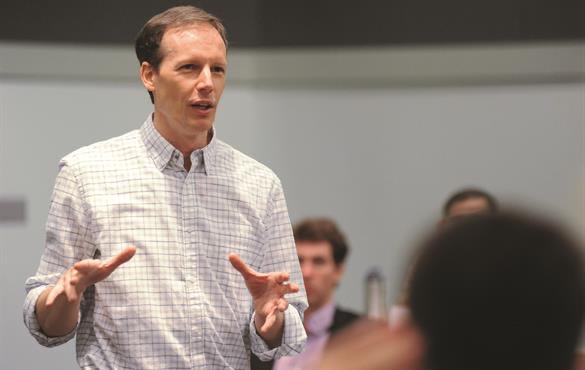
Jim McKelvey, cofounder of Square and undergraduate economics major

Each year, Forbes magazine compiles a list of the 400 richest people in the United States. A recent article in Forbes reports on the college majors of these billionaires. Forbes was able to find that information for 357 of the 400. Perhaps unsurprisingly, 65 chose business, making it the most popular undergraduate major.  

Economics was the second most popular major, with 58 having chosen it, followed closely by engineering with 55. There is a substantial drop to the next most popular major—politics and government—with 22 of the 400 billionaires having chosen it. Given that we often associate billion dollar fortunes with the founders of tech companies, it may be surprising that only 17 of the 400 majored in computer science. Included among them, though, is Jeff Bezos, who majored in computer science and engineering at Princeton and who holds first place on the Forbes list of the wealthiest Americans. 

The article quotes Jim McKelvey, cofounder of credit card processor Square, as observing about economics: “There are a few basic concepts in economics that help in business. Micro and especially game theory are helpful to predict customer behavior. And macro has been super helpful ever since I joined the board of the Federal Reserve.” McKelvey currently serves as deputy chair of the board of directors of the Federal Reserve Bank of St. Louis.

Source: Matt Durot, “Want to Be a Billionaire? These Are the Most Popular Majors of the Richest Americans,” forbes.com, October 8, 2021. LINK

Card, Angrist, and Imbens Win Nobel Prize in Economics

David Card
Joshua Angrist
Guido Imbens

   David Card of the University of California, Berkeley; Joshua Angrist of the Massachusetts Institute of Technology; and Guido Imbens of Stanford University shared the 2021 Nobel Prize in Economics (formally, the Sveriges Riksbank Prize in Economic Sciences in Memory of Alfred Nobel). Card received half of the prize of 10 million Swedish kronor (about 1.14 million U.S. dollars) “for his empirical contributions to labor economics,” and Angrist and Imbens shared the other half “for their methodological contributions to the analysis of causal relationships.” (In the work for which they received the prize, all three had collaborated with the late Alan Krueger of Princeton University. Card was quoted in the Wall Street Journal as stating that: “I’m sure that if Alan was still with us that he would be sharing this prize with me.”)

The work of the three economists is related in that all have used natural experiments to address questions of economic causality. With a natural experiment, economists identify some variable of interest—say, an increase in the minimum wage—that has changed for one group of people—say, fast-food workers in one state—while remaining unchanged for another similar group of people—say, fast-food workers in a neighboring state. Researchers can draw an inference about the effects of the change by looking at the difference between the outcomes for the two groups. In this example, the difference between changes in employment at fast-food restaurants in the two states can be used to measure the effect of an increase in the minimum wage.

Using natural experiments is an alternative to the traditional approach that had dominated empirical economics from the 1940s when the increased availability of modern digital computers made it possible to apply econometric techniques to real-world data. With the traditional approach to empirical work, economists would estimate structural models to answer questions about causality. So, for instance, a labor economist might estimate a model of the demand and supply of labor to predict the effect of an increase in the minimum wage on employment.

Over the years, many economists became dissatisfied with using structural models to address questions of economic causality. They concluded that the information requirements to reliably estimate structural models were too great. For instance, structural models require assumptions about the functional form of relationships, such as the demand for labor, that are not inferable directly from economic theory. Theory also did not always identify all variables that should be included in the model. Gathering data on the relevant variables was sometimes difficult. As a result, answers to empirical questions, such as the employment effects of the minimum wage, differed substantially across studies. In such cases, policymakers began to see empirical economics as an unreliable guide to economic policy.

In a famous study of the effect of the minimum wage on employment published in 1994 in the American Economic Review, Card and Krueger pioneered the use of natural experiments.  In that study, Card and Krueger analyzed the effect of the minimum wage on employment in fast-food restaurants by comparing what happened to employment in New Jersey when it raised the state minimum wage from $4.25 to $5.05 per hour with employment in eastern Pennsylvania where the minimum wage remained unchanged.  They found that, contrary to the usual analysis that increases in the minimum wage lead to decreases in the employment of unskilled workers, employment of fast-food workers in New Jersey actually increased relative to employment of fast-food workers in Pennsylvania. 

The following graphic from Nobel Prize website summarizes the study. (Note that not all economists have accepted the results of Card and Krueger’s study. We briefly summarize the debate over the effects of the minimum wage in Chapter 4, Section 4.3 of our textbook.)

Drawing inferences from natural experiments is not as straightforward as it might seem from our brief description. Angrist and Imbens helped develop the techniques that many economists rely on when analyzing data from natural experiments.

Taken together, the work of these three economists represent a revolution in empirical economics. They have provided economists with an approach and with analytical techniques that have been applied to a wide range of empirical questions. 

For the annoucement from the Nobel website click HERE.

For the article in the Wall Street Journal on the prize click HERE (note that a subscription may be required).

For the orignal Card and Krueger paper on the minimum wage click HERE.

For David Card’s website click HERE.

For Joshua Angrist’s website click HERE.

For Guido Imbens’s website click HERE.

Solved Problem: The Fed’s Policy Dilemma

Supports:  Macroneconomics Chapter 15, Section 15.3; Economics Chapter 25, Section 25.3; and Essentials of Economics Chapter 17, Sections 17.3.

Solved Problem: The Fed’s Policy Dilemma

   In the fall of 2021, the inflation rate was at its highest level since 2008. The unemployment rate was above 5 percent, which was much lower than in the spring of 2020, but still well above its level of early 2020 before the Covid-19 pandemic. In testifying before Congress, Fed Chair Jerome Powell stated that he believed the high inflation rate was transitory and in the longer run “inflation is expected to drop back toward our longer-run 2 percent goal.”

But Powell also stated that if inflation continued to remain high the Fed would face a policy dilemma. “Almost all of the time, inflation is low when unemployment is high, so interest rates work on both problems.” But in contrast, in the fall of 2021 both the unemployment and inflation rates were high: “That’s the very difficult situation we find ourselves in.”

a. Briefly explain what Powell meant by saying that almost all of the time “interest rates work on both problems.”

b. Why did macroeconomic conditions in the fall of 2021 present Fed policymakers with a “very difficult” situation?

Source: Kate Davidson and Nick Timiraos, “Powell Says Fed Faces ‘Difficult Trade-Off’ if Inflation Doesn’t Moderate,” Wall Street Journal, September 30, 2021; and Chair Jerome H. Powell, “Testimony Before the Committee on Banking, Housing, and Urban Affairs, U.S. Senate, Washington, D.C.” September 28, 2021, federalreserve. gov..

Solving the Problem

Step 1:   Review the chapter material. This problem is about the policy situation the Fed faces when the unemployment and inflation rates are both high, so you may want to review Chapter 15, Section 15.3, “Monetary Policy and Economic Activity,” and the discussion of staflation, including Figure 13.7, in Chapter 13, Section 13.3, “Macroeconomic Equilibrium in the Long Run and the Short Run.”

Step 2:   Explain what Powell meant by “interest rates work on both problems.” We’ve seen that in the typical recession the unemployment rate increases while the inflation rate decreases. We’ve also seen that if the economy is above potential GDP, the unemployment rate is very low but the inflation rate increases. (To review these facts, see Chapter 10, Section 10.3 “The Business Cycle.”) The Fed uses changes in its target for the federal funds rate to affect the level of real GDP and the price level, as it attempts to hit its policy goals of high employment and price stability.

So “almost all of the time,” the Fed can use interest rates–changes in the target for the federal funds rate–to work on the problems of high unemployment and high inflation–depending on which is occuring during a particular period.

Step 3: Explain why macroeconomic conditions in the fall of 2021 presented Fed policymakers with a “very difficult” situation. As Powell observes, “almost all the time” Fed policy is focused on reducing either high unemployment or high inflation, but not both. As we note in Chapter 13, Section 13.3, economists refer to a situation when the unemployment and inflations rates are both high at the same time as a period of stagflation. If the inflation rate is high, then expansionary monetary policy–a low target for the federal funds rate–will reduce the unemployment rate but make an already high inflation rate even higher. Similarly, if the unemployment rate is high, then contractionary monetary policy–a high target for the federal funds rate–will reduce the inflation rate but make an already high unemploument rate even higher. A very difficult policy dilemma for the Fed!

How did Fed policymakers expect to resolve this difficulty? In his testimony, Powell explained that he believed that the high inflation rate the U.S. economy was experiencing during the fall of 2021 was transitory and would begin to decline once the supply problems caused by the Covid-19 pandemic were resolved in the coming months. Referring to the supply problems he noted that “These aren’t things that we [the Fed] can control.” Therefore, the Fed did not intend to use policy to address the high inflation rate and could continue to pursue an expansionary monetary policy to push the labor market back to full employment.

Coming Attractions: Hubbard and O’Brien Principles of Economics Updated

It’s customary for textbook authors to note that “much has happened in the economy” since the last edition of their book appeared. To say that much has happened since we prepared our last edition in 2019 would be a major understatement. Never in the lifetimes of today’s students and instructors have events like those of 2020 and 2021 occurred. The U.S. and world economies had experienced nothing like the Covid-19 pandemic since the influenza pandemic of 1918. In the spring of 2020, the U.S. economy suffered an unprecedented decline in the supply of goods and services as a majority of businesses in the country shut down to reduce spread of the virus. Many businesses remained closed or operated at greatly reduced capacity well into 2021. Most schools, including most colleges, switched to remote learning, which disrupted the lives of many students and their parents.

During the worst of the pandemic, total spending in the economy declined as the unemployment rate soared to levels not seen since the Great Depression of the 1930s. Reduced spending and closed businesses resulted in by far the largest decline in total production in such a short period in the history of the U.S. economy. Congress, the Trump and Biden administrations, and the Federal Reserve responded with fiscal and monetary policies that were also unprecedented.

Our updated Eighth Edition covers all of these developments as well as the policy debates they initiated. As with previous editions, we rely on extensive digital resources, including: author-created application videos and audio recordings of the chapter openers and Apply the Concept features; figure animation videos; interactive real-time data graphs animations; and Solved Problem whiteboard videos.

Glenn and Tony discuss the updated edition in this video:

Sample chapters will be available by October 15.

The full Macroeconomics text will available in early to mid December.

The full Microeconomics text will be available in mid to late December.

If you would like to view the sample chapters or are considering adopting the updated Eighth Edition for the spring semester, please contact your local Pearson representative. You can use this LINK to find and contact your representative.

New 09/03/21 Podcast – Authors Glenn Hubbard & Tony O’Brien discuss the recent jobs report, Fed comments, and financial stability!

Authors Glenn Hubbard and Tony O’Brien discuss the recent jobs report falling short of expectations. They also discuss the comments of Fed Chairman Powell’s comments at the Federal Reserve’s recent Jackson Hole conference. They also get to some of the recommendations of a Brookings Task Force, co-chaired by Glenn Hubbard, on ways to address financial stability. Use the links below to see more information about these timely topics:
Powell’s Jackson Hole speech: 

https://www.federalreserve.gov/newsevents/speech/files/powell20210827a.pdf 

The report of Glenn’s task force: 

https://www.brookings.edu/wp-content/uploads/2021/06/financial-stability_report.pdf 

The most recent economic forecasts of the FOMC: 

https://www.federalreserve.gov/monetarypolicy/files/fomcprojtabl20210616.pdf

Menu Costs in the Digital Age

Inflation imposes a number of costs on households and firms (see our discussion in Economics, Chapter 19, Section 19.7 and Macroeconomics, Chapter 19, Section 19.7). Economists call the costs to firms of changing prices menu costs. For instance, when supermarkets raise prices, employees have to spend time changing the prices posted on shelves. 

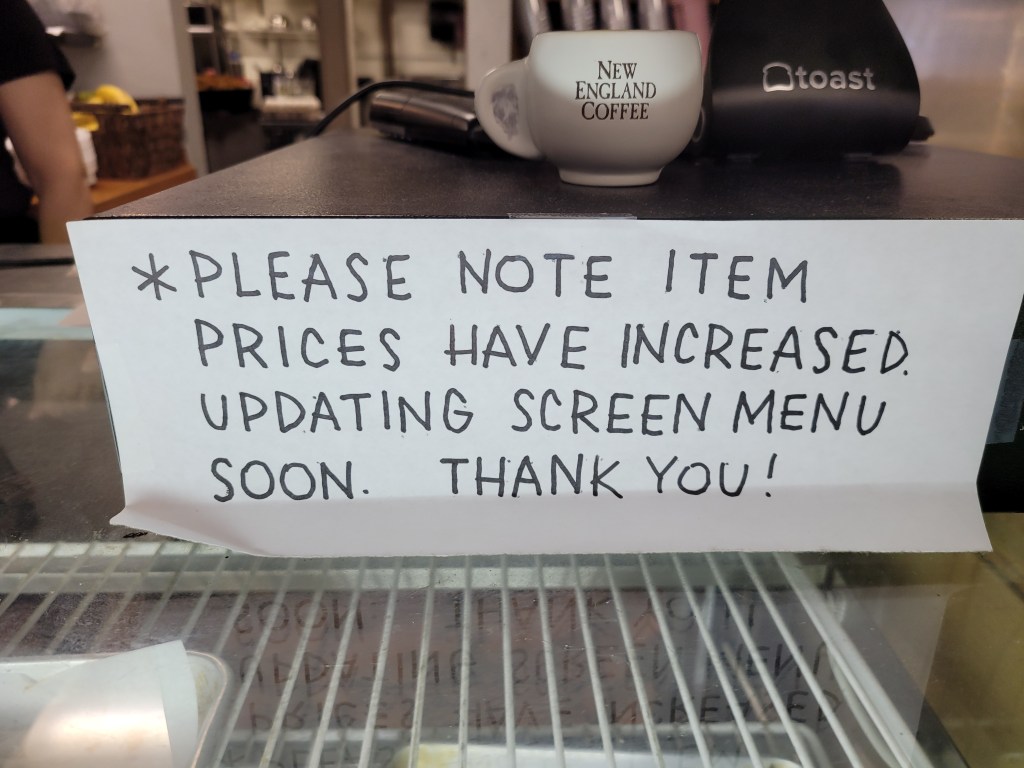
When restaurants raise prices, they have to print new menus (hence the general name economists give to these costs). Particularly during the Covid-19 pandemic, the trend toward having digital menus rather than paper ones increased.  But even with digital menus, a restaurant incurs some costs, as this sign in a coffee shop indicates. An employee has to update the digital menu to reflect the new prices and, in the meantime, the shop may experience friction from customers who see one price on the digital menu and are charged a higher price when they pay at the register. 

H/T Lena Buonanno