Authors Glenn Hubbard and Tony O’Brien discuss early thoughts on the Biden Administration’s economic plan. They consider criticisms of the most recent stimulus packages price tag of $1.9B that it may spur inflation in future quarters. They offer thoughts on how this may become the primary legislative initiative of Biden’s first term as it crowds out other potential policy initiatives. Questions are asked about what bounce we may see for the economy and comparisons are made to the Post World War II era. Please listen and share with students!
The following editorials are mentioned in the podcast:
Glenn recently co-wrote an op-ed column for the Washington Post with Alan Blinder. Blinder is a professor of economics and public affairs at Princeton University and served as vice chairman of the Federal Reserve Board from 1994 to 1996. They discuss President Biden’s proposed $1.9 trillion relief package currently before Congress. You can read the column HERE, but note that to read articles in the Washington Post you need a subscription, although you may be able to access several article per month for free.
The recession that resulted from the Covid-19 pandemic affected most sectors of the U.S. economy, but some sectors of the economy fared better than others. As a broad generalization, we can say that online retailers, such as Amazon; delivery firms, such as FedEx and DoorDash; many manufacturers, including GM, Tesla, and other automobile firms; and firms, such as Zoom, that facilitate online meetings and lessons, have done well. Again, generalizing broadly, firms that supply a service, particularly if doing so requires in-person contact, have done poorly. Examples are restaurants, movie theaters, hotels, hair salons, and gyms.
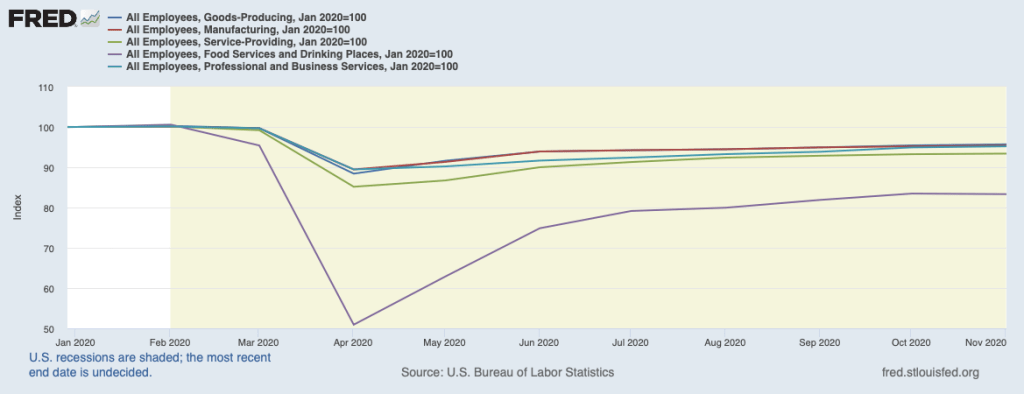
The following figure uses data from the Federal Reserve Economic Data (FRED) website (fred.stlouisfed.org) on employment in several business sectors—note that the sectors shown in the figure do not account for all employment in the U.S. economy. For ease of comparison, total employment in each sector in February 2020 has been set equal to 100.
Employment in each sector dropped sharply between February and April as the pandemic began to spread throughout the United States, leading governors and mayors to order many businesses and schools closed. Even in areas where most businesses remained open, many people became reluctant to shop in stores, eat in restaurants, or exercise in gyms. From April to November, there were substantial employment gains in each sector, with employment in all goods-producing industries and employment in manufacturing (a subcategory of goods-producing industries) in November being just 5 percent less than in February. Employment in professional and business services (firms in this sector include legal, accounting, engineering, legal, consulting, and business software firms), rose to about the same level, but employment in all service industries was still 7 percent below its February level and employment in restaurants and bars was 17 percent below its February level.
Raj Chetty of Harvard University and colleagues have created the Opportunity Insights website that brings together data on a number of economic indicators that reflect employment, income, spending, and production in geographic areas down to the county or, for some cities, the ZIP code level. The Opportunity Insights website can be found HERE.
In a paper using these data, Chetty and colleagues find that during the pandemic “spending fell primarily because high-income households started spending much less.… Spending reductions were concentrated in services that require in-person physical interaction, such as hotels and restaurants …. These findings suggest that high-income households reduced spending primarily because of health concerns rather than a reduction in income or wealth, perhaps because they were able to self-isolate more easily than lower-income individuals (e.g., by substituting to remote work).”
As a result, “Small business revenues in the highest-income and highest-rent ZIP codes (e.g., the Upper East Side of Manhattan) fell by more than 65% between March and mid-April, compared with 30% in the least affluent ZIP codes. These reductions in revenue resulted in a much higher rate of small business closure in affluent areas within a given county than in less affluent areas.” As the revenues of small businesses declined, the businesses laid off workers and sometimes reduced the wages of workers they continued to employ. The employees of these small businesses, were typically lower- wage workers. The authors conclude from the data that: “Employment for high- wage workers also rebounded much more quickly: employment levels for workers in the top wage quartile [the top 20 percent of wages] were almost back to pre-COVID levels by the end of May, but remained 20% below baseline for low-wage workers even as of October 2020.”
The paper, which goes into much greater detail than the brief summary just given, can be found HERE.
The Economic Strategy Group (ESG) is a program for discussing economic policy issues. On November 19, 2020, the ESG released a statement urging Congress to provide additional funding to deal with the Covid-19 pandemic. Glenn Hubbard joined economists from both political parties in signing the statement. You can read the statement HERE.
In an opinion column on bloomberg.com, Michael Strain of the American Enterprise Institute argues that Congress should pass another stimulus package to supplement the $1.8 trillion Coronavirus Aid, Relief, and Economic Security Act that Congress passed and President Trump signed into law in March. His proposal would involve an additional $1 trillion in spending.
You can read the column HERE. Note that most bloomberg.com articles require a paid subscription, but you can read several articles per month for free.
Authors Glenn Hubbard and Tony O’Brien continue their weekly discussion about the effects of the Pandemic on the US Economy. They discuss the disconnect between stock market performance and the overall economy. Also, they look at the decision of restaurants to stay open despite struggling to breakeven due to limitations on indoor seating. The Fed’s pivot on the dual-mandate is also discussed as they announce more of their monetary policy focus will be on unemployment rather than inflation.
Over the next several weeks, we will be gearing up this podcast to become an essential listen during your week. Whether your interest is teaching or policy, you will learn from this discussion.
Just search Hubbard O’Brien Economics on Apple iTunes and subscribe!
Listen as authors Glenn Hubbard and Tony O’Brien have a wide-ranging discussion with Jadrian Wooten, an economics professor at Penn State University. Jadrian discusses some pedagogical approaches in his online classes, his use of a standing desk in zoom teaching his large classes, as well as the unclear impact of missing college football to the local college economies.
Over the next several weeks, we will be gearing up this podcast to become an essential listen during your week. Whether your interest is teaching or policy, you will learn from this discussion.
Just search Hubbard O’Brien Economics on Apple iTunes and subscribe! Episodes are usually available the next day on Apple iTunes or any other podcast app.
Authors Glenn Hubbard and Tony O’Brien revisit some of the policy responses to the Pandemic to discuss unemployment payments and other government fiscal responses. They also consider some of the longer-term impacts on business – like supply-chains – and the role that Economics can play in these issues. Glenn and Tony discuss how tourism is impacted in places like Orlando or college towns without college football as an economic engine.
Over the next several weeks, we will be gearing up this podcast to become an essential listen during your week. Whether your interest is teaching or policy, you will learn from this discussion.
Just search Hubbard O’Brien Economics on Apple iTunes and subscribe!
Glenn Hubbard and Tony O’Brien talk about the effects of the Covid-19 pandemic as we head into fall classes. They discuss the impact on teaching and learning as well as a fresh look at the impact of government policies over the past few months. The challenges facing the US economy are discussed as well as how the Nike swoosh or V-downturn is now looking somewhat differently in August 2020. We will begin doing WEEKLY podcasts as we head into Fall of 20202. Please look for new episodes at the end of each week and please subscribe to our Podcast feed via your preferred Podcast app – including iTunes Podcasts!
Just search Hubbard O’Brien Economics and subscribe!
Glenn Hubbard and Tony O’Brien talk with Eva Dziadula of the University of Notre Dame. In the podcast, they discuss economics, teaching, and the impact of the pandemic on the classroom. Eva discusses teaching Microeconomics in the middle of a pandemic and teaching Immigration in the midst of our national immigration debate.
Also, these podcasts are now on iTunes or your regular podcast feed! Just search Hubbard O’Brien Economics and subscribe!

 HubbardOBrienEconomics.com Blog