Solved Problem: Using the Demand and Supply Model to Analyze the Effects of a Tariff on Televisions

Supports: MicroeconomicsMacroeconomicsEconomics, and Essentials of Economics, Chapter 4, Section 4.4

Image generated by ChapGPT

The model of demand and supply is useful in analyzing the effects of tariffs. In Chapter 9, Section 9.4 (Macroeconomics, Chapter 7, Section 7.4) we analyze the situation—for instance, the market for sugar—when U.S. demand is a small fraction of total world demand and when the U.S. both produces the good and imports it.

In this problem, we look at the television market and assume that no domestic firms make televisions. (A few U.S. firms assemble limited numbers of televisions from imported components.) As a result, the supply of televisions consists entirely of imports. Beginning in April, the Trump administration increased tariff rates on imports of televisions from Japan, South Korea, China, and other countries. Tariffs are effectively a tax on imports, so we can use the analysis in Chapter 4, Section 4.4, “The Economic Effect of Taxes” to analyze the effect of tariffs on the market for televisions.  

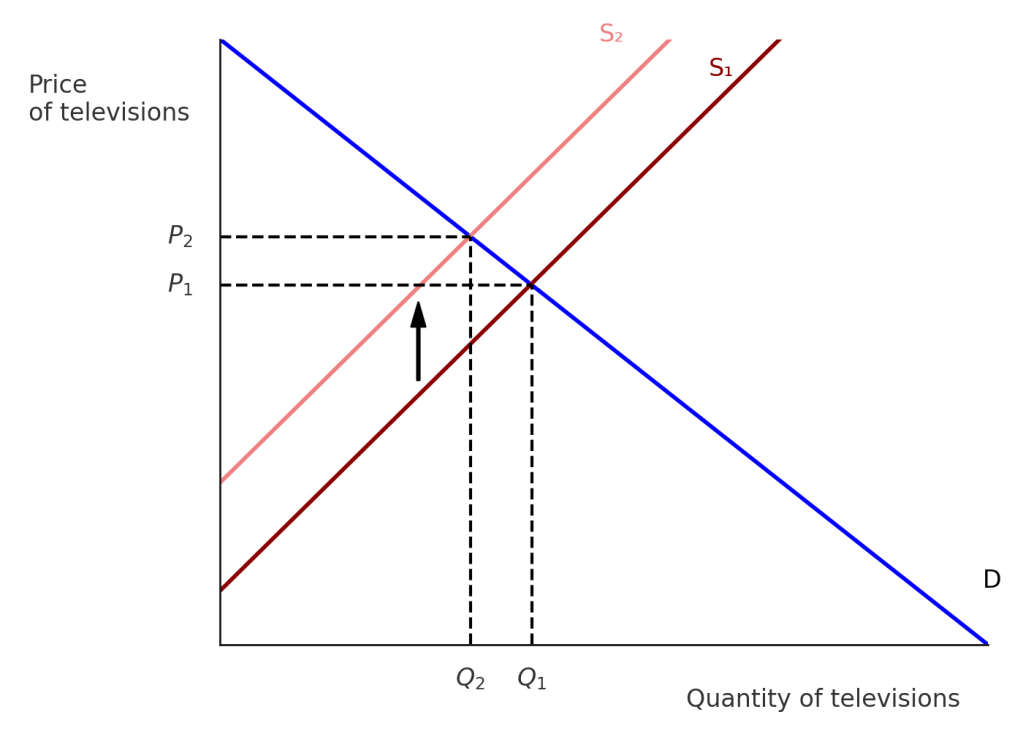
  1. Use a demand and supply graph to illustrate the effect of an increased tariff on imported televisions on the market for televisions in the United States. Be sure that your graph shows any shifts of the curves and the equilibrium price and quantity of televisions before and after the tariff increase.
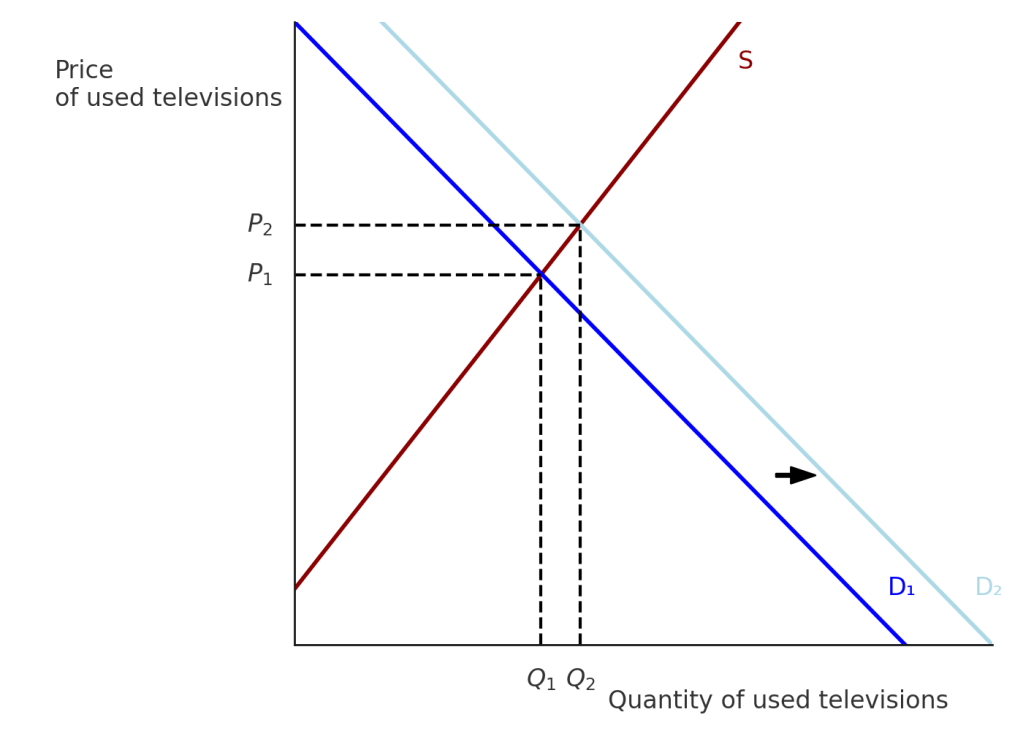
  2. An article in the Wall Street Journal discussed the effect of tariffs on the market for used goods. Use a second demand and supply graph to show the effect of a tariff on imports of new televisions on the market in the United States for used televisions. Assume that no used televisions are imported and that the supply curve for used televisions is upward sloping.

Solving the Problem
Step 1: Review the chapter material. This problem is about the effect of a tariff on an imported good on the domestic market for the good. Because a tariff is a like a tax, you may want to review Chapter 4, Section 4.4, “The Economic Effect of Taxes.”

Step 2: Answer part a. by drawing a demand and supply graph of the market for televisions in the United States that illustrates the effect of an increased tariff on imported televisions.  The following figure shows that a tariff causes the supply curve of televisions to shift up from S1 to S2. As a result, the equilibrium price increases from P1 to P2, while the equilibrium quantity falls from Q1 to Q2.

Step 2: Answer part b. by drawing a demand and supply graph of the market for used televisions in the United States that illustrates the effect on that market of an increased tariff on imports of new televisions. Although the tariff on imported televisions doesn’t directly affect the market for used televisions, it does so indirectly. As the article from the Wall Street Journal notes, “Today, in the tariff era, demand for used goods is surging.” Because used televisions are substitutes for new televisions, we would expect that an increase in the price of new televisions would cause the demand curve for used televisions to shift to the right, as shown in the following figure. The result will be that the equilibrium price of used televisions will increase from P1 to P2, while the equilibrium quantity of used televisions will increase from Q1 to Q2.

To summarize: A tariff on imports of new televisions increases the price of both new and used televisions. It decreases the quantity of new televisions sold but increases the quantity of used televisions sold.

Solved Problem: Rent Control in Holland

Supports: Microeconomics, MacroeconomicsEconomics, and Essentials of Economics, Chapter 4, Section 4.3

Image generated by ChatGTP-40 of a street in a Dutch city.

An article on bloomberg.com has the headline “How Rent Controls Are Deepening the Dutch Housing Crisis.” The article’s subheadline states that: “A law designed to make homes more affordable ended up aggravating an apartment shortage.” According to the article, the Dutch government passed a law that increased the number of apartments subject to rent control from 80% of all apartments to 96%.

  1. Why might the Dutch government have seen expanding rent control as a way to make apartments more affordable? 
  2. Why might the law have aggravated the shortage of apartments in Holland?

Solving the Problem
Step 1: Review the chapter material. This problem is about the effects of rent control, so you may want to review Chapter 4, Section 4.3, “Government Intervention in the Market: Price Floors and Price Ceilings.”

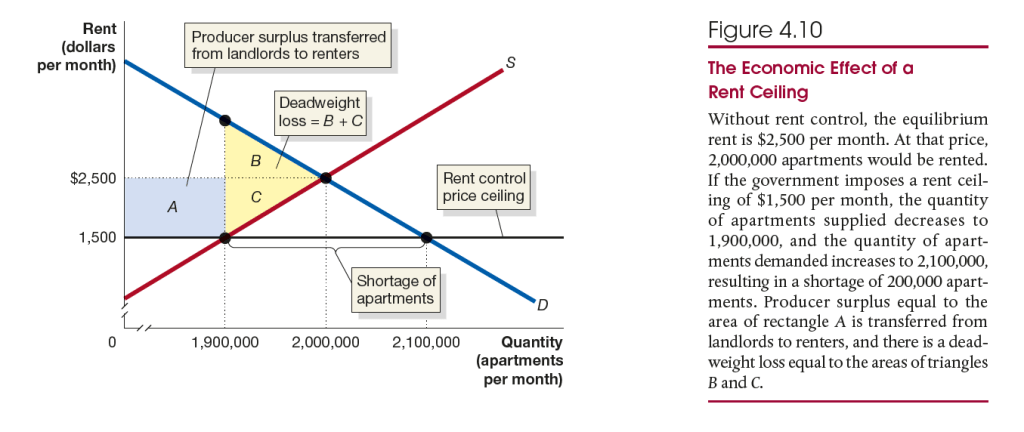
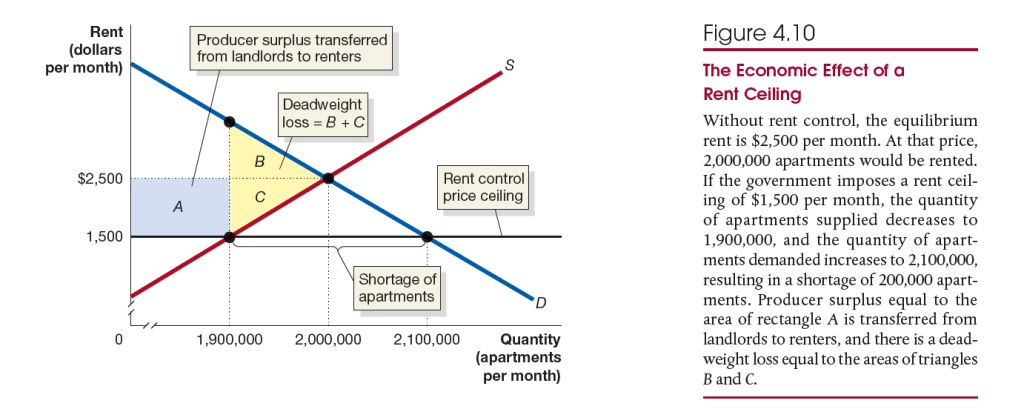
Step 2: Answer part a. by explaining why the Dutch government may have seen expanding rent control as a way to make apartments more affordable. Figure 4.10 from the textbook shows the effects of rent control. In the example illustrated in the figure, after the government imposes rent control, the 1,900,000 people who are still able to rent an apartment pay $1,500 per month rather than $2,500 per month. For these people, rent control has made apartments more affordable.

Step 3: Answer part b. by explaining why rent control laws can make an apartment shortage worse. As Figure 4.10 shows, rent control laws impose a price ceiling below the equilibrium market rent. The result is that the quantity of apartments supplied is less than the quantity of apartments demanded, causing a shortage of apartments. In the case of the Dutch law discussed in the article, existing rent controls were expanded to cover more apartments, forcing the rents charged by landlords for these apartments to fall below what had been the equilibrium market rent, thereby adding to the shortage of apartments in Holland.

Extra credit: The article notes that as a result of the law, some owners of apartments that had previously not been subject to rent control had decided to sell their apartments, taking them off the rental market. That result is common when governments impose rent control or expand the scope of an existing rent control law. One important aspect of rent control is that a shortage of apartments gives landlords a greater opportunity to pick and choose the tenants they prefer. The article notes that a provision of the new law requires that rental contracts be open-ended, rather than for only one or two years, as is more common. As a result, landlords have more difficulty evicting tenants who might be noisy or causing other problems. The law thereby gives landlords an incentive to rent to foreign tenants who would be more likely to give up their apartments voluntarily after a year or two. The result is even fewer apartments available for Dutch residents to rent.

A recent article on bloomberg.com notes that the negative consequences of the law expanding rent control has led the Dutch government to propose modifying the law to allow landlords to charge higher rents on at least some apartments. If passed by the Dutch parliment, the changes would go into effect January 1, 2026.

Rent Control in Europe

Image generated by GTP-4o of “an apartment building in Amersterdam.”

Recent articles in the media discussed the effects of rent control on the market for apartments in the Netherlands and in Stockholm, the capital of Sweden. The articles describe a situation that is consistent with the analysis in Chapter 4, Section 4.3. Figure 4.10 shows the expected results from the imposition of a rent control law. Some renters gain by living in apartments at below the equilibirum market rent, but the shortage of apartments resulting from the price ceiling means that some renters are unable to find apartments. As with other price controls, rent ceilings impose a deadweight loss on the economy, shown in the figure as the areas B + C.

An article on bloomberg.com discusses the effect on the market for apartments in the Netherlands of the passage in June of the Affordable Rent Act. The act raised the fraction of apartments covered by rent control from about 80 percent to 96 percent. The expansion of rent control appears to have led to an increased shortage of apartments. The article quotes one teacher who has been unable to find an apartment for her family as saying: “The cost isn’t the problem, but a real shortage of housing is.”

The article indicates that some landlords who doubt they can earn a profit under the new law are selling their buildings. If the buildings are converted to other uses, the shortage of apartments will be increased. The article mentions another unintended change to the apartment market from the provision of the new law that requires leases to be open-ended. Some landlords fear that as a result they may find themselves unable to evict tenants, however troublesome the tenants may be. In response, these landlords are giving priority to foreigners, who they believe are likely to move more often.

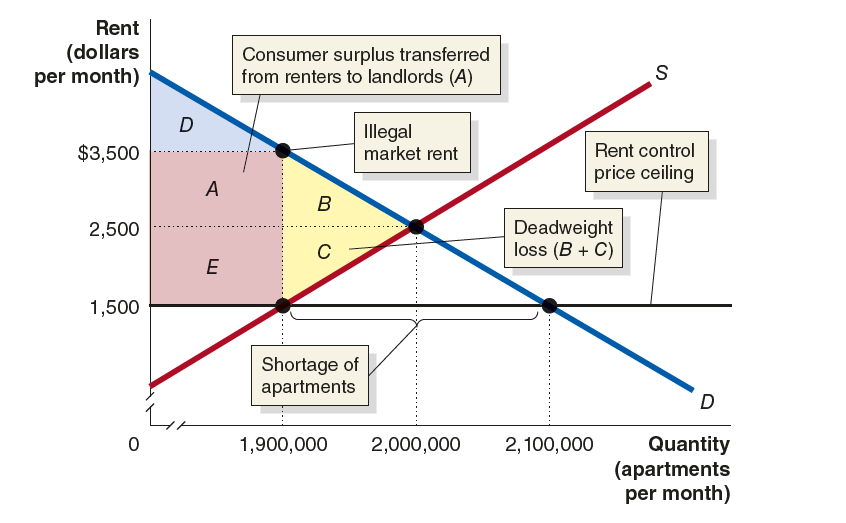
An article in the Economist looks at another aspect of rent control. The following figure is reproduced from Solved Problem 4.3. It shows that because rent control leads to a shortage of apartments it creates an incentive for tenants and landlords to agree to a rent that is higher than the legal rent ceiling. In this example, renters who are unable to find an apartment at the rent control ceiling of $1,500 may bid up the rent to $3,500—which in this example is $1,000 higher than the market equilibrium rent in the absence of rent control—rather than not be able to rent an apartment. Clearly, renters paying this illegal rent are worse off than they would be if there were no rent control law.

According to the article in the Economist, the average time on a waiting list for a rent controlled apartment is 20 years. Not surprisingly, “Young Swedes often have to put up with expensive sublets agreed to under the table,” for which they typically pay rents above both the rent control ceiling and the market equilibrium rent. Most economists agree that expanding the quantity of available housing by making it easier to build homes and apartments is a better way of reducing housing costs than is imposing rent controls.

Glenn on Economic Populism

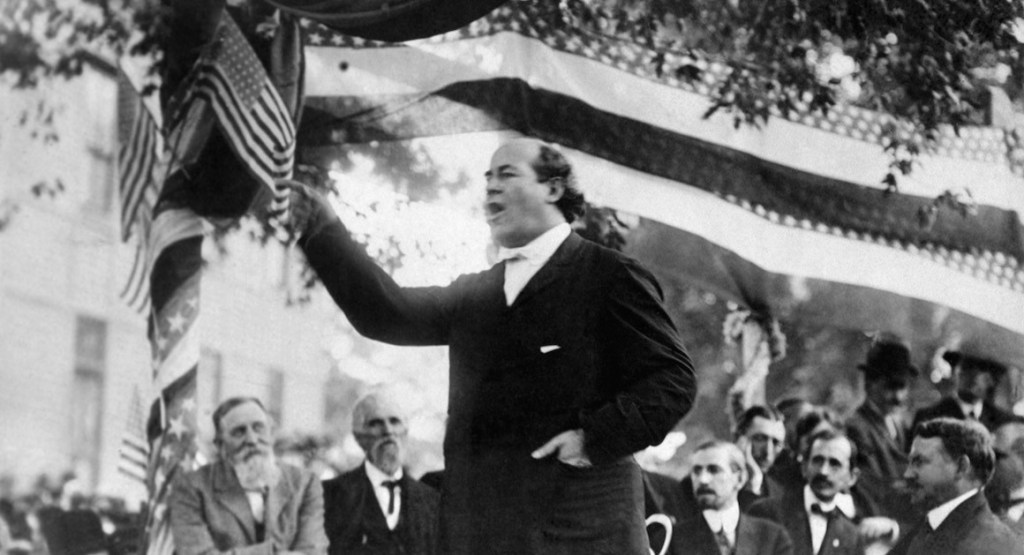
Ninteenth century populist William Jennings Bryan delivering a campaign speech. (Photo from the AP via politico.com)

The following op-ed originally appeared in the Wall Street Journal.

The Economic Populists Have a Point

Many issues divide voters heading into the November election, but the economy may be the most crucial. Sound economic policy can foster prosperity and high living standards and affect income and opportunities. Economic resources can also enable society to fund defense or address social and environmental concerns.

Conservative economic policy traditionally has emphasized the openness of markets and growth. By contrast, the populist conservative ideas under discussion at the Republican National Convention focus on people and places hard hit by the disruption that accompanies openness and growth. While many commentators emphasize the differences between the two approaches, a modern conservative economic agenda should build on elements of both.

To begin, a conservative economic agenda should include policies that advance economic growth and living standards. That means supporting research and development, maintaining pro-investment business tax provisions in the Tax Cuts and Jobs Act of 2017, and making regulations that benefit everyone. Such an economy lets businesses and individuals get the most out of the opportunities they seize.

Populist conservatives argue that this traditional approach to policy misses an important objective: a disruptive, rough-and-tumble economy, guided by technological advances and globalization, one that brings everyone along. Populist conservatives want more emphasis on protecting jobs and communities.

There’s more to the populist conservatives’ skepticism than traditional conservatives acknowledge. But backward-looking protectionist measures such as inflationary tariffs or industrial policy aren’t the answer.

However, there is a conservative economic agenda that can unite these groups. The shortcomings of Bidenomics give conservatives an opening to push beyond both market-only neoliberalism and the statist tendencies of industrial policy and protectionism, with their attendant economic inefficiencies. To do so, conservative economic policy needs three ingredients.

The first is agreeing with populist conservatives that markets don’t always work perfectly and that a hands-off approach isn’t always the solution. The state can play a useful role in the market economy. Supply-chain restrictions and export controls can be tools to deny national-security-sensitive technologies to adversaries such as China. But an economic agenda requires more than a sound bite to avoid overreach—such as using “national security” as a pretext for slapping steel tariffs on Canada.

The second essential is competition—the linchpin of economic possibilities for classical economic thinkers from Adam Smith onward. While competition at home and abroad expands the economic pie, it says little about the relative sizes of the slices, a point noted by populist conservatives. A modern conservative economic approach would not only promote competition but also prepare more individuals to compete in a changing economy. One avenue could be supporting community colleges that understand local job needs rather than establishing more government training programs.

Third and most important, a conservative economic platform should recall why conservatives have stressed the benefits of markets. The goal, as my Columbia colleague and Nobel laureate Edmund Phelps puts it, is “mass flourishing.” That is why we want markets to work—to advance innovation and productivity and allow communities to make that flourishing possible.

As far as government’s role, a contemporary economic agenda should recognize a limited measure of successful industrial policy. Two roads should be on offer. The first is to provide more general support for basic and applied research, while letting market forces determine winners and losers. The second is to assign specific goals to particular interventions. The Apollo program’s goal was to put a man on the moon in a decade. The Trump administration’s Operation Warp Speed sought vaccines against Covid. 

Populist conservatives are right that there is a role in a conservative economic agenda for helping areas hard hit by disruption. But that role isn’t a mercantilist blunderbuss of protectionism and industrial policy to turn back the economic clock. Rather, place-based aid could support business services for firms trying to create local jobs.

The economic ideas under discussion at the Republican National Convention have populist features that haven’t figured in earlier conservative economic agendas. Populists have some reasonable skepticism about excessive deference to markets. But avoiding excessive meddling from tempting protectionism and the mushy mercantilism of Bidenomics is important, too. Under a conservative economic agenda, growth can flourish.

Would Cutting the Federal Excise Tax on Gasoline Lower the Price that Consumers Pay?

Photo from bloomberg.com.

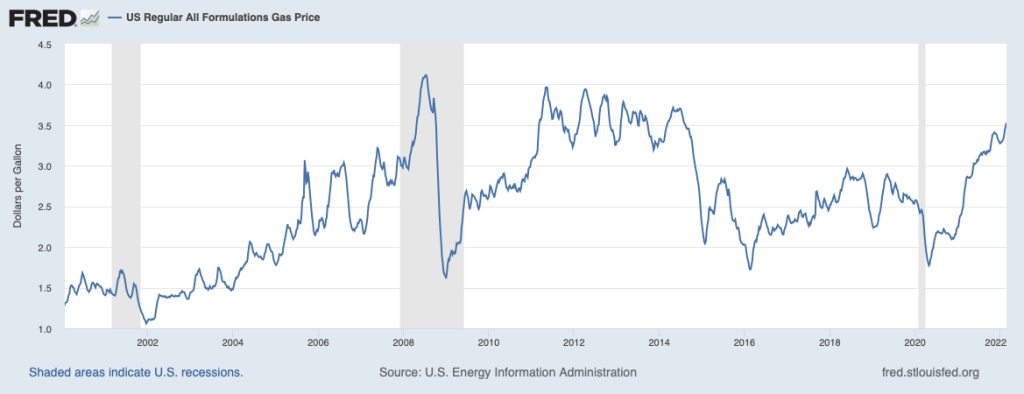
The federal government levies an excise tax of 18.4 cents per gallon of gasoline. (An excise tax is a tax that a government imposes on a particular product. In addition to the tax on gasoline, the federal government imposes excise taxes on tobacco, alcohol, airline tickets, and a few other products.) In February 2022, inflation was running at the highest level in several decades. The average retail price of gasoline across the country had risen to $3.50 per gallon from $2.60 per gallon a year earlier. The following figure shows fluctuations in the retail price of gasoline since January 2000. 

Policymakers were looking for ways to lessen the effects of inflation on consumers. An article in the Wall Street Journalreported that several Democratic members of the U.S. Senate, including Mark Kelly of Arizona, Maggie Hassan of New Hampshire, and Raphael Warnock of Georgia proposed that the federal excise tax on gasoline be suspended for the remainder of 2022. The sponsors of the proposal believed that cutting the tax would reduce the price of gasoline that consumers pay at the pump. Other members of the Senate weren’t so sure, with one quoted as saying that cutting the tax was “not going to change anything” and another arguing that oil companies would receive most of the benefit of the tax cut.

Some members of Congress were opposed to suspending the gasoline tax because the revenue raised from the tax is placed in the highway trust fund, which helps to pay for federal contributions to highway building and repair and for mass transit. In that sense, the gasoline tax follows the benefits-received principle, under which people who receive benefits from a government program—in this case, highway maintenance—should help pay for the program. (We discuss the principles for evaluating taxes in Microeconomics, Chapter 17, Section 17.2 and in Economics, Chapter 17, Section 17.2) Other members of Congress were opposed to suspending the tax because they believe that the tax helps to reduce the quantity of gasoline consumed, thereby helping to slow climate change. 

Focusing just on the question of the effect of suspending the tax on the retail price of gasoline, what can we conclude? The question is one of tax incidence, which looks at the actual division of the burden of a tax between buyers and sellers in a market. In other words, tax incidence looks beyond the fact that gasoline stations collect the tax and send the revenue to federal government to the issue of who actually pays the tax. As we note in Chapter 17, Section 17.3:

When the demand for a product is less elastic than supply, consumers pay the majority of the tax on the product. When the demand for a product is more elastic than supply, firms pay the majority of the tax on the product. 

Consumers would receive all of the tax cut—that is, the retail price of gasoline would fall by 18.4 cents—only in the polar case where the demand for gasoline were perfectly price inelastic. Similarly, consumers would receive none of the tax cut and the price of gasoline would remain unchanged—so oil companies would receive all of the tax cut—only in the polar case where the demand for gasoline is perfectly price inelastic. (It’s a worthwhile exercise to show these two cases using demand and supply graphs.)

In the real world, we would expect to be somewhere in between these two cases, with consumers receiving some of the benefit of suspending the tax and producers receiving the remainder of the benefit. The short-run price elasticity of demand for gasoline is quite small; according to one estimate it is only −.06.  The short-run price elasticity of supply of gasoline is likely to be somewhat larger than that in absolute value, which means that we would expect that consumers would receive the majority of the tax cut. (Note that we would expect the long-run price elasticities of demand and supply to both be larger for reasons we discuss in Chapter 6, Section 6.2 and 6.6.) In other words, the retail price of gasoline would fall, holding all other factors constant, but not by the full tax cut of 18.4 cents.

Joseph Doyle of MIT and Krislert Samphantharak of the University of California, San Diego studied the effect of suspension in the state excise tax on gasoline in Indiana and Illinois in 2000. In that year, Indiana suspended collecting its gasoline excise tax for 120 days and Illinois suspended its tax for 184 days. The authors estimate that consumers received about 70 percent of the tax cut in the form of lower gasoline prices. If we apply that estimate to the federal gasoline tax, then suspending the tax would lower the price of gasoline by about 12.9 cents per gallon, holding all other factors that affect the price of gasoline constant. As the above figure shows, the retail price of gasoline frequently fluctuates up and down by more than 12.9 cents, even over fairly brief periods of time. In that sense, the effect on the gasoline market of suspending the federal excise tax on gasoline would be relatively small.  

Sources: Andrew Duehren and Richard Rubin, “Some Lawmakers Want to Halt Gas Tax Amid High Inflation. Others See a Gimmick,” Wall Street Journal, February 16, 2022; Tony Romm and Jeff Stein, “White House, Congressional Democrats Eye Pause of Federal Gas Tax as Prices Remain High, Election Looms,” Washington Post, February 15, 2022; Joseph J. Doyle, Jr., Krislert Samphantharak, “$2.00 Gas! Studying the Effects of a Gas Tax Moratorium,” Journal of Public Economics, Vol. 92, No.s 3-4, April 2008, pp. 869-884; and Federal Reserve Bank of St. Louis.

New 10/17/21 Podcast – Authors Glenn Hubbard & Tony O’Brien discuss economic impact of infrastructure spending & the supply-chain challenges.

Authors Glenn Hubbard and Tony O’Brien discuss the economic impact of the recent infrastructure bill and what role fiscal policy plays in determining shovel-ready projects. Also, they explore the vast impact of the economy-wide supply-chain issues and the challenges companies face. Until the pandemic, we had a very efficient supply chain but now we’re seeing companies employ the “just-in-case” inventory method vs. “just-in-time”!

Some links referenced in the podcast:

Here’s Alan Cole’s blog: https://fullstackeconomics.com/how-i-reluctantly-became-an-inflation-crank/

Neil Irwin wrote a column referencing Cole here:  https://www.nytimes.com/2021/10/10/upshot/shadow-inflation-analysis.html

Here’s a Times article on the inefficiency of subway construction in NYC:  https://www.nytimes.com/2017/12/28/nyregion/new-york-subway-construction-costs.html

A recent article on the state of CA’s bullet train:  https://www.kcra.com/article/california-bullet-trains-latest-woe-high-speed/37954851

A WSJ column on goods v. services: https://www.wsj.com/articles/at-times-like-these-inflation-isnt-all-bad-11634290202

More Than You Probably Want to Know about the Debate Over Whether Giving Presents Causes a Deadweight Loss

If your sister gives you a sweater that you don’t like, the subjective value you place on the sweater will probably be less than the price your sister paid for it. As we saw in Chapter 4, Sections 4.1 and 4.2, consumer surplus is the difference between the highest price a consumer is willing to pay for a good (which equals the consumer’s marginal benefit from the good) and the actual price the consumer pays. We expect that you will only buy things that have a marginal benefit to you greater than (or, at worst, equal to) the price you paid. Therefore, everything you buy provides you with positive (or, again at worst, zero) consumer surplus. But if the price is greater than the marginal benefit—as is the case with the sweater your sister gave you—consumer surplus is negative and there is a deadweight loss.

In the early 1990s, Joel Waldfogel, currently at the University of Minnesota, published an article in the American Economic Review in which he reported surveying his undergraduate students, asking them to: (1) list every gift they had received for Christmas, (2) estimate the retail price of each gift, and (3) state how much they would have been willing to pay for each gift. Waldfogel’s students estimated that their families and friends had paid $438 on average on the students’ gifts. The students themselves, however, would have been willing to pay only $313 for the goods they received as gifts—so, on average, each student’s gifts caused a deadweight loss of $313 – $438 = –$125. If the deadweight losses experienced by Waldfogel’s students were extrapolated to the whole population, the total deadweight loss of Christmas gift giving could be as much as $23 billion (adjusting the value in Waldfogel’s article to 2020 prices).

If the gifts had been cash, the people receiving the gifts would not have been constrained by the gift givers’ choices, and there would have been no deadweight loss. If your sister had given you cash instead of that sweater you didn’t like, you could have bought whatever you wanted and received positive consumer surplus.

Waldfogel’s article attracted much more attention than is received by the typical academic journal article, being covered in newspaper articles and on television. It also set off a lively debate among economists over whether his approach was valid. Waldfogel later published a short book, Scroogenomics, in which he argued that, in fact, his journal article had underestimated the deadweight loss of gift giving because it compared the value of the gift to the person receiving it to the value of receiving cash instead. He noted that a more accurate comparison would be not to cash but to the value of the good the person receiving the gift would have bought with the cash. Because that purchase would provide positive consumer surplus to the buyer, the buyer’s loss from receiving a gift rather than cash is significantly greater than he had originally calculated.

Waldfogel again surveyed his undergraduate students asking them to make this revised comparison and found (p. 35): “Dollars on gifts for you produce 18 percent less satisfaction, per dollar, than dollars you spend on yourself.” Waldfogel also noted that a gift giver has to spend time shopping for a gift, which—unless the giver enjoys spending time shopping—should be added to the cost of gift giving.

As a number of critics of Waldfogel’s analysis have noted, if giving gifts rather than cash makes the recipient worse off and the giver no better off (or worse off if we take into account the cost of the time spent shopping) why has the tradition of giving gifts on holidays and birthdays persisted? Waldfogel argues that for a large fraction of the U.S. population, giving gifts at Christmas is a strong social custom that people are reluctant to break. He believes there is also a social custom against close friends and relatives—parents, siblings, girlfriends, boyfriends, and spouses—giving cash. (Although he believes that it’s socially acceptable for relatives—such as grandparents, aunts, and uncles—who see the gift recipient infrequently to give cash or gift cards).

Some economists have questioned Waldfogel’s results because he surveyed only college students, who are not a representative sample of the population because they are on average younger and come from higher-income families. Because Waldfogel’s students were all enrolled in an economics course, their views may have been affected by what they learned in class. Sarah Solnick, of the University of Vermont, and David Hemenway, of the Harvard University School of Public Health, argue that because most economics students know the economic result that receiving cash as a gift is likely to be preferable to receiving a good, they may have felt social pressure to value their gifts at less than the price paid for them.

To see whether Waldfogel’s including only college students in his survey mattered for his results, Solnick and Hemenway surveyed graduate students and staff at the Harvard School of Public Health as well as people randomly approached at train stations and airports in Boston and Philadelphia. On average the people Solnick and Hemenway surveyed gave their Christmas gifts a value 114 percent higher than the price they estimated the gift giver had paid. In other words, contrary to Waldfogel’s result, gift giving generated a large positive consumer surplus or a welfare gain rather than a welfare loss. The authors speculate that the positive consumer surplus in gift giving may result because the recipient “respects the tastes of the giver, or the item is something the recipient never remembers to get.” Or, perhaps, “The individual wants the item but would feel bad purchasing it for herself. She is grateful to receive it as a gift.”

Solnick and Hemenway’s analysis has also been criticized. Bradley Ruffle and Orit Tykocinski of Ben Gurion University in Israel point out that the order in which questions are asked in a survey can influence the responses. Both Waldfogel and Solnick and Hemenway asked people being surveyed to first estimate what the giver had paid for the gift before asking the value the recipient assigned to the gift. Ruffle and Tykocinski also noted that Solnick and Hemenway changed one question being asked from “the amount of cash such that you are indifferent” between receiving the gift and receiving cash (which is how Waldfogel phrased the question) to the “amount of money that would make you equally happy.” Ruffle and Tykocinski believe this change in wording may also help account for why Solnick and Hemenway’s results differed from Waldfogel’s.

Ruffle and Tykocinski carried out a survey using undergraduate psychology and economics students, varying the wording and the order of the questions. Their results indicated that the wording of the questions mattered, although the order the questions had only a slight effect, and that the psychology students and the economics students did not have significant differences in how much they valued gifts, although psychology students tended to estimate that gift givers had paid a higher price for the gifts. The authors concluded: “Is gift-giving a source of deadweight loss? Our results indicate that it depends critically on how you ask the question and, to a lesser degree, on whom you ask.”

Solnick and Hemenway responded that Ruffle and Tykocinski’s analysis was flawed because, like Waldfogel, they surveyed only undergraduate students: “Ours remains the only study to use adults, living independently, as subjects.” They note that “Ruffle and Tykocinski’s subjects performed poorly in estimating costs,” which may indicate that they lack the experience in buying a large range of goods and so have trouble comparing the value they place on a gift to the cost the giver paid.

John List, of the University of Chicago, and Jason Shogren, of the University of Wyoming, raised the issue of whether the hypothetical nature of the values the gift recipients placed on their gifts mattered. That is, whatever subjective value the recipient gave to a gift, he or she would not actually have the opportunity to sell the gift at a price equal to that value. To test the possibility the recipient’s valuation of a gift would change if the recipient had the opportunity to sell the gift, List and Shogren asked a group of undergraduates to estimate the costs of the gifts they had received for Christmas and to indicate the value they placed on the gifts (just as Waldfogel and the other economists discussed earlier had done). But List and Shogren then added another step by carrying out a so-called random nth price auction of the gifts: “For example, suppose G = 500 gifts overall and #6 was chosen as the random nth price, then only the five lowest-valuation gifts overall would be purchased at the sixth lowest offer.” This somewhat complicated auction design was intended to make it more likely that the students being surveyed would reveal the true value they placed on the gifts.

The results were similar to those found by Solnick and Hemenway in that the recipients put a higher value on the gifts than their estimates of the price the givers paid—so there was positive consumer surplus from gift giving. Their estimate of the welfare gain was significantly smaller than Solnick and Hemenway’s estimate—21 percent to 35 percent versus 114 percent.

Solnick and Hemenway were not entirely convinced by List and Shogren’s findings. They note that because the auction design made it unlikely that the students would actually have to sell their most expensive gifts, the students may have placed a subjective value on these gifts that was too low. In addition, they note that List and Shogren, like Waldfogel, included only college students in their survey.

Joel Waldfogel also replied to List and Shogren, making several of the points he was later to elaborate on in his Scroogenomics book, as discussed above: Basic economic analysis assumes that consumers choose the goods and services they buy to maximize their utility (see Chapter 10 in our textbook), therefore: “If givers, through their choice of gifts, can achieve higher recipient utility than can the recipients themselves, then a fundamental economic assumption is called into question.” List and Shogren compare the value students place on their gifts to the value of receiving cash rather than to the consumer surplus the students would receive from the goods and services they could buy with the cash. Finally, Waldfogel notes that List and Shogren’s results may be affected by what behavioral economists call the endowment effect: The tendency of people to be unwilling to sell a good they already own even if they are offered a price that is greater than the price they would be willing to pay to buy the good if they didn’t already own it. (See the discussion in Chapter 10, Section 10.4 of our textbook.) Because people will require a higher price to sell a good they already own than the price they would pay to buy it, “deadweight loss estimates based on selling prices are much smaller than deadweight loss estimates based on buying prices.”

Even though economists have carried on the debate over the deadweight loss of gift giving in technical terms involving how consumer surplus is best measured, how surveys should be designed, and how best to solicit accurate answers from survey takers, journalists have been intrigued enough by the debate to write it about for general audiences. Josh Barro, who writes for New York magazine and is the son of Harvard economist Robert Barro, wrote a column for the New York Times, “An Economist Goes Christmas Shopping,” in which he observes that the debate among economists over gift giving “makes ordinary people think economists are kind of crazy.” He writes that his father had given him a box of chocolates for Christmas and notes that because he’s on a diet, the gift was “an example of what Mr. Waldfogel warned us about: gift mismatch leading to deadweight loss.” But that he actually ate half the box of chocolates indicated that his father had “identified an item I would not have bought for myself but apparently wanted.” But “now feel I should not have eaten the chocolates, or at least not so many of them in two days.” He concludes that, “The real drag on the economy then isn’t gifts; it’s bad gifts.”

A recent article by Andrew Silver on the Wired website in the United Kingdom notes that a study by academics in India found “an average deadweight loss of about 15 per cent for non-monetary gifts” given during the Hindu festival Diwali. Silver notes that the deadweight loss to gift giving is difficult to avoid because the social custom of gift giving during holidays is very strong in many countries. He concludes, “Sometimes you’ve just got to buckle down and buy something you suspect the recipient won’t value as much as you paid for it.”

Finally, do most economists agree with Waldfogel that there is a significant deadweight loss to gift giving or do they agree with his critics who argue that holiday gift giving actually increases welfare? Although the question has never been asked in a large survey of economists, it was included in a survey of leading economists conducted by the Booth School of Business at the University of Chicago as part of its Initiative on Global Markets (IGM). The IGM regularly surveys a panel of economists on important (although in this case, maybe not so important) economic issues.

A few years ago, they asked their panel whether they agreed with this statement: “Giving specific presents as holiday gifts is inefficient, because recipients could satisfy their preferences much better with cash.” Of the 42 economists who responded to the question, 25 disagreed with the statement, 7 agreed, and 10 were uncertain. Of those who commented, several mentioned a point that Waldfogel had intentionally excluded from his analysis: the sentimental or emotional value that some people attach to giving and receiving presents. For instance, Janet Currie of Princeton noted that: “Gifts serve many functions such as signaling regard and demonstrating social ties with the recipient. Cash transfers don’t do this as well.” Or as Barry Eichengreen of the University of California, Berkeley put it: “Implications of a specific gift (signal it sends, behavioral impact) may give additional utility to either the giver or receiver.” Eric Maskin of Harvard may have stated his reason for disagreeing with the statement most succinctly: “Only an economist could think like this.”

Sources: Joel Waldfogel, “The Deadweight Loss of Christmas,” American Economic Review, Vol. 83, No. 4, December 1993, pp. 328–336; Joel Waldfogel, Scroogenomics: Why You Shouldn’t Buy Presents for the Holidays, Princeton, NJ: Princeton University Press, 2009; Sara J. Solnick and David Hemenway, “The Deadweight Loss of Christmas: Comment,” American Economic Review, Vol. 86, No. 5, December 1996, pp. 1299-1305; Bradley J. Ruffle and Orit Tykocinski, ““The Deadweight Loss of Christmas: Comment,” American Economic Review, Vol. 90, No. 1, March 2000, pp. 319-324; Sara J. Solnick and David Hemenway, “The Deadweight Loss of Christmas: Reply,” American Economic Review, Vol. 90, No. 1, March 2000, pp. 325-326; John A. List and Jason F. Shogren, “The Deadweight Loss of Christmas: Comment,” American Economic Review, Vol. 88, No. 5, December 1998, pp. 1350-1355; Sara J. Solnick and David Hemenway, “The Deadweight Loss of Christmas: Reply,” American Economic Review, Vol. 88, No. 5, December 1998, pp. 1356-1357; Joel Waldfogel, “The Deadweight Loss of Christmas: Reply,” American Economic Review, Vol. 88, No. 5, December 1998, pp. 1358-1360; Tim Hyde, “Did Holiday Gift Giving Just Create a Multi-Billion-Dollar Loss for the Economy?” aeaweb.org, December 28, 2015; Josh Barro, “An Economist Goes Christmas Shopping,” New York Times, December 19, 2014; Andrew Silver, “Economists Want You to Have the Most Boring Christmas Possible,” wired.co.uk, December 17, 2020; and Chicago Booth School of Business, The Initiative on Markets, “Bah, Humbug,” December 17, 2013.


11/06/20 Podcast – Authors Glenn Hubbard & Tony O’Brien discuss the economic outlook given where the Presidential election stands.

Authors Glenn Hubbard and Tony O’Brien look at the economic outlook given the current status of the presidential election. Will a divided government lead to economic prosperity or result in more gridlock? They discuss how much the President actually controls economic policy by setting the tone but that other instruments of our government likely have more effect in creating long-term growth in the Economy.

Just search Hubbard O’Brien Economics on Apple iTunes or any other Podcast provider and subscribe!

Please listen & share!

10/24/20 Podcast – Authors Glenn Hubbard & Tony O’Brien discuss the economics of issues raised during the Final 2020 Presidential Debate.

Authors Glenn Hubbard and Tony O’Brien discuss the economic impacts of what was discussed in the final Presidental debate on 10/22/20. They discuss wide-ranging topics that were raised in the debate from reopening the economy & schools, decreasing participation of women in the workforce due to COVID, healthcare, environment, and general tax policy. Listen to gain economic context on these important items. Click HERE for the New York Times article discussed during the Podcast:

Just search Hubbard O’Brien Economics on Apple iTunes and subscribe!

Please listen & share!

9/11/20 Podcast – Authors Glenn Hubbard & Tony O’Brien cover current events, Micro, and Macro! They discuss 9/11, the rising stock market, the challenges facing restaurants, as well as shifts in strategy for the Fed!

Authors Glenn Hubbard and Tony O’Brien continue their weekly discussion about the effects of the Pandemic on the US Economy. They discuss the disconnect between stock market performance and the overall economy. Also, they look at the decision of restaurants to stay open despite struggling to breakeven due to limitations on indoor seating. The Fed’s pivot on the dual-mandate is also discussed as they announce more of their monetary policy focus will be on unemployment rather than inflation.

Over the next several weeks, we will be gearing up this podcast to become an essential listen during your week. Whether your interest is teaching or policy, you will learn from this discussion.

Just search Hubbard O’Brien Economics on Apple iTunes and subscribe!

Please listen & share!