Solved Problem: Pricing Video Games

Supports:  Econ (Chapter 12 – Oligopoly: Firms in Less Competitive Markets (Section 14.2); Essentials: Chapter 11 – Monopolistic Competition and Oligopoly (Section 11.6)

Solved Problem: Pricing Video Games

   In November 2020, an article on bloomberg.com discussed the pricing of video games for consoles like PlayStation and Xbox. The article noted that firms selling video games had kept prices constant at $60 per game since 2005. But this stable price was about to change: “This week, video game publishers will press ahead with an industry-wide effort to raise the standard price to $70.” An article in the Wall Street Journal indicated that the number of people playing video games has been increasing and had reached 244 million in the United States and 3.1 billion worldwide in 2020. Answer the following questions assuming that the video game industry is an oligopoly.

a. Is it likely that the demand for video games and the cost of producing them have remained constant for 15 years? If not, what can explain the fact that the prices of video games remained constant from 2005 to 2020?

b. Given your answer to part a., what can explain the fact that the prices of video games increased by $10 in 2020? Does the fact that this increase was an “industry-wide effort” matter? Briefly explain.

Sources: Olga Kharif and Takashi Mochizuki, “Video Game Prices Are Going Up for the First Time in 15 Years,” Bloomberg.com, November 9, 2020; and Sarah E. Needleman, “From ‘Fall Guys’ to ‘Among Us,’ How America Turned to Videogames Under Lockdown,” Wall Street Journal, October 31, 2020.

Solving the Problem

Step 1:   Review the chapter material. This problem is about pricing in an oligopolistic industry, so you may want to review Chapter 14, Section 14.2 “Game Theory and Oligopoly.”

Step 2:   Answer part a. by discussing whether it’s likely that the demand for video games and the cost of producing them have remained constant for 15 years and by providing an alternative explanation for the prices of video games remaining constant over this period. Over such a long period, it’s unlikely that the demand for video games and the cost of producing them have remained constant. For one thing, the Wall Street Journal article indicates that the number of people playing video games has been increasing, reaching 244 million in the United States in 2020 (out of a U.S. population of about 330 million). The cost of producing most consumer electronics has declined over the years. Although we are not given specific information that the cost of producing video games has followed this pattern, it seems probable that it did. So, it’s unlikely that the reason that the prices of video games have remained constant is that the demand for video games and the cost of producing them have remained unchanged.

The problem tells us to assume that the video game industry is an oligopoly. We know that price stability in an oligopolistic industry can sometimes be the result of the firms in the industry finding themselves in a prisoner’s dilemma. In this situation, the most profitable strategy for a firm is to match the low price charged by competitors even though the firm and its competitors could, both as a group and individually, earn larger profits by all charging a higher price. It seems more likely that the firms in the video game industry were stuck for years in a prisoner’s dilemma than that they have faced unchanged demand and production costs over such a long period.

Step 3:   Answer part b. by explaining why the prices of video games increased by $10 in 2020, taking into account that the increase was an “industry-wide effort.” As we note in the textbook, the prisoner’s dilemma is an example of a noncooperative equilibrium in which firms fail to cooperate by taking actions—in this case raising the prices of video games—that would make them all better off. Firms have an incentive to increase their profits by switching to a cooperative equilibrium of charging $10 more for video games by implicitly colluding to do so. Explicitly colluding by having firms’ executives meet and agree to raise prices is against the law in the United States and Europe. But implicit collusion in which firms signal to each other—perhaps by talking about their plans with journalists—that they intend to raise prices is a gray area of the law that governments may not take action against. The fact that the bloomberg.com article states that the price increase was an “industry-wide effort” is an indication that video game firms may have implicitly colluded to raise video game prices by $10.


Statement from the Economic Strategy Group Urging Congress to Provide Additional Spending in Response to the Covid-19 Pandemic

The Economic Strategy Group (ESG) is a program for discussing economic policy issues. On November 19, 2020, the ESG released a statement urging Congress to provide additional funding to deal with the Covid-19 pandemic. Glenn Hubbard joined economists from both political parties in signing the statement. You can read the statement HERE.

Now for Something Completely Different: Mickey Does Econ!

The O’Brien family dog takes a bite out of the Dismal Science. 

Hmm. Should I keep playing in the leaves or should I do my MyLab assignment on opportunity cost?

Would you please explain the formula for price elasticity one more time?

Why did I sign up for an 8 am Econ class?

No, Mickey, you can’t copy my class notes. You need to start getting up on time!

My TA is always so helpful!

Measuring Changes in Income Inequality

As we discuss in Chapter 17, there are several complications in accurately measuring changes in the distribution of income over time. First, people will not typically remain in the same place in the income distribution their whole lives. Instead, their incomes are likely to fluctuate, moving them up and down the income distribution. So comparing the distribution of income for the whole population at two points in time can give a misleading idea of how the incomes of particular individuals changed. Measuring income mobility can be difficult, however, because it entails tracking the incomes of individuals over time. Doing that requires specialized studies rather than relying on the more readily available government data we can use to track changes in the incomes of the whole population. 

Second, we are more interested in the income people have available to spend rather than the income they earn. Because people pay taxes on the incomes they receive and because many people receive transfer payments from the government, including unemployment insurance payments and Social Security payments, the income distribution is more equal if we measure it after taking into account the taxes people pay and the transfer payments they receive.

Finally, people earn income from a variety of sources in addition to wages and salaries, including dividends they receive from owning stock, capital gains they earn from selling a financial or other asset, and income they earn from owning a business such as a restaurant or dry cleaners. The income people at the top of the income distribution earn from owning a business can be particularly hard to measure because it depends on how the income is reported to the Internal Revenue Service, which depends in turn on changes in laws affecting how businesses are organized and how they pay taxes. Dealing with these measurement issues is particular important in determining how much the share of income earned by the top 1% of the income distribution has changed over time—an issue that has been the subject of much political debate.

Wojciech Kopczuk of Columbia University and Eric Zwick of the University of Chicago address these measurement issues in a new article in the Journal of Economic Perspectives. Even skimming the article makes clear just how difficult the measurement issues are. Click HERE to read the article.

Note that the article is part of a symposium on income and wealth inequality that appears in that issue of the journal. The other articles in the symposium are also worth reading. Articles that appear in the Journal of Economic Perspectives are frequently (but not always!) nontechnical summaries of research that can be read without knowledge of economics beyond the principles course. 

Does the U.S. Economy Need Another Government Stimulus Package?

In an opinion column on bloomberg.com, Michael Strain of the American Enterprise Institute argues that Congress should pass another stimulus package to supplement the $1.8 trillion Coronavirus Aid, Relief, and Economic Security Act that Congress passed and President Trump signed into law in March. His proposal would involve an additional $1 trillion in spending.

You can read the column HERE. Note that most bloomberg.com articles require a paid subscription, but you can read several articles per month for free.

Does Automation Lead to Permanent Job Losses?

This post on the Federal Reserve Bank of St. Louis’s Page One blog discusses how the belief that automation can lead to permanent job losses is an example of the “lump of labor” fallacy. Click HERE to read the article.

The post refers to the circular-flow diagram, which we discuss in Chapter 2 and in Chapter 18 in the textbook. We discuss the effects of automation and robots on the labor market in Chapter 16.

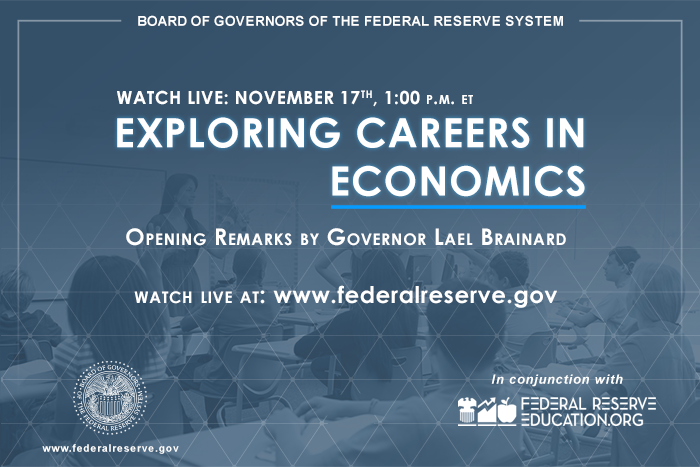
Attend the Federal Reserve’s session on “Exploring Careers in Economics – Fall 2020” on Wednesday, 11/17/20, at 1:00 PM EST – federalreserve.gov, Twitter, or Facebook Live

Federal Reserve Board and Federal Reserve Education (FRE) will welcome students nationwide via webcast to discuss career opportunities and diversity in economics and to learn about career paths within the Federal Reserve System. Opening Remarks by Governor Lael Brainard, administrative governor of the US Federal Reserve.

The event takes place beginning at 1 p.m. ET on Tuesday November 17, 2020.

Watch the online webcast of the event at http://www.federalreserve.gov/ and YouTube. Twitter and Facebook users can follow the Federal Reserve Board’s feed, @FederalReserve, and www.facebook.com/federalreserve/ and join the discussion about the event by using the hashtag: #FedEconJobs

11/13/20 Podcast – Authors Glenn Hubbard & Tony O’Brien talk with recent Econ graduates – Fernando Zuniga & Greg Mitchell

Authors Glenn Hubbard and Tony O’Brien catch up with two recent Penn State University Economics graduates – Fernando Zuniga & Gregory Mitchell. They discuss their path through their econ courses – what interested them, what they learned, and what’s been helpful as they begin their careers. They also discuss their careers – how they got there and what econ principles have offered insight in their roles. Students and instructors will gain more insight from this conversation around learning economics and the career paths chosen.

Just search Hubbard O’Brien Economics on Apple iTunes or any other Podcast provider and subscribe!

Please listen & share!

11/06/20 Podcast – Authors Glenn Hubbard & Tony O’Brien discuss the economic outlook given where the Presidential election stands.

Authors Glenn Hubbard and Tony O’Brien look at the economic outlook given the current status of the presidential election. Will a divided government lead to economic prosperity or result in more gridlock? They discuss how much the President actually controls economic policy by setting the tone but that other instruments of our government likely have more effect in creating long-term growth in the Economy.

Just search Hubbard O’Brien Economics on Apple iTunes or any other Podcast provider and subscribe!

Please listen & share!