Image generated by ChatGTP-4o illustrating tariffs.
Douglas Irwin, a professor of economics at Dartmouth College, may be the leading historian of international trade in the United States today. Irwin has posted at this link a useful overview of the economics of tariffs.
Irwin’s feed on X offers day-to-day commentary on current developments in the Trump Administration’s rapidly changing tariff policies. At the top of his X feed, you can find a free download of Clashing over Commerce, his 2019 history of U.S. foreign trade policy. At 862 pages, the book is the most thorough and comprehensive account available of the long-running political disputes in the United States over foreign trade.
As we’ve noted in earlier posts, according to the usually reliable GDPNow forecast from the Federal Reserve Bank of Atlanta, real GDP in the first quarter of 2025 will decline by 2.8 percent. This morning (April 4), the Bureau of Labor Statistics (BLS) released its “Employment Situation” report (often called the “jobs report”) for March. The data in the report show no sign that the U.S. economy is in a recession. We should add two caveats, however: 1. The effects of the unexpectedly large tariff increases announced this week by the Trump Administration are not reflected in the data from this report, and 2. at the beginning of a recession the data in the jobs report can be subject to large revisions.
The jobs report has two estimates of the change in employment during the month: one estimate from the establishment survey, often referred to as the payroll survey, and one from the household survey. As we discuss in Macroeconomics, Chapter 9, Section 9.1 (Economics, Chapter 19, Section 19.1), many economists and Federal Reserve policymakers believe that employment data from the establishment survey provide a more accurate indicator of the state of the labor market than do the household survey’s employment data and unemployment data. (The groups included in the employment estimates from the two surveys are somewhat different, as we discuss in this post.)
According to the establishment survey, there was a net increase of 228,000 jobs during March. This increase was well above the increase of 140,000 that economists had forecast. Somewhat offsetting this unexpectedly large increase was the BLS revising downward its previous estimates of employment in January and February by a combined 48,000 jobs. (The BLS notes that: “Monthly revisions result from additional reports received from businesses and government agencies since the last published estimates and from the recalculation of seasonal factors.”) The following figure from the jobs report shows the net change in payroll employment for each month in the last two years.
The unemployment rate rose slightly to 4.2 percent in March from 4.1 percent in February. As the following figure shows, the unemployment rate has been remarkably stable in recent months, staying between 4.0 percent and 4.2 percent in each month since May 2024. In March, the members of the Federal Open Market Committee (FOMC) forecast that the unemployment rate for 2025 would average 4.4 percent.
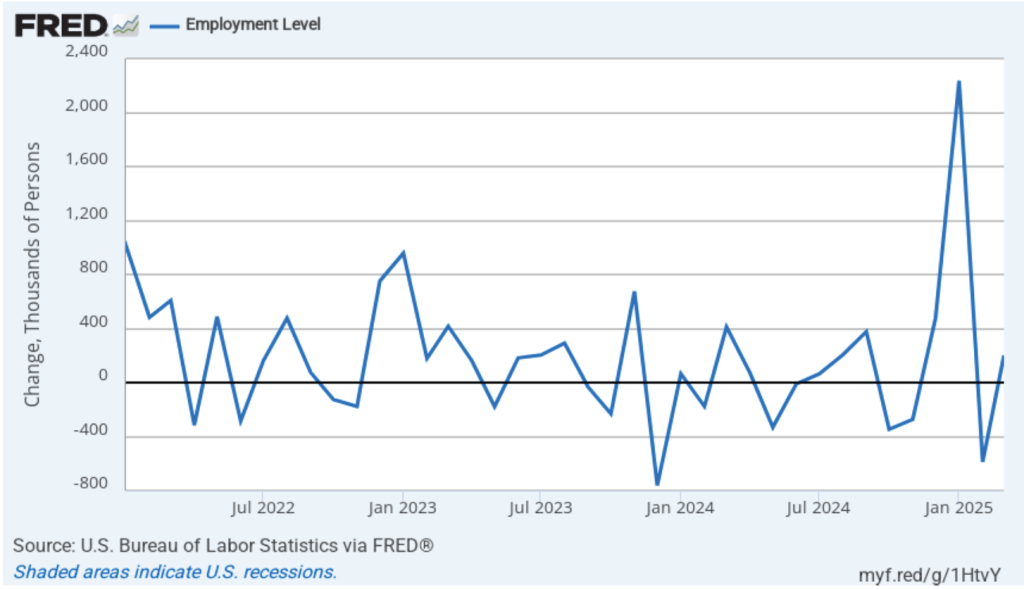
As the following figure shows, the monthly net change in jobs from the household survey moves much more erratically than does the net change in jobs from the establishment survey. As measured by the household survey, there was a net increase of 201,000 jobs in March, following a sharp decrease of 588,000 jobs in February. In any particular month, the story told by the two surveys can be inconsistent with employment increasing in one survey while falling in the other. This month, however, both surveys showed roughly the same net job increase. (In this blog post, we discuss the differences between the employment estimates in the two surveys.)
One concerning sign in the household survey is the fall in the employment-population ratio for prime age workers—those aged 25 to 54. The ratio declined from 80.5 percent in February to 80.4 percent in March. Although the prime-age employment-population is still high relative to the average level since 2001, it’s now well below the high of 80.9 percent in mid-2024. Continuing declines in this ratio would indicate a significant softening in the labor market.
It’s unclear how many federal workers have been laid off since the Trump Administration took office. The establishment survey shows a decline in total federal government employment of 4,000 in March. However, the BLS notes that: “Employees on paid leave or receiving ongoing severance pay are counted as employed in the establishment survey.” It’s possible that as more federal employees end their period of receiving severance pay, future jobs reports may find a more significant decline in federal employment.
The establishment survey also includes data on average hourly earnings (AHE). As we noted in this post, many economists and policymakers believe the employment cost index (ECI) is a better measure of wage pressures in the economy than is the AHE. The AHE does have the important advantage of being available monthly, whereas the ECI is only available quarterly. The following figure shows the percentage change in the AHE from the same month in the previous year. The AHE increased 3.8 percent in March, down from 4.0 percent in February.
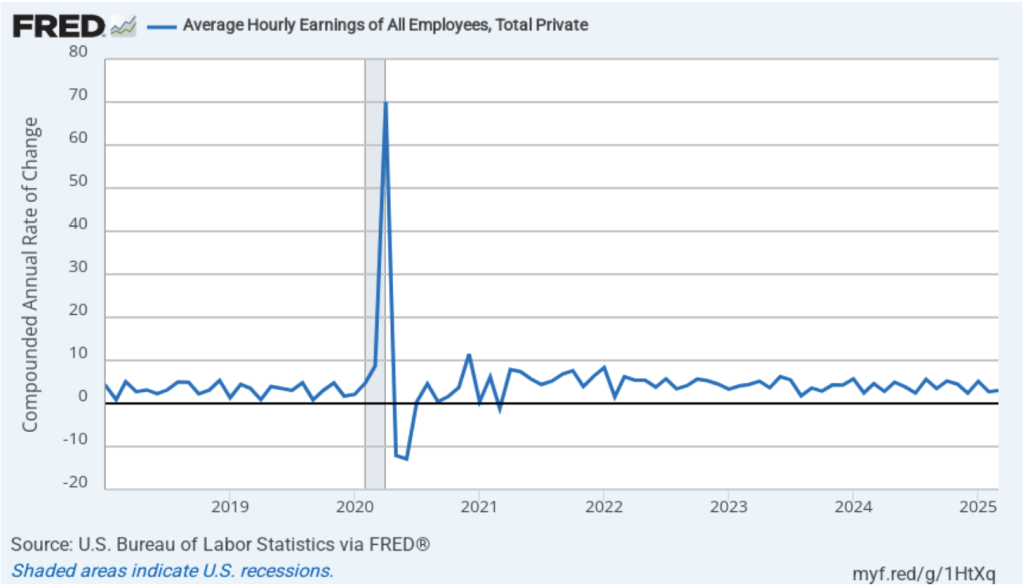
The following figure shows wage inflation calculated by compounding the current month’s rate over an entire year. (The figure above shows what is sometimes called 12-month wage inflation, whereas this figure shows 1-month wage inflation.) One-month wage inflation is much more volatile than 12-month wage inflation—note the very large swings in 1-month wage inflation in April and May 2020 during the business closures caused by the Covid pandemic. The March 1-month rate of wage inflation was 3.0 percent, up from 2.7 percent in February. Whether measured as a 12-month increase or as a 1-month increase, AHE is still increasing somewhat more rapidly than is consistent with the Fed achieving its 2 percent target rate of price inflation.
Taken by itself, today’s jobs report leaves the situation facing the Federal Reserve’s policy-making Federal Open Market Committee (FOMC) largely unchanged. There are some indications that the economy may be weakening, as shown by some of the data in the jobs report and by some of the data incorporated by the Atlanta Fed in its pessimistic nowcast of first quarter real GDP. But the Fed hasn’t yet brought inflation down to its 2 percent annual target.
Looming over monetary policy is the fallout from the Trump Administration’s implementation of unexpectedly large tariff increases. As we note in this blog post, a large unexpected increase in tariffs results in an aggregate supply shock to the economy. In terms of the basic aggregate demand and aggregate supply model that we discuss in Macroeconomics, Chapter 13 (Economics, Chapter 23), an unexpected increase in tariffs shifts the short-run aggregate supply curve (SRAS) to the left, increasing the price level and reducing the level of real GDP.
The effect of the tariffs poses a dilemma for the Fed. With inflation still running above the 2 percent annual target, additional upward pressure on the price level is unwelcome news. The dramatic decline in both stock prices and in the interest rate on the 10-Treasury note indicate that investors are concerned that the tariffs increases may push the U.S. economy into a recession. The FOMC can respond to the threat of a recession by cutting its target for the federal funds rate, but doing so runs the risk of pushing inflation higher.
In a speech today, Fed Chair Jerome Powell stated the following:
“We have stressed that it will be very difficult to assess the likely economic effects of higher tariffs until there is greater certainty about the details, such as what will be tariffed, at what level and for what duration, and the extent of retaliation from our trading partners. While uncertainty remains elevated, it is now becoming clear that the tariff increases will be significantly larger than expected. The same is likely to be true of the economic effects, which will include higher inflation and slower growth. The size and duration of these effects remain uncertain. While tariffs are highly likely to generate at least a temporary rise in inflation, it is also possible that the effects could be more persistent. Avoiding that outcome would depend on keeping longer-term inflation expectations well anchored, on the size of the effects, and on how long it takes for them to pass through fully to prices. Our obligation is to keep longer-term inflation expectations well anchored and to make certain that a one-time increase in the price level does not become an ongoing inflation problem.”
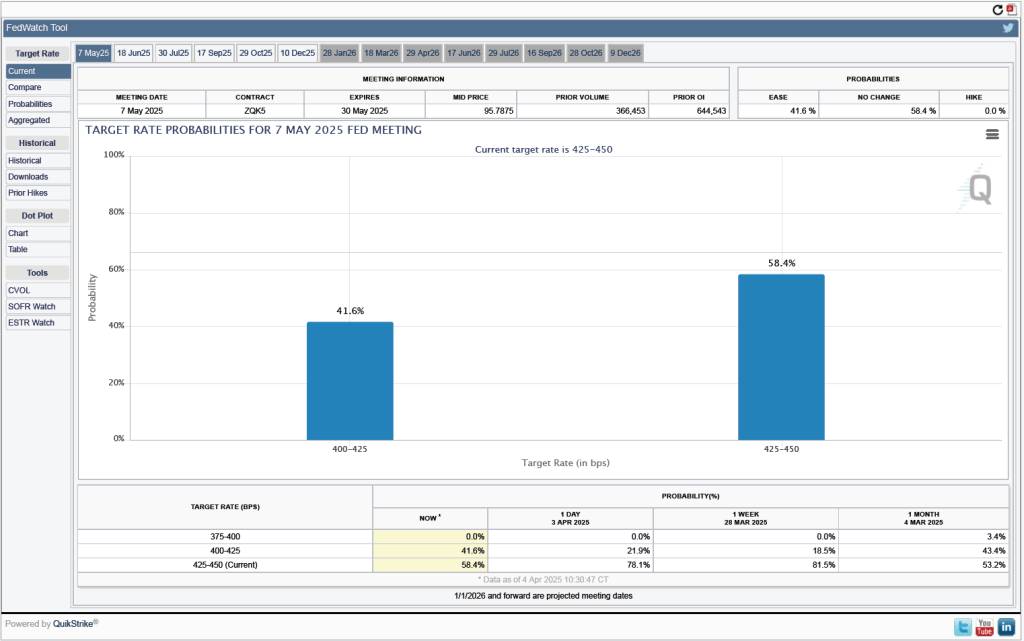
One indication of expectations of future cuts in the target for the federal funds rate comes from investors who buy and sell federal funds futures contracts. (We discuss the futures market for federal funds in this blog post.) The data from the futures market indicate that, despite the potential effects of the surprisingly large tariff increases, investors don’t expect that the FOMC will cut its target for the federal funds rate at its May 6–7 meeting. As shown in the following figure, investors assign a 58.4 percent probability to the committee keeping its target unchanged at 4.25 percent to 4.50 percent at that meeting.
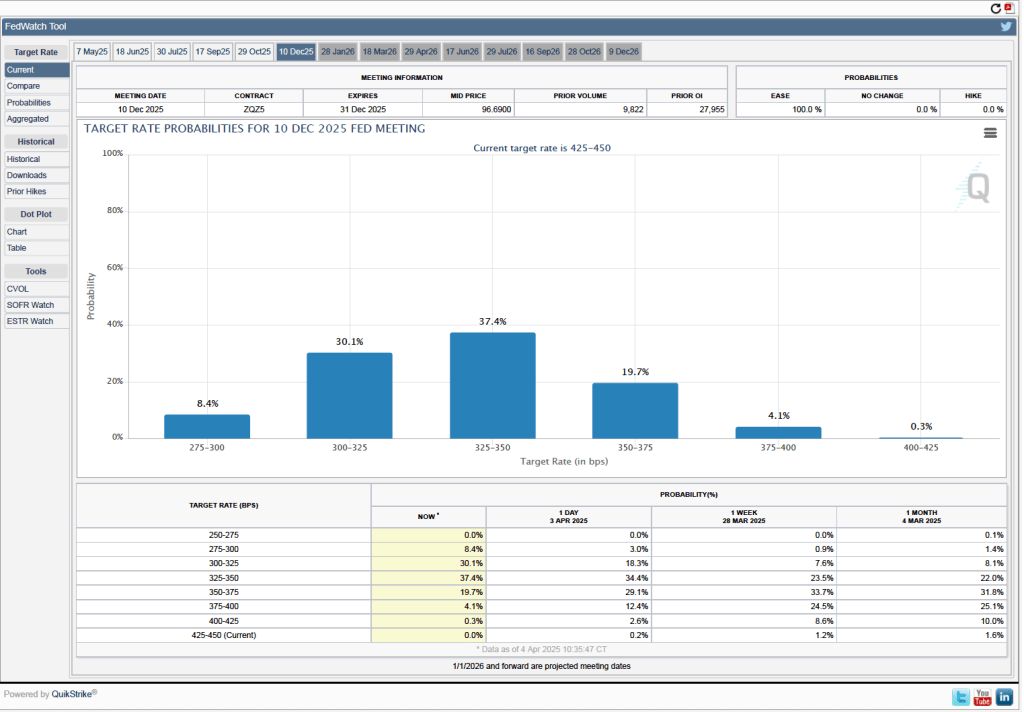
It’s a different story if we look at the end of the year. As the following figure shows, investors now expect that by the end of the FOMC’s meeting on December 9-10, the committee will have implemented at least four 0.25 percentage point (25 basis points) cuts in its target range for the federal funds rate. Investors assign a probability of 75.8 percent that the target range will end the year 3.25 percent to 3.50 percent or lower. At their March meeting, FOMC members projected only two 25 basis point cuts this year—but that was before the announcement of the unexpectedly large tariff increases.
Image generated by ChatGTP-4o of new cars on a dealer’s lot.
This afternoon (April 2), President Donald Trump announced a sweeping increase in tariff rates on imported goods. The increases were by far the largest since the Smoot-Hawley Tariff of 1930. The United States will impose 10 percent across-the-board tariff on all imports, with higher tariffs being imposed on individual countries. Taking into account earlier tariffs, Chinese imports will be subject to a 54 percent tariff. Imports from Vietnam will be subject to a 46 percent tariff, and imports from the countries in the European Union will be subject to a 20 percent tariff.
President Trump’s objectives in imposing the tariffs aren’t entirely clear because he and his advisers have emphasized different goals at different times. The most common objectives the president and his advisers have offered for the tariff increases are these three:
To increase the size of the U.S. manufacturing sector by raising the prices of imported manufactured goods.
To retaliate against barriers that other countries have raised against U.S. exports.
To raise revenue for the federal government.
The effects of the tariffs on the U.S. economy depend in part on whether foreign countries retaliate by raising their tariffs on imports from the United States and on whether, in the future, the president reduces tariffs in exchange for other countries reducing barriers to U.S. imports. For a background discussion of tariffs, see this post. Glenn and Tony discuss tariffs in this podcast, which was recorded on Friday afternoon (March 28). A discussion of the Smoot-Hawley Tariff can be found here.
The following Solved Problem looks at one aspect of the effects of a tariff increase.
Supports:Microeconomics and Economics, Chapter 6, Section 6.3.
Nearly every automobile assembled in the United States contains at least some imported parts. An article on axis.com made the following statement about the effect on U.S. automobile manufacturers of an increase in the tariff on imported auto parts: “If car prices [in the United States] go up, Americans will buy fewer of them, meaning less revenue ….” What assumption is the author of this article making about the demand for new automobiles in the United States?
Solving the Problem
Step 1: Review the chapter material. This problem is about the effect of price increases on a firm’s revenue, so you may want to review the section “The Relationship between Price Elasticity of Demand and Total Revenue.”
Step 2: Answer the question by explaining what must be true of the demand for new automobiles in the United States if an increase in automobile prices results in a decline in the revenue received by automobile producers. This section of Chapter 6 explains how the price elasticity of demand affects the revenue a firm receives following a price increase. A price increase, holding everything else constant that affects the demand for a good, always causes a decline in the quantity demanded. If demand is price inelastic, an increase in price will result in an increase in revenue because the percentage decline in quantity demanded will be smaller than the percentage increase in the price. If demand is price elastic, an increase in price will result in a decrease in revenue because the percentage decline in the quantity demanded will be larger than the percentage increase in price. We can conclude that the author of the article must be assuming that the demand for new automobiles in the United States is price elastic.
Even though Russia and Ukraine were engaged in cease-fire talks with American representatives in Saudi Arabia, apparently with some progress on Tuesday, President Vladimir Putin of Russia has shown little actual commitment to ending his war.
President Trump needs some better cards.
Several weeks ago, the president floated the idea of sanctions and tariffs over Russian imports. But the Kremlin has been dismissive — mainly because the United States imports very little from Russia. Extensive financial and trade sanctions have been in place, most of them for around three years, and they are plainly not enough to bring peace.
Fortunately, there is a simple way to improve the American hand. The administration should impose sanctions on any company or individual — in any country — involved in a Russian oil and gas sale. Russia could avoid these so-called secondary sanctions by paying a per shipment fee to the United States Treasury. The payment would be called a Russian universal tariff, and it would start low but increase every week that passes without a peace deal.
Ships carry most Russian oil and gas to world markets. The secondary sanctions — if Russia does not make the required payments — would fall on all parties to the transaction, including the oil tanker owner, the insurer and the purchaser. Recent evidence confirms that Indian and Chinese entities — whose nations import considerable oil from Russia and have not imposed their own penalties on the Russian economy over the war in Ukraine — do not want to be caught up in American sanctions, making this idea workable. Another factor in its favor: All such tanker traffic is tracked carefully by commercial parties and by U.S. authorities.
Secondary sanctions are powerful tools: Violators can be cut off from the U.S. financial system, and they apply even to transactions that don’t directly involve American companies. They have been used to limit Iranian oil exports and to require that payments for Iranian oil be held in restricted accounts until sanctions were lifted. Our proposal would take this approach to another level. Under our plan, a portion of each Russian oil and gas sale would be paid to the U.S. Treasury until Russia agrees to a peace deal. The goal is to keep Russian oil flowing to global markets but with less money going to the Kremlin. The plan would sap Russia’s ability to continue waging war, and it puts money into U.S. government coffers.
In Russia, fossil fuel revenues and military spending are intertwined, although the country can also draw on its sovereign wealth fund and other sources. Fossil fuel exports provide the main source of dollar revenue for the Kremlin, which depends on hard currency to buy arms and other military supplies from abroad and pay for North Korean soldiers. The country currently exports about $500 million worth of crude oil and petroleum products and $100 million worth of natural gas every day. The Kremlin budgeted a slightly lower amount, almost $400 million per day for military spending in 2025.
The Russia universal tariff would provide money for the United States immediately, unlike the proposed Ukrainian critical minerals fund, which would take years to generate any returns. A fee of $20 per barrel of oil could generate up to $120 million per day (more than $40 billion per year), with additional revenue available if a similar fee is imposed on natural gas. Every dollar the United States collects is a dollar that Russia can’t spend to fund its war.
Ideally, the policy would pressure Russia into negotiations, where its removal could be part of a deal. If not, the United States would still collect billions annually, which could help fund Mr. Trump’s proposed tax cuts. In that scenario, Russia would effectively be helping repaythe U.S. tax dollars used to provide aid to Ukraine to defend itself against Russia’s assault.
For the past three years, Western sanctions and public outcry, including some dockworkers’ refusal to unload Russian oil tankers, have forced Russia to search for new buyers and sell its oil at a discount compared with global prices. The oil discount averaged about $9 per barrel over the previous 12 months and was as high as $35 per barrel in April 2022. Despite receiving lower prices for its oil, Russia has maintained export volumes, ensuring a steady supply in the global oil market.
By imposing secondary sanctions unless the Russia universal tariff is paid, the United States would be taking a cut of the revenues, effectively increasing the discount on Russian oil. Russia’s continued exports, despite facing large discounts over the past three years, suggest it would continue exporting the same volume. That would keep global oil supply stable and help keep oil prices in check. Oil and gas in Russia are inexpensive to produce, and it relies heavily on the income they generate, so it has little option but to keep selling, even at lower prices.
While Mr. Trump can adopt this strategy, Congress can strengthen his negotiating position by passing a bill that puts the Russia universal tariff in place on its own. That would allow the president to protect his lines of communication with Mr. Putin by blaming the measure on Congress. He would also determine if and when he wants to sign the bill, giving him additional leverage over Russia. It’s possible the mere discussion of such a bill could help push the Kremlin toward a peace deal.
Combining secondary sanctions, a strong tool in the U.S. economic kit, with a tarifflike fee could pressure Mr. Putin by threatening his most valuable source of revenues. It would also make it easier for Mr. Trump to deliver on his promise of a lasting peace.
Catherine Wolfram, a former deputy assistant secretary for climate and energy in the Treasury Department, is a professor at M.I.T.’s Sloan School of Management.
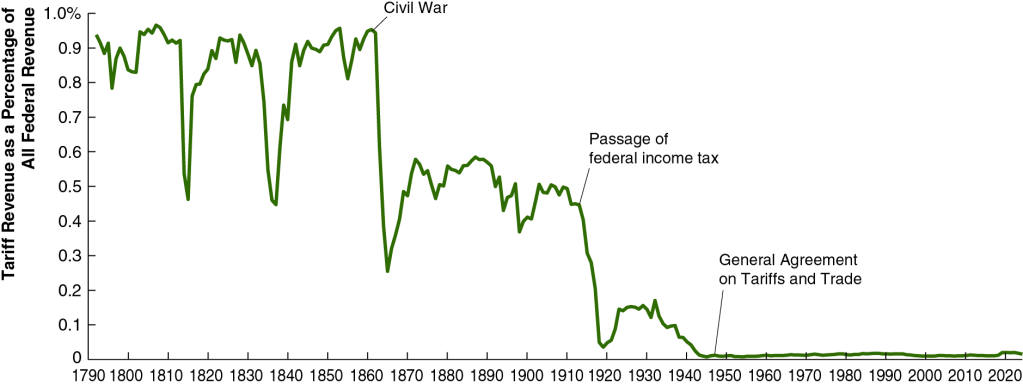
A tariff is a tax a government imposes on imports. Since the end of World War II, high-income countries have only occasionally used tariffs as an important policy tool. The following figure shows how the average U.S. tariff rate, expressed as a percentage of the value of total imports, has changed in the years since 1790. The ups and downs in tariff rates reflect in part political disa-greements in Congress. Generally speaking, through the early twentieth century, members of Congress who represented areas in the Midwest and Northeast that were home to many manufacturing firms favored high tariffs to protect those industries from foreign competition. Members of Congress from rural areas opposed tariffs, because farmers were primarily exporters who feared that foreign governments would respond to U.S. tariffs by imposing tariffs on U.S. agricultural exports. From the pre-Civil War period until after World War II the Republicans Party generally favored high tariffs and the Democratic Party generally favored low tariffs, reflecting the economic interests of the areas the parties represented in Congress. (Note: Because the tariffs that the Trump Administration will end up imposing are still in flux, the value for 2025 in the figure is only a rough estimate.)
By the end of World War II in 1945, government officials in the United States and Europe were looking for a way to reduce tariffs and revive international trade. To help achieve this goal, they set up the General Agreement on Tariffs and Trade (GATT) in 1948. Countries that joined the GATT agreed not to impose new tariffs or import quotas. In addition, a series of multilateral negotiations, called trade rounds, took place, in which countries agreed to reduce tariffs from the very high levels of the 1930s. The GATT primarily covered trade in goods. A new agreement to cover services and intellectual property, as well as goods, was eventually negotiated, and in January 1995, the GATT was replaced by the World Trade Organization (WTO). In 2025, 166 countries are members of the WTO.
As a result of U.S. participation in the GATT and WTO, the average U.S. tariff rate declined from nearly 20% in the early 1930s to 1.8% in 2018. The first Trump Administration increased tariffs beginning in 2018, raising the average tariff rate to 2.5%. (The Biden Administration continued most of the increases.) In 2025, the second Trump Administration’s substantial increases in tariffs raised the average tariff rate to the highest level since the 1940s.
Until the enactment in 1913 of the 16th Amendment to the U.S. Constitution, which allowed for a federal income tax, tariffs were an important source of revenue to the federal government. As the following figure shows, in the early years of the United States, more than 90% of federal government revenues came from the tariff. As tariff rates declined and federal income and payroll taxes increased, tariffs declined to only 2% of federal government revenue. It’s unclear yet how much tariff’s share of federal government revenue will rise as a result of the Trump Administration’s tariff increases.
The effect of tariff increases on the U.S. economy are complex and depend on the details of which tariffs are increased, by how much they are increased, and whether foreign governments raise their tariffs on U.S. exports in response to U.S. tariff increases. We can analyze some of the effects of tariffs using the basic aggregate demand and aggregate supply model that we discuss in Macroeconomics, Chapter 13 (Economics, Chapter 23). We need to keep in mind in the following discussion that small increases in tariffs rates—such as those enacted in 2018—will likely have only small effects on the economy given that net exports are only about 3% or U.S. GDP.
An increase in tariffs intended to protect domestic industries can cause the aggregate demand curve to shift to the right if consumers switch spending from imports to domestically produced goods, thereby increasing net exports. But this effect can be partially or wholly offset if trading partners retaliate by increasing tariffs on U.S. exports. When Congress passed the Smoot-Hawley Tariff in 1930, which raised tariff rates to historically high levels, retaliation by U.S. trading partners contributed to a sharp decline in U.S. exports during the early 1930s.
International trade can increase a country’s production and income by allowing a country to specialize in the goods and services in which it has a comparative advantage. Tariffs shift a country’s allocation of labor, capital, and other resources away from producing the goods and services it can produce most efficiently and toward producing goods and services that other countries can produce more efficiently. The result of this misallocation of resources is to reduce the productive capacity of the country, shifting the long-run aggregate supply curve (LRAS) to the left.
Tariffs raise the prices of U.S. imports. This effect can be partially offset because tariffs increase the demand for U.S. dollars relative to trading partners’ currencies, increasing the dollar exchange rate. Because a tariff effectively acts as a tax on imports, like other taxes its incidence—the division of the burden of the tax between sellers and buyers—depends partly on the price elasticity of demand and the price elasticity of supply, which vary across the goods and services on which tariffs are imposed. (We discuss the effects of demand and supply elasticity on the incidence of a tax in Microeconomics, Chapter 17, Section 17.3.)
About two-thirds of U.S. imports are raw materials, intermediate goods, or capital goods, all of which are used as inputs by U.S. firms. For example, many cars assembled in the United States contain imported parts. The popular Ford F-Series pickup trucks are assembled in the United States, but more than two-thirds of the parts are imported from other countries. That fact indicates that the automobile industry is one of many U.S. industries that depend on global supply chains that can be disrupted by tariffs. Because tariffs on imported raw materials, parts and other intermediate goods, and capital goods increase the production costs of U.S. firms, tariffs reduce the quantity of goods these firms will produce at any given price. In terms of the aggregate demand and aggregate supply model , a large unexpected increase in tariffs results in an aggregate supply shock to the economy, shifting the short-run aggregate supply curve (SRAS) to the left.
Our thanks to Fernando Quijano for preparing the two figures.
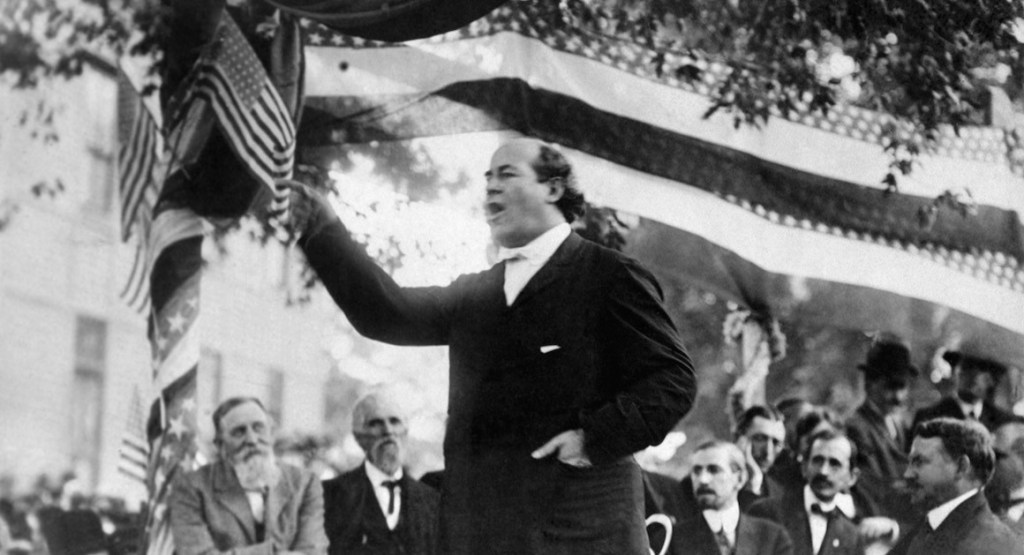
Ninteenth century populist William Jennings Bryan delivering a campaign speech. (Photo from the AP via politico.com)
The following op-ed originally appeared in the Wall Street Journal.
The Economic Populists Have a Point
Many issues divide voters heading into the November election, but the economy may be the most crucial. Sound economic policy can foster prosperity and high living standards and affect income and opportunities. Economic resources can also enable society to fund defense or address social and environmental concerns.
Conservative economic policy traditionally has emphasized the openness of markets and growth. By contrast, the populist conservative ideas under discussion at the Republican National Convention focus on people and places hard hit by the disruption that accompanies openness and growth. While many commentators emphasize the differences between the two approaches, a modern conservative economic agenda should build on elements of both.
To begin, a conservative economic agenda should include policies that advance economic growth and living standards. That means supporting research and development, maintaining pro-investment business tax provisions in the Tax Cuts and Jobs Act of 2017, and making regulations that benefit everyone. Such an economy lets businesses and individuals get the most out of the opportunities they seize.
Populist conservatives argue that this traditional approach to policy misses an important objective: a disruptive, rough-and-tumble economy, guided by technological advances and globalization, one that brings everyone along. Populist conservatives want more emphasis on protecting jobs and communities.
There’s more to the populist conservatives’ skepticism than traditional conservatives acknowledge. But backward-looking protectionist measures such as inflationary tariffs or industrial policy aren’t the answer.
However, there is a conservative economic agenda that can unite these groups. The shortcomings of Bidenomics give conservatives an opening to push beyond both market-only neoliberalism and the statist tendencies of industrial policy and protectionism, with their attendant economic inefficiencies. To do so, conservative economic policy needs three ingredients.
The first is agreeing with populist conservatives that markets don’t always work perfectly and that a hands-off approach isn’t always the solution. The state can play a useful role in the market economy. Supply-chain restrictions and export controls can be tools to deny national-security-sensitive technologies to adversaries such as China. But an economic agenda requires more than a sound bite to avoid overreach—such as using “national security” as a pretext for slapping steel tariffs on Canada.
The second essential is competition—the linchpin of economic possibilities for classical economic thinkers from Adam Smith onward. While competition at home and abroad expands the economic pie, it says little about the relative sizes of the slices, a point noted by populist conservatives. A modern conservative economic approach would not only promote competition but also prepare more individuals to compete in a changing economy. One avenue could be supporting community colleges that understand local job needs rather than establishing more government training programs.
Third and most important, a conservative economic platform should recall why conservatives have stressed the benefits of markets. The goal, as my Columbia colleague and Nobel laureate Edmund Phelps puts it, is “mass flourishing.” That is why we want markets to work—to advance innovation and productivity and allow communities to make that flourishing possible.
As far as government’s role, a contemporary economic agenda should recognize a limited measure of successful industrial policy. Two roads should be on offer. The first is to provide more general support for basic and applied research, while letting market forces determine winners and losers. The second is to assign specific goals to particular interventions. The Apollo program’s goal was to put a man on the moon in a decade. The Trump administration’s Operation Warp Speed sought vaccines against Covid.
Populist conservatives are right that there is a role in a conservative economic agenda for helping areas hard hit by disruption. But that role isn’t a mercantilist blunderbuss of protectionism and industrial policy to turn back the economic clock. Rather, place-based aid could support business services for firms trying to create local jobs.
The economic ideas under discussion at the Republican National Convention have populist features that haven’t figured in earlier conservative economic agendas. Populists have some reasonable skepticism about excessive deference to markets. But avoiding excessive meddling from tempting protectionism and the mushy mercantilism of Bidenomics is important, too. Under a conservative economic agenda, growth can flourish.
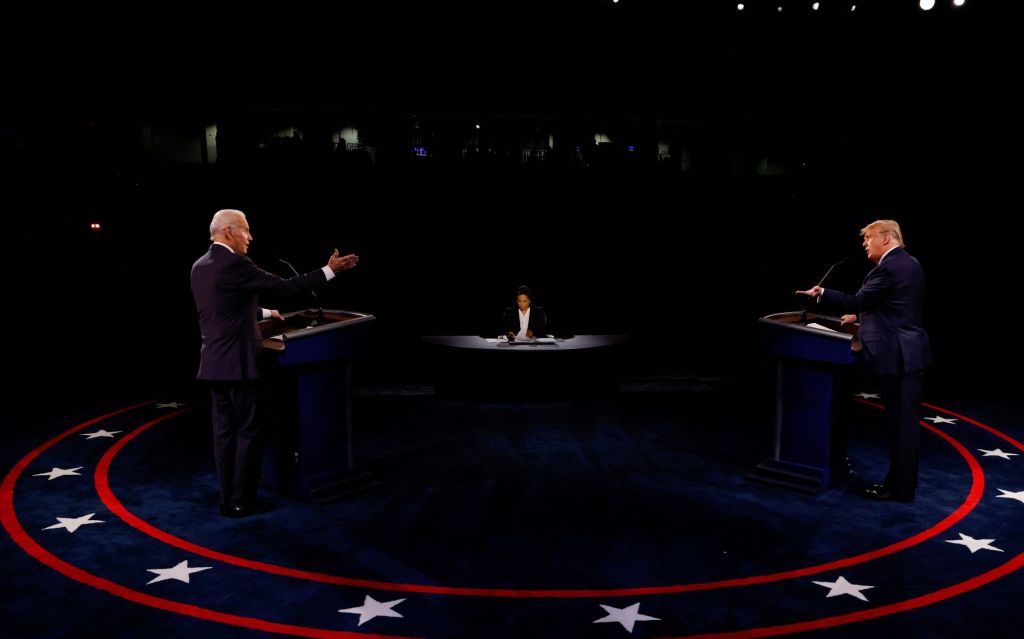
Presidents Biden and Trump during one of their 2020 debates. (Photo from the Wall Street Journal)
On the eve of first debate between President Joe Biden and former President Donald Trump, Glenn reflects on the fundamentals of sound economic policy. This essay first appeared inNational Affairs.
The advent of “Bidenomics” has resurrected decades-old debates about the merits of markets versus industrial policy. When President Joe Biden announced his eponymous strategy in June 2023, he blasted what he described as “40 years of Republican trickle-down economics” and insisted that he would seek instead to build “an economy from the middle out and the bottom up, not the top down.” He would achieve this through “targeted investments” in technologies like semiconductors, batteries, and electric cars — all of which featured heavily in initiatives like the CHIPS and Science Act and the Inflation Reduction Act. Yet despite the president’s professed support for a “middle out” economics, Bidenomics has thus far proven to be less of an intellectual framework than a set of well-intended yet ill-fated industrial-policy interventions implemented from the top down.
Some conservatives have joined Biden in embracing industrial policy. Writing recently in these pages, Republican senator Marco Rubio of Florida asserted that while it is difficult to “get industrial policy right, conservatives can and must take ownership of this space to keep the American economy strong and free.” Former president Donald Trump, for his part, staunchly advocates heavy tariffs to promote domestic manufacturing.
Conservatives who adopt their own version of protectionist tinkering with markets are missing an important opportunity. As mercantilism’s decline did for classical liberalism in the 19th century and Keynesianism’s misadventures did for neoliberalism in the 20th, Bidenomics’ failures offer an opening for the right to champion a new type of economics — one that puts opportunity for the people ahead of the economic rules of the game.
Rapid globalization and technological change have left too many Americans behind. But the answer is not for the state to invest in costly projects with dubious prospects, nor is it to adopt a strictly laissez-faire approach to the economy. By reviving classically liberal ideas about competition and opportunity in the face of change, conservatives can promote an alternative economics that retains the enormous benefits of markets and openness while putting people first.
LIBERALISM’S RISE AND FALL
Before “Bidenomics” became a popular term, national-security advisor Jake Sullivan hinted at the president’s economic priorities in an April 2023 speech at the Brookings Institution. There, he declared that a “new Washington consensus” had formed around a “modern industrial and innovation strategy,” which would correct for the excesses of the free-market orthodoxy propagated by the likes of Adam Smith, Friedrich Hayek, and Milton Friedman.
This orthodoxy, according to Sullivan, “championed tax cutting and deregulation, privatization over public action, and trade liberalization as an end in itself,” all of which eroded the nation’s industrial and social foundations. Finally, after nearly three decades of such policies, two “shocks” — the global financial crisis of 2007-2009 and the Covid-19 pandemic — ”laid bare the limits” of liberalism. The time had come, Sullivan concluded, to dispense with decades of policies touting the benefits of markets and free trade — and economists would just have to get over it.
The Biden administration’s assault on open markets and free trade is odd in some respects. Scholars at the Peterson Institute for International Economics — located just across the street from Brookings — concluded in a 2022 report that, thanks to America’s openness to globalization, trillions of dollars in economic benefits have flowed to U.S. households. Moreover, the United Nations estimates that integrating China, India, and other economies into the world trading order has brought one billion individuals out of poverty since the 1980s. The impact of technological change as a driver of growth and incomes is larger still. Juxtaposing such outcomes with the administration’s grievances calls to mind the popular outcry in Monty Python’s Life of Brian: “What have the Romans ever done for us?” Quite a lot, in fact.
Proponents of free markets have clashed with advocates of government intervention before, most notably at the dawn of classical liberalism toward the end of the 18th century and the advent of neoliberalism during the first half of the 20th. These contests were not so much battles of ideas as they were intellectual critiques of real-life policy failures.
In 1776, Adam Smith’s Inquiry into the Nature and Causes of the Wealth of Nations threw down the gauntlet. The book was radical, offering a sharp rebuke of the economic-policy order of the day. Mercantilism — or the “mercantile system,” as Smith called it — assumed that the world’s wealth is fixed, and that a state wishing to improve its relative financial strength would have to do so at the expense of others by maintaining a favorable balance of trade — typically by restricting imports while encouraging exports. Recognizing merchants’ role in generating domestic wealth, mercantilist states also developed government-controlled monopolies that they protected from domestic and foreign competition through regulations, subsidies, and even military force.
Predictably, this system enriched the merchant class. But it did so at the expense of the poor, who were subject to trade restrictions and import taxes that drove up the price of goods. It also stunted business growth, expanded the slave trade, and triggered inflation in regions with little gold and silver bullion on hand.
Smith turned the mercantilist view on its head, insisting that the real touchstone of “the wealth of a nation” was not the amount of gold and silver held in its treasury, but the value of the goods and services it produced for its citizens to consume. To maximize a nation’s wealth, he argued that the state should unleash its population’s productive capacity by liberating markets and trade. Setting markets free, he observed, would enable firms to specialize in generating the goods they produced most efficiently, and to exchange surpluses of those goods for specialized goods produced by others. This approach would spread the benefits of free trade throughout the population.
While sometimes caricatured as a full-throated endorsement of laissez-faire economics, Wealth of Nations also recognized that government played an important role in sustaining an environment that would allow free markets to flourish. This included protecting property rights, building and maintaining infrastructure, upholding law and order, promoting education, providing for national security, and ensuring competition among firms. Smith cautioned, however, that government officials should be careful not to distort markets unnecessarily through such mechanisms as taxation and overregulation, and should avoid accumulating large public debts that would drain capital from future productive activities.
Mercantilism did not suddenly fall away after Smith’s critique; it continued to dominate much of the world’s economic order for another half-century. But eventually, Smith’s arguments in favor of market liberalization carried the day. For much of the 19th and early 20th centuries, free markets and free trade facilitated unprecedented prosperity in the West.
A parallel series of events occurred during the 1930s and ’40s, when Friedrich Hayek and John Maynard Keynes famously (and nastily) debated economic theory in the pages of the Economic Journal. That contest, too, revolved around what was happening on the ground: the Great Depression and increasing government investment in industry. Keynes contended that market economies experience booms and busts based on fluctuations in aggregate demand, and that the government could mitigate the harms of recessions by stimulating that demand through increased spending. Hayek disagreed, arguing that such large-scale public spending programs as those Keynes proposed would prompt not just market inefficiency and inflation, but tyranny.
During the 1950s and ’60s, Milton Friedman took on Keynes’s theories, asserting instead that the key to stimulating and maintaining economic growth was to control the money supply. He also expanded on Hayek’s case for free markets as necessary elements of free societies: As he wrote in Capitalism and Freedom, economic freedom serves as both “a component of freedom broadly understood” and “an indispensable means toward the achievement of political freedom.”
Of course Hayek and Friedman, like Smith before them, did not immediately win the debate; Keynesianism dominated America’s economic policy for decades after the Second World War. But by the mid-1970s, rising inflation and slowed economic growth pressured policymakers to consider a different approach. Hayek and Friedman’s arguments — now often referred to collectively as “neoliberalism” — ultimately won over important political figures like Ronald Reagan and Bill Clinton in the United States and Margaret Thatcher and Tony Blair in Britain. It had a major impact on each of their economic-policy initiatives, which typically combined tax cuts and deregulation with reduced government spending and liberalized international trade.
The upshot of that liberal market order is reflected in the 2022 findings of the Peterson Institute outlined above — namely the trillions of dollars in economic benefits that have flowed to American households. In a similar vein, the institute found in a 2017 report that between 1950 and 2016, trade liberalization combined with cheaper transportation and communication owing to technological change increased per-household GDP in the United States by about $18,000. The benefits of economic liberalism have thus been and continue to be massive.
NEOLIBERAL OVERCORRECTION
For all the prosperity it brought to the world, market-induced change in an era of globalization and rapid technological advance also entailed significant costs. Leaders across the political spectrum celebrated the former but paid little attention to the latter, which hit low- and medium-skilled American workers particularly hard. As global competition intensified and technological change mounted, tens of thousands of Americans in the manufacturing industry lost their jobs. Meanwhile, state benefits programs and occupational-licensing requirements made it difficult, if not impossible, for these individuals to move in search of better opportunities.
Neoliberal economic logic asserts that maintaining the labor market’s dynamism will right the ship in response to economic change — that new jobs will be created to replace the old. While true in most respects, for individuals and communities buffeted by structural market forces beyond their control, “just let the market work” is neither an economically correct answer nor a response likely to win political favor.
Proponents of neoliberalism tend to overlook the politically salient pressures generated by the speed, irreversibility, and geographic concentration of market-induced changes. Their lack of empathy for working-class communities hollowed out by the competitive and technological disruption that took place between the 1980s and the early 2010s ceded the political lane to proponents of industrial policy, enabling Trump to ride the wave of working-class grievances to the White House in 2016.
The ensuing tariffs, along with President Biden’s protectionist activity, invited retaliation from America’s trading partners. A Federal Reserve study by economists Aaron Flaaen and Justin Pierce concluded that, contrary to protectionists’ claims, employment losses triggered by trade retaliation were significantly greater than the number of jobs garnered through protectionism. The subsidy game tells a similar story: The Inflation Reduction Act’s large incentives for domestic clean-energy projects put America’s trading partners engaged in battery and electric-vehicle manufacturing at a disadvantage, which in turn pushed greater subsidization efforts overseas and prompted political grumbling among our trading partners.
It is policy failure, not a grand new economic strategy, that the Biden and Trump administrations’ industrial policies have teed up. Market liberalism must rise once again to counter the muddled mercantilism of both. But instead of repeating the cycle of neoliberalism overcorrecting for central planning and vice versa, today’s free-market and free-trade proponents will need to update their theories to address the challenges of our contemporary economy. By recovering insights from classical liberalism while keeping people in mind, economic policymakers can once again facilitate an open economy that ensures mass opportunity and flourishing.
MUDDLED MERCANTILISM
An intellectual path forward for today’s economic liberals must begin by highlighting the practical failures of Sullivan’s “new Washington consensus.” To that end, it will be useful to revisit the lack of intellectual foundation in today’s mercantilist industrial policy.
Skepticism of industrial policy revolves around two major challenges inherent to the strategy. The first is ensuring that capital is allocated to “winners” and not “losers.” The second is protecting industrial policy from mission creep and rent seeking.
Hayek addressed the first problem in his classic 1945 article, “The Use of Knowledge in Society.” As he observed there, “the knowledge of the particular circumstances of time and place” necessary to rationally plan an economy is distributed among innumerable individuals. No single person has access to all of this localized knowledge, which is not only infinite, but also constantly in flux. Statistical aggregates cannot account for it all, either. Thus, even the most earnest and sophisticated government planners could not amass the knowledge required to allocate capital to the right firms based on ever-changing circumstances on the ground. Recent examples of the government’s misfires — from the bankruptcy of the federally subsidized solar-panel startup Solyndra to the billions in Covid-19 relief aid lost to fraud and waste — speak to the truth of Hayek’s argument.
The free market, by contrast, transmits relevant information — that “knowledge of the particular circumstances of time and place” — in real time to everyone who needs it. It does so in large part via the price system. Friedman famously illustrated this process using the humble No. 2 pencil:
Suppose that, for whatever reason, there is an increased demand for lead pencils — perhaps because a baby boom increases school enrollment. Retail stores will find that they are selling more pencils. They will order more pencils from their wholesalers. The wholesalers will order more pencils from the manufacturers. The manufacturers will order more wood, more brass, more graphite — all the varied products used to make a pencil. In order to induce their suppliers to produce more of these items, they will have to offer higher prices for them. The higher prices will induce the suppliers to increase their work force to be able to meet the higher demand. To get more workers they will have to offer higher wages or better working conditions. In this way ripples spread out over ever widening circles, transmitting the information to people all over the world that there is a greater demand for pencils — or, to be more precise, for some product they are engaged in producing, for reasons they may not and need not know.
In this way, free markets ensure that capital is allocated to the right place at the right time based on the laws of supply and demand.
The second problem that plagues industrial policy arises when policies that are nominally targeted at a single goal end up serving the interests of government actors and individual firms. This problem comes in two flavors: mission creep and rent seeking.
Mission creep is the tendency of government actors to gradually expand the goal of a given policy beyond its original scope. One illustrative example comes from the CHIPS and Science Act, a bill designed to encourage semiconductor manufacturing in the United States. The act tasked the Commerce Department with drafting the conditions that manufacturers must meet to qualify for the program’s $39 billion in subsidies. In addition to manufacturing semiconductors domestically, those rules now require subsidy recipients to offer workers affordable housing and child care, develop plans for hiring disadvantaged workers, and encourage mass-transit use among their workforces. While arguably laudable (and certainly attractive to various interest groups), these goals distract from the original purpose of the law and may even detract from it.
Rent seeking — another problem characteristic of industrial policy — is a strategy that firms employ to increase their profits without creating anything of value. They do so by attempting to influence public policy or manipulate economic conditions in their favor.
Rent seeking often arises when firms devote lobbying resources to garnering funds from new government largesse. For the CHIPS and Science Act, firms’ scramble for subsidies replaces a focus on basic research. For the Inflation Reduction Act, firms’ hiring consultants to help them gain access to agricultural-conservation spending and technical assistance replaces a focus on researching market trends.
Industrial unions — whose goals might not be consistent with market outcomes or the new industrial policy — are a second source of rent seeking. Today, both the left and right have slouched away from liberalism’s emphasis on maintaining an open and dynamic labor market, pledging instead to create and protect “good jobs” — primarily in the manufacturing sector. This new thrust is yet another example of Washington picking “winners” and “losers” among industries and firms.
Concerns about this new approach to labor policy extend well beyond neoliberal critiques of limiting labor-market dynamism. Practically speaking, who decides what a “good job” is, or that manufacturing jobs are the ones to be prized and protected? Many of today’s most desired jobs for labor-market entrants did not exist decades ago when manufacturing employment was at its peak. Why should industrial policy’s goal be to cement the past as opposed to preparing individuals and locales for the work of the future?
A PATH FORWARD
Bidenomics’ policy failures offer an opening for leaders on the right to champion a new type of liberal economics that avoids the pitfalls of both markets-only neoliberalism and industrial policy’s central planning. In doing so, they will need to keep three things in mind.
The first is obvious but bears repeating: Markets don’t always work well, and calls for intervention are not necessarily calls for industrial policy.
Critiques of neoliberalism often focus on the stark observation from Friedman’s famous 1970 New York Times piece on the purpose of the corporation, which he asserted is to maximize its profits — full stop. While the article has now generated more than five decades of criticism, Friedman’s argument is quite sensible as a starting point under the assumptions he had in mind: perfect competition in product and labor markets, and a government that does its job well — namely by providing public goods like education and defense, and correcting for externalities.
Put this way, the problem with neoliberalism is less that it is laissez-faire and more that it assumes away important questions about the state’s role in the market economy. As a prominent example, national-security concerns raise questions about the boundaries between markets and the state. Export controls and certain supply-chain restrictions can be a legitimate way to deny sensitive technologies to adversaries (principally China in the present context). But they also raise several thorny questions. For instance, which technologies should be subject to controls and restrictions? What if those technologies are also employed for non-sensitive purposes? How do we defend sensitive technologies while avoiding blatant protectionism? (The Trump administration’s invocation of “national security” in levying steel tariffs against Canada was less than convincing.) Economists should invite scientists and technology experts into these discussions rather than ceding all ground to politicians and Commerce Department officials.
A second lesson relates to competition — the linchpin of both neoliberalism and classical-liberal economics dating back to Adam Smith. Is the pursuit of competition, though a worthy goal, sufficient to ensure widespread flourishing?
Contemporary economic models assign value to economic growth, openness to globalization, and technological advance. But as noted above, with that growth, openness, and advance comes disruption, often in the form of a diminished ability to compete for new jobs and business opportunities. It’s not a stretch to argue that a classical-liberal focus on free markets should also recognize the ability to compete as an important component to advancing competition. Competition might increase the size of the economic pie, but some will have easier access to a larger slice than others. Thus, in addition to promoting competition, today’s free-market advocates need to focus on preparing individuals to reconnect to opportunity in a changing economy.
To that end, neoliberals would do well to increase public investment in education and skill training. This includes greater support for community colleges — the loci of much of the training and retraining efforts required to reconnect workers to the job market. The demand for such training is rising among young workers skeptical of the value of a four-year college degree: The Wall Street Journal recently reported that the “number of students enrolled in vocational-focused community colleges rose 16% last year to its highest level since the National Student Clearinghouse began tracking such data in 2018.” Returning to Hayek’s “Use of Knowledge” essay, these interventions are likely to be successful because they decentralize training programs, divvying them up to the educational institutions that are in the best position to prepare workers for the jobs of today and tomorrow.
A third lesson for today’s neoliberals relates to the goals of the market. Smith, the father of modern economics, was also a student of moral philosophy — a discipline studiously avoided by most contemporary economists. To win the war of policy ideas, Smith understood that the goal could not simply be for the market to function. Today, demands to “let the market work” clearly do not meet the moment.
Market and trade liberalization are not ends in themselves; they are tools for organizing and promoting economic activity. Channeling Smith’s thoughts in his other classic work emphasizing shared purpose, The Theory of Moral Sentiments, Columbia professor and Nobel laureate Edmund Phelps argued that economic policies should pursue freedom not for its own sake, but to facilitate “mass flourishing.” In this vein, markets should promote, not prevent, innovation and productivity. They should aid, not hinder, the formation of strong families, communities, and religious and civic institutions.
Just as neoliberals need to be more cognizant of the human element in economics, proponents of industrial policy need to rethink the mercantilist strand present in their proposals.
To minimize the problems endemic to industrial policy — mission creep, rent seeking, and the risk of backing the wrong firms and industries — policy architects need to be both more general and more specific in their proposed interventions. By more general, I mean they must emphasize broad mechanisms to counter market failures. In the technology industry, for instance, expanding federal funding for basic scientific research can lead to useful applications for technologies and industries without picking winners and losers. Likewise, adopting a carbon tax would provide more neutral incentives for firms to develop low-carbon fuels and technologies without the need to pick winners and spend taxpayer dollars on costly subsidies. And again, as workers’ skills are an important policy concern, increases in general public investment in education and training should be front and center in any industrial policy.
By more specific, I mean the proposed policy interventions must have more specific goals. The Trump administration’s Operation Warp Speed succeeded without picking winners or over-relying on bureaucracy largely because its goals — developing and deploying a vaccine against Covid-19 as quickly as possible — were narrowly defined. Similarly, the Apollo program — which Senator Rubio rightly pointed to as an effective example of industrial policy — succeeded in part because it focused on a single, concrete, time-bound goal: putting a man on the moon within the decade.
Targeting and customizing aid is another way of making industrial-policy goals more specific. Economist Timothy Bartik has pushed for reforms to current place-based jobs policies, which typically consist of business-related tax and cash incentives. Such incentives, he argues, should be “more geographically targeted to distressed places,” “more targeted at high-multiplier industries” like technology, more favorable to small businesses, and more “attuned to local conditions.” Different local economies have different needs, from infrastructure to land development to job training. Funding customized services and inputs is more cost effective, more directly targeted at local shortcomings, and more likely to raise employment and productivity than one-size-fits-all tax and cash incentives.
While much of this analysis has been applied to the manufacturing context, such approaches can also be applied to the services sector. Customized input support would focus on developing partnerships between businesses and local educational institutions to develop job-specific training. Public support for applied research centers could help disseminate technological and organizational improvements to firms across the country. As with the general improvements to current industrial policy outlined above, these methods harness market mechanisms while recognizing and responding to underlying market failures.
A RIGHT TO OPPORTUNITY
The neoliberal notion that markets should focus on allocation and growth alone cannot be an endpoint; updating classical-liberal ideas with a deliberate focus on adaptation and the ability to compete is the place to start. Recognizing a right to opportunity in addition to property rights could provide a liberal counterweight to the temptation to reach for industrial policy to help distressed communities.
This right to opportunity — for today and tomorrow — should lead a conservative pushback to Bidenomics. Voters might not have much of a choice between Biden and Trump’s economic populism in the election this fall, but economists and policymakers can begin to advance a new market economics that leaves no Americans behind in the hope that future administrations will take notice.
Authors Glenn Hubbard & Tony O’Brien reflect on the global economic effects of Russia’s invasion of Ukraine last week. They consider the impact on the global commodity market, US monetary policy, and the impact on the financial markets in the US. Impact touches Introductory Economics, Money & Banking, International Economics, and Intermediate Macroeconomics as the effects of Russia’s aggression moves into its second week.
A map of Europe with Ukraine in the middle right below Belarus and to the east of Poland.
Supports: Econ (Chapter 9 – Comparative Advantage & the Gains from International Trade); Micro (Chapter 9): Macro (Chapter 7); Essentials: Chapter 19.
Is the Second Golden Age of Globalization Over?
In the past 150 years, international trade and international financial flows rapidly expanded during two periods that are sometimes called the Golden Ages of Globalization. The first began in 1870 and ended in 1914, when the outbreak of World War I caused a sharp reduction in international trade. The second began in 1948 with the establishment of the General Agreement on Tariffs and Trade (GATT) under which 23 countries, including the United States, agreed to reduce tariffs from the very high levels they had reached during the 1930s. Will the coronavirus pandemic end the Second Golden Age of Globalization?
The coronavirus pandemic that spread around the world during early 2020 resulted in a sharp decline in international trade as governments in many countries shut down businesses. For example, exports of goods from the United States declined by more than 20 percent during the first quarter of 2020, even though the virus only began to have a major effect on the world economy during the second half of the quarter.
The Debate over Importing Medical Supplies During a Pandemic
Some policymakers and economists were concerned that goods critical to responding to the pandemic were not being produced in the United States. For example, most pharmaceuticals sold in the United States are produced in other countries or rely on ingredients that are produced in other countries. The same is true of personal protective equipment (PPE), such as facemasks, protective clothing, and face shields. As more than 75 countries, including France, Germany, South Korea, and Brazil restricted or banned exports of medical supplies and hospital equipment, U.S.-based firms struggled to meet surging demand for these goods. Some policymakers argued that the coronavirus pandemic and fears of future pandemics meant that the United States should stop importing pharmaceuticals and PPE. They urged that the supply chains for those goods be relocated to the United States so that the entire quantity of the goods demanded by U.S. households and firms—particularly under pandemic conditions—could be produced domestically.
The G-20 is an organization of 20 large countries. At a G-20 meeting of trade ministers in March 2020, U.S. Trade Representative Robert Lightizer stated that “we are learning in this crisis that over-dependence on other countries as a source of cheap medical production has created a strategic vulnerability to our economy.” Some policymakers noted that China supplies more than 40 percent of world imports of PPE and also produces a substantial fraction of generic pharmaceuticals, including penicillin.
Some economists noted two important problems countries may encounter if they move to no longer relying on importing some or all medical supplies:
Comparative Advantage. If countries move to produce all critical medical supplies domestically rather than relying on imports from countries with a comparative advantage in producing those goods, the cost of the goods would rise.
Retaliatory Tariffs. It was unclear whether relocating production of medical supplies to domestic factories might result in retaliation—such as tariff increases—by countries that formerly exported those goods.
Other Threats to the World Trading System Resulting from the Pandemic
The World Trade Organization (WTO) is an international organization that replaced the GATT in 1995 and that oversees international trade agreements. WTO rules allow countries to impose tariffs on imports of goods that foreign governments have subsidized. During the pandemic, many governments, including the U.S. federal government, subsidized firms to help them survive the loss of revenue resulting from social distancing policies. If countries take advantage of the WTO rules to impose tariffs on imports produced by firms that had received subsidies from their governments, the result could further reduce international trade. In 2019, international trade had already declined from its level in 2018, partly as a result of a trade war between the United States and China.
Some countries, including the United States, suspended immigration and barred visitors from certain countries. If such restrictions remain in place after the pandemic has ended, they could impede international trade, which requires businesspeople to freely travel among countries.
What Can We Learn from the End of the First Golden Age of Globalization?
In the spring of 2020, it was unclear whether the disruptions to global trade from the pandemic were temporary or whether they indicated that a possible end to the Second Golden Age of Globalization. During the decades since the GATT began in 1948, many countries, including the United States, benefited from the reduction in tariffs and other barriers to trade in goods, as well as the elimination of many obstacles to the flow of funds and physical investments across borders. Countries were better able to pursue their comparative advantage in producing goods and services, thereby raising incomes. Developing countries, in particular, were able to use global financial markets to finance investment in real capital projects, such as factories, and gain access to current technologies through foreign direct investment. (In Chapter 9, Section 9.3, we discuss how countries gain from international trade and which groups within a country may lose increased international trade.)
In fact, the greatest beneficiaries of the Second Golden Age of Globalization were developing countries, such as South Korea, Taiwan, Singapore, China, and India. By relying on the global economic system, these countries were able to greatly increase economic growth, which lifted hundreds of millions of their citizens out of poverty. If the path these countries followed to increasing economic growth and rising incomes is disrupted by a new wave of tariffs and other restrictions on the international movement of goods and investment, those most likely to be hurt are low-income countries in sub-Saharan Africa, Latin America, and Asia where economic growth rates remain low.
What followed the end of the First Golden Age of Globalization helps us understand the potential consequences from disrupting trade. Kevin O’Rourke of University College Dublin, Alan Taylor of the University of California, Davis, Jeffrey Williamson of Harvard, and colleagues have documented the rapid increase in globalization—increasing foreign trade and investment—during the years between 1870 and 1913. As a fraction of world GDP, exports of goods increased by more than 70 percent between those years. This increase in world trade resulted from the following developments:
A reduction of about 50 percent in the cost of shipping goods across oceans following the introduction of steamships
Improved communications resulting from the spread of telegraphs and the telephones
Adoption of the gold standard by most countries, which reduced exchange rate uncertainty and the transactions costs of having to convert currencies when engaging in international trade
International investment flows also grew, with foreign-owned assets, such as bonds and factories, increasing from 7 percent of world GDP in 1870 to 20 percent of world GDP in 1914. These investment flows made it possible for entrepreneurs in many countries to borrow from foreign investors and also allowed technologies to spread from high-income countries, such as the United Kingdom and the United States, to lower income countries in Latin America and Asia.
International trade and foreign financial investment contributed to rising incomes during these years throughout most of western and northern Europe, the United States, Canada, Australia, New Zealand, Argentina, Chile, Uruguay, Japan, and South Africa. In addition, during these years millions of people were able to improve their living standards by migrating to other countries. The immigrants made themselves better off while also increasing the labor forces of the countries they settled in and, therefore, economic growth in those countries. Between 1870 and 1914, more than 25 million people immigrated to the United States. Argentina, Canada, and Australia, among other countries, also received large numbers of immigrants. Because these immigrants were, on average, more productive in the countries they arrived in than in the—usually lower-income—countries they left, immigration increased world GDP relative to what it would have been without this immigration.
If the First Golden Age of Globalization hadn’t ended with the beginning of World War I in 1914, other countries might have used international trade and foreign investment to increase economic growth and raise living standards. In fact, though, the world economy was entering a 30-year period of reduced trade and foreign investment. During the 1920s, several countries including the United States, raised tariffs, many countries left the gold standard, leading to instability in exchange rates, and the cost of ocean shipping actually rose. In the Great Depression of the 1930s, many countries, again including the United States, raised tariffs, and international trade declined sharply. By the end of World War II in 1945, many countries had imposed capital controls that made foreign investment difficult. In 1950, exports as a percentage of world GDP were 30 percent lower than they had been in 1913. Foreign assets as a percentage of world GDP collapsed by 75 percent between 1914 and 1945. They did not regain their 1914 level until 1980.
The problems in the global economy during this 30-year period led policymakers in many developing countries to conclude that relying on exports and foreign investment was not an effective strategy for increasing economic growth. Instead, policies of protectionism and import substitution became popular as countries imposed high tariffs to keep out foreign imports and capital controls to limit foreign investment. Government subsidies and tax breaks were used to encourage the establishment of import-competing firms, particularly in heavy industries such as steel and automobiles. Economists and policymakers who supported this approach argued that, having been given government aid and having been protected from foreign competition, domestic industries would flourish, allowing for rapid economic growth without a reliance on international trade. Sebastian Edwards of the University of California, Los Angeles has described the acceptance of these policies in Latin America: “By the late 1940s and early 1950s protectionist policies based on import substitution were well entrenched and constituted, by far, the dominant perspective.”
Unfortunately, these polices moved countries away from pursuing their comparative advantage. Many of the industries being supported were inefficient and produced goods at much higher costs than foreign producers. As a result, consumers in these countries had to pay higher prices for goods than did consumers in higher income countries where during these years import tariffs were being gradually reduced. Most countries pursuing policies of import substitution experienced slow economic growth in part because local firms, shielded from foreign competition, were much less efficient than firms in countries that still participated in the global economy. Countries in Latin America, in particular, didn’t turn away from a strategy of import substitution and begin to reopen their economies to international trade and foreign investment until the 1980s.
The decline in international trade and foreign investment that began in 1914 and persisted for 30 years reduced incomes in nearly every country relative to what they would have been if the First Golden Age of Globalization had continued. What began as a temporary reduction in trade and investment attributable to the effects of World War I persisted for various reasons long after the war had ended. Today, some economists and policymakers are concerned that the disruptions to the global economy from the coronavirus pandemic might also persist after the immediate effects of the pandemic have faded.
Sources: Greg Ip, “Globalization Is Down but Not Out Yet,” Wall Street Journal, April 28, 2020; Zachary Karabell, “Will the Coronavirus Bring the End of Globalization? Don’t Count on It,” Wall Street Journal, March 20, 2020; “Has Covid-19 Killed Globalisation?” Economist, May 14, 2020; King Abdullah II, “It’s Time to Return to Globalization. But This Time Let’s Do It Right,” Washington Post, April 27, 2020; Chad P. Brown, “COVID-19 Could Bring Down the Trading System,” Foreign Affairs, May/June, 2020; Antoni Estevadeordal, Brian Frantz, and Alan M. Taylor, “The Rise and Fall of World Trade, 1870-1939,” Quarterly Journal of Economics, Vol. 118, No. 2, May 2003, pp. 359-407; Kevin H. O’Rourke and Jeffrey G. Williamson, “When Did Globalization Begin?” European Review of Economic History, Vol. 6, No. 1, April 2002, pp. 23-50; Kevin H. O’Rourke, “The European Grain Invasion, 1870-1913,” Journal of Economic History, Vol. 57, No. 4, December 1997, pp. 775-801; Michael D. Bordo, Alan M. Taylor, and Jeffrey G. Williamson, eds., Globalization in Historical Perspective, Chicago: The University of Chicago Press, 2003; Sebastian Edwards, “Trade and Industrial Policy Reform in Latin America,” Nation Bureau of Economic Research Working Paper No. 4772, June 1994; U.S. Bureau of Economic Analysis; and U.S. Census Bureau.
Question:
There are both positive and normative aspects to the debate over whether the United States should become less reliant on imports of pharmaceuticals, medical devices, and personal protective equipment (PPE) by taking steps to relocate production of these goods to the United States.
Briefly identify what you think are the key positive and normative aspects of this debate.
What economic statistics would be most useful in evaluating the positive aspects of this debate?
Assuming that the statistics you identified in b. are available or could be determined, are they likely to resolve the normative issues in this debate? Briefly explain.
For Economics Instructors that would like the approved answers to the above questions, please email Christopher DeJohn from Pearson at christopher.dejohn@pearson.com and list your Institution and Course Number.











 HubbardOBrienEconomics.com Blog