FOMC Holds Its Target for the Federal Funds Rate Constant as Powell Announces that He Intends to Remain on the BoG

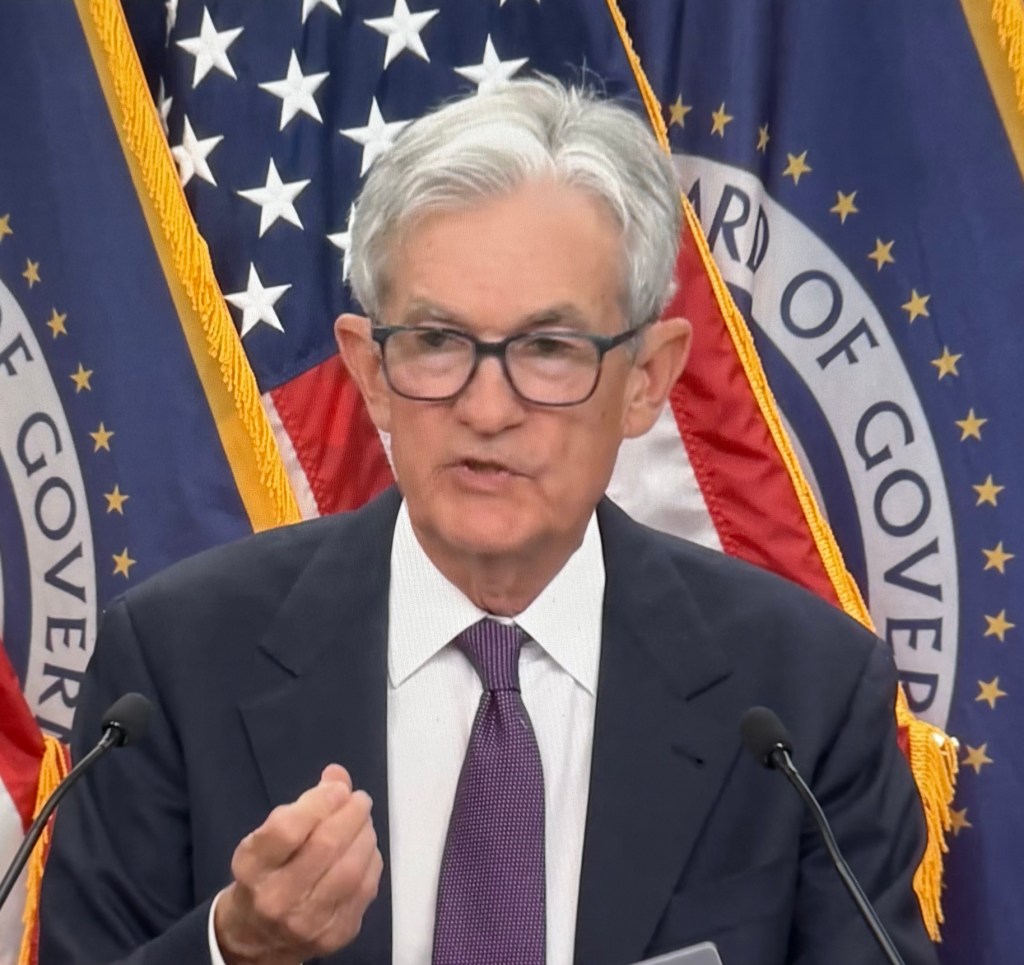
Screenshot of Fed Chair Jerome Powell at his FOMC press conference on April 29

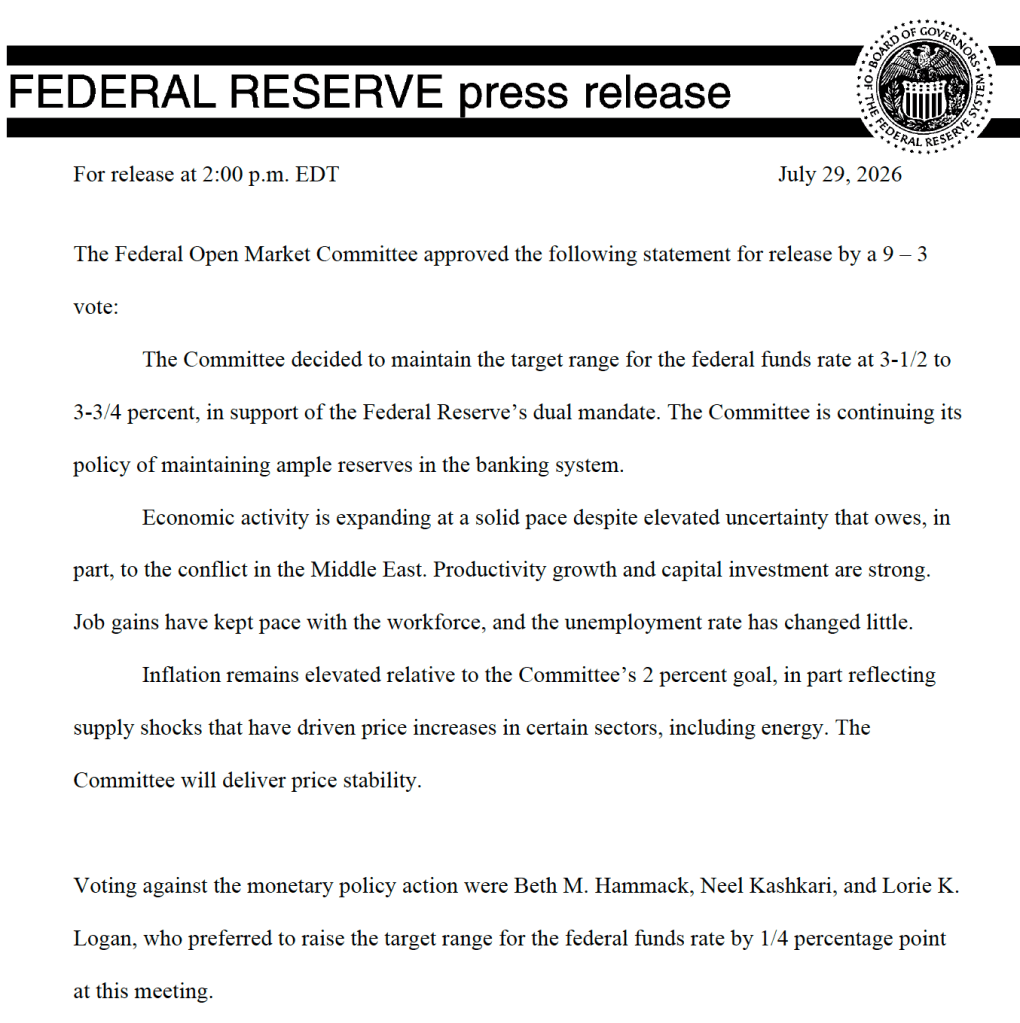
Today’s meeting of the Federal Reserve’s policymaking Federal Open Market Committee (FOMC) had the expected result with the committee deciding to leave unchanged its target for the federal funds rate at its current range of 3.50 percent to 3.75 percent. The members of the committee voted 8 to 4 in favor of the decision. Fed Governor Stephen Miran voted against the decision, preferring to lower the target range for the federal funds rate by 0.25 percentage point (25 basis points). Beth Hammack, president of the Federal Reserve Bank of Cleveland; Neel Kashkari, president of the Federal Reserve Bank of Minneapolis; and Lorie Logan, president of the Federal Reserve Bank of Dallas; supported keeping the target rate unchanged but “but did not support inclusion of an easing bias in the statement at this time.”

Perhaps the most significant news came at Chair Powell’s press conference at the conclusion of the meeting. Powell noted that Kevin Warsh’s nomination to be Fed chair had advanced out of the Senate Banking Committee this morning. Powell expected that Warsh would assume the role of chair by the time Powell’s term as chair ends on May 15. However, Powell announced that he would break with decades of tradition and remain on the Board of Governors. He noted that: “I have said that I will not leave the Board until this investigation [into his testimony before Congress concerning the renovations of the Fed’s headquarters building] is well and truly over, with transparency and finality, and I stand by that…. After my term as Chair ends on May 15, I will continue to serve as a governor for a period of time, to be determined. I plan to keep a low profile as a governor.” Powell’s term on the Board expires on January 31, 2028.

Powell will be the first Fed chair to remain on the Board after the end of his term as chair since Marriner Eccles continued to serve for three years after the end of his term as chair in 1948. The person whom the president has nominated as chair of the Board of Governors, once confirmed by the Senate, by tradition also serves as the chair of the FOMC. However, the Federal Reserve Act allows the FOMC to select its own chair. To head off any speculation that he might attempt to remain as chair of the FOMC, Powell stated at his press conference that: “When Kevin Warsh is confirmed and sworn, he will be that Chair. Once sworn in as Board Chair, his new colleagues will elect him to chair the FOMC as well.”

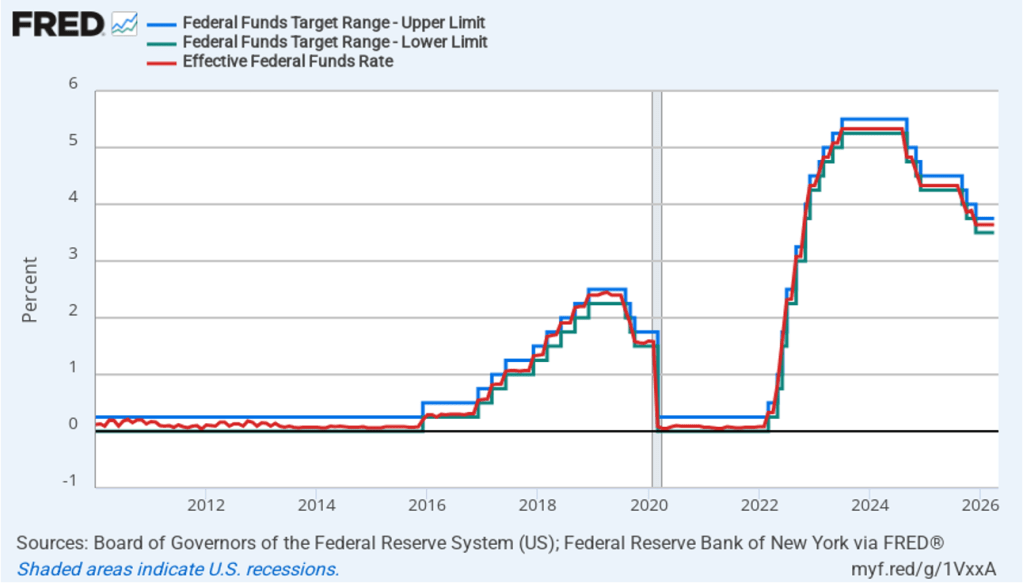
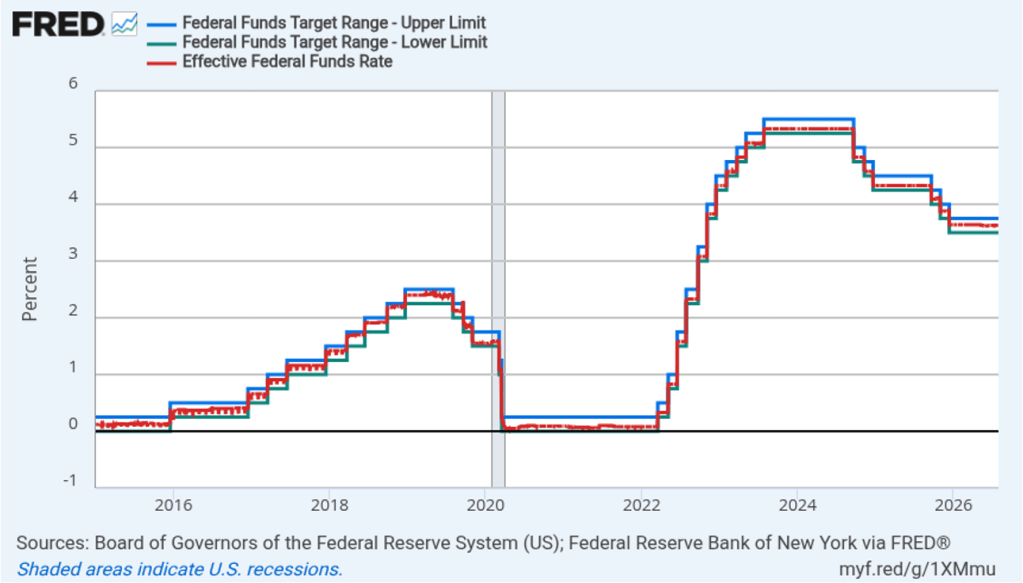
The FOMC has left its target for federal funds rate unchanged since lowering it by 25 basis points on December 10 of last year. The following figure shows for the period since January 2010, the upper bound (the blue line) and the lower bound (the green line) for the FOMC’s target range for the federal funds rate, as well as the actual values for the federal funds rate (the red line). Note that the Fed has been successful in keeping the value of the federal funds rate in its target range. (We discuss the monetary policy tools the FOMC uses to maintain the federal funds rate within its target range in Macroeconomics, Chapter 15, Section 15.2 (Economics, Chapter 25, Section 25.2).)
During his press conference, Powell discussed the reasons for the dissenting votes by Hammack, Kashkari, and Logan. The area of disagreement has to do with this sentence from the committee’s statement: “In considering the extent and timing of additional adjustments to the target range for the federal funds rate, the Committee will carefully assess incoming data, the evolving outlook, and the balance of risks.” The three dissenters believe that the statement implies that the next change would likely be to lower the target range for the federal funds. They wished the language to be changed to communicate that the next change might also be to raise the target range. The four dissents were the most at an FOMC meeting since 1992.

Powell stated that he believed the current target range was mildly restrictive, which he believed was appropriate given that the economy was still experiencing strong output growth and that the labor market appears to be stable, while tariffs and rising oil prices are putting upward pressure on the price level.

When might the FOMC lower its target range for the federal funds rate? One indication of expectations of future changes in the FOMC’s target for the federal funds rate comes from investors who buy and sell federal funds futures contracts. There are four more FOMC meeting scheduled for this year and for each meeting investors assign a probability of greater than 98 percent that the committee will either keep its target constant or raise it. For each meeting in 2027 until the last one on December 17–18, investors assign a probability of greater than 70 percent that the committee will keep its target constant or raise it. In other words, investors don’t believe that the target rate will be cut until the end of next year.

The next FOMC meeting will be on June 16–17. At that meeting, the committee is scheduled to release its quarterly Summary of Economic Projections (SEP), which includes a “dot plot” that represents each member’s expectations of future values of the federal funds rate. Warsh has questioned whether the SEP and the dot plot serve a good purpose and he may attempt to persuade the committee to abandon them. He has also questioned whether the chair should hold a press conference after every FOMC meeting as Powell has done since January 2019.

If Warsh does hold a press conference after the June meeting, his responses to questions will be closely analyzed for clues about the direction he intends to take the committee.

How Will the Fed React to Another High Inflation Report?

In a recent podcast we discussed what actions the Fed may take if inflation continues to run well above the Fed’s 2 percent target. We are likely a step closer to finding out with the release this morning (April 10) by the Bureau of Labor Statistics (BLS) of data on the consumer price index (CPI) for March. The inflation rate measured by the percentage change in the CPI from the same month in the previous month—headline inflation—was 3.5 percent, slightly higher than expected (as indicated here and here). As the following figure shows, core inflation—which excludes the prices of food and energy—was 3.8 percent, the same as in January.

If we look at the 1-month inflation rate for headline and core inflation—that is the annual inflation rate calculated by compounding the current month’s rate over an entire year—the values seem to confirm that inflation, while still far below its peak in mid-2022, has been running somewhat higher than it did during the last months of 2023. Headline CPI inflation in March was 4.6 percent (down from 5.4 percent in February) and core CPI inflation was 4.4 percent (unchanged from February). It’s worth bearing in mind that the Fed’s inflation target is measured using the personal consumption expenditures (PCE) price index, not the CPI. But CPI inflation at these levels is not consistent with PCE inflation of only 2 percent.

As has been true in recent months, the path of inflation in the prices of services has been concerning. As we’ve noted in earlier posts, Federal Reserve Chair Jerome Powell has emphasized that as supply chain problems have gradually been resolved, inflation in the prices of goods has been rapidly declining. But inflaion in services hasn’t declined nearly as much. Last summer he stated the point this way:

“Part of the reason for the modest decline of nonhousing services inflation so far is that many of these services were less affected by global supply chain bottlenecks and are generally thought to be less interest sensitive than other sectors such as housing or durable goods. Production of these services is also relatively labor intensive, and the labor market remains tight. Given the size of this sector, some further progress here will be essential to restoring price stability.”

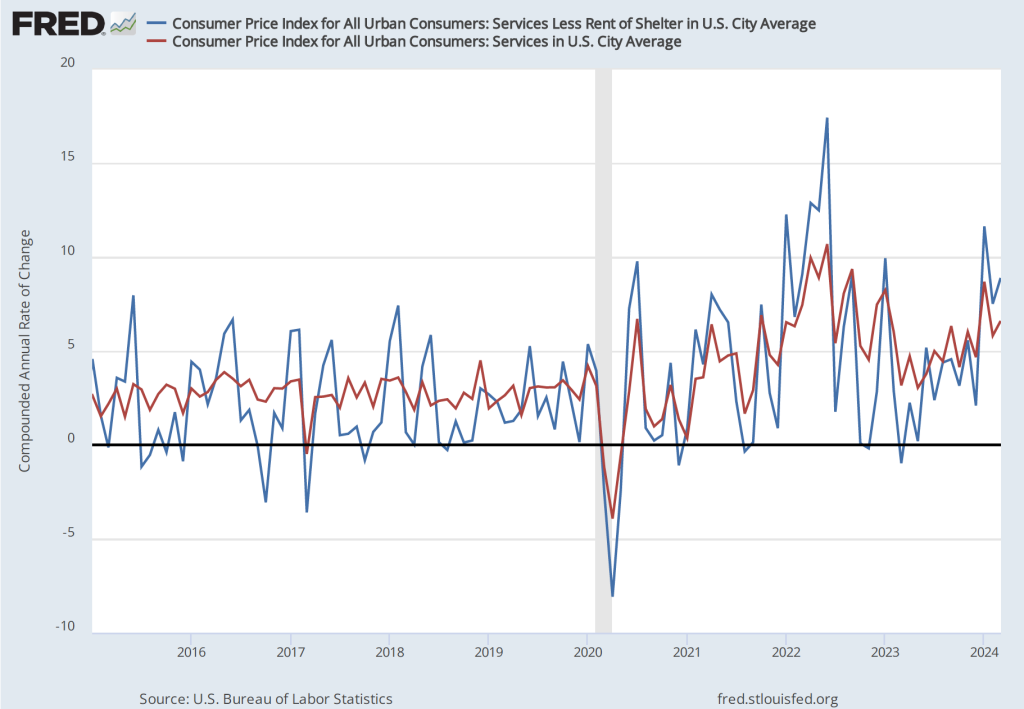
The following figure shows the 1-month inflation rate in services prices and in services prices not included including housing rent. Some economists believe that the rent component of the CPI isn’t well measured and can be volatile, so it’s worthwhile to look at inflation in service prices not including rent. The figure shows that inflation in all service prices has been above 4 percent in every month since July 2023. Inflation in service prices increased from 5.8 percent in February to 6.6 percent in March . Inflation in service prices not including housing rent was even higher, increasing from 7.5 percent in February to 8.9 percent in March. Such large increases in the prices of services, if they were to continue, wouldn’t be consistent with the Fed meeting its 2 percent inflation target.

Finally, some economists and policymakers look at median inflation to gain insight into the underlying trend in the inflation rate. If we listed the inflation rate in each individual good or service in the CPI, median inflation is the inflation rate of the good or service that is in the middle of the list—that is, the inflation rate in the price of the good or service that has an equal number of higher and lower inflation rates. As the following figure shows, although median inflation declined in March, it was still high at 4.3 percent. Median inflation is volatile, but the trend has been generally upward since July 2023.

Financial investors, who had been expecting that this CPI report would show inflation slowing, reacted strongly to the news that, in fact, inflation had ticked up. As of late morning, the Dow Jones Industrial Average had decline by nearly 500 points and the S&P 5o0 had declined by 59 points. (We discuss the stock market indexes in Macroeconomics, Chapter 6, Section 6.2 and in Microeconomics and Economics, Chapter 8, Section 8.2.) The following figure from the Wall Street Journal shows the sharp reaction in the bond market as the interest rate on the 10-year Treasury note rose sharply following the release of the CPI report.

Lower stock prices and higher long-term interest rates reflect the fact that investors have changed their views concerning when the Fed’s Federal Open Market Committee (FOMC) will cut its target for the federal funds and how many rate cuts there may be this year. At the start of 2024, the consensus among investors was for six or seven rate cuts, starting as early as the FOMC’s meeting on March 19-20. But with inflation remaining persistently high, investors had recently been expecting only two or three rate cuts, with the first cut occurring at the FOMC’s meeting on June 11-12. Two days ago, Neel Kashkari, president of the Federal Reserve Bank of Minneapolis raised the possibility that the FOMC might not cut its target for the federal funds rate during 2024. Some economists have even begun to speculate that the FOMC might feel obliged to increase its target in the coming months.

After the FOMC’s next meeting on April 30-May 1 first, Chair Powell may provide some additional information on the committee’s current thinking.

Is the Fed Becoming Too Political to Remain Independent?

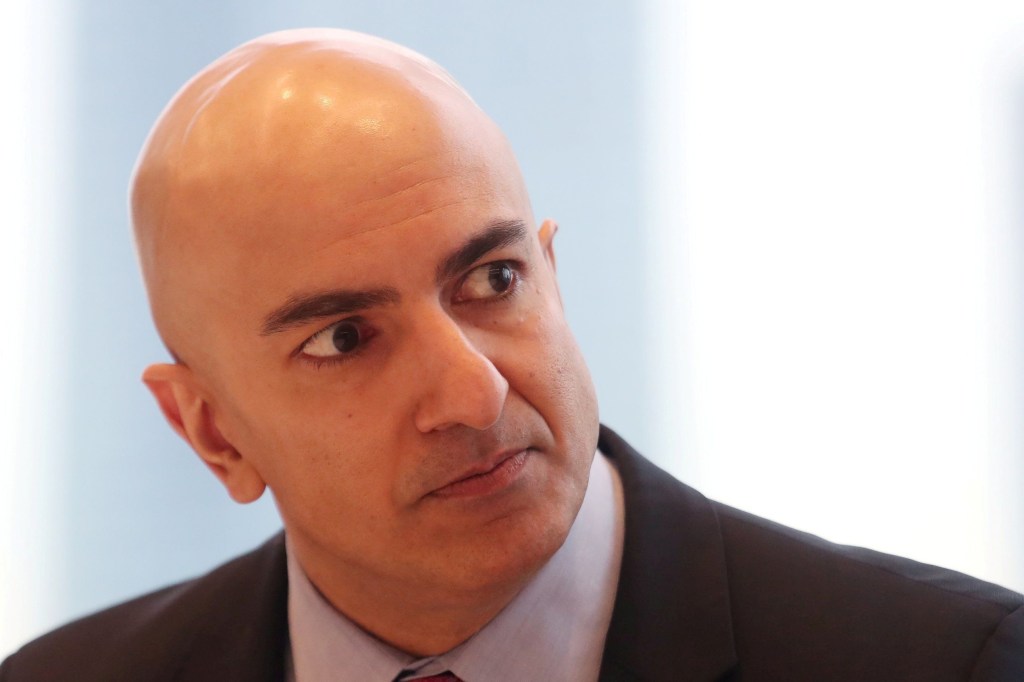
Neel Kashkari, president of the Federal Reserve Bank of Minneapolis. Photo from the Wall Street Journal.
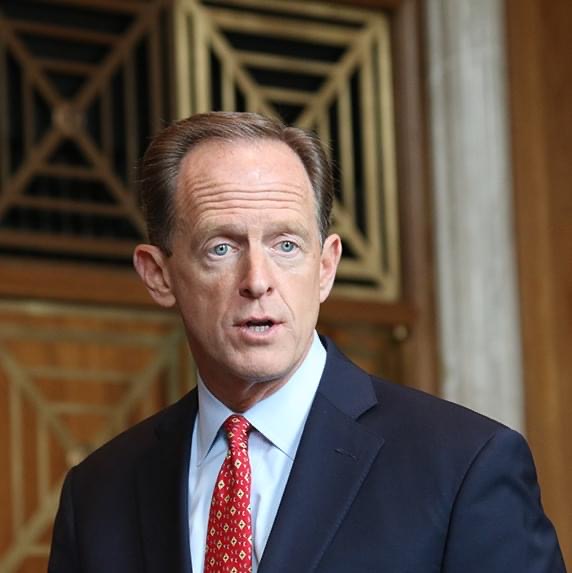
Pat Toomey, U.S. Senator from Pennsylvania. Photo from http://www.toomey.senate.gov.

As we discuss in Macroeconomics, Chapter 17, Section 17.4 (Economics, Chapter 27, Section 27.4), the Federal Reserve is unusual among federal government agencies in being able to operate largely independently of Congress and the president.  Congress passed the Federal Reserve Act, which established the Federal Reserve System, in 1913, and has amended it several times in the years since. (Note that, as we discuss in the Apply the Concept, “End the Fed?” in this chapter, the U.S. Constitution does not explicitly authorized the federal government to establish a central bank.) Section 2A of the act gives the Federal Reserve System the following charge:

“The Board of Governors of the Federal Reserve System and the Federal Open Market Committee shall maintain long run growth of the monetary and credit aggregates commensurate with the economy’s long run potential to increase production, so as to promote effectively the goals of maximum employment, stable prices, and moderate long-term interest rates.”

Elsewhere in the act, the Fed was given other specified responsibilities, such as supervising commercial banks that are members of the Federal Reserve System and serving on the Financial Stability Oversight Council (FSOC), which is charged with assessing risks to the financial system. 

Because Congress can change the structure and operations of the Fed at any time and because Congress has given the Fed only certain specific responsibilities, traditionally the Fed has avoided becoming involved in policy debates that are not directly concerned with its responsibilities. Over the years, most members of the Board of Governors have believed that if the Fed were to become involved in issues beyond monetary policy and the working of the financial system, Congress might decide to revise the Federal Reserve Act to reduce, or even eliminate, Fed independence.

In the spring of 2022, though, there were two instances where some members of Congress argued that the Fed had become involved in policy issues that went beyond the Fed’s responsibilities under the Federal Reserve Act. The first instance involved President Joe Biden’s nomination in January 2022 of Sarah Bloom Raskin to serve on the Fed’s Board of Governors. In 2010, Raskin was nominated to the Board of Governors by President Barack Obama and confirmed by the Senate in a voice vote without significant opposition. (In 2014, she resigned from the Board to accept a position in the Treasury Department.)

Her nomination by President Biden encountered significant opposition, however, largely because in July 2020 she had suggested that when the Fed expanded its lending programs during the Covid-19 pandemic it should have excluded firms in the oil, natural gas, and coal industries: “The Fed is ignoring clear warning signs about the economic repercussions of the impending climate crisis by taking action that will lead to increases in greenhouse gas emissions at a time when even in the short term, fossil fuels are a terrible investment.” Although her supporters argued that in formulating policy the Fed should take into account the threats to financial stability caused by climate change, when it became clear that a majority of the Senate disagreed, Raskin withdrew her nomination. 

In April 2022, some members of Congress, including Senator Pat Toomey of Pennsylvania, questioned whether it was appropriate for President Neel Kashkari of the Federal Reserve Bank of Minneapolis to formally support the campaign to amend the Minnesota state constitution to include a provision stating that, “All children have a fundamental right to a quality public education …. It is a paramount duty of the state to ensure quality public schools that fulfill this fundamental right.”

The Bank defended its support for the amendment in a statement on its website: “The Federal Reserve Bank of Minneapolis’ support of the Page amendment is closely linked to the mission of the Federal Reserve. Congress assigned the Federal Reserve the dual goals of achieving (1) stable prices and (2) maximum employment, and one of the greatest determinants of success in the job market is education.”

Senator Toomey strongly disagreed, arguing in a letter of Bank President Kashkari that: “This amendment is highly political, as it wades into an ongoing debate about whether government-run school systems are preferable to parental choice in education.” Toomey asserted that: “These political lobbying efforts by you and other Minneapolis Fed officials … are well beyond the Federal Reserve’s mandate, violate Federal Reserve Bank policies, constitute a misuse of Minneapolis Fed resources, and ultimately undermine the Federal Reserve’s independence and credibility.”

It remains to be seen whether Congress will ultimately accept the arguments of Federal Reserve policymakers such as Kashkari and Raskin that the Fed needs to interpret its mandate from Congress more broadly, or whether Congress will decide to amend the Federal Reserve Act to more explicitly limit the boundaries of Fed action—or to reduce Fed independence in some other ways. 

Sources: Sarah Bloom Raskin, “Why Is the Fed Spending So Much Money on a Dying Industry?” New York Times, May 28, 2020; Andrew Ackerman and Ken Thomas, “Sarah Bloom Raskin Withdraws as Biden’s Pick for Top Fed Banking Regulator,” Wall Street Journal, March 15, 2022; Michael S. Derby, “GOP Senator Criticizes Minneapolis Fed Over Education Issue,” Wall Street Journal, April 12, 2022; Federal Reserve Bank of Minneapolis, “Page Amendment: Every Child Deserves a Quality Public Education,” minneapolisfed.org; and Pat Toomey, “Letter to Neel Kashkari,” banking.senate. gov, April 11, 2022.