COVID-19 Update – Can Mom and Pop Businesses Survive the Coronavirus Pandemic?

Supports:  Econ & Micro: Chapter 11, Technology, Production, and Costs (Section 11.6); Chapter 13, Monopolistic Competition; Chapter 14, Oligopoly (Section 14.1); Essentials: Chapter 9, Technology, Production, and Costs; Chapter 11, Monopolistic Competition and Oligopoly

Can Mom and Pop Businesses Survive the Coronavirus Pandemic?

By early April 2020, because of the coronavirus pandemic, all 50 state governments had issued declarations of emergency and had closed schools and some or all businesses considered to be non-essential.  A survey by Alexander Bartik of the University of Illinois and colleagues indicated that about 43 percent of small businesses in the Unites States had closed, causing most of their revenue to disappear.  As a result, those businesses had laid off about 40 percent of their employees.

In March 2020, Congress and President Donald Trump enacted the Coronavirus Aid, Relief, and Economic Security (CARES) Act. The act included the Paycheck Protection Program (PPP), which provided loans to businesses with 500 or fewer employees to pay for up to eight weeks of payroll expenses and certain other costs. The government would forgive the loans if business owners used 75 percent of the funds for payroll expenses.

            The PPP was administered by the federal Small Business Administration with the loans being made primarily by local banks. Many small businesses have trouble borrowing from banks, particularly if they lack collateral, such as owning the building they operate in, or if they don’t have a long-term relationship with a bank by having borrowed from them in the past or having maintained a business checking account with them. In a survey by the Federal Reserve conducted in 2019, before the coronavirus pandemic, 64 percent of small businesses had faced financial challenges, such as paying operating expenses or purchasing inventories, during the previous year.  Of those firms, 69 percent had relied on the owner’s personal funds to meet the financial challenge. 

            In mid-April 2020, it was unclear whether Congress might change the PPP to make it easier for small businesses to borrow through credit unions and other lenders that are not commercial banks. News reports indicated that a significant number of small businesses had exhausted the funds their owners had available and intended to permanently close.  It’s not unusual for a small firm to fail. In a typical year, even when the economy is expanding, hundreds of thousands of businesses fail (and a similar number open).  But some economists and policymakers were concerned that the effects of the pandemic might lead to a permanent reduction in the number of small firms, particularly so-called “Mom and Pop businesses”—sole proprietorships that employ fewer than 20 workers.  (We discuss the differences between sole proprietorships and other ways of organizing a business in Chapter 8, Section 8.1)

The pandemic posed particular challenges for these businesses.  Many small retailers, such as clothing stores, shoe stores, card shops, and toy stores, had already been hurt before the pandemic as consumers shopped at online sites such as Amazon. This trend increased during the pandemic. In addition, as many consumers shifted from eating in restaurants to buying groceries from supermarkets or online, the future of some small restaurants seemed in doubt.

Even as states and cities began to allow nonessential businesses to reopen, many consumers were reluctant to return to eating in restaurants, staying in hotels, and shopping in brick-and-mortar stores in the absence of a vaccine against the coronavirus.  The shift to online buying was evident during March and April 2020 when, as many small businesses were laying off workers, Amazon was hiring an additional 175,000 workers and Walmart was hiring an additional 150,000.  Some public health authorities and epidemiologists were suggesting that businesses take certain steps to reassure consumers, although doing so would raise the businesses’ costs of operating. For instance, Scott Gottlieb, former Food and Drug Administration commissioner, suggested that “businesses … should look at trying to bring testing on-site at the place of employment” to reassure customers that the businesses’ workers did not have the virus. He also suggested that restaurants print their menus on paper that could be thrown away after each use and commit to more frequent disinfecting. Clearly, the revenue earned by larger businesses would be better able to cover these costs while still at least breaking even.

            If the world is entering a new period with more frequent epidemics of viruses to which most people lack immunity, small businesses will be at a further disadvantage. Although Congress and the president responded to the coronavirus with the PPP program, whether they would have funds to do so during future epidemics remained unclear. As a result, it may be of increased importance that firms have the resources to finance periods of closure without having to rely on government payments, loans from banks for which they may lack the necessary collateral, or running balances on high-interest rate credit cards. The survey by Alexander Bartik and colleagues referred to earlier indicated that the average small business has $10,000 in monthly costs and less than that amount readily available to use to pay those costs.  In other words, many small businesses are dependent on paying their current costs from their current revenues.

            Most small business owners are resourceful enough to respond to changing conditions, but the challenges posed by the coronavirus seemed likely to reshape the structure of some industries, including restaurants, small retail stores, gyms, non-chain hotels, and small medical and dental practices. When discussing the role that barriers to entry play in determining the level of competition and the size of firms in an industry, we emphasized the role played by physical economies of scale. For instance, we noted that:

A music streaming firm has the following high fixed costs:  very large server capacity, large research and development costs for its app, and the cost of the complex accounting necessary to keep track of the payments to the musicians and other copyright holders whose songs are being streamed.  A large streaming firm such as Spotify has much lower average costs than would a small music streaming firm, partly because a large firm can spread its fixed costs over a much larger quantity of subscriptions sold.

We also noted that economies of scale of this type did not exist in the restaurant industry. Prior to the pandemic, it was reasonable to argue that large restaurants were typically unable to serve meals at a lower average cost than smaller restaurants and that even if smaller restaurants faced higher average costs, by differentiating the meals they served, smaller restaurants could still attract customers despite charging a higher price than larger restaurants. But if small restaurants lack the ability to finance periods of closure during epidemics and have trouble breaking even due to the higher costs of printing paper menus, testing their employees onsite, and more frequent cleaning, they may struggle to survive. Larger restaurants can spread these costs over a larger number of meals, reducing the average cost of one meal compared with smaller restaurants. As more consumers avoid restaurants and eat more frequently at home, smaller restaurants may be pushed further up their average cost curves by being able to sell only a smaller quantity of meals.

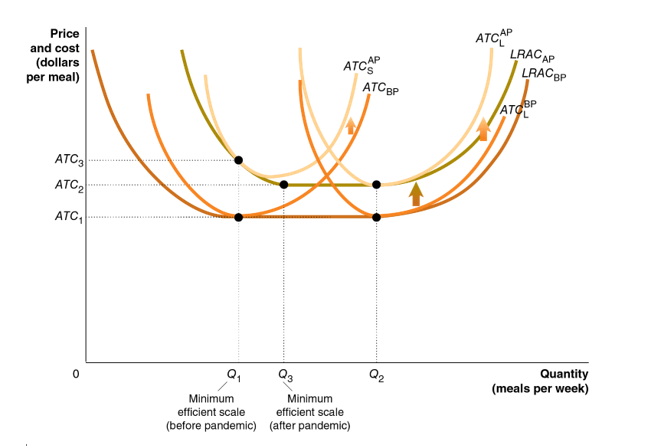
The following figure illustrates how the pandemic may affect the costs of a typical restaurant.  The long-run average cost curve LRACBP shows the situation before the pandemic. The higher costs necessary to operate after the pandemic, including printing paper menus and more frequent cleaning, shifts up the long-run average cost curve to LRACAP.  Before the pandemic, the average total cost curve for the small restaurant is  and for the large restaurant is .  Notice that even though the large restaurant serves Q2 meals per week and the small restaurant serves Q1 meals per week, they both have the same average total cost per meal, ATC1.

Also notice that before the pandemic, serving Q1 meals per week was the minimum efficient scale for a restaurant.  Minimum efficient scale is the level of output at which all economies of scale are exhausted.  The pandemic increases the costs of the small restaurant from  to is , and the costs of the large restaurant from to .  Minimum efficient scale increases to Q3, which is more meals per week than a small restaurant can sell. As a result, the average total cost of small restaurant increases to ATC3. A larger restaurant is still selling a quantity of meals that is beyond minimum efficient scale, so its average cost only rises to ATC2.  With higher average costs, smaller restaurants are less able to successfully compete with larger restaurants.  
Small firms in other industries are likely to face similar challenges. The result could be a contraction in the number of firms in some industries.  For instance, we may see franchised firms replacing Mom and Pop businesses—more Domino’s and Pizza Hut outlets and fewer independent pizza restaurants.  Although it’s too early to tell the full effects of the coronavirus pandemic on U.S. businesses, the effects are likely to be far-reaching.

Sources: Ruth Simon, “For These Companies, Stimulus Was No Solution; ‘We Decided to Cut Our Losses,’” Wall Street Journal, April 15, 2020; Amara Omeokwe, “Small-Business Funding Dispute Challenges Community Lenders,” Wall Street Journal, April 14, 2020; Alexander W. Bartik, Marianne Bertrand, Zoë B. Cullen, Edward L. Glaeser, Michael Luca, and Christopher T. Stanton, “How Are Small Businesses Adjusting to Covid-19? Early Evidence from a Survey,” National Bureua of Economic Research, Working Paper 26989, April 2020 (https://www.nber.org/papers/w26989.pdf); Board of Governors of the Federal Reserve System, 2019 Report on Employer Firms: Small Business Credit Survey, https://www.fedsmallbusiness.org/medialibrary/fedsmallbusiness/files/2019/sbcs-employer-firms-report.pdf, 2019; Norah O’Donnell And Margaret Hynds, “5 Things to Know about Reopening the Country from Dr. Scott Gottlieb,” cbsnews.com, April 14, 2020.

Question: 

Sendhil Mullainathann of the University of Chicago wrote an opinion column in the New York Times describing the situation facing the owner of a small restaurant:

She has little money in cash reserve; operating margins are thin … and her savings had already been spent on expanding the cramped kitchen. What was a thriving enterprise before the pandemic will emerge—if it emerges at all—as a hobbled business, which may well fail shortly thereafter.

A) What does Mullainathan mean by the restaurant’s “operating margins are thin”? Why would we expect the operating margins of a small restaurant to be thin?

B) If this restaurant was a “thriving enterprise” before the pandemic, why might it be likely to fail after the pandemic?

For Economics Instructors that would like the approved answers to the above questions, please email Christopher DeJohn from Pearson at christopher.dejohn@pearson.com and list your Institution and Course Number.
COVID-19 Update – The Futures Market and the Strange Case of Negative Price of Oil.

Supports:  Econ and Micro: Chapter 8, “Firms, the Stock Market, and Corporate Governance” Macro Chapter 6; Essentials Chapter 6

The Futures market and the strange case of negative price of oil

There’s a point that seems so obvious that we haven’t explicitly mentioned it until now:  The price of a good or service is always positive. After all, a price being negative means that a seller is paying a buyer to accept a good or service, which seems very unlikely.  But this strange outcome did occur in the U.S. oil market during the economic upheaval caused by the coronavirus pandemic of 2020.

            In the spring of 2020, there were two important developments in the world oil market:

  1. A sharp decline in demand   Many countries imposed social-distancing protocols and required non-essential business to shut down in response to the pandemic.   These policies caused the demand for oil products to decline dramatically. For instance, in the United States, the demand for gasoline fell by about 50 percent between the middle of March and the middle of April. The decline was the largest in history over such a short period.
  2. A decline in world supply   Twenty-three countries, including the United States, Russia, and Saudi Arabia—the world’s three largest oil producer—agreed to reduce oil production by 9.7 million barrels per day, or about 13 percent of daily world production. These countries  hoped that the decline in supply would keep the world price of oil from falling to very low levels.  In fact, though, through mid-April the decline in demand was larger than the decline in supply leading to a dramatic decline in oil prices.

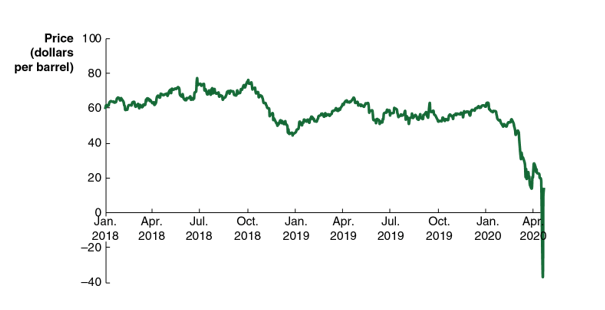
Crude oil from different rock formations can vary in its characteristics, such as its sulfur content.  Crude oil that requires more processing as it is being refined into gasoline, aviation fuel, or other products, sells for a lower price. The benchmark oil price in the United States is for a grade of crude oil called West Texas Intermediate.  The following figure shows the fluctuations in the price per barrel of this type of oil from January 2018 through late April 2020.

After reaching a high of $63 per barrel in January 2020, the price of oil declined to negative $37 per barrel on April 20.  In other words, sellers were willing to pay buyers $37 per barrel to accept delivery of oil.  Why would a seller ever pay someone to accept a product?  There are two related reasons. We can discuss the first reason using demand and supply analysis. The second reason requires a brief discussion of how the oil market is different from most other markets for goods.

Demand and Supply in the Spot Market for Oil

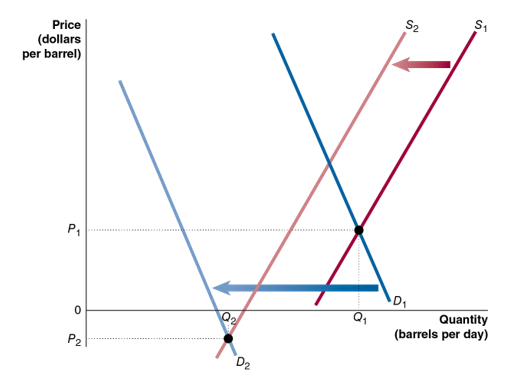
            To understand how movements in demand and supply in the oil market resulted in a negative price, consider the following figure illustrating this situation. Before the coronavirus pandemic, the demand for oil is shown by demand curve D1 and the supply of oil by supply curve S1. The equilibrium price is P1.  During the pandemic, the amount of oil demanded declined sharply from D1 to D2, and the supply of oil declined from S1 to S2.  As a result, the new equilibrium price became negative at P2.  We can see that for the equilibrium price to be negative, the demand curve and supply curve must intersect below the horizontal axis.  

But why would a firm be willing to supply any oil at a negative price?  The answer requires  understanding how oil markets work.  The spot price of oil is the price for oil that is available for immediate delivery.  A seller at the spot price is typically a firm pumping oil, and a buyer is a firm that uses oil as an input, such as a firm that refines oil into gasoline.  When you buy bread in the supermarket or a Big Mac at McDonald’s you are paying the spot price, which is the only price in the markets for most goods and services. In the figure we are showing the spot market for oil and the price is the spot price.

The Futures Market for Oil

But in addition to a spot market for oil, there is a futures market for oil, which allows individuals and firms to buy and sell futures contracts.  A futures contract specifies the quantity of an asset—such as a barrel of oil—that will be delivered by the seller on a future date, the settlement date. Futures contracts exist for commodities such as oil, as well as for financial assets, such as Treasury bonds and stock indexes like the S&P 500. Futures contracts don’t set the price—the futures price—that the buyer will pay and the seller will receive on the settlement date. Instead, the price fluctuates as the contract is bought and sold on a futures exchange, such as the Chicago Board of Trade or the New York Mercantile Exchange, just as the price of a share of stock fluctuates as the stock is bought and sold in the stock market.  Each oil futures contract represents 1,000 barrels (or 42,000 gallons) of oil.

The futures price of oil can differ from the spot price if people trading futures contracts expect that conditions in the oil market will differ on the settlement date from conditions today. For instance, on April 20, 2020, the date on which the spot price of oil was negative, the oil futures price on a contract with a settlement date in June was $22 per barrel and the price on a contract with a settlement date in November was $33 per barrel.  The higher oil prices for June and November reflected the view among buyers and sellers and futures contracts that (1) the economy was likely to begin recovering from the worst of the pandemic by then, increasing the demand for oil and (2)  the supply of oil was likely to decline further.

The spot price and the futures price are linked because it’s possible to store oil. So, the futures price should roughly equal the spot price plus the cost of storing oil between today and the settlement date of the futures contract. As the settlement date approaches, the futures price comes closer to the spot price, eventually equaling the spot price on the settlement date. Why must the spot price equal the futures price on the settlement date? Because if there were a difference between the two prices, it would be possible for an investor to make a profit. For instance, if the spot price of oil was $35 on the settlement date of the futures contract but the futures price was $40, an investor could buy oil on the spot market and simultaneously sell futures contracts. The buyers of the futures contract would have to accept delivery of oil at $40, which would allow the investor to make a risk-free profit of $5 per barrel. In practice, investors selling additional futures contracts would drive down the futures price until it equaled the spot price. Only then would the ability to make a profit disappear.

Unlike with the spot market, buyers and sellers in the futures market may not be involved with either pumping or using oil. Instead, they may be investors who hope to profit by placing a bet on which way the price of oil will change in the future. These market participants are called speculators.  Speculators serve the useful purpose of adding to the number of buyers and sellers in the futures market, thereby increasing market liquidity, which is the ease with which a buyer or seller can sell an asset, such as a futures contract.

You can speculate on the price of oil using the futures market in oil. If you believe that the futures price is lower than the spot price of oil will be on the settlement date, you can hope to make a profit by buying futures contracts today and selling them after the price rises. Similarly, if you believe that the futures prices is higher than the price of oil will be in the spot market on the settlement date, you can sell futures contracts at the current high price and  buy them back after the price has fallen. It’s important to understand that investors doing this type of buying and selling of futures contracts don’t expect to actually deliver or receive barrels of oil.

What Happened in the Oil Market in April 2020?

Ordinarily, when firms pumping oil expect prices to be significantly higher in the future, they can respond by withholding oil from the market in several ways: (1) They can reduce the quantity of oil they pump, in effect storing it in the ground until prices increase; (2) they can pump oil and store it until prices rise; and (3) they can store oil products like gasoline that are refined from oil on supertankers, which are capable of holding millions of barrels of oil, waiting for prices to rise.

But in the spring of 2020, the decline in demand was so large and so sudden that firms were uncertain how much to reduce the quantity of oil they were pumping.  If the decline in demand was temporary, lasting only during the worst of the pandemic, firms that cut back too much would face both the cost of both closing and then reopening oil wells.  In some cases, even temporarily stopping production from a well can permanently reduce how much oil can be recovered from the well. In addition, the usual places to store oil were rapidly reaching capacity.  As an article in the Wall Street Journal put it: “The buildup of crude is overwhelming storage space and clogging pipelines. And in areas where tanker-ship storage isn’t readily available, producers could need to go to extremes to get rid of the excess.” The “extremes” included accepting negative prices. 

On April 20, there was a second factor pushing oil prices into negative values. The May futures contract was expiring the next day, meaning that any buyer who had not sold the contract would legally have to pay for and accept delivery of 1,000 barrels of oil.  As we’ve seen, some buyers and sellers of oil futures contracts are speculators who don’t intend to deliver or receive barrels of oil.  Given the shortage of storage facilities, rather than accept delivery for oil with nowhere to put it, speculators were willing to take steep losses by selling their contracts at a negative price.  In effect, a buyer of a contract received $37,000 ($37 per barrel × 1,000 barrels per contract) in addition to 1,000 barrels of oil—a great deal, but only if you had somewhere to store the oil.

If oil producers become convinced that the decline in demand is likely to be long-lived, they will reduce the supply of oil substantially and the spot price will rise enough to ensure that the producers are able to cover all of their costs.  But the fact that the spot price of oil was briefly negative indicates the level of economic disruption the coronavirus caused.

Sources: Ryan Dezember, “U.S. Oil Costs Less Than Zero After a Sharp Monday Selloff,” Wall Street Journal, April 21, 2020; Neil Irwin, “What the Negative Price of Oil Is Telling Us,” New York Times, April 21, 2020; Myra P. Saefong, “Oil Market in ‘Super Contango’ Underlines Storage Fears as Coronavirus Destroys Crude Demand,” marketwatch.com, April 18, 2020; Benoit Faucon, Summer Said, and Timothy Puko, “U.S., Saudi Arabia, Russia Lead Pact for Record Cuts in Oil Output,” Wall Street Journal, April 12, 2020; Federal Reserve Bank of St. Louis; and U.S. Energy Information Administration.

Question: 

  1. If a futures market for oil didn’t exist,  would the spot price of oil ever be negative?
  2. If you were a manager of a firm that owns oil wells, how would you benefit from the existence of a futures market for oil? If you were a manager of a firm that buys oil to refine into gasoline, how would you benefit from the existence of a futures market for oil?

For Economics Instructors that would like the approved answers to the above questions, please email Christopher DeJohn from Pearson at christopher.dejohn@pearson.com and list your Institution and Course Number.

4/17/20 Podcast – Glenn Hubbard & Tony O’Brien discuss the Federal Reserve response and toilet paper shortages.

On April 17th, Glenn Hubbard and Tony O’Brien continued their podcast series by spending just under 30 minutes discuss varied topics such as the Federal Reserve’s monetary response, record unemployment numbers, panic buying of toilet paper as compared to bank runs, as well as recent books they’ve been reading with increased downtime from the pandemic.

COVID-19 Update – How Will the Coronavirus Pandemic Affect the Airline Industry?

Supports:  Chapter 12 in Economics and Microeconomics – Firms in Perfectly Competitive Markets; Essentials Chapter 9.

SOLVED PROBLEM: HOW WILL THE CORONAVIRUS PANDEMIC AFFECT THE AIRLINE INDUSTRY?

During the coronavirus pandemic, many airlines experienced a sharp decline in ticket sales.  Some airlines responded by cutting ticket prices to very low levels.  For example, in early March, Frontier Airlines was offering round-trip tickets from New York City to Miami for $51 (compared to over $200 three months earlier). As one columnist in the Wall Street Journal put it, the price of many airline tickets was “cheaper than dinner or what you’ll spend on Ubers or taxis.”

  1. Briefly explain whether it was likely that the price Frontier was charging was high enough to cover the average total cost of a flying an airplane from New York City to Miami. Why was Frontier willing to accept such a low price? Would the airline be willing to accept such a low price in the long run?
  2. Some airlines believed that even after the pandemic was over, consumers might not be willing to fly on planes as crowded as they were prior to the pandemic. Accordingly, airlines were considering either flying planes with some rows kept empty or reconfiguring planes to have more space between rows—and therefore fewer seats per plane. Briefly explain what effect having fewer seats per airplane might have on the price of an airline ticket.

Sources: Jonathan Roeder, “NYC to Miami for $51: Coronavirus Slump Leads to Steep Airfare Discounts,” bloomberg.com, March 5, 2020; and Scott McCartney, “There Are Plenty of Coronavirus Flight Deals Out There, But Think Before You Buy,” Wall Street Journal, March 25, 2020.

Solving the Problem

Step 1:   Review the chapter material. This problem is about the break-even price for a firm in the short run and in the long run, so you may want to review Chapter 12, Section 12.4 “Deciding Whether to Produce or to Shut Down in the Short Run” and Section 12.5 “‘If Everyone Can Do It, You Can’t Make Money at It’: The Entry and Exit of Firms in the Long Run.”. In Hubbard/O’Brien, Essentials of Economics, it is Chapter 9.

Step 2:   Answer part a. by explaining why even though a ticket price of $51 was unlikely to cover the average total cost of the flight, Frontier Airlines was still willing to accept such a low ticket price—but only in the short run. As we’ve seen in Section 12.5, competition among firms drives the price of a good to equal the average total cost of the typical firm. Assuming that ticket prices prior to the pandemic equaled average total cost, then the low ticket prices in the spring of 2020 must have been below average total cost.  We have also seen, though, that firms will continue to produce in the short run provided they receive a price equal to or greater than average variable cost. For a particular flight, the fixed cost—primarily the cost of aviation fuel and the salaries of the flight crew—is much greater than the variable cost—additional meals served, somewhat more fuel used because more passengers make the plane heavier, and possibly an additional flight attendant needed to assist additional passengers.  So, the $51 ticket price may have been enough for Frontier to cover its average variable cost. The airline would not accept such a low price in the long run, though, because in the long run it would need to cover all of its costs or it would no longer fly the route. (Note: In the short run, an airline might have another reason to continue to fly planes on a route even if it is unable to cover the average total cost of a flight. The contracts that airlines have with airports sometimes require a specified number of flights each day in order for the airline to retain the right to use certain airport gates.)

Step 3:   Answer part b. by explaining the effect that having fewer seats per airplane would have on airline ticket prices. For an airline to break even on a flight, its total revenue from the flight must equal its total cost.  Flying fewer seats per plane will not greatly reduce the airline’s cost of the flight because, as noted in the answer to part b., most of the cost of a flight is fixed and so the total cost of a flight doesn’t vary much with the number of passengers on the flight.  But flying half as many passengers—if every other row is left empty—will significantly decrease the revenue the airline earns from the flight. To increase revenue on the flight, the airline would have to increase the price of a ticket. We can conclude that if airlines decide to fly planes equipped with fewer seats, ticket prices are likely to rise. Note that if on some routes the demand for tickets is price elastic, raising the price will reduce revenue and the airline will be unable to cover its cost of flying the route.

COVID-19 Update – Impact on Supply Chains: Will Apple Start Making iPhones in the United States?

Supports:  Chapter 2, Trade-offs, Comparative Advantage, and the Market System [Econ, Micro, Macro, and Essentials]; Chapter 9, Comparative Advantage and the Gains from International Trade     [Econ and Micro; Macro Chapter 7; and Essentials Chapter 19]; Chapter 22, Aggregate Expenditure and Output in the Short Run   [Macro Chapter 12].

WILL APPLE START MAKING IPHONES IN THE UNITED STATES?

Apple, like many U.S. firms, relies on a global supply chain (sometimes also called a global value chain) comprised of firms in dozens of countries to make the components used in Apple’s products. (See Hubbard/O’Brien Chapter 2, Section 2.3 of Hubbard and O’Brien Economics and Microeconomics).  This strategy has allowed Apple to take advantage of both lower production costs and the engineering and manufacturing skills of firms in other countries to produce iPhones, iPads, iWatches, and MacBooks. But during the coronavirus pandemic, Apple found its supply chain disrupted because many of its suppliers located in China were forced to close for several months.

            Because of the coronavirus pandemic and the trade war between the United States  and China, many U.S. firms, including Apple, were considering moving some of their operations out of China. (The trade war is discussed in Chapter 9, section 9.5 of Hubbard and O’Brien Economics and Microeconomics, Chapter 7, Section 7.5 of Macroeconomics.)  As an article on bloomberg.com put it, these firms were “actively seeking ways to diversify their supply chains and reduce their dependence on any single country, no matter how attractive.” For example, two Taiwanese firms, Wistron and Pegatron, which had used factories in China to assemble iPhones were moving some factories to India, Vietnam, and Taiwan.

            It seemed unlikely, though, that production of iPhones would move back to the United States. Why not?  First, manufacturing employment has been in decline in the United States since long before U.S. firms began using suppliers based in China. In 1947, shortly after the end of World War II, 33 percent of U.S. workers were employed in manufacturing. By 2001, when China became a member of the World Trade Organization, that percentage had already declined to 12 percent. In 2019, it was 9 percent.

Manufacturing production in the United States has held up better than manufacturing employment. The Federal Reserve’s index of manufacturing production increased more than 250 percent between the beginning of 1972 and the beginning of 2020. U.S. manufacturing has been able to increase output while employment has declined because of increases in productivity. The increases in productivity have relied, in part, on increased use of robotics, particularly in assembly line work, such as the production of automobiles.  The United States has a comparative advantage in producing goods and services that require skilled labor and involve artificial intelligence, machine learning, and the use of other sophisticated computer programing. Manufacturing that relies on lower-skilled labor, such as textile and shoe production, has been mostly moved overseas. 

            The Taiwanese firms Foxconn, Wistron, and Pegatron assemble iPhones, primarily in factories in China and elsewhere in Asia where large quantities of unskilled labor are available.  Some components of the iPhone that require skilled labor and sophisticated engineering, including the screens, the touchscreen controller, and the Wi-Fi chip, are produced by U.S. firms and shipped to China for final assembly. In fact, surprisingly, the value of the U.S.-made components exceeds the value of assembling the iPhone in Chinese factories. (See Hubbard and O’Brien Economics, Chapter 22, Section 22.3 and Macroeconomics, Chapter 12, Section 12.3).

            Factory assembly lines, like those in China making iPhones, need to be flexible to respond quickly to Apple introducing new models. So, in addition, to hundreds of thousands of unskilled workers in its assembly plants, Foxconn and other firms operating in China hire thousands of engineers. Typically, these engineers do not have college degrees, but they have sufficient training to rapidly redesign and reconfigure assembly lines to produce new models. In 2010, when President Barack Obama pressed Steve Jobs, the late Apple CEO, to produce iPhones in the United States, Jobs pointed to lack of sufficient workers with engineering skills to make such production possible. Jobs stated that he would need 30,000 such engineers if Apple were to make iPhones in the United States, but “You can’t find that many in America to hire.”

            The situation hasn’t changed much in the past 10 years. As an article in the Wall Street Journal observed in March 2020, in addition to a large number of unskilled workers, Foxconn employs in China, “Tens of thousands of experienced manufacturing engineers [to] oversee the [production] process. Finding a comparable amount of unskilled and skilled labor [elsewhere] is impossible.”

            Although some firms were attempting to reduce their reliance on Chinese factories in response to the coronavirus pandemic, because the United States lacks a comparative advantage in the assembly of consumer electronics, it seemed unlikely that those factories would be relocated here.  But the coronavirus pandemic may lead some U.S. firms to change their supply chains in other ways.  For instance, firms may now put greater value on redundancy. Apple might underwrite the cost to its suppliers of building facilities in several Asian countries to assemble iPhones. In the event of problems occurring in one country, this redundant capacity would allow production to switch from factories in one country to factories in other countries.

            Similarly, some firms may rethink their inventory management. Before the 1970s, most manufacturing firms kept substantial inventories of parts and components. Retail firms often kept substantial inventories of goods in warehouses. This approach began to change during the 1970s, as Toyota pioneered just-in-time inventory systems in which firms accept shipments from suppliers as close as possible to the time they will be needed. Most manufacturers in the United States and elsewhere adopted these systems, as did many retailers.

            For example, at Walmart, as goods are sold in the stores, this point-of-sale information is sent electronically to the firm’s distribution centers to help managers determine what products to ship to each store. This distribution system allows Walmart to minimize its inventory holdings.  Because Walmart sells 15 to 25 percent of all the toothpaste, disposable diapers, dog food, and other products sold in the United States, it has involved many manufacturers in its supply chain. For example, a company such as Procter & Gamble, one of the world’s largest manufacturers of toothpaste, laundry detergent, and toilet paper, receives Wal-Mart’s point-of-sale and inventory information electronically. Procter & Gamble uses that information to determine its production schedules and the quantities and timing of its shipments to Walmart’s distribution centers.

            But as the pandemic disrupted supply chains, many manufacturers had to suspend production because they did not receive timely shipments of parts. Similarly, Walmart and other retailers experienced stockouts—sales lost because the goods consumer want to buy aren’t on the shelves.

            In 2020, firms were reconsidering their supply chains as they evaluated whether to underwrite the building of redundant capacity among their suppliers and whether to reduce the extent to which they relied on just-in-time inventory systems.

Sources: Debby Wu, “Not Made in China Is Global Tech’s Next Big Trend,” bloomberg.com, March 31, 2020; Yossi Sheffi, “Commentary: Supply-Chain Risks From the Coronavirus Demand Immediate Action,” Wall Street Journal, February 18, 2020; Tripp Mickle and Yoko Kubota, “Tim Cook and Apple Bet Everything on China. Then Coronavirus Hit,” Wall Street, March 3, 2020; and Walter Isaacson, Steve Jobs, New York: Simon & Schuster, 2011, pp. 544-547.

Question:  Suppose that you’re a manager at Apple. Given the coronavirus pandemic, Apple is considering whether to underwrite the cost to its suppliers, such as Foxconn, of building redundant factories in countries outside of China.. The goal is to reduce the production problems that occur when factories are concentrated in a single country during a pandemic or other disaster. Your manager asks you to prepare a brief evaluation of this idea.  What factors should you take into account in your evaluation?

4/9/20 – UNWRITTEN Pearson Webinar with Glenn Hubbard and Jaylen Brown, Pearson Campus Ambassador.

During the initial UNWRITTEN webinar from Pearson, Glenn Hubbard had a conversation with Jaylen Brown, a Pearson Campus Ambassador as well as a student at University of Central Florida -also Glenn’s undergrad alma mater!

Over the 30-minute broadcast, they discussed topics of relevance to all students – real world outlook on jobs, supply and demand, and the policies aimed at relief. Glenn talks of recovery shaped like a Nike swoosh with a sharp decline and a slightly longer climb back to normalcy. Check out the full episode now posted on YouTube!

4/10/20 Podcast – Glenn Hubbard & Tony O’Brien discuss the economic impacts of the pandemic.

On April 10th Glenn Hubbard and Tony O’Brien sat down together to discuss some of the larger impacts of the pandemic.

In these 18 minutes, Glenn and Tony discuss the fiscal & monetary response, the future relationship of the US Treasury and the Federal Reserve System, as well as several other topics.

COVID-19 Update: Lessons from the Influenza Pandemic of 1918-1919 for the Coronavirus Pandemic of 2020

Supports: 

Economics – Chapter 7, The Economics of Health Care; Chapter 18, GDP:  Measuring Total Production and Income; Micro – Chapter 7, The Economics of Health Care; Macro Chapter 5, The Economics of Health Care; Chapter 8, GDP:  Measuring Total Production and Income; Essentials – Chapter 5, The Economics of Health Care; Chapter 12, GDP:  Measuring Total Production and Income

Lessons from the Influenza Pandemic of 1918-1919 for the Coronavirus Pandemic of 2020

The coronavirus pandemic of 2020 was by far the most serious epidemic to affect the United States since the influenza pandemic of 1918-1919, sometimes called the Spanish Flu.  Does the 1918-1919 influenza pandemic provide clues that help us predict how the coronavirus pandemic might affect the U.S. economy?   In this discussion, we:

  • Summarize scholarly and popular articles that address this question.
  • Provide links to the full articles.
  • Draw some tentative conclusions.

SCHOLARLY ARTICLES

What Effect Did the 1918-1919 Influenza Pandemic Have on Death Rates and Real GDP?

            A National Bureau of Economic Research (NBER) Working Paper by Robert Barro of Harvard University, José Ursúa of Dodge & Cox, a mutual fund firm, and Joanna Weng of EverLife, an online food firm, estimate that the 1918-1919 pandemic killed about 39 million or about 2.0 percent of the world’s population.  An equivalent percentage of the world’s population today would be 150 million people.  The pandemic killed about 550,000 people in the United States or about 0.5 percent of the population.  If the death rate in the United States from the coronavirus were also 0.5 percent, the result would be 1.65 million deaths. 

            Barro, Ursúa, and Weng also estimate that the influenza pandemic reduced real GDP per capita in the typical country by 6 percent and real private consumption per capita by 8 percent. The comparable estimates for the United States are a decline in real GDP per capita of 1.5 percent and of real private consumption per capita by 2.0 percent.  They conclude that, “At this point, the probability that COVID-19 reaches anything close to the Great Influenza Pandemic seems remote, given advances in public-health care and measures that are being taken to mitigate propagation.”  The following table summarizes the Barro, Ursúa, and Weng estimates.

The What Effect Did Air Pollution Have on theWhat Effect Did Social Distancing Have on the 1918-1919 Influenza Pandemic?

A working paper by Sergio Correia, of the Federal Reserve Board, Stephan Luck of the Federal Reserve Bank of New York, and Emil Verner of the MIT School of Management examines the benefits and costs of non-pharmaceutical interventions (NPIs)—such as social distancing policies—during the 1918 pandemic.  They find that cities that implemented NPIs early and maintained them for longer experienced both lower mortality and higher economic growth, as measured by increases in manufacturing employment between 1914 and 1919. The cities of Seattle, Portland, Oakland, Los Angeles, and Omaha particularly stand out in this respect. Cities such as Pittsburgh, Philadelphia, and Boston that were slow to implement NPIs, or kept them in place for shorter periods, experienced both higher mortality rates and slower economic growth. The authors note: “This suggests that NPIs play a role in attenuating mortality, but without reducing economic activity. If anything, cities with longer NPIs grow faster in the medium term.”

            Correia, Luck, and Verner find substantial positive economic effect from early and prolonged implementation of NPIs: “Reacting 10 days earlier to the arrival of the pandemic in a given city increases manufacturing employment by around 5% in the post period. Likewise, implementing NPIs for an additional 50 days increases manufacturing employment by 6.5% after the pandemic.” They suggest that early implementation of NPIs may “flatten the curve,” keeping hospitals from being overwhelmed, and reducing mortality. They note that aggressive early use of NPIs appear to have successfully reduced both mortality rates and economic losses in Taiwan and Singapore.

What Effect Did Air Pollution Have on the 1918-1919 Influenza Pandemic?

Karen Clay and Edson Severnini of Carnegie Mellon University and Joshua Lewis of the Université de Montréal find that U.S. cities with worse air pollution—largely as the result of local utilities using more coal to generate electric power—suffered significantly higher death rates: “Cities that used more coal experienced tens of thousands of excess deaths in 1918 relative to cities that used less coal with similar pre-pandemic socioeconomic conditions and baseline health.”

Sources:  Robert J. Barro, José F. Ursúa, and Joanna Weng, “The Coronavirus and the Great Influenza Pandemic: Lessons from the “Spanish Flu” for the Coronavirus’s Potential Effects on Mortality and Economic Activity,” National Bureau of Economic Research, March 2020—The paper can be found here (the NBER is providing free access to working papers related to the coronavirus epidemic): https://www.nber.org/papers/w26866.pdf; Sergio Correia, Stephan Luck, and Emil Verner, “Pandemics Depress the Economy, Public Health Interventions Do Not: Evidence from the 1918 Flu,” March 26, 2020—the paper can be found here: ; and Karen Clay, Joshua Lewis, and Edson Severnini, “Pollution, Infectious Disease, and Mortality: Evidence from the 1918 Spanish Influenza Pandemic,” Journal of Economic History, Vol. 78, No. 4, December 2018, pp. 1179-1209—The NBER working paper version can be found here.


Did People Who Were in Utero during the 1918-1919 Influenza Pandemic Suffer Negative Health Effects?

In an influential academic article published in 2008, Douglas Almond of Columbia University argued that people who were in utero during the influenza pandemic “displayed reduced educational attainment, increased rates of physical disability, lower income, lower socioeconomic status, and higher transfer payments compared with other birth cohorts.”  However, research by Ryan Brown of the University of Colorado, Denver and Duncan Thomas of Duke University provides evidence that the women who became pregnant during the pandemic were likely to be from lower socio-economic status than were women who became pregnant during earlier or later years. This result is attributable to the pandemic occurring during 1918 when many men of higher-than-average socio-economic status had been drafted to fight in World War I.   After correcting for the socio-economic status of the parents of people who were in utero during the pandemic, Brown and Thomas find that “there is little evidence that individuals born in 1919 have worse socio-economic outcomes in adulthood relative to surrounding birth cohorts.”

            Brian Beach of the College of William and Mary, Joseph P. Ferrie of Northwestern University, and Martin H. Saavedra of Oberlin College study this issue using individual data from the population censuses of 1920 and 1930 linked to World War II enlistment records. Their sample is large enough to contain many brothers, which allows them to completely control for the effects of socio-economic factors. They conclude that in utero exposure reduced high school graduation rates by about 2 percentage points but had no effect on adult height, weight, or body mass index (BMI).

Sources: Douglas Almond, “Is the 1918 Influenza Pandemic Over? Long- Term Effects of In Utero Influenza Exposure in the Post-1940 U.S. Population,” Journal of Political Economy, Vol. 114, No. 4, August 2006, pp. 672-712; Ryan Brown and Duncan Thomas, “On the Long Term Effects of the 1918 U.S. Influenza Pandemic,” June 2018 (https://clas.ucdenver.edu/ryan-brown/sites/default/files/attached-files/brownthomas_0.pdf); and Brian Beach, Joseph P. Ferrie, and Martin H. Saavedra, “Fetal Shock or Selection? The 1918 Influenza Pandemic and Human Capital Development,” National Bureau of Economic Research, Working Paper 24725, June 2018 (https://www.nber.org/papers/w24725).

POPULAR ARTICLES

An article on msnbc.com notes that compared with the 1918-1919 influenza pandemic, the coronavirus pandemic may turn out to be more contagious but with a lower death rate (although the death rate from the coronavirus appeared higher when the article was first published).

            In an opinion column in the New York Times, John Barry, a professor of public health at Tulane University and the author of the best-known history of the 1918-1919 pandemic, notes that an analysis of differences in the policies enacted among U.S. cities during the influenza pandemic indicates that when social distancing happened “before a virus spreads throughout the community, [it] did flatten the curve”—that is, it avoided a spike in deaths that would overwhelm hospitals.  

            An article on nationalgeographic.com has some interesting graphs showing death rates from the influenza pandemic across many U.S. cities. Some cities experienced two peaks during 1918, while others did not. The article, which summarizes earlier epidemiological research, concludes that “death rates were around 50 percent lower in cities that implemented preventative measures early on, versus those that did so late or not at all.” The cities that kept these measures in place longest were the ones that did not experience a second spike in death rates.

            Although the nationalgeographic.com article attributes the relatively low death rate in New York City during the influenza pandemic to the early implementation of quarantine and other public health measures, this op-ed in the New York Times by historian Mike Wallace indicates that the city did not close its public schools or most of its theaters, although it did levy fines to enforce a prohibition on public spitting—a common habit among men at the time.

            This essay in the Wall Street Journal by a medical doctor and adjunct professor at the Duke Global Health Institute reviews the course of the influenza pandemic in the United States and attempts to draw some lessons for the current coronavirus pandemic. The essay discusses the often-mentioned mistake by the Philadelphia city government of allowing a crowd of 200,000 to attend a parade to sell Liberty Loans: “within 72 hours, every bed in the city’s 31 hospitals was filled.” The doctor  notes that “cities which implemented isolation policies (such as quarantining houses where influenza was present) and ‘social distancing’ measures (such as closing down schools, theaters and churches) saw death rates 50% lower than those that did not.”

Tentative Conclusions

There are limits to drawing parallels between the 1918-1919 influenza pandemic and the 2020 coronavirus pandemic for at least three key reasons:

  1. Epidemiological profiles  The viruses are different and have different epidemiological profiles.  The coronavirus appears to be more contagious than the 1918 influenza virus but has a lower death rate.  The influenza virus killed more people in the prime age groups, particularly people aged 25 to 34. The influenza virus also had a higher death rate among children. In both pandemics, men were more likely to die from the coronavirus than women.
  2. Medical knowledge, drugs, and equipment   The state of medical knowledge is greater today than it was in 1918-1919, which may be helping to reduce the death rate. There are many more intensive care units in hospitals—such units were rare in hospitals in 1918.  Antibiotics had not yet been discovered in 1918, so people died of secondary infections, particularly pneumonia, who have been saved in the current pandemic. There are also antiviral drugs available today that were unknown in 1918, although at this writing (early April 2020) it was unclear whether any current antiviral drug will be effective against the coronavirus. No medical equipment similar to current-day respirators were available in 1918, which made it difficult for people suffering from severely reduced lung capacity to survive.
  3. Knowledge of policies during 1918  Knowledge of the course of pandemics is greater now than in 1918, partly because the breadth and scope of the influenza pandemic made it the subject of close study during the decades since.  Three lessons in particular have affected the response to the coronavirus pandemic. First, errors committed by local government officials in 1918, notably the mayor of Philadelphia allowing the Liberty Loan parade to take place despite warnings from local health officials, have been widely publicized. As a result these errors have largely been avoided in 2020. For instance, most cities canceled their St. Patrick’s Day parades and U.S. sports leagues shut down promptly in mid-March.  Second, we know that those cities that enacted policies of quarantines and social distancing in 1918-1919 had the lowest death rates.   This knowledge contributed to government officials and the general public supporting similar policies in 2020. Finally, we know that the 1918-1919 pandemic occurred in three waves—with the second wave during the fall of 1918 being the worst in the United States.  In 2020, the public and government officials are aware that the initial coronavirus wave in the late winter-early spring of 2020 would likely be followed by additional waves in the absence of an effective vaccine or the development (or repurposing) of therapeutic drugs.

Despite the differences between the 1918-1919 and 2020 pandemics, we can offer several tentative observations:

1. The decline in real GDP from the coronavirus pandemic is likely to be greater than the decline in real GDP from the influenza pandemic.  As noted earlier, Barro, Ursúa, and Weng found a surprisingly small decline in real GDP as a result of the 1918-1919 pandemic. Determining the macroeconomic effects of the pandemic is difficult because it began during the last year of World War I and because it preceded the short, but sharp, recession that lasted from January 1920 to July 1921. Most economic historians don’t believe that the pandemic was a significant cause of the 1920-1921 recession.

 This period was also before the U.S. Bureau of Economic Analysis began collecting GDP data. Several economists have estimated changes in GDP during these years, but their estimates differ significantly.  Nathan Balke of Southern Methodist University and Robert Gordon of Northwestern University estimate that real GDP declined by 2.9 percent from 1918 to 1919. Christina Romer of the University of California, Berkeley estimates that real GDP increased by 1.1 percent from 1918 to 1919.  Robert Barro and José Ursúa estimate that real GDP per capita declined by 3.4 percent from 1918 to 1919 (note that the 1.5 percent decline quoted earlier is their estimate of how much of the total 3.4 percent decline was due to the pandemic).

The decline in U.S. real GDP during the second quarter of 2020 is likely to be substantial—perhaps as high as 20 percent on an annualized basis. Still unknown is whether the U.S. economy will experience a V-shaped recession—a sharp decline in real GDP followed by a sharp rebound—or what has been called a “Nike swoosh-shaped recession”—a sharp decline followed by a slower recovery.  If the United States experiences a swoosh-shaped recession, the decline in real GDP is likely to significantly exceed the decline during 1918-1919.

As we discussed earlier, during 2020 the social distancing policies recommended by the federal government and implemented by many states and cities far exceeded anything implemented in 1918.  In 1918, even New York City, which historians generally praise for its vigorous public health response, allowed its schools, restaurants, and most theaters to remain open.  In comparing 2020 with 1918, we can say that in fighting the coronavirus, the United States was willing in 2020 to accept large declines in production and employment in order to reduce projected death rates.  In 1918, perhaps inadvertently, the United States   experienced a higher death rate in part because economic life was not disrupted to the extent that it was in 2020.

2. The long-range health effects of the coronavirus pandemic are not known.  As we noted earlier, Douglas Almond’s research has been frequently cited for its finding that people who were in utero in 1918 suffered substantial negative health and socioeconomic effects as adults. As discussed, recent unpublished research has called Almond’s results into question. It remains unclear whether the influenza pandemic had lasting effects either in the way Almond’s study suggests or perhaps because some people who recovered from the flu suffered reduced lung capacity or were more prone to developing pneumonia or other respiratory diseases later in life. Here’s the key point:  The coronavirus is not a type of influenza, so the long-run health effects from the influenza epidemic—if there were any—may not be relevant in evaluating coronavirus.

In 2020, there was some discussion in the news media that patients with coronavirus who needed to use ventilators might subsequently suffer from reduced lung capacity. Modern ventilators were not available in 1918, so that episode doesn’t provide evidence for the consequences of their widespread use.

Sources: For 1918-1919 real GDP estimates: Balke and Gordon: Nathan S. Balke and Robert J. Gordon, “The Estimation of Prewar Gross National Product: Methodology and New Evidence,” Journal of Political Economy, Vol. 97, No. 1, February 1989, pp. 38–92; Christina Romer: Christina D. Romer, “The Prewar Business Cycle Reconsidered: New Estimates of Gross National Product, 1869–1908,” Journal of Political Economy, Vol. 97, No. 1, February 1989, pp. 1–37; Barro and Ursúa: Excel file posted under “Data Sets” on Barro’s homepage, https://scholar.harvard.edu/barro/publications/macroeconomic-crises-1870-bpe.

COVID-19 Update: Externalities During a Pandemic

Supports:  Hubbard/O’Brien, Chapter 5, Externalities, Environmental Policy, and Public Goods; Essentials of Economics Chapter 4, Market Efficiency & Market Failure

Apply the Concept: Should the Government Use Command-and-Control Policies to Deal with Epidemics?

Here’s the key point:   To deal with the negative externalities from an epidemic, a command-and-control policy may be more effective than a market-based policy.

The Externalities of Spring Break during the Coronavirus Epidemic

            When we think of negative externalities, we are typically thinking of externalities in production.   For example, a utility company that produces energy by burning coal causes a negative externality by emitting air pollution that imposes costs on people who may not be customers of that utility company.   During the coronavirus epidemic, some public health experts identified a significant negative externality in consumption.

            The coronavirus epidemic became widespread in the United States during March 2020—when many colleges were on spring break.  By mid-March several states including California, Washington state, and New York closed non-essential businesses such as hotels and restaurants, as well as parks and beaches. But many hotels, restaurants, and beaches in spring break destinations such as Florida remained open and   were packed with college students.  Many students realized that because of the crowds, they might catch the virus.

Why take the risk? There are two possible explanations.   First, many students likely agreed with an American University senior who was quoted in the Wall Street Journal as saying, “It’s a risk to be down here with crowds … [but] it’s my last spring break. I want to live it up as best I can.”  Second, some spring breakers were relying on early reports that people in their 20s who caught the virus would experience only mild symptoms or none at all.  But even young people with mild symptoms could spread the virus to others, including people older than 60 for whom the disease might be fatal.

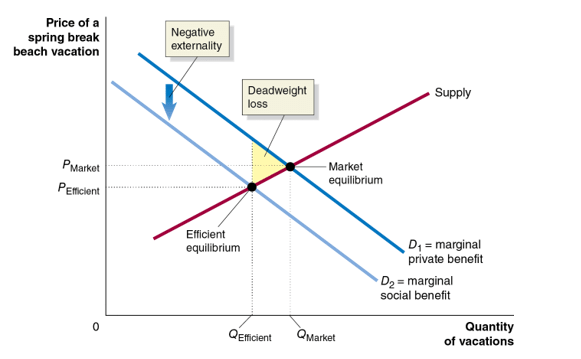
            So, in March 2020 there was an externality in consumption from college students taking spring break beach vacations because people in large crowds spread the virus. In other words, the students’ marginal private benefit from being on the beach was greater than the marginal social benefit, taking into account that being on the beach might spread the virus.

            The following figure shows the market for spring break beach vacations. The price of a vacation includes transportation costs, renting a hotel room, meals, and any fees to use the beach.  Demand curve D1 is the market demand curve and represents the marginal private benefit to students from vacationing on a crowded beach during spring break.  But spring breakers don’t bear all the cost of potentially contracting the coronavirus by being on a crowded beach because the cost of their spreading the virus is borne by others. So, there is negative externality from vacationing on the beach equal to the vertical distance between D1, which represents the marginal private benefit, and D2, which represents the marginal social benefit, including the chance of spreading the virus by contracting it on a crowded beach.

Because of the externality, the actual number of people taking spring break beach vacations in March 2020, QMarket, was greater than the efficient number, QEfficient.  In Section 5.3 of the Hubbard and O’Brien textbook, we show that when there is an externality in production, a tax equal to the per unit cost of the externality will result in the efficient level of output because the tax causes firms to internalize the externality.  In a similar way, a tax on spring break beach vacations equal to the per unit cost of the externality would shift the marginal private benefit curve, D1, down to where it became the same as the marginal social benefit curve, D2.  By leading spring breakers to internalize the cost of the externality, the tax would cause the market quantity of beach vacations to decline to the efficient quantity, QEfficient.

In practice, however, imposing a tax on people taking a beach vacation would be difficult for two key reasons: (1) In March 2020, there were many aspects of the coronavirus, including how it spread and its fatality rate, that made calculating the value of the negative externality difficult, and  (2) collecting a tax on the many spring breakers crowded on beaches would have been administratively difficult. In the face of these factors, governors and mayors used the command-and-control approach in March of closing beaches, hotels, and restaurants rather than the market-based approach of levying a tax.

Sources: Arian Campo-Flores and Craig Karmin, “The Last Place to be Hit With Coronavirus Worries? Florida Beaches,” Wall Street Journal, March 21, 2020; Aimee Ortiz, “Man Who Said, ‘If I Get Corona, I Get Corona,’ Apologizes,” New York Times, March 24, 2020; and Ryan W. Miller, “’If I Get Corona, I Get Corona’: Coronavirus Pandemic Doesn’t Slow Spring Breakers’ Party,” usatoday.com, March 21, 2020.

Question 

According to news reports, some college students on spring break in March 2020 were unaware that partying on the beach put them at risk of contracting the coronavirus. Many also assumed that no one younger than 30 was at risk of becoming seriously ill from the virus, although, in fact, the virus did kill people in their 20s. Suppose that every student on spring break were completely informed about the risks of partying on the beach.  Using the figure above, briefly explain how each of the following would have been affected. Draw a graph to illustrate your answer.

a. the demand curve, D1

b. the demand curve, D2

c. QMarket

d. QEfficient

e. PMarket

f. PEfficient

g. Size of the deadweight loss

Instructors can access the answers to these questions by emailing Pearson at christopher.dejohn@pearson.com and stating your name, affiliation, school email address, course number.

COVID-19 Update: How is Run on Toilet Paper Like a Run on Banks?

Supports:  Hubbard/O’Brien, Chapter 24, Money, Banks, and the Federal Reserve System; Macroeconomics Chapter 14; Essentials of Economics Chapter 16.

Apply the Concept: WHAT DO BANK RUNS TELL US ABOUT PANIC TOILET PAPER BUYING DURING THE CORONAVIRUS PANDEMIC?

Here’s the key point:   Lack of confidence leads to panic buying, but a return of confidence leads to a return to normal buying.

In Chapter 24, Section 24.4 of the Hubbard and O’Brien Economics 8e text (Chapter 14, Section 14.4 of Macroeconomics 8e) we discuss the problem of bank runs that plagued the U.S. financial system during the years before the Federal Reserve began operations 1914.  During the 2020 coronavirus epidemic in the United States consumers bought most of the toilet paper available in supermarkets leaving the shelves bare.  Toilet paper runs turn out to be surprisingly similar to bank runs.

            First, consider bank runs.  The United States, like other countries, has a fractional reserve banking system, which means that banks keep less than 100 percent of their deposits as reserves.  During most days, banks will experience roughly the same amount of funds being withdrawn as being deposited. But if, unexpectedly, a large number of depositors simultaneously attempt to withdraw their deposits from a bank, the bank experiences a run that it may not be able to meet with its cash on hand. If large numbers of banks experience runs, the result is a bank panic that can shut down the banking system.

Runs on commercial banks in the United States have effectively ended due to the combination of the Federal Reserve acting as a lender of last resort to banks experiencing runs and the Federal Deposit Insurance Corporation (FDIC) insuring bank deposits (currently up to $250,000 per person, per bank).  But consider the situation prior to 1914. As a depositor in a bank during that period, if you had any reason to suspect that your bank was having problems, you had an incentive to be at the front of the line to withdraw your money. Even if you were convinced that your bank was well managed and its loans and investments were sound, if you believed the bank’s other depositors thought the bank had a problem, you still had an incentive to withdraw your money before the other depositors arrived and forced the bank to close. In other words, in the absence of a lender of last resort or deposit insurance, the stability of a bank depends on the confidence of its depositors. In such a situation, if bad news—or even false rumors—shakes that confidence, a bank will experience a run.

Moreover, without a system of government deposit insurance, bad news about one bank can snowball and affect other banks, in a process called contagion. Once one bank has experienced a run, depositors of other banks may become concerned that their banks might also have problems. These depositors have an incentive to withdraw their money from their banks to avoid losing it should their banks be forced to close.

            Now think about toilet paper in supermarkets.  From long experience, supermarkets, such as Kroger, Walmart, and Giant Eagle, know their usual daily sales and can place orders that will keep their shelves stocked.  The same is true of online sites like Amazon. By the same token, manufacturers like Kimberly-Clark and Procter and Gamble, set their production schedules to meet their usual monthly sales.  Consumers buy toilet paper as needed, confident that supermarkets will always have some available.


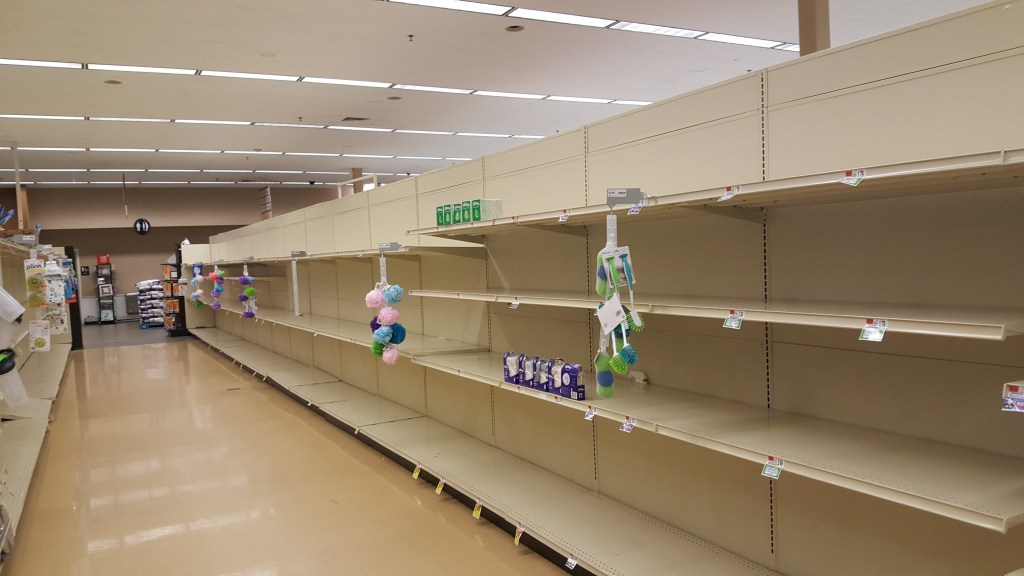
Photo of empty supermarket shelves taken in Boston, MA in March 2020. Credit: Lena Buananno


But then the coronavirus hit and in some states non-essential businesses, colleges, and schools were closed and people were advised to stay home as much as possible.  Supermarkets remained open everywhere as did, of course, online sites such as Amazon.  But as people began to consider what products they would need if they were to remain at home for several weeks, toilet paper came to mind.

At first only a few people decided to buy several weeks worth of toilet paper at one time, but that was enough to make the shelves holding toilet paper begin to look bare in some supermarkets. As they saw the bare shelves, some people who would otherwise have just bought their usual number of rolls decided that they, too, needed to buy several weeks worth, which made the shelves look even more bare, which inspired more to people to buy several weeks worth, and so on until most supermarkets had sold out of toilet paper, as did Amazon and other online sites.

            Before 1914 if you were a bank depositor, you knew that if other depositors were withdrawing their money, you had to withdraw yours before the bank had given out all its cash and closed. In the coronavirus epidemic, you knew that if you failed to rush to the supermarket to buy toilet paper, the supermarket was likely to be sold out when you needed some.  Just as banks relied on the confidence of depositors that their money would be available when they wanted to withdraw it, supermarkets rely on the confidence of shoppers that toilet paper and other products will be available to buy when they need them.  A loss of that confidence can cause a run on toilet paper just as before 1914 a similar loss of confidence caused runs on banks.

            In bank runs, depositors are, in effect, transferring a large part of the country’s inventory of currency out of banks, where it’s usually kept, and into the depositors’ homes. Similarly, during the epidemic, consumers were transferring a large part of the country’s inventory of toilet paper out of supermarkets and into the consumers’ homes.  Just as currency is more efficiently stored in banks to be withdrawn only as depositors need it, toilet paper is more efficiently stored in supermarkets (or in Amazon’s warehouses) to be purchased only when consumers need it.

            Notice that contagion is even more of a problem in a toilet paper run than in a bank run.  People can ordinarily only withdraw funds from banks where they have a deposit, but consumers can buy toilet paper wherever they can find it. And during the epidemic there were news stories of people traveling from store to store—often starting early in the morning—buying up toilet paper.

            Finally, should the government’s response to the toilet paper run of 2020 be similar to its response to the bank runs of the 1800s and early 1900s? To end bank runs, Congress established   (1) the Fed—to lend banks currency during a run—and (2) the FDIC—to insure deposits, thereby removing a depositor’s fear that the depositor needed to be near the head of the line to withdraw money before the bank’s cash holdings were exhausted.

The situation is different with toilet paper. Supermarkets are eventually able to obtain as much toilet paper as they need from manufacturers. Once production increases enough to restock supermarket shelves, consumers—many of whom already have enough toilet paper to last them several weeks—stop panic buying and ample quantities of toilet paper will be available. Once consumers regain confidence that toilet paper will be available when they need it, they have less incentive to hoard it. Just as a lack of confidence leads to panic buying, a return of confidence leads to a return to normal buying.

Although socialist countries such as Venezuela, Cuba, and North Korea suffer from chronic shortages of many goods, market economies like the United States experience shortages only under unusual circumstances like an epidemic or natural disaster.

Note: For more on bank panics, see Hubbard and O’Brien, Money, Banking, and Financial Markets, 3rd edition, Chapter 12 on which some of this discussion is based.

Sources: Sharon Terlep, “Relax, America: The U.S. Has Plenty of Toilet Paper,” Wall Street Journal, March 16, 2020; Matthew Boyle, “You’ll Get Your Toilet Paper, But Tough Choices Have to Be Made: Grocery CEO,” bloomberg.com, March 18, 2020; and Michael Corkery and Sapna Maheshwari, “Is There Really a Toilet Paper Shortage?” New York Times, March 13, 2020.

Question 

Suppose that as a result of their experience during the coronavirus pandemic, the typical household begins to store two weeks worth of toilet paper instead of just a few days worth as they had previously been doing.  Will the result be that toilet paper manufacturers permanently increase the quantity of toilet paper that they produce each week?

Instructors can access the answers to these questions by emailing Pearson at christopher.dejohn@pearson.com and stating your name, affiliation, school email address, course number.