Glenn discusses Fed policy, the state of the U.S economy, economic growth, China in the world economy, industrial policy, protectionism, and other topics in this episode of the Political Economy podcast from the American Enterprise Institute.
Category: Trade
Glenn’s Op-Ed on the Need for Pro-Growth Policies

(Photo from the New York Times.)
This op-ed orginally appeared in the Wall Street Journal.
Put Growth Back on the Political Agenda
In a campaign season dominated by the past, a central economic topic is missing: growth. Rapid productivity growth raises living standards and incomes. Resources from those higher incomes can boost support for public goods such as national defense and education, or can reconfigure supply chains or shore up social insurance programs. A society without growth requires someone to be worse off for you to be better off. Growth breaks that zero-sum link, making it a political big deal.
So why is the emphasis on growth fading? More than economics is at play. While progress from technological advances and trade generally is popular, the disruption that inevitably accompanies growth and hits individuals, firms and communities has many politicians wary. Such concerns can lead to excessive meddling via industrial policy.
As we approach the next election, the stakes for growth are high. Regaining the faster productivity that prevailed before the global financial crisis requires action. The nonpartisan Congressional Budget Office estimates potential gross domestic product growth of 1.8% over the coming decade, and somewhat lower after that. Those figures are roughly 1 percentage point lower than the growth rate over the three decades before the pandemic. Many economists believe productivity gains from generative artificial intelligence can raise growth in coming decades. But achieving those gains requires an openness to change that is rare in a political climate stuck in past grievances about disruption—the perennial partner of growth.
Traditionally, economic policy toward growth emphasized support for innovation through basic research. Growth also was fostered by reducing tax burdens on investment, streamlining regulation (which has proliferated during the Biden administration) and expanding markets. These important actions have flagged in recent years. But such attention, while valuable, masks inattention to adverse effects on some individuals and communities, raising concerns about whether open markets advance broad prosperity.
This opened a lane for backward-looking protectionism and industrial policy from Democrats and Republicans alike. Absent strong national-defense arguments (which wouldn’t include tariffs on Canadian steel or objections to Japanese ownership of a U.S. steel company), protectionism limits growth. According to polls by the Chicago Council on Global Affairs, roughly three-fourths of Americans say international trade is good for the economy. Finally, protectionism belies ways in which gains from openness may be preserved, such as by simultaneously offering support for training and work for communities of individuals buffeted by trade and technological change.
On industrial policy, it is true that markets can’t solve every allocation problem. But such concerns underpin arguments for greater federal support of research for new technologies in defense, climate-change mitigation, and private activity, not micromanaged subsidies to firms and industries. If a specific defense activity merits assistance, it could be subsidized. These alternatives mitigate the problems in conventional industrial policy of “winner picking” and, just as important, the failure to abandon losers. It is policymakers’ hyperattention to those buffeted by change that hampers policy effectiveness and, worse, invites rent-seeking behavior and costly regulatory micromanagement.
Examples abound. Appending child-care requirements to the Chips Act and the inaptly named Inflation Reduction Act has little to do with those laws’ industrial policy purpose. The Biden administration’s opposition to Nippon Steel’s acquisition of U.S. Steel raises questions amid the current wave of industrial policy. How is a strong American ally’s efficient operation of an American steel company with U.S. workers an industrial-policy problem? Flip-flops on banning TikTok fuel uncertainty about business operations in the name of industrial policy.
The wrongly focused hyperattention is supposedly grounded in putting American workers first. But it raises three problems. First, the interventions raise the cost of investments, and the jobs they are to create or protect, by using mandates and generating policy uncertainty. Second, they contradict the economic freedom in market economies of voluntary transactions. Absent a strong national-security foundation, why is public policy directing investment in or ownership of assets? Such policies threaten the nation’s long-term prosperity by discouraging investment and invite rent-seeking in a way that voluntary market transactions don’t. Both problems hamstring growth.
Third, and perhaps most important, such micromanagement misses the economic and political mark of actually helping individuals and communities disrupted by growth-enhancing openness. A more serious agenda would focus on training suited to current markets (through, for example, more assistance to community colleges), on work (through expanding the Earned Income Tax Credit), and on aid to communities hit by prolonged employment loss (through services that enhance business formation and job creation). The federal government could also establish research centers around the country to disseminate ideas for businesses.
Growth matters—for individual livelihoods, business opportunities and public finances. Pro-growth policies that account for disruption’s effects while encouraging innovation, saving, capital formation, skill development and limited regulation must return to the economic agenda. A shift to prospective, visionary thinking would reorient the bipartisan, backward-looking protectionism and industrial policy that weaken growth and fail to address disruption.
9/16/23 Podcast – Authors Glenn Hubbard & Tony O’Brien discuss inflation, the current status of a soft-landing, and the green economy.
Join authors Glenn Hubbard & Tony O’Brien as they discuss the economic landscape of inflation, soft-landings, and the green economy. This conversation occurred on Saturday, 9/16/23, prior to the FOMC meeting on September 19th-20th.
Solved Problem: The Mexican “Super Peso”

A food market in Mexico. (Photo from mexperience.com)
Supports: Macroeconomics, Chapter 18, Economics, Chapter 28, and Essentials of Economics, Chapter 19.
In September 2023, an article in the Los Angeles Times discussed the effects on Mexico of the “’super-peso,’ as the Mexican currency has been dubbed since steadily gaining 18% on the dollar during the last 12 months.” The article focused on the effects of the rising value of the peso on people in Mexico who receive U.S. dollars from relatives and friends working in the United States. Many of the people who receive these payments rely on them to buy basic necessities, such as food and clothing. An article in the Wall Street Journal on the effects of the rising value of the peso noted that: “The peso’s strength has helped curtail inflation ….”
- Briefly explain what the Los Angeles Times article means by the peso “gaining” on the U.S. dollar? Does the peso gaining on the dollar mean that someone exchanging dollars for pesos would receive more pesos or fewer pesos?
- As a result of the rising value of the peso would people in Mexico receiving dollar payments from relatives in the United States be better off or worse off? Briefly explain.
- Why would the increasing strength of the peso reduce the inflation rate in Mexico?
- The Los Angeles Times article also noted that: “The Bank of Mexico’s benchmark interest rate of 11.25% is more than double the U.S. Federal Reserve target …” Does this fact have anything to do with the increase in the value of the peso in exchange for the dollar? Briefly explain.
Solving the Problem
Step 1: Review the chapter material. This problem is about the effect of fluctuations in the exchange rate and the relationship between interest rates and exchange rates, so you may want to review Macroeconomics, Chapter 18, Section 8.2, “The Foreign Exchange Market and Exchange Rates,” or the corresponding sections in Economics, Chapter 28 or Essentials of Economics, Chapter 19.
Step 2: Answer part a. by explaining what it means for the peso to be “gaining” on the U.S. dollar. The peso gaining on the dollar means that someone can exchange fewer pesos to receive a dollar. Or, alternatively, someone exchanging dollars for pesos will receive fewer pesos.
Step 3: Answer part b. by explaining why people in Mexico receiving dollar payments from relatives in the United States will be worse off because of the rising value of the peso. People living in Mexico needs pesos to buy food and clothing from Mexican stores. Because people will receive fewer pesos in exchange for the dollars they receive from relatives in the United States, these people will have been made worse off by the rising value of the peso.
Step 4: Answer part c. by explaining why the increasing strength of the peso will reduce inflation in Mexico. A country’s inflation rate includes the prices of imported goods as well as the prices of domestically produced goods. A stronger peso means that fewer pesos are needed to buy the same quantity of a foreign currency, which reduces the peso price of imports from that country. For example, a stronger peso reduces the number of pesos Mexican consumers pay to buy $10 worth of cucumbers imported from the United States. Falling prices of imported goods will reduce the inflation rate in Mexico.
Step 5: Answer part d. by explaining why higher interest rates in Mexico relative to interest rates in the United States will increase the value of the peso in exchange for the U.S. dollar. If interest rates in Mexico rise relative to interest rates in the United States, Mexican financial assets, such as Mexican government bonds, will be more desirable, causing investors to increase their demand for the pesos they need to buy Mexican financial assets. The resulting shift to the right in the demand curve for pesos will cause the equilibrium exchange rate between the peso and the dollar to increase.
Sources: Patrick J. McDonnell, “Mexico’s Peso Is Soaring. That’s Bad News for People Who Rely on Dollars Sent from the U.S.,” Los Angeles Times, September 5, 2023; and Anthony Harrup, “Mexico’s Peso Surges to Strongest Level Since 2015,” Wall Street Journal, July 13, 2023.
The Surprising Effect of Weight-Loss Drugs on Monetary Policy in Denmark

Novo Nordisk production facility in Denmark (Photo from Bloomberg News via the Wall Street Journal.)
Like most other small European countries, imports and exports are more important in the Danish economy than in the U.S. economy. In 2022, imports were 59 percent of Danish GDP and exports were 70 percent. In contrast, in 2022 imports were only 16 percent of U.S. GDP and exports were only 12 percent.
The Danish company Novo Nordisk makes the weight-loss prescription injections Ozempic and Wegovy. Because these and related pharmaceuticals are the first to result in significant weight loss among patients, demand for them has been very strong. (Note that some researchers believe that is not yet clear whether long-term use of these drugs might have side effects.) Demand has been so strong that Novo Nordisk’s market cap—the total value of its outstanding shares of stock—is now larger than Denmark’s GDP. According to the Wall Street Journal, Novo Nordisk now has the second largest market cap in Europe, behind only luxury good manufacturer LVMH Moët Hennessy Louis Vuitton
Most of Novo Nordisk’s customers are outside of Denmark, so to buy Ozempic or Wegovy, these customers much exchange their domestic currency—for example, euros, U.S. dollars, pounds, or yen—for Danish kroner. This increase in demand, increases the value of kroner relative to dollars, euros, and other currencies. (We discuss the effects of changes in demand and supply of a currency relative other currencies in Macroeconomics, Chapter 18, Section 18.2, Economics, Chapter 28, Section 28.2, and Essentials of Economics, Chapter 19, Section 19.6.)
Denmark has been a member of the European Union (EU), since the EU’s formation in 1991. But it is one of two EU countries (Sweden is the other) that has retained its own currency rather than using the euro. Because most of Denmark’s trade has traditionally been with other countries in the EU, the Danmarks Nationalbank, Denmark’s central bank, has pegged the value of the krone to the euro. Pegging makes it easier for Danish firms to plan because they know the prices their goods and services will sell for in eurozone countries. In addition, Danish firms that borrow in euros know how much in interest they will be paying in kroner. Finally, if the krone rises in value against other currencies, prices of imported goods and services will increase, raising the Danish inflation rate. (We discuss currency pegs in Macroeconomics, Chapter 18, Section 18.3, and Economics, Chapter 28, Section 28.3.) Inflation is a significant concern in Denmark because, as the following figure shows, the inflation rate reached 10.1 percent in October 2022. Although by July 2023, the inflation rate had decline to 3.1 percent, that rate was still above the Nationalbank’s inflation target of 2 percent.

Source: Statistics Denmark, dst.dk.
To keep the the krone pegged against the euro, the Nationalbank has to reduce the demand for the krone. The key tool that a central bank has to reduce demand for its country’s currency is interest rates. If the Nationalbank keeps interest rates in Denmark below interest rates in eurozone countries, investors will demand fewer kroner in exchange for euros. Accordingly, the Nationalbank as kept its key monetary policy rate below the corresponding rate set by the European Central Bank. In August the ECB’s policy rate was 3.75 percent, whereas the Nationalbank’s corresponding policy rate was 3.35 percent.
It’s unusual even for a small country that its central bank has to take steps to respond to a surge in demand for a single product. But that was the situation of the Danish central bank in 2023.
Sources: Joseph Walker, Dominic Chopping, and Sune Engel Rasmussen Wall Street Journal, August 17, 2023; Matthew Fox, “America’s Favorite Weight Loss Drugs Are Impacting Denmark’s Currency and Interest Rates,” finance.yahoo.com, August 18, 2023; Christian Weinberg, “Novo’s Value Surpasses Denmark GDP After Obesity Drug Boost,” bloomberg.com, August 9, 2023; Tom Fairless, “European Central Bank Raises Rates, Says Pausing Is an Option” Wall Street Journal, July 27, 2023; and “Official Interest Rates,” nationalbanken.dk.
4/29/23 Podcast – Authors Glenn Hubbard & Tony O’Brien discuss a hard vs. soft landing, the debt ceiling, and an economics view of the CHIPS act passed in 2022.
Join authors Glenn Hubbard & Tony O’Brien as they discuss the state of the landing the economy will achieve – hard vs. soft – or “no landing”. Also, they address the debt ceiling and the barriers it might present to a recovery. We also delve into the Chips Act and what economics has to say about the subsidy of a particular industry. Gain insights into today’s economy through our final podcast of the 2022-2023 academic year! Our discussion covers these points but you can also check for updates on our blog post that can be found HERE .
U.S. Carbon Dioxide Emissions in a Global Context

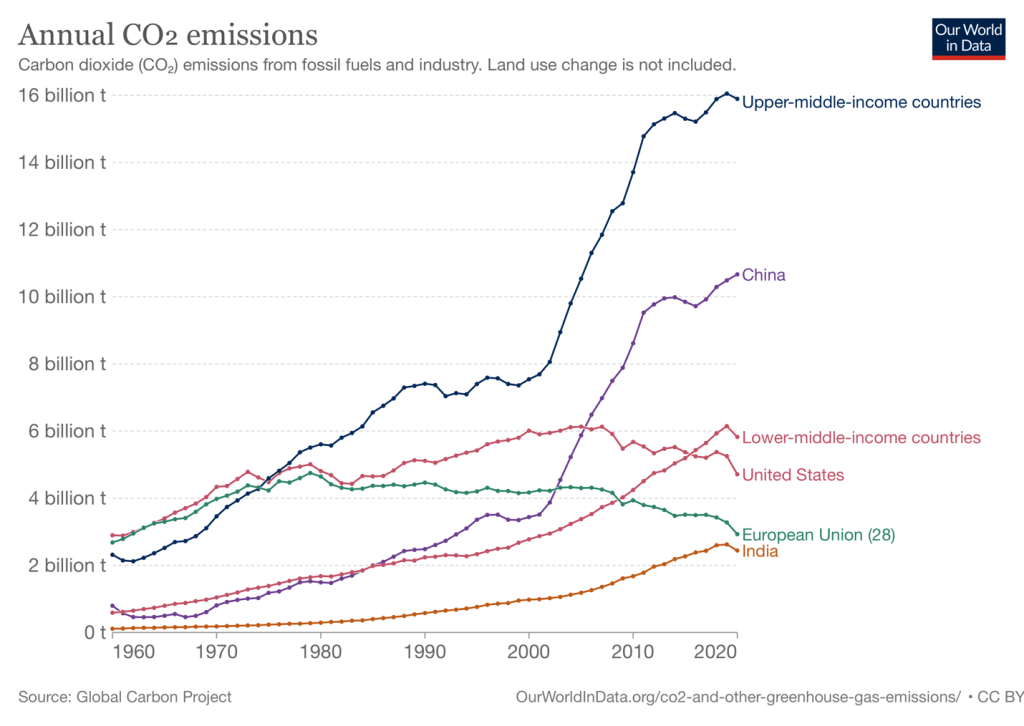
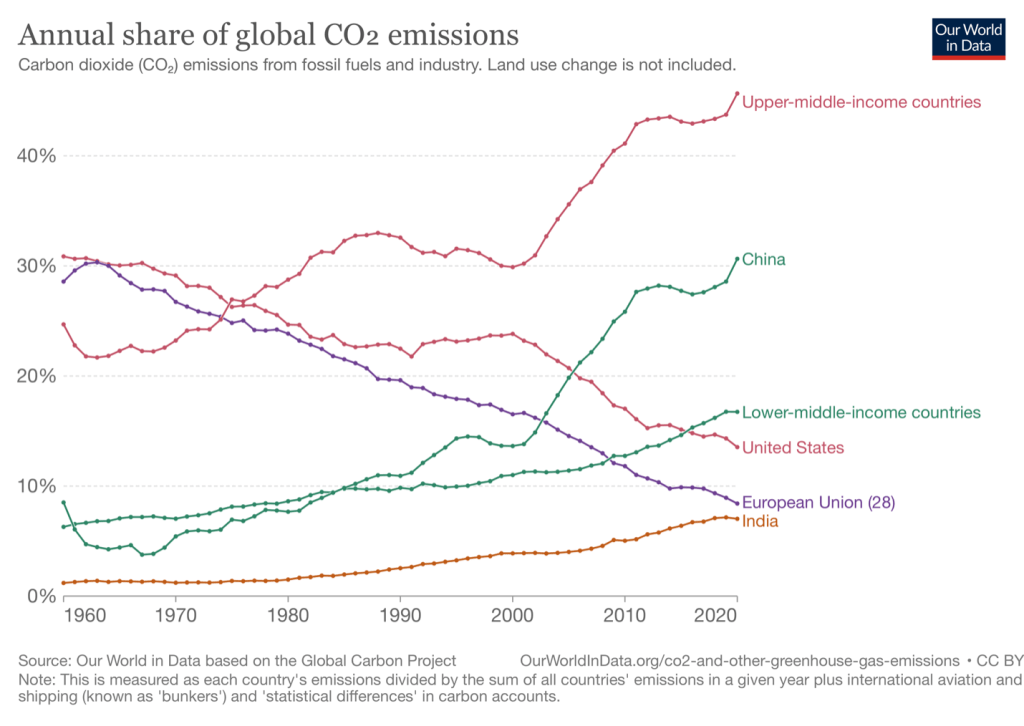
As we discuss in Microeconomics and Economics, Chapter 5, Section 5.3, carbon dioxide (CO2) emissions contribute to climate change, including the increases in temperatures that have been experienced worldwide. We’ve found that students are interested in seeing U.S. CO2 emissions in a global context.
The first of the following figures shows for the years 1960 to 2020, the total amount of CO2 emissions by the United States, China, India, the 28 countries in the European Union, lower-middle-income countries (including India, Nigeria, and Vietnam), and upper-middle-income countries (including China, Brazil, and Argentina). The second of the figures shows the percentage of total world CO2 accounted for by each of the three individual countries and by the indicated groups of countries. in the United States and in the countries of the European Union both total emissions and the percentage of total world emissions have been declining over the past 15 years. Emissions have been increasing in China, India, and in middle-income countries. The figures are from the Our World in Data website (ourworldindata.org). (Note that the reductions in emissions during 2020 largely reflect the effects of the slowdown in economic activity as a result of the Covid-19 pandemic rather than long-term trends in emissions.)


Governments in many countries have attempted to slow the pace of climate change by enacting policies to reduce CO2emissions. (According to estimates by the U.S. Environmental Protection Agency, CO2 accounts for about 76 percent of all emissions worldwide of greenhouse gases that contribute to climate change. Methane and nitrous oxide, mainly from agricultural activity, make up most of the rest of greenhouse gas emissions.) In August 2022, Congress and President Biden enacted additional measures aimed at slowing climate change. Included among these measures were government subsidies to firms and households to use renewable energy such as rooftop solar panels, tax rebates for some buyers of certain electric vehicles, and funds for utilities to develop power sources such as wind and solar that don’t emit CO2. The measures have been estimated to reduce U.S. greenhouse gas emissions by somewhere between 6 percent and 15 percent. Because the United States is responsible for only about 14 percent of annual global greenhouse gas emissions, the measures would likely reduce global emissions by only about 2 percent.
The figures shown above make this result unsurprising. Because the United States is the source of only a relatively small percentage of global greenhouse emissions, reductions in U.S. emissions can result in only small reductions in global emissions. Although many policymakers and economists believe that the marginal benefit from these reductions in U.S. emissions exceed their marginal cost, the reductions can’t by themselves do more than slow the rate of climate change. A key reason that India, China, and other middle income countries have accounted for increasing quantities of greenhouse gases is that they rely much more heavily on burning coal than do the United States, the countries in the European Union, and other high-income countries. Utilities switching to generating electricity by burning coal rather than by burning natural gas has been a key source of reductions in greenhouse gas emissions in the United States.
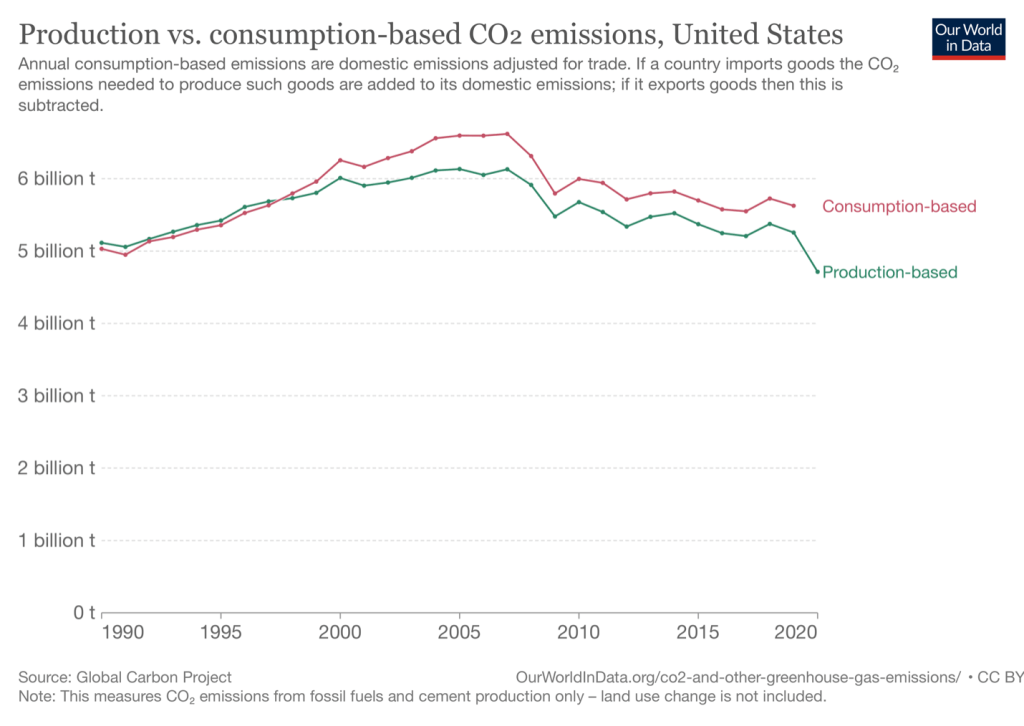
The two figures above measure a country’s contribution to CO2 emissions by looking at the quantity of emissions generated by production within the country. But suppose instead that we look at the quantity of CO2 emitted during the production of the goods consumed within the country? In that case, we would allocate to the United States CO2 emitted during the product of a good, such as a television or a shirt, that was produced in China or another foreign country but consumed in the United States.
For the United States, as the following figure shows it makes only a small difference whether we measure CO2emissions on the basis of production of goods and services or on the basis of consumption of goods and services. U.S. emissions of CO2 are about 7 percent higher when measured on a consumption basis rather than on a production basis. By both measures, U.S. emissions of CO2 have been generally declining since about 2007. (1990 is the first year that these two measures are available.)

Sources: Hannah Ritchie, Max Roser and Pablo Rosado, “CO₂ and Greenhouse Gas Emissions,” OurWorldInData.org, https://ourworldindata.org/co2-and-other-greenhouse-gas-emissions; Greg Ip, “Inflation Reduction Act’s Real Climate Impact Is a Decade Away,” Wall Street Journal, August 24, 2022; Lisa Friedman, “Democrats Designed the Climate Law to Be a Game Changer. Here’s How,” New York Times, August 22, 2022; Hannah Ritchie, “How Do CO2 Emissions Compare When We Adjust for Trade?” ourworldindata.org, October 7, 2019; and United States Environmental Protection Agency, “Global Greenhouse Gas Emissions Data,” epa.gov, February 22, 2022.
Glenn Will Be Speaking on Friday, October 14 at a Seminar Sponsored by the Texas Tech Economics Department
Time: Friday, October 14, 1:00 p.m.
Location: Red Raider Lounge 119 in the Student Union Building (SUB)

Solved Problem: How Does the Value of the U.S. Dollar Affect the U.S. and World Economies?

Supports: Macroeconomics, Chapter 18, Economics, Chapter 28, and Essentials of Economics, Chapter 19.
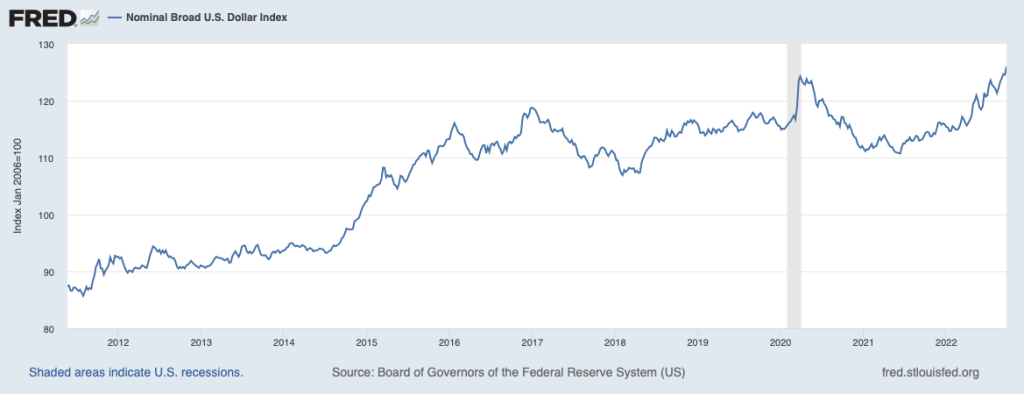
Between June 2021 and September 2022, the exchange rate between the U.S. dollar and an average of the currencies of the major trading partners of the United States increased by 14 percent. (This movement is shown in the figure above.) An article in the New York Times had the headline “The Dollar Is Strong. That Is Good for the U.S. but Bad for the World.”
- Briefly explain what the headline means by a “strong” dollar.
- Do you agree with the assertion in the headline that a stronger dollar is good for the United States but bad for the economies that the United States trades with? Briefly explain.
- During this period the Federal Reserve was taking actions that raised U.S. interest rates. The article noted that “Those interest rate increases are pumping up the value of the dollar ….” Why would increases in U.S. interest rates relative to interest rates in other countries increase the value of the dollar?
Solving the Problem
Step 1: Review the chapter material. This problem is about the effect of fluctuations in the exchange rate and the relationship between interest rates and exchange rates, so you may want to review Macroeconomics, Chapter 18, Section 8.2, “The Foreign Exchange Market and Exchange Rates,” or the corresponding sections in Economics, Chapter 28 or Essentials of Economics, Chapter 19.
Step 2: Answer part a. by explaining what a “strong” dollar means. A strong dollar is one that exchanges for more units of foreign currencies, such as British pounds or euros. (A “weak” dollar means the opposite: A dollar that exchanges for fewer units of foreign currencies.)
Step 3: Answer part b. by explaining whether you agree with the assertion that a stronger dollar is good for the United States but bad for the economies of other countries. A stronger U.S. dollar produces winners and losers both in the United States and in other countries. U.S. consumers win because a stronger dollar means that fewer dollars are needed to buy the same quantity of a foreign currency, which reduces the dollar price of imports from that country. For example, a stronger dollar reduces the number of dollars U.S. consumers pay to buy a bottle of French wine that has a 40 euro price. A strong dollar is bad news for foreign consumers because they must pay more units of their currency to buy goods imported from the United States. For example, Japanese consumers will have to pay more yen to buy an imported Hershey’s candy bar with a $1.25 price.
The situation is reversed for U.S. and foreign firms exporting goods. Because foreign consumers have to pay higher prices in their own currencies for goods imported from the United States, they are likely to buy less of them, buying more domestically produced goods or goods imported from other countries. U.S. firms will either to have accept lower sales, or cut the prices they charge for their exports. In either case, U.S. exporters’ revenue will decline. Foreign firms that export to the United States will be in the opposite situation: The dollar prices of their exports will decline, increasing their sales.
We can conclude that the article’s headline is somewhat misleading because not all groups in the United States are helped by a strong dollar and not all groups in other countries are hurt by a strong dollar.
Step 4: Answer part c. by explaining why higher interest rates in the United States relative to interest rates in other countries will increase the exchange value of the dollar. If interest rates in the United States rise relative to interest rates in other countries—as was true during the period from the spring of 2021 to the fall of 2022—U.S. financial assets, such as U.S. Treasury bills, will be more desirable, causing investors to increase their demand for the dollars they need to buy U.S. financial assets. The resulting shift to the right in the demand curve for dollars will cause the equilibrium exchange rate between the dollar and other currencies to increase.
Source: Patricia Cohen, “The Dollar Is Strong. That Is Good for the U.S. but Bad for the World,” New York Times, September 26, 2022.
3/01/22 Podcast – Authors Glenn Hubbard & Tony O’Brien discuss Russia’s Invasion of Ukraine.
Authors Glenn Hubbard & Tony O’Brien reflect on the global economic effects of Russia’s invasion of Ukraine last week. They consider the impact on the global commodity market, US monetary policy, and the impact on the financial markets in the US. Impact touches Introductory Economics, Money & Banking, International Economics, and Intermediate Macroeconomics as the effects of Russia’s aggression moves into its second week.

A map of Europe with Ukraine in the middle right below Belarus and to the east of Poland.