COVID-19 Update – The Futures Market and the Strange Case of Negative Price of Oil.

Supports:  Econ and Micro: Chapter 8, “Firms, the Stock Market, and Corporate Governance” Macro Chapter 6; Essentials Chapter 6

The Futures market and the strange case of negative price of oil

There’s a point that seems so obvious that we haven’t explicitly mentioned it until now:  The price of a good or service is always positive. After all, a price being negative means that a seller is paying a buyer to accept a good or service, which seems very unlikely.  But this strange outcome did occur in the U.S. oil market during the economic upheaval caused by the coronavirus pandemic of 2020.

            In the spring of 2020, there were two important developments in the world oil market:

  1. A sharp decline in demand   Many countries imposed social-distancing protocols and required non-essential business to shut down in response to the pandemic.   These policies caused the demand for oil products to decline dramatically. For instance, in the United States, the demand for gasoline fell by about 50 percent between the middle of March and the middle of April. The decline was the largest in history over such a short period.
  2. A decline in world supply   Twenty-three countries, including the United States, Russia, and Saudi Arabia—the world’s three largest oil producer—agreed to reduce oil production by 9.7 million barrels per day, or about 13 percent of daily world production. These countries  hoped that the decline in supply would keep the world price of oil from falling to very low levels.  In fact, though, through mid-April the decline in demand was larger than the decline in supply leading to a dramatic decline in oil prices.

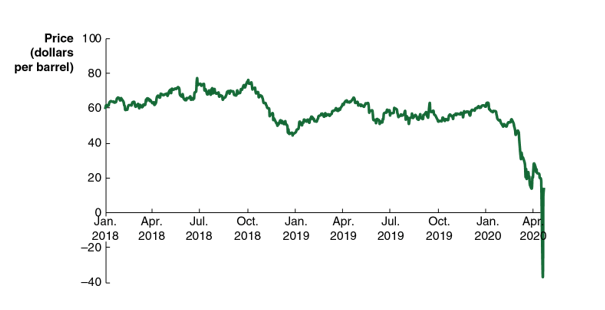
Crude oil from different rock formations can vary in its characteristics, such as its sulfur content.  Crude oil that requires more processing as it is being refined into gasoline, aviation fuel, or other products, sells for a lower price. The benchmark oil price in the United States is for a grade of crude oil called West Texas Intermediate.  The following figure shows the fluctuations in the price per barrel of this type of oil from January 2018 through late April 2020.

After reaching a high of $63 per barrel in January 2020, the price of oil declined to negative $37 per barrel on April 20.  In other words, sellers were willing to pay buyers $37 per barrel to accept delivery of oil.  Why would a seller ever pay someone to accept a product?  There are two related reasons. We can discuss the first reason using demand and supply analysis. The second reason requires a brief discussion of how the oil market is different from most other markets for goods.

Demand and Supply in the Spot Market for Oil

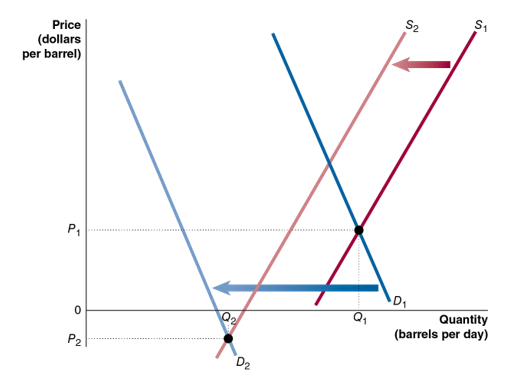
            To understand how movements in demand and supply in the oil market resulted in a negative price, consider the following figure illustrating this situation. Before the coronavirus pandemic, the demand for oil is shown by demand curve D1 and the supply of oil by supply curve S1. The equilibrium price is P1.  During the pandemic, the amount of oil demanded declined sharply from D1 to D2, and the supply of oil declined from S1 to S2.  As a result, the new equilibrium price became negative at P2.  We can see that for the equilibrium price to be negative, the demand curve and supply curve must intersect below the horizontal axis.  

But why would a firm be willing to supply any oil at a negative price?  The answer requires  understanding how oil markets work.  The spot price of oil is the price for oil that is available for immediate delivery.  A seller at the spot price is typically a firm pumping oil, and a buyer is a firm that uses oil as an input, such as a firm that refines oil into gasoline.  When you buy bread in the supermarket or a Big Mac at McDonald’s you are paying the spot price, which is the only price in the markets for most goods and services. In the figure we are showing the spot market for oil and the price is the spot price.

The Futures Market for Oil

But in addition to a spot market for oil, there is a futures market for oil, which allows individuals and firms to buy and sell futures contracts.  A futures contract specifies the quantity of an asset—such as a barrel of oil—that will be delivered by the seller on a future date, the settlement date. Futures contracts exist for commodities such as oil, as well as for financial assets, such as Treasury bonds and stock indexes like the S&P 500. Futures contracts don’t set the price—the futures price—that the buyer will pay and the seller will receive on the settlement date. Instead, the price fluctuates as the contract is bought and sold on a futures exchange, such as the Chicago Board of Trade or the New York Mercantile Exchange, just as the price of a share of stock fluctuates as the stock is bought and sold in the stock market.  Each oil futures contract represents 1,000 barrels (or 42,000 gallons) of oil.

The futures price of oil can differ from the spot price if people trading futures contracts expect that conditions in the oil market will differ on the settlement date from conditions today. For instance, on April 20, 2020, the date on which the spot price of oil was negative, the oil futures price on a contract with a settlement date in June was $22 per barrel and the price on a contract with a settlement date in November was $33 per barrel.  The higher oil prices for June and November reflected the view among buyers and sellers and futures contracts that (1) the economy was likely to begin recovering from the worst of the pandemic by then, increasing the demand for oil and (2)  the supply of oil was likely to decline further.

The spot price and the futures price are linked because it’s possible to store oil. So, the futures price should roughly equal the spot price plus the cost of storing oil between today and the settlement date of the futures contract. As the settlement date approaches, the futures price comes closer to the spot price, eventually equaling the spot price on the settlement date. Why must the spot price equal the futures price on the settlement date? Because if there were a difference between the two prices, it would be possible for an investor to make a profit. For instance, if the spot price of oil was $35 on the settlement date of the futures contract but the futures price was $40, an investor could buy oil on the spot market and simultaneously sell futures contracts. The buyers of the futures contract would have to accept delivery of oil at $40, which would allow the investor to make a risk-free profit of $5 per barrel. In practice, investors selling additional futures contracts would drive down the futures price until it equaled the spot price. Only then would the ability to make a profit disappear.

Unlike with the spot market, buyers and sellers in the futures market may not be involved with either pumping or using oil. Instead, they may be investors who hope to profit by placing a bet on which way the price of oil will change in the future. These market participants are called speculators.  Speculators serve the useful purpose of adding to the number of buyers and sellers in the futures market, thereby increasing market liquidity, which is the ease with which a buyer or seller can sell an asset, such as a futures contract.

You can speculate on the price of oil using the futures market in oil. If you believe that the futures price is lower than the spot price of oil will be on the settlement date, you can hope to make a profit by buying futures contracts today and selling them after the price rises. Similarly, if you believe that the futures prices is higher than the price of oil will be in the spot market on the settlement date, you can sell futures contracts at the current high price and  buy them back after the price has fallen. It’s important to understand that investors doing this type of buying and selling of futures contracts don’t expect to actually deliver or receive barrels of oil.

What Happened in the Oil Market in April 2020?

Ordinarily, when firms pumping oil expect prices to be significantly higher in the future, they can respond by withholding oil from the market in several ways: (1) They can reduce the quantity of oil they pump, in effect storing it in the ground until prices increase; (2) they can pump oil and store it until prices rise; and (3) they can store oil products like gasoline that are refined from oil on supertankers, which are capable of holding millions of barrels of oil, waiting for prices to rise.

But in the spring of 2020, the decline in demand was so large and so sudden that firms were uncertain how much to reduce the quantity of oil they were pumping.  If the decline in demand was temporary, lasting only during the worst of the pandemic, firms that cut back too much would face both the cost of both closing and then reopening oil wells.  In some cases, even temporarily stopping production from a well can permanently reduce how much oil can be recovered from the well. In addition, the usual places to store oil were rapidly reaching capacity.  As an article in the Wall Street Journal put it: “The buildup of crude is overwhelming storage space and clogging pipelines. And in areas where tanker-ship storage isn’t readily available, producers could need to go to extremes to get rid of the excess.” The “extremes” included accepting negative prices. 

On April 20, there was a second factor pushing oil prices into negative values. The May futures contract was expiring the next day, meaning that any buyer who had not sold the contract would legally have to pay for and accept delivery of 1,000 barrels of oil.  As we’ve seen, some buyers and sellers of oil futures contracts are speculators who don’t intend to deliver or receive barrels of oil.  Given the shortage of storage facilities, rather than accept delivery for oil with nowhere to put it, speculators were willing to take steep losses by selling their contracts at a negative price.  In effect, a buyer of a contract received $37,000 ($37 per barrel × 1,000 barrels per contract) in addition to 1,000 barrels of oil—a great deal, but only if you had somewhere to store the oil.

If oil producers become convinced that the decline in demand is likely to be long-lived, they will reduce the supply of oil substantially and the spot price will rise enough to ensure that the producers are able to cover all of their costs.  But the fact that the spot price of oil was briefly negative indicates the level of economic disruption the coronavirus caused.

Sources: Ryan Dezember, “U.S. Oil Costs Less Than Zero After a Sharp Monday Selloff,” Wall Street Journal, April 21, 2020; Neil Irwin, “What the Negative Price of Oil Is Telling Us,” New York Times, April 21, 2020; Myra P. Saefong, “Oil Market in ‘Super Contango’ Underlines Storage Fears as Coronavirus Destroys Crude Demand,” marketwatch.com, April 18, 2020; Benoit Faucon, Summer Said, and Timothy Puko, “U.S., Saudi Arabia, Russia Lead Pact for Record Cuts in Oil Output,” Wall Street Journal, April 12, 2020; Federal Reserve Bank of St. Louis; and U.S. Energy Information Administration.

Question: 

  1. If a futures market for oil didn’t exist,  would the spot price of oil ever be negative?
  2. If you were a manager of a firm that owns oil wells, how would you benefit from the existence of a futures market for oil? If you were a manager of a firm that buys oil to refine into gasoline, how would you benefit from the existence of a futures market for oil?

For Economics Instructors that would like the approved answers to the above questions, please email Christopher DeJohn from Pearson at christopher.dejohn@pearson.com and list your Institution and Course Number.
COVID-19 Update – How Will the Coronavirus Pandemic Affect the Airline Industry?

Supports:  Chapter 12 in Economics and Microeconomics – Firms in Perfectly Competitive Markets; Essentials Chapter 9.

SOLVED PROBLEM: HOW WILL THE CORONAVIRUS PANDEMIC AFFECT THE AIRLINE INDUSTRY?

During the coronavirus pandemic, many airlines experienced a sharp decline in ticket sales.  Some airlines responded by cutting ticket prices to very low levels.  For example, in early March, Frontier Airlines was offering round-trip tickets from New York City to Miami for $51 (compared to over $200 three months earlier). As one columnist in the Wall Street Journal put it, the price of many airline tickets was “cheaper than dinner or what you’ll spend on Ubers or taxis.”

  1. Briefly explain whether it was likely that the price Frontier was charging was high enough to cover the average total cost of a flying an airplane from New York City to Miami. Why was Frontier willing to accept such a low price? Would the airline be willing to accept such a low price in the long run?
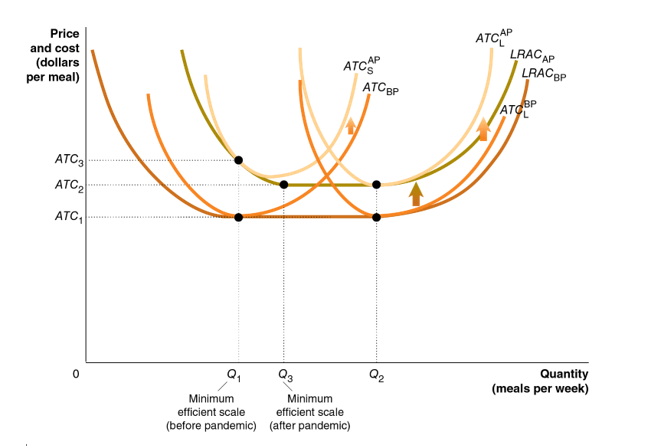
  2. Some airlines believed that even after the pandemic was over, consumers might not be willing to fly on planes as crowded as they were prior to the pandemic. Accordingly, airlines were considering either flying planes with some rows kept empty or reconfiguring planes to have more space between rows—and therefore fewer seats per plane. Briefly explain what effect having fewer seats per airplane might have on the price of an airline ticket.

Sources: Jonathan Roeder, “NYC to Miami for $51: Coronavirus Slump Leads to Steep Airfare Discounts,” bloomberg.com, March 5, 2020; and Scott McCartney, “There Are Plenty of Coronavirus Flight Deals Out There, But Think Before You Buy,” Wall Street Journal, March 25, 2020.

Solving the Problem

Step 1:   Review the chapter material. This problem is about the break-even price for a firm in the short run and in the long run, so you may want to review Chapter 12, Section 12.4 “Deciding Whether to Produce or to Shut Down in the Short Run” and Section 12.5 “‘If Everyone Can Do It, You Can’t Make Money at It’: The Entry and Exit of Firms in the Long Run.”. In Hubbard/O’Brien, Essentials of Economics, it is Chapter 9.

Step 2:   Answer part a. by explaining why even though a ticket price of $51 was unlikely to cover the average total cost of the flight, Frontier Airlines was still willing to accept such a low ticket price—but only in the short run. As we’ve seen in Section 12.5, competition among firms drives the price of a good to equal the average total cost of the typical firm. Assuming that ticket prices prior to the pandemic equaled average total cost, then the low ticket prices in the spring of 2020 must have been below average total cost.  We have also seen, though, that firms will continue to produce in the short run provided they receive a price equal to or greater than average variable cost. For a particular flight, the fixed cost—primarily the cost of aviation fuel and the salaries of the flight crew—is much greater than the variable cost—additional meals served, somewhat more fuel used because more passengers make the plane heavier, and possibly an additional flight attendant needed to assist additional passengers.  So, the $51 ticket price may have been enough for Frontier to cover its average variable cost. The airline would not accept such a low price in the long run, though, because in the long run it would need to cover all of its costs or it would no longer fly the route. (Note: In the short run, an airline might have another reason to continue to fly planes on a route even if it is unable to cover the average total cost of a flight. The contracts that airlines have with airports sometimes require a specified number of flights each day in order for the airline to retain the right to use certain airport gates.)

Step 3:   Answer part b. by explaining the effect that having fewer seats per airplane would have on airline ticket prices. For an airline to break even on a flight, its total revenue from the flight must equal its total cost.  Flying fewer seats per plane will not greatly reduce the airline’s cost of the flight because, as noted in the answer to part b., most of the cost of a flight is fixed and so the total cost of a flight doesn’t vary much with the number of passengers on the flight.  But flying half as many passengers—if every other row is left empty—will significantly decrease the revenue the airline earns from the flight. To increase revenue on the flight, the airline would have to increase the price of a ticket. We can conclude that if airlines decide to fly planes equipped with fewer seats, ticket prices are likely to rise. Note that if on some routes the demand for tickets is price elastic, raising the price will reduce revenue and the airline will be unable to cover its cost of flying the route.

COVID-19 Update – Impact on Supply Chains: Will Apple Start Making iPhones in the United States?

Supports:  Chapter 2, Trade-offs, Comparative Advantage, and the Market System [Econ, Micro, Macro, and Essentials]; Chapter 9, Comparative Advantage and the Gains from International Trade     [Econ and Micro; Macro Chapter 7; and Essentials Chapter 19]; Chapter 22, Aggregate Expenditure and Output in the Short Run   [Macro Chapter 12].

WILL APPLE START MAKING IPHONES IN THE UNITED STATES?

Apple, like many U.S. firms, relies on a global supply chain (sometimes also called a global value chain) comprised of firms in dozens of countries to make the components used in Apple’s products. (See Hubbard/O’Brien Chapter 2, Section 2.3 of Hubbard and O’Brien Economics and Microeconomics).  This strategy has allowed Apple to take advantage of both lower production costs and the engineering and manufacturing skills of firms in other countries to produce iPhones, iPads, iWatches, and MacBooks. But during the coronavirus pandemic, Apple found its supply chain disrupted because many of its suppliers located in China were forced to close for several months.

            Because of the coronavirus pandemic and the trade war between the United States  and China, many U.S. firms, including Apple, were considering moving some of their operations out of China. (The trade war is discussed in Chapter 9, section 9.5 of Hubbard and O’Brien Economics and Microeconomics, Chapter 7, Section 7.5 of Macroeconomics.)  As an article on bloomberg.com put it, these firms were “actively seeking ways to diversify their supply chains and reduce their dependence on any single country, no matter how attractive.” For example, two Taiwanese firms, Wistron and Pegatron, which had used factories in China to assemble iPhones were moving some factories to India, Vietnam, and Taiwan.

            It seemed unlikely, though, that production of iPhones would move back to the United States. Why not?  First, manufacturing employment has been in decline in the United States since long before U.S. firms began using suppliers based in China. In 1947, shortly after the end of World War II, 33 percent of U.S. workers were employed in manufacturing. By 2001, when China became a member of the World Trade Organization, that percentage had already declined to 12 percent. In 2019, it was 9 percent.

Manufacturing production in the United States has held up better than manufacturing employment. The Federal Reserve’s index of manufacturing production increased more than 250 percent between the beginning of 1972 and the beginning of 2020. U.S. manufacturing has been able to increase output while employment has declined because of increases in productivity. The increases in productivity have relied, in part, on increased use of robotics, particularly in assembly line work, such as the production of automobiles.  The United States has a comparative advantage in producing goods and services that require skilled labor and involve artificial intelligence, machine learning, and the use of other sophisticated computer programing. Manufacturing that relies on lower-skilled labor, such as textile and shoe production, has been mostly moved overseas. 

            The Taiwanese firms Foxconn, Wistron, and Pegatron assemble iPhones, primarily in factories in China and elsewhere in Asia where large quantities of unskilled labor are available.  Some components of the iPhone that require skilled labor and sophisticated engineering, including the screens, the touchscreen controller, and the Wi-Fi chip, are produced by U.S. firms and shipped to China for final assembly. In fact, surprisingly, the value of the U.S.-made components exceeds the value of assembling the iPhone in Chinese factories. (See Hubbard and O’Brien Economics, Chapter 22, Section 22.3 and Macroeconomics, Chapter 12, Section 12.3).

            Factory assembly lines, like those in China making iPhones, need to be flexible to respond quickly to Apple introducing new models. So, in addition, to hundreds of thousands of unskilled workers in its assembly plants, Foxconn and other firms operating in China hire thousands of engineers. Typically, these engineers do not have college degrees, but they have sufficient training to rapidly redesign and reconfigure assembly lines to produce new models. In 2010, when President Barack Obama pressed Steve Jobs, the late Apple CEO, to produce iPhones in the United States, Jobs pointed to lack of sufficient workers with engineering skills to make such production possible. Jobs stated that he would need 30,000 such engineers if Apple were to make iPhones in the United States, but “You can’t find that many in America to hire.”

            The situation hasn’t changed much in the past 10 years. As an article in the Wall Street Journal observed in March 2020, in addition to a large number of unskilled workers, Foxconn employs in China, “Tens of thousands of experienced manufacturing engineers [to] oversee the [production] process. Finding a comparable amount of unskilled and skilled labor [elsewhere] is impossible.”

            Although some firms were attempting to reduce their reliance on Chinese factories in response to the coronavirus pandemic, because the United States lacks a comparative advantage in the assembly of consumer electronics, it seemed unlikely that those factories would be relocated here.  But the coronavirus pandemic may lead some U.S. firms to change their supply chains in other ways.  For instance, firms may now put greater value on redundancy. Apple might underwrite the cost to its suppliers of building facilities in several Asian countries to assemble iPhones. In the event of problems occurring in one country, this redundant capacity would allow production to switch from factories in one country to factories in other countries.

            Similarly, some firms may rethink their inventory management. Before the 1970s, most manufacturing firms kept substantial inventories of parts and components. Retail firms often kept substantial inventories of goods in warehouses. This approach began to change during the 1970s, as Toyota pioneered just-in-time inventory systems in which firms accept shipments from suppliers as close as possible to the time they will be needed. Most manufacturers in the United States and elsewhere adopted these systems, as did many retailers.

            For example, at Walmart, as goods are sold in the stores, this point-of-sale information is sent electronically to the firm’s distribution centers to help managers determine what products to ship to each store. This distribution system allows Walmart to minimize its inventory holdings.  Because Walmart sells 15 to 25 percent of all the toothpaste, disposable diapers, dog food, and other products sold in the United States, it has involved many manufacturers in its supply chain. For example, a company such as Procter & Gamble, one of the world’s largest manufacturers of toothpaste, laundry detergent, and toilet paper, receives Wal-Mart’s point-of-sale and inventory information electronically. Procter & Gamble uses that information to determine its production schedules and the quantities and timing of its shipments to Walmart’s distribution centers.

            But as the pandemic disrupted supply chains, many manufacturers had to suspend production because they did not receive timely shipments of parts. Similarly, Walmart and other retailers experienced stockouts—sales lost because the goods consumer want to buy aren’t on the shelves.

            In 2020, firms were reconsidering their supply chains as they evaluated whether to underwrite the building of redundant capacity among their suppliers and whether to reduce the extent to which they relied on just-in-time inventory systems.

Sources: Debby Wu, “Not Made in China Is Global Tech’s Next Big Trend,” bloomberg.com, March 31, 2020; Yossi Sheffi, “Commentary: Supply-Chain Risks From the Coronavirus Demand Immediate Action,” Wall Street Journal, February 18, 2020; Tripp Mickle and Yoko Kubota, “Tim Cook and Apple Bet Everything on China. Then Coronavirus Hit,” Wall Street, March 3, 2020; and Walter Isaacson, Steve Jobs, New York: Simon & Schuster, 2011, pp. 544-547.

Question:  Suppose that you’re a manager at Apple. Given the coronavirus pandemic, Apple is considering whether to underwrite the cost to its suppliers, such as Foxconn, of building redundant factories in countries outside of China.. The goal is to reduce the production problems that occur when factories are concentrated in a single country during a pandemic or other disaster. Your manager asks you to prepare a brief evaluation of this idea.  What factors should you take into account in your evaluation?