The U.S. Dollar in the World Economy

The U.S. dollar is the most important currency in the world economy. The funds that governments and central banks hold to carry out international transactions are called their official foreign exchange reserves. (See Macroeconomics, Chapter 18, Section 18.1 and Economics, Chapter 28, Section 28.1.) There are 180 national currencies in the world and foreign exchange reserves can be held in any of them. In practice, international transactions are conducted in only a few currencies. Because the U.S. dollar is used most frequently in international transactions, the majority of foreign exchange reserves are held in U.S. dollars. The following figure shows the composition of official foreign exchange reserves by currency as of mid-2021.
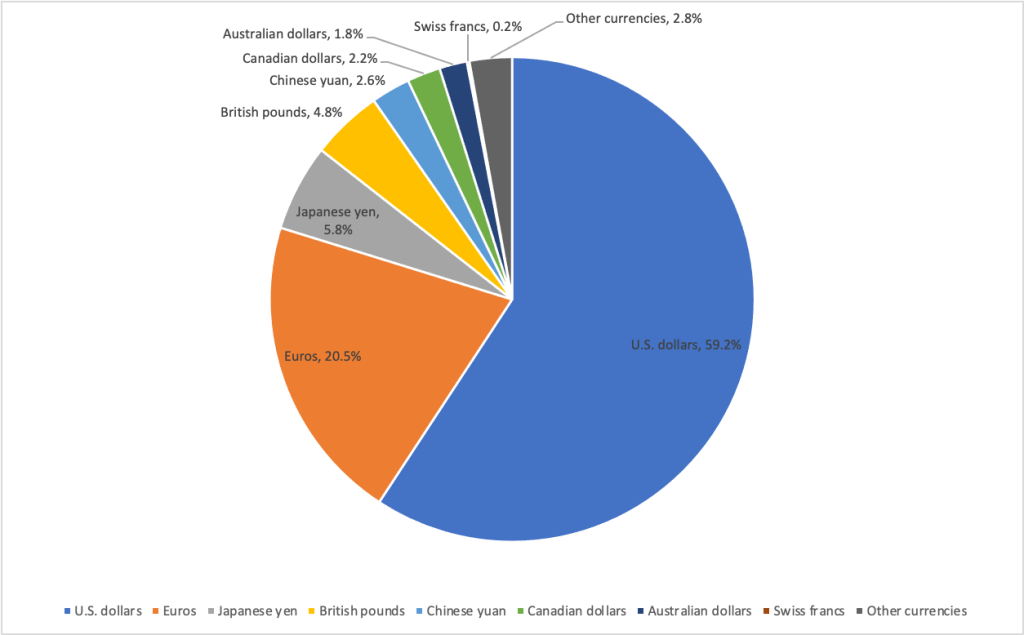
Over time, the percentage of foreign exchange reserves in U.S. dollars has been gradually declining, although the dollar seems likely to remain the dominant foreign reserve currency for a considerable period. Does the United States gain an advantage from being the most important foreign reserve currency? Economists and policymakers are divided in their views. At the most basic level, dollars are claims on U.S. goods and services and U.S. financial assets. When foreign governments, banks, corporations, and investors hold U.S. dollars rather than spending them, they are, in effect, providing the United States with interest-free loans. U.S. households and firms also benefit from often being able to use U.S. currency around the world when buying and selling goods and services and when borrowing, rather than first having to exchange dollars for other currencies.

But there are also disadvantages to the dollar being the dominant reserve currency. Because the dollar plays this role, the demand for the dollar is higher than it would otherwise be, which increases the exchange rate between the dollar and other currencies. If the dollar lost its status as the key foreign reserve currency, the exchange rate might decline by as much as 30 percent. A decline in the value of the dollar by that much would substantially increase exports of U.S. goods. Barry Eichengreen of the University of California, Berkeley, has noted that the result might be “a shift in the composition of what America exports from Treasury [bonds and other financial securities] … toward John Deere earthmoving equipment, Boeing Dreamliners, and—who knows—maybe even motor vehicles and parts.”

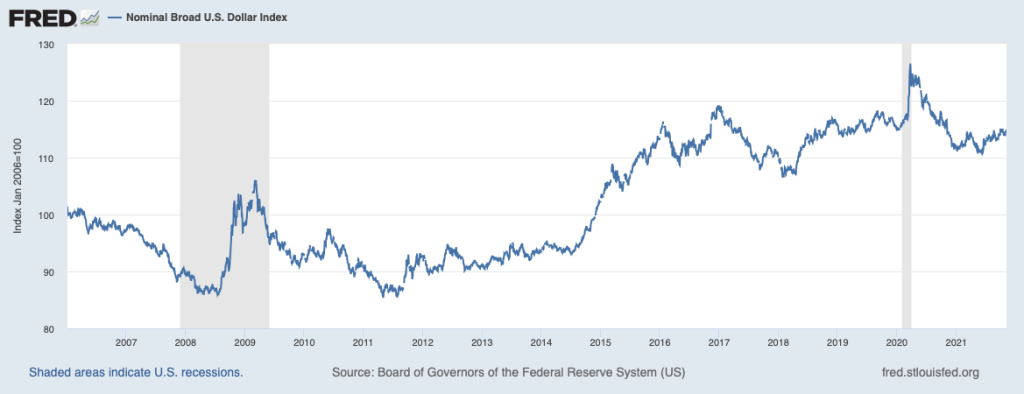
As shown in the following figure, the importance of the U.S. dollar in the world economy is also indicated by the sharp increase in the demand for dollars and, therefore, in the exchange rate during the financial crisis in the fall of 2008 and during the spread of Covid-19 in the spring of 2020. (The exchange rate in the figure is a weighted average of the exchange rates between the dollar and the currencies of the major trading partners of the United States.) As an article in the Economist put it: “Last March, when suddenly the priority was to have cash, the cash that people wanted was dollars.”
Sources: International Monetary Fund, “Currency Composition of Official Foreign Exchange Reserves,” data.imf.org; Alina Iancu, Neil Meads, Martin Mühleisen, and Yiqun Wu, “Glaciers of Global Finance: The Currency Composition of Central Banks’ Reserve Holdings,” blogs.imf.org, December 16, 2020; Barry Eichengreen, Exorbitant Privilege: The Rise and Fall of the Dollar and the Future of the International Monetary System, New York: Oxford University Press, 2001, p. 173; “How America’s Blockbuster Stimulus Affects the Dollar,” economist.com, March 13, 2021; and Federal Reserve Bank of St. Louis. 

NEW! – 04/16/21 Podcast – Authors Glenn Hubbard & Tony O’Brien discuss monetary policy and the tools available to the Federal Reserve.

Authors Glenn Hubbard and Tony O’Brien follow up on last week’s fiscal policy podcast by discussing monetary policy in today’s world. The Fed’s role has changed significantly since it was first introduced. They keep an eye on inflation and employment but aren’t clear on which is their priority. The tools and models used by economists even a decade ago seem outdated in a world where these concepts of a previous generation may be outdated. But, are they? LIsten to Glenn & Tony discuss these issues in some depth as we navigate our way through a difficult financial time.

Just search Hubbard O’Brien Economics on Apple iTunes or any other Podcast provider and subscribe! Today’s episode is appropriate for Principles of Economics and/or Money & Banking!

Please listen & share!

Solved Problem: The Macroeconomic Effects of a Stronger Euro

Supports:  Economics: Chapter 28 – Macroeconomics in an Open Economy (Section 28.2); Macroeconomics: Chapter 12, Section 12.2; and Essentials: Chapter 19 – Comparative Advantage, International Trade, and Exchange Rates (Section 19.6)

Solved Problem: The Macroeconomic Effects of a Stronger Euro

In December 2020, an article in the Wall Street Journal discussed the effects of changes in the value of the euro in exchange for the U.S. dollar. The article noted that: “A stronger euro makes exports from the region less competitive overseas” and that a stronger euro would also “damp inflation” in countries using the euro as their currency.

a. What does the article mean by a “stronger euro”? Why would a stronger euro make European exports less competitive?

b. What does the article mean by “damp inflation”? Why would a stronger euro damp inflation in countries using the euro?

Source: Caitlin Ostroff, “Euro Rally Weighs on Inflation, Sapping Appetite for Stocks,” Wall Street Journal, December 9, 2020.

Solving the Problem

Step 1:   Review the chapter material. This problem is about the effect of changes in the exchange rate on a country’s (or region’s) imports and exports, so you may want to review Chapter 28, Section 28.2 “How Movements in Exchange Rates Affect Imports and Exports.”

Step 2:   Answer part a. by explaining what a “stronger euro” means and why a stronger euro would make European exports less competitive. A stronger euro is one that exchanges for more dollars or, which amounts to the same thing, requires fewer euros to exchange for a dollar. (You may want to review the Apply the Concept “Is a Strong Currency Good for a Country?”) A stronger euro results in U.S. consumers having to pay more dollars to buy goods and services imported from Europe. In other words, the prices of European exports to the United States will rise making the exports less competitive with U.S.-produced goods or with other countries exports to the United States. If the euro is also becoming stronger against currencies such as the British pound, Japanese yen, and Chinese yuan, then European exports will also be less competitive in those countries.

Step 3:   Answer part b. by explaining what “damp inflation” means and why a stronger euro would damp inflation in countries using the euro. To “damp inflation” is to reduce inflation. So the article is stating that a stronger euro will result in lower inflation in Europe. To understand why, remember that while a stronger euro will raise the dollar price of European exports to the United States, it will reduce the euro price of European imports from the United States (and from other countries if the euro is also becoming stronger against currencies such as the British pound, Japanese yen, and Chinese yuan). Inflation in a country is measured using the prices of goods and services that consumers purchase, whether those goods and services are produced domestically or are imported.

The Wall and the Bridge – an article from Glenn Hubbard in National Affairs.

Advances in technology and expanding international trade have disrupted some key U.S. industries. These developments have made new products available, lowered the prices of existing products, and fostered the creation of new companies and new jobs. Yet, there has also been a downside. Some U.S. manufacturing firms have disappeared and some workers have been left unemployed for long periods. How can economists help frame a discussion about policies that will help everyone participate as the economy continues to evolve? Glenn Hubbard discusses a new approach in his article “The Wall and the Bridge”, published in National Affairs in September 2020.

5/29/20 Podcast – Glenn Hubbard & Tony O’Brien Welcome Guest – Prof. Bill Goffe from Penn State University!

Glenn Hubbard and Tony O’Brien continue their podcast series hosting guest – Professor Bill Goff of Penn State University. In talking with Bill, we discuss the challenges of teaching online during the Pandemic this past spring. We talk some about unemployment as well as hearing how Bill how he developed his passion for photography in his travels around the world. The image on this post was a picture of the Milky Way taken by Bill in North Central Pennsylvania!

Links for podcast of May 29, 2020 with Bill Goffe of Penn State

1. Link to RFE:  Resources for Economists on the Internet that Bill edits: https://www.aeaweb.org/rfe/

2. Link to the website of the Journal of Economic Education where Bill is an associate editor: https://www.tandfonline.com/loi/vece20

3. Link to the CTALE TeachECONference – https://ctale.org/teacheconference/. You can register – for free – by clicking HERE

Please listen & share!

5/22/20 Podcast – Glenn Hubbard & Tony O’Brien Welcome Guest – Prof. Mike Ryan from Western Michigan University!

Glenn Hubbard and Tony O’Brien continue their podcast series hosting guest – Professor Mike Ryan of Western Michigan University. During the conversation, we learn about Mike’s experiences working with faculty from Western Michigan School of Business taking their courses online. He also offers his thoughts on the current trade situation as well as personal insights from a January visit to Japan.

Please listen & share!