Is the Natural Rate of Unemployment the Best Guide to Monetary Policy? The Fed’s New Monetary Policy Strategy

In response to the 2007-2009 financial crisis, in December 2008, the Federal Open Market Committee effectively cut its target for the federal funds to zero where it remained during the first six years of the recovery. In December 2015, Fed Chair Janet Yellen and the FOMC began the process of normalizing monetary policy by raising the target for the federal funds rate to 0.25 to 0.50 percent.

The FOMC raised the target several more times during the following years (Jerome Powell succeeded Janet Yellen as Fed Chair in February 2018) until it reached 2.25 to 2.50 percent in December 2018. In Chapter 27 of the textbook we discuss the fact that the experience of the Great Inlfation that had lasted from the late 1960s to the early 1980s had convinced many economists inside and outside of the Fed that if the unemployment rate declined below the natural rate of unemployment (also referred to as the nonaccelerating inflation rate of unemployment, or NAIRU), the inflation rate was likely to accelerate unless the FOMC increased its target for the federal funds rate. The actions the FOMC took starting in December 2015 were consistent with this view.

At the December 2015 meeting, the FOMC members gave their estimates of several key economic variables, including the natural rate of unemployment. At the time of the meeting, the unemployment rate was 5.0 percent. The average of the FOMC members’ estimates of the natural rate of unemployment was 4.9 percent. The inflation rate in December 2015 was 1.2 percent—well below the Fed’s target inflation rate of 2 percent. Although it might seem that with such a low inflation rate, the FOMC should not have been increasing the federal funds rate target, doing so was consistent with one of the lessons from the Great Inflation: Because monetary policy affects the economy with a lag, it’s important for the Fed to react before inflation begins to increase and a higher inflation rate becomes embedded in the economy. With many FOMC members believing that the NAIRU had been reached in December 2015, raising the federal funds rate from effectively zero seemed like an appropriate policy.

At least until the end of 2018, some members of the FOMC indicated publicly that they still believed that the Fed should pay close attention to the relationship between the natural rate of unemployment and the actual rate of unemployment. For example, in a speech delivered in December 2018, Raphael Bostic, president of the Federal Reserve Bank of Atlanta, who was serving that year on the FOMC, made the following points:

“[P]eriods of time when the actual unemployment rate fell below what the U.S. Congressional Budget Office now estimates as the so-called natural rate of unemployment … I refer to … as “high-pressure” periods. … Dating back to 1960, every high-pressure period ended in a recession. And all but one recession was preceded by a high-pressure period….

One potential consequence of overheating is that inflationary pressures inevitably build up, leading the central bank to take a much more “muscular” stance of policy at the end of these high-pressure periods to combat rising nominal pressures. Economic weakness follows. You might argue that the simple answer is to not respond so aggressively to building signs of inflation, but that would entail risks that few responsible central bankers would accept. It is true that the Fed and most other advanced-economy central banks have the luxury of solid credibility for achieving and maintaining their price stability goals. But we shouldn’t forget that such credibility was hard won. Inflation expectations are reasonably stable for now, but we know little about how far the scales can tip before it is no longer so.”

Bostic also noted in the speech that “it is very difficult to determine when the economy is actually overheating.” One indication of that difficulty is given by the following table, which shows how the average estimate by FOMC members of the natural rate of unemployment declined each year during the period in which they were raising the target for the federal funds rate. 

December 20154.9%
December 20164.8%
December 20174.7%
December 20184.4%
December 20194.1%
Federal Open Market Committee Forecasts of the Natural Rate of Unemployment, 2015-2019

As we discuss in Chapter 19, Section 19.1 of the textbook, because of problems in measuring the actual unemployment rate and in estimating the natural rate of unemployment, some economists inside and outside of the Fed have argued that the employment-population ratio for prime age workers is a better measure of the state of the labor market.  The following shows movements in the employment-population ratio for workers aged 25 to 54 between January 2000, when the ratio was near its post-World War II high, and February 2021. 
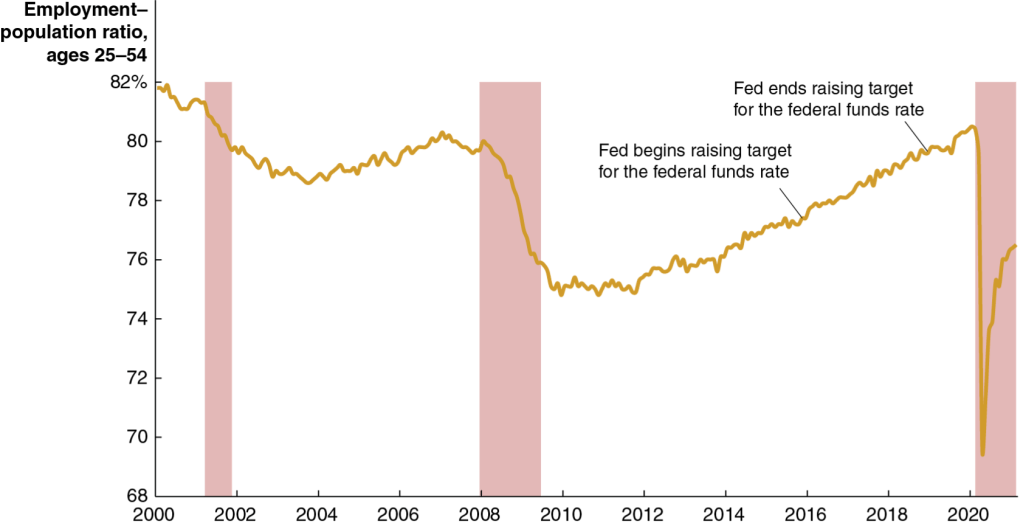
Employment-Population Ratio for Worker Aged 25 to 54, 2000-2021

The figure shows that in December 2015, when the Fed began to raise its target for the federal funds rate and when the average estimate of the FOMC members indicated that unemployment was at its natural rate, the employment-population rate was still 4.5 percentage points below its level of early 2000. The FOMC members do not report individual forecasts of the employment-population ratio. If they had focused on that measure rather than on the unemployment rate, they may have concluded that there was more slack in the labor market and, therefore, have been less concerned that inflation might be about to significantly increase.

In 2019, the Fed began to cut its target for the federal funds rate as the growth of real GDP slowed. In March 2020, following the start of the Covid-19 pandemic, the Fed cut the target back to 0 to 0.25 percent. During that time, some members of the FOMC and some economists outside of the Fed concluded that the Fed may have made a mistake by raising the target for the federal funds rate multiple times between 2015 and 2018. For example, Bostic in a speech in November 2020, noted that “the actual unemployment rate exceeded estimates of the NAIRU by an average of 0.8 percentage points each year” between 1979 and 2019. He concluded that “If estimates of the NAIRU are actually too conservative, as many would argue they have been …unemployment could have averaged one to two percentage points lower” between 1979 and 2019, which he argues would have been a particular benefit to black workers. In a speech in September 2020, Lael Brainard, a member of the Fed’s Board of Governors, noted that the Fed’s previous approach of making policy less expansionary “when the unemployment rate nears the [natural] rate in anticipation of high inflation that is unlikely to materialize risks an unwanted loss of opportunity for many Americans.”  

in August 2020, the Fed announced the results of a review of its monetary policy. In a speech that accompanied the statement Fed Chair Jerome Powell noted that in attempting to achieve its mandate of high employment, the Fed faces the difficulty that “the maximum level of employment is not directly measurable and changes over time for reasons unrelated to monetary policy. The significant shifts in estimates of the natural rate of unemployment over the past decade reinforce this point.” Powell noted that the in the Fed’s new monetary policy statement, policy will depend on the FOMC’s: “’assessments of the shortfalls of employment from its maximum level’ rather than by ‘deviations from its maximum level’ as in our previous statement. This change may appear subtle, but it reflects our view that a robust job market can be sustained without causing an outbreak of inflation.” 

At this point, the details of how the Fed’s new monetary policy strategy will be implemented are still uncertain. But it seems clear that the Fed has ended its approach dating back to the early 1980s of raising its target for the federal funds rate when the unemployment rate declined to or below the FOMC’s estimate of the natural rate of unemployment. Particularly after Congress and the Biden administration passed the $1.9 trillion American Rescue Plan in March 2021, some economists wondered whether the Fed’s new strategy might make it harder to counter an increase in inflation without pushing the U.S. economy into a recession. For instance, Olivier Blanchard of the Peterson Institute for International Economics argued that the combination of very expansionary fiscal and monetary policies might lead to a situation similar to the late 1960s:

“From 1961 to 1967, the Kennedy and Johnson administrations ran the economy above potential [GDP], leading to a steady decrease in the unemployment rate down to less than 4 percent. Inflation increased but not very much, from 1 percent to just below 3 percent, suggesting to many a permanent trade-off between inflation and unemployment. In 1967, however, inflation expectations started adjusting, and by 1969, inflation had increased to close to 6 percent and was then seen as a major issue. Fiscal and monetary policies tightened, leading to a recession from the end of 1969 to the end of 1970.”

Fed Chair Jerome Powell seems confident, however, that any increase in inflation will only be temporary. In testifying before Congress, he stated that: “We might see some upward pressure on prices [as a result of expansionary monetary and fiscal policy]. Our best view is that the effect on inflation will be neither particularly large nor persistent.” 

Time will tell which side in what one economic columnist called the Great Overheating Debate of 2021 will turn out to be correct.

Sources: Neil Irwin, “If the Economy Overheats, How Will We Know?” New York Times, March 24, 2012; Olivier Blanchard, “In Defense of Concerns over the $1.9 Trillion Relief Plan,”  piie.com, February 18, 2021; Paul Kiernan and Kate Davidson, “Powell Says Stimulus Package Isn’t Likely to Fuel Unwelcome Inflation,” Wall Street Journal, March 23, 2021; Federal Open Market Committee, “Minutes,” various dates; Lael Brainard, “Bringing the Statement on Longer-Run Goals and Monetary Policy Strategy into Alignment with Longer-Run Changes in the Economy,” September 1, 2020; Raphael Bostic, “Views on the Economic and Policy Outlook,”  December 6, 2018; Raphael Bostic, “Racism and the Economy: Focus on Employment,” November 17, 2020; Jerome Powell, “New Economic Challenges and the Fed’s Monetary Policy Review,” August 27, 2020; and Federal Reserve Bank of St. Louis. 

NEW! – 04/16/21 Podcast – Authors Glenn Hubbard & Tony O’Brien discuss monetary policy and the tools available to the Federal Reserve.

Authors Glenn Hubbard and Tony O’Brien follow up on last week’s fiscal policy podcast by discussing monetary policy in today’s world. The Fed’s role has changed significantly since it was first introduced. They keep an eye on inflation and employment but aren’t clear on which is their priority. The tools and models used by economists even a decade ago seem outdated in a world where these concepts of a previous generation may be outdated. But, are they? LIsten to Glenn & Tony discuss these issues in some depth as we navigate our way through a difficult financial time.

Just search Hubbard O’Brien Economics on Apple iTunes or any other Podcast provider and subscribe! Today’s episode is appropriate for Principles of Economics and/or Money & Banking!

Please listen & share!

Christopher Waller Confirmed by Senate as Federal Reserve Governor

Christopher Waller

On Thursday, December 3, Christopher Waller, executive vice president and research director at the Federal Reserve Bank of St. Louis, was confirmed by the Senate as a member of the Federal Reserve’s Board of Governors.  The Board of Governors has seven members and, under the Federal Reserve Act, is responsible for the monetary policy of the United States and for overseeing the operation of the Federal Reserve System.

Board members are appointed by the president and confirmed by the Senate to 14-year nonrenewable terms. The terms are staggered so that one expires every other January 31. Members frequently leave the Board before their terms expire to return to their previous occupations or to accept other positions in the government. The following table shows the current Board members, when their terms will expire, and which president appointed them.  Note that one seat on the Board is vacant. President Trump nominated Judy Shelton to fill this seat but it appears unlikely that she will be confirmed by the Senate before the change in administration takes place on January 20.

NameYear Term EndsAppointed to the Board by
Jerome Powell, ChairAs Chair: 2022
As Board member: 2028
As Chair: President Trump
As Board member: President Obama
Richard Clarida, Vice ChairAs Vice Chair and as Board member: 2022President Trump
Randal Quarles, Vice Chair for SupervisionAs Vice Chair for Supervision: 2021; As Board member: 2032President Trump
Michelle Bowman2034President Trump
Lael Brainard2026President Obama
Christopher Waller2030President Trump
Vacant

Information on the history and structure of the Board of Governors and on the backgrounds of current members can be found HERE on the Fed’s website.  An announcement of Waller’s confirmation can be found HERE on the website of the St. Louis Fed. A news story discussing Waller’s confirmation and the likely outcome of Shelton’s nomination, as well as some of the politics involved with current Fed nominations can be found HERE (those with a subscription to the Wall Street Journal may also want to read the article HERE).

Janet Yellen Nominated to Be Treasury Secretary

Janet Yellen

President-elect Joe Biden has nominated Janet Yellen to be treasury secretary. If confirmed by the Senate, Yellen would be the first woman to hold that post. She would also be the first person to have been both Federal Reserve Chair and treasury secretary. Yellen also served as President of the Federal Reserve Bank of San Francisco and as Chair of the Council of Economic Advisers during the Clinton administration. Prior to entering government service, Yellen was on the economics faculties of Harvard University and the University of California, Berkeley. At the time of her nomination she was a Distinguished Fellow in Residence at the Brookings Institution.

A news story on her nomination can be read HERE. Her biography on the Brookings Institution web site is HERE (includes a video conversation from a few years ago with former Fed Chair Ben Bernanke). A speech she gave in 2018 reflecting on the 2007-2009 financial crisis can be read HERE.

9/11/20 Podcast – Authors Glenn Hubbard & Tony O’Brien cover current events, Micro, and Macro! They discuss 9/11, the rising stock market, the challenges facing restaurants, as well as shifts in strategy for the Fed!

Authors Glenn Hubbard and Tony O’Brien continue their weekly discussion about the effects of the Pandemic on the US Economy. They discuss the disconnect between stock market performance and the overall economy. Also, they look at the decision of restaurants to stay open despite struggling to breakeven due to limitations on indoor seating. The Fed’s pivot on the dual-mandate is also discussed as they announce more of their monetary policy focus will be on unemployment rather than inflation.

Over the next several weeks, we will be gearing up this podcast to become an essential listen during your week. Whether your interest is teaching or policy, you will learn from this discussion.

Just search Hubbard O’Brien Economics on Apple iTunes and subscribe!

Please listen & share!

4/9/20 – UNWRITTEN Pearson Webinar with Glenn Hubbard and Jaylen Brown, Pearson Campus Ambassador.

During the initial UNWRITTEN webinar from Pearson, Glenn Hubbard had a conversation with Jaylen Brown, a Pearson Campus Ambassador as well as a student at University of Central Florida -also Glenn’s undergrad alma mater!

Over the 30-minute broadcast, they discussed topics of relevance to all students – real world outlook on jobs, supply and demand, and the policies aimed at relief. Glenn talks of recovery shaped like a Nike swoosh with a sharp decline and a slightly longer climb back to normalcy. Check out the full episode now posted on YouTube!

COVID-19 Update: Monetary and Fiscal Policy Responses: The Great Recession vs. the Coronavirus Pandemic

Supports:  Hubbard/O’Brien, Economics, Chapter 25 – Monetary Policy (Macro Chapter 15 and Essentials Chapter 17), and Chapter 26 – Fiscal Policy (Macro Chapter 16 and Essentials Chapter 18).

The Great Recession of 2007-2009 was the worst economic contraction in the United States since the Great Depression of the 1930s.  Accordingly, it brought a vigorous response from federal policymakers.  As of late March 2020, it was too soon to tell how severe the economic contraction from the coronavirus pandemic might be.  But policymakers had already responded with major initiatives.  In the following sections, we compare monetary and fiscal policies employed during the Great Recession and those employed at the beginning of the coronavirus pandemic.

A Brief History of U.S. Recessions

             Historically, most recessions in the United States have been caused by one of two often related factors: (1) A financial crisis or (2) Federal Reserve actions taken to reduce the inflation rate.  The two main exceptions are the recession of 1973-1975, which was primarily the result of a sharp increase in oil prices, and the recession of 2020, which was the result of the effects of the coronavirus pandemic and of the business closures ordered by state and local governments in an attempt to contain the pandemic.

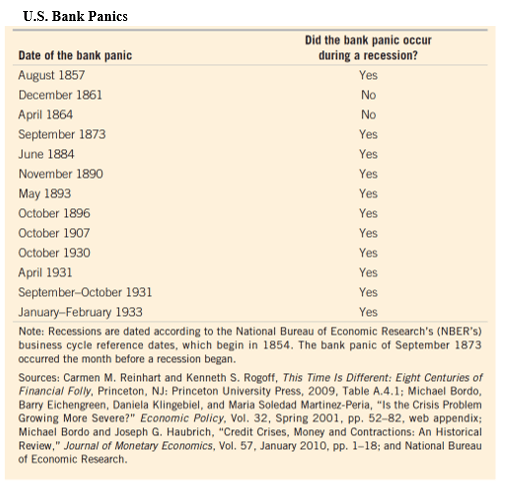
            Prior to 1914, the United States lacked both a central bank that could act as a lender of last resort to keep bank runs from escalating into bank panics and a system of deposit insurance.  By cutting off many businesses from their main source of credit and cutting off both households and firms from their bank deposits, bank panics resulted in declines in production and employment. The failure of the Federal Reserve to effectively deal with the waves of bank panics from 1930 to 1933 at the beginning of the Great Depression led Congress in 1934 to establish the Federal Deposit Insurance Corporation (FDIC) to insure deposits in commercial banks (currently up to $250,000 per depositor, per bank). The following table shows that prior to World War II (U.S. participation lasted from 1941 to 1945), most recessions were associated with bank panics.

 As a result of deposit insurance and more active Federal Reserve discount lending, after World War II problems in the commercial banking system were no longer a major source of instability in the U.S. economy.  As the following figure shows, declines in residential construction have preceded every recession in the United States since 1958 (the shaded areas represent periods of recession). Edward Leamer of the University of California, Los Angeles had gone so far as to argue that “housing is the business cycle.” Prior to the housing crash that preceded the Great Recession, the main cause of the declines in residential construction shown in the figure were rising mortgage interest rates, typically due to the Federal Reserve raising its target for the federal funds rate—the interest rate that banks charge each other on overnight loans—in response to increases in the inflation rate.


Monetary Policy during the Great Recession

Both the Great Recession of 2007-2009 and pre-World War II recessions were accompanied by financial panics.  Both the Great Recession of 2007-2009 and post-World War II recessions were accompanied by sharp downturns in the housing market.

But the Great Recession differed from earlier recessions two key ways:  First, it was caused by problems internal to the housing market rather than the effect on the housing market of contractionary monetary policy; and second, it did not involve commercial banks.  Instead, it involved the shadow banking sector of investment banks, money market mutual funds, and insurance companies. 

            Problems began in the market for mortgage-backed securities—bonds that consisted of mortgages bundled together. The value of the bonds depended on the value of the underlying mortgages. When housing prices began to decline in 2006, borrowers began defaulting on mortgages.  Many commercial and investment banks owned these mortgage-backed securities, so the decline in the value of the securities caused these banks to suffer heavy losses. By mid-2007, investors and policymakers became concerned about the decline in the value of mortgage-backed securities and the large losses suffered by commercial and investment banks. Many investors refused to buy mortgage-backed securities, and some investors would buy only bonds issued by the U.S. Treasury.

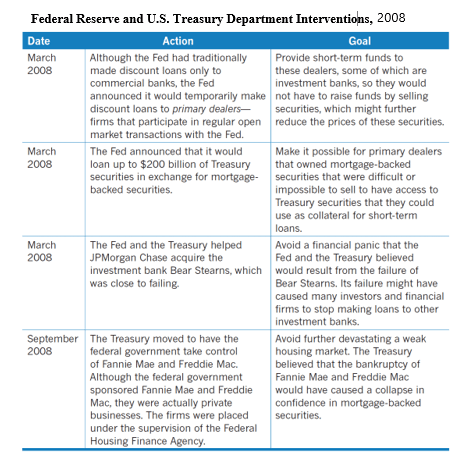
            The problems in financial markets resulting from the bursting of the housing bubble were severe, particularly after the failure of the Lehman Brothers investment bank in September 2008.  In previous recessions, the focus of the Fed’s expansionary policy had been on cutting its target for the federal funds rate to reduce borrowing costs and spur spending, particularly spending on residential construction.  The Fed did rapidly cut its target for the federal funds rate from 5.25 percent in September 2007 to effectively 0 percent in December 2008. But the financial crisis reduced the effect of these rate cuts because the flow of funds through the financial system had largely dried up.  As a result, the Fed entered into an unusual partnership with the U.S. Treasury Department and intervened in financial markets in unprecedented ways, which we summarize in the following table. In addition to the actions shown in the table, for the first time since the 1930s, the Fed bought commercial paper—short-term bonds issued by corporations—because many firms found their usual sources of funds were no longer available in the crisis. The Fed’s aim was to restore the flow of funds through the financial system to enable firms to obtain the credit they needed to maintain production and employment.


Fiscal Policy during the Great Recession

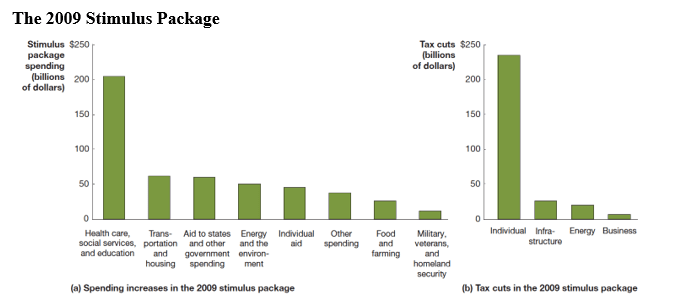
Presidents George W. Bush and Barack Obama both initiated fiscal policy responses to the Great Recession. In 2008, President Bush and Congress enacted a tax cut that took the form of rebates of taxes had already paid. After taking office in January 2009, President Obama and Congress enacted the $840 billion American Recovery and Reinvestment Act (AARA), often called the “stimulus package.”  The following figure summarizes the spending and tax cuts in the ARRA.

During the Great Recession, the Fed’s monetary policy moved well beyond its usual focus on targeting the federal funds rate. But fiscal policy was more conventional: Increasing government spending and cutting taxes to increase aggregate demand, real GDP, and employment. The ARRA was notable mainly because of its size.

Monetary Policy in Response to the Coronavirus Epidemic

            During 2019, prior to the epidemic beginning to affect the United States, the Fed had twice cut its target for the federal funds rate in response to a slowing rate of economic growth.  With the spread of the coronavirus at the start of 2020, the Fed again cut its target twice, returning it effectively to 0 percent in mid-March.  With many businesses closed and many consumers largely confined to their homes, the Fed knew that lower borrowing costs would not be the key to maintaining economic activity.  Accordingly, the Fed revived some of the lending facilities that it had used during the 2007-2009 financial crisis and set up some new facilities with the goal of maintaining the flow of funds through the financial system and the ability of firms whose revenues had plunged to continue to access credit.

            Here is a summary of Fed’s policy actions during March and early April 2020:

  • Cuts to the Federal Funds Rate  The Fed reduced its target for the federal funds rate from a range of 1.75 percent to 1.50 percent to a range of 0 percent to 0.25 percent.
  • Purchases of Mortgage-Backed Securities  To provide funds to the market for mortgage lending, the Fed began purchasing mortgage-backed securities guaranteed by Fannie Mae, Freddie Mac, and Ginnie Mae, which are government-sponsored enterprises (GSEs).
  • Central Bank Liquidity Swap Lines  To meet a surge in demand by foreign businesses and governments for U.S. dollars, the Fed expanded its Central Bank Liquidity Swap Lines, which allow foreign central banks to exchange their currencies for dollars.
  • Facility for Foreign and International Monetary Authorities  To further help foreign central banks meet the demand for U.S. dollars by foreign businesses and governments, the Fed established the Foreign and International Monetary Authorities repurchase agreement facility, which allowed these authorities to “temporarily exchange their U.S. Treasury securities held with the Federal Reserve for U.S. dollars, which can then be made available to institutions in their jurisdictions.” This new facility reduced the need for foreign central banks to sell U.S. Treasury securities to obtain U.S. dollars. Those sales had been contributing to volatility in the market for U.S. Treasury securities.
  • Primary Dealer Credit Facility  To ensure the liquidity of the 24 primary dealers, which are the large financial firms who interact with the Fed in securities markets, the Fed established the Primary Dealer Credit Facility to provide loans to these dealers.
  • Commercial Paper Funding Facility  To ensure that corporations would have access to short-term funds necessary to meet payrolls and pay their suppliers, the Fed established the Commercial Paper Funding Facility to buy commercial paper from corporations.
  • Primary Market Corporate Credit Facility  To ensure that corporations have access to longer-term funds, the Fed established the Primary Market Corporate Credit Facility to make loans to corporations whose bonds are rated investment grade by Moody’s, S&P, and Fitch, the private bond rating agencies.
  • Secondary Market Corporate Credit Facility  To ensure the smooth functioning of the corporate bond market, the Fed established the Secondary Market Corporate Credit Facility to buy in the secondary market investment grade bonds issued by corporations and to buy shares in exchange-traded funds that are primarily invested in such bonds. First established in March, the facility was expanded in April to allow for the purchase of some non-investment grade corporate bonds and the purchase of shares in exchange-traded funds that are invested in such bonds.
  • Term Asset-Backed Securities Loan Facility (TALF) To support the flow of credit to consumers and businesses, the Fed began buying asset-backed securities (ABS) backed by student loans, auto loans, credit card loans, loans guaranteed by the Small Business Administration (SBA).
  • Municipal Liquidity Facility To support the ability of state, county, and city governments to borrow, the Fed began buying short-term state and local bonds.
  • Main Street New Loan Facility (MSNLF) and Main Street Expanded Loan Facility (MSELF) To ensure that small and medium size businesses had the financial resources to survive the crisis, the Fed offered 4-year loans to companies employing up to 10,000 workers or with revenues of less than $2.5 billion. Principal and interest payments were deferred for one year. The facility was intended to augment the Paycheck Protection Programs, which was part of the CARES act and involves loans administered through the federal government’s Small Business Administration to firms with 500 or fewer employees.

In taking these actions, the Fed relied on its authority under Section 13(3) of the Federal Reserve Act, which authorizes the Fed under “unusual and exigent circumstances” to lend broadly.  Following the 2007-2009 financial crisis, Congress amended the Federal Reserve Act to require that the Fed receive the prior approval for such actions from the Secretary of the Treasury. After consultation with Fed Chair Jerome Powell, Treasury Secretary Steven Munchin provided the required approval.  As in the 2007-2009 financial crisis, the Fed was again conducting monetary policy in collaboration with the U.S. Treasury, rather than operating independently, as it had prior to 2007.

It remains to be seen whether these extraordinary actions will be sufficient to keep funds flowing through the financial system and to provide sufficient credit to allow businesses whose revenues had plunged to remain solvent. 

Fiscal Policy in Response to the Coronavirus Epidemic

            During the week of March 15, 2020, more than 3 million workers applied for federal unemployment benefits—five times more than had ever previously applied during a single week.  Congress and President Donald Trump responded to the crisis by passing three aid packages by the end of March 2020, with the likelihood that further aid packages would be passed during the following weeks.

            Unlike with fiscal policy actions during previous recessions, including the ARRA passed during the Great Recession, the main goal of these aid packages was not to directly stimulate aggregate demand by increasing government spending and cutting taxes. With many businesses closed and people in some states being asked to “shelter in place” or stay home except for essential trips such as buying groceries, a stimulus package of the conventional type was unlikely to be effective. Congress and the president instead focused on (1) helping businesses to remain open after many had experienced enormous declines in revenue and (2) providing households with sufficient funds to pay their rent or mortgage, buy groceries, and cover other essential spending.

Here is a summary of Congress and the president’s first three fiscal policy actions:

  • Research Funding and Aid to State and Local Governments In early March, Congress and the president passed an $8.3 billion bill to provide funds for research into a vaccine for the coronavirus and for state and local governments to help cover some of their costs in fighting the virus.
  • Increases in Benefits and Tax Credits  In mid-March, Congress and the president passed a $100 billion bill aimed at increasing unemployment benefits, increasing benefits under the Supplemental Nutrition Assistance Program ( also called food stamps), and providing tax credits to firms offering paid sick leave to employees.
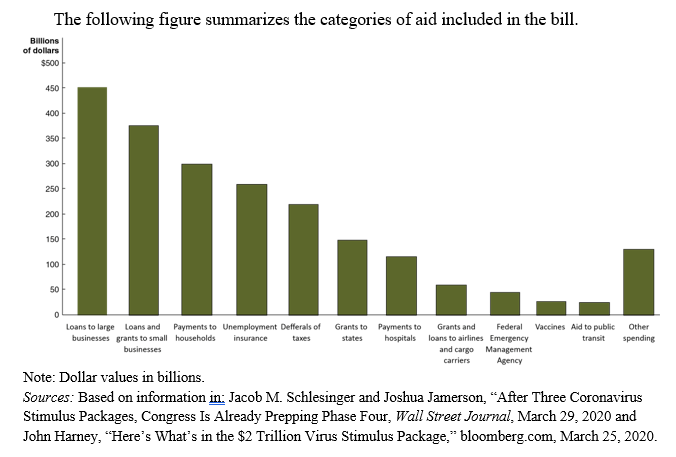
  • Coronavirus Aid, Relief and Economic Security (CARES) Act  On March 27, Congress and the president passed the Coronavirus Aid, Relief and Economic Security (CARES) Act, a more than $2 trillion aid package—by far the largest fiscal policy action in U.S. history—to provide:
    • Direct payments to households
    • Supplemental unemployment insurance payments
    • Funds to state governments to offset some of their costs in fighting in the epidemic
    • Loans and grants to businesses

The macroeconomic policy actions undertaken by the Fed, Congress, and the president in the spring of 2020 were unprecedented in size and scope. Whether they would be effective in keeping the coronavirus epidemic from causing a major recession in the United States remains to be seen.

Note: Some of the figures and tables reproduced here were first published in Hubbard and O’Brien, Economics, 6th and 8th editions or Hubbard and O’Brien, Money, Banking, and Financial Markets, 3rd edition.

Sources: Federal Reserve Bank of New York, “New York Fed Actions Related to COVID-19,” newyorkfed.org; Board of Governors of the Federal Reserve System, “Text of the Federal Reserve Act: Section 13. Powers of Federal Reserve Banks,” federalreserve.gov, February 13, 2017; Nick Timiraos, “Fed Cuts Rates to Near Zero and Will Relaunch Bond-Buying Program,” Wall Street Journal, March 26, 2020; Eric Morath, Jon Hilsenrath and Sarah Chaney, “Record Rise in Unemployment Claims Halts Historic Run of Job Growth,” Wall Street Journal, March 18, 2020; Emily Cochrane, “House Passes $8.3 Billion Emergency Coronavirus Response Bill,” New York Times, March 9, 2020; and John Harney, “Here’s What’s in the $2 Trillion Virus Stimulus Package,” bloomberg.com, March 25, 2020.

Questions 

1. There are both similarities and differences between monetary policies employed during the Great Recession of 2007-2009 and those employed at the beginning of the coronavirus pandemic in 2020.

(a) How has the Fed attempted to stimulate the economy during a typical recession? 

(b) Briefly discuss ways in which the Fed’s approach during the Great Recession and during the coronavirus pandemic was similar.

(c) Briefly discuss ways in which the Fed’s approach during the Great Recession and during the coronavirus pandemic differed.

2.  There are both similarities and differences between fiscal policies employed during the Great Recession of 2007 – 2009 and those employed at the beginning of the coronavirus pandemic of 2020.

(a) How have Congress and the president attempted to stimulate the economy during a typical recession?

(b) Briefly discuss ways in which Congress and the president’s approach during the Great Recession and during the coronavirus pandemic was similar to traditional expansionary policy.

(c) Briefly discuss how Congress and the president’s approach during the Great Recession and during the coronavirus pandemic differed from traditional expansionary policy.

Instructors can access the answers to these questions by emailing Pearson at christopher.dejohn@pearson.com and stating your name, affiliation, school email address, course number.