Solved Problem: Why Do U.S. Airlines Charge Solo Travelers Higher Ticket Prices?

Supports: Microeconomics and Economics, Chapter 15, Section 15.5, and Essentials of Economics, Chapter 10, Section 10.5

Image generated by ChatGTP 03

According to a recent article in the Economist, some U.S. airlines have “started charging higher per-person fares for single-passenger bookings than for identical itineraries with two people.” However, the difference in fares held only for round-trip tickets that included a weekday return flight. For round-trip tickets with a return flight on Saturday, the per-ticket price was the same whether booking for two people or for one person. Briefly explain why an airline might expect to increase its profit using this pricing strategy.

Step 1: Review the chapter material. This problem is about firms using price discrimination, so you may want to review Chapter 15, Sections 15.5 

Step 2: Answer the question by explaining why an airline might expect to increase its profit by charging people traveling alone a higher ticket price than the price it charges per ticket to two people traveling together. The airline is attempting to increase its profit by using price discrimination. Price discrimination involves charging different prices to different customers for the same good or service when the price difference isn’t due to differences in cost. Firms who able to price discriminate increase their profits by doing so.

In Chapter 15, Section 15.5, we call the airlines the “kings of price discrimination” because they often charge many different prices for tickets on the same flight. One key way that airlines practice price discrimination is by charging higher prices to business travelers—who are likely to have a lower price elasticity of demand—than to leisure travelers—who are likely to have a higher price elasticity of demand. To employ this strategy, airlines have to successfully identify which flyers are business travelers. Someone flying alone is more likely than someone flying in a group of two or more people to be a business traveler. In addition, business travelers often attempt to complete their trips before the weekend. Therefore, people returning from a trip on a Saturday or Sunday are more likely to be leisure travelers.

We can conclude that an airline can expect to increase its profit using the pricing strategy discussed in the Economist article because the strategy helps the airline to better identify business travelers.

Solved Problem: Do Some Cable Companies Engage in Price Discrimination?

Supports: Microeconomics and Economics, Chapter 15, Section 15.5, and Essentials of Economics, Chapter 10, Section 10.5

Image generated by ChatGTP-4o

A national provider of cable television and internet service has been frequently criticized by customers on social media for using the following business strategy: The company raises its prices every six to nine months. Any subscriber who calls to complain is offered a discount off of the price increase. Analyze how this strategy can be profit mazimizing for the company.

Step 1: Review the chapter material. This problem is about firms using price discrimination, so you may want to review Chapter 15, Sections 15.5 

Step 2: Answer the question by explaining how the cable company is using price discrimination to increase its profit. Price discrimination involves charging different prices to different customers for the same good or service when the price difference isn’t due to differences in cost. Firms who able to price discriminate increase their profits by doing so.

We’ve seen that there are three requirements for a firm to practice price discrimination: 1) The firm must possess market power, 2) some of the firm’s customers much have a greater willingness to pay for the product than do other customers, and 3) the firm must be able to segment the market to keep customers who buy the product at the low price from reselling it. Cable companies can meet all three requirements. Cable firms possess market power—they  aren’t perfect competitors. Some customers have a higher willingness than other customers to pay for cable service. In fact, many people have become cable cutters and prefer to stream content rather than watch programs on cable. Finally, someone who receives a lower-priced cable subscription can’t resell it.

To increase profit by price discrimination, a firm needs to charger a higher price to customers with a lower price elasticity of demand, and a lower price to customers with a higher price elasticity of demand. People who call up to complain about an increase in the price of a cable subscription are likely to be more price sensitive—and, therefore, more likely to switch to a competing cable company or to cut the cable and switch to streaming—than are people who don’t complain about the increase in the price of a subscription. In other words, the complainers have a higher price elasticity of demand than do the non-complainers and receive a lower price. We can conclude that this business strategy is an example of price discrimination and will increase the profit of the cable company that uses it.

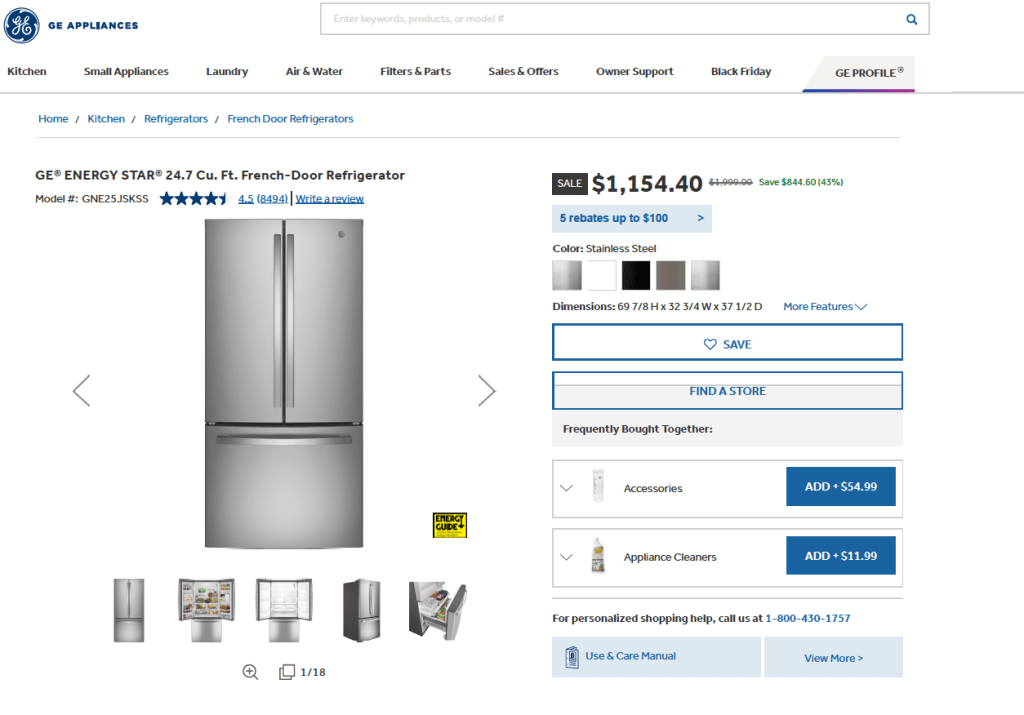
The Curious Case of the GE Refrigerators

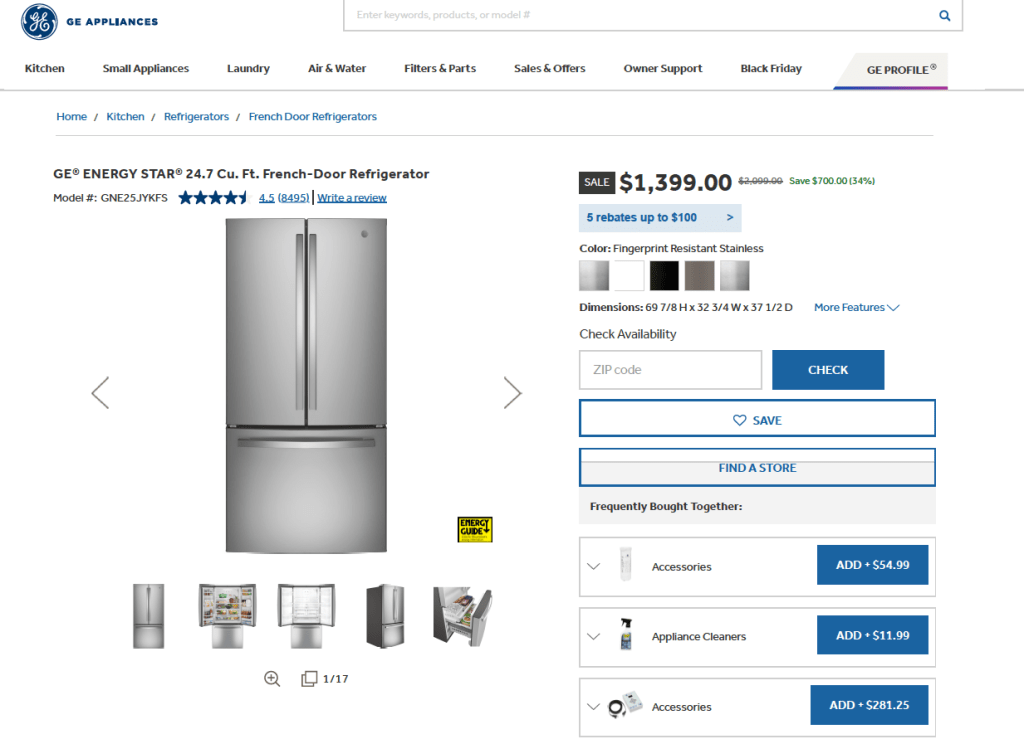
Is the refrigerator above different from the refrigerator below?

Consumer Reports is a magazine and web site devoted to product reviews. Their November-December 2024 issue noted something unusual about the two GE refrigerators shown above. (The images are from the geappliances.com web site.) At the time the issue was printed, the first refrigator above had a price of $2,300 and the second refrigerator had a price of $1,300: Consumer Reports notes that:

“These look-alike fridges offer equally impressive performance, have the same interior features … and are from the same brand. So why the $1,000 price difference? We don’t know.”

(Note: GE referigators, and many other products branded with the GE name are no longer produced by the General Electric company, which dates back to 1892 and was co-founded by Thomas Edison. Today, GE is primarily an aerospace company and GE appliances are produced by the Chinese-owned Haier Smart Home Company.)

If we assume that Consumer Reports is correct and the two refrigerators are identical, what strategy is the firm pursuing by charging different prices for the same product? As we discuss in Microeconomics, Chapter 15, Section 15.5 firms can increase their profits by practicing price discrimination—charging different prices to different customers. To pursue a strategy of price discrimination the firm needs to be able to divide up—or segment—the market for its refrigerators.

Firms sometimes use a high price to signal quality. The old saying “you get what you pay for” can lead some consumers to expect that when comparing two similar goods, such as two models of refrigerators, the one with the higher price also has higher quality. In the appliance section of a large store, such as Lowe’s or the Home Depot, or online at Amazon or another site, you will have a wide variety of refrigerators to choose from. You may have trouble evaluating the features each model offers and be unable to tell whether a particular model is likely to be more or less reliable. So, if you are choosing between the two GE models shown above, you may decide to choose the one with the higher price because the higher price may indicate that the components used are of higher quality.

In this case, GE may be relying on a segmentation in the market between consumers who carefully research the features and the quality of the refrigerators that different firms offer for sale and those consumers don’t. The consumers who do careful research and are aware of all the features of each model may be more sensitive to the price and, therefore, have a high price elasticity of demand. The consumers who haven’t done the research may be relying on the price as a signal of quality and, therefore, have a lower price elasticty of demand.

If what we have just outlined was the firm’s strategy for increasing profit by charging different prices for two models that are, apparently, either identical or very similar, it doesn’t seem to have worked. Note that the model shown in the first photo above is the one that had a price of $2,300 when Consumer Reports wrote about it, but now has a price of $1,154.40. The model shown in the second photo had a price of $1,300, but now has a price of $1,399.00. In other words, the model that had the lower price now has the higher price and the model that had the higher price now has the lower price.

What happened between the time the issue of Consumer Reports published and now? We might conjecture that there are few consumers who would be likely to pay $1,000 more for a refrigator that seems to have the same features as another model from the same company. In other words, segmenting consumers in this way seems unlikely to succeed. Why, though, the firm decided to make its formerly higher-price model its lower-price model, is difficult to explain without knowing more about the firm’s pricing strategy.

Solved Problem: Public Utility Pricing

Supports:  Microeconomics, Chapter 15, Section 15.6; Economics, Chapter 55, Section 15.6; and Essentials of Economics, Chapter 10, Sections 10.6.

PG&E workers moving a powerline underground. (Photo from the Wall Street Journal.)

PG&E, Southern California Edison, and San Diego Gas and Electric are public utilities that provide electricity and natural gas to households and firms in California. (For the most part, they provide these services in different parts of the state.) The California Public Utilities Commission regulates the prices that these utilities charge. In March 2024, an article in the San Francisco Chronicle reported that the commission proposed that the utilities begin charging households who receive their electricity from these utilities an additional flat fee of $24 per month (that would not depend on the quantity of electricity a household uses), while reducing the price households pay for each kilowatt hour they use by about 6 cents.

Isn’t this policy contradictory—adding a flat fee to households’ electric bills while reducing the price per kilowatt hour households pay? Can you explain why the policy might make economic sense? Draw a graph showing the situation of a public utility to illustrate your answer. 

Solving the Problem

Step 1:  Review the chapter material. This problem is about how the government regulates public utilities, so you may want to review the section in Microeconomics, Chapter 15, Section 15.6, on “Regulating Natural Monopolies,” (Economics, Chapter 15, Section 15.6 and Essentials of Economics, Chapter 10, Section 10.6).

Step 2:   Explain why the policy isn’t contradictory and why it might make economic sense.  It may seem as if the commission is being contradictory in imposing a new flat rate fee on households while at the same time lowering the price they pay per kilowatt hour used. But, as we discuss in Chapter 15, public utilities are typically natural monoplies because economies of scale are so large in that industy that one firm can supply the electricity in a market at a lower average cost than can two or more firms. Figure 15.1, reproduced below, shows this situation.

As we discuss in the “Regulating Monopoly” section of Chapter 15, Section 15.6, as a result of the large economies of scale in generating electricity, at the quantity at which the marginal cost curve crosses the demand curve, the marginal cost curve is below the demand curve. The economically efficient price is the price equal to the marginal cost of generating electricity. But if the public utility commission requires the utility to charge this price, the utility will suffer losses because it will not be covering its average total cost. The combination of charging households a flat fee while lowering the price they pay per kilowatt hour can help overcome this problem.

Step 3: Finishing solving the problem by drawing a graph to illustrate your answer.  You should draw graph similar to Figure 18.8, which we reproduce below. In this graph, if the utility is required to charge the economically efficient price, PE, it will suffer a loss equal to red rectangle. As a result, public utility commissions often set the price of electricity equal to PR, but at that price households demand the quantity of electricity, QR, which is less than the economically efficient quantity, QE. Note, though, that if a public utility commission allows a utillity to collect a flat fee from households equal to the amount shown by the red rectangle, it can require the utility to charge the economically efficient price, PE.

The key point here is that, because it doesn’t change as the quantity of electricity generated and used changes, the flat fee doesn’t affect either the utility’s marginal cost of generating electricity or the cost to households of using another kilowatt of electricity.

We don’t know from the discussion in the article whether the flat fee will cover the entire amount of the utilities’ losses or if the new price will be equal to the efficient price. But the policy can still make economic sense if the new price is closer to the efficient price than was the previous price.

Source: Julie Johnson, “California Proposes A $24 Flat Fee on Utility Bills in Exchange for Lower Electricity Prices,” San Francisco Chronicle, March 28, 2024.

At Wendy’s Price Discrimination Encountered Behavioral Economics

Wendy’s management intends to begin using dynamic pricings in its fast-food restaurants.  As we discuss in Microeconomics and Economics, Chapter 15, Section 15.5 (Essentials of Economics, Chapter 10, Section 10.5), dynamic pricing is a form of price discrimination, which is the business practice of charging different prices to different customers for the same good or service. The ability of firms to analyze customer data using machine learning models has increased the ability to price discriminate.

One form of price discrimination involves charging customers different prices at different times, as, for instance, when movie theaters charge a lower price during afternoon showings than during evening showings. As a group, people who can choose whether to attend either an afternoon or an evening showing are more sensitive to changes in the price of a ticket—that is, their demand for tickets is more price elastic—than are people who can only attend an evening showing. Price discrimination with respect to movie tickets results in movie theaters earning a greater profit than if they charged the same price for all showings.

In a conference call with investors in February, Wendy’s CEO Kirk Tanner indicated that next year the firm would begin using dynamic pricing of its hamburgers and other menu items by charging different prices at different times of the day. Tanner didn’t provide details on how prices would differ in high demand times, such as during lunch and dinner, and low demand times, such as the middle of the afternoon. Some business commentators, though, assumed that Wendy’s dynamic pricing strategy would resemble Uber’s surge pricing strategy. As we discuss in Microeconomics, Economics, and Essentials of Economics, Chapter 4, Section 4.1, Uber increases prices during periods of high demand, such as on New Year’s Eve.

The idea that Wendy’s would increase prices at peak times sparked a strong reaction on social media with many people criticizing the firm for “price gouging.” Rival fast-food restaurants joined the criticism. Burger King posted on X (formerly Twitter) that “we don’t believe in charging people more when they’re hungry.” As we note in Microeconomics and Economics, Chapter 10, Section 10.3 (Essentials of Econmics, Chapter 7, Section 7.3), surveys indicate that many people believe that it is fair for firms to raise prices following an increase in the firms’ costs, but unfair to raise prices following an increase in demand.

One way for firms to avoid this reaction from consumers while still price discriminating is to frame the issue by stating that they charge regular prices during times of peak demand and discount prices during times of low demand. For example, recently one AMC theater was charging $13.99 for a 7:15 PM showing of Dune: Part Two, but a “Matinee Discount Price” of $10.39 for a 1:oo PM showing of the film. Note that there is no real economic difference between AMC calling the evening price the normal price and the afternoon price the discoung price and the firm calling the afternoon price the normal price and the evening price a “surge price.” But one of the lessons of behavioral economics is that firms should pay attention to how consumers intepret a policy. Many consumers clearly see the two pricing strategies as different even though economically they aren’t. (We discuss behavioral economics in Microeconomics and Economics, Chapter 10, Section 10.4, and in Essentials of Economics, Chapter 7, Section 7.4.)

Not surprisingly, following the adverse reaction to its annoucement that it would begin using dynamic pricing, Wendy’s responded with a blog post in which it stated that its new pricing strategy was “misconstrued in some media reports as an intent to raise prices when demand is highest at our restaurants. We have no plans to do that and would not raise prices when our customers are visiting us most.” And that: “Digital menuboards could allow us to change the menu offerings at different times of day and offer discounts and value offers to our customers more easily, particularly in the slower times of day.” In effect, Wendy’s was framing its pricing strategy the way movie theaters do rather than the way Uber does.

Wendy’s CEO probably realizes now that how a pricing strategy is presented to consumers can affect how successful the strategy will be.  

Antitrust Policy and Monopsony Power

Photo from the New York Times.

As we discuss in Microeconomics and Economics, Chapter 15, Section 15.6, the U.S. Department of Justice’s Antitrust Division and the Federal Trade Commission have merger guidelines that they typically follow when deciding whether to oppose a merger between two firms in the same industry—these mergers are called horizontal mergers. The guidelines are focused on the effect a potential merger would have on market price of the industry’s output. We know that if the price in a market increases, holding everything else constant, consumer surplus will decline and the deadweight loss in the market will increase. But, as we note in Chapter 15, if a merger increases the efficiency of the merged firms, the result can be a decrease in costs that will lower the price, increase consumer surplus, and reduce the deadweight loss. 

The merger guidelines focus on the effect of two firms combining on the merged firms’ market power in the output market.  For example, if two book publishers merge, what will be the effect on the price of books? But what if the newly merged firm gains increased market power in input markets and uses that power to force its suppliers to accept lower prices? For example, if two book publishers merge will they be able to use their market power to reduce the royalties they pay to writers? The federal antitrust authorities have traditionally considered market power in the output market—sometimes called monopoly power—but rarely considered market power in the input market—sometimes called monopsony power.

In Chapter 16, Section 16.6, we note that a pure monopsony is the sole buyer of an input, a rare situation that might occur in, for example, a small town in which a lumber mill is the sole employer. A monopoly in an output market in which a single firm is the sole seller of a good is also rare, but many firms have some monopoly power because they have the ability to charge a price higher than marginal cost. Similarly, although monopsonies in input markets are rare, some firms may have monopsony power because they have the ability to pay less than the competitive equilibrium price for an input. For example, as we noted in Chapter 14, Section 14.4, Walmart is large enough in the market for some products, such as detergent and toothpaste, that it is able to insist that suppliers give it discounts below what would otherwise be the competitive price.

Monopsony power was the key issue involved in November 2021 when the Justice Department filed an antitrust lawsuit to keep the book publisher Penguin Random House from buying Simon & Schuster, another one of the five largest publishers. The merged firm would account for 31 percent of books published in the U.S. market. The lawsuit alleged that buying Simon & Schuster would allow “Penguin Random House, which is already the largest book publisher in the world, to exert outsized influence over which books are published in the United States and how much authors are paid for their work.”

We’ve seen that when two large firms propose a merger, they often argue that the merger will allow efficiency gains large enough to result in lower prices despite the merged firm having increased monopoly power. In August 2022, during the antitrust trial over the Penguin–Simon & Schuster merger, Markus Dohle, the CEO of Penguin made a similar argument, but this time in respect to an input market—payments to book authors. He argued that because Penguin had a much better distribution network, sales of Simon & Schuster books would increase, which would lead to increased payments to authors. Authors would be made better off by the merger even though the newly merged firm would have greater monopsony power. Penguin’s attorneys also argued that the market for book publishing was larger than the Justice Department believed. They argued that the relevant book market included not just the five largest publishers but also included Amazon and many medium and small publishers “all capable of competing for [the right to publish] future titles from established and emerging authors.”  The CEO of Hachette Book Group, another large book publisher, disagreed, arguing at the trial that the merger between Penguin and Simon & Schuster would result in lower payments to authors. 

The antitrust lawsuit against Penguin and Simon & Schuster was an example of the more aggressive antitrust policy being pursued by the Biden administration. (We discussed the Biden administration’s approach to antitrust policy in this earlier blog post.) An article in the New York Times quoted a lawyer for a legal firm that specializes in antitrust cases as arguing that the lawsuit against Penguin and Simon & Schuster was unusual in that the lawsuit “declines to even allege the historically key antitrust harm—increased prices.” The outcome of the Justice Department’s lawsuit against Penguin and Simon & Schuster may provide insight into whether federal courts will look favorably on the Biden administration’s more aggressive approach to antitrust policy. 

Sources: Jan Wolfe, “Penguin Random House CEO Defends Publishing Merger at Antitrust Trial,” Wall Street Journal, August 4, 2022;  David McCabe, “Justice Dept. and Penguin Random House’s Sparring over Merger Has Begun,” New York Times, August 1, 2022; Eduardo Porter, “A New Legal Tactic to Protect Workers’ Pay,” New York Times, April 14, 2022; Janet H. Cho and Karishma Vanjani, “Justice Department Seeks to Block Penguin Random House Buy of Viacom’s Simon & Schuster,” barrons.com, November 2, 2021; United States Department of Justice, “Justice Department Sues to Block Penguin Random House’s Acquisition of Rival Publisher Simon & Schuster,” justice.gov, November 2, 2021; 

Solved Problem: High Prices and High Revenue in the U.S. Car Industry

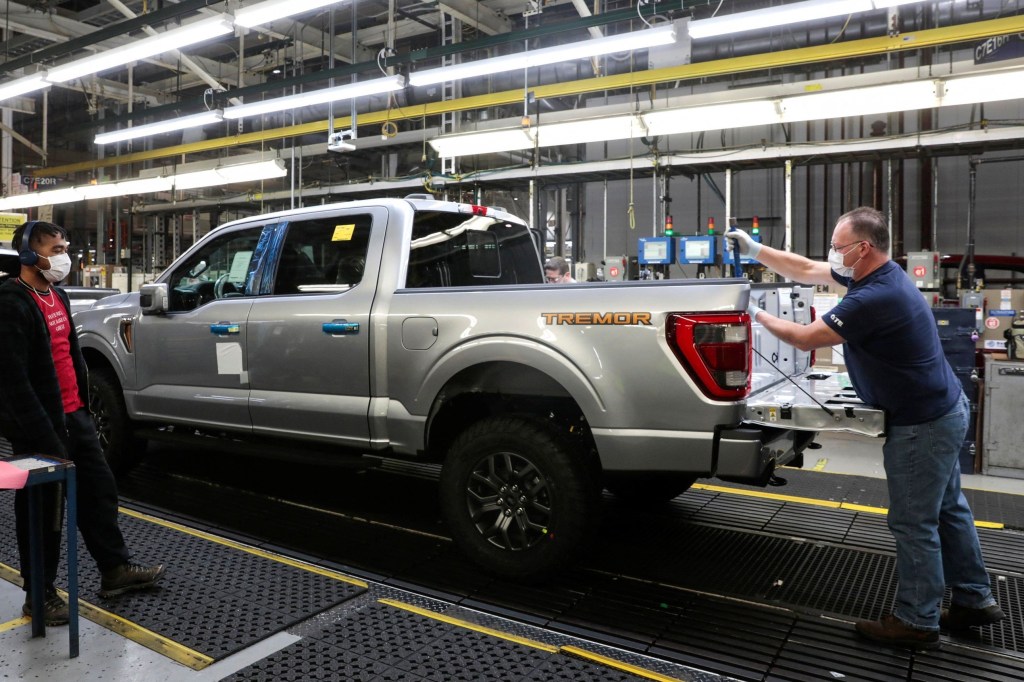
Production line for Ford F-series trucks. Photo from the Wall Street Journal.

Supports: Microeconomics, Chapter 6, Section 6.3 and Chapter 15, Section 15.6, Economics Chapter 6, Section 6.3 and Chapter 15, Section 15.6, and Essentials of Economics, Chapter 7, Section 7.7 and Chapter 10, Section 10.5.

In July 2022, an article in the Wall Street Journal noted that “The chip shortage and broader supply constraints have hampered vehicle production … Many major car companies on Friday reported U.S. sales declines of 15% or more for the first half of the year.” But the Wall Street Journal also reported that car makers were experiencing increases in revenues. For example, Ford Motor Company reported an increase in revenue even though it had sold fewer cars than during the same period in 2021.

  1. Briefly explain what must be true of the demand for new cars if car makers can sell 15 percent fewer cars while increasing their revenue.
  2. Eventually, the chip shortage and other supply problems facing car makers will end. At that point, would we expect that car makers will expand production to prepandemic levels or will they continue to produce fewer cars in order to maintain higher levels of profits? Briefly explain. 

Solving the Problem

Step 1: Review the chapter material. This problem is about the effects of price increases on firms’ revenues and on the ability of firms to restrict output in order increase profits, so you may want to review Chapter 6, Section 6.3, “The Relationship between Price Elasticity of Demand and Total Revenue” and Chapter 15, Section 15.6, “Government Policy toward Monopoly.” 

Step 2: Answer part a. by explaining what must be true of the demand for new cars if car makers are increasing their profits while selling fewer cars. Assuming that the demand curve for cars is unchanged, a decline in the quantity of cars sold will result in a move up along the demand curve for cars, raising the price of cars.  Only if the demand curve for new cars is price inelastic will the revenue car markers receive increase when the price increases. Revenue increases in this situation because with an inelastic demand curve, the percentage increase in price is greater than the percentage decrease in quantity demanded. 

Step 3: Answer part b. by explaining whether we should expect that once the car industry’s supply problems are resolved, car makers will continue to produce fewer cars.  Although as a group car makers would be better off if they could continue to reduce the supply of cars, they are unlikely to be able to do so. Any one car maker that decided to keep producing fewer cars would lose sales to other car makers who increased their production to prepandemic levels. Because this increased production would result in a movement down along the demand curve for new cars, the price would fall. So a car maker that reduced output would receive a lower price on its reduced output, causing its profit to decline. (Note that this situation is effectively a prisoner’s dilemma as discussed in Chapter 14, Section 14.2.)

The firms could attempt to keep output of new cars at a low level by explicitly agreeing to do so.  But colluding in this way would violate the antitrust laws, and executives at the firms would risk being fined or even imprisoned. The firms could attempt to implicitly collude by producing lower levels of output without explicitly agreeing to do so. (We discus implicit collusion in Chapter 14, Section 14.2.) But implicit collusion is unlikely to succeed because firms have an incentive to break an implicit agreement by increasing output. 

We can conclude that once the chip and other supply problems facing car makers are resolved, production of cars is likely to increase.

Sources: Mike Colias and Nora Eckert, “GM Says Unfinished Cars to Hurt Quarterly Results,” Wall Street Journal, July 1, 2022; and Nora Eckert, “Ford’s U.S. Sales Increase 32% in June, Outpacing Broader Industry,” Wall Street Journal, July 5, 2022.

Fanatics: The Unlikely Unicorn

Image from fanatics.com website.

unicorn is a startup, or newly formed firm, that has yet to begin selling stock publicly and has a value of $1 billion or more. (We discuss the difference between private firms and public firms in Economics and Microeconomics, Chapter 8, chapter opener and Section 8.2, and in Macroeconomics, Chapter 6, chapter opener and Section 6.2.) Usually, when we think of unicorns, we think of tech firms. That assumption is largely borne out by the following list of the 10 highest-valued U.S.-based startups, as compiled by cbinsights.com.

FirmValue
SpaceX$100.3 B
Stripe$95 B
Epic Games$42 B
Instacart$39 B
Databricks$38 B
Fanatics$27 B
Chime$25 B
Miro$17.5 B
Ripple$15 B
Plaid$13.4 B

Nine of the ten firms are technology firms, with six being financial technology—fintech—firms. (We discuss fintech firms in the Apply the Concept, “Help for Young Borrowers: Fintech or Ceilings on Interest Rates,” which appears in Macroeconomics, Chapter 14, Section 14.3, and Economics, Chapter 24, Section 24.3.) The one non-tech firm on the list is Fanatics, whose main products are sports merchandise and sports trading cards.  Because a unicorn doesn’t issue publicly traded stock, the firm’s valuation is determined by how much an investor pays for a percentage of the firm. In Fanatics’s case, the valuation was based on a $1.5 billion investment in the firm made in early March 2022 by a group of investors, including Fidelity, the large mutual find firm; Blackrock, the largest hedge fund in the world; and Michael Dell, the founder of the computer company.

These investors were expecting that Fanatics would earn an economic profit. But, as we discuss in Chapter 14, Section 14.1 and Chapter 15, Section 15.2, a firm will find its economic profit competed away unless other firms that might compete against it face barriers to entry. Although Fanatics CEO Michael Rubin has plans for the firm to expand into other areas, including sports betting, the firm’s core businesses of sports merchandise and trading cards would appear to have low barriers to entry. There are already many firms selling sportswear and there are many firms selling trading cards. The investment required to establish another firm to sell those products is low. So, we would expect competition in the sports merchandise and trading card markets to eliminate economic profit.

The key to Fanatics success is that it is selling differentiated products in those markets. Its differentiation is based on a key resource that competitors lack access to: The right to produce sportswear with the emblems of professional sports teams and the right to produce trading cards that show images of professional athletes. Fanatics has contracts with the National Football League (NFL), Major League Baseball (MLB), the National Hockey League (NHL), the National Basketball Association (NBA), and Major League Soccer (MLS)—the five most important professional sports leagues in North America—to produce jerseys, caps, and other sportswear that uses the copyrighted brands of the leagues’ teams. (In some cases, as with the NBA, Fanatics shares the right with another firm.)

Similarly, Fanatics has the exclusive right to produce trading cards bearing the images of NFL, NBA, and MLB players. In January 2022, Fanatics bought Topps, the firm that for decades had held the right to produce MLB trading cards. 

Fanatics has paid high prices to these sports leagues and their players to gain the rights to sell branded merchandise and cards. Some business analysts questioned whether Fanatics will be able to sell the merchandise and cards for prices high enough to earn an economic profit on its investments. Fanatics CEO Rubin is counting on an increase in the popularity of trading cards and the increased interest in sports caused by more states legalizing sports gambling. 

That Fanatics has found a place on the list of the most valuable startups that is otherwise dominated by tech firms indicates that many investors agree with Rubin’s business strategy.

Sources:  “The Complete List of Unicorn Companies,” cbinsights.com; Miriam Gottfried and Andrew Beaton, “Fanatics Raises $1.5 Billion at $27 Billion Valuation,” Wall Street Journal, March 2, 2022; Tom Baysinger, “Fanatics Scores $27 Billion Valuation,” axios.com March 2, 2022; Lauren Hirsch, “Fanatics Is Buying Mitchell & Ness, a Fellow Sports Merchandiser,” New York Times, February 18, 2022; and Kendall Baker, “Fanatics Bets Big on Trading Card Boom,” axios.com, January 5, 2022.

Are Economic Profits a Sign of Market Power?

Cecilia Rouse, chair of the Council of Economic Advisers. Photo from the Washington Post.

An article in the Washington Post discussed a debate among President Biden’s economic advisers. The debate was over “over whether the White House should blame corporate consolidation and monopoly power for price hikes.” Some members of the National Economic Council supported the view that the increase in inflation that began in the spring of 2021 was the result of a decline in competition in the U.S. economy.

Some Democratic members of Congress have also supported this view. For instance, Massachusetts Senator Elizabeth Warren argued on Twitter that: “One clear explanation for higher inflation? Giant corporations are exploiting their market power to further raise prices. And corporate executives are bragging about their higher profits.” Or, as Vermont Senator Bernie Sanders put it: “The problem is not inflation. The problem is corporate greed, collusion & profiteering.”

But according to the article, Cecilia Rouse, chair of the President’s Council of Economic Advisers (CEA), and other members of the CEA are skeptical that a lack of competition are the main reason for the increase in inflation, arguing that very expansionary monetary and fiscal policies, along with disruptions to supply chains, have been more important.

In an earlier blog post (found here), we noted that a large majority of more than 40 well-known academic economists surveyed by the Booth School of Business at the University of Chicago disagreed with the statement: “A significant factor behind today’s higher US inflation is dominant corporations in uncompetitive markets taking advantage of their market power to raise prices in order to increase their profit margins.”

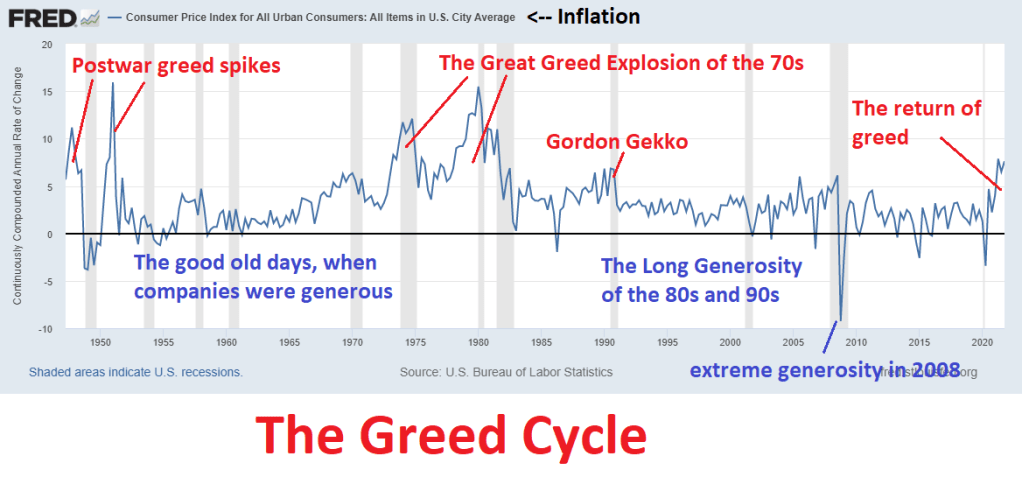
One difficulty with the argument that the sharp increase in inflation since mid-2021 was due to corporate greed is that there is no particular reason to believe that corporations suddenly became more greedy than they had been when inflation was much lower. If inflation were mainly due to corporate greed, then greed must fluctuate over time, just as inflation does. Economic writer and blogger Noah Smith poked fun at this idea in the following graph

It’s worth noting that “greed” is one way of characterizing the self-interested behavior that underlies the assumption that firms maximize profits and individual maximize utility. (We discuss profit maximization in Microeconomics, Chapter 12, Section 12.2, and utility maximization in Chapter 10, Section 10.1.) When economists discuss self-interested behavior, they are not making a normative statement that it’s good for people to be self-interested. Instead, they are making a positive statement that economic models that assume that businesses maximize profit and consumers maximize utility have been successful in analyzing and predicting the behavior of businesses and households. 

Corporate profits increased from $1.95 trillion in the first quarter of 2021 to $2.40 trillion in third quarter of 2021 (the most recent quarter for which data are available). Using another measure of profit, during the same period, corporate profits increased from about 16 percent of value added by nonfinancial corporate businesses to about 18 percent. (Value added measures the market value a firm adds to a product. We discuss calculating value added in Macroeconomics, Chapter 8, Section 8.1.)

There have been mergers in some industries that may have contributed to an increase in profits—the Biden Administration has singled out mergers in the meatpacking industry as having led to higher beef and chicken prices. At this point, though, it’s not possible to gauge the extent to which mergers have been responsible for higher prices, even in the meatpacking industry.   

An increase in profit is not by itself an indication that firms have increased their market power. We would expect that even in a perfectly competitive industry, an increase in demand will lead in the short run to an increase in the economic profit earned by firms in the industry. But in the long run we expect economic profit to be competed away either by existing firms expanding their production or by new firms entering the industry.

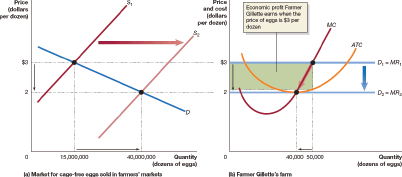
In Chapter 12, we use Figure 12.8 to illustrate the effects of entry in the market for cage-free eggs. Panel (a) shows the market for cage-free eggs, made up of all the egg sellers and egg buyers. Panel (b) shows the situation facing one farmer producing cage-free eggs. (Note the very different scales of the horizontal axes in the two panels.) At $3 per dozen eggs, the typical egg farmer is earning an economic profit, shown by the green rectangle in panel (b). That economic profit attracts new entrants to the market—perhaps, in this case, egg farmers who convert to using cage-free methods. The result of entry is a movement down the demand curve to a new equilibrium price of $2 per dozen. At that price, the typical egg farmer is no longer earning an economic profit.

A few last observations:

  1. The recent increase in profits may also be short-lived if it reflects a temporary increase in demand for some durable goods, such as furniture and appliances, raising their prices and increasing the profits of firms that produce them. The increase in spending on goods, and reduced spending on services, appears to have resulted from:  (1) Households having additional funds to spend as a result of the payments they received from fiscal policy actions in 2020 and early 2021, and (2) a reluctance of households to spend on some services, such as restaurant meals and movie theater tickets, due to the effects of the Covid-19 pandemic.
  2. The increase in profits in some industries may also be due to a reduction in supply in those industries having forced up prices. For instance, a shortage of semiconductors has reduced the supply of automobiles, raising car prices and the profits of automobile manufacturers. Over time, supply in these industries should increase, bringing down both prices and profits.
  3. If some changes in consumer demand persist over time, we would expect that the  economic profits firms are earning in the affected industries will attract the entry of new firms—a process we illustrated above. In early 2022, this process is far from complete because it takes time for new firms to enter an industry.

Source:  Jeff Stein, “White House economists push back against pressure to blame corporations for inflation,” Washington Post, February 17, 2022; Mike Dorning, “Biden Launches Plan to Fight Meatpacker Giants on Inflation,” bloomberg.com, January 3, 2022; and U.S. Bureau of Economic Analysis.ec

Price Leadership in the Beer Market

InBev’s St. Louis production line for Stell Artois beer. Photo from the Wall Street Journal

Firms in an oligopoly can increase their profits by agreeing with other firms in the industry on what prices to charge. Explicit price fixing violates the antitrust laws and can subject the firms involved to fines of up to $100 million and executives at the firms to fines of up to $1 million and prison terms of up to 10 years. Despite these penalties, the rewards to avoiding price competition are often so great that firms look for ways to implicitly collude—that is, to arrange ways to coordinate their prices without violating the law by explicitly agreeing on the prices to charge. (We discuss the antitrust laws in Microeconomics and Economics, Chapter 15, Section 15.6.) 

One way for firms to implicitly collude is through price leadership. With price leadership, one firm in the industry takes the lead in announcing a price change that other firms in the industry then match. (We briefly discuss price leadership in Microeconomics and Economics, Chapter 14, Section 14.2.)

In their classic industrial organization textbook, F.M. Scherer of Harvard’s Kennedy School and David Ross of Bryn Mawr College summarize the legal status of price leadership, given court opinions from antitrust cases: “[P]rice leadership is not apt to be found contrary to the antitrust laws unless the leader attempts to coerce other producers into following its lead, or unless there is evidence of an agreement among members of the industry to use the leadership device as the basis of a price-fixing scheme.” As the Federal Trade Commission notes on its website: “A uniform, simultaneous price change could be the result of price fixing, but it could also be the result of independent business responses to the same market conditions.”

Scherer and Ross describe price leadership in a number of oligopolistic industries during the twentieth century, including cigarettes, steel, automobiles, breakfast cereals, turbogenerators, and gasoline.

Recently, Nathan Miller of Georgetown University, Gloria Sheu of the Federal Reserve, and Matthew Weinberg of Ohio State University published an article in the American Economic Review analyzing price leadership in the beer industry. They focus on the period from 2001 to 2011, although they believe that conditions in the beer industry are similar today. From 2001 to 2007, three large U.S.-based firms—Anheuser-Busch, SABMiller, and Molson Coors—accounted for about two-thirds of beer sales in the United States. Two importers—Heineken and Grupo Modelo—accounted for about 14 percent of sales.  In 2008, SABMiller and Molson Coors combined to form MillerCoors and InBev—which had a small market share—bought Anheuser Busch. In 2011, MillerCoors and InBev together accounted for 63 percent of beer sales.

ABI has acted as the price leader, announcing prices in the late summer that MillerCoors typically matches. ABI’s Bud Light had the largest market share among beers in the United States in 2011, well ahead of Coors Light, which had the second largest share. They find that industry profits were 17 percent above the competitive level in 2007—just before the Miller-Coors merger—and 22 percent above the competitive level in 2010—after the merger. The U.S. Department of Justice (DOJ) had decided not to contest the Miller-Coors merger because “cost savings in distribution likely would offset any loss of competition.” As it turned out, the cost savings occurred but their value was smaller than the losses in consumer surplus resulting from reduced competition.

The authors estimate that, compared with the competitive outcome, the reduction in consumer surplus in the beer market due to price leadership equaled 154 of the increase in producer surplus before the Miller-Coors merger and 170 percent after it. Figure 15.5 from Chapter 15 of Microeconomics (reproduced below) illustrates why the loss of consumer surplus is larger than the increase in producer surplus: The increase in price and decline in quantity compared with the competitive level results in a deadweight loss that reduces the total economic surplus in the market. (Note that the figure is comparing the situation when a market is monopoly with the situation when the market is perfectly competitive. For simplicity, we are assuming that price leadership in an oligopolistic industry, such as beer, results in the monopoly outcome. But note that whenever collusive behavior, like price leadership, occurs in an industry, we would expect an increase in deadweight loss that will make the gains to firms larger than the losses to consumers.)

Sources: Federal Trade Commission, “Price Fixing,” ftc.gov; U.S. Department of Justice, Antitrust Division, “Price Fixing, Bid Rigging, and Market Allocation Schemes: What They Are and What to Look for,” justice.gov; Nathan H. Miller, Gloria Sheu, and Matthew C. Weinberg, “Oligopolistic Price Leadership and Mergers: The United States Beer Industry,” American Economic Review, Vol. 111, No. 10, pp. 3123-3159; and F.M Scherer and David Ross, Industrial Market Structure and Economic Performance, Third edition, Boston: Houghton Mifflin, 1990.