
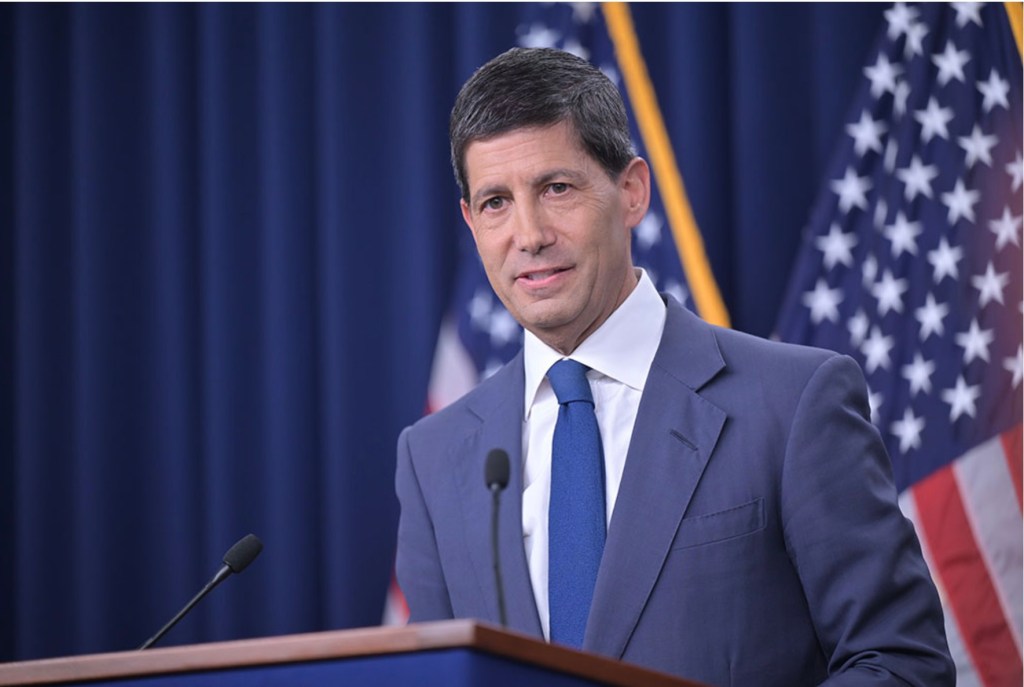
Photo of Fed Chair Kevin Warsh from federalreserve.gov
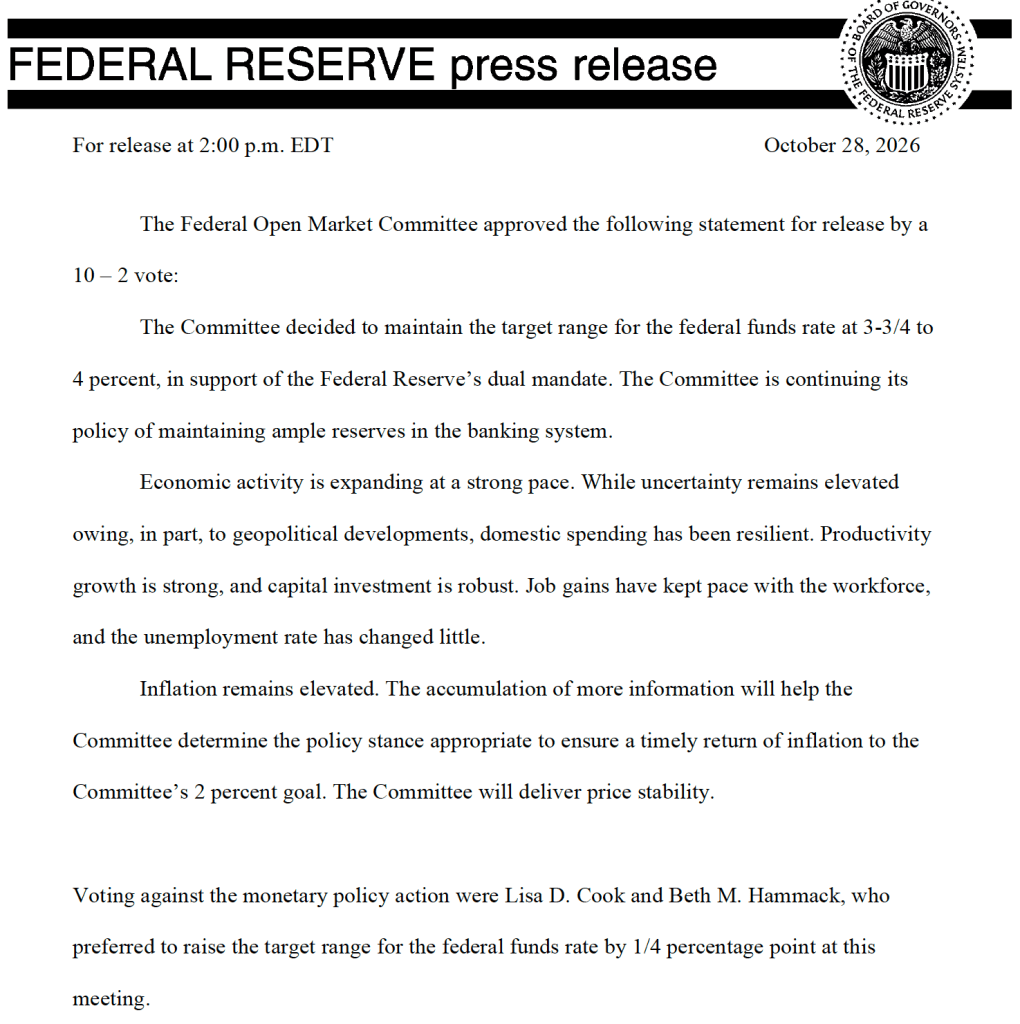
Today, the Federal Open Market Committee (FOMC) met expectations by keeping its target range for the federal funds rate unchanged at 3.75 percent to 4.00 percent. As of yesterday, trading in the federal funds rate futures market had implied a 93.4 percent probability that the target range would be unchanged. Fed Governor Lisa Cook and Federal Reserve Bank of Cleveland President Beth Hammack dissented from the vote, preferring that the target range be increased by 0.25 percentage points (25 basis points). Hammack had also dissented at the July FOMC meeting in favor of a target range increase. Cook had not previously dissented from the majority at any meeting.
At his press conference following the meeting, Fed Chair Kevin Warsh said that political considerations did not play a role in the FOMC’s decision to leave the target range unchanged. As we noted in this earlier blog post, some analysts believe that the committee was reluctant to raise the target range so close to Tuesday’s midterm elections.
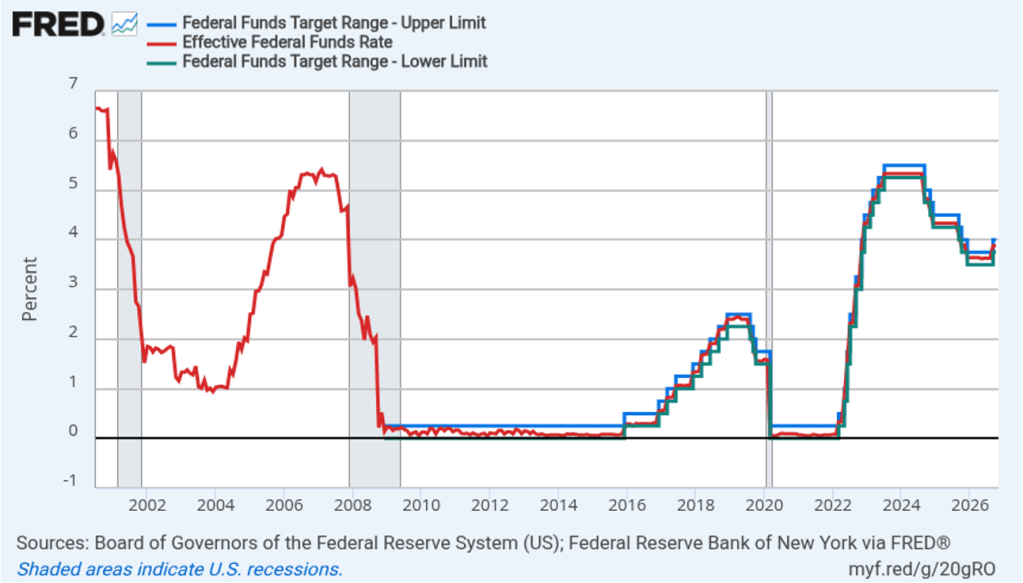
The following figure shows for the period since 2001, the upper bound (the blue line) and the lower bound (the green line) for the FOMC’s target range for the federal funds rate, as well as the actual values for the federal funds rate (the red line). Before December 2008, the Fed announced a single numerical target for the federal funds rate, rather than a target range. Note that the Fed has been successful in keeping the value of the federal funds rate in its target range. (We discuss the monetary policy tools the FOMC uses to maintain the federal funds rate within its target range in Macroeconomics, Chapter 15, Section 15.2 (Economics, Chapter 25, Section 25.2).)
As with the policy statements issued following Warsh’s previous three FOMC meetings, today’s policy statement was short and did not include any discussion of the specific circumstances under which further target range increases might occur—so-called forward guidance. We discuss forward guidance in Macroeconomics, Chapter 15 (Economics, Chapter 25).
At his press conference following the meeting, as he typically does, Warsh resisted attempts by reporters to get him to expand on the circumstances under which the committee might implement further increases in the target range. He reiterated his belief that the Fed was currently meeting its Congressional mandate for maximum employment but had not yet met its mandate for price stability by bringing inflation back to an annual rate of 2 percent.
He did note that the period between now and the next FOMC meeting on December 8–9 would be “information rich,” presumably because there will be additional data releases on inflation and unemployment during that time. In addition, the committee might have greater clarity about what Warsh referred to as “geopolitical factors,” such as the conflict in the Middle East.
Warsh also announced at the press conference that, beginning in fall 2027, the FOMC will devote one of its eight annual meetings to discussing monetary policy strategy. In 2028, the FOMC may devote two of its eight meetings to discussing monetary policy strategy. He expected that following those meetings the committee would not release a policy statement. It was unclear whether he intends to hold a press conference following those meetings. If implemented, this plan would result in longer periods during which the public would not be receiving formal updates on monetary policy.

