
Supports: Macroeconomics, Chapter 14, Section 14.1, Economics, Chapter 24, Section 24.1, and Money, Banking, and the Financial System, Chapter 2, Section 2.1.
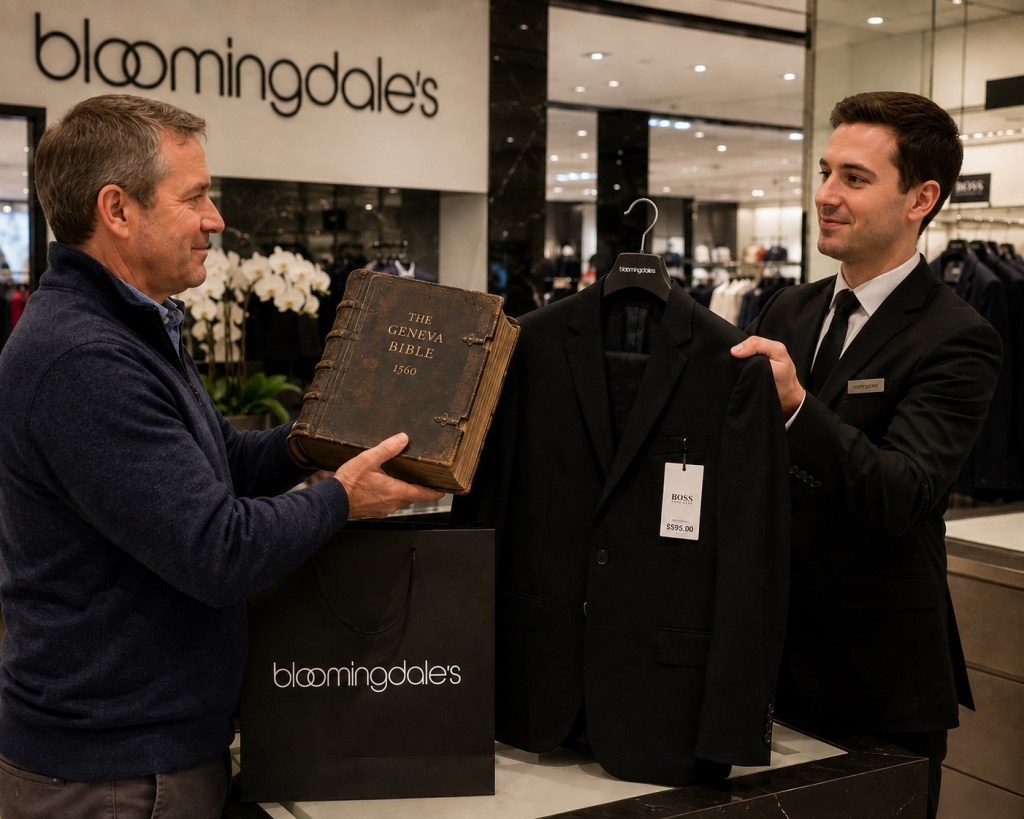
Image created by ChatGPT
A rare book dealer who often posts to YouTube made the following observation in one of his videos:
“… thousands of years ago, they had the barter system where you could literally exchange wheat for barley and barley for wheat directly. And the idea behind that was to … have a quick solution for [a] transaction, but over time they invented a monetary unit—coinage and money—and they thought that that would inject some efficiency into economic transactions. And in some ways it’s done the complete opposite. There’s a lot of inefficiency because now unfortunately I cannot go right into Bloomingdale’s and take a nice black suit off the shelf and exchange it for a Geneva Bible. I actually have to sell the Bible first … then go buy the suit. So that gives me a lot of extra work, so I’d rather go back to bartering ….”
The dealer may not have been entirely serious, but assuming that he was, is he correct that transacting using barter is more efficient than transacting using money? In your answer, be sure to define “efficient” in this context.
Solving the Problem
Step 1: Review the chapter material. This problem is about the efficiency of using money to purchase goods rather than engaging in barter, so you may want to review Macroeconomics, Chapter 15, Section 15.1, “What Is Money and Why Do We Need It?”
Step 2: Answer the problem by explaining why using money is more efficient than engaging in barter. The book dealer is correct that thousands of years ago, most societies used barter rather than money. Societies transitioned from barter to money because of the inefficiencies of barter. A key inefficiency of barter is the need for a double coincidence of wants. For a barter transaction to take place, each person must want what the other person has. It’s not enough for the book dealer to want a black suit from the Bloomingdale’s department store; Bloomingdale’s must be willing to trade the suit for a copy of the Geneva Bible—which is unlikely.
To use a copy of the Geneva Bible to obtain a suit using barter, the book dealer might have to make—possibly many—additional trades until he obtains some good that Bloomingdale’s would accept in exchange for the suit. In practice, it might be difficult to find such a good and doing so would likely involve substantial search costs.
We can conclude that money has replaced barter in most transaction because it is more efficient in the sense that it allows transactions to be completed at a lower cost.

