Where Did Dark Age English Kings Obtain the Metal for Their Coins?

Silver pennies used in England during the 600s. (Image from Jane Kershaw, et al.)

As economies move from subsistence agriculture towards specialization and trade, the inefficiency of barter exchange pushes them toward developing money. Any commodity that is widely accepted in payment for goods and services—that is, any commodity that can function as a medium of exchange—can be used as money. As we discuss in a recent blog post, in frontier America animal hides were used as money. In a World War II German prisoner of war camp, the British prisoners used cigarettes as money.  Most economies made a transition from using commodities like animal skins to using coins made of precious metals, such as copper, silver, and gold. (We discuss the development of money in Macroeconomics, Chapter 14, Section 14.1, Economics, Chapter 24, Section 24.1, and Essentials of Economics, Chapter 16, Section 16.1.)

Coins were typically minted by kings, local warlords, bishops, or other people with control over a sufficient sized territory to make minting coins worthwhile. Where did they get the metal needed to mint coins? During the height of the gold standard in the 1800s and early 1900s, governments could rely on supplies of precious metals from domestic mines or from trade with other countries. In earlier periods, access to sufficient supplies of precious metals could be more difficult.

A recent academic paper by Jane Kershaw, of the University of Oxford; Stephen W. Merkel and Paolo D’Imporzano, of Vrije Universiteit Amsterdam; and Rory Naismith the University of Cambridge, examined the case of coins minted by kings of England during the year 660 to 820. During the time from the year 43 to the year 409, most of modern England and Wales was part of the Roman Empire. (A non-technical summary of the paper, with a video, is here. A timeline of Roman Britain is here.) During that time, the Roman province of Britannia used the same gold, silver, and copper coins used throughout the empire. After the withdrawal of the last Roman legions, England experienced waves of invasions from Saxons, Angles, and other Germanic tribes that destroyed most of Roman civilization on the island. Very few written records have survived from 409 through the end of the 500s. But it’s likely that few, if any, coins were minted during this period.

As trade within England began to revive in the second half of the 600s, the demand for coins increased. Given the inefficiency of barter, the absence of a sufficient supply of coins would have hobbled the growth of trade. With more than 200 years having passed since the end of Roman rule, Roman coins were no longer available in significant quantities. The increased demand for coins was met by silver pennies, like those shown in the photo at the top of this post.
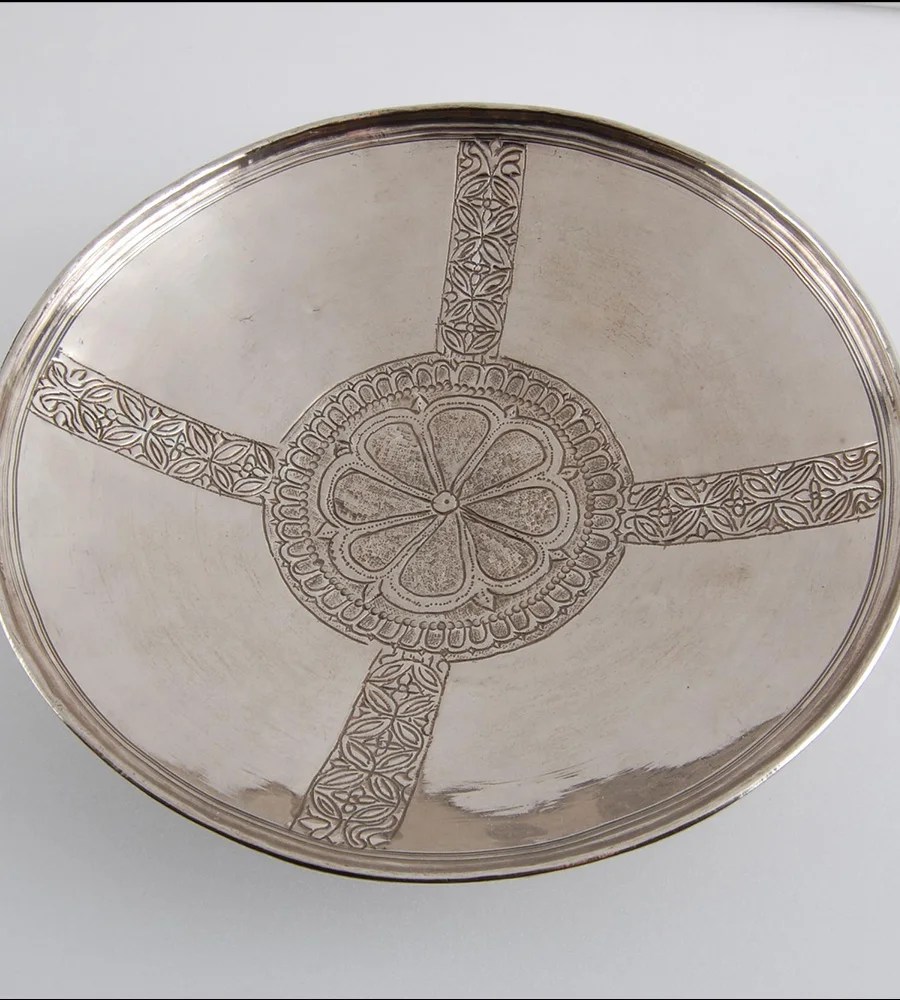
Where did the rulers of the various English kingdoms get the silver to mint pennies, given that there were no known silver mines operating during this period? Searching for clues, Jane Kershaw and her colleagues analyzed the composition of the silver used in the pennies. Surprisingly, the silver turned out to have the same composition as silver used in the Byzantine Empire in the eastern Mediterranean. Because in this period there was little to no trade between England and the Byzantine Empire, Kershaw and colleagues believe that the silver was likely obtained from melting silver objects, like the plate shown above, obtained from trade with the Byzantine Empire in earlier periods.

The work of these researchers has provided insight into an historical example of governments supplying the money needed to facilitate the transition away from barter.

Another Effect of Inflation in the Long Run—People Are Throwing Their Coins in the Trash

Should you just throw these away?

It’s not surprising that waste management firms often recycle metals that have either been separated by households and firms in recycling bins or have been thrown away mixed in with other trash. But according to a recent article in the Wall Street Journal, Reworld, a nationwide waste management firm headquartered in Morristown, New Jersey, has been recovering metal that you wouldn’t ordinarily expect to find in garbage: U.S. coins. Are these coins that people have accidentally thrown in the garbage? Some of the coins were probably mistakenly included in garbage but the article indicates that most were likely intentionally thrown away:

“Coins are as good as junk for many Americans…. [Many people believe that] change is often more trouble than it is worth to carry around.”

Why would people throw coins—things of obvious value—into the garbarge? As we discuss in Macroeconomics, Chapter 14, Section 14.1 (Economics, Chapter 24, Sextion 24.1 and Essentials of Economics, Chapter 16, Section 16.1), consumers have been buying things using paper money and coins much less frequently in recent years. People have relied more on making purchases or transferring funds using credit and debit cards, Apple Pay and Google Pay, or smartphones apps like Venmo.

Even if people use cash to buy things, they are more likely to use paper currency rather than coins. As prices increase, the amount of goods or services you can buy with a coin of a given face value decreases. For instance, the following figure shows that with a quarter you could have bought 25 cents worth of goods and services in 1980 but, because of inflation, only 7 cents worth of goods and services in 2023.

In other words, coins have become less useful both because more convenient means of payment, such as Apple Pay or Venmo, have become more widely and available and because inflation has eroded the purchasing power of coins. In addition, for decades, drinks, snacks, and other products sold from vending machines could only be purchased using coins. But in recent years, most vending machines have been modified to accept credit cards. Because fewer people use coins to buy things, if they receive coins in change after paying with paper currency, they are likely to just accumulate the coins in a jar or other container or, as Reworld has discovered, throw the coins in the garbage.

If an increasing number of coins are being thrown away, should the government stop minting them? It’s unlikely that the U.S. Mint will stop producing all coins, but there have been serious proposals to at least stop producing the penny and, perhaps, also the nickel. Governments make a profit from issuing money because it is usually produced using paper or low-value metals that cost far less than the face value of the money. The government’s profit from issuing money is called seigniorage.

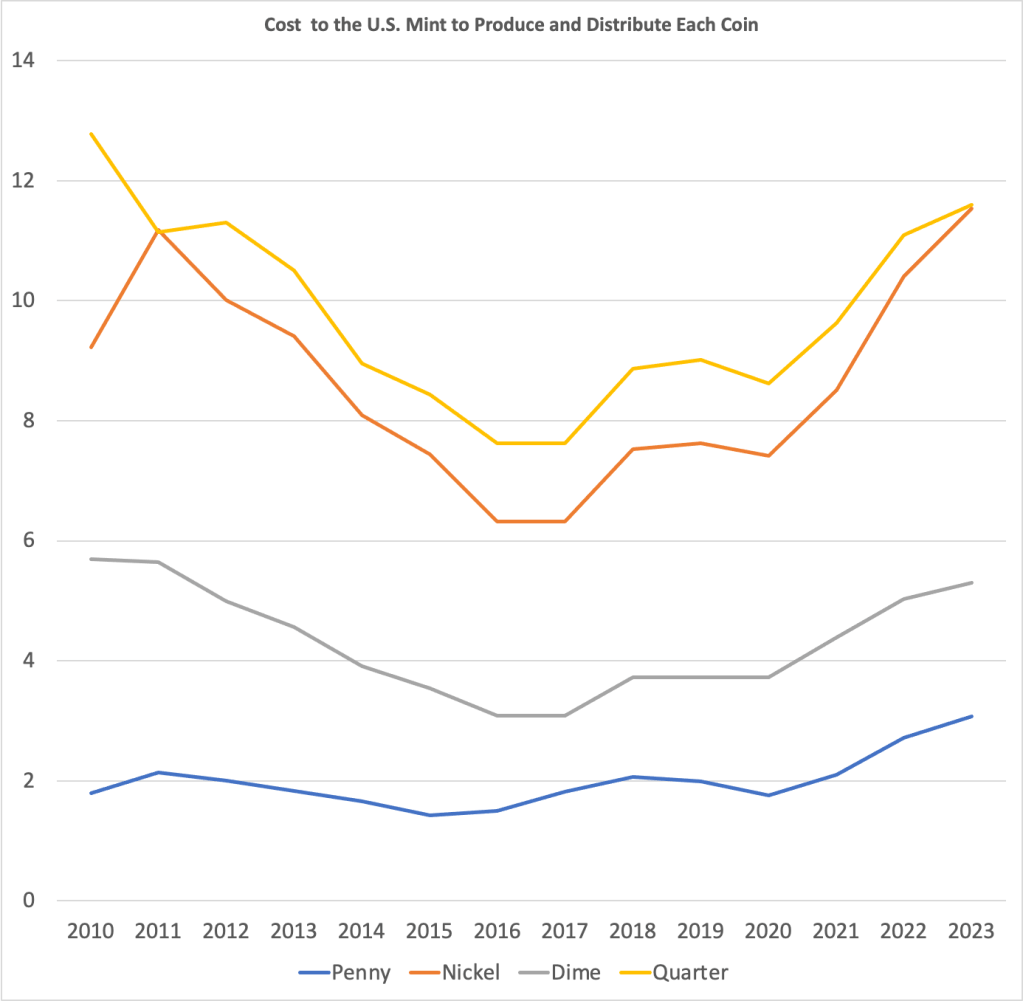
As the following figure shows (cents are measured on the vertical axis), in recent decades, the penny and the nickel have cost more to produce than their face value. In other words, the federal government has experienced negative seigniorage in minting pennies and nickels, paying more to produce them than they are worth. For instance, in 2023, as the blue line shows, it cost 3.1 cents to produce a penny and distribute it to Federal Reserve Banks (which, in turn, distribute coins to local commercial banks). Similarly, each nickel (the orange line) cost 11.5 cents to produce and distribute. The penny is made from copper and zinc and the other coins are made from copper and nickel. As the market prices of these metals change, so does the cost to the Mint of producing the coins, as shown in the figure.

Data in the figure were compiled from the U.S. Mint’s biennial reports to Congress.

François Velde, an economist at the Federal Reserve Bank of Chicago, has come up with a possible solution to the problem of the penny: The federal government would simply declare that Lincoln pennies are now worth five cents. There would then be two five-cent coins in circulation—the current Jefferson nickels and the current Lincoln pennies—and no one-cent coins. In the future, only the Lincoln coins—now worth five cents—would be minted. This would solve the problem of consumers and retail stores having to deal with pennies, it would make the face value of the Lincoln five-cent coin greater than its cost of production, and it would also deal with the problem that the current Jefferson nickel costs more than five cents to produce.

With some consumers valuing coins so little that they throw them out in the trash and with the U.S. Mint spending more than their face value to produce pennies and nickels, it seems likely that at some point Congress will make changes to U.S. coinage.

Can Counterfeits of Coins That Never Existed Function as Money?

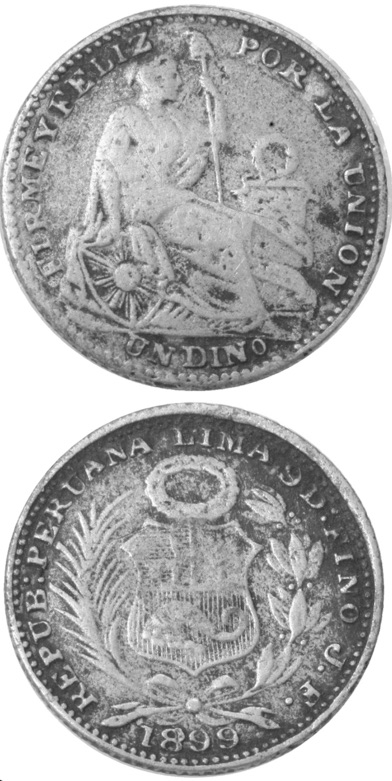
Counterfeit 1899 Peruvian dinero. (Image from Luis Ortega-San-Martín and Fabiola Bravo-Hualpa article.)

What counts as money is an interesting topic. For instance, in Macroeconomics, Chapter 14, Section 14.2 (Economics, Chapter 24, Section 24.2, and Essentials of Economics, Chapter 16, Section 16.2), we discuss whether bitcoin is money (spoiler alert: it isn’t).  

Of the four functions of money that we discuss in Chapter 14, the most important is that money serves as a medium of exchange. Anything can be used as money if most people are willing to accept it in exchange for goods and services.  In that chapter, we mention that at one time in West Africa cowrie shells were used as money. In the early years of the United States, animal skins were sometimes used as money. For instance, the first governor of Tennessee received an annual salary of 1,000 deerskins.

In a famous article in the academic journal Economica, economist Richard A. Radford who had been captured in 1942 by German troops while fighting with the British Army in North Africa described his experiences in a prisoner-of-war camp. The British prisoners in the camp developed an economy in which cigarettes were used as money:

“Everyone, including nonsmokers, was willing to sell for cigarettes, using them to buy at another time and place. Cigarettes became the normal currency .… Laundrymen advertised at two cigarettes a garment …. There was a coffee stall owner who sold tea, coffee or cocoa at two cigarettes a cup, buying his raw materials at market prices and hiring labour ….”

In Chapter 24, in end of chapter problem 1.8, we note that according to historian Peter Heather, during the time of the Roman Empire, German tribes east of the Rhine river used Roman coins as money even though Rome didn’t govern that area. Roman coins were apparently also used as money in parts of India during those years even though the nearest territory the Romans controlled was hundreds of miles to the west. Again we have an example of something—roman coins in this case—being used as money because people were willing to aceept it in exchange for goods and services even though the government that issued the coins didn’t control that area.

Even more striking case is the case of Iraqi paper currency issued by the government of Saddam Hussein. This currency continued to circulate even after Saddam’s government had collapsed following the invasion of Iraq by U.S. and British troops. U.S. officials in Iraq had expected that as soon as the war was over and Saddam had been forced from power, the currency with his picture on it would lose all its value. This result had seemed inevitable once the United States had begun paying Iraqi officials in U.S. dollars. However, for some time many Iraqis continued to use the old currency because they were familiar with it. According to an article in the Wall Street Journal, the Iraqi manager of a currency exchange put it this way: “People trust the dinar more than the dollar. It’s Iraqi.” In fact, for some weeks after the invasion, increasing demand for the dinar caused its value to rise against the dollar. Eventually, a new Iraqi government was formed, and the government ordered that dinars with Saddam’s picture be replaced by a new dinar. Again we see that anything can be used as money as long as people are willing to accept it in exchange for goods and services, even paper currency issued by a government that no longer exists.

Finally, there is the case of the coin shown at the beginning of this post. The coin looks like the dineros—small denomination silver coins—issued by the Peruvian government. But the coin is dated 1899, a year in which the Peruvian government did not issue any dineros. An analysis of one of these coins by Luis Ortega-San-Martín, Fabiola Bravo-Hualpa, and their students at the Pontifical Catholic University of Peru showed that it was made of copper, nickel, and zinc, in contrast to deniros from other years, which where made primarily of silver with a small amount of copper. They concluded that the coin was a counterfeit made around 1900:

“It is our belief that this counterfeit coin was not made as a numismatic rarity to deceive modern collectors … but rather to be used as current money (its worn state indicates ample use) …. [C]ounterfeiters usually make common coins that do not draw attention expecting them to pass unnoticed.”

In other words, as long as people are willing to accept counterfeit coins—which they likely will do if they do not recognize them as being counterfeit—they can serve as money. In fact, even if coins are easily recognizable as being counterfeit, they might still be used as money—particularly in a time and place where there is a shortage of government issued coins. In the British North American colonies, there was frequently a shortage of coins. Some people would clip small amounts off gold and silver coins, either selling the metal or having it minted into coins. The clipped coins, while not actually counterfeit, contained less precious metal than did unclipped coins, yet they continued to be used in buying and selling because of the general shortage of coins.