
Where Did 818,000 Jobs Go?

Image of “people attending a job fair” generated by GTP-4o

On Wednesday, August 21, the Bureau of Labor Statistics (BLS) issued revised estimates of the increase in employment, as measured by the establishment survey, over the period from April 2023 through March 2024. The BLS had initially estimated that on average during that period net employment had increased by 242,000 jobs per month. The revision lowered this estimate by 28 percent to an average of only 174,000 net new jobs created per month. The difference between those two monthly averages means that the U.S. economy had generated a total of 818,000 fewer jobs during that period.

Why does the BLS have to revise its employment estimates? As we discuss in Macroeonomics, Chapter 9, Section 9.1 (Economics, Chapter 19, Section 19.1) the initial estimates that the BLS issues each month in its “Employment Situation” reports are based on a sample of 300,000 establishments. The monthly data also rely on estimates of the number of employees at establishments that opened or closed during the month and on employment changes at establishments that failed to respond to the survey. In August of each year, the BLS issues revised employment estimates based on state unemployment insurance tax records, which are much more comprehensive than the original sample of establishments because nearly all employers are included.

Although this year’s revision is particularly large in absolute terms—the largest since 2009—it still represents only about 0.5 percent of the more than 158 million people employed in the U.S. economy. How will this revision affect the decision by the Federal Open Market Committee (FOMC) at its next meeting on September 17-18 to cut or maintain its target for the federal funds rate? The members of the committee were probably not surprised by the downward revision in the employment estimates, although they may have anticipated that the revision would be smaller. In five of the past six years, the BLS has revised its estimates of payroll employment downward in its annual benchmark revision.

In his press conference following the June 12 FOMC meeting, Fed Chair Jerome Powell observed that “you have payroll jobs still coming in strong, even though, you know, there’s an argument that they may be a bit overstated.” (Note that FOMC members don’t receive the data in BLS reports until the reports are publicly released.) As we noted in this recent post, even before the BLS revised its employment estimates downward, recent monthly increases were below the level likely needed to keep up with population growth—so-called breakeven employment growth. There was already a high likelihood that the FOMC intended to cut its target for the federal funds rate at its September meeting. The substantial downward revision in the employment data makes a cut nearly a certainty.

Chair Powell is scheduled to give a speech on Friday morning at the Kansas City Fed’s annual monetary policy symposium held in Jackson Hole, Wyoming. During that speech, he’s likely to give his reaction to the revised employment data—and the state of the labor market more generally.

How Should the Fed Interpret the Monthly Employment Reports?

Jerome Powell arriving to testify before Congress. (Photo from Bloomberg News via the Wall Street Journal.)

Each month the Bureau of Labor Statistics (BLS) releases its “Employment Situation” report. As we’ve discussed in previous blog posts, discussions of the report in the media, on Wall Street, and among policymakers center on the estimate of the net increase in employment that the BLS calculates from the establishment survey.  

How should the members of the Fed’s policy-making Federal Open Market Committee interpret these data? For instance, the BLS reported that the net increases in employment in June was 206,000. (Always worth bearing in mind that the monthly data are subject to—sometimes substantial—revisions.) Does a net increase of employment of that size indicate that the labor market is still running hot—with the quantity of labor demanded by businesses being greater than the quantity of labor workers are supplying—or that the market is becoming balanced with the quantity of labor demanded roughly equal to the quantity of labor supplied?

On July 9, in testimony before the Senate Banking Committee indicated that his interpretation of labor market data indicate that: “The labor market appears to be fully back in balance.”  One interpretation of the labor market being in balance is that the number of net new jobs the economy creates is enough to keep up with population growth. In recent years, that number has been estimated to be 70,000 to 100,000. The number is difficult to estimate with precision for two main reasons:

  1. There is some uncertainty about the number of older workers who will retire. The more workers who retire, the fewer net new jobs the economy needs to create to accommodate population growth. 
  2. More importantly, estimates of population growth are uncertain, largely because of disagreements among economists and demographers over the number of immigrants who have entered the United States in recent years.

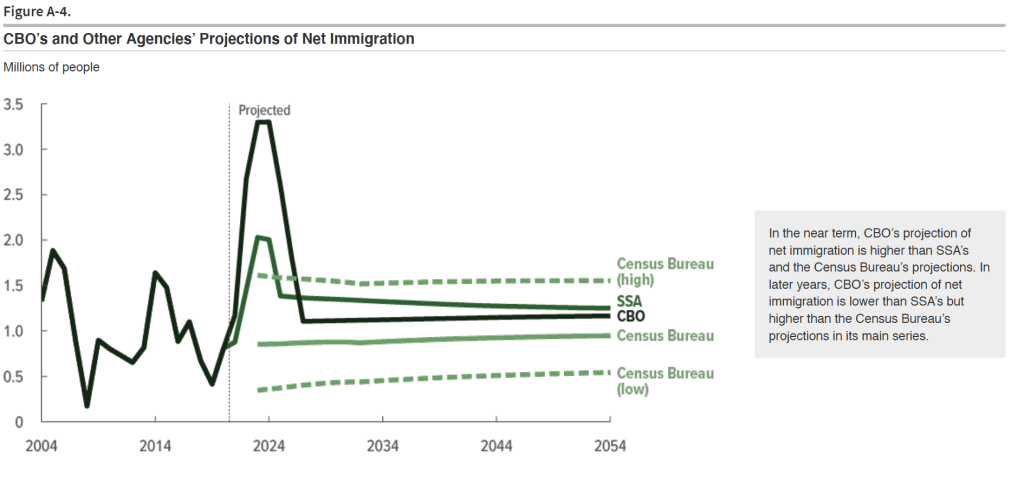
In calculating the unemployment rate and the size of the labor force, the BLS relies on estimates of population from the Census Bureau. In a January report, the Congressional Budget Office (CBO) argued that the Census Bureau’s estimate of the population of the United States is too low by about 6 million people. As the following figure from the CBO report indicates, the CBO believes that the Census Bureau has underestimated how much immigration has occurred and what the level of immigration is likely to be over the next few years. (In the figure, SSA refers to the Social Security Administration, which also makes forecasts of population growth.)

Some economists and policymakers have been surprised that low levels of unemployment and large monthly increases in employment have not resulted in greater upward pressure on wages. If the CBO’s estimates are correct, the supply of labor has been increasing more rapidly than is indicated by census data, which may account for the relative lack of upward pressure on wages. If the CBO’s estimates of population growth are correct, a net increase in employment of 200,000, as occured in June, may be about the number necessary to accommodate growth in the labor force. In other words, Chair Powell would be correct that the labor market was in balance in June.

In a recent publication, economists Nicolas Petrosky-Nadeau and Stephanie A. Stewart of the Federal Reserve Bank of San Francisco look at a related concept: breakeven employment growth—the rate of employment growth required to keep the unemployment rate unchanged. They estimate that high rates of immigration during the past few years have raised the rate of breakeven employment growth from 70,000 to 90,000 jobs per month to 230,000 jobs per month. This analysis would be consistent with the fact that as net employment increases have averaged 177,000 over the past three months—somewhat below their estimate of breakeven employment growth—the unemployment rate has increased from 3.8 percent to 4.1 percent.