Supports: Money, Banking, and the Financial System, Chapter 3.
Image generated by ChatGPT of the U.S. Treasury building in Washington, DC
In a recent book review in the Wall Street Journal, financial analyst James Grant wrote: “The Treasury may indeed pay off every claim in freshly printed dollars. But 30-year Treasurys issued at the sub-2% yields prevailing in 2020 change hands today for less than 45 cents on the dollar.”
To illustrate Grant’s point: On May 15, 2020, the U. S. Treasury issued a 30-year bond with a $12.50 coupon and a face value, or par value, of $1,000. On October 6, the market price of the bond was $424.25. If you buy this bond today, you will receive a payment of $1,000 from the U.S. Treasury on May 15, 2050. The U.S. Treasury most recently issued 30-year bonds on August 17, 2026. Those 30-year bonds have a coupon of $51.25.
a. What does Grant mean by writing that 30-year Treasury bonds issued in 2020 “change hands today for less than 45 cents on the dollar”?
b. Why would anyone would be willing to sell you a bond for less than 50 percent of the amount the seller would receive by holding the bond to maturity?
Solving the Problem
Step 1: Review the chapter material. This problem is about why bond prices fluctuate, so you may want to review Money, Banking, and the Financial System, Chapter 3, “Interest Rates and Rates of Return,” particularly the section “What Happens to Bond Prices When Interest Rates Change?”
Step 2: Answer part a. by explaining what Grant meant by bonds changing hands at less than 45 cents on the dollar. By “changing hands” Grant is referring to buying and selling bonds in the bond market. By “less than 45 cents on the dollar,” Grant means that bonds with a face value of $1,000 are selling for less than $450.
Step 3: Answer part b. by explaining why someone would be willing to sell you a bond for only $450 even though the bond has a face value of $1,000. In the bond market, as bonds are bought and sold, bonds of the same characteristics should have the same yield, as measured by the yield to maturity on the bonds. The 30-year bonds the Treasury issued in August of this year currently have a yield to maturity of about of about 5.31%. (The yield to maturity on these bonds is greater than the bonds coupon rate of 5.125% because the prices of the bonds are currently less than $1,000.) As an investor, you would only be willing to buy the 30-year bonds the Treasury issued in 2020 with a coupon rate of 1.25% if the price of the bonds will result in your receiving a yield to maturity of 5.31%.
The expression that links the price of a coupon bond, P, to the yield to maturity on the bond, i, is:

Keeping mind that the coupon, C, on a bond is fixed once the bond is issued, an increase in the yield to maturity must cause a decline in price of the bond. Because the gap in coupon rates between Treasury bonds issued in 2020 and in 2026 is so large, the 2020 bonds must have much lower prices in order to have the same yield to maturity.
Extra credit. The U.S. Treasury only started regularly issuing coupon bonds in the 1970s as the federal government began to run substantial budget deficits nearly every year. Prior to that, individuals rarely bought Treasury bonds with the exception of the tens of billions of “war bonds” the Treasury issued to raise funds during World War I and World War II.

Image from the American Museum of Natural History
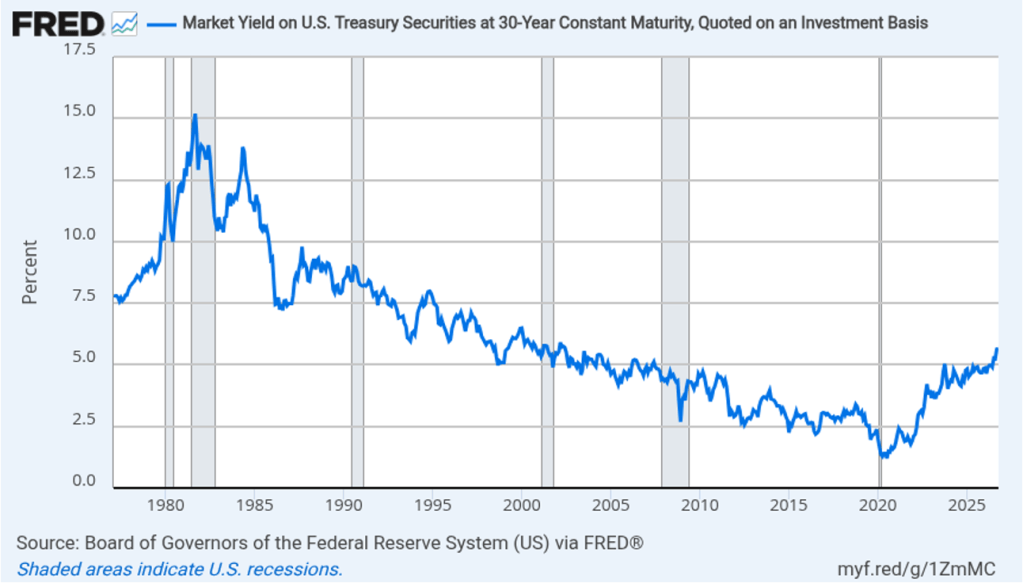
As the following figure shows, since the 1970s, the yields on 30-year Treasury bonds have changed dramatically over time, from more than 15% in 1981 to less than 2% in 2020. These variations in yields reflect the higher or lower coupon rates the Treasury needs to offer investors as a result of fluctuations in inflation and in other factors that affect the demand for bonds.