The U.S. Dollar in the World Economy

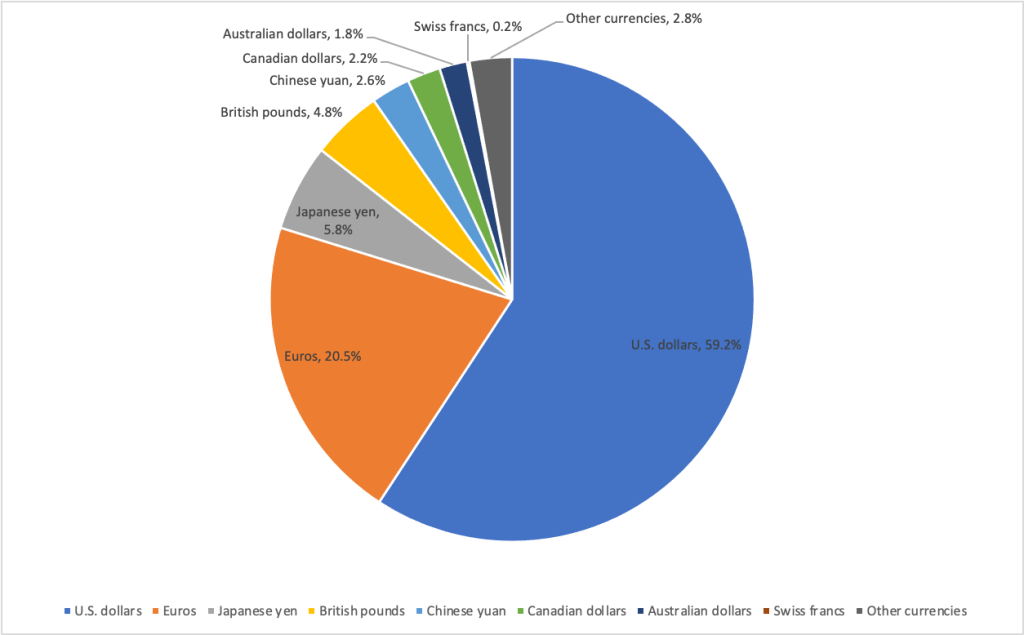
The U.S. dollar is the most important currency in the world economy. The funds that governments and central banks hold to carry out international transactions are called their official foreign exchange reserves. (See Macroeconomics, Chapter 18, Section 18.1 and Economics, Chapter 28, Section 28.1.) There are 180 national currencies in the world and foreign exchange reserves can be held in any of them. In practice, international transactions are conducted in only a few currencies. Because the U.S. dollar is used most frequently in international transactions, the majority of foreign exchange reserves are held in U.S. dollars. The following figure shows the composition of official foreign exchange reserves by currency as of mid-2021.

Over time, the percentage of foreign exchange reserves in U.S. dollars has been gradually declining, although the dollar seems likely to remain the dominant foreign reserve currency for a considerable period. Does the United States gain an advantage from being the most important foreign reserve currency? Economists and policymakers are divided in their views. At the most basic level, dollars are claims on U.S. goods and services and U.S. financial assets. When foreign governments, banks, corporations, and investors hold U.S. dollars rather than spending them, they are, in effect, providing the United States with interest-free loans. U.S. households and firms also benefit from often being able to use U.S. currency around the world when buying and selling goods and services and when borrowing, rather than first having to exchange dollars for other currencies.

But there are also disadvantages to the dollar being the dominant reserve currency. Because the dollar plays this role, the demand for the dollar is higher than it would otherwise be, which increases the exchange rate between the dollar and other currencies. If the dollar lost its status as the key foreign reserve currency, the exchange rate might decline by as much as 30 percent. A decline in the value of the dollar by that much would substantially increase exports of U.S. goods. Barry Eichengreen of the University of California, Berkeley, has noted that the result might be “a shift in the composition of what America exports from Treasury [bonds and other financial securities] … toward John Deere earthmoving equipment, Boeing Dreamliners, and—who knows—maybe even motor vehicles and parts.”

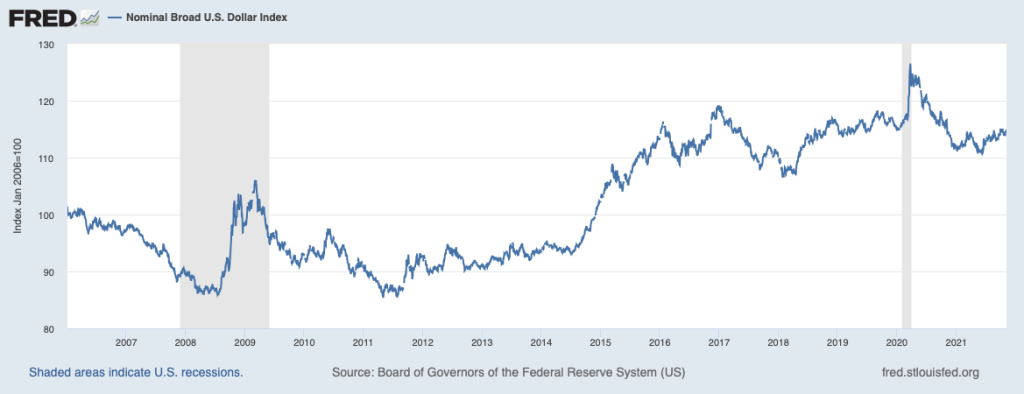
As shown in the following figure, the importance of the U.S. dollar in the world economy is also indicated by the sharp increase in the demand for dollars and, therefore, in the exchange rate during the financial crisis in the fall of 2008 and during the spread of Covid-19 in the spring of 2020. (The exchange rate in the figure is a weighted average of the exchange rates between the dollar and the currencies of the major trading partners of the United States.) As an article in the Economist put it: “Last March, when suddenly the priority was to have cash, the cash that people wanted was dollars.”

Sources: International Monetary Fund, “Currency Composition of Official Foreign Exchange Reserves,” data.imf.org; Alina Iancu, Neil Meads, Martin Mühleisen, and Yiqun Wu, “Glaciers of Global Finance: The Currency Composition of Central Banks’ Reserve Holdings,” blogs.imf.org, December 16, 2020; Barry Eichengreen, Exorbitant Privilege: The Rise and Fall of the Dollar and the Future of the International Monetary System, New York: Oxford University Press, 2001, p. 173; “How America’s Blockbuster Stimulus Affects the Dollar,” economist.com, March 13, 2021; and Federal Reserve Bank of St. Louis. 

Should Tariffs Be Used to Slow Climate Change?

Why do countries impose tariffs on imported goods? As we discuss in Economics Chapter 9 and MacroeconomicsChapter 7 (particularly in Section 5 of these chapters) countries primarily use tariffs to protect domestic industries from foreign competition. Protectionism appeared to be the main motivation when the Trump administration imposed tariffs on imports of steel, aluminum, and some other products from China, Canada, and countries in the European Union. It was also the main reason that the Biden administration decided in 2021 to retain many of those tariffs.

The other main justification for imposing tariffs is for reasons of national security. For instance, as we note in the textbook, the United States would not want to import its jet fighter engines from China. In fact, the Trump administration relied on Section 232 of the Trade Expansion Act of 1962 when it imposed tariffs, particularly tariffs on steel and aluminum. The Biden administration also cited this section of the law when continuing the tariffs. (In October 2021, the Biden administration negotiated with the European Union a partial reduction of these tariffs.) Under that section of the law, if the president decides that imports of a good threaten nationals security, “he shall take such action, and for such time, as he deems necessary to adjust the imports of such article and its derivatives so that such imports will not so threaten to impair the national security.” In other words, presidents have the power to impose tariffs on imports of a good if they assert that doing so protects the national security of the United States.

When they invoked this section of the law, both the Trump and Biden administrations were criticized for stretching its application beyond what Congress had intended. Critics argue that using this section of the law to impose tariffs on such close allies of the United States as the countries of the European Union was a violation of Congress’s intent because it was unlikely that imports of steel or aluminum from Europe threaten the national security of the United States.

If used as intended, Section 232 is a rare example of imposing tariffs for reasons other than protecting domestic industries. (It’s worth noting that during the 1800s and early 1900s, before there was a federal income tax, Congress relied on revenues from tariffs as the main source of funds to the federal government. In recent years tariff revenues have been very small compared with income taxes and the federal government’s other sources of revenue.) In 2021, some policymakers were proposing using tariffs for another purpose unrelated to protecting domestic industries: Slowing climate change.

In November 2021, the United States and the European Union announced that they would explore imposing tariffs on imports of steel from countries that impose few regulations on carbon emissions from steel mills. (These climate tariffs are sometimes referred to as border carbon adjustments (BCAs).) The tariffs might be extended to include imports of aluminum, chemicals, and cement. The rationale for these tariffs is that in the United States and Europe, steel producers must install expensive equipment to reduce carbon emissions or must pay a tax on those emissions.

These regulations raise the cost of producing steel and, therefore, the price of steel produced in Europe and the United States. As a result, U.S. and European firms that use steel, such as automobile companies, have an incentive to import lower-priced steel from countries that have few regulations on carbon emissions. According to one estimate, the production of steel being imported into the United States generates 50 percent to 100 percent more carbon dioxide emissions than does the production of domestic steel.  An article in the Wall Street Journal noted that a report from a consulting firm argued that “the emissions that many developed countries claim to have eliminated were ‘outsourced to developing countries,’ which generally have fewer resources to invest in cleaner and more advanced technology.”

Critics of using tariffs as a means of slowing climate change note that there are other measures that countries can use to reduce their own CO2 emissions and that attempts to use economic coercion to prod countries into changing policies have not generally been successful. They also note that Section 232 of the Trade Expansion Act of 1962 was intended to be used only for reasons of national security but has been used by the Trump and Biden administration more broadly to protect domestic industries. They fear that the same thing may happen if climate tariffs are allowed under international agreements: The tariffs may be used to protect domestic industries for reasons that have nothing to do with reducing climate change. In fact, an article on barrons.com noted that the agreement between the United States and the European Union to impose climate tariffs on steel imports was “aimed, according to administration officials, at countering the flood of cheap steel from China, which accounts for roughly 60% of production worldwide.”

In addition, some economists and policymakers fear that imposing climate tariffs may undermine the rules of the World Trade Organization (WTO), which do not authorize countries to impose tariffs for this reason. This outcome is particularly likely if some countries see the tariffs as aimed more at protecting domestic industries than at slowing climate change. As we discuss in Section 5 of Chapter 9 in Economics (Macroeconomics Chapter 7), the WTO and its predecessor, the General Agreement on Tariffs and Trade (GATT) resulted in decades of multilateral negotiations that greatly reduced tariffs. The tariff reductions spurred a tremendous expansion in world trade, which significantly increased incomes in the United States and most other countries—although it also disrupted some domestic industries in those countries. If the WTO were to cease to be effective, the world might return to the situation of the 1930s and earlier when countries used tariffs for a variety of policy reasons. The trade war of the 1930s, during which most countries raised tariff rates, led to a collapse in world trade and helped to worsen the Great Depression. 

If climate tariffs become common, the effect on both the climate and on the international trading system may be significant. 

Sources:  Josh Zumbrun, “U.S.-EU Steel Tariffs Deal Is Onerous for Smaller Importers,” wsj.com, November 5, 2021; Yuka Hayashi and Jacob M. Schlesinger, “Tariffs to Tackle Climate Change Gain Momentum. The Idea Could Reshape Industries,” wsj.com, November 2, 2021; By Reshma Kapadia, “The EU Tariff Deal Doesn’t Mean the Trade War With China Is Over,” barrons.com, November 2, 2021; Jennifer A. Dlouhy and Ari Natter, “Democrats Propose Tax on Carbon-Intensive Imports in Budget,” bloomberg.com, July 14, 2021; and Billy Pizer, “The Trade Tool that Could Unlock Climate Ambitions,” barrons.com, November 5, 2021.

Economies of Scale in Ocean Shipping and U.S. Retailers’ Response to Pandemic Supply Chain Problems

Beginning in the 1950s, several companies pioneered in developing modern shipping containers that once arrived at docks can be lifted by cranes and directly attached to trucks or loaded on to trains for overland shipping. As economist Marc Levinson was the first to discuss in detail in his 2004 book, The Box, container shipping, by greatly reducing transportation costs, helped to make the modern global economy possible. (We discuss globalization in Economics, Chapter 9, Section 9.1 and Chapter 21, Section 21.4, and in Macroeconomics, Chapter 7, Section 7.1 and Chapter 11, Section 11.4.) 

Lower transportation costs meant that small manufacturing firms and other small businesses that depended on selling in local markets faced much greater competition, including from firms located thousands of miles away. The number of dockworkers declined dramatically as the loading and unloading of cargo ships became automated. Ports such as New York City, San Francisco, and Liverpool that were not well suited for handling containers because they lacked sufficient space for the automated equipment and the warehouses, lost most of their shipping business to other ports, such as Los Angeles, Seattle, and London. Consumers in all countries benefited because lower transportation costs meant they were able to buy cheaper imported goods and had a much greater variety of goods to choose from.

In the decades since the 1950s, shipping firms have continued to exploit economies of scale in container ships. (We discuss the concept of economies of scale in Econimics and Microeconomics, Chapter 11, Section 11.6.) Today, shipping containers have been standardized at either 20 feet or 40 feet long and the largest ships can haul thousands of containers. Levinson explains why economies of scale are important in this industry:

“A vessel to carry 3,000 containers did not require twice as much steel or twice as large an engine as a vessel to carry 1,500. [Because of automation, a] larger ship did not require a larger crew, so crew wages per container were much lower. Fuel consumption did not increase proportionally with the vessel’s size.”

To take advantage of these economies of scale, the ships needed to sail fully loaded. The largest ships can sail fully loaded only on routes where shipping volumes are highest, such as between Asia and the United States or between the United States and Europe. As a result, as Levinson notes, the largest ships are “uneconomic to run on most of the world’s shipping lanes” because on most routes the costs per container are higher for the largest ships for smaller ships. (Note that even these “smaller ships” are still very large in absolute size, being able to haul 1,000 containers.) 

Large U.S. retail firms, such as Walmart, Home Depot, and Target rely on imported goods from Asian countries, including China, Japan, and Vietnam. Ordinarily, they are importing goods in sufficient quantities that the goods are shipped on the largest vessels, which today have the capacity to haul 20,000 containers. But during the pandemic, a surge in demand for imported goods combined with disruptions caused by Covid outbreaks in some Asian ports and a shortage of truck drivers and some other workers in the United States, resulted in a backlog of ships waiting to disembark their cargoes at U.S. ports. The ports of Los Angeles and Long Beach in southern California were particularly affected. By October 2021, it was taking an average of 80 days for goods to be shipped across the Pacific, compared with an average of 40 days before the pandemic.

Some large U.S. firms responded to the shipping problems by chartering smaller ships that ordinarily would only make shorter voyages. According to an article in the Wall Street Journal, “the charters provide the big retailers with a way to work around bottlenecks at ports such as Los Angeles, by rerouting cargo to less congested docks such as Portland, Ore., Oakland, Calif., or the East Coast.”  Unfortunately, because the smaller ships lacked the economies of scale of the larger ships, the cost the U.S. firms were paying per container were nearly twice as high. (Note that this result is similar to the cost difference between a large and a small automobile factory, which we illustrated in Economics and Microeconomics, Figure 11.6.)

Unfortunately for U.S. consumers, the higher costs U.S. retailers paid for transporting goods across the Pacific Ocean resulted in higher prices on store shelves. Shopping for presents during the 2021 holiday season turned out to be more expensive than in previous years. 

Sources: Marc Levinson, The Box: How the Shipping Container Made the World Smaller and the World Economy Bigger, Second edition, Princeton, NJ: Princeton University Press, 2016; Sarah Nassauer and Costas Paris, “Biggest U.S. Retailers Charter Private Cargo Ships to Sail Around Port Delays,” wsj.com, October 10, 2021; and Melissa Repko, “How Bad Are Global Shipping Snafus? Home Depot Contracted Its Own Container Ship as a Safeguard,” cnbc.com, June 13, 2021. 

Solved Problem: The Macroeconomic Effects of a Stronger Euro

Supports:  Economics: Chapter 28 – Macroeconomics in an Open Economy (Section 28.2); Macroeconomics: Chapter 12, Section 12.2; and Essentials: Chapter 19 – Comparative Advantage, International Trade, and Exchange Rates (Section 19.6)

Solved Problem: The Macroeconomic Effects of a Stronger Euro

In December 2020, an article in the Wall Street Journal discussed the effects of changes in the value of the euro in exchange for the U.S. dollar. The article noted that: “A stronger euro makes exports from the region less competitive overseas” and that a stronger euro would also “damp inflation” in countries using the euro as their currency.

a. What does the article mean by a “stronger euro”? Why would a stronger euro make European exports less competitive?

b. What does the article mean by “damp inflation”? Why would a stronger euro damp inflation in countries using the euro?

Source: Caitlin Ostroff, “Euro Rally Weighs on Inflation, Sapping Appetite for Stocks,” Wall Street Journal, December 9, 2020.

Solving the Problem

Step 1:   Review the chapter material. This problem is about the effect of changes in the exchange rate on a country’s (or region’s) imports and exports, so you may want to review Chapter 28, Section 28.2 “How Movements in Exchange Rates Affect Imports and Exports.”

Step 2:   Answer part a. by explaining what a “stronger euro” means and why a stronger euro would make European exports less competitive. A stronger euro is one that exchanges for more dollars or, which amounts to the same thing, requires fewer euros to exchange for a dollar. (You may want to review the Apply the Concept “Is a Strong Currency Good for a Country?”) A stronger euro results in U.S. consumers having to pay more dollars to buy goods and services imported from Europe. In other words, the prices of European exports to the United States will rise making the exports less competitive with U.S.-produced goods or with other countries exports to the United States. If the euro is also becoming stronger against currencies such as the British pound, Japanese yen, and Chinese yuan, then European exports will also be less competitive in those countries.

Step 3:   Answer part b. by explaining what “damp inflation” means and why a stronger euro would damp inflation in countries using the euro. To “damp inflation” is to reduce inflation. So the article is stating that a stronger euro will result in lower inflation in Europe. To understand why, remember that while a stronger euro will raise the dollar price of European exports to the United States, it will reduce the euro price of European imports from the United States (and from other countries if the euro is also becoming stronger against currencies such as the British pound, Japanese yen, and Chinese yuan). Inflation in a country is measured using the prices of goods and services that consumers purchase, whether those goods and services are produced domestically or are imported.

The Wall and the Bridge – an article from Glenn Hubbard in National Affairs.

Advances in technology and expanding international trade have disrupted some key U.S. industries. These developments have made new products available, lowered the prices of existing products, and fostered the creation of new companies and new jobs. Yet, there has also been a downside. Some U.S. manufacturing firms have disappeared and some workers have been left unemployed for long periods. How can economists help frame a discussion about policies that will help everyone participate as the economy continues to evolve? Glenn Hubbard discusses a new approach in his article “The Wall and the Bridge”, published in National Affairs in September 2020.

5/29/20 Podcast – Glenn Hubbard & Tony O’Brien Welcome Guest – Prof. Bill Goffe from Penn State University!

Glenn Hubbard and Tony O’Brien continue their podcast series hosting guest – Professor Bill Goff of Penn State University. In talking with Bill, we discuss the challenges of teaching online during the Pandemic this past spring. We talk some about unemployment as well as hearing how Bill how he developed his passion for photography in his travels around the world. The image on this post was a picture of the Milky Way taken by Bill in North Central Pennsylvania!

Links for podcast of May 29, 2020 with Bill Goffe of Penn State

1. Link to RFE:  Resources for Economists on the Internet that Bill edits: https://www.aeaweb.org/rfe/

2. Link to the website of the Journal of Economic Education where Bill is an associate editor: https://www.tandfonline.com/loi/vece20

3. Link to the CTALE TeachECONference – https://ctale.org/teacheconference/. You can register – for free – by clicking HERE

Please listen & share!

5/22/20 Podcast – Glenn Hubbard & Tony O’Brien Welcome Guest – Prof. Mike Ryan from Western Michigan University!

Glenn Hubbard and Tony O’Brien continue their podcast series hosting guest – Professor Mike Ryan of Western Michigan University. During the conversation, we learn about Mike’s experiences working with faculty from Western Michigan School of Business taking their courses online. He also offers his thoughts on the current trade situation as well as personal insights from a January visit to Japan.

Please listen & share!

COVID-19 Update – Is the Second Golden Age of Globalization Over?

Supports:  Econ (Chapter 9 – Comparative Advantage & the Gains from International Trade); Micro (Chapter 9): Macro (Chapter 7); Essentials: Chapter 19.

Is the Second Golden Age of Globalization Over?

In the past 150 years, international trade and international financial flows rapidly expanded during two periods that are sometimes called the Golden Ages of Globalization. The first began in 1870 and ended in 1914, when the outbreak of World War I caused a sharp reduction in international trade. The second began in 1948 with the establishment of the General Agreement on Tariffs and Trade (GATT) under which 23 countries, including the United States, agreed to reduce tariffs from the very high levels they had reached during the 1930s.  Will the coronavirus pandemic end the Second Golden Age of Globalization?

The coronavirus pandemic that spread around the world during early 2020 resulted in a sharp decline in international trade as governments in many countries shut down businesses.  For example, exports of goods from the United States declined by more than 20 percent during the first quarter of 2020, even though the virus only began to have a major effect on the world economy during the second half of the quarter.

The Debate over Importing Medical Supplies During a Pandemic

Some policymakers and economists were concerned that goods critical to responding to the pandemic were not being produced in the United States.  For example, most pharmaceuticals sold in the United States are produced in other countries or rely on ingredients that are produced in other countries. The same is true of personal protective equipment (PPE), such as facemasks, protective clothing, and face shields. As more than 75 countries, including France, Germany, South Korea, and Brazil restricted or banned exports of medical supplies and hospital equipment, U.S.-based firms struggled to meet surging demand for these goods. Some policymakers argued that the coronavirus pandemic and fears of future pandemics meant that the United States should stop importing pharmaceuticals and PPE. They urged that the supply chains for those goods be relocated to the United States so that the entire quantity of the goods demanded by U.S. households and firms—particularly under pandemic conditions—could be produced domestically.

The G-20 is an organization of 20 large countries.  At a G-20 meeting of trade ministers in March 2020, U.S. Trade Representative Robert Lightizer stated that “we are learning in this crisis that over-dependence on other countries as a source of cheap medical production has created a strategic vulnerability to our economy.”  Some policymakers noted that China supplies more than 40 percent of world imports of PPE and also produces a substantial fraction of generic pharmaceuticals, including penicillin. 

Some economists noted two important problems countries may encounter if they move to no longer relying on importing some or all medical supplies:

  1. Comparative Advantage.  If countries move to produce all critical medical supplies domestically rather than relying on imports from countries with a comparative advantage in producing those goods, the cost of the goods would rise. 
  2. Retaliatory Tariffs.  It was unclear whether relocating production of medical supplies to domestic factories might result in retaliation—such as tariff increases—by countries that formerly exported those goods.

Other Threats to the World Trading System Resulting from the Pandemic

The World Trade Organization (WTO) is an international organization that replaced the GATT in 1995 and that oversees international trade agreements.  WTO rules allow countries to impose tariffs on imports of goods that foreign governments have subsidized. During the pandemic, many governments, including the U.S. federal government, subsidized firms to help them survive the loss of revenue resulting from social distancing policies. If countries take advantage of the WTO rules to impose tariffs on imports produced by firms that had received subsidies from their governments, the result could further reduce international trade. In 2019, international trade had already declined from its level in 2018, partly as a result of a trade war between the United States and China.

Some countries, including the United States, suspended immigration and barred visitors from certain countries. If such restrictions remain in place after the pandemic has ended, they could impede international trade, which requires businesspeople to freely travel among countries.  

What Can We Learn from the End of the First Golden Age of Globalization?

In the spring of 2020, it was unclear whether the disruptions to global trade from the pandemic were temporary or whether they indicated that a possible end to the Second Golden Age of Globalization.  During the decades since the GATT began in 1948, many countries, including the United States, benefited from the reduction in tariffs and other barriers to trade in goods, as well as the elimination of many obstacles to the flow of funds and physical investments across borders.  Countries were better able to pursue their comparative advantage in producing goods and services, thereby raising incomes.  Developing countries, in particular, were able to use global financial markets to finance investment in real capital projects, such as factories, and gain access to current technologies through foreign direct investment. (In Chapter 9, Section 9.3, we discuss how countries gain from international trade and which groups within a country may lose increased international trade.)

In fact, the greatest beneficiaries of the Second Golden Age of Globalization were developing countries, such as South Korea, Taiwan, Singapore, China, and India.   By relying on the global economic system, these countries were able to greatly increase economic growth, which lifted hundreds of millions of their citizens out of poverty.  If the path these countries followed to increasing economic growth and rising incomes is disrupted by a new wave of tariffs and other restrictions on the international movement of goods and investment, those most likely to be hurt are low-income countries in sub-Saharan Africa, Latin America, and Asia where economic growth rates remain low.

What followed the end of the First Golden Age of Globalization helps us understand the potential consequences from disrupting trade. Kevin O’Rourke of University College Dublin, Alan Taylor of the University of California, Davis, Jeffrey Williamson of Harvard, and colleagues have documented the rapid increase in globalization—increasing foreign trade and investment—during the years between 1870 and 1913.  As a fraction of world GDP, exports of goods increased by more than 70 percent between those years. This increase in world trade resulted from the following developments:

  • A reduction of about 50 percent in the cost of shipping goods across oceans following the introduction of steamships
  • Improved communications resulting from the spread of telegraphs and the telephones
  • Adoption of the gold standard by most countries, which reduced exchange rate uncertainty and the transactions costs of having to convert currencies when engaging in international trade  

International investment flows also grew, with foreign-owned assets, such as bonds and factories, increasing from 7 percent of world GDP in 1870 to 20 percent of world GDP in 1914. These investment flows made it possible for entrepreneurs in many countries to borrow from foreign investors and also allowed technologies to spread from high-income countries, such as the United Kingdom and the United States, to lower income countries in Latin America and Asia.

International trade and foreign financial investment contributed to rising incomes during these years throughout most of western and northern Europe, the United States, Canada, Australia, New Zealand, Argentina, Chile, Uruguay, Japan, and South Africa.  In addition, during these years millions of people were able to improve their living standards by migrating to other countries.  The immigrants made themselves better off while also increasing the labor forces of the countries they settled in and, therefore, economic growth in those countries.  Between 1870 and 1914, more than 25 million people immigrated to the United States. Argentina, Canada, and Australia, among other countries, also received large numbers of immigrants. Because these immigrants were, on average, more productive in the countries they arrived in than in the—usually lower-income—countries they left, immigration increased world GDP relative to what it would have been without this immigration.

If the First Golden Age of Globalization hadn’t ended with the beginning of World War I in 1914, other countries might have used international trade and foreign investment to increase economic growth and raise living standards.  In fact, though, the world economy was entering a 30-year period of reduced trade and foreign investment.  During the 1920s, several countries including the United States, raised tariffs, many countries left the gold standard, leading to instability in exchange rates, and the cost of ocean shipping actually rose. In the Great Depression of the 1930s, many countries, again including the United States, raised tariffs, and international trade declined sharply. By the end of World War II in 1945, many countries had imposed capital controls that made foreign investment difficult. In 1950, exports as a percentage of world GDP were 30 percent lower than they had been in 1913. Foreign assets as a percentage of world GDP collapsed by 75 percent between 1914 and 1945. They did not regain their 1914 level until 1980.

The problems in the global economy during this 30-year period led policymakers in many developing countries to conclude that relying on exports and foreign investment was not an effective strategy for increasing economic growth.  Instead, policies of protectionism and import substitution became popular as countries imposed high tariffs to keep out foreign imports and capital controls to limit foreign investment.  Government subsidies and tax breaks were used to encourage the establishment of import-competing firms, particularly in heavy industries such as steel and automobiles. Economists and policymakers who supported this approach argued that, having been given government aid and having been protected from foreign competition, domestic industries would flourish, allowing for rapid economic growth without a reliance on international trade. Sebastian Edwards of the University of California, Los Angeles has described the acceptance of these policies in Latin America: “By the late 1940s and early 1950s protectionist policies based on import substitution were well entrenched and constituted, by far, the dominant perspective.”

Unfortunately, these polices moved countries away from pursuing their comparative advantage. Many of the industries being supported were inefficient and produced goods at much higher costs than foreign producers. As a result, consumers in these countries had to pay higher prices for goods than did consumers in higher income countries where during these years import tariffs were being gradually reduced. Most countries pursuing policies of import substitution experienced slow economic growth in part because local firms, shielded from foreign competition, were much less efficient than firms in countries that still participated in the global economy. Countries in Latin America, in particular, didn’t turn away from a strategy of import substitution and begin to reopen their economies to international trade and foreign investment until the 1980s.

The decline in international trade and foreign investment that began in 1914 and persisted for 30 years reduced incomes in nearly every country relative to what they would have been if the First Golden Age of Globalization had continued. What began as a temporary reduction in trade and investment attributable to the effects of World War I persisted for various reasons long after the war had ended. Today, some economists and policymakers are concerned that the disruptions to the global economy from the coronavirus pandemic might also persist after the immediate effects of the pandemic have faded.

Sources: Greg Ip, “Globalization Is Down but Not Out Yet,” Wall Street Journal, April 28, 2020; Zachary Karabell, “Will the Coronavirus Bring the End of Globalization? Don’t Count on It,” Wall Street Journal, March 20, 2020; “Has Covid-19 Killed Globalisation?” Economist, May 14, 2020; King Abdullah II, “It’s Time to Return to Globalization. But This Time Let’s Do It Right,” Washington Post, April 27, 2020; Chad P. Brown, “COVID-19 Could Bring Down the Trading System,” Foreign Affairs, May/June, 2020; Antoni Estevadeordal, Brian Frantz, and Alan M. Taylor, “The Rise and Fall of World Trade, 1870-1939,” Quarterly Journal of Economics, Vol. 118, No. 2, May 2003, pp. 359-407; Kevin H. O’Rourke and Jeffrey G. Williamson, “When Did Globalization Begin?” European Review of Economic History, Vol. 6, No. 1, April 2002, pp. 23-50; Kevin H. O’Rourke, “The European Grain Invasion, 1870-1913,” Journal of Economic History, Vol. 57, No. 4, December 1997, pp. 775-801; Michael D. Bordo, Alan M. Taylor, and Jeffrey G. Williamson, eds., Globalization in Historical Perspective, Chicago: The University of Chicago Press, 2003; Sebastian Edwards, “Trade and Industrial Policy Reform in Latin America,” Nation Bureau of Economic Research Working Paper No. 4772, June 1994; U.S. Bureau of Economic Analysis; and U.S. Census Bureau.

Question:

There are both positive and normative aspects to the debate over whether the United States should become less reliant on imports of pharmaceuticals, medical devices, and personal protective equipment (PPE) by taking steps to relocate production of these goods to the United States. 

  1. Briefly identify what you think are the key positive and normative aspects of this debate.
  2. What economic statistics would be most useful in evaluating the positive aspects of this debate?
  3. Assuming that the statistics you identified in b. are available or could be determined, are they likely to resolve the normative issues in this debate? Briefly explain.

For Economics Instructors that would like the approved answers to the above questions, please email Christopher DeJohn from Pearson at christopher.dejohn@pearson.com and list your Institution and Course Number.