The FOMC Leaves Its Target for the Federal Funds Rate Unchanged While Still Projecting Two Rate Cuts This Year

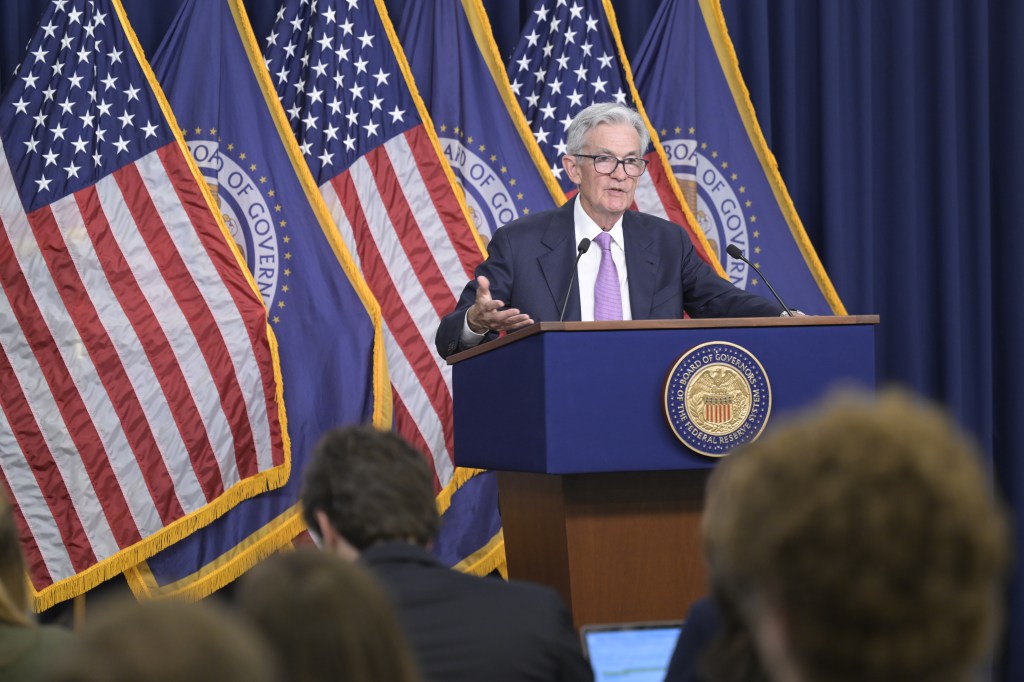
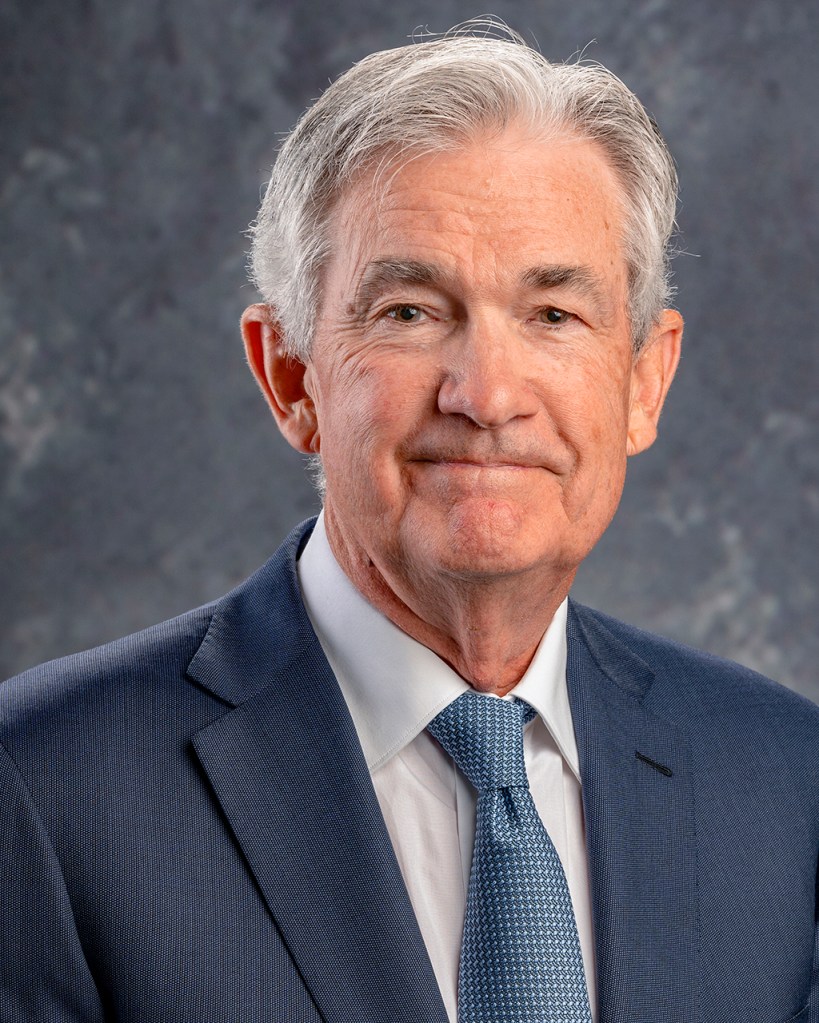
Fed Chair Jerome Powell speaking at a press conference following a meeting of the FOMC (photo from federalreserve.gov)

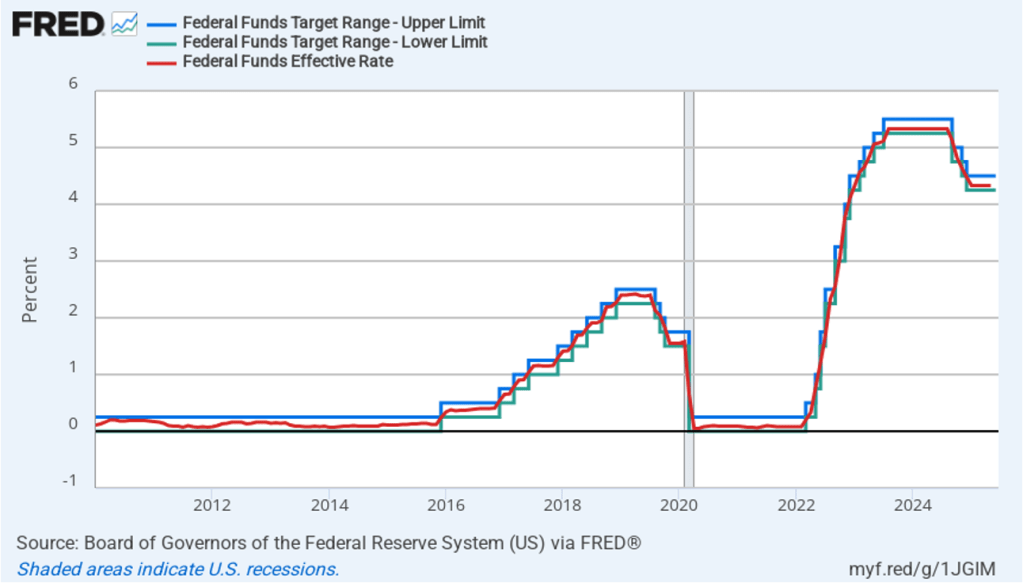
Members of the Fed’s policymaking Federal Open Market Committee (FOMC) had signaled clearly before today’s (June 18) meeting that the committee would leave its target range for the federal funds rate unchanged at 4.25 percent to 4.50 percent. In the statement released after its meeting, the committee noted that a key reason for keeping its target range unchanged was that: “Uncertainty about the economic outlook has diminished but remains elevated.” Committee members were unanimous in voting to keep its target range unchanged.

In his press conference following the meeting, Fed Chair Jerome Powell indicated that a key source of economic uncertainty was the effect of tariffs on the inflation rate. Powell indicated that the likeliest outcome was that tariffs would lead to the inflation rate temporarily increasing. He noted that: “Beyond the next year or so, however, most measures of longer-term expectations [of inflation] remain consistent with our 2 percent inflation goal.”

The following figure shows, for the period since January 2010, the upper bound (the blue line) and lower bound (the green line) for the FOMC’s target range for the federal funds rate and the actual values of the federal funds rate (the red line) during that time. Note that the Fed has been successful in keeping the value of the federal funds rate in its target range. (We discuss the monetary policy tools the FOMC uses to maintain the federal funds rate in its target range in Macroeconomics, Chapter 15, Section 15.2 (Economics, Chapter 25, Section 25.2).)

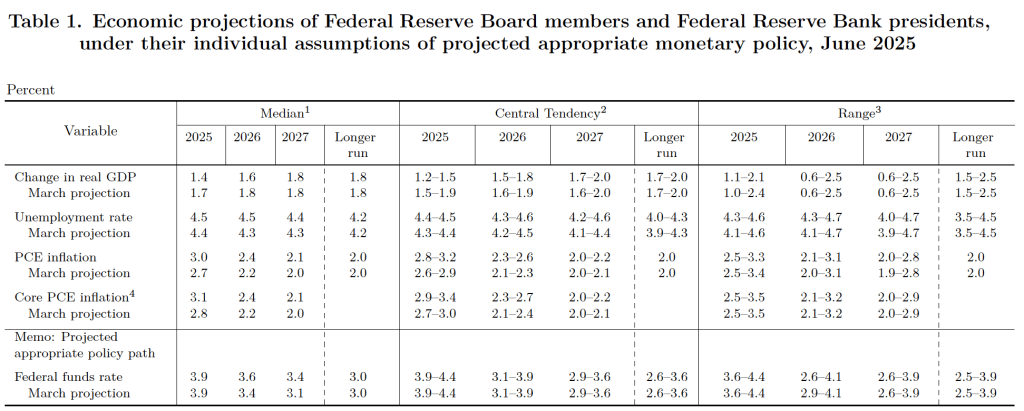
After the meeting, the committee also released a “Summary of Economic Projections” (SEP)—as it typically does after its March, June, September, and December meetings. The SEP presents median values of the 18 committee members’ forecasts of key economic variables. The values are summarized in the following table, reproduced from the release.

There are several aspects of these forecasts worth noting:

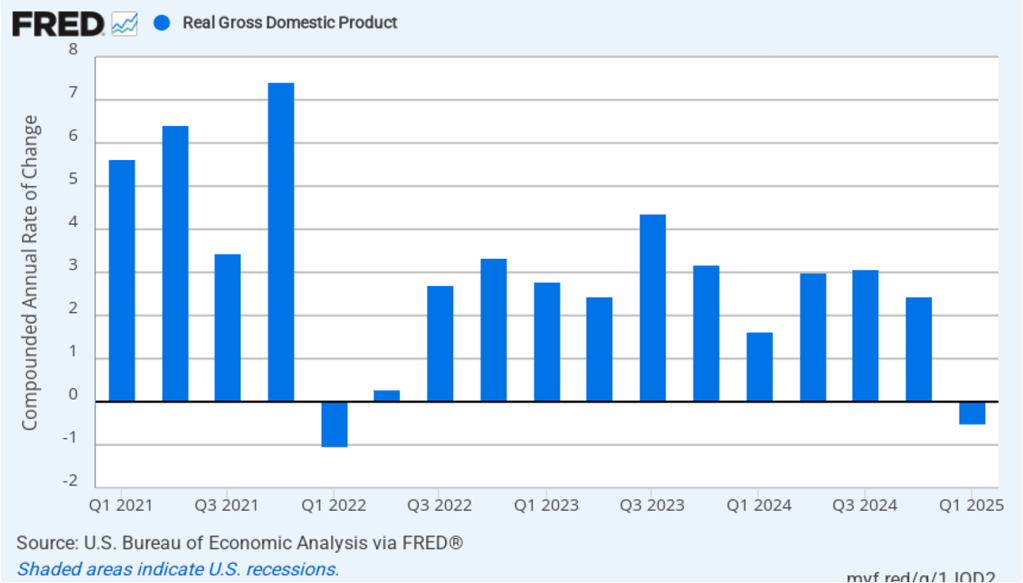
  1. Committee members reduced their forecast of real GDP growth for 2025 from 1.7 percent in March to 1.4 percent today. (It had been 2.1 percent in their December forecast.) Committee members also slightly increased their forecast of the unemployment rate at the end of 2025 from 4.4 percent to 4.5 percent. (The unemployment rate in May was 4.2 percent.)
  2. Committee members now forecast that personal consumption expenditures (PCE) price inflation will be 3.0 percent at the end of 2025. In March they had forecast that it would be 2.7 percent at the end of 2025, and in December, they had forecast that it would 2.5 percent. Similarly, their forecast of core PCE inflation increased from 2.8 percent to 3.1 percent. It had been 2.5 percent in December. The committee does not expect that PCE inflation will decline to the Fed’s 2 percent annual target until sometime after 2027.
  3. The committee’s forecast of the federal funds rate at the end of 2025 was unchanged at 3.9 percent. The federal funds rate today is 4.33 percent, which indicates that the median forecast of committee members is for two 0.25 percentage point (25 basis points) cuts in their target for the federal funds rate this year. Investors are similarly forecasting two 25 basis point cuts.

During his press conference, Powell indicated that because the tariff increases the Trump administration implemented beginning in April were larger than any in recent times, their effects on the economy are difficult to gauge. He noted that: “There’s the manufacturer, the exporter, the importer and the retailer and the consumer. And each one of those is going to be trying not to be the one to pay for the tariff, but together they will all pay together, or maybe one party will pay it all.” The more of the tariff that is passed on to consumers, the higher the inflation rate will be.

Earlier today, President Trump reiterated his view that the FOMC should be cutting its target for the federal funds rate, labeling Powell as “stupid” for not doing so. Trump has indicated that the Fed should cut its target rate by 1 percentage point to 2.5 percentage points in order to reduce the U.S. Treasury’s borrowing costs. During World War II and the beginning of the Korean War, the Fed pegged the interest rates on Treasury securities at low levels: 0.375 percent on Treasury bills and 2.5 percent on Treasury bonds. Following the Treasury-Federal Reserve Accord, reached in March 1951, the Federal Reserve was freed from the obligation to fix the interest rates on Treasury securities. (We discuss the Accord in Chapter 13 of Money, Banking, and the Financial System.) Since that time, the Fed has focused on its dual mandate of maximum employment and price stability and it has not been directly concerned with affecting the Treasury’s borrowing cost.

Barring a sharp slowdown in the growth of real GDP, a significant rise in the unemployment rate, or a significant rise in the inflation rate, the FOMC seems unlikely to change its target for the federal funds rate before its meeting on September 16–17 at the earliest.

Not Much Sign of the Effects of Tariffs in the May CPI Inflation Report

Image generated by ChatGTP-4o of someone shopping for clothes.

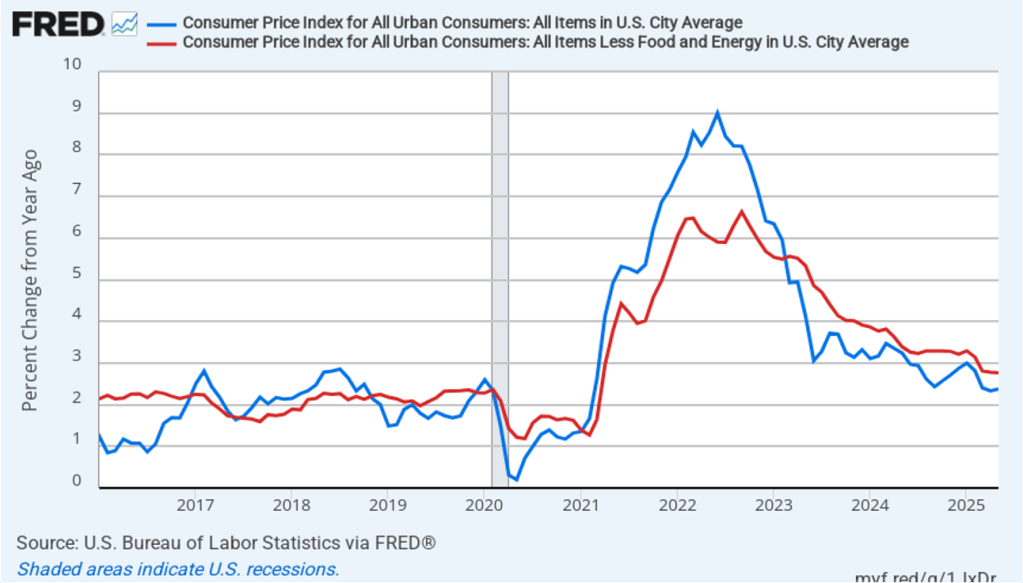
Today (June 11), the Bureau of Labor Statistics (BLS) released its report on the consumer price index (CPI) for May. The following figure compares headline CPI inflation (the blue line) and core CPI inflation (the green line).

  • The headline inflation rate, which is measured by the percentage change in the CPI from the same month in the previous year, was 2.4 percent in May—up slightly from 2.3 percent in April. 
  • The core inflation rate, which excludes the prices of food and energy, was 2.9 percent in May—up slightly from 2.8 percent in April. 

Headline inflation was slightly lower and core inflation was the same as what economists surveyed had expected.

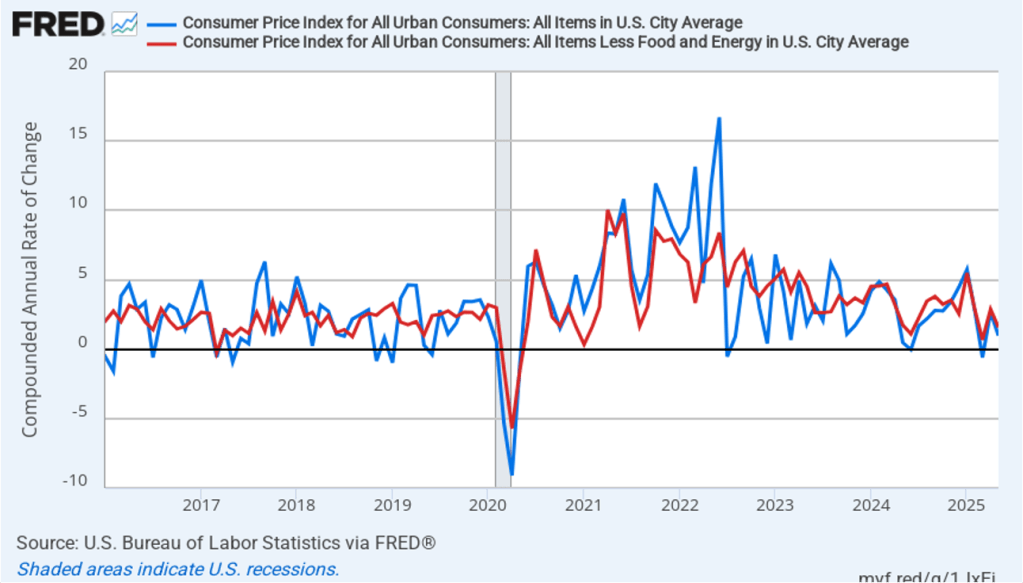
In the following figure, we look at the 1-month inflation rate for headline and core inflation—that is the annual inflation rate calculated by compounding the current month’s rate over an entire year. Calculated as the 1-month inflation rate, headline inflation (the blue line) decreased from 2.7 percent in April to 1.0 percent in May. Core inflation (the red line) decreased from 2.9 percent in April to 1.6 percent in May.

The 1-month and 12-month inflation rates are telling different stories, with 12-month inflation indicating that the rate of price increase is running slightly above the Fed’s 2 percent inflation target. The 1-month inflation rate indicates a significant slowing of inflation during May. 

Of course, it’s important not to overinterpret the data from a single month. The figure shows that the 1-month inflation rate is particularly volatile. Also note that the Fed uses the personal consumption expenditures (PCE) price index, rather than the CPI, to evaluate whether it is hitting its 2 percent annual inflation target.

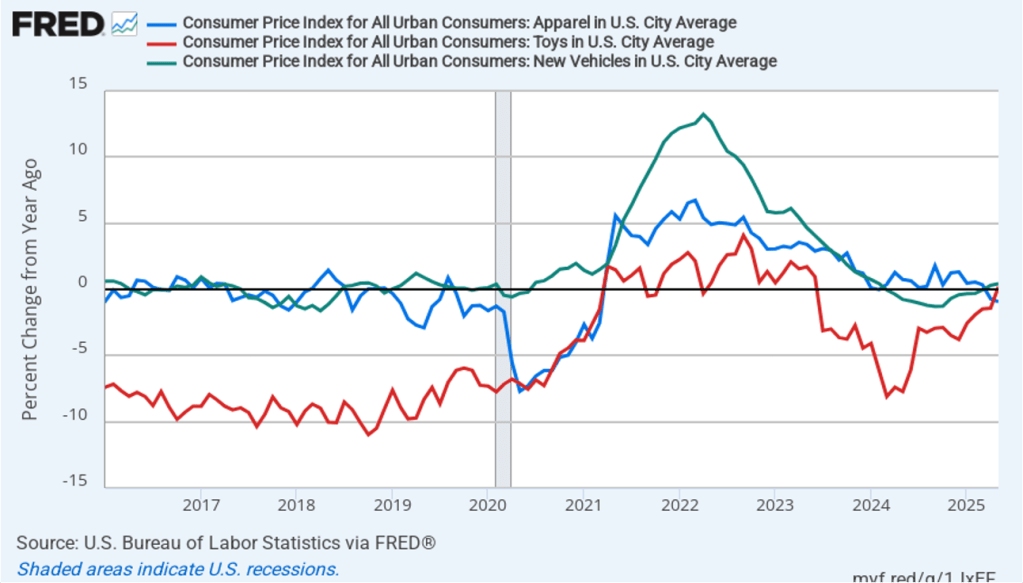
One of the key questions facing Federal Reserve policymakers is to what extent inflation will be affected by the increase in tariffs that the Trump administration announced on April 2. The following figure shows 12-month inflation in three categories of products whose prices are thought to be particularly vulnerable to the effects of tariffs: apparel (the blue line), toys (the red line), and motor vehicles (the green line). In May, prices of apparel fell, while the prices of toys and motor vehicles rose by less than 0.5 percent.

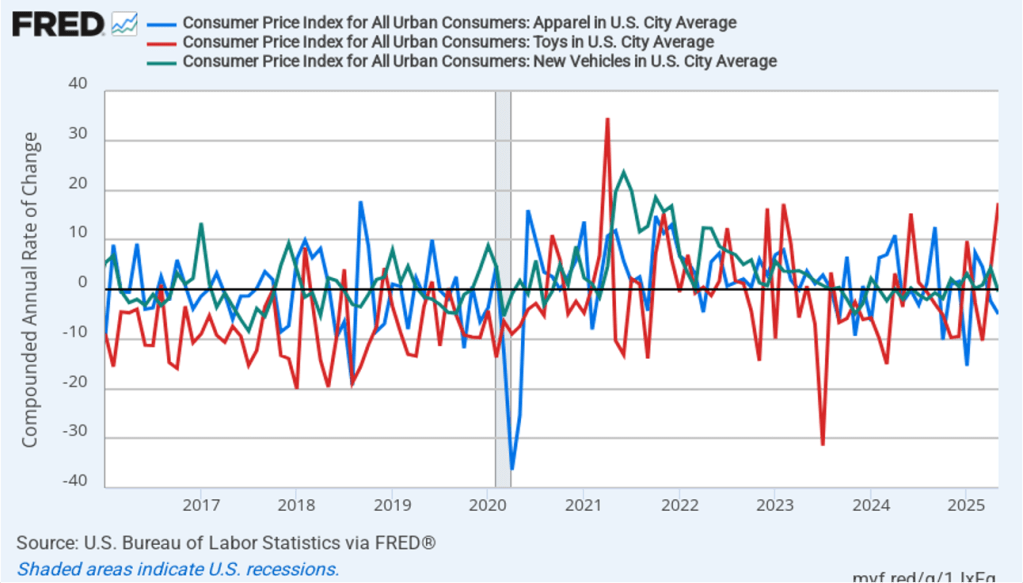
The following figure shows 1-month inflation in these categories. In May, the prices of apparel and motor vehicles fell, while the price of toys soared by 17.4 percent, but that followed a decline of 10.3 percent in April.

Taken together this month’s CPI data don’t show much effect of tariffs on inflation. It’s possible that some of the effects of the tariffs have been cushioned by firms increasing their inventories earlier in the year in anticipation of price increases resulting from the tariffs. If so, as firms draw down their inventories, we may see tariff-related increases in the prices of some goods later in the year.

To better estimate the underlying trend in inflation, some economists look at median inflation and trimmed mean inflation.

  • Median inflation is calculated by economists at the Federal Reserve Bank of Cleveland and Ohio State University. If we listed the inflation rate in each individual good or service in the CPI, median inflation is the inflation rate of the good or service that is in the middle of the list—that is, the inflation rate in the price of the good or service that has an equal number of higher and lower inflation rates. 
  • Trimmed-mean inflation drops the 8 percent of goods and services with the highest inflation rates and the 8 percent of goods and services with the lowest inflation rates. 

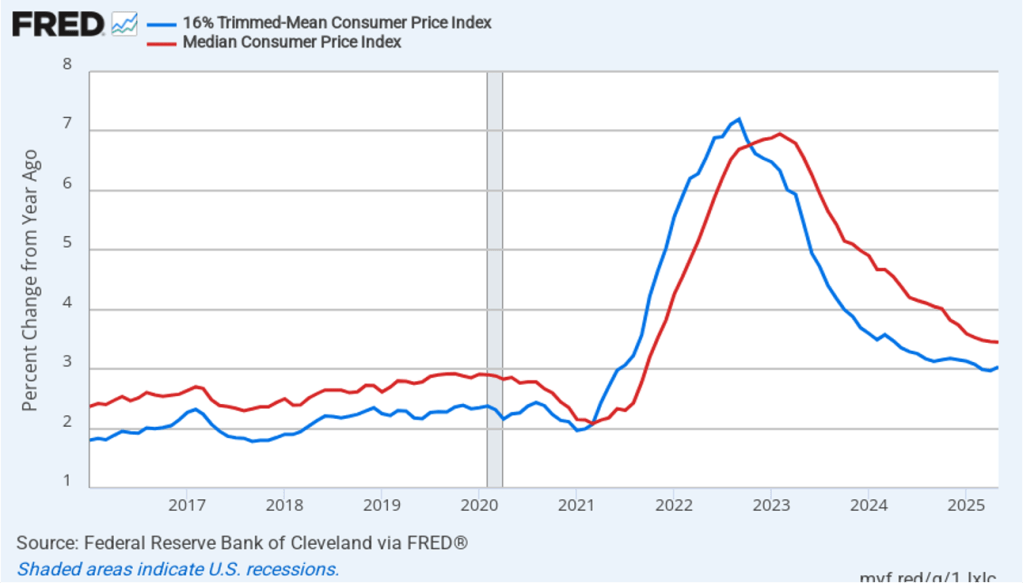
The following figure shows that 12-month trimmed-mean inflation (the blue line) was 3.0 percent in May, unchanged from April. Twelve-month median inflation (the red line) 3.5 percent in May, also unchanged from April.

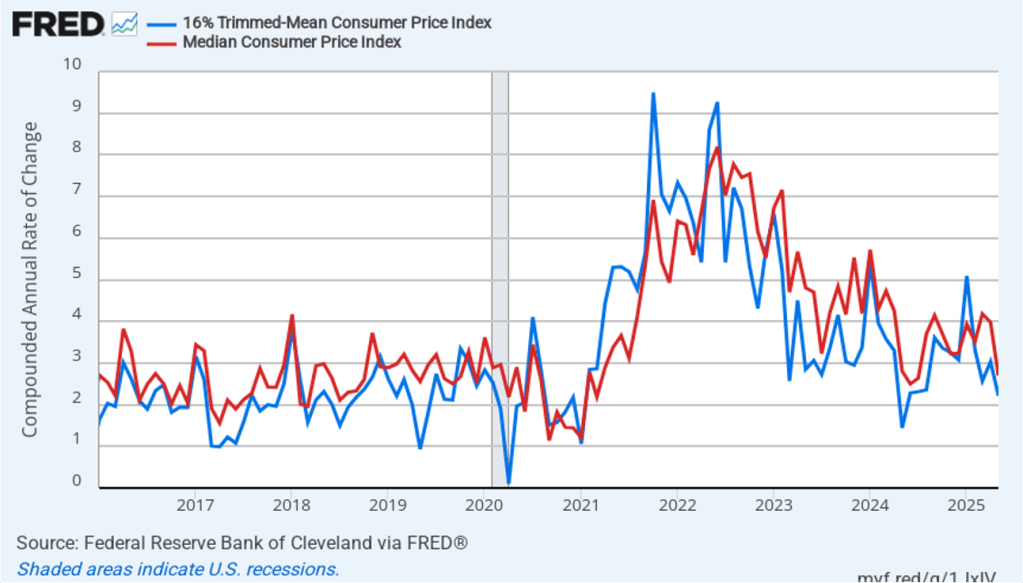
The following figure shows 1-month trimmed-mean and median inflation. One-month trimmed-mean inflation decreased from 3.0 percent in April to 2.2. percent in May. One-month median inflation declined from 4.0 percent in April to 2.7 percent in May. These data provide some confirmation that inflation likely fell somewhat from April to May.

What are the implications of this CPI report for the actions the Federal Reserve’s policymaking Federal Open Market Committee (FOMC) may take at its next several meetings? Investors who buy and sell federal funds futures contracts still do not expect that the FOMC will cut its target for the federal funds rate at its next two meetings. (We discuss the futures market for federal funds in this blog post.) Investors assign the highest probability to the FOMC making two 0.25 percentage point (25 basis points) cuts in its target rate by the end of the year. Those cuts would reduce the target range from the current 4.25 percent to 4.50 percent range to a range of 3.75 to 4.00 percent. The FOMC’s actions will likely depend in part on what the tariff increases will end up being following the conclusion of the current trade negotiations and what the effect on inflation from the tariff increases will be. 

Does the Structure of the Fed Matter?

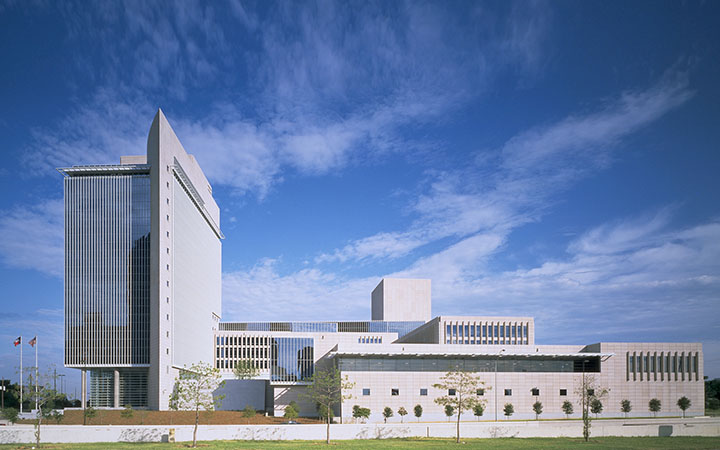
Photo of the Federal Reserve Bank of Dallas from federalreservehistory.org.

The unusual structure of the Federal Reserve System reflects the political situation at the time that Congress passed the Federal Reserve Act in 1913. As we discuss in Money, Banking, and the Financial System, Chapter 13, at that time, many members of Congress believed that a unified central bank based in Washington, DC would concentrate too much economic power in the hands of the officials running the bank. So, the act divided economic power within the Federal Reserve System in three ways: among bankers and business interests, among states and regions, and between the federal government and the private sector.

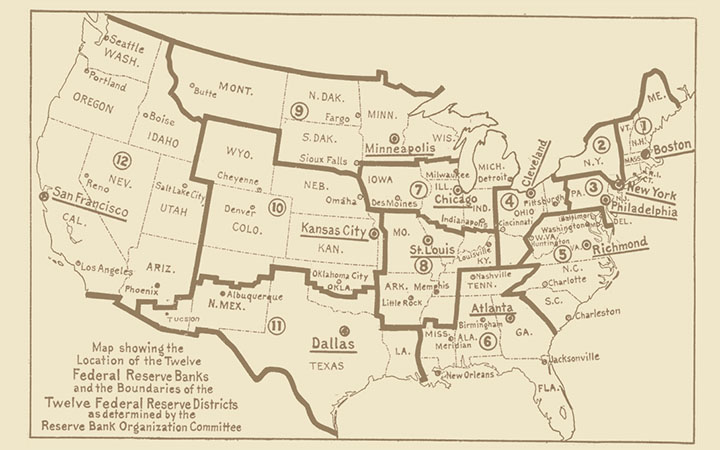
As part of its plan to divide authority within the Federal Reserve System, Congress decided not to establish a single central bank with branches, which had been the structure of both the First and Second Banks of the United States—which were the two attempts by Congress during the period from 1791 to 1836 to establish a central bank. Instead, the Federal Reserve Act divided the United States into 12 Federal Reserve districts, each of which has a Federal Reserve Bank in one city (and, in most cases, additional branches in other cities in the district). The following figure is the original map drawn by the Federal Reserve Organizing Committee in 1913 showing the 12 Federal Reserve Districts. Congress adopted the map with a few changes, following which the areas of the 12 districts have remained largely unchanged down to the present.

The map is from federalreservehistory.org.

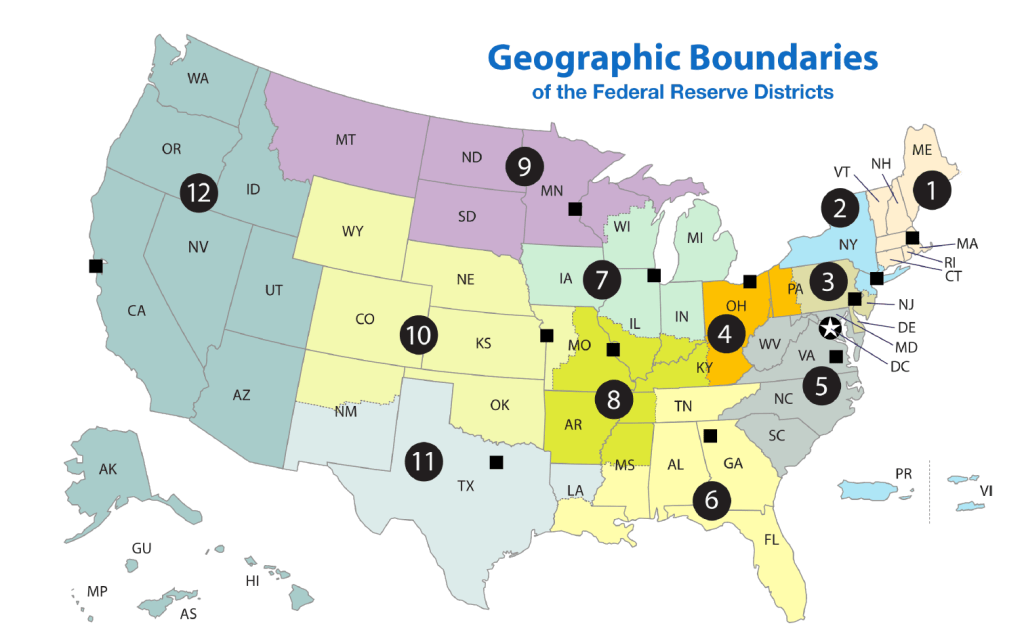
The following map shows the current boundaries of the Federal Reserve Districts.

The map is reproduced from the working paper discussed below.

All national banks—commercial banks with charters from the federal government—were required to join the Federal Reserve System. State banks—commercial banks with charters from state governments—were given the option to join. Congress intended that the primary function of each of the Federal Reserve Banks would be to make discount loans to member banks in its region. These loans were to provide liquidity to banks, thereby fulfilling in a decentralized way the system’s role as a lender of last resort.

When banks join the Federal Reserve System, they are required to buy stock in their Federal Reserve Bank, which pays member banks a dividend on this stock. So, in principle, the private commercial banks in each district that are members of the Federal Reserve System own the District Bank. In fact, each Federal Reserve Bank is a private–government joint venture because the member banks enjoy few of the rights and privileges that shareholders ordinarily exercise. For example, member banks do not have a legal claim on the profits of the District Banks, as shareholders of private corporations do.

On paper, the Federal Reserve System is a decentralized organization with a public-private structure. In practice, power within the system is concentrated in the seven member Board of Governors in Washington, DC. Control over the most important aspect of monetary policy—setting the target for the federal funds rate—is vested in the Federal Open Market Committee (FOMC). The voting membership of the FOMC consists of the seven member of the Board of Governors, the president of the Federal Reserve Bank of New York and four other district bank presidents on a rotating basis (although all 12 district presidents participate in committee discussions). The district bank presidents are elected by the boards of directors of the district banks, but the Board of Governors has final say on who is chosen as a district bank president.

Given these considerations, does the structure of the Fed matter or is it an unimportant historical curiosity? There are reasons to think the Fed’s structure does still matter. First, as we discuss in this blog post, in a recent decision, the U.S. Supreme Court implied—but didn’t state explicitly—that, because of the Fed’s structure, U.S. presidents will likely not be allowed to remove Fed chairs except for cause. That is, if presidents disagree with monetary policy actions, they will not be able to remove Fed chairs on that basis.

Second, as Michael Bordo of Rutgers University and the late Nobel Laureate Edward Prescott argue, the decentralized structure of the Fed has helped increase the variety of policy views that are discussed within the system:

“What is unique about the Federal Reserve, at least compared with other
entities created by the federal government, is that the Reserve Banks’
semi-independent corporate structure allows for ideas to be communicated to
the System . . . . Moreover, it also allows for new and sometimes dissenting views to develop and gestate within the System without being viewed as an expression of disloyalty that undermines the organization as a whole, as would be more likely within a government bureau.”

Finally, recent research by Anton Bobrov of the University of Michigan, Rupal Kamdar of Indiana University, and Mauricio Ulate of the Federal Reserve Bank of San Francisco indicates that the FOMC votes of the district bank presidents reflect economic conditions in those districts. This result indicates that the district bank presidents arrive at independent judgements about monetary policy rather than just reflecting the views of the Board of Governors, which has to approve the appointment of the presidents. The authors analyze the 896 dissenting votes district bank presidents (other than the president of the NY Fed) cast during the period from 1990 to 2017. A dissenting vote is one in which the district bank president voted to either increase or decrease the target for the federal funds relative to the target the majority of the committee favored.

The authors’ key finding is that the FOMC votes of district bank presidents are influenced by the level of unemployment in the district: “a 1 percentage point higher District unemployment rate increases the likelihood that the respective District president will dissent in favor of looser policy [that is, a lower federal funds rate target than the majority of the committee preferred] at the FOMC by around 9 percentage points.” The authors note that: “The influence of local economic conditions on dissents by District presidents reflects the regional structure of the Federal Reserve System, which was designed to accommodate diverse views across the nation.” (The full text of the paper can be found here. A summary of the paper’s findings by Ulate and Caroline Paulson and Aditi Poduri of the San Francisco Fed can be found here.)

PCE Inflation Slowed More than Expected in April

Image generated by ChatGTP-4o.

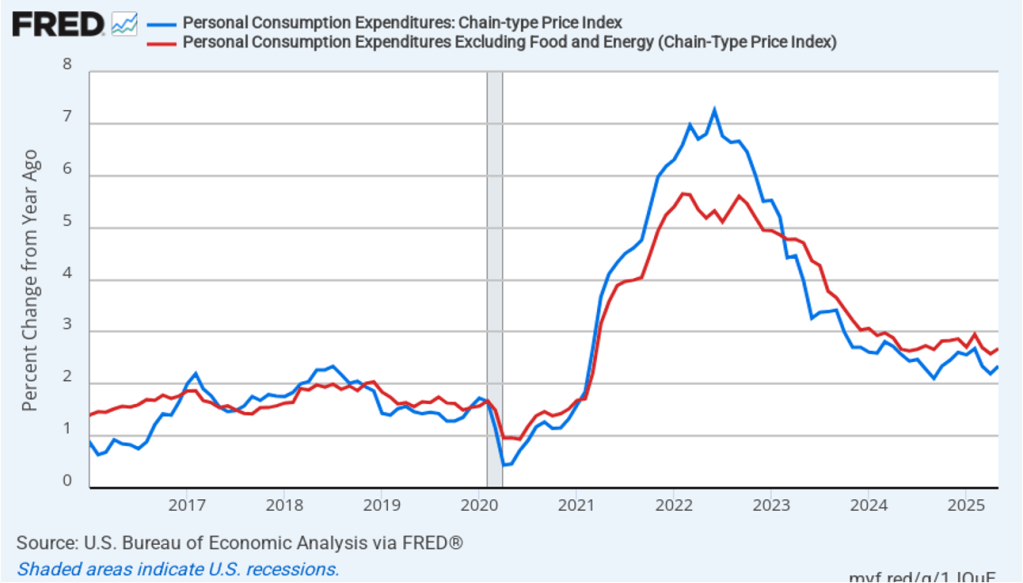
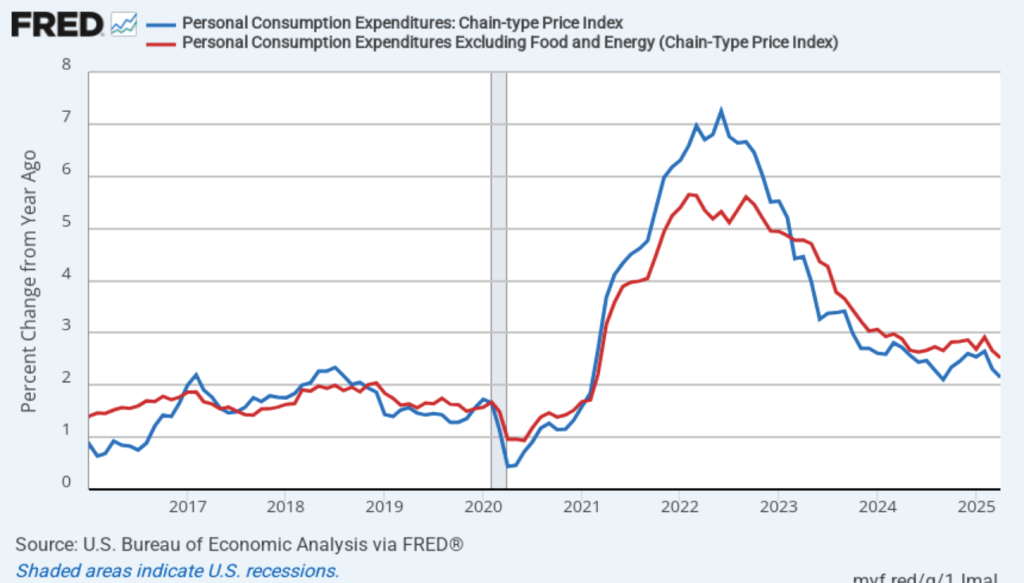
Today (May 30), the BEA released monthly data on the personal consumption expenditures (PCE) price index as part of its “Personal Income and Outlays” report. The Fed relies on annual changes in the PCE price index to evaluate whether it’s meeting its 2 percent annual inflation target. The following figure shows PCE inflation (the blue line) and core PCE inflation (the red line)—which excludes energy and food prices—for the period since January 2016, with inflation measured as the percentage change in the PCE from the same month in the previous year. In April, PCE inflation was 2.1 percent, down from 2.3 percent in March. Core PCE inflation in April was 2.5 percent, down from 2.7 percent in March. Headline PCE inflation was below the forecast of economists surveyed, while core PCE inflation was consistent with the forecast.

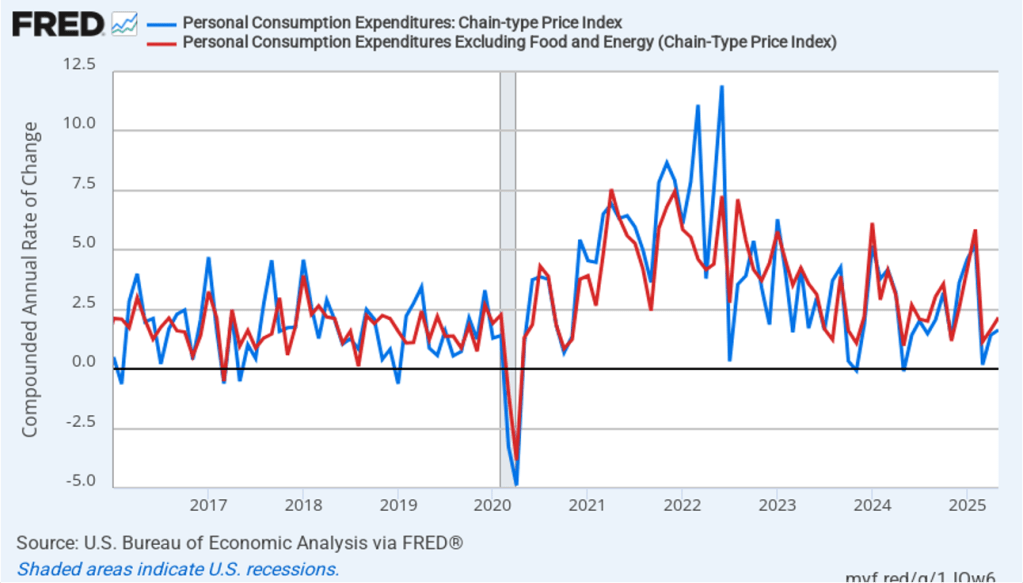
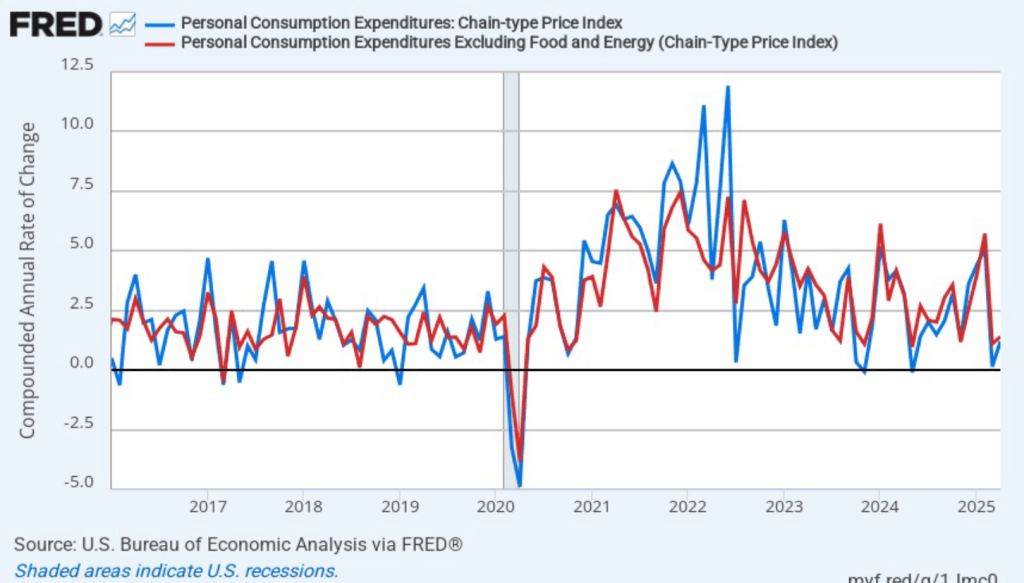
The following figure shows PCE inflation and core PCE inflation calculated by compounding the current month’s rate over an entire year. (The figure above shows what is sometimes called 12-month inflation, while this figure shows 1-month inflation.) Measured this way, PCE inflation increased in April to 1.2 percent from 0.1 percent in March. Core PCE inflation also increased from 1.1 percent in March to 1.4 percent in April. So, both 1-month PCE inflation estimates are well below the Fed’s 2 percent target. The usual caution applies that 1-month inflation figures are volatile (as can be seen in the figure), so we shouldn’t attempt to draw wider conclusions from one month’s data. In addition, because these data are for April, they don’t capture fully the price increases resulting from the tariff increases the Trump administration announced on April 2.

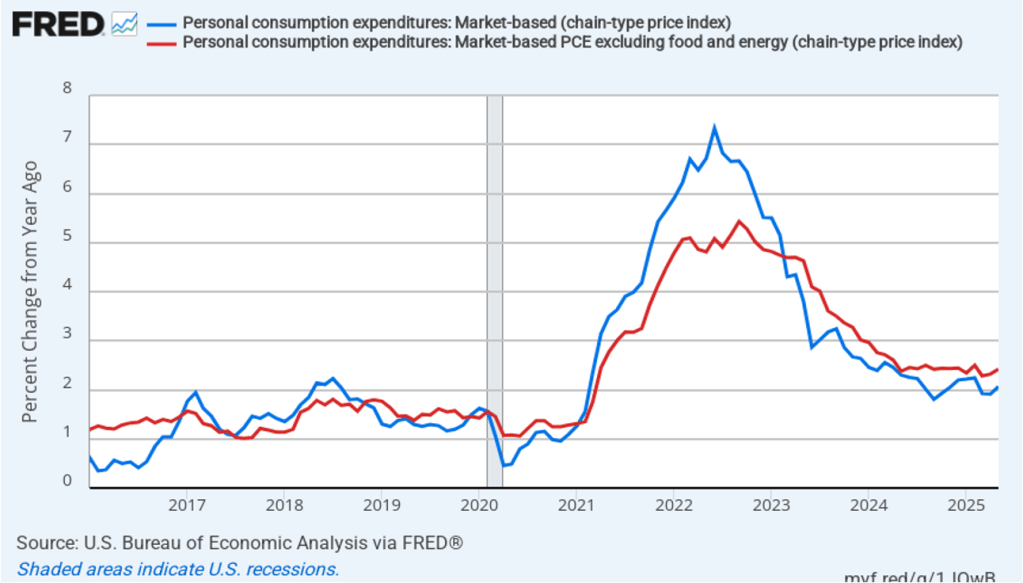
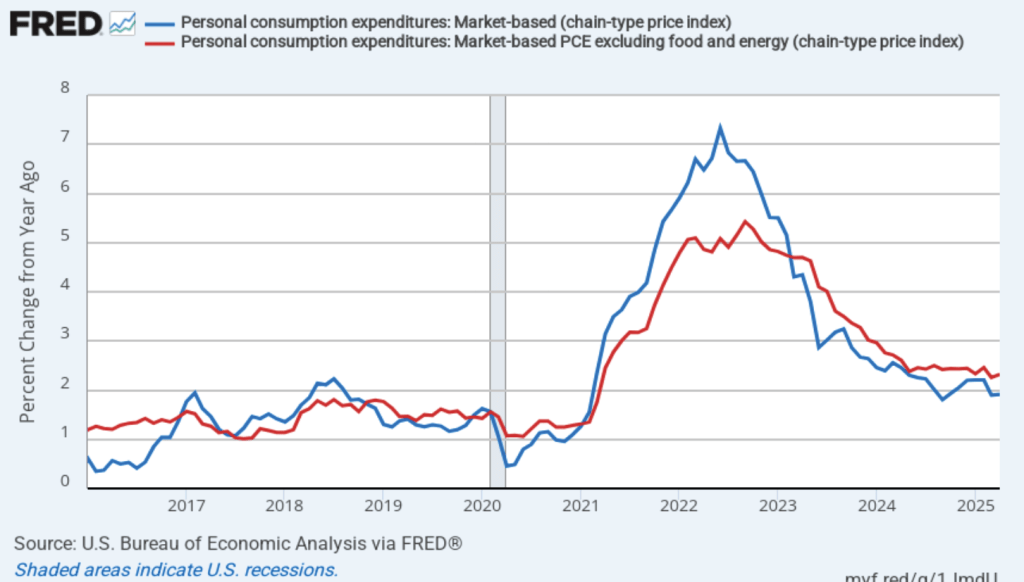
Fed Chair Jerome Powell has noted that inflation in non-market services has been high. Non-market services are services whose prices the BEA imputes rather than measures directly. For instance, the BEA assumes that prices of financial services—such as brokerage fees—vary with the prices of financial assets. So that if stock prices fall, the prices of financial services included in the PCE price index also fall. Powell has argued that these imputed prices “don’t really tell us much about … tightness in the economy. They don’t really reflect that.” The following figure shows 12-month headline inflation (the blue line) and 12-month core inflation (the red line) for market-based PCE. (The BEA explains the market-based PCE measure here.)

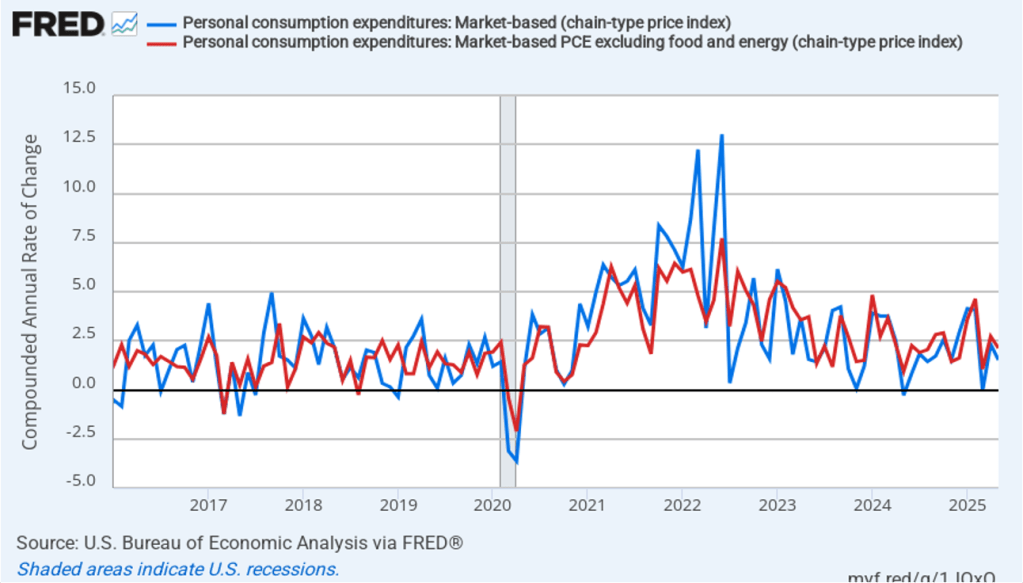
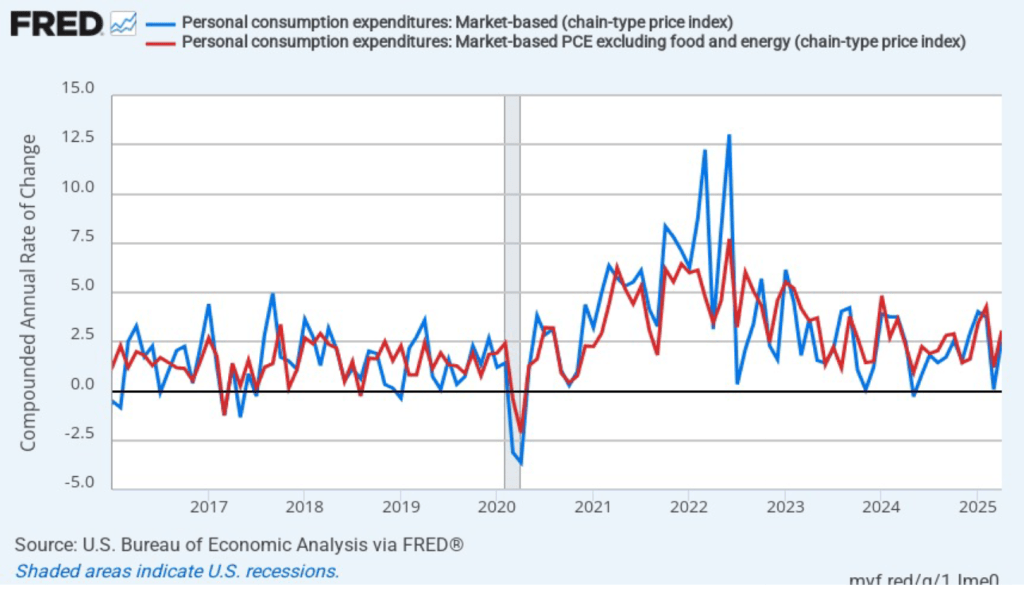
Headline market-based PCE inflation was 1.9 percent in April, unchanged from March. Core market-based PCE inflation was 2.3 percent in April, which was also unchanged from March. So, both market-based measures show about the same rate of inflation in April as the total measures do. In the following figure, we look at 1-month inflation using these measures. The 1-month inflation rates are both higher than the 12-month rates. Headline market-based inflation was 2.6 percent in April, up from 0.1 percent in March. Core market-based inflation was 3.1 percent in April, up from 1.2 percent in March. As the figure shows, the 1-month inflation rates are more volatile than the 12-month rates, which is why the Fed relies on the 12-month rates when gauging how close it is coming to hitting its target inflation rate.

In summary, today’s data provide some evidence that the inflation rate is getting closer to the Fed’s 2 percent annual target. Improving inflation combined with some indications that output growth is slowing—the  BEA release indicated that growth in real consumption expenditures slowed in April—might make it more likely that the Fed’s policymaking Federal Open Market Committee (FOMC) will cut its target for the federal funds rate relatively soon.

However, investors who buy and sell federal funds futures contracts expect that the FOMC will leave its federal funds rate target unchanged at its next meetings on June 17–18 and July 29–30. (We discuss the futures market for federal funds in this blog post.) Investors assign a probability 0f 72.6 percent to the FOMC cutting its target at its September 29–30 meeting. Investor expectations reflect the recent statements from Fed Chair Jerome Powell and other members of the FOMC that they intend to wait until the effects of the tariff increases on the economy are clearer before changing the target for the federal funds rate.

Fed Chair Powell Has First Meeting with President Trump

Photo of Federal Reserve Chair Jerome Powell from federalreserve.gov.

As we discussed in a recent blog post, through the years a number of presidents have attempted to pressure Fed chairs to implement the monetary policy the president preferred. Although President Donald Trump nominated Jerome Powell to his first term as Fed chair—which began in February 2018—Trump has had many critical things to say about Powell’s conduct of monetary policy. Early in Trump’s current term, it seemed possible that he would attempt to replace Powell as Fed chair before the end of Powell’s second term in May 2026. Trump has stated, though, that he doesn’t intend to remove Powell. (As we discussed in this recent blog post, it seems unlikely that the Supreme Court would allow a president to remove a Fed chair because of disagreements over monetary policy.)

It’s not unusual for Fed chairs to meet with presidents, but until today (May 29) Powell had not met with Trump. When asked in a press conference on May 7 about a meeting with Trump, Powell responded that: “I don’t think it’s up to a Fed Chair to seek a meeting with the President, although maybe some have done so. I’ve never done so, and I can’t imagine myself doing that. It’s—I think it’s always—comes the other way: A President wants to meet with you. But that hasn’t happened.”

Today, Powell met with Trump after Trump requested a meeting. After the meeting, the Fed released this brief statement:

“At the President’s invitation, Chair Powell met with the President today at the White House to discuss economic developments including for growth, employment, and inflation.

Chair Powell did not discuss his expectations for monetary policy, except to stress that the path of policy will depend entirely on incoming economic information and what that means for the outlook.

Finally, Chair Powell said that he and his colleagues on the FOMC will set monetary policy, as required by law, to support maximum employment and stable prices and will make those decisions based solely on careful, objective, and non-political analysis.”

According to an article in the Wall Street Journal, following the meeting, White House Press Secretary Karoline Leavitt stated that:

“The president did say that he believes the Fed chair is making a mistake by not lowering interest rates, which is putting us at an economic disadvantage to China and other countries. The president has been very vocal about that both publicly—and now I can reveal—privately, as well.”

Turns Out That Incentives Matter

Image of an apartment house under construction generated by ChatGTP 4o.

In Chapter 1, we discuss one of our three key economic ideas: “People respond to economic incentives.” When government policymakers ignore this idea, government programs can fail to meet their goals as the following example shows.

In April 2024, to spur construction of new apartment houses, the New York state legislature enacted the Affordable Neighborhoods for New Yorkers program. The program includes what’s known as the 485-x tax break for apartment house builders. The details of the program are complex but basically a builder can have a new apartment house exempted from property taxes for up to 40 years provided that the building includes a specified number of apartments set aside for people with lower incomes. Some members of the state legislature believe that developers of larger apartment houses are typically better able to pay higher wages than are developers of smaller apartment houses. So, the legislation contained a provision that builders of projects with 100 or more units must pay construction workers at least $40 per hour.

An article in Crain’s New York Business reported today on newly released data on developers registering an interest in participating in the program. The developers proposed building 118 apartment houses. (The developers can register an interest in the program, but aren’t formally awarded the tax break until after the projects are finished.) None of the projects would have 100 or more units; three projects will have 99 units. Not too surprisingly, developers have responded to the law by building smaller apartment houses rather than larger apartment houses that would require them to pay higher construction wages. The higher wages are also required for any project built south of 96th Street in the New York City borough of Manhattan. Again, unsurprisingly, only 2 of the 118 proposed projects are located in that part of the city. Although it was not the intent of the state legislature, the law provided an economic incentive to build smaller apartment houses outside of Manhattan and builders responded to that incentive.

The article quotes the president of the Real Estate Board of New York (REBNY) as saying: “The absence of the larger projects we need at scale to meet the city’s production goals was identified early on by REBNY as a likely outcome of the new program design.”

The article is here, although a subscription may be required.

Glenn on Policies to Increase Economic Growth and Reduce the Federal Budget Deficit

Image generated by ChatGTP 40

Glenn, along with co-authors Douglas Elmendorf of Harvard’s Kennedy School and Zachary Liscow of the Yale Law School, has written a new National Bureau of Economic Research working paper: “Policies to Reduce Federal Budget Deficits by Increasing Economic Growth”

Here’s the abstract:

Could policy changes boost economic growth enough and at a low enough cost to meaningfully reduce federal budget deficits? We assess seven areas of economic policy: immigration of high-skilled workers, housing regulation, safety net programs, regulation of electricity transmission, government support for research and development, tax policy related to business investment, and permitting of infrastructure construction. We find that growth-enhancing policies almost certainly cannot stabilize federal debt on their own, but that such policies can reduce the explicit tax hikes, spending cuts, or both that are needed to stabilize debt. We also find a dearth of research on the likely impacts of potential growth-enhancing policies and on ways to design such policies to restrain federal debt, and we offer suggestions for ways to build a larger base of evidence.

The full working paper can be found at this link.

The Rise and Decline in the Number of U.S. Banks

ChatGTP-4o image of customers at a teller’s window in a nineteenth century bank.

The United States has many more commercial banks than do other high-income countries. At the end of 2024, there were about 4,000 commercial banks in the United States. In contrast, in 2024, there were only 35 commercial banks in Canada, 20 in South Korea, and fewer than 400 in Japan, France, Germany, Spain, Switzerland, Norway, Sweden, and the United Kingdom.

But even 4,000 commercial banks is many fewer than the peak of 29,417 commercial banks in the United States in 1921. The following figure shows the number of commercial banks in the United States from 1781, when the Bank of North America became the first bank to operate in the United States, through 2024. The grey line shows the total number of banks; the blue line shows the number of state banks—banks with a charter from a state government; and the orange line shows the number of national banks—banks with a charter from the federal government.

A key to the rapid expansion in the number of banks in the United States—there were already 1,600 in 1861—was legislation in most states that restricted banks to a single location.  Without the ability to operate branches and with travel slow and expensive, most banks collected deposits and made loans only to businesses and firms in a small geographical area. Research by David Wheelock of the Federal Reserve Bank of St. Louis has shown that in 1900, of the 12,427 commercial banks in the United States, only 87 had any branches. In addition, a series of federal laws limited the ability of banks to operate in more than one state. The most recent of these laws was the McFadden Act, which Congress passed in 1927. With their loans concentrated in one geographic area—and often in a single industry—unit banks were inefficient because they were exposed to greater credit risk. If a bank is located in a town in down-state Illinois where most local businesses depend on agriculture, a drought could force many farmers to default on loans, causing the bank to suffer heavy losses and possibly fail.

The figure shows a surge in the number of banks during the World War I period. The total number of banks rose from 24,308 in 1913 to 29,417 in 1921—an increase of 21 percent. Research by David Wheelock and Mathew Jaremski of Utah State University discusses the reasons for the sharp increase in the number of banks through 1921 and the rapid decline in the number of banks in the following years. World War I led to problems in European agriculture, which drove up agricultural prices worldwide. U.S. farmers responded by expanding production and new banks opened to meet farmers’ increased demand for credit. Newly opened banks were particularly aggressive lenders. When European agriculture revived following the end of the war in 1918, agricultural prices declined sharply and many farmers defaulted on their loans. As unit banks, the assets of many newly opened banks were highly concentrated in loans to local farmers. When defaults on these loans sharply increased, many banks failed.

The number of banks declined slowly through the 1920s, reflecting in part the continuing problems of U.S. agriculture during those years. The Great Depression, which began in August 1929, led to a series of bank panics that reduced the number of banks from 25,125 in 1928 to 13,949 in 1933.

Over time, legal restrictions on the size and geographic scope of banking were gradually removed. After the mid-1970s, most states eliminated restrictions on branching within the state. In 1994, Congress passed the Riegle–Neal Interstate Banking and Branching Efficiency Act, which allowed for the phased removal of restrictions on interstate banking. The 1998 merger of NationsBank, based in North Carolina, and Bank of America, based in California, produced the first bank with branches on both coasts.

Rapid consolidation in the U.S. banking industry has resulted from these regulatory changes. While in 1984, there were 14,496 commercial banks in the United States, in 2024, as noted earlier, there were only about 4,000. This consolidation is what we would expect in an industry with substantial economies of scale when firms are free to compete with each other. When an industry has economies of scale, firms that expand have a lower average cost of producing goods or services. This lower cost allows the expanding firms to sell their goods or services at a lower price than smaller rivals, driving them out of business or forcing them to merge with other firms. Because large banks have lower costs than smaller banks, they can offer depositors higher interest rates, offer borrowers lower interest rates, and provide investment advice and other financial services at a lower price. (We discuss many aspects of the history and economics of banking in Chapter 10 of Money, Banking, and the Financial System.)

Even though over the past 30 years there has been tremendous consolidation in the U.S. banking industry, 4,000 banks is still many more banks than in most other countries. So, it seems likely that further consolidation will take place, and the number of banks will continue to dwindle. 

The Supreme Court Seems Unlikely to Allow Presidents to Fire Fed Chairs

Photo of Federal Reserve Chair Jerome Powell from federalreserve.gov

Can a president fire the chair of the Federal Reserve in the same way that presidents have been able to fire cabinet secretaries? President Donald Trump has had a contentious relationship with Fed Chair Jerome Powell. Powell’s term as Fed chair is scheduled to end in May 2026. At times, Trump has indicated that he would like to remove Powell before Powell’s term ends, although most recently he’s indicated that he won’t do so.

Does Trump, or any president, have the legal authority to replace a Fed chair before the chair’s term expires? As we discuss in Macroeconomics, Chapter 27 (Economics Chapter 17), according to the Federal Reserve Act, once a Fed chair is nominated to a four-year term by the president (President Trump first nominated Powell to be chair in 2017 and Powell took office in 2018) and confirmed by the Senate, the president cannot remove the Fed chair except “for cause.” As we’ve noted in previous blog posts, most legal scholars argue that a president cannot remove a Fed chair due to a disagreement over monetary policy.

But if the Fed is part of the executive branch of the federal government and the president is the head of executive branch, why shouldn’t the president be able to replace a Fed chair. Article I, Section II of the Constitution of the United States states that: “The executive Power shall be vested in a President of the United States of America.” The ability of Congress to limit the president’s power to appoint and remove heads of commissions, agencies, and other bodies in the executive branch of government—such as the Federal Reserve—is not clearly specified in the Constitution. In 1935, a unanimous Supreme Court ruled in the case of Humphrey’s Executor v. United States that President Franklin Roosevelt couldn’t remove a member of the Federal Trade Commission (FTC) because in creating the FTC, Congress specified that members could only be removed for cause. Legal scholars have presumed that the ruling in this case would also bar attempts by a president to remove members of the Fed’s Board of Governors because of a disagreement over monetary policy.

Earlier this year, the Trump administration fired a member of the National Labor Relations Board (NLRB) and a member of the Merit Systems Protection Board (MSPB). The members sued and an appeals court ordered the president to reinstate the members. The Trump administration appealed the order to the Supreme Court, which on Thursday (May 22) granted a stay of the order on the grounds that “the Government is likely to show that both the NLRB and MSPB exercise considerable executive power,” and therefore can be removed by the president, when the case is heard by the lower court. The ruling indicated that a majority of the Supreme Court is likely to overturn the Humphrey’s Executor precedent either in this case, if it ends up being argued before the court, or in a similar case. (The Supreme Court’s order is here. An Associated Press article describing the decision is here. An article in the Wall Street Journal discussing the issues involved is here.)

Does the Supreme Court’s ruling in this case indicate that it would allow a president to remove a Fed chair? The court explicitly addressed this question, first noting that attorneys for the two board members had argued that “arguments in this case necessarily implicate the constitutionality of for-cause removal protections for members of the Federal Reserve’s Board of Governors or other members of the Federal Open Market Committee.” But the majority of the court didn’t accept the attorneys’ argument: “We disagree. The Federal Reserve is a uniquely structured, quasi-private entity that follows in the distinct historical tradition of the First and Second Banks of the United States.” (We discuss the First and Second Banks of the United States in Money, Banking, and the Financial System, Chapter 10.)

We discuss the unusual nature of the Fed’s structure in Macroeconomics, Chapter 14, Section 14.4, where we note that Congress gave the Fed a hybrid public-private structure and the ability to fund its own operations without needing appropriations from Congress. Fed Chair Powell clearly agrees that the Fed’s structure distinguishes its situation from that of other federal boards and commissions. Responding to a question following a speech in April, Powell indicated that he believes that the Fed’s unique structure means that a president would not have the power to remove a Fed chair.

It’s worth noting that the statement the court issued had the limited scope of staying the appeals court’s ruling that the members of the two commissions be reinstated. If a case arises that addresses directly the question of whether presidents can remove Fed chairs, it’s possible that, after hearing oral and written arguments, some of the justices may change their minds and decide that the president has that power. It wouldn’t be unusual for justices to change their minds during the process of deciding a case. But for now it appears that the Supreme Court would likely not allow a president to remove a Fed chair.

Consumer Expectations of Inflation Have Jumped. How Accurately Have They Forecast Past Inflation?

Image generated by ChatGTP-4o

Since 1946, the Institute for Social Research (ISR) at the University of Michigan has conducted surveys of consumers. Each month, the ISR interviews a nationwide sample of 900 to 1,000 consumers, asking a variety of questions, including some on inflation.

The results of the University of Michigan surveys are widely reported in the business press. In the latest ISR survey it’s striking how much consumers expect inflation to increase.  The median response by those surveyed to the question “By about what percent do you expect prices to go up/down on the average, during the next 12 months?” was 7.3 percent. If this expectation were to prove to be correct, inflation, as measured by the percentage change in the consumer price index (CPI), will have to more than double from its April value of 2.3 percent. 

How accurately have consumers surveyed by the ISR predicted future inflation? The question is difficult to answer definitively because the survey question refers only to “prices” rather than to a measure of the price level, such as the consumer price index (CPI). Some people may have the CPI in mind when answering the question, but others may think of the prices of goods they buy regularly, such as groceries or gasoline. Nevertheless, it can be interesting to see how well the responses to the ISR survey match changes in the CPI, which we do in the following figure for the period from January 1978—when the survey began—to April 2024—the last month for which we have CPI data from the month one year in the future.

The blue line shows consumers’ expectations of what the inflation rate will be over the following year. The red line shows the inflation rate in a particular month calculated as the percentage change in the CPI from the same month in the previous year. So, for instance, in February 2023, consumers expected the inflation rate over the next 12 months to be 4.2 percent. The actual inflation, measured as the percentage change in the CPI between February 2023 and February 2024 was 3.2 percent.

The figure shows that consumers forecast inflation reasonably well. As a simple summary, the average inflation rate consumers expected over this whole period was 3.6 percent, while the actual inflation rate was 3.5 percent. So, for the period as a whole, the inflation rate that consumers expected was about the same as the actual inflation rate. The most persistent errors occurred during the recovery from the Great Recession of 2007–2008, particularly the five years from 2011 to 2016. During those five years, consumers expected inflation to be 2.5 percent or more, whereas actual inflation was typically below 2 percent.

Consumers also missed the magnitude of dramatic changes in the inflation rate. For instance, consumers did not predict how much the inflation would increase during the 1978 to 1980 period or during 2021 and early 2022. Similarly, consumers did not expect the decline in the price level from March to October 2009.

The two most recent expected inflation readings are 6.5 percent in April and, as noted earlier, 7.3 percent in May. In other words, the consumers surveyed are expecting inflation in April and May 2026 to be much higher than the 2 percent to 3 percent inflation rate most economists and Fed policymakers expect. For example, in March, the median forecast of inflation at the end of 2026 by the members of the Fed’s policymaking Federal Open Market Committee (FOMC) was only 2.2 percent. (Note, though, that FOMC members are projecting the percentage change in the personal consumption expenditures (PCE) price index rather than the percentage change in the CPI. CPI inflation has typically been higher than PCE inflation. For instance, in the period since January 1978, average CPI inflation was 3.6 percent, while average PCE inflation was 3.1 percent).

If economists and policymakers are accurately projecting inflation in 2026, it would be an unusual case of consumers in the ISR survey substantially overpredicting the rate of inflation. One possibility is that news reports of the effect of the Trump Administration’s tariff policies on the inflation rate may have caused consumers to sharply increase the inflation rate they expect next year. If, as seems likely, the tariff increases end up being much smaller than those announced on April 2, the inflation rate in 2026 may be lower than the consumers surveyed expect.