
Microsoft Buys Activision

Photo from the Wall Street Journal

When a firm decides to expand, it has two main choices: 1) Grow internally, or 2) grow by purchasing (or merging with) another. When Microsoft decided to increase its ability to produce and distribute video games, it chose to grow by acquiring Activision Blizzard, maker of Call of Duty and World of Warcraft among other games. Microsoft’s main objective in buying Activision was to increase the number of games it would have available on its Game Pass cloud-based game streaming service.

Traditionally, people have played video games like Call of Duty on video game consoles like Microsoft’s Xbox or Sony’s PlayStation. This arrangement is similar to how at one time many people watched movies on DVD or Blu-ray players. Today, more people stream movies by subscribing to streaming services like Netflix, Amazon Prime, or Disney+. With these cloud-based movie streaming services, people watch movies on their computers, tablets, or smartphones without having to download them.

With Game Pass, Microsoft is trying to bring the streaming model to video games. If successful, gameplayers would no longer need a video game console, being able to instead play the game on any internet-connected device, including a smartphone.  So far, cloud-based gaming has been growing fairly slowly because games contain much more data than do movies, which makes it more difficult to adapt them to streaming. Microsoft hopes that after successfully converting Activision’s popular games to streaming, it will give a boost to its Game Pass service. 

Microsoft also indicated that it acquired Activision to help it expand its ability to offer products in the “metaverse,” which is a so far not fully developed version of the internet in which people can interact using augmented reality or virtual reality. Most industry observers believe that given that at this point few metaverse services and products are available, the contribution of Activision to the expansion of Game Pass was likely Microsoft’s main motivation in acquiring the company.

Microsoft’s acquisition of Activision would appear to benefit consumers because it would allow them to stream Activision’s games. Prior to being acquired, Activision apparently had no plans to launch its own game streaming service. In that sense, the acquisition brought together a firm with a popular product (video games) and a firm that had a better way of distributing the product (Game Pass). Still, some industry observers wondered whether the acquisition might lead to an antitrust investigation by either the Antitrust Division of the U.S. Department of Justice or the Federal Trade Commission. (We discuss antitrust policy in Economics and Microeconomics, Chapter 15, Section 15.6.)

Antitrust investigations are most common when two firms in the same industry merge because that type of horizontal merger raises the possibility that the new, larger firm may have greater market power, which would increase its ability to raise prices.  Microsoft’s acquisition of Activision is an example of a vertical merger, or a merger between firms at different stages of the production of a good or service. Activision’s game content would be combined with Microsoft’s Game Pass system of distributing games.

The federal government doesn’t typically challenge vertical mergers because they rarely impose a burden on consumers, as horizontal mergers may. But officials in the Biden Administration have promised stricter scrutiny of mergers involving large tech firms, like Microsoft. In response to the possibility of antitrust action against its acquisition of Activision, Microsoft argued that it wouldn’t “be withdrawing games from existing platforms, and our strategy is player-centric—gamers should be able to play the games they want where they want. We believe this acquisition will only increase competition, but it is ultimately up to regulators to decide.” 

Sources:  Kellen Browning, “It’s Not Complicated. Microsoft Wants Activision for Its Games,” New York Times, January 19, 2022; Cara Lombardo, Kirsten Grind, and Aaron Tilley, “Microsoft to Buy Activision Blizzard in All-Cash Deal Valued at $75 Billion,” Wall Street Journal, January 18, 2022; Sarah E. Needleman, Wall Street Journal, January 20, 2022; and Stefania Palma, James Fontanella-Khan, Javier Espinoza, and Richard Waters, “’Too Big to Be Ignored’: Microsoft-Activision Deal Tests Regulators,” ft.com, January 22, 2022.

Macroeconomics or Microeconomics? Is a Lack of Competition in Some Industries Behind the Increase in Inflation?

Photo from the Wall Street Journal

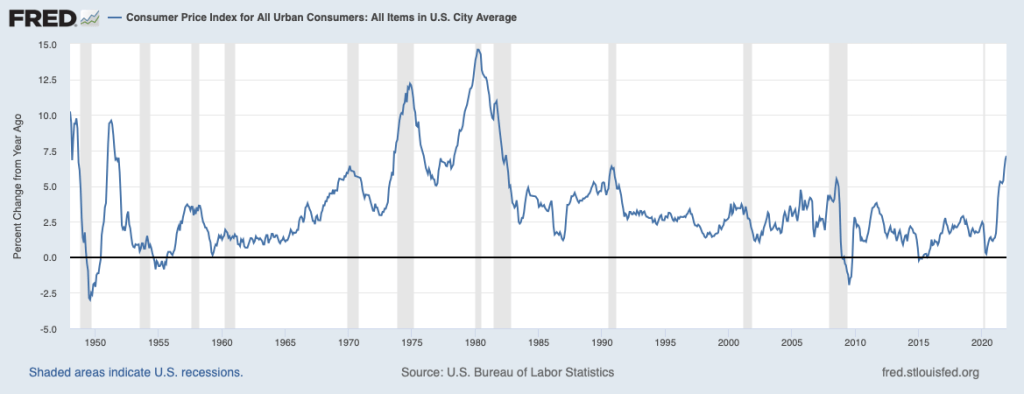
In January 2022, the Bureau of Labor Statistics (BLS) announced that inflation, measured as the percentage change in the consumer price index (CPI) from December 2020 to December 2021, was 7 percent. That was the highest rate since June 1982, which was near the end of the Great Inflation that lasted from 1968 to 1982. The following figure shows the inflation rate since the beginning of 1948. 

What explains the surge in inflation? Most economists believe that it is the result of the interaction of increases in aggregate demand resulting from very expansionary monetary and fiscal policy and disruptions to supply in some industries as a result of the Covid-19 pandemic. (We discuss movements in aggregate demand and aggregate supply during the pandemic in the updated editions of Economics, Chapter 23, Section 23.3 and Macroeconomics, Chapter 13, Section, 13.3.)

But President Joe Biden has suggested that mergers and acquisitions in some industries—he singled out meatpacking—have reduced competition and contributed to recent price increases. Massachusetts Senator Elizabeth Warren has made a broader claim about reduced competition being responsible for the surge in inflation: “Market concentration has allowed giant corporations to hide behind claims of increased costs to fatten their profit margins. [Corporations] are raising prices because they can.” And “Corporations are exploiting the pandemic to gouge consumers with higher prices on everyday essentials, from milk to gasoline.”

Do many economists agree that reduced competition explains inflation? The Booth School of Business at the University of Chicago periodically surveys a panel of more than 40 well-known academic economists for their opinions on significant policy issues. Recently, the panel was asked whether they agreed with these statements:

  1. A significant factor behind today’s higher US inflation is dominant corporations in uncompetitive markets taking advantage of their market power to raise prices in order to increase their profit margins.
  2. Antitrust interventions could successfully reduce US inflation over the next 12 months.
  3. Price controls as deployed in the 1970s could successfully reduce US inflation over the next 12 months.

Large majorities of the panel disagreed with statements 1. and 2.—that is, they don’t believe that a lack of competition explains the surge in inflation or that antitrust actions by the federal government would be likely to reduce inflation in the coming year. A smaller majority disagreed with statement 3., although even some of those who agreed that price controls would reduce inflation stated that they believed price controls were an undesirable policy. For instance, while he agreed with statement 3., Oliver Hart of Harvard noted that: “They could reduce inflation but the consequence would be shortages and rationing.”

One way to characterize the panel’s responses is that they agreed that the recent inflation was primarily a macroeconomic issue—involving movements in aggregate demand and aggregate supply—rather than a microeconomic issue—involving the extent of concentration in individual industries. 

The panels responses can be found here

Sources for Biden and Warren quotes: Greg Ip, “Is Inflation a Microeconomic Problem? That’s What Biden’s Competition Push Is Betting,” Wall Street Journal, January 12, 2022; and Patrick Thomas and Catherine Lucey, “Biden Promotes Plan Aimed at Tackling Meat Prices,” Wall Street Journal, January 3, 2022; and https://twitter.com/SenWarren/status/1464353269610954759?s=20

The Biden Administration’s New Approach to Antitrust Policy

Chair Lina Khan of the Federal Trade Commission

For the past few decades, across different presidential administrations, antitrust policy has typically involved the following key points, which we discuss in Chapter 15, Section 15.6:

  1. Responsibility for antitrust policy is divided between the Federal Trade Commission (FTC) and the Antitrust Division of the Department of Justice (DOJ). 
  2. For horizontal mergers, the DOJ and the FTC have published numerical guidelines that provide a benchmark for their decisions on whether to oppose a merger and give firms a good idea of whether a proposed merger will be allowed.
  3. Antitrust enforcement is focused on consumer well-being, so a merger that increases monopoly power while at the same time improving economic efficiency will be allowed if the net effect of the merger is to increase consumer surplus.
  4. If firms disagree with a merger decision from the FTC or the DOJ, those agencies typically file a law suit in a federal court to enforce their decision. Therefore, antitrust policy ultimately depends on how the federal courts interpret the antitrust laws. (We list the most important antitrust laws in Chapter 15, Table 15.2.)

During the 2020 presidential campaign President Joe Biden did not announce a detailed policy towards antitrust and the issue played only a small role in the campaign. Late in the campaign, a Biden spokesman did state that, “growing economic concentration and monopoly power in our nation today threatens our American values of competition, choice, and shared prosperity.” Once in office, Biden’s appointments to key antitrust positions favored a more aggressive approach to antitrust policy.

The views of most Biden appointees were similar to those of Louis Brandeis who served on the U.S. Supreme Court from 1916 to 1939. Brandeis was not familiar with economics and his views on antitrust as stated in his articles and court decisions can be contradictory.

But Robert Bork of the University of Chicago in his book the Antitrust Paradox provided an influential interpretation of Brandeis’s views. According to Bork, in the early twentieth century, “the dominant goal [of antitrust policy] was the protection of consumer welfare, though Justice Louis Brandeis … was the first to give operative weight to the conflicting goal of small-business welfare.” Bork argued that an implication of Brandeis’s views was that antitrust enforcement might end up “protecting the inefficient [firms] from competition.”  Similarly, Daniel Crane of the University of Michigan refers to the “’Brandeisian’ tradition, associated with US Supreme Court Justice Louis Brandeis, [which] is often described as … supporting atomistic competition because of its beneficial effects on personal liberty and autonomy.”

President Biden has appointed several people who support the Brandeis approach to antitrust including Lina Khan of Columbia University as chair of the FTC; Tim Wu of Columbia University as an adviser to the president; and Bharat Ramamurti, a former aide to Massachusetts Senator Elizabeth Warren, as deputy director of the National Economic Council. John Cassidy, an economics writer for the New Yorker, summarized their position:

“Proponents of the New Brandeis-ism contend that these agencies should act proactively—carrying out broad investigations, publishing reports, and establishing rules of conduct for companies with a great deal of market power, including tech platforms and broadband providers.”

In July 2021, President Biden issued an executive order creating a White House Competition Council. According to a statement from the White House, the purpose of the council is to: “to coordinate the federal government’s response to the rising power of large corporations in the economy.” Also in July 2021, the FTC under Chair Khan’s leadership voted to move away from the consumer welfare standard for judging anticompetitive business strategies, including merging or acquiring other firms and certain pricing decisions, such as cutting prices to below those charged by smaller rivals. The result of the FTC’s new approach is that the agency will  take action against business strategies that are not directly in violation of the federal antitrust laws. The FTC is particularly concerned by strategies used over the years by large technology firms such as Facebook, Google, Amazon, and Apple. 

The Biden administration’s redirection of antitrust policy has run into criticism. An article in the Wall Street Journalquoted the president of the Consumer Technology Association as stating that: “The consumer-welfare standard grounds competition policy in objective facts and evidence. By protecting consumers rather than competitors, we ensure antitrust decisions are not subjective or political.” The “consumer-welfare standard” is the standard that had been used under previous presidential administrations as we outlined in points 2. and 3. above. A possible barrier to the Biden administration’s change in policy is that ultimately it is up to the federal courts to decide the legality of a business strategy. In recent decades, the federal courts have consistently required that for a strategy to be declared illegal it must be a violation of the antitrust laws.

Until the FTC or the DOJ use the new standard to bring actions against firms and until the courts either uphold or dismiss those actions, it won’t be possible to know whether the Biden administration’s antitrust policy will end up being much different from the policies of previous administrations. It could be a number of years before actions brought under the new standard make their way through the court system. 

Sources: Brent Kendall, “New Policy Gives FTC Greater Control Over How Companies Do M&A,” wsj.com, October 29, 2021; Executive Office of the President, “Fact Sheet: Executive Order on Promoting Competition in the American Economy,” whitehouse.gov, July 9, 2021; John D. McKinnon, “FTC Vote to Broaden Agency’s Mandate Seen as Targeting Tech Industry,” wsj.com, July 1, 2021; John Cassidy, “The Biden Antitrust Revolution,” newyorker.com, July 12, 2021;  David McCabe and Jim Tankersley, “Biden Urges More Scrutiny of Big Businesses, Such as Tech Giants,” nytimes.com, September 16, 2021; Daniel A. Crane, “Rationales for Antitrust: Economics and Other Bases,” in Roger D. Blair and D. Daniel Sokol, The Oxford Handbook of International Antitrust Economics, Vol. 1, New York: Oxford University Press, 2015; Robert H. Bork, The Antitrust Paradox: A Policy at War with Itself, New York: Basic Books, 1978; and Kenneth G. Elzinga and Micah Webber, “Louis Brandeis and Contemporary Antitrust Enforcement,” Touro Law Review, 2015, Vol. 33, No. 1 , Article 15.