Markets for the People

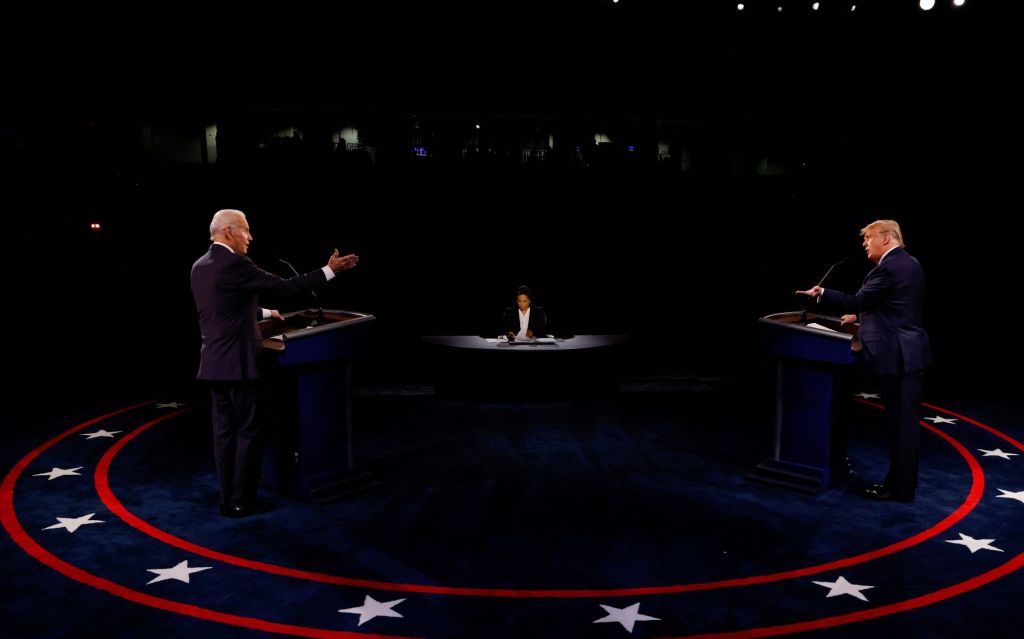
Presidents Biden and Trump during one of their 2020 debates. (Photo from the Wall Street Journal)

On the eve of first debate between President Joe Biden and former President Donald Trump, Glenn reflects on the fundamentals of sound economic policy. This essay first appeared in National Affairs.

The advent of “Bidenomics” has resurrected decades-old debates about the merits of markets versus industrial policy. When President Joe Biden announced his eponymous strategy in June 2023, he blasted what he described as “40 years of Republican trickle-down economics” and insisted that he would seek instead to build “an economy from the middle out and the bottom up, not the top down.” He would achieve this through “targeted investments” in technologies like semiconductors, batteries, and electric cars — all of which featured heavily in initiatives like the CHIPS and Science Act and the Inflation Reduction Act. Yet despite the president’s professed support for a “middle out” economics, Bidenomics has thus far proven to be less of an intellectual framework than a set of well-intended yet ill-fated industrial-policy interventions implemented from the top down.

Some conservatives have joined Biden in embracing industrial policy. Writing recently in these pages, Republican senator Marco Rubio of Florida asserted that while it is difficult to “get industrial policy right, conservatives can and must take ownership of this space to keep the American economy strong and free.” Former president Donald Trump, for his part, staunchly advocates heavy tariffs to promote domestic manufacturing.

Conservatives who adopt their own version of protectionist tinkering with markets are missing an important opportunity. As mercantilism’s decline did for classical liberalism in the 19th century and Keynesianism’s misadventures did for neoliberalism in the 20th, Bidenomics’ failures offer an opening for the right to champion a new type of economics — one that puts opportunity for the people ahead of the economic rules of the game.

Rapid globalization and technological change have left too many Americans behind. But the answer is not for the state to invest in costly projects with dubious prospects, nor is it to adopt a strictly laissez-faire approach to the economy. By reviving classically liberal ideas about competition and opportunity in the face of change, conservatives can promote an alternative economics that retains the enormous benefits of markets and openness while putting people first.

LIBERALISM’S RISE AND FALL

Before “Bidenomics” became a popular term, national-security advisor Jake Sullivan hinted at the president’s economic priorities in an April 2023 speech at the Brookings Institution. There, he declared that a “new Washington consensus” had formed around a “modern industrial and innovation strategy,” which would correct for the excesses of the free-market orthodoxy propagated by the likes of Adam Smith, Friedrich Hayek, and Milton Friedman.

This orthodoxy, according to Sullivan, “championed tax cutting and deregulation, privatization over public action, and trade liberalization as an end in itself,” all of which eroded the nation’s industrial and social foundations. Finally, after nearly three decades of such policies, two “shocks” — the global financial crisis of 2007-2009 and the Covid-19 pandemic — ”laid bare the limits” of liberalism. The time had come, Sullivan concluded, to dispense with decades of policies touting the benefits of markets and free trade — and economists would just have to get over it.

The Biden administration’s assault on open markets and free trade is odd in some respects. Scholars at the Peterson Institute for International Economics — located just across the street from Brookings — concluded in a 2022 report that, thanks to America’s openness to globalization, trillions of dollars in economic benefits have flowed to U.S. households. Moreover, the United Nations estimates that integrating China, India, and other economies into the world trading order has brought one billion individuals out of poverty since the 1980s. The impact of technological change as a driver of growth and incomes is larger still. Juxtaposing such outcomes with the administration’s grievances calls to mind the popular outcry in Monty Python’s Life of Brian: “What have the Romans ever done for us?” Quite a lot, in fact.

Proponents of free markets have clashed with advocates of government intervention before, most notably at the dawn of classical liberalism toward the end of the 18th century and the advent of neoliberalism during the first half of the 20th. These contests were not so much battles of ideas as they were intellectual critiques of real-life policy failures.

In 1776, Adam Smith’s Inquiry into the Nature and Causes of the Wealth of Nations threw down the gauntlet. The book was radical, offering a sharp rebuke of the economic-policy order of the day. Mercantilism — or the “mercantile system,” as Smith called it — assumed that the world’s wealth is fixed, and that a state wishing to improve its relative financial strength would have to do so at the expense of others by maintaining a favorable balance of trade — typically by restricting imports while encouraging exports. Recognizing merchants’ role in generating domestic wealth, mercantilist states also developed government-controlled monopolies that they protected from domestic and foreign competition through regulations, subsidies, and even military force.

Predictably, this system enriched the merchant class. But it did so at the expense of the poor, who were subject to trade restrictions and import taxes that drove up the price of goods. It also stunted business growth, expanded the slave trade, and triggered inflation in regions with little gold and silver bullion on hand.

Smith turned the mercantilist view on its head, insisting that the real touchstone of “the wealth of a nation” was not the amount of gold and silver held in its treasury, but the value of the goods and services it produced for its citizens to consume. To maximize a nation’s wealth, he argued that the state should unleash its population’s productive capacity by liberating markets and trade. Setting markets free, he observed, would enable firms to specialize in generating the goods they produced most efficiently, and to exchange surpluses of those goods for specialized goods produced by others. This approach would spread the benefits of free trade throughout the population.

While sometimes caricatured as a full-throated endorsement of laissez-faire economics, Wealth of Nations also recognized that government played an important role in sustaining an environment that would allow free markets to flourish. This included protecting property rights, building and maintaining infrastructure, upholding law and order, promoting education, providing for national security, and ensuring competition among firms. Smith cautioned, however, that government officials should be careful not to distort markets unnecessarily through such mechanisms as taxation and overregulation, and should avoid accumulating large public debts that would drain capital from future productive activities.

Mercantilism did not suddenly fall away after Smith’s critique; it continued to dominate much of the world’s economic order for another half-century. But eventually, Smith’s arguments in favor of market liberalization carried the day. For much of the 19th and early 20th centuries, free markets and free trade facilitated unprecedented prosperity in the West.

A parallel series of events occurred during the 1930s and ’40s, when Friedrich Hayek and John Maynard Keynes famously (and nastily) debated economic theory in the pages of the Economic Journal. That contest, too, revolved around what was happening on the ground: the Great Depression and increasing government investment in industry. Keynes contended that market economies experience booms and busts based on fluctuations in aggregate demand, and that the government could mitigate the harms of recessions by stimulating that demand through increased spending. Hayek disagreed, arguing that such large-scale public spending programs as those Keynes proposed would prompt not just market inefficiency and inflation, but tyranny.

During the 1950s and ’60s, Milton Friedman took on Keynes’s theories, asserting instead that the key to stimulating and maintaining economic growth was to control the money supply. He also expanded on Hayek’s case for free markets as necessary elements of free societies: As he wrote in Capitalism and Freedom, economic freedom serves as both “a component of freedom broadly understood” and “an indispensable means toward the achievement of political freedom.”

Of course Hayek and Friedman, like Smith before them, did not immediately win the debate; Keynesianism dominated America’s economic policy for decades after the Second World War. But by the mid-1970s, rising inflation and slowed economic growth pressured policymakers to consider a different approach. Hayek and Friedman’s arguments — now often referred to collectively as “neoliberalism” — ultimately won over important political figures like Ronald Reagan and Bill Clinton in the United States and Margaret Thatcher and Tony Blair in Britain. It had a major impact on each of their economic-policy initiatives, which typically combined tax cuts and deregulation with reduced government spending and liberalized international trade.

The upshot of that liberal market order is reflected in the 2022 findings of the Peterson Institute outlined above — namely the trillions of dollars in economic benefits that have flowed to American households. In a similar vein, the institute found in a 2017 report that between 1950 and 2016, trade liberalization combined with cheaper transportation and communication owing to technological change increased per-household GDP in the United States by about $18,000. The benefits of economic liberalism have thus been and continue to be massive.

NEOLIBERAL OVERCORRECTION

For all the prosperity it brought to the world, market-induced change in an era of globalization and rapid technological advance also entailed significant costs. Leaders across the political spectrum celebrated the former but paid little attention to the latter, which hit low- and medium-skilled American workers particularly hard. As global competition intensified and technological change mounted, tens of thousands of Americans in the manufacturing industry lost their jobs. Meanwhile, state benefits programs and occupational-licensing requirements made it difficult, if not impossible, for these individuals to move in search of better opportunities.

Neoliberal economic logic asserts that maintaining the labor market’s dynamism will right the ship in response to economic change — that new jobs will be created to replace the old. While true in most respects, for individuals and communities buffeted by structural market forces beyond their control, “just let the market work” is neither an economically correct answer nor a response likely to win political favor.

Proponents of neoliberalism tend to overlook the politically salient pressures generated by the speed, irreversibility, and geographic concentration of market-induced changes. Their lack of empathy for working-class communities hollowed out by the competitive and technological disruption that took place between the 1980s and the early 2010s ceded the political lane to proponents of industrial policy, enabling Trump to ride the wave of working-class grievances to the White House in 2016.

The ensuing tariffs, along with President Biden’s protectionist activity, invited retaliation from America’s trading partners. A Federal Reserve study by economists Aaron Flaaen and Justin Pierce concluded that, contrary to protectionists’ claims, employment losses triggered by trade retaliation were significantly greater than the number of jobs garnered through protectionism. The subsidy game tells a similar story: The Inflation Reduction Act’s large incentives for domestic clean-energy projects put America’s trading partners engaged in battery and electric-vehicle manufacturing at a disadvantage, which in turn pushed greater subsidization efforts overseas and prompted political grumbling among our trading partners.

It is policy failure, not a grand new economic strategy, that the Biden and Trump administrations’ industrial policies have teed up. Market liberalism must rise once again to counter the muddled mercantilism of both. But instead of repeating the cycle of neoliberalism overcorrecting for central planning and vice versa, today’s free-market and free-trade proponents will need to update their theories to address the challenges of our contemporary economy. By recovering insights from classical liberalism while keeping people in mind, economic policymakers can once again facilitate an open economy that ensures mass opportunity and flourishing.

MUDDLED MERCANTILISM

An intellectual path forward for today’s economic liberals must begin by highlighting the practical failures of Sullivan’s “new Washington consensus.” To that end, it will be useful to revisit the lack of intellectual foundation in today’s mercantilist industrial policy.

Skepticism of industrial policy revolves around two major challenges inherent to the strategy. The first is ensuring that capital is allocated to “winners” and not “losers.” The second is protecting industrial policy from mission creep and rent seeking.

Hayek addressed the first problem in his classic 1945 article, “The Use of Knowledge in Society.” As he observed there, “the knowledge of the particular circumstances of time and place” necessary to rationally plan an economy is distributed among innumerable individuals. No single person has access to all of this localized knowledge, which is not only infinite, but also constantly in flux. Statistical aggregates cannot account for it all, either. Thus, even the most earnest and sophisticated government planners could not amass the knowledge required to allocate capital to the right firms based on ever-changing circumstances on the ground. Recent examples of the government’s misfires — from the bankruptcy of the federally subsidized solar-panel startup Solyndra to the billions in Covid-19 relief aid lost to fraud and waste — speak to the truth of Hayek’s argument.

The free market, by contrast, transmits relevant information — that “knowledge of the particular circumstances of time and place” — in real time to everyone who needs it. It does so in large part via the price system. Friedman famously illustrated this process using the humble No. 2 pencil:

Suppose that, for whatever reason, there is an increased demand for lead pencils — perhaps because a baby boom increases school enrollment. Retail stores will find that they are selling more pencils. They will order more pencils from their wholesalers. The wholesalers will order more pencils from the manufacturers. The manufacturers will order more wood, more brass, more graphite — all the varied products used to make a pencil. In order to induce their suppliers to produce more of these items, they will have to offer higher prices for them. The higher prices will induce the suppliers to increase their work force to be able to meet the higher demand. To get more workers they will have to offer higher wages or better working conditions. In this way ripples spread out over ever widening circles, transmitting the information to people all over the world that there is a greater demand for pencils — or, to be more precise, for some product they are engaged in producing, for reasons they may not and need not know.

In this way, free markets ensure that capital is allocated to the right place at the right time based on the laws of supply and demand.

The second problem that plagues industrial policy arises when policies that are nominally targeted at a single goal end up serving the interests of government actors and individual firms. This problem comes in two flavors: mission creep and rent seeking.

Mission creep is the tendency of government actors to gradually expand the goal of a given policy beyond its original scope. One illustrative example comes from the CHIPS and Science Act, a bill designed to encourage semiconductor manufacturing in the United States. The act tasked the Commerce Department with drafting the conditions that manufacturers must meet to qualify for the program’s $39 billion in subsidies. In addition to manufacturing semiconductors domestically, those rules now require subsidy recipients to offer workers affordable housing and child care, develop plans for hiring disadvantaged workers, and encourage mass-transit use among their workforces. While arguably laudable (and certainly attractive to various interest groups), these goals distract from the original purpose of the law and may even detract from it.

Rent seeking — another problem characteristic of industrial policy — is a strategy that firms employ to increase their profits without creating anything of value. They do so by attempting to influence public policy or manipulate economic conditions in their favor.

Rent seeking often arises when firms devote lobbying resources to garnering funds from new government largesse. For the CHIPS and Science Act, firms’ scramble for subsidies replaces a focus on basic research. For the Inflation Reduction Act, firms’ hiring consultants to help them gain access to agricultural-conservation spending and technical assistance replaces a focus on researching market trends.

Industrial unions — whose goals might not be consistent with market outcomes or the new industrial policy — are a second source of rent seeking. Today, both the left and right have slouched away from liberalism’s emphasis on maintaining an open and dynamic labor market, pledging instead to create and protect “good jobs” — primarily in the manufacturing sector. This new thrust is yet another example of Washington picking “winners” and “losers” among industries and firms.

Concerns about this new approach to labor policy extend well beyond neoliberal critiques of limiting labor-market dynamism. Practically speaking, who decides what a “good job” is, or that manufacturing jobs are the ones to be prized and protected? Many of today’s most desired jobs for labor-market entrants did not exist decades ago when manufacturing employment was at its peak. Why should industrial policy’s goal be to cement the past as opposed to preparing individuals and locales for the work of the future?

A PATH FORWARD

Bidenomics’ policy failures offer an opening for leaders on the right to champion a new type of liberal economics that avoids the pitfalls of both markets-only neoliberalism and industrial policy’s central planning. In doing so, they will need to keep three things in mind.

The first is obvious but bears repeating: Markets don’t always work well, and calls for intervention are not necessarily calls for industrial policy.

Critiques of neoliberalism often focus on the stark observation from Friedman’s famous 1970 New York Times piece on the purpose of the corporation, which he asserted is to maximize its profits — full stop. While the article has now generated more than five decades of criticism, Friedman’s argument is quite sensible as a starting point under the assumptions he had in mind: perfect competition in product and labor markets, and a government that does its job well — namely by providing public goods like education and defense, and correcting for externalities.

Put this way, the problem with neoliberalism is less that it is laissez-faire and more that it assumes away important questions about the state’s role in the market economy. As a prominent example, national-security concerns raise questions about the boundaries between markets and the state. Export controls and certain supply-chain restrictions can be a legitimate way to deny sensitive technologies to adversaries (principally China in the present context). But they also raise several thorny questions. For instance, which technologies should be subject to controls and restrictions? What if those technologies are also employed for non-sensitive purposes? How do we defend sensitive technologies while avoiding blatant protectionism? (The Trump administration’s invocation of “national security” in levying steel tariffs against Canada was less than convincing.) Economists should invite scientists and technology experts into these discussions rather than ceding all ground to politicians and Commerce Department officials.

A second lesson relates to competition — the linchpin of both neoliberalism and classical-liberal economics dating back to Adam Smith. Is the pursuit of competition, though a worthy goal, sufficient to ensure widespread flourishing?

Contemporary economic models assign value to economic growth, openness to globalization, and technological advance. But as noted above, with that growth, openness, and advance comes disruption, often in the form of a diminished ability to compete for new jobs and business opportunities. It’s not a stretch to argue that a classical-liberal focus on free markets should also recognize the ability to compete as an important component to advancing competition. Competition might increase the size of the economic pie, but some will have easier access to a larger slice than others. Thus, in addition to promoting competition, today’s free-market advocates need to focus on preparing individuals to reconnect to opportunity in a changing economy.

To that end, neoliberals would do well to increase public investment in education and skill training. This includes greater support for community colleges — the loci of much of the training and retraining efforts required to reconnect workers to the job market. The demand for such training is rising among young workers skeptical of the value of a four-year college degree: The Wall Street Journal recently reported that the “number of students enrolled in vocational-focused community colleges rose 16% last year to its highest level since the National Student Clearinghouse began tracking such data in 2018.” Returning to Hayek’s “Use of Knowledge” essay, these interventions are likely to be successful because they decentralize training programs, divvying them up to the educational institutions that are in the best position to prepare workers for the jobs of today and tomorrow.

A third lesson for today’s neoliberals relates to the goals of the market. Smith, the father of modern economics, was also a student of moral philosophy — a discipline studiously avoided by most contemporary economists. To win the war of policy ideas, Smith understood that the goal could not simply be for the market to function. Today, demands to “let the market work” clearly do not meet the moment.

Market and trade liberalization are not ends in themselves; they are tools for organizing and promoting economic activity. Channeling Smith’s thoughts in his other classic work emphasizing shared purpose, The Theory of Moral Sentiments, Columbia professor and Nobel laureate Edmund Phelps argued that economic policies should pursue freedom not for its own sake, but to facilitate “mass flourishing.” In this vein, markets should promote, not prevent, innovation and productivity. They should aid, not hinder, the formation of strong families, communities, and religious and civic institutions.

Just as neoliberals need to be more cognizant of the human element in economics, proponents of industrial policy need to rethink the mercantilist strand present in their proposals.

To minimize the problems endemic to industrial policy — mission creep, rent seeking, and the risk of backing the wrong firms and industries — policy architects need to be both more general and more specific in their proposed interventions. By more general, I mean they must emphasize broad mechanisms to counter market failures. In the technology industry, for instance, expanding federal funding for basic scientific research can lead to useful applications for technologies and industries without picking winners and losers. Likewise, adopting a carbon tax would provide more neutral incentives for firms to develop low-carbon fuels and technologies without the need to pick winners and spend taxpayer dollars on costly subsidies. And again, as workers’ skills are an important policy concern, increases in general public investment in education and training should be front and center in any industrial policy.

By more specific, I mean the proposed policy interventions must have more specific goals. The Trump administration’s Operation Warp Speed succeeded without picking winners or over-relying on bureaucracy largely because its goals — developing and deploying a vaccine against Covid-19 as quickly as possible — were narrowly defined. Similarly, the Apollo program — which Senator Rubio rightly pointed to as an effective example of industrial policy — succeeded in part because it focused on a single, concrete, time-bound goal: putting a man on the moon within the decade.

Targeting and customizing aid is another way of making industrial-policy goals more specific. Economist Timothy Bartik has pushed for reforms to current place-based jobs policies, which typically consist of business-related tax and cash incentives. Such incentives, he argues, should be “more geographically targeted to distressed places,” “more targeted at high-multiplier industries” like technology, more favorable to small businesses, and more “attuned to local conditions.” Different local economies have different needs, from infrastructure to land development to job training. Funding customized services and inputs is more cost effective, more directly targeted at local shortcomings, and more likely to raise employment and productivity than one-size-fits-all tax and cash incentives.

While much of this analysis has been applied to the manufacturing context, such approaches can also be applied to the services sector. Customized input support would focus on developing partnerships between businesses and local educational institutions to develop job-specific training. Public support for applied research centers could help disseminate technological and organizational improvements to firms across the country. As with the general improvements to current industrial policy outlined above, these methods harness market mechanisms while recognizing and responding to underlying market failures.

A RIGHT TO OPPORTUNITY

The neoliberal notion that markets should focus on allocation and growth alone cannot be an endpoint; updating classical-liberal ideas with a deliberate focus on adaptation and the ability to compete is the place to start. Recognizing a right to opportunity in addition to property rights could provide a liberal counterweight to the temptation to reach for industrial policy to help distressed communities.

This right to opportunity — for today and tomorrow — should lead a conservative pushback to Bidenomics. Voters might not have much of a choice between Biden and Trump’s economic populism in the election this fall, but economists and policymakers can begin to advance a new market economics that leaves no Americans behind in the hope that future administrations will take notice.

Solved Problem: How Much Did Using a Ticket to a Taylor Swift Concert Cost You?

SupportsMicroeconomics, Macroeconomics, Economics, and Essentials of Economics, Chapter 1.

Photo of Taylor Swift from the Wall Street Journal.

Suppose that as a “verified fan” of Taylor Swift, you are able to buy a ticket to one of her concerts for $215. The price of the ticket isn’t refundable. (We discuss how Taylor Swift handles the sale of tickets to her concerts in the Apply the Concept “Taylor Swift Tries to Please Fans and Make Money” in Microeconomics and in Economics, Chapter 10, and in Essentials of Economics, Chapter 7.) You had been hoping to work a few hours of overtime at your job to earn some extra money. The day of the concert, your boss tells you that the only overtime available for the next month is that night from 6 pm to 10 pm—the same time as the concert. Working those hours of overtime will earn you $100 (after taxes). You check StubHub and find that you can resell your ticket for $1,000 (afer paying StubHub’s fee).

Given that information, briefly explain which of the following statements is correct:

  1. If you attend the concert, the cost of using your ticket is $215—the price that you paid for it.
  2. If you attend the concert, the cost of using your ticket is $1,000—the amount you can resell your ticket for.
  3. If you attend the concert, the cost of using your ticket is $1,000 + $100 = $1,100—the amount you can resell your ticket for plus the amount you would have earned from working overtime rather than attending the concert.
  4. If you attend the concert, the cost of using your ticket is $1,000 + $100 – $215 = $885—the amount you can resell your ticket for plus the amount you would have earned from working overtime rather than attending the concert minus the price you paid to buy the ticket. 

Solving the Problem

Step 1: Review the chapter material. This problem is about the concept of opportunity cost, so you may want to review Chapter 1, Section 1.2.

Step 2: Solve the problem by using the concept of opportunity cost to determine which of the four statements is correct. Economists measure the cost of engaging in an activity as an opportunity cost—the value of what you have to give up to engage in the activity. Using this definition, only statement c. is correct; if you decide to use your ticket to attend the concert you will give up the $1,000 you could have received from selling the ticket plus the $100 you fail to earn as a result of attending the concert rather than working overtime. Note that the price you paid for the ticket isn’t relevant to your decision whether to attend the concert because the price of the ticket is nonrefundable. (The amount you paid for the ticket is a sunk cost because it can’t recovered. We discuss the role of sunk costs in decision making in Microeconomics and Economics, Chapter 10, Section 10.4, and in Essentials of Economics, Chapter 7, Section 7.4.)

A Reporter for NPR Encounters the Challenge of Network Externalities on an EV Road Trip

An electric vehicle (EV) charging station. (Photo from the Associated Press via the Wall Street Journal.)

Secretary of Energy Jennifer Granholm recently took a road trip in a caravan of electric vehicles (EVs). The road trip “was intended to draw attention to the billions of dollars the White House is pouring into green energy and clean cars.” A reporter for National Public Radio (NPR) went on the trip and wrote an article on her experience.

One conclusion the reporter drew was: “Riding along with Granholm, I came away with a major takeaway: EVs that aren’t Teslas have a road trip problem, and the White House knows it’s urgent to solve this issue.” The problem was that charging stations are less available and less likely to be functioning than would be needed for a road trip in an EV to be as smooth as a similar trip in a gasoline-powered car. The reporter noted that in her experience with her own EV: “I use multiple apps to find chargers, read reviews to make sure they work and plot out convenient locations for a 30-minute pit stop (a charger by a restaurant, for instance, instead of one located at a car dealership).”

EVs exhibit network externalities. As we discuss in Microeconomics and Economics, Chapter 10, 10.3 (Essentials of Economics, Chapter 7, Section 7.3), Network externalities are a situation in which the usefulness of a product increases with the number of consumers who use it. For example, the more iPhones people buy, the more profit firms and individuals can earn by creating apps for the iPhone. And the more apps that are available, the more useful an iPhone becomes to people who use it.

In this blog post, we discuss how Mark Zuckerberg’s Meta Platforms (which was originally named Facebook) has had difficulty selling Oculus augmented reality headsets. Many people have been reluctant to buy these headsets because they don’t believe there are enough software programs available to use the headsets with. Software designers don’t have much incentive to produce such programs because not many consumers own a headset necessary to use the programs.

The difficulty that Meta has experienced with augmented reality headsets can be overcome if the product is sufficiently useful that consumers are willing to buy it even if complementary products are not yet available. That was the case with the iPhone, which experienced strong sales even before Apple opened its app store. Or to take an historical example relevant to the current situation with EVs: When the Ford Motor Company introduced the Model T car in the early twentieth century, many people found that owning a car was such an advance over using a horse-drawn vehicle that they were willing to buy one despite there being realtively few gas stations and repair shops available. Because so many cars were being sold, entrepreneurs had an incentive to begin opening gas stations and repair shops, which increased the attractiveness of using a car, thereby further increasing demand.

As the NPR reporter’s experience shows, consumers choosing between buying an EV or a gasoline-powered car are in a situation similar to that faced by early twentieth century consumers in choosing between cars and horse-drawn vehicles. One difference between the two situations is that Congress and the Biden administration are attempting to ease the transition to EVs by subsidizing the construction of charging stations and by providing tax credits to people who buy EVs.

Does Majoring in Economics Increase Your Income?

Image by Andrea D’Aquino in the Wall Street Journal.

Studying economics provides students in any major with useful tools for understanding business decision making and for evaluating government policies. As we discuss in Chapter 1, Section 1.5 of Microeconomics, Macroeconomics, and Economics, majoring in economics can lead to a career in business, government, or at nonprofit organizations. Many students considering majoring in economics are interested in how the incomes of economics majors compare with the incomes of students who pursue other majors.

            The Federal Reserve Bank of New York maintains a web page that uses data collected by the U.S. Census to show the incomes of people with different college majors. The following table shows for economics majors and for all majors the median annual wage received by people early in their careers and in the middle of their careers. The median is a measure of the average calculated as the annual wage at which half of people in the group have a higher annual wage and half have a lower annual wage. “Early career” refers to people aged 22 to 27, and “mid-career” refers to people aged 35 to 45.  The data are for people with a bachelor’s degree only, so people with a masters or doctoral degree are not included.  

 Median Wage Early CareerMedian Wage Mid-Career
Economics majors$55,000$93,000
All majors$42,000$70,000

The table shows that early in their careers, on average, economics majors earn an annual wage about 31 percent higher than annual wage earned by all majors. At mid-career, in percentage terms, the gap increases slightly to 33 percent.

            How should we interpret these data? In Chapter 1, Section 1.3, in discussing how to evaluate economic models, we made the important distinction between correlation and causality. Just because two things are correlated, or happen at the same time, doesn’t mean that one caused the other. In this case, are the higher than average incomes of economics majors caused by majoring in economics or is majoring in economics correlated with higher incomes, but not actually causing the higher incomes. It might be true, for instance, that on average economics majors have certain characteristics—such as being more intelligent or harder workers—than are students who choose other majors. Because being intelligent and working hard can lead to successful careers, students majoring in economics might have earned higher incomes on average even if they had chosen a different major.

(Here’s a  more advanced point about identifying causal relationships in data: The problem with determining causality described in the previous paragraph is called selection bias. Students aren’t randomly assigned majors; they choose, or self-select, them. If students with characteristics that make it more likely that they will earn high incomes are also more likely to choose to major in economics, then the higher incomes earned by economics majors weren’t caused by (or weren’t entirely caused by) majoring in economics.)

            Economists Zachary Bleemer of the University of California, Berkeley and Aashish Mehta of the University of California, Santa Barbara have found a way to evaluate whether majoring in economics causes students to earn higher incomes. The authors gathered data on all the students admitted to the University of California, Santa Cruz (UCSC) between 2008 and 2012 and on their incomes in 2017 and 2018. To major in economics, students at UCSC needed a grade point average (GPA) of 2.8 or higher in the two principles of economics courses. The authors compared the choices of majors and the average early career earnings of students who just met or just failed to meet the 2.8 GPA threshold for majoring in economics. The authors use advanced statistical analysis to reach the conclusion that: “Comparing the major choices and average wages of above-and-below-threshold students shows that majoring in economics caused a $22,000 (46 percent) increase in annual early-career wages of barely above-threshold students.” 

            The authors attribute half of the higher wages earned by economics majors to their being more likely to pursue careers in finance, insurance, real estate, and accounting, which tend to pay above average wages.  The authors note that their findings from this study “imply that students’ major choices could have financial implications roughly as large as their decision to enroll in college ….”

Sources: Federal Reserve Bank of New York, The Labor Market for Recent College Graduates, https://www.newyorkfed.org/research/college-labor-market/index.html; and Zachary Bleemer and Aashish Meta, “Will Studying Economics Make You Rich? A Regression Discontinuity Analysis of the Returns to College Major,” American Economic Journal: Applied Economics, Vol. 14, No. 2, April 2022, pp. 1-22.

Is Vladimir Putin Acting Rationally?

Photo of Russian President Vladimir Putin from the Wall Street Journal.

On February 24, when Russian President Vladimir Putin launched an assault on Ukraine he apparently expected within a few days to achieve his main objectives, including occupying the Ukrainian capital of Kyiv and replacing the Ukrainian government. After three weeks, the fierce resistance of the Ukrainian armed forces have resulted in his failing to achieve these objectives. Although the Russian military had expected to experience few casualties or losses of equipment, in fact Russia has already lost more military personnel killed than the United States has since 2001 in Afghanistan and Iraq combined, as well as experiencing the destruction of many tanks, planes, and other equipment. 

The United States, the European Union, and other countries have imposed economic sanctions on Russia that have reduced the country’s ability to import or export most goods, other than oil and natural gas. The sanctions have the potential to reduce the standard of living of the average Russian citizen.

Most importantly, the war has killed thousands of Ukrainians and inflicted horrendous damage on many Ukrainian cities.

Despite all this, is Putin’s persistence in the invasion rational or if he were acting rationally would he instead withdraw his troops or accept a political comprise (at this writing, negotiations between representatives of Russia and Ukraine are continuing)?  First, recall the economic definition of rationality: People are rational when they take actions that are appropriate to achieve their goals given the information available to them. (We discuss rationality in Microeconomics, Chapter 10, Section 10.4, and in Economics, Chapter 10, Section 10.4.) Note that rationality does not deal with whether a person’s goals are good or bad. In this discussion, we are considering whether Putin is acting rationally in attempting to achieve the—immoral—goal of subjugating a foreign country.

Peter Coy, a columnist for the New York Times, discusses three reasons Putin may continue his attack on Ukraine even though, “The bloody invasion of Ukraine has been a disaster” for Putin. The first reason, Coy recognizes, involves an economic concept. His other two reasons can also be understood within the economic framework we employ in Microeconomics.

First, Coy argues that Putin may have fallen into one of the pitfalls to decision making we discuss in Chapter 10: A failure to ignore sunk costs. Coy notes that Putin may want to continue the attack to justify the death and destruction that has already occurred. However, those costs are sunk because no subsequent action Putin takes can reduce them. If Putin is continuing the attack for this reason, then Coy is correct that Putin is not acting rationally because he is failing to ignore sunk costs in making his decision. 

There is a subtle point, though, that Coy may be overlooking: Putin is effectively a dictator, but he may still believe he needs to avoid Russian public opinion turning too sharply against him. In that case, even if recognizes that he should ignore sunk costs he may believe that the Russian public may not be willing to ignore the costs of the death and destruction that has already occurred. In that case, his refusal to ignore this sunk cost be rational.

Coy’s second reason why Putin may continue the attack is that he may believe “just another few weeks of fighting will be enough to subdue Ukraine.”  Although Coy doesn’t discuss the point in these terms, it would be rational for Putin to continue the attack if he believes that the marginal benefit of doing so exceeds the marginal cost. (We discuss this point directly in Chapter 1, Section 1.1 “Optimal Decisions Are Made at the Margin,” and provided many examples throughout the text.)  The marginal cost includes the additional Russian military casualties and losses of equipment from prolonging the war and the cost of economic sanctions to the Russian economy. (It seems unlikely that Putin is taking into account the additional loss of life among Ukrainians and the additional devastation to Ukrainian cities from prolonging the war.)

The marginal benefit from continuing the attack would be either winning the war or obtaining a more favorable peace settlement in negotiations with the Ukrainian government. If Putin believes that the marginal benefit is greater than the marginal cost, he is acting rationally in continuing to attack. 

Coy’s final reason why Putin may continue the attack is that “he has little to lose by fighting on.” Although Coy doesn’t discuss the point in these terms, Russia may be suffering from a principal-agent problem. As we discuss in Microeconomics, Chapter 8, Section 8.1 (also Economics, Chapter 8, Section 8.1 and Macroeconomics, Chapter 6, Section 6.1) the principal-agent problem arises when an agent pursues the agent’s interst rather than the interests of the principal in whose behalf the agent is supposed to act. In this case, Putin is the agent and the Russian people are the principal. Putin’s own interest may be in prolonging the war indefinitely in the hopes of ultimately winning, despite the additional Russian soldiers who will be wounded or killed and despite the economic suffering of the Russian people resulting from the sanctions.

Although as president of Russia, Putin should be acting in the best interests of the Russian people, as a dictator, he can largely disregard their interests. Unlike his soldiers, Putin isn’t exposed to the personal dangers of being in battle. And unlike the average Russian, Putin will not suffer a decline in his standard of living because of economic sanctions.

Appalling as the consequences will be, Putin’s continuing his attack on Ukraine may be rational.

Sources: Peter Coy, “Here Are Three Reasons Putin Might Fight On,” New York Times, March 14, 2022; Alan Cullison, “Talks to End Ukraine War Pause as Russia’s Offensive Intensifies,” Wall Street Journal, March 14, 2022; and Thomas Grove, “Russia’s Military Chief Promised Quick Victory in Ukraine, but Now Faces a Potential Quagmire,” Wall Street Journal, March 6, 2022.

The Many Uses of Elasticity: An Example from Law Enforcement Policy

In this chapter, we have studied several types of elasticities, starting with the price elasticity of demand. Elasticity is a general concept that economists use to measure the effect of a change in one variable on another variable. An example of a more general use of elasticity, beyond the uses we discussed in this chapter, appears in a new academic paper written by Anne Sofie Tegner Anker of the University of Copenhagen, Jennifer L. Doleac of Texas A&M University, and Rasmus LandersØ of Aarshus University. 

The authors are interested in studying the effects of crime deterrence. They note that rational offenders will be deterred by government policies that increase the probability that an offender will be arrested. Even offenders who don’t respond rationally to an increase in the probability of being arrested will still commit fewer crimes because they are more likely to be arrested. Governments have different policies available to reduce crime. Given that government resources are scarce, efficient allocation of resources requires policymakers to choose policies that provide the most deterrence per dollar of cost.

The authors note “we currently know very little about precisely how much deterrence we achieve for any given increase in the likelihood that an offender is apprehended.” They attempt to increase knowledge on this point by analyzing the effects of a policy change in Denmark in 2005 that made it much more likely that an offender would have his or her DNA entered into a DNA database: “The goal of DNA registration is to deter offenders and increase the likelihood of detection of future crimes by enabling matches of known offenders with DNA from crime scene evidence.”

The authors find that the expansion of Denmark’s DNA database had a substantial effect on recidivism—an offender committing additional crimes—and on the probability that an offender who did commit additional crimes would be caught. They estimate that “a 1 percent higher detection probability reduces crime by more than 2 percent.” In other words, the elasticity of crime with respect to the detection probability is −2.

Just as the price elasticity of demand gives a business manager a useful way to summarize the responsiveness of the quantity demanded of the firm’s product to a change in its price, the elasticity the authors estimated gives a policymaker a useful way to summarize the responsiveness of crime to a policy that increases the probability of catching offenders.  

Source: Anne Sofie Tegner Anker, Jennifer L. Doleac, and Rasmus LandersØ, “The Effects of DNA Databases on the Deterrence and Detection of Offenders,” American Economic Journal: Applied Economics, Vol. 13, No. 4, October 2021, pp. 194-225. 

Card, Angrist, and Imbens Win Nobel Prize in Economics

David Card
Joshua Angrist
Guido Imbens

   David Card of the University of California, Berkeley; Joshua Angrist of the Massachusetts Institute of Technology; and Guido Imbens of Stanford University shared the 2021 Nobel Prize in Economics (formally, the Sveriges Riksbank Prize in Economic Sciences in Memory of Alfred Nobel). Card received half of the prize of 10 million Swedish kronor (about 1.14 million U.S. dollars) “for his empirical contributions to labor economics,” and Angrist and Imbens shared the other half “for their methodological contributions to the analysis of causal relationships.” (In the work for which they received the prize, all three had collaborated with the late Alan Krueger of Princeton University. Card was quoted in the Wall Street Journal as stating that: “I’m sure that if Alan was still with us that he would be sharing this prize with me.”)

The work of the three economists is related in that all have used natural experiments to address questions of economic causality. With a natural experiment, economists identify some variable of interest—say, an increase in the minimum wage—that has changed for one group of people—say, fast-food workers in one state—while remaining unchanged for another similar group of people—say, fast-food workers in a neighboring state. Researchers can draw an inference about the effects of the change by looking at the difference between the outcomes for the two groups. In this example, the difference between changes in employment at fast-food restaurants in the two states can be used to measure the effect of an increase in the minimum wage.

Using natural experiments is an alternative to the traditional approach that had dominated empirical economics from the 1940s when the increased availability of modern digital computers made it possible to apply econometric techniques to real-world data. With the traditional approach to empirical work, economists would estimate structural models to answer questions about causality. So, for instance, a labor economist might estimate a model of the demand and supply of labor to predict the effect of an increase in the minimum wage on employment.

Over the years, many economists became dissatisfied with using structural models to address questions of economic causality. They concluded that the information requirements to reliably estimate structural models were too great. For instance, structural models require assumptions about the functional form of relationships, such as the demand for labor, that are not inferable directly from economic theory. Theory also did not always identify all variables that should be included in the model. Gathering data on the relevant variables was sometimes difficult. As a result, answers to empirical questions, such as the employment effects of the minimum wage, differed substantially across studies. In such cases, policymakers began to see empirical economics as an unreliable guide to economic policy.

In a famous study of the effect of the minimum wage on employment published in 1994 in the American Economic Review, Card and Krueger pioneered the use of natural experiments.  In that study, Card and Krueger analyzed the effect of the minimum wage on employment in fast-food restaurants by comparing what happened to employment in New Jersey when it raised the state minimum wage from $4.25 to $5.05 per hour with employment in eastern Pennsylvania where the minimum wage remained unchanged.  They found that, contrary to the usual analysis that increases in the minimum wage lead to decreases in the employment of unskilled workers, employment of fast-food workers in New Jersey actually increased relative to employment of fast-food workers in Pennsylvania. 

The following graphic from Nobel Prize website summarizes the study. (Note that not all economists have accepted the results of Card and Krueger’s study. We briefly summarize the debate over the effects of the minimum wage in Chapter 4, Section 4.3 of our textbook.)

Drawing inferences from natural experiments is not as straightforward as it might seem from our brief description. Angrist and Imbens helped develop the techniques that many economists rely on when analyzing data from natural experiments.

Taken together, the work of these three economists represent a revolution in empirical economics. They have provided economists with an approach and with analytical techniques that have been applied to a wide range of empirical questions. 

For the annoucement from the Nobel website click HERE.

For the article in the Wall Street Journal on the prize click HERE (note that a subscription may be required).

For the orignal Card and Krueger paper on the minimum wage click HERE.

For David Card’s website click HERE.

For Joshua Angrist’s website click HERE.

For Guido Imbens’s website click HERE.

COVID-19 Update – Apply the Concept: Can You Catch Covid-19 from Touching a Surface? Taking into Account How People React to Changing Circumstances

Supports:  Econ (Chapter 1, Section 1.3- in All Volumes)

Here’s the key point:   To forecast the effects of a government policy, it’s important for economists to take into account how people will change their behavior in response to the policy.

In forecasting the effects of a government policy, economists take into account how people will respond to the policy.  In general, when people’s circumstances change, including when the government enacts a new policy, people change how they act.  It’s easy to fall into an error if you fail to take into account how people’s actions might change—their behavioral response—as their circumstances change.  Let’s consider two examples.

First consider an example from the Covid-19 pandemic.  In May 2020, the federal Centers for Disease Control and Prevention (CDC) noted that few people were contracting the disease as a result of touching surfaces contaminated by the virus and that most people became ill by breathing in the virus while near an infected person. Some media outlets interpreted the CDC’s announcement as meaning, in the words of one headline: “CDC Now Says Coronavirus Isn’t Easily Spread by Touching Surfaces.” But is this conclusion correct? Consider two scenarios:

Scenario 1: Despite the spread of the coronavirus, people and businesses don’t adjust their behavior. People are unconcerned if they touch a surface, such as a doorknob, that may contain the virus.  After touching a surface, they don’t immediately wash their hands or use hand sanitizer.  No one wears gloves. Businesses don’t make a special effort to clean surfaces.

Scenario 2: Most people react to the spread of the coronavirus by avoiding touching surfaces whenever they can.  If they do touch a surface, they wash their hands or use hand sanitizer. Some people wear gloves. Businesses disinfect surfaces much more frequently than they did before the virus became widespread.

If Scenario 1 accurately described the situation in the United States in May 2020, we could reasonably draw the conclusion contained in the media headline we quoted: You are unlikely to catch Covid-19 by touching a contaminated surface. In fact, of course, Scenario 2 more accurately describes the situation in the United States at that time. As a result, the fact that few people caught the virus from touching a contaminated surface does not allow us to conclude that you are unlikely to catch Covid-19 that way because people adjusted their behavior to make that outcome less likely.

Now consider an economic example.  Suppose that a city decides to tax colas and other sweetened beverages.  If stores in the city are currently selling 100 million ounces of soda and the city imposes a tax of 2 cents per ounce, will it collect $2 million (= $0.02 per ounce × 100,000,000 ounces) in revenue from the tax per year?  We can expect that because of the tax, stores will increase the prices they charge for soda. Those price increases will cause consumers to change their behavior. Some people will buy less soda and, if the city’s suburbs don’t also enact a tax, some people will drive to stores outside the city to buy their soda. As a result, sales of sweetened beverages in the city will fall below 100 million ounces and the city will collect less than $2 million per year from the tax.

In both these cases, we would draw an incorrect conclusion if we failed to take into account the behavioral response of people to changes in their circumstances, whether the change is from the arrival of a new disease or an increase in a tax.  Economist sometimes call the error of failing to take into account the effect of behavioral responses to policy changes the Lucas critique, named after Nobel laureate Robert Lucas of the University of Chicago.

Question: An article in the Seattle Times published in late May 2020 noted that: “Half of new coronavirus infections in Washington [state] are now occurring in people under the age of 40….” Yet an opinion column in the New York Times published in March 2020 near the beginning of the pandemic noted that the coronavirus was disproportionately infecting older people.  Is one of these accounts of which age group is most likely to be infected necessarily incorrect? Briefly explain.

For instructors that would like the solutions to these questions, please email your name, course number, and affiliation to christopher.dejohn@pearson.com and we’ll send along a solutions manual.

Sources: Sandi Doughton, “Half of Newly Diagnosed Coronavirus Cases in Washington Are in People under 40,” Seattle Times, May 28, 2020; and Louise Aronson, “‘Covid-19 Kills Only Old People.’ Only?” New York Times, March 22, 2020.