Solved Problem: Is a Weak Yen Good or Bad for the Japanese Economy?

Supports: Macroeconomics, Chapter 18, Economics, Chapter 28, and Essentials of Economics, Chapter 19.
In a recent post, economics blogger Noah Smith discussed the effects on the Japanese economy of a “weaker yen”: “A weaker yen is making Japanese people feel suddenly poorer ….” But “let’s remember that a ‘weaker’ exchange rate isn’t always a bad thing.”  

  1. When the yen becomes weaker, does one yen exchange for more or fewer U.S. dollars?
  2. Why might a weaker yen make Japanese people feel poorer?
  3. Are there any ways that a weaker yen might help the Japanese economy? Briefly explain.
  4. Considering your answers to parts b. and c., can you determine whether a weak yen is good or bad for the Japanese economy? Briefly explain.

Solving the Problem

Step 1:  Review the chapter material. This problem is about the effect of changes in a country’s exchange rate on the country’s economy, so you may want to review Macroeconomics, Chapter 18, Section 18.2, “The Foreign Exchange Market and Exchange Rates,” (Economics, Chapter 28, Section 18.2, and Essentials of Economics, Chapter 19, Section 19.6.

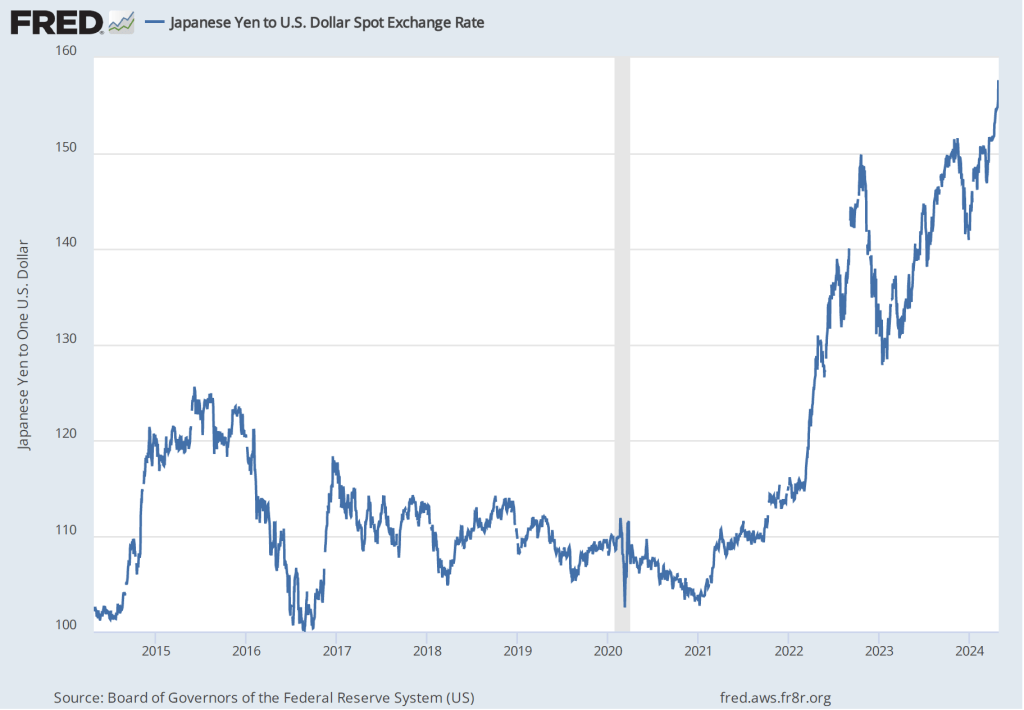
Step 2: Answer part a. by explaining what a “weaker” yen means. A weaker yen will exchange for fewer U.S. dollars (or other currencies), or, equivalently, more yen will be required in exchange for a U.S. dollar. (This situation is illustrated in the figure at the top of this post, which shows the substantial weakening of yen against the dollar in the period since the end of the 2020 recession.)

Step 3: Answer part b. by explaining why a weaker yen might make people in Japan feel poorer. A weaker yen raises the yen price of imported goods. For example at an exchange rate of ¥100 = $1, a $1 Hershey candy bar imported from the United States will sell in Japan for ¥100. But if the yen becomes weaker and the exchange rate moves to ¥120 = $1, then the imported candy bar will have increased in price to ¥120. (Note that this discussion is simplified because a change in the exchange rate won’t necessarily be fully passed through to the prices of imported goods, particularly in the short run. But we would still expect that a weaker yen will result in higher yen prices of imports.)  A weaker yen will require people in Japan to pay more for imports, leaving them with less to spend on other goods. Because they will be able to consume less, people in Japan will feel poorer. (As we note in Section 18.3, many goods traded internally are priced in U.S. dollars—oil being an important example. Because Japan imports nearly all of its oil and more than half of its food, a decline in the value of the yen in exchange for the dollar will increase the yen price of key consumer goods.)

Step 4: Answer part c. by explaining how a weaker yen might help the Japanese economy. A weaker yen increases the yen price of Japanese imports but it also decreases the foreign currency price of Japanese exports. This effect would be the main way in which a weaker yen might help the Japanese economy but we can also note that Japanese businesses that compete with foreign imports will also be helped by the increase in import prices.

Step 5: Answer part d. by explaining that a weaker yen isn’t all bad or all good for the Japanese economy. As the answers to parts b. and c. indicate, a weaker yen creates both winners and losers in the Japanese economy. Japanese consumers lose as a result of a weaker yen but Japanese firms that export or that compete against foreign imports will be helped.  

Solved Problem: Will Investors in Japan and Europe Buy the Increased Quantity of U.S. Treasury Bonds?

Supports: Macroeconomics, Chapter 18, Section 18.2;  Economics, Chapter 28, Section 28.2; and Essentials of Economics, Chapter 19, Section 19.6.

As the figure above shows, federal government debt, sometimes called the national debt, has been increasing rapidly in the years since the 2020 Covid pandemic. (The figure show federal government debt held by the public, which excludes debt held by federal government trust funds, such as the Social Security trusts funds.) The debt grows each year the federal government runs a budget deficit—that is, whenever federal government expenditures exceed federal government revenues. The Congressional Budget Office (CBO) forecasts large federal budget deficits over the next 30 years, so unless Congress and the president increase taxes or cut expenditures, the size of the federal debt will continue to increase rapidly. (The CBO’s latest forecast can be found here. We discuss the long-run deficit and debt situation in this earlier blog post.)

When the federal government runs a budget deficit, the U.S. Treasury must sell Treasury bills, notes, and bonds to raise the funds necessary to bridge the gap between revenues and expenditures. (Treasury bills have a maturity—the time until the debt is paid off by the Treasury—of 1 year or less; Treasury notes have a maturity of 2 years to 10 years; and Treasury bonds have a maturity of greater than 10 years. For convenience, we will refer to all of these securities as “bonds.”) A recent article in the Wall Street Journal discussed the concern among some investors about the ability of the bond market to easily absorb the large amounts of bonds that Treasury will have to sell. (The article can be found here. A subscription may be required.)

According to the article, one source of demand is likely to be European and Japanese investors.

“The euro and yen are both sinking relative to the dollar, in part because the Bank of Japan is still holding rates low and investors expect the European Central Bank to slash them soon. That could increase demand for U.S. debt, with Treasury yields remaining elevated relative to global alternatives.”

a. What does the article mean by “the euro and the yen are both sinking relative to the dollar”?

b. Why would the fact that U.S. interest rates are greater than interest rates in Europe and Japan cause the euro and the yen to sink relative to the dollar?

c. If you were a Japanese investor, would you rather be invested in U.S. Treasury bonds when the yen is sinking relative to the dollar or when it is rising? Briefly explain.

Solving the Problem

Step 1:  Review the chapter material. This problem is about the determinants of exchange rates, so you may want to review Macroeconomics, Chapter 18, Section 18.2, “The Foreign Exchange Market and Exchange Rates” (Economics, Chapter 28, Section 28.2; Essentials of Economics, Chapter 19, Section 19.6.)

Step 2: Answer part a. by explaining what it means that the euro and the yen “sinking relative to the dollar.” Sinking relative to the dollar means that the exchange rates between the euro and the dollar and between the yen and the dollar are declining. In other words, a dollar will exchange for more yen and for more euros.

Step 3: Answer part b. by explaining how differences in interest rates between countries can affect the exchange between the countries’ currencies. Holding other factors that can affect the attractiveness of an investment in a country’s bonds constant, the demand foreign investors have for a country’s bonds will depend on the difference in interest rates between the two countries. For example, a Japanese investor will prefer to invest in U.S. Treasury bonds if the interest rate is higher on Treasury bonds than the interest rate on Japanese government bonds. So, if interest rates in Europe decline relative to interest rates in the United States, we would expect that European investors will increase their investments in U.S. Treasury bonds. To invest in U.S. Treasury bonds, European investors will need to exhange euros for dollars, causing the supply curve for euros in exchange for dollars to shift to the right, reducing the value of the euro.

Step 4: Answer part c. by discussing whether if you were a Japanese investor, you would you rather be invested in U.S. Treasury bonds when the yen is sinking relative to the dollar or when it is rising.  In answering this part, you should draw a distinction between the situation of a Japanese investor who already owns U.S. Treasury bonds and one who is considering buying U.S. Treasury bonds. A Japanese investor who already owns U.S. Treasury bonds would definitely prefer to own them when the value of the yen if falling against the dollar. In this situation, the investor will receive more yen for a given amount of dollars the investor earns from the Treasury bonds. A Japanese investor who doesn’t currently own U.S. bonds, but is thinking of buying them, would want the value of the yen to be increasing relative to the dollar because then the investor would have to pay fewer yen to buy a Treasury bond with a price in dollars, all other factors being equal. (The face value of a Treasury bond is $1,000, although at any given time the price in the bond market may not equal the face value of the bond.) If the interest rate difference between U.S. and Japanese bonds is increasing at the same time as the value of the yen is decreasing (as in the situation described in the article) a Japanese investor would have to weigh the gain from the higher interest rate against the higher price in yen the investor would have to pay to buy the Treasury bond.


Interest Rates, the Yen, the Dollar, and the International Financial System 

Photo from the Wall Street Journal.

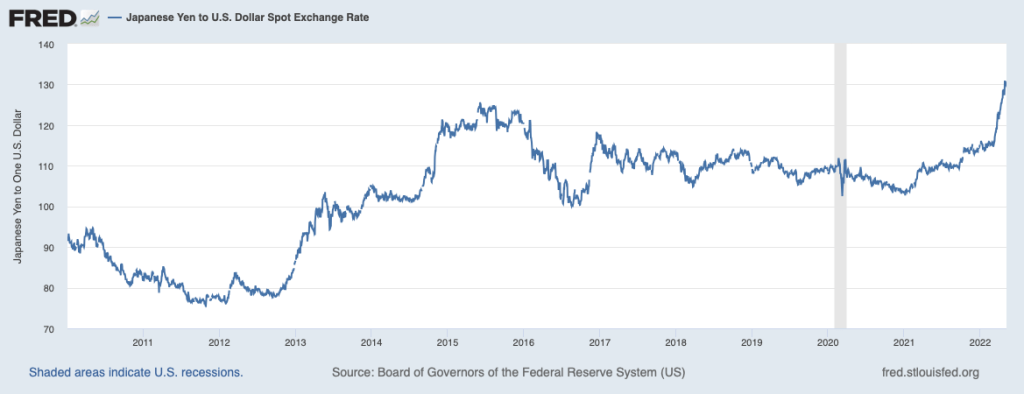
From early March to early May 2022, the Japanese yen persistently lost value versus the U.S. dollar. Between March 1 and May 9, the yen declined by 14% against the dollar, which is a substantial loss in value during such a short time period.  What explains the decline in the exchange rate between the yen and the dollar during that time? In Macroeconomics, Chapter 18, Section 18.2 (Economics, Chapter 28, Section 28.2), we saw that the exchange rate between most pairs of currencies fluctuates in response to these factors:

  • The foreign demand for U.S. goods
  • U.S. interest rates relative to foreign interest rates
  • Foreign demand for making direct investments or portfolio investments in the United States
  • The U.S. demand for foreign goods
  • Foreign interest rates relative to U.S interest rates
  • U.S. demand for making direct investments or portfolio investments in other countries

The following figure shows movements in the exchange rate between the yen and the U.S. dollar since 2010.  During different periods, the factor that is most important in explaining fluctuations in an exchange rate varies.  (Important note: The figure follows the convention of expressing the exchange between the yen and dollar in terms of yen per dollar. Therefore, in the figure, an increase in the exchange rate corresponds to a decrease in the value of the yen versus the dollar because it takes more yen to buy one dollar.)

From early March to early May 2022, the decline in value of the yen versus the dollar was mainly the result of U.S. interest rates increasing relative to Japanese interest rates. As the inflation rate increased rapidly in the spring of 2022, both short-term and long-term interest rates in the United States increased, partly in response to policy actions taken by the Federal Reserve. The Federal Reserve was attempting to increase interest rates in order to raise borrowing costs for households and firms, thereby slowing spending and inflation.  Japan was experiencing much lower rates of inflation—well below the Bank of Japan’s 2% annual inflation target—so the BOJ was reluctant to increase interest rates. As a consequence, the gap between the interest rate on 10-year U.S. Treasury notes and the interest rate on 10-year Japanese government bonds had risen to 2.9 percentage points.

Higher U.S. interest rates caused a shift to the right in the demand for dollars in exchange for yen as foreign investors exchanged their yen for dollars in order to buy U.S. Treasury securities and other U.S. financial assets.  As we show in Chapter 18, Figure 18.13, an increase in the demand for dollars (holding all other factors constant) increases the equilibrium exchange rate between the yen and the dollar.  

What effect does a stronger dollar and a weaker yen have on the two countries’ economies?  A weaker yen means that the yen price of imports from the United States will be higher. The higher prices will increase the Japanese inflation rate, but with inflation being low in in the spring of 2022, Japanese policymakers weren’t concerned by this effect. And because the value of U.S. imports is small relative to the size of the Japanese economy, the effect on the inflation rate wouldn’t be large in any case. The dollar price of Japanese exports to the United States will be lower, which should help Japanese firms exporting to the United States.

The effect on the U.S. economy will be the mirror image of the effect on the Japanese economy. The dollar price of Japanese imports being lower will help reduce the U.S. inflation rate, but not to a great extent because the value of Japanese imports is small relative to the size of the U.S. economy. The yen price of U.S. exports to Japan will be higher, which will be bad news for U.S. firms exporting to Japan.

Finally, many banks, other financial firms, and non-financial firms borrow money in dollars. They do so because over time the advantages of borrowing dollars has increased, even for foreign firms that receive most of their revenue in their domestic currency rather than dollars. In particular, the value of the dollar is relatively stable compared with the value of many other currencies. In addition, the Federal Reserve has made available short-term dollar loans to foreign central banks that allow those banks to provide short-term loans to local firms that are having temporary difficulty making dollar payments on their loans. By late 2021, the total amount of dollar loans made outside of the United States had risen to more than $13 trillion. In the spring of 2022, the value of the dollar was rising not just against the Japanese yen but also against many other currencies. The increase was bad news for foreign firms borrowing in U.S. dollars because it would take more of their domestic currency to buy the dollars necessary to make their loans payments. A large and prolonged increase in the value of the U.S. dollar could possibly upset the stability of the international financial system. 

Sources:  Yuko Takeo and Komaki Ito, “Japan’s Stepped-Up Warnings Fail to Stem Yen’s Slide Past 128,” bloomberg.com, April 19, 2022; Jacky Wong, “Japan Gets a Taste of the Wrong Type of Inflation,” Wall Street Journal, April 1, 2022; Megumi Fujikawa, “Yen Hits Lowest Level Since 2015, and Japan, U.S. Are OK With That,” Wall Street Journal, March 28, 2022; Bank for International Settlements, “BIS International Banking Statistics and Global Liquidity Indicators at End-September 2021,” January 28, 2022; and Federal Reserve Bank of St. Louis.