What Will the U.S. Economy Be Like in 50 Years? Glenn Predicts!

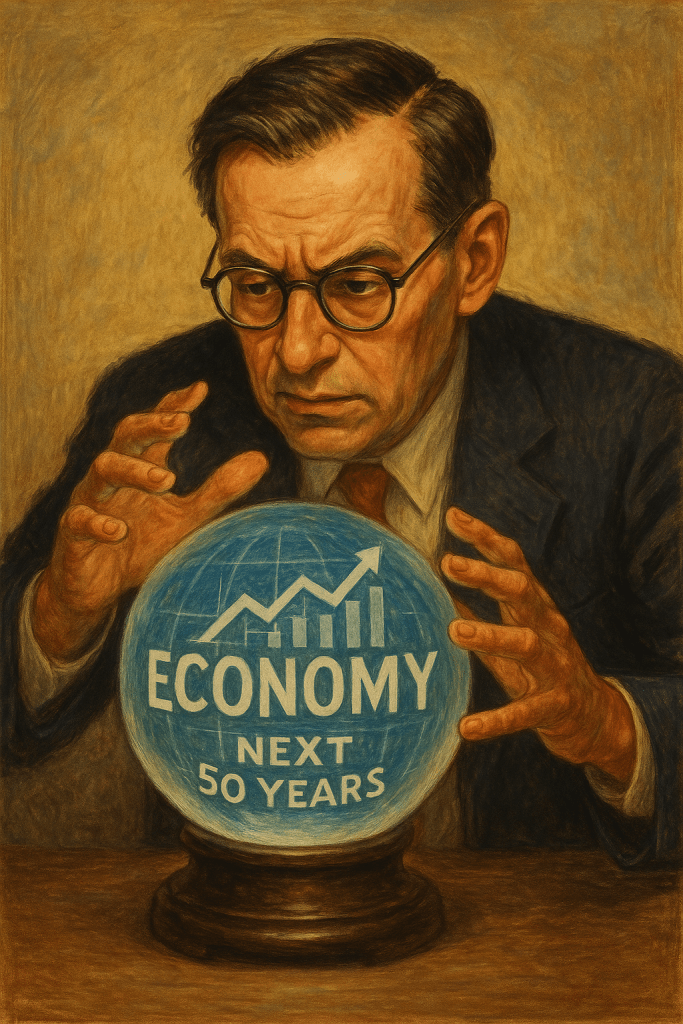
Image generated by ChatGPT

A Stronger Safety Net

Modern industrial capitalism’s bounty has been breathtaking globally and especially in the U.S. It’s tempting, then, to look at critics in the crowd in Monty Python’s “Life of Brian” as they ask, “What have the Romans ever do for us?,” only to be confronted with a large list of contributions. But, in fact, over time, American capitalism has been saved by adapting to big economic changes.

We’re at another turning point, and the pattern of American capitalism’s keeping its innovative and disruptive core by responding, if sometimes slowly, to structural shocks will play out as follows. 

The magnitude, scope and speed of technological change surrounding generative artificial intelligence will bring forth a new social insurance aimed at long-term, not just cyclical, impacts of disruption. For individuals, it will include support for work, community colleges and training, and wage insurance for older workers. For places, it will include block grants to communities and areas with high structural unemployment to stimulate new business and job opportunities. Such efforts are a needed departure from a focus on cyclical protection from short-term unemployment toward a longer-term bridge of reconnecting to a changing economy. 

These ideas, like America’s historical big responses in land-grant colleges and the GI Bill, combine federal funding support with local approaches (allowing variation in responses to local business and employment opportunities), another hallmark of past U.S. economic policy. 

With a stronger economic safety net, the current push toward higher tariffs and protectionism will gradually fade. Protectionism is a wall against change, but it is one that insulates us from progress, too. 

A growing budget deficit and strains on public finances will lead to a reliance on consumption taxes to replace the current income tax system; continuing to raise taxes on saving and investment will arrest growth prospects. For instance, a tax on business cash flow, which places a levy on a firm’s revenue minus all expenses including investment, would replace taxes on business income. Domestic production would be enhanced by adding a border adjustment to business taxes—exports would be exempt from taxation, but companies can’t claim a deduction for the cost of imports.

That reform allows a shift from helter-skelter tariffs to tax reform that boosts investment and offers U.S. and foreign firms alike an incentive to invest in the U.S. 

These ideas to retain opportunity amid creative destruction will also refresh American capitalism as the nation celebrates its 250th anniversary. They also celebrate the classical liberal ideas of Adam Smith, whose treatise “The Wealth of Nations” appeared the same year. This refresh marries competition’s role in “The Wealth of Nations” and American capitalism with the ability to compete, again a feature of turning points in capitalism in the U.S.

Decades down the road, this “Project 2026” will have preserved the bounty and mass prosperity of American capitalism.

These observations first appeared in the Wall Street Journal, along with predictions from six other economists and economic historians.

Technological Change Smacks Snacks

Photo from cnbc.com

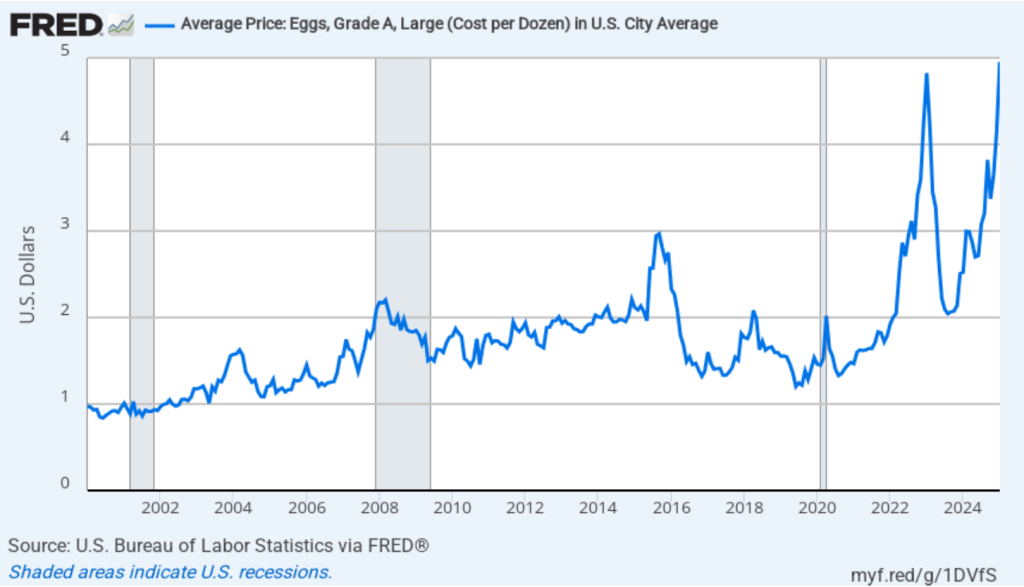
What causes consumer demand for a product to decline?  Why does demand for some products suddenly rise?  As we discuss in Chapter 3, changes in the relative price of a substitute or a complement cause the demand for a good to shift. For instance, the following figure shows the recent rapid increase in the price of eggs, due in part from the spread of bird flu. We would expect that the increase in the price of eggs will shift to the right the demand curve for egg substitutes, such as the product shown below the figure.

Sometimes a shift in the demand for a product represents a change in consumer tastes. For instance, as we discuss in an Apply the Concept in Chapter 3, for decades most people wore a hat while outdoors. The first photo below shows people walking down a street in New York City in the 1920s. Beginning in the 1960s, hats started to fall out of fashion. As the second photo shows, today few people wear hats—unless they’re walking outside during the winter in the Northeast or the Midwest!

Photo from the New York Daily News

Photo from the New York Times

Technological change can also affect the demand for goods. For example, the development of network television, beginning in the late 1940s, reduced the demand for tickets to movie theaters. Similarly, the development of the internet reduced the demand for physical newspapers.

A recent example of technological change having a substantial effect on a number of consumer goods is the introduction of GLP–1 drugs, beginning in 2005. These drugs, such as Ozempic and Mounjaro, were first developed to treat type 2 diabetes. The drugs were found to significantly reduce appetite in most users, leading to users losing weight. Accordingly, doctors began to prescribe the drugs to treat obesity. By 2025, about half of the users of GLP–1 drugs were doing so to lose weight. A recent article in the Washington Post quoted Jan Hatzius, chief economist at Goldman Sachs, as predicting that by 2028, 60 million people in the United States will be taking a GLP–1 drug.

Many consumers who use these drugs decide to change the mix of foods they eat. Typically, users demand fewer ultra-processed foods, such as chips, cookies, and soft drinks. The percentage of people in the United States who are considered obese—having a body mass index (BMI) of 30 or greater—had been increasing for decades before declining slightly in 2023, the most recent year with available data. It seems likely that the increasing use of GLP–1 drugs helps to explain the decline in obesity.

People taking these drugs have also typically increased the share of foods they eat with higher levels of protein and fiber. These changes in diet are likely to lead to improved health, reducing the demand for some medical services. The number of people experiencing significant weight loss has already begun to reduce demand for extra-large clothing sizes and increase the demand for medium clothing sizes.

How much has the use of Ozempic and similar drugs reduced the demand for snacks? A recent study by Sylvia Hristakeva and Jura Liaukonyt of Cornell University and Leo Feler of Numerator, a market research firm, presents numerical estimates of changes in demand for different foods by users of GLP–1 drugs. The authors assembled a representative sample of 150,000 U.S. households and the households’ grocery purchases from July 2022 through September 2024. They estimate that the share of the U.S. population using a GLP–1 drug increased from 5.5% in October 2023 to 8.8% in July 2024.

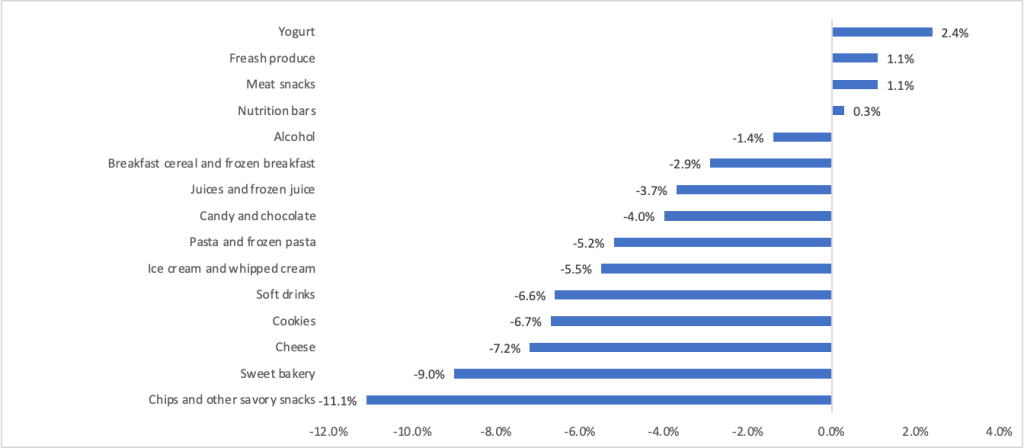
The study finds that households with at least one person using a GLP–1 drug reduced their total grocery shopping by 5.5 percent or $416. The study gathered data on changes in the categories of food that households were buying six months after at least one person in the household began using one of these drugs. The figure below is compiled from data in the study.

As expected, purchases of snacks declined. The category of “chips and other savor snacks” (bottom row in the figure) declined by more than 11 percent. Purchases of sweet bakery products, cheese, cookies, soft drinks, ice cream, and pasta all declined by more than 5 percent. Purchases of yogurt, fresh produce, meat snacks, and nutrition bars, all increased. An article in the Wall Street Journal noted that “food makers are starting to understand better and cater to, in some cases with products specifically designed for” users of this drug. The image below shows some of the new products that Nestle—a major candy producer—has introduced to appeal to users of GLP–1 drugs. Nestle’s Vital Pursuit line of frozen packaged foods contain high levels of protein and fiber.

It’s too early to gauge the full effects of GLP–1 drugs on consumer demand. But it’s already clear that GLP–1 drugs are a striking example of technological change affecting demand in a major industry

Glenn’s Interview with Jim Pethokoukis

Glenn discusses Fed policy, the state of the U.S economy, economic growth, China in the world economy, industrial policy, protectionism, and other topics in this episode of the Political Economy podcast from the American Enterprise Institute.

https://podcasts.apple.com/us/podcast/glenn-hubbard-a-pro-growth-policy-agenda/id589914386?i=1000665131415

Streaming Conquers the Music Industry

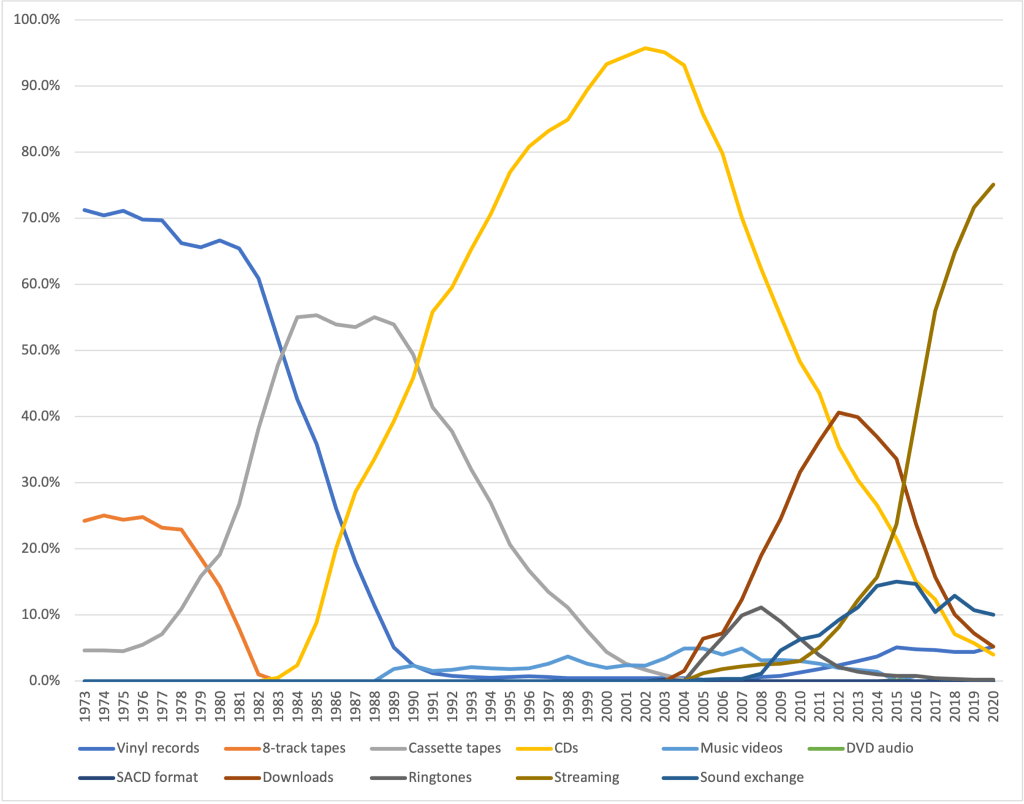
Listening to recorded music seems like a basic, uncomplicated activity, but as we discuss in the opening to Chapter 14, few markets have been as disrupted by technological change over the years as the market for recorded music.  The following graph shows the distribution of revenue received by firms in the recording industry by type of music format. The data are first available for 1973. 

From the 1930s to the mid-1960s, nearly all recorded music was sold on vinyl records. In the 1960s, 8-track tapes began to compete with vinyl records. In 1973, recording companies received about 71 percent of their revenue from selling vinyl records, 24 percent from selling 8-track tapes, and 5 percent from selling cassette tapes. Cassette tapes became increasingly popular after Sony introduced the Walkman, a portable cassette player, in 1979.  The popularity of cassettes contributed to a sharp decline in sales of vinyl records.  The share of vinyl records in revenue received from sales of recorded music dropped from 71 percent in 1975 to only 2 percent in 1990. The greater portability of cassette tapes was a significant advantage over 8-track tapes, which were most frequently used in players built into automobiles. By 1983, 8-track tapes had largely disappeared from the market.

The introduction of digital compact discs (CDs) in the early 1980s ended the rapid rise in sales of cassette tapes. By the end of the 1980s, sales of cassette tapes began to decline rapidly and their share of the market had fallen to less than 2 percent by the early 2000s. 

As discussed in the opening to Chapter 14, the development by engineers in Germany of the MP3 file format made it possible to store the contents of a music CD on a file small enough to be downloaded from the internet. Apple’s opening its iTunes online music store in 2003 increased sales of music downloads, which peaked at 40 percent of the market in 2012. In that year, recording companies earned about 8 percent of their revenue from payments from streaming services like Spotify or Apple Music.

Steaming music has become increasingly popular and by 2020, 75 percent of industry revenue was earned from streaming. Ten percent was earned from “sound exchange,” which refers to revenue recording companies receive when music is used in a movie, television series, advertisement, or online video. (Some industry analysts consider sound exchange to be a form of streaming. Using that definition raises streaming’s share to 85 percent of the market.) Downloads had a market share of only 5 percent, about the same as the share of vinyl records, which had increased from a low point of less than 1 percent in 2007. CD sales continue to slowly decline and make up about 4 percent of the market. 

In Chapter 14, we discuss the streaming market as an example of oligopolistic competition.  When a market expands as rapidly as music streaming has, competition can be less intense because it’s possible for firms to increase their revenue as the market expands without having to attract customers from competitors. Typically when a market matures and the increase in total revenue levels off, competition can become more intense. We may see that development in the market for streaming music in coming years.

Source: Data from Recording Industry Association of America, “U.S. Sales Database.”