Buy Stablecoins and Receive … a Free Toaster?

Image generated by ChatGPT

Beginning in 1933, under the Federal Reserve’s Regulation Q, commercial banks were prohibited from paying interest on checking account deposits. As we discuss in Money, Banking, and the Financial System, Chapter 12, Section 12.4, in 1980 Congress allowed banks to pay interest on Negotiable Order of Withdrawal (NOW) accounts. Because NOW accounts effectively functioned as checking accounts, many people moved funds out of checking accounts and into NOW accounts.

Once NOW accounts were available, a bank could try to attract deposits by offering higher interest rates. But what did a bank do to attract deposits prior to 1980 when it couldn’t legally pay interest? Many banks offered rewards, such as toasters, clock radios, or other small appliances, to people who opened a new checking account or made a large deposit. Banks heavily advertised these rewards on television and radio and in newspapers. The 1960s and 1970s are sometimes called “the free-toaster era” in banking. For example, in 1973, the Marquette National Bank placed this advertisement in a local Minneapolis newspaper offering a variety of gifts to anyone depositing $250 or more in a checking account.

In 1977, a bank in Morton Grove, Illinois offered candy bowls and ashtrays to people opening new accounts.

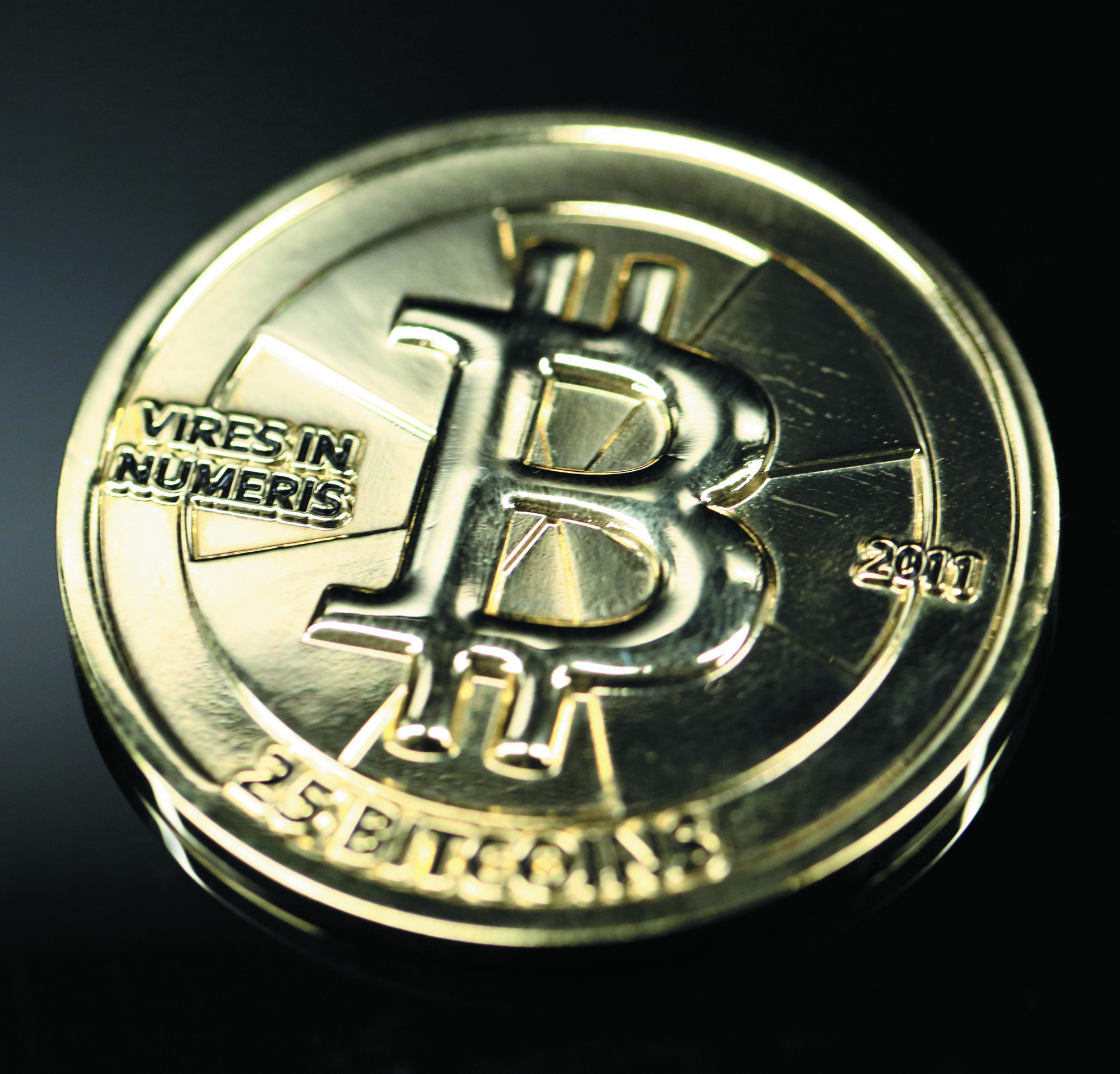
Congress authorized NOW accounts because as interest rates rose during the 1970s—despite the offers of free gifts—banks  were losing deposits to money market mutual funds and other short-term financial assets such as Treasury bills. Today, banks are afraid that they will lose deposits to cryptocurrencies, particularly stablecoins. As we discuss in this blog post, stablecoins are a type of cryptocurrency—bitcoin is the best-known cryptocurrency—that can be bought and sold for a constant number of units of a currency, usually U.S. dollars. Typically, one stablecoin can be exchanged for one dollar.

In July 2025, Congress passed and President Trump signed the Guiding and Establishing National Innovation for U.S. Stablecoins Act (Genius Act) to provide a regulatory framework for stablecoins. Firms issuing stablecoins earn income on the assets, such as Treasury bills and money market funds that invest in Treasury bills, that they are required to hold to back the stablecoins they issue. But a provision of the Act bars issues of stablecoins from paying interest to holders of stablecoins. So, stablecoin issuers can’t copy the strategy of banks by paying interest to attract deposits and funding the interest on deposits with the interest earnings on their assets.

To this point, few people are buying stablecoins unless they intend to use them in buying and selling bitcoin and other cryptocurrencies or unless they need a convenient way to transfer funds across national borders. Some of these international transfers are related to drug dealing and other illegal activities. Because few retail firms—either brick-and-mortar or online—are equipped to accept stablecoins in payment for goods and services, and because stablecoins pay no interest, most households and firms don’t see stablecoins as good substitutes for checking accounts in banks.

As we discuss in Chapter 12 of Money, Banking, and the Financial System, when the federal government adopts new financial regulations, like the Genius Act, financial firms often respond by attempting to evade the regulations. People buy and sell cryptocurrencies on exchanges, such as Coinbase. Circle issues the stablecoin USDC and has agreed to pay Coinbase some of the interest it earns on Circle’s assets. As the following screenshot from the Coinbase site shows, Coinbase offers to pay interest to anyone who holds USDC on the Coinbase site.

Screenshot

An article in the Wall Street Journal notes that: “The result is something that critics say looks a lot like a yield-bearing stablecoin. Coinbase says the reward program is separate from its revenue-sharing deal with Circle.” If other stablecoins attract funds by offering interest payments in this indirect way and if more retailers begin to accept stablecoins as payment for goods and services—which they have an incentive to do to avoid the 1 percent to 3 percent fee that credit card issuers charge retailers on purchases—banks stand to lose trillions in deposits.  

Smaller banks, often called community banks, might be most at risk from deposit outflows because they are more reliant on deposits to fund their investments than are larger banks. As we discuss in Money, Banking, and the Financial System, Chapter 9, community banks practice relationship banking by using private information to assess the credit risk involved in lending to local borrowers, such as car dealers and restaurants. Many large banks believe that the transaction costs involved in evaluating risk on small business loans make such loans unprofitable. So the disappearance of many community banks may make it more difficult for small businesses to access the credit they need to operate.

The Bank Policy Institute (BPI), which lobbies on behalf of the banking industry, argues that:

“Stablecoin issuers want to engage in banking activities, like paying interest. Being a bank requires the full suite of regulatory requirements, deposit insurance and discount window access that keep banks safe. Stablecoins seeking to offer banking services must be subject to those requirements and protections, rather than using workarounds and backdoors to pay interest, take deposits and access the federal payment rails.”

BPI urges Congress to eliminate the ability of Coinbase and other crypto exhanges to help stablecoin issuers evade the prohibition on paying interest.

If the prohibition on stablecoin issuers paying interest is tightened, how else might issuers attract people to invest in stablecoins? Well, there’s always free toasters!

Are Stablecoins about to Become an Important Part of the U.S. Financial System?

Image illustrating stablecoins generated by ChatGTP4-o

Recently, U.S. Treasury Secretary Scott Bessent testified before Congress that the value of stablecoins could reach $2 trillion. In a post on X (formerly Twitter) he stated that “that stablecoins could grow into a $3.7 trillion market by the end of the decade.” Those amounts are far above the $250 billion estimated value of stablecoins in June 2025, yet still small relative to the value of M2—currently $21.9 trillion. But if the value of stablecoins were to rise to $2 trillion, that would be large enough to have a noticeable effect on the U.S. financial system.

As we discuss in Macroeconomics, Chapter 24 and in Money, Banking, and the Financial System, Chapter 2, stablecoins are a type of cryptocurrency—bitcoin is the best-known cryptocurrency—that can be bought and sold for a constant number of units of a currency, usually U.S. dollars. Typically, one stablecoin can be exchanged for one dollar. 

Tether CEO Paolo Ardoino (photo from Bloomberg news via the Wall Street Journal)

Firms that issue stablecoins will redeem them in the underlying currency, which—as already noted—is nearly always the U.S. dollar. To make the promise to redeem stablecoins in dollars credible, firms that issue stablecoins hold reserve assets that are safe and highly liquid, such as U.S. Treasury bills or U.S. dollar bank deposits. Tether, which is headquartered in El Salvador, is the largest issuer of stablecoins, with about two-thirds of the market. As with bitcoins and other cryptocurrencies, stablecoins are stored and traded on public blockchains, which are decentralized networks of ledgers that record transactions. This system avoids the use of financial intermediaries—such as banks—which advocates for cryptocurrencies see as a key advantage because it eliminates the possibility that the intermediary might reject the transaction. But it also increases the appeal of stablecoins to people engaged in illegal activities.  

Advocates for stablecoins believe that they can become a digital medium of exchange, which is a role that initially bitcoin was intended to play. The swings in the value of bitcoin turned out to be much larger than most people expected and made that crypto currency unsuitable for use as a medium of exchange. Stablecoins avoid this problem by keeping the value of the stablecoins fixed at one dollar. To this point, though, stablecoins have been primarily used to buy and sell bitcoin and other crypto currencies. As Federal Reserve Governor Christopher Waller put it in a speech earlier this year: “By their tie to the dollar, stablecoins are the medium of exchange and unit of account in the crypto ecosystem.” According to Waller, more than 80 percent of trading in cryptocurrencies is conducted using stablecoins.

One drawback to stablecoins is that firms that issue them charge a fee to redeem them. For instance, Tether requires that a minimum of $100,000 of stablecoins be redeemed and charges a fee of 0.1 percent of the amount redeemed with a minimum charge of $1,000. The redemption fee would be less important if stablecoins are used in large dollar transactions, such as occur in international trade. Advocates for stablecoins believe that they are particularly well suited for use in cross-border transactions because they don’t involve banks, as typically is necessary when firms buy or sell goods or services in foreign countries. The fees stablecoin issuers charge are generally lower than the fees banks charge for foreign exchange transactions.

The main source of profit for firms issuing stablecoins is the interest they earn on the assets they use to back the stablecoins they issue. Note, though, that firms issuing stablecoins have an incentive to buy riskier assets in order to increase the return on the stablecoins they issue. The incentives are similar to those banks face in investing depositors’ funds in assets that are riskier than the depositors would prefer. However, the risk that commercial banks take on is limited by bank regulations, which don’t yet apply to firms issuing stablecoins, although they may soon.

On June 17, the U.S. Senate moved to provide a regulatory framework for stablecoins by passing the Guiding and Establishing National Innovation for U.S. Stablecoins Act (Genius Act). The act requires that firms issuing stablecoins in the United States back them 100 percent with a limited number of reserve assets: dollar deposits in banks, Treasury securities that mature in 93 days or less, repurchase agreements backed by Treasuries (we discuss repurchase agreements in Macroeconomics, Chapter 15; Economics, Chapter 25; and Money, Banking, and the Financial System, Chapter 10), and money market funds that invest in eligible Treasury securities and repurchase agreements. Issuers of stablecoins will be subject to audits by U.S. federal regulators. To become law, the Genius Act must also be passed by the U.S. House and signed by President Trump.

Passage of the Genius Act would potentially provide a regulatory framework that would reassure users that the stablecoins they hold can be readily redeemed for dollars. Passage is also expected to lead some large retail firms, such as Walmart and Amazon, to issue stablecoins that could be used to make purchases on their sites. If enough consumers are willing to use stablecoins, these large retailers could save the fees they currently pay to credit card companies. In addition, stablecoin transactions can be cleared instantly, as opposed to the several days it can take for credit card payments to clear. Why would a consumer want to use stablecoin rather than a credit card to pay for something? Apart from the familiarity of using credit cards, the cards often provide rewards, such as points that can be redeemed for airline tickets or hotel stays. To attract consumers, stablecoin issuers would likely have to offer similar rewards to consumers who use stablecoins to make purchases.

As Waller notes, it will likely take years before consumers and firms routinely use stablecoins for day-to-day transactions. Today, very few retail firms are equipped to accept stablecoins and very few consumers own stablecoins.

Passage of the Genius Act would pose potential problems for Tether. Tether has held a wide range of reserve assets to back its stablecoins, including bitcoin and precious metals. It has also not been willing to be fully audited. Either Tether would have to change its business model to fit the requirements of the Genius Act or it would have to issue a separate stablecoin that would be used only in the United States and would meet the Genius Act requirements.

We noted earlier that Treasury Secretary Bessent believes that over the next few years, the value of stablecoins could increase to several trillions dollars. If that happens, the demand for Treasury securities would increase substantially as firms issuing stablecoins accumulated reserve assets. The result could be higher prices on Treasury securities and lower interest rates, which would eventually reduce the interest payments the Treasury makes on the federal government’s debt.

Finally, as we note in the text, Barry Eichengreen of the University of California, Berkeley as been a notable skeptic of stablecoins. As he wrote back in 2018, when the idea of stablecoins was just beginning to be widely discussed, when someone exchanges a dollar for a stablecoin, “one of us then will have traded a perfectly liquid dollar, supported by the full faith and credit of the U.S. government, for a cryptocurrency with questionable backing that is awkward to use. This exchange may be attractive to money launderers and tax evaders, but not to others.”

Could issuers of stablecoins be subject to runs like the one that led to the failure of Silicon Valley Bank in the spring of 2023?

In a recent opinion column in the New York Times, Eichengreen wrote that he is concerned about the possibility of runs on stablecoins. As we discuss in Macroeconomics, Chapter 14, and in Money, Banking, and the Financial Systems, Chapter 10, a commercial bank can be subject to a run if the bank’s depositors believe that the value of the bank’s assets are no longer sufficient to pay off the bank’s depositors. As we discuss in this blog post, Silocon Valley Bank experienced a run in the spring of 2023 that affected several other banks. Runs on commercial banks are unusual in the United States because of deposit insurance and the willingness of the Federal Reserve to act as lender of last resort to banks suffering liquidity problems. Eichengreen raises the question of whether stablecoins could experience runs if holders of the stablecoins come to doubt that the value of issuers’ reserve assets is sufficient to redeem all the coins.

Although the Genius Act provides for regulation of stablecoin issuers, Eichengreen believes that if enough firms begin issuing stablecoins, it’s likely that at some point one of them will experience a decline in the value of its reserve assets, which will cause a run. If the run spreads from one issuer to many in a process called contagion, stablecoin issuers will have to sell reserve assets, including Treasury securities. The result could be a sharp fall in the prices of those asset and an increase in interest rates. It’s possible that the outcome could be a wider financial panic and a deep recession. To head off that possibility, the Federal Reserve might feel obliged to intervene to save some, possibly many, stablecoin issuers from failing. The result could be that taxpayer dollars would flow to firms issuing stablecoins, which would likely cause a significant political backlash.

Many people see stablecoins as an exciting development in the financial system. But, as we’ve noted, there still remain some substantial roadblocks in the way of stablecoins becoming an important means of transacting business in the U.S. economy.

Should the Federal Reserve Issue a Digital Currency?

The Problem with Bitcoin as Money

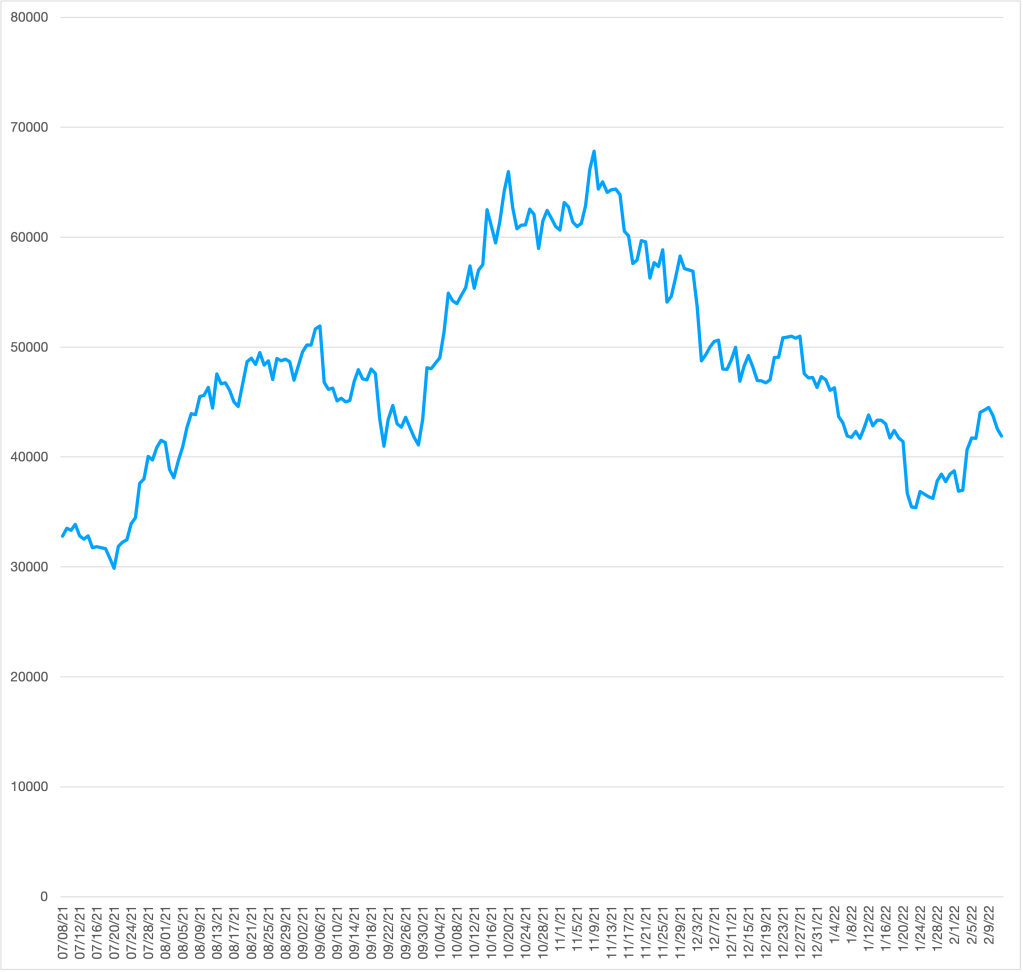
Bitcoin has failed in their original purpose of providing a digital currency that could be used in everyday transactions like buying lunch and paying a cellphone bill. As the following figure shows, swings in the value of bitcoin have been too large to make useful as a medium of exchange like dollar bills. During the period shown in the figure—from July 2021 to February 2022—the price of bitcoin has increased by more than $30,000 per bitcoin and then fallen by about the same amount. Bitcoin has become a speculative asset like gold. (We discuss bitcoin in the Apply the Concept, “Are Bitcoins Money?” which appears in Macroeconomics, Chapter 14,  Section 14.2 and in Economics, Chapter 24, Section 24.2. In an earlier blog post found here we discussed how bitcoin has become similar to gold.)

The vertical axis measures the price of bitcoin in dollars per bitcoin.

The Slow U.S. Payments Increases the Appeal of a Digital Currency

Some economists and policymakers argue that there is a need for a digital currency that would do what bitcoin was originally intended to do—serve as a medium of exchange. Digital currencies hold the promise of providing a real-time payments system, which allow payments, such as bank checks, to be made available instantly. The banking systems of other countries, including Japan, China, Mexico, and many European countries, have real-time payment systems in which checks and other payments are cleared and funds made available in a few minutes or less. In contrast, in the United States, it can two days or longer after you deposit a check for the funds to be made available in your account. 

The failure of the United States to adopt a real-time payments system has been costly to many lower-income people who are likely to need paychecks and other payments to be quickly available. In practice, many lower-income people: 1) incur bank overdraft fees, when they write checks in excess of the funds available in their accounts, 2) borrow money at high interest rates from payday lenders, or 3) pay a fee to a check cashing store when they need money more quickly than a bank will clear a check. Aaron Klein of the Brookings Institution estimates that lower-income people in the United States spend $34 billion annually as a result of relying on these sources of funds. (We discuss the U.S. payments system in Money, Banking, and the Financial System, 4th edition, Chapter 2, Section 2.3.)

The Problem with Stablecoins as Money 

Some entrepreneurs have tried to return to the original idea of using cryptocurrencies as a medium of exchange by introducing stablecoins that can be bought and sold for a constant number of dollars—typically one dollar for one stablecoin. The issuers of stablecoins hold in reserve dollars, or very liquid assets like U.S. Treasury bills, to make credible the claim that holders of stablecoins will be able to exchange them one-for-one for dollars. Tether and Circle Internet Financial are the leading issuers of stablecoins. 

So far, stablecoins have been used primarily to buy bitcoin and other cryptocurrencies rather than for day-to-day buying and selling of goods and services in stores or online. Financial regulators, including the U.S. Treasury and the Federal Reserve, are concerned that stablecoins could be a risk to the financial system. These regulators worry that issuers of stablecoins may not, in fact, keep sufficient assets in reserve to redeem them. As a result, stablecoins might be susceptible to runs similar to those that plagued the commercial banking system prior to the establishment of the Federal Deposit Insurance Corporation in the 1930s or that were experienced by some financial firms during the 2008 financial crisis.  In a run, issuers of stablecoins might have to sell financial assets, such as Treasury bills, to be able to redeem the stablecoins they have issued. The result could be a sharp decline in the prices of these assets, which would reduce the financial strength of other firms holding the assets.

In 2019, Facebook (whose corporate name is now Meta Platforms) along with several other firms, including PayPal and credit card firm Visa, began preparations to launch a stablecoin named Libra—the name was later changed to Diem. In May 2021, the firms backing Diem announced that Silvergate Bank, a commercial bank in California, would issue the Diem stablecoin. But according to an article in the Wall Street Journal, the Federal Reserve had “concerns about [the stablecoin’s] effect on financial stability and data privacy and worried [it] could be misused by money launderers and terrorist financiers.” In early 2022, Diem sold its intellectual property to Silvergate, which hoped to still issue the stablecoin at some point.

A Federal Reserve Digital Currency?

If private firms or individual commercial banks have not yet been able to issue a digital currency that can be used in regular buying and selling in stores and online, should central banks do so? In January 2022, the Federal Reserve issued a report discussing the issues involved with a central bank digital currency (CBCD). As we discuss in Macroeconomics, Chapter 14, Section 14.2, most of the money supply of the United States consists of bank deposits. As the Fed’s report points out, because bank deposits are computer entries on banks’ balance sheets, most of the money in the United States today is already digital. As we discuss in Section 14.3, bank deposits are liabilities of commercial banks. In contrast, a CBCD would be a liability of the Fed or other central bank.

The Fed report lists the benefits of a CBCD:

“[I]t could provide households and businesses [with] a convenient, electronic form of central bank money, with the safety and liquidity that would entail; give entrepreneurs a platform on which to create new financial products and services; support faster and cheaper payments (including cross-border payments); and expand consumer access to the financial system.” 

Importantly, the Fed indicates that it won’t begin issuing a CBCD without the backing of the president and Congress:  “The Federal Reserve does not intend to proceed with issuance of a CBDC without clear support from the executive branch and from Congress, ideally in the form of a specific authorizing law.”

The Fed report acknowledges that “a significant number of Americans currently lack access to digital banking and payment services. Additionally, some payments—especially cross-border payments—remain slow and costly.” By issuing a CBDC, the Fed could help to reduce these problems by making digital banking services available to nearly everyone, including lower-income people who currently lack bank checking accounts, and by allowing consumers to have payments instantly available rather than having to wait for a check to clear. 

The report notes that: “A CBDC would be the safest digital asset available to the general public, with no associated credit or liquidity risk.” Credit risk is the risk that the value of the currency might decline. Because the Fed would be willing to redeem a dollar of CBDC currency for a dollar or paper money, a CBDC has no credit risk. Liquidity risk is the risk that, particularly during a financial crisis, someone holding CBDC might not be able to use it to buy goods and services or financial assets. Fed backing of the CBDC makes it unlikely that someone holding CBDC would have difficulty using it to buy goods and services or financial assets.

But the report also notes several risks that may result from the Fed issuing a CBDC:

  • Banks rely on deposits for the funds they use to make loans to households and firms. If large numbers of households and firms switch from using checking accounts to using CBDC, banks will lose deposits and may have difficulty funding loans. 
  • If the Fed pays interest on the CBDC it issues, households, firms, and investors may switch funds from Treasury bills, money market mutual funds, and other short-term assets to the CBDC, which might potentially disrupt the financial system. Money market mutual funds buy significant amounts of corporate commercial paper. Some corporations rely heavily on the funds they raise from selling commercial paper to fund their short-term credit needs, including paying suppliers and financial inventories. 
  • In a financial panic, many people may withdraw funds from commercial bank deposits and convert the funds into CBDC. These actions might destabilize the banking system. 
  • A related point: A CBDC might result in large swings in bank reserves, particularly during and after a financial panic. As we discuss in Macroeconomics, Chapter 14, Section 14.4 (Economics, Chapter 24, Section 24.4), increasing and decreasing bank reserves is one way in which the Fed carries out monetary policy. So fluctuations in bank reserves may make it more difficult for the Fed to conduct monetary policy, particularly during a financial panic. (This consideration is less important during times like the present when banks hold very large reserves.)
  • Because the Fed has no experience in operating a retail banking operation, it would be likely that if it began issuing a CBDC, it would do so through commercial banks or other financial firms rather than doing so directly. These financial firms would then hold customers CBDC accounts and carry out the actual flow of payments in CBDC among households and firms.

The report notes that the Fed is only beginning to consider the many issues that would be involved in issuing a CBDC and still needs to gather feedback from the general public, financial firms, nonfinancial firms, and investors, as well as from policymakers in Washington. 

Sources:  Peter Rudegeair and Liz Hoffman, “Facebook’s Cryptocurrency Venture to Wind Down, Sell Assets,” Wall Street Journal, January 26, 2022; Liana Baker, Jesse Hamilton, and Olga Kharif, “Mark Zuckerberg’s Stablecoin Ambitions Unravel with Diem Sale Talks,” bloomberg.com, January 25, 2022; Amara Omeokwe, “U.S. Regulators Raise Concern With Stablecoin Digital Currency,” Wall Street Journal, December 17, 2022; Jeanna Smialek, “Fed Opens Debate over a U.S. Central Bank Digital Currency with Long-Awaited Report,”, January 20, 2022;  Board of Governors of the Federal Reserve System, Money and Payments: The U.S. Dollar in the Age of Digital Transformation, January 2022; and Aaron Klein, “The Fastest Way to Address Income Inequality? Implement a Real Time Payments System,” brookings.edu, January 2, 2019.