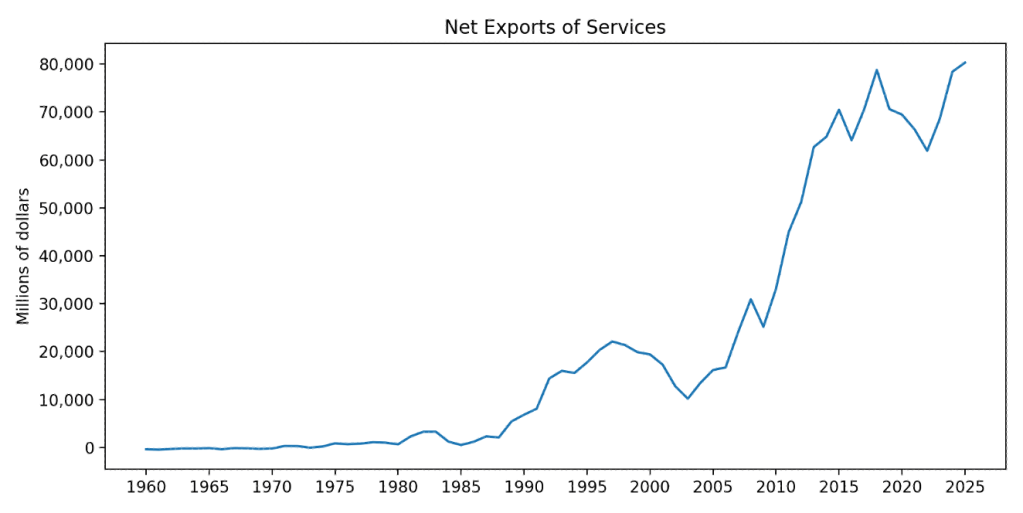
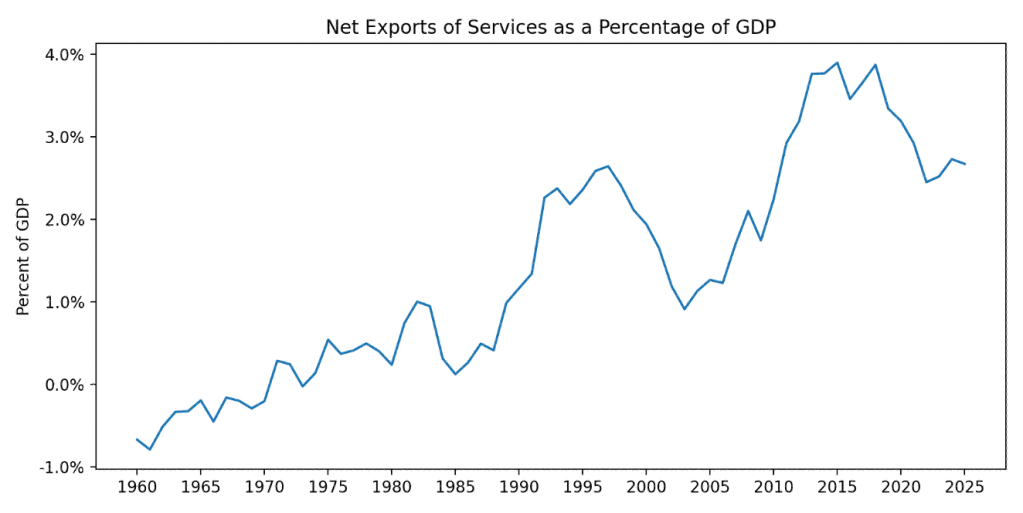
A recent post on the blog of the Federal Reserve Bank of St. Louis reminds us that although the media and some policymakers tend to focus on the fact that the United States typically runs a deficit in trade in goods, it also typically runs a surplus in trade in services. We discuss these points in Economics, Chapter 9, Section 9.1 and Chapter 28, Section 28.1 (Macroeconomics, Chapter 7, Section 7.1 and Chapter 18, Section 18.1, and Microeconomics, Section 9.1). The first of the following figures shows U.S. net exports in services in dollar terms for the period from the first quarter of 1960 through the second quarter of 2025. The second figure show U.S. net exports in services as a percentage of U.S. GDP.
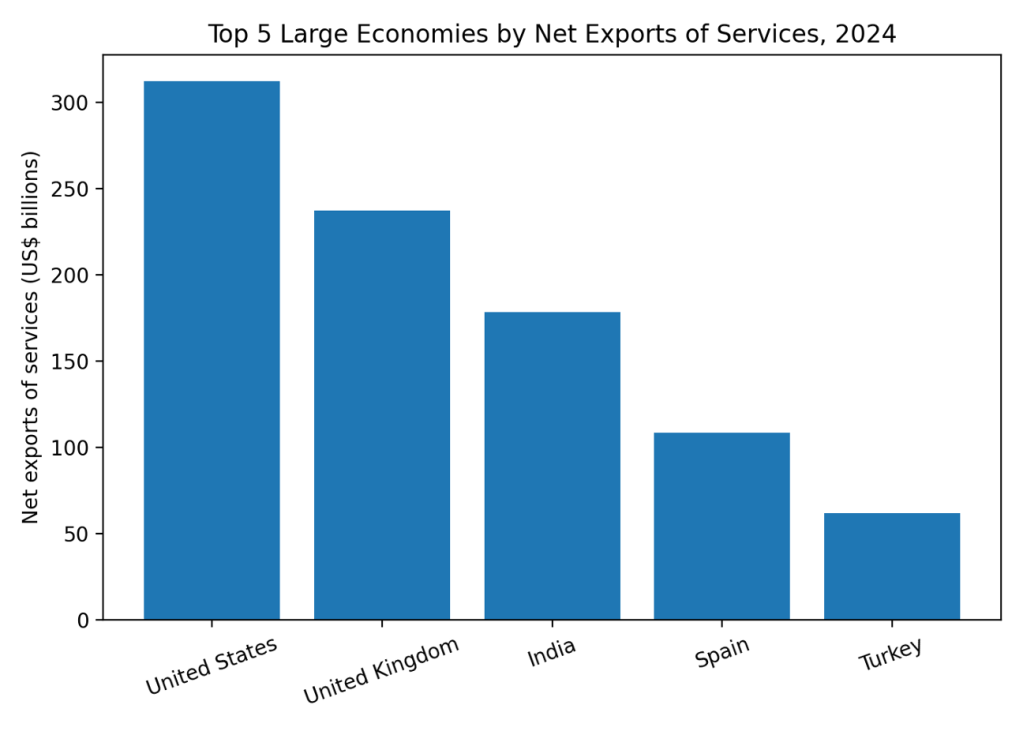
How does the United States compare to other countries? The following figure shows for 2024 the leaders in net exports of services for large economies (those with GDP of $1 trillion or more). The United States has largest value for net exports of services followed by the United Kingdom. China had negative net exports of services in 2024.
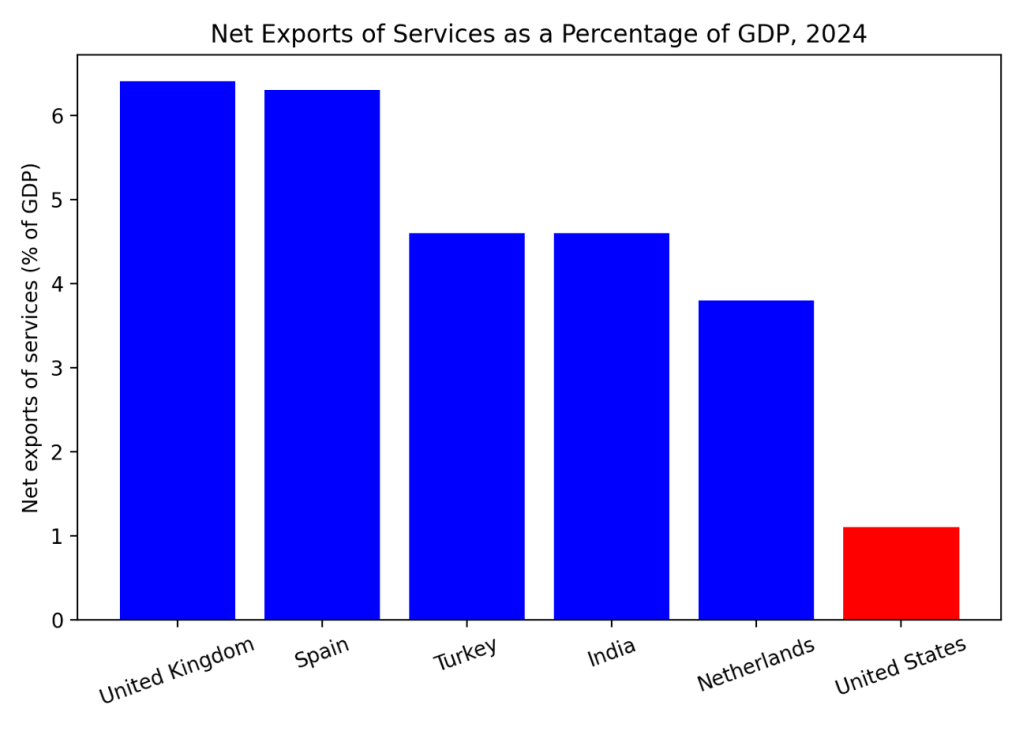
The following figure shows net exports in services as percentage of GDP among large economies. Measured this way, the largest net exporter of services is the United Kingdom, followed by Spain. The United States is included in graph (in red) for comparison and ranks ninth.
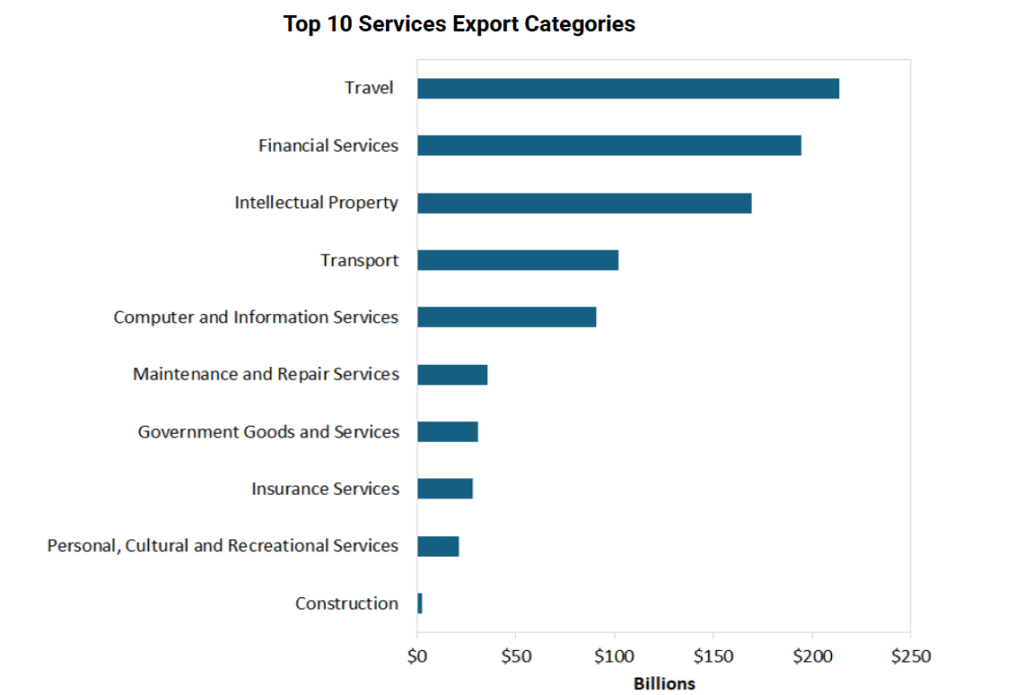
The following table from the St. Louis Fed’s blog posts shows the U.S. industries that export the most services.
The export of travel services represents largely foreign tourism in the United States. For example, if a family from France visits Walt Disney World in Florida, their spending would be included as an export of travel services.
Supports:Macroeconomics, Chapter 18, Economics, Chapter 28, and Essentials of Economics, Chapter 19.
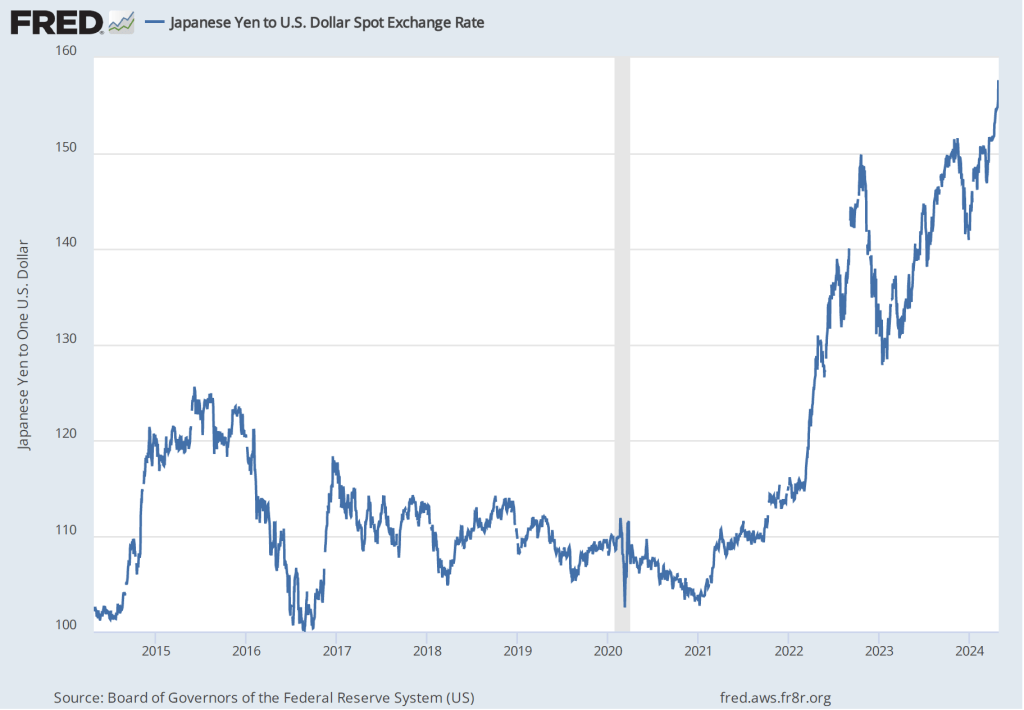
In a recent post, economics blogger Noah Smith discussed the effects on the Japanese economy of a “weaker yen”: “A weaker yen is making Japanese people feel suddenly poorer ….” But “let’s remember that a ‘weaker’ exchange rate isn’t always a bad thing.”
When the yen becomes weaker, does one yen exchange for more or fewer U.S. dollars?
Why might a weaker yen make Japanese people feel poorer?
Are there any ways that a weaker yen might help the Japanese economy? Briefly explain.
Considering your answers to parts b. and c., can you determine whether a weak yen is good or bad for the Japanese economy? Briefly explain.
Solving the Problem
Step 1:Review the chapter material. This problem is about the effect of changes in a country’s exchange rate on the country’s economy, so you may want to review Macroeconomics, Chapter 18, Section 18.2, “The Foreign Exchange Market and Exchange Rates,” (Economics, Chapter 28, Section 18.2, and Essentials of Economics, Chapter 19, Section 19.6.
Step 2:Answer part a. by explaining what a “weaker” yen means. A weaker yen will exchange for fewer U.S. dollars (or other currencies), or, equivalently, more yen will be required in exchange for a U.S. dollar. (This situation is illustrated in the figure at the top of this post, which shows the substantial weakening of yen against the dollar in the period since the end of the 2020 recession.)
Step 3: Answer part b. by explaining why a weaker yen might make people in Japan feel poorer. A weaker yen raises the yen price of imported goods. For example at an exchange rate of ¥100 = $1, a $1 Hershey candy bar imported from the United States will sell in Japan for ¥100. But if the yen becomes weaker and the exchange rate moves to ¥120 = $1, then the imported candy bar will have increased in price to ¥120. (Note that this discussion is simplified because a change in the exchange rate won’t necessarily be fully passed through to the prices of imported goods, particularly in the short run. But we would still expect that a weaker yen will result in higher yen prices of imports.) A weaker yen will require people in Japan to pay more for imports, leaving them with less to spend on other goods. Because they will be able to consume less, people in Japan will feel poorer. (As we note in Section 18.3, many goods traded internally are priced in U.S. dollars—oil being an important example. Because Japan imports nearly all of its oil and more than half of its food, a decline in the value of the yen in exchange for the dollar will increase the yen price of key consumer goods.)
Step 4: Answer part c. by explaining how a weaker yen might help the Japanese economy. A weaker yen increases the yen price of Japanese imports but it also decreases the foreign currency price of Japanese exports. This effect would be the main way in which a weaker yen might help the Japanese economy but we can also note that Japanese businesses that compete with foreign imports will also be helped by the increase in import prices.
Step 5: Answer part d. by explaining that a weaker yen isn’t all bad or all good for the Japanese economy. As the answers to parts b. and c. indicate, a weaker yen creates both winners and losers in the Japanese economy. Japanese consumers lose as a result of a weaker yen but Japanese firms that export or that compete against foreign imports will be helped.
Supports:Macroeconomics, Chapter 18, Economics, Chapter 28, and Essentials of Economics, Chapter 19.
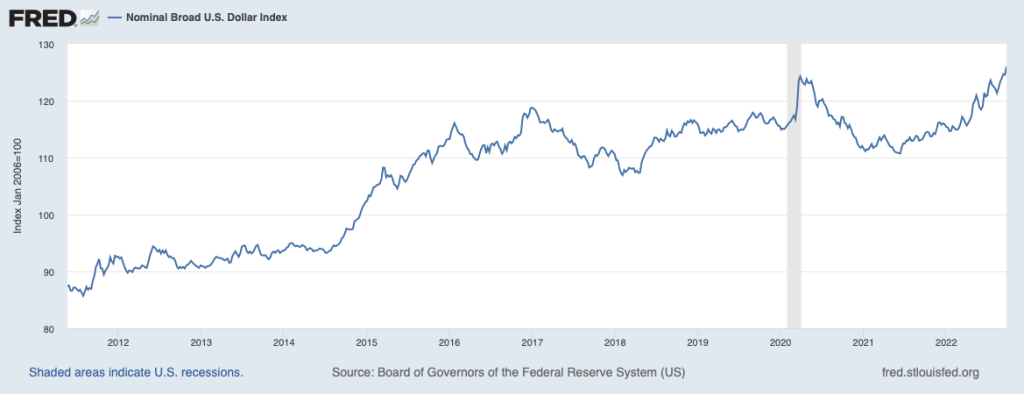
Between June 2021 and September 2022, the exchange rate between the U.S. dollar and an average of the currencies of the major trading partners of the United States increased by 14 percent. (This movement is shown in the figure above.) An article in the New York Times had the headline “The Dollar Is Strong. That Is Good for the U.S. but Bad for the World.”
Briefly explain what the headline means by a “strong” dollar.
Do you agree with the assertion in the headline that a stronger dollar is good for the United States but bad for the economies that the United States trades with? Briefly explain.
During this period the Federal Reserve was taking actions that raised U.S. interest rates. The article noted that “Those interest rate increases are pumping up the value of the dollar ….” Why would increases in U.S. interest rates relative to interest rates in other countries increase the value of the dollar?
Solving the Problem
Step 1: Review the chapter material. This problem is about the effect of fluctuations in the exchange rate and the relationship between interest rates and exchange rates, so you may want to review Macroeconomics, Chapter 18, Section 8.2, “The Foreign Exchange Market and Exchange Rates,” or the corresponding sections in Economics, Chapter 28 or Essentials of Economics, Chapter 19.
Step 2:Answer part a. by explaining what a “strong” dollar means. A strong dollar is one that exchanges for more units of foreign currencies, such as British pounds or euros. (A “weak” dollar means the opposite: A dollar that exchanges for fewer units of foreign currencies.)
Step 3: Answer part b. by explaining whether you agree with the assertion that a stronger dollar is good for the United States but bad for the economies of other countries. A stronger U.S. dollar produces winners and losers both in the United States and in other countries. U.S. consumers win because a stronger dollar means that fewer dollars are needed to buy the same quantity of a foreign currency, which reduces the dollar price of imports from that country. For example, a stronger dollar reduces the number of dollars U.S. consumers pay to buy a bottle of French wine that has a 40 euro price. A strong dollar is bad news for foreign consumers because they must pay more units of their currency to buy goods imported from the United States. For example, Japanese consumers will have to pay more yen to buy an imported Hershey’s candy bar with a $1.25 price.
The situation is reversed for U.S. and foreign firms exporting goods. Because foreign consumers have to pay higher prices in their own currencies for goods imported from the United States, they are likely to buy less of them, buying more domestically produced goods or goods imported from other countries. U.S. firms will either to have accept lower sales, or cut the prices they charge for their exports. In either case, U.S. exporters’ revenue will decline. Foreign firms that export to the United States will be in the opposite situation: The dollar prices of their exports will decline, increasing their sales.
We can conclude that the article’s headline is somewhat misleading because not all groups in the United States are helped by a strong dollar and not all groups in other countries are hurt by a strong dollar.
Step 4: Answer part c. by explaining why higher interest rates in the United States relative to interest rates in other countries will increase the exchange value of the dollar. If interest rates in the United States rise relative to interest rates in other countries—as was true during the period from the spring of 2021 to the fall of 2022—U.S. financial assets, such as U.S. Treasury bills, will be more desirable, causing investors to increase their demand for the dollars they need to buy U.S. financial assets. The resulting shift to the right in the demand curve for dollars will cause the equilibrium exchange rate between the dollar and other currencies to increase.
Source: Patricia Cohen, “The Dollar Is Strong. That Is Good for the U.S. but Bad for the World,” New York Times, September 26, 2022.
Supports: Economics: Chapter 28 – Macroeconomics in an Open Economy (Section 28.2); Macroeconomics: Chapter 12, Section 12.2; and Essentials: Chapter 19 – Comparative Advantage, International Trade, and Exchange Rates (Section 19.6)
Solved Problem: The Macroeconomic Effects of a Stronger Euro
In December 2020, an article in the Wall Street Journal discussed the effects of changes in the value of the euro in exchange for the U.S. dollar. The article noted that: “A stronger euro makes exports from the region less competitive overseas” and that a stronger euro would also “damp inflation” in countries using the euro as their currency.
a. What does the article mean by a “stronger euro”? Why would a stronger euro make European exports less competitive?
b. What does the article mean by “damp inflation”? Why would a stronger euro damp inflation in countries using the euro?
Source: Caitlin Ostroff, “Euro Rally Weighs on Inflation, Sapping Appetite for Stocks,” Wall Street Journal, December 9, 2020.
Solving the Problem
Step 1: Review the chapter material. This problem is about the effect of changes in the exchange rate on a country’s (or region’s) imports and exports, so you may want to review Chapter 28, Section 28.2 “How Movements in Exchange Rates Affect Imports and Exports.”
Step 2: Answer part a. by explaining what a “stronger euro” means and why a stronger euro would make European exports less competitive. A stronger euro is one that exchanges for more dollars or, which amounts to the same thing, requires fewer euros to exchange for a dollar. (You may want to review the Apply the Concept “Is a Strong Currency Good for a Country?”) A stronger euro results in U.S. consumers having to pay more dollars to buy goods and services imported from Europe. In other words, the prices of European exports to the United States will rise making the exports less competitive with U.S.-produced goods or with other countries exports to the United States. If the euro is also becoming stronger against currencies such as the British pound, Japanese yen, and Chinese yuan, then European exports will also be less competitive in those countries.
Step 3: Answer part b. by explaining what “damp inflation” means and why a stronger euro would damp inflation in countries using the euro. To “damp inflation” is to reduce inflation. So the article is stating that a stronger euro will result in lower inflation in Europe. To understand why, remember that while a stronger euro will raise the dollar price of European exports to the United States, it will reduce the euro price of European imports from the United States (and from other countries if the euro is also becoming stronger against currencies such as the British pound, Japanese yen, and Chinese yuan). Inflation in a country is measured using the prices of goods and services that consumers purchase, whether those goods and services are produced domestically or are imported.


 HubbardOBrienEconomics.com Blog