

This morning (August 7), the Bureau of Labor Statistics (BLS) released its “Employment Situation” report (often called the “jobs report”) for July. The report showed a decline in employment.
The jobs report has two estimates of the change in employment during the month: one estimate from the establishment survey, often referred to as the payroll survey, and one from the household survey. As we discuss in Macroeconomics, Chapter 9, Section 9.1 (Economics, Chapter 19, Section 19.1), many economists and Federal Reserve policymakers believe that employment data from the establishment survey provide a more accurate indicator of the state of the labor market than do the household survey’s employment and unemployment data. (The groups included in the employment estimates from the two surveys are somewhat different, as we discuss in this post.)
According to the establishment survey, there was a net decrease of 23,000 nonfarm jobs during July. Economists surveyed by the Wall Street Journal had forecast an increase of 83,000 jobs. Economists surveyed by FactSet had forecast a higher net increase of 100,000 jobs. The BLS revised downward its previous estimates of employment in May and June by a combined 103,000 jobs. (The BLS notes that: “Monthly revisions result from additional reports received from businesses and government agencies since the last published estimates and from the recalculation of seasonal factors.”)
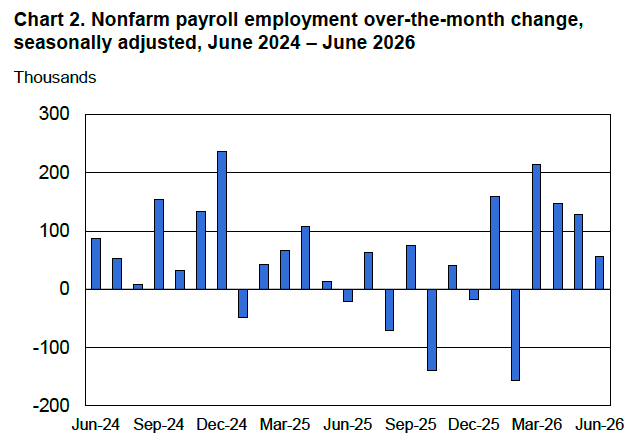
The following figure from the jobs report shows the net change in nonfarm payroll employment for each month in the last two years. The figure shows that since peaking in March with a net increase of 214,000 jobs, job growth has slowed markedly over the last four months. Over the last three months, we’ve seen only an average of 20,000 net new jobs created.
The slow pace of recent job growth is consistent with the view among some economists that slowing labor force growth has driven the break-even rate of employment growth—the rate required to keep the unemployment rate constant—down to nearly zero

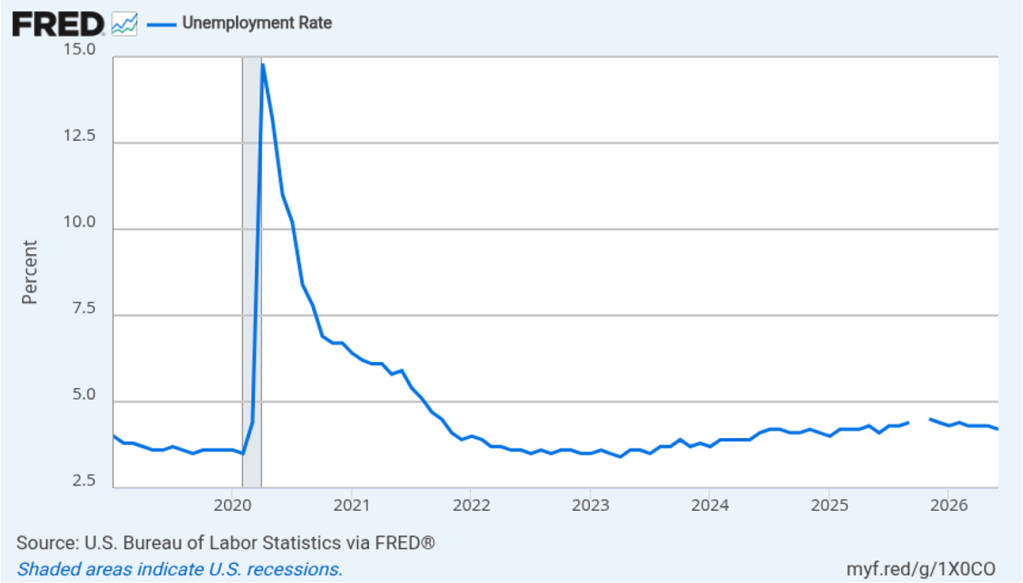
Despite the decrease in employment in July, the unemployment rate, which is calculated from data in the household survey, declined to 4.1 percent from 4.2 percent in June. The decline in the unemployment rate was due to a decline in the estimated size of the labor force. Although the estimated size of the labor force can fluctuate significantly from month to month, July was the fifth month in a row during which the labor force is estimated to have declined. Despite that fact, as the following figure shows, the unemployment rate has been remarkably stable over the past year and a half, staying between 4.0 percent and 4.4 percent in each month since June 2024. The Federal Open Market Committee’s current estimate of the natural rate of unemployment—the normal rate of unemployment over the long run—is 4.2 percent. So, currently the unemployment rate is slightly below that estimate of the natural rate. (We discuss the natural rate of unemployment in Macroeconomics, Chapter 9 and Economics, Chapter 19.)

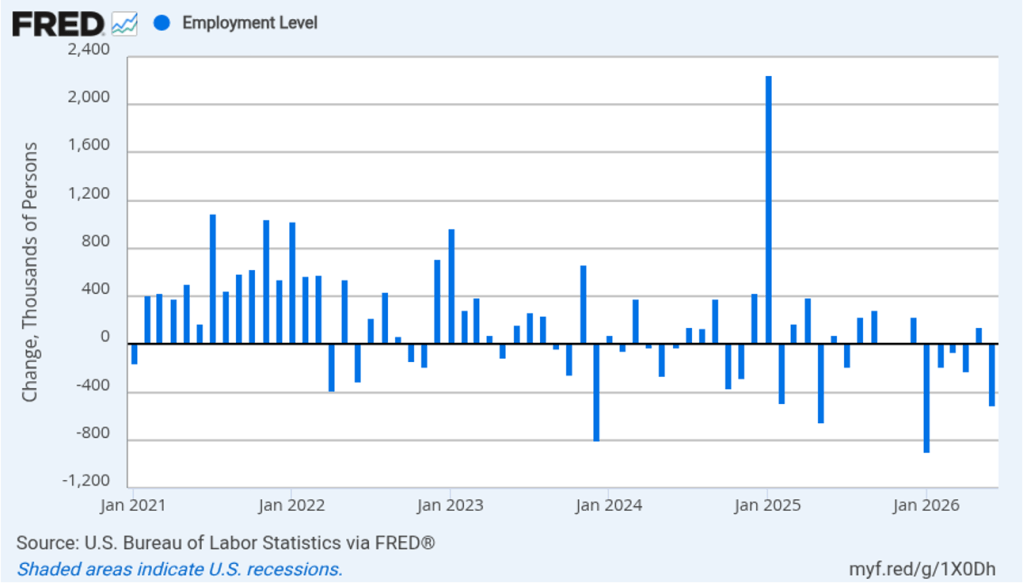
As the following figure shows, the monthly net change in jobs from the household survey moves much more erratically than does the net change in jobs from the establishment survey. As measured by the household survey, there was a net decrease of 87,000 jobs in July, roughly similar to the net decrease in employment shown in the establishment survey. Since January, the household survey has sown a net increase in jobs in only one month, with a total net decrease of 1.8 million jobs. In contrast, the establishment survey has shown a net increase of 426,000 jobs over the same period. (Note that because of last year’s shutdown of the federal government, there are no data for October or November.)

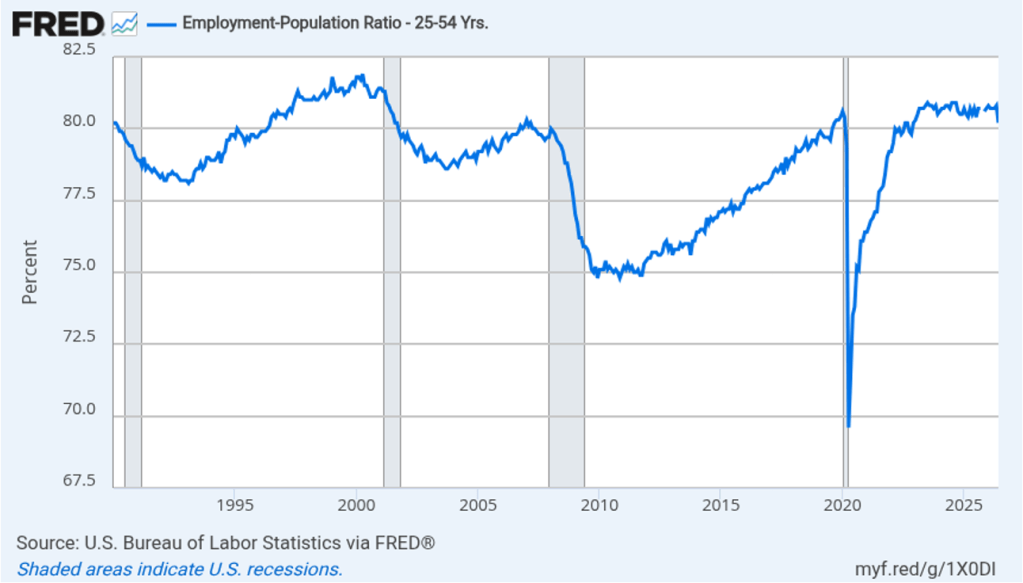
The household survey has another important labor market indicator: the employment-population ratio for prime age workers—those workers aged 25 to 54. In July, the ratio increased to 80.4 percent, partially reversing the sharp decline in June. The prime-age population ratio can show volatility from month to month but has remained above 80 percent every month since December 2022.

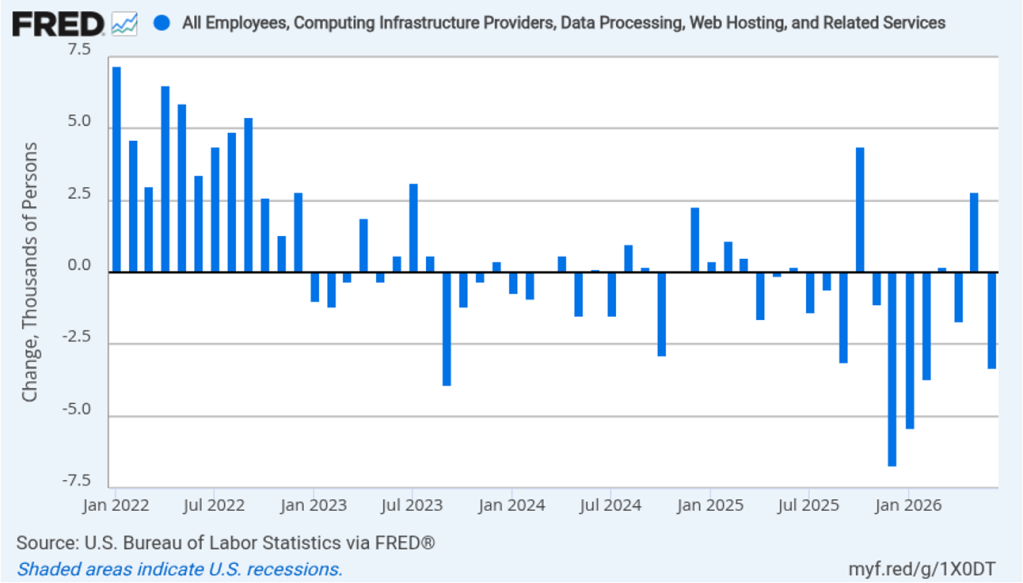
There have been media reports of firms, including Salesforce, Cloudflare, Coinbase, Cisco Systems, and Meta Platforms, laying off workers in information systems. The following figure shows net employment changes in the BLS employment category of “computing infrastructure providers, data processing, web hosting, and related services.” Employment in this sector has been declining during most months since the beginning of 2023. July was an exception with a net increase of 2,400 jobs.

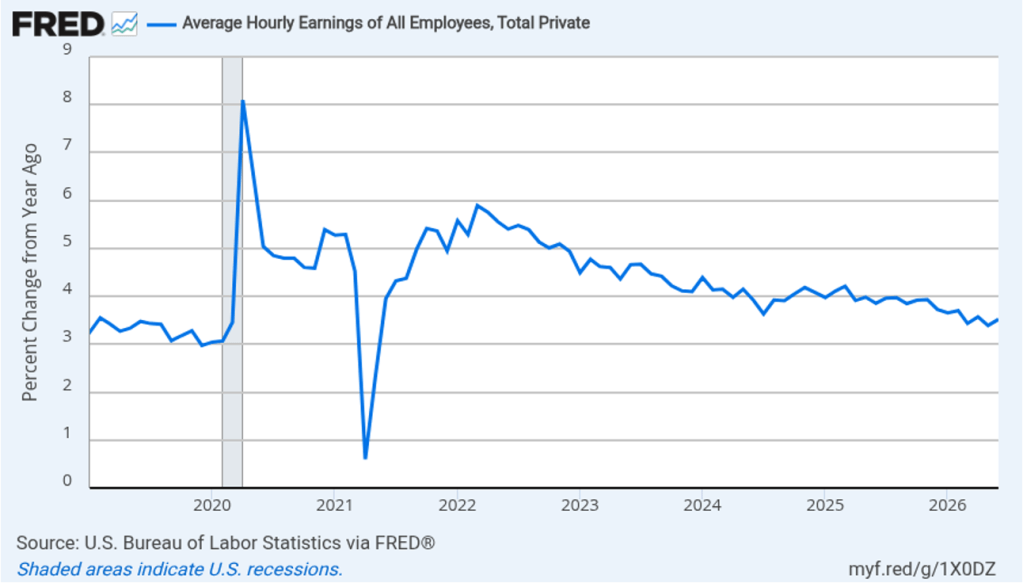
The establishment survey also includes data on average hourly earnings (AHE). As we noted in earlier posts, many economists and policymakers believe the employment cost index (ECI) is a better measure of wage pressures in the economy than is AHE. AHE does have the important advantage of being available monthly, whereas the ECI is only available quarterly. The following figure shows the percentage change in AHE from the same month in the previous year. AHE increased 3.2 percent in July, down from 3.4 percent in June. The rate of increase in AHE has been below 4.0 percent each month since August 2025, indicating that cost pressure from wage increases has not been a significant source of price inflation during the past year.

With inflation having been above the Federal Reserve’s 2 percent annual target every month since March 2021, there has been increasing speculation that the Fed’s policymaking Federal Open Market Committee (FOMC) would increase its target for the federal funds rate at least once before the end of 2026. At the FOMC’s last meeting in late July, three members of the committee voted to increase the target, an unusual amount of dissent from a committee decision.
Does the slowdown in employment growth in recent months reduce the chance that the FOMC will increase its target range for the federal funds rate at its next meeting on September 15–16? Investors in the federal funds futures market believe that the answer is “yes.” Yesterday, investors assigned only a 45.0 percent probability to the committee keeping its target rate unchanged. This afternoon, that probability had increased to 55.9 percent. The BLS will release its estimate of inflation as measured by the consumer price index next Wednesday. That report will provide further evidence about the current state of inflation.

 HubbardOBrienEconomics.com Blog