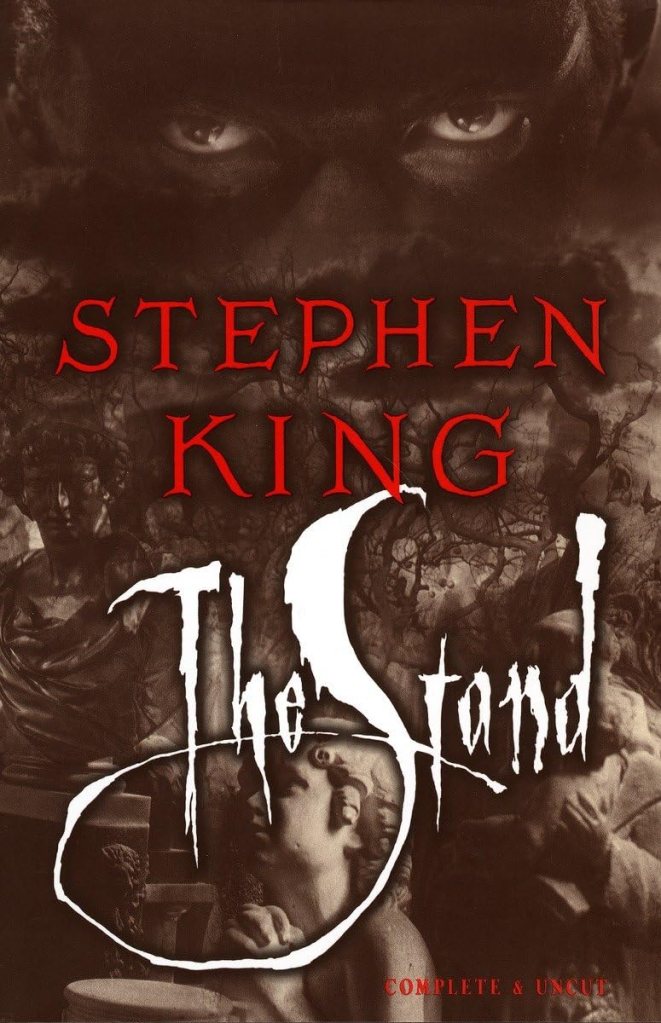
The cover of Steven King’s novel The Stand. (Image from amazon.com)
In Microeconomics, Chapter 10, we have a section on “Pitfalls in Decision Making.” One of those pitfalls is the failure to ignore sunk costs. A sunk cost is one that has already been paid and cannot be recovered.
In his book On Writing: A Memoir of the Craft, King discusses his writing of The Stand (a book he describes as “the one my longtime readers still seem to like the best.”) At one point he had had trouble finishing the manuscript and was considering whether to stop working on the novel:
“If I’d had two or even three hundred pages of single-spaced manuscript instead of more than five hundred, I think I would have abandoned The Stand and gone on to something else—God knows I had done it before. But five hundred pages was too great an investment, both in time and in creative energy; I found it impossible to let go.”
King seems to have committed the error of ignoring sunk costs. The time and creative energy he had put into writing the 500 pages were sunk—whether he abandoned the manuscript or continued writing until the book was finished, he couldn’t get back the time and energy he had expanded on writing the first five hundred pages. That he had already written 300 pages or 500 pages wasn’t relevant to his decision because if a cost is sunk it doesn’t matter for decision making whether the cost is large or small.
Is it relevant in assessing King’s decision that in the end he did finish The Stand, the novel sold well—earning King substantial royalties—and his fans greatly admire the novel? Not directly because only with hindsight do we know that The Stand was successful. In deciding whether to finish the manuscript, King shouldn’t have worried about the cost of the time and energy he had already spent writing it. Instead, King should have compared the expected marginal cost of finishing the manuscript with the expected marginal benefit from completing the book. Note that the expected marginal benefit could include not only the royalty earnings from sales of the books, but also the additional appreciation he received from his fans for writing what turned out to be their favorite novel.
When King paused working on the manuscript after having written 500 pages, the marginal cost of finishing was the opportunity cost of not being able to spend those hours and creative energy writing a different book. Given the success of The Stand, the marginal benefit to King from completing the manuscript was almost certainly greater than the marginal cost. So, completing the manuscript was the correct decision, even if he made it for the wrong reason!
Image generated by GTP-4o of a woman singer performing at a concert.
The answer to the question in the title is “yes” according to a column by James Mackintosh in the Wall Street Journal. In the Apply the Concept “Taylor Swift Tries to Please Fans and Make Money,” in Chapter 11 of Microeconomics, we discussed how for her The Eras Tour, Taylor Swift reserved more than half of the concert tickets for her “verified fans.” The tickets sold to verified fans for an average price of $250.
On the resale market, prices of the tickets soared to $1,000 or more. Yet only about 5 percent of tickets purchased by verified fans were resold. Mackintosh’s wife and “eldest offspring” were in in the other 95 percent—they had purchased their tickets at a low price but wouldn’t resell them at a much higher price. Moreover—and this is where Mackintosh sees economics as breaking—if they didn’t already have the tickets they wouldn’t have bought them at the current high price.
Not being willing to buy something at a price you wouldn’t sell it for is inconsistent behavior because it ignores a nonmonetary opportunity cost. (As we discuss in Chapter 10, Section 10.4.) If Mackintosh’s wife won’t sell her ticket for $1,000, she incurs a $1,000 opportunity cost, which is the amount she gives up by not selling the ticket. The two alternatives—either paying $1,000 for a ticket or not receiving $1,000 by declining to sell a ticket—amount to exactly the same thing.
Mackintosh recognizes that the actions of his wife and offspring reflect what he calls a “mental bias,” which he correctly labels the endowment effect: The tendency to be unwilling to sell something you already own even if you are offered a price greater than the price you would be willing to buy the thing for if you didn’t already own it.
As we discuss in Chapter 10, the endowment effect is one of a number of results from behavioral economics, which is the study of situations in which people make choices that don’t appear to be economically rational. So, Mackintosh’s family—and other Swifties—didn’t break economics. Instead, they demonstrated one of the results of behavioral economics.
Wendy’s management intends to begin using dynamic pricings in its fast-food restaurants. As we discuss in Microeconomics and Economics, Chapter 15, Section 15.5 (Essentials of Economics, Chapter 10, Section 10.5), dynamic pricing is a form of price discrimination, which is the business practice of charging different prices to different customers for the same good or service. The ability of firms to analyze customer data using machine learning models has increased the ability to price discriminate.
One form of price discrimination involves charging customers different prices at different times, as, for instance, when movie theaters charge a lower price during afternoon showings than during evening showings. As a group, people who can choose whether to attend either an afternoon or an evening showing are more sensitive to changes in the price of a ticket—that is, their demand for tickets is more price elastic—than are people who can only attend an evening showing. Price discrimination with respect to movie tickets results in movie theaters earning a greater profit than if they charged the same price for all showings.
In a conference call with investors in February, Wendy’s CEO Kirk Tanner indicated that next year the firm would begin using dynamic pricing of its hamburgers and other menu items by charging different prices at different times of the day. Tanner didn’t provide details on how prices would differ in high demand times, such as during lunch and dinner, and low demand times, such as the middle of the afternoon. Some business commentators, though, assumed that Wendy’s dynamic pricing strategy would resemble Uber’s surge pricing strategy. As we discuss in Microeconomics, Economics, and Essentials of Economics, Chapter 4, Section 4.1, Uber increases prices during periods of high demand, such as on New Year’s Eve.
The idea that Wendy’s would increase prices at peak times sparked a strong reaction on social media with many people criticizing the firm for “price gouging.” Rival fast-food restaurants joined the criticism. Burger King posted on X (formerly Twitter) that “we don’t believe in charging people more when they’re hungry.” As we note in Microeconomics and Economics, Chapter 10, Section 10.3 (Essentials of Econmics, Chapter 7, Section 7.3), surveys indicate that many people believe that it is fair for firms to raise prices following an increase in the firms’ costs, but unfair to raise prices following an increase in demand.
One way for firms to avoid this reaction from consumers while still price discriminating is to frame the issue by stating that they charge regular prices during times of peak demand and discount prices during times of low demand. For example, recently one AMC theater was charging $13.99 for a 7:15 PM showing of Dune: Part Two, but a “Matinee Discount Price” of $10.39 for a 1:oo PM showing of the film. Note that there is no real economic difference between AMC calling the evening price the normal price and the afternoon price the discoung price and the firm calling the afternoon price the normal price and the evening price a “surge price.” But one of the lessons of behavioral economics is that firms should pay attention to how consumers intepret a policy. Many consumers clearly see the two pricing strategies as different even though economically they aren’t. (We discuss behavioral economics in Microeconomics and Economics, Chapter 10, Section 10.4, and in Essentials of Economics, Chapter 7, Section 7.4.)
Not surprisingly, following the adverse reaction to its annoucement that it would begin using dynamic pricing, Wendy’s responded with a blog post in which it stated that its new pricing strategy was “misconstrued in some media reports as an intent to raise prices when demand is highest at our restaurants. We have no plans to do that and would not raise prices when our customers are visiting us most.” And that: “Digital menuboards could allow us to change the menu offerings at different times of day and offer discounts and value offers to our customers more easily, particularly in the slower times of day.” In effect, Wendy’s was framing its pricing strategy the way movie theaters do rather than the way Uber does.
Wendy’s CEO probably realizes now that how a pricing strategy is presented to consumers can affect how successful the strategy will be.
In the Apply the Concept “Trying to Use the Apple Approach to Save J.C. Penney” in Chapter 10, Section 10.4 in both Microeconomics and Economics, we discussed how Ron Johnson had been successful as head of Apple’s retail stores but failed when he was hired as CEO of J. C. Penney. Insights from behavioral economics indicate that Johnson made a mistake in eliminating Penney’s previous strategy of keeping prices high but running frequent sales. Although Penney’s “every day prices” under Johnson were lower than they had been under the previous management, many consumers failed to recognize that fact and began shopping elsewhere.
Johnson’s experience may indicate the dangers of changing a firm’s long-standing business model. Customers at brick-and-mortar retail stores fall into several categories: Some people shop in a number of stores, depending on which store has the lowest price on the particular product they’re looking for; some shop only for products such as televisions or appliances that they hesitate to buy from Amazon or other online sites; while others shop primarily in the store that typically meets their needs with respect to location, selection of products, and pricing. It’s the last category of customer that was most likely to stop shopping at Penney because of Johnson’s new pricing policy because they were accustomed to primarily buying products that were on sale.
Bed Bath & Beyond was founded in 1971 by Warren Eisenberg and Leonard Feinstein. As the name indicates, it has focused on selling household goods—sometimes called “home goods”—such as small appliances, towels, and sheets. It was perhaps best known for mailing massive numbers of 20 percent off coupons, printed on thin blue cardboard and nicknamed Big Blue, to households nationwide. Although by 2019, the firm was operating more than 1,500 stores in the United States, some investors were concerned that Bed Bath & Beyond could be run more profitably. In March 2019, the firm’s board of directors replaced the current CEO with Mark Tritton who had helped make Target stores very profitable.
In an approach similar to the one Ron Johnson had used at J.C. Penney, Tritton cut back on the number of coupons sent out, reorganized the stores to reduce the number of different products available for sale, and replaced some name brand goods with so-called private-label brands produced by Bed Bath & Beyond. Unfortunately, Tritton’s strategy was a failure and the firm, which had been profitable in 2018, suffered losses each year between 2019 and 2022. The losses totaled almost $1.5 billion. In June 2022, the firm’s board of directors replaced Tritton with Sue Grove who had been serving on the board.
Why did Tritton’s strategy fail? Partly because in March 2020, the effects of the Covid-19 pandemic forced the closure of many Bed Bath & Beyond stores. Unlike some other chains, Bed Bath & Beyond’s web site struggled to fulfill online orders. The firm also never developed a system that would have made it easy for customers to order goods online and pick them up at the curb of their retail stores. That approach helped many competitors maintain sales during the pandemic. Covid-19 also disrupted the supply chains that Tritton was depending on to produce the private-label brands he was hoping to sell in large quantities.
But the larger problems with Tritton’s strategy would likely have hurt Bed Bath & Beyond even if there had been no pandemic. Tritton thought the stores were too cluttered, particularly in comparison with Target stores, so he reduced the number of products for sale. It turned out, though, that many of Bed Bath & Beyond’s most loyal customers liked searching through the piles of goods on the shelves. One customer was quoted as saying, “I used to find so many things that I didn’t need, that I’d end up buying anyway, like July 4th-themed corn holders.” Customers who preferred to shop in less cluttered stores were likely to already be shopping elsewhere. And it turned out that many Bed Bath & Beyond customers preferred national brands and switched to shopping elsewhere when Tritton replaced those brands with private-label brands. Finally, many customers were accustomed to shopping at Bed Bath & Beyond shortly after receiving a Big Blue 20 percent off coupon. Sending out fewer coupons meant fewer trips to Bed Bath & Beyond by those customers.
In a manner similar to what happened to Johnson in his overhaul of the Penney department stores, Tritton’s changes to Bed Bath & Beyond’s business model caused many existing customer to shop elsewhere while attracting relatively few new customers. An article in the Wall Street Journal quoted an industry analyst as concluding: “Mark Tritton entered the business and ripped up its playbook. But the strategy he replaced it with was not tested and nowhere near sharp enough to compensate for the loss of traditional customers.”
Sources: Jeanette Neumann, “Bed Bath & Beyond Traced an Erratic Path to Its Current Crisis,” bloomberg.com, September 29, 2022; Kelly Tyko, “What to expect at Bed Bath & Beyond closing store sales,” axios.com September 22, 2022; Inti Pacheco and Jodi Xu Klein, “Bed Bath & Beyond to Close 150 Stores, Cut Staff, Sell Shares to Raise Cash,” Wall Street Journal, August 31, 2022; Suzanne Kapner and Dean Seal, “Bed Bath & Beyond CEO Mark Tritton Exits as Sales Plunge,” Wall Street Journal, June 29, 2022; Suzanne Kapner, “Bed Bath & Beyond Followed a Winning Playbook—and Lost,” Wall Street Journal, July 23, 2022; and Ron Lieber, “An Oral History of the World’s Biggest Coupon,” New York Times, November 3, 2021.
Supports: Microeconomics, Chapter 6, Section 6.3 and Chapter 10, Section 10.3, Economics Chapter 6, Section 6.3 and Chapter 10, Section 10.3, and Essentials of Economics, Chapter 7, Section 7.4 and Section 7.7.
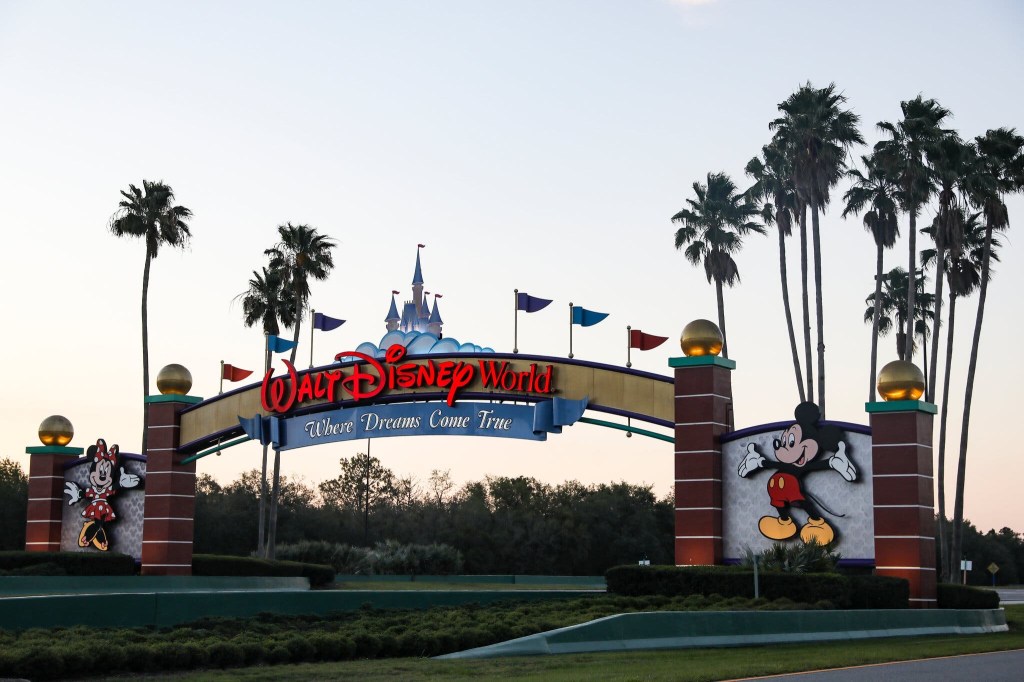
In August 2022, an article in the Wall Street Journal discussed the Disney Company increasing the prices it charges for admission to its Disneyland and Walt Disney World theme parks. As a result of the price increases, “For the quarter that ended July 2 [2022], the business unit that includes the theme parks … posted record revenue of $5.42 billion and record operating income of $1.65 billion.” The increase in revenue occurred even though “attendance at Disney’s U.S. parks fell by 17% compared with the previous year….”
The article also contains the following observations about Disney’s ticket price increases:
“Disney’s theme-park pricing is determined by ‘pure supply and demand,’ said a company spokeswoman.”
“[T]he changes driving the increases in revenue and profit have drawn the ire of what Disney calls ‘legacy fans,’ or longtime parks loyalists.”
Briefly explain what must be true of the demand for tickets to Disney’s theme parks if its revenue from ticket sales increased even though 17 percent fewer tickets were sold. [For the sake of simplicity, ignore any other sources of revenue Disney earns from its theme parks apart from ticket sales.]
In Chapter 10, Section 10.3 the textbook discusses social influences on decision making, in particular, the business implications of fairness. Briefly discuss whether the analysis in that section is relevant as Disney determines the prices for tickets to its theme parks.
Solving the Problem
Step 1: Review the chapter material. This problem is about the effects of price increases on firms’ revenues and on whether firms should pay attention the possibility that consumers might be concerned about fairness when making their consumption decisions, so you may want to review Chapter 6, Section 6.3, “The Relationship between Price Elasticity of Demand and Total Revenue” and Chapter 10, Section 10.3, “Social Influences on Decision Making,” particularly the topic “Business Implications of Fairness.”
Step 2: Answer part a. by explaining what must be true of the demand for tickets to Disney’s theme parks if revenue from ticket sales increased even though Disney sold fewer tickets. Assuming that the demand curve for tickets to Disney’s theme parks is unchanged, a decline in the quantity of tickets sold will result in a move up along the demand curve for tickets, raising the price of tickets. Only if the demand curve for theme park tickets is price inelastic will the revenue Disney receives from ticket sales increase when the price of tickets increases. Revenue increases in this situation because with an inelastic demand curve, the percentage increase in price is greater than the percentage decrease in quantity demanded.
Step 3: Answer part b. by explaining whether the textbook’s discussion of the business implications of fairness is relevant as Disney as determines ticket prices. Section 10.3 may be relevant to Disney’s decisions because the section discusses that firms sometimes take consumer perceptions of fairness into account when deciding what prices to charge. Note that ordinarily economists assume that the utility consumers receive from a good or service depends only on the attributes of the good or service and is not affected by the price of the good or service. Of course, in making decisions on which goods and services to buy with their available income, consumers take price into account. But consumers take price into account by comparing the marginal utilities of products realtive to their prices, with the marginal utilities assumed not to be affected by the prices.
In other words, a consumer considering buying a ticket to Disney World will compare the marginal utility of visiting Disney World relative to the price of the ticket to the marginal utility of other goods and services relative to their prices. The consumer’s marginal utility from spending a day in Disney World will not be affected by whether he or she considers the price of the ticket to be unfairly high.
The textbook gives examples, though, of cases where a business may fail to charge the price that would maximize short-run profit because the business believes consumers would see the price as unfair, which might cause them to be unwilling to buy the product in the future. For instance, restaurants frequently don’t increase their prices during a particularly busy night, even though doing so would increase the profit they earn on that night. They are afraid that if they do so, some customers will consider the restaurants to have acted unfairly and will stop eating in the restaurants. Similarly, the National Football League doesn’t charge a price that would cause the quantity of Super Bowl tickets demanded to be equal to the fixed supply of seats available at the game because it believes that football fans would consider it unfair to do so.
The Wall Street Journal article quotes a Disney spokeswomen as saying that the company sets the price of tickets according to demand and supply. That statement seems to indicate that Disney is charging the price that will maximize the short-run profit the company earns from selling theme park tickets. But the article also indicates that many of Disney’s long-time ticket buyers are apparently upset at the higher prices Disney has been charging. If these buyers consider Disney’s prices to be unfair, they may in the future stop buying tickets.
In other words, it’s possible that Disney might find itself in a situation in which it has increased its profit in the short run at the expense of its profit in the long run. The managers at Disney might consider sacrificing some profit in the long run to increase profit in the short run an acceptable trade-off, particularly because it’s difficult for the company to know whether in fact many of its customers will in the future stop buying admission tickets because they believe current ticket prices to be unfairly high.
Sources: Robbie Whelan and Jacob Passy, “Disney’s New Pricing Magic: More Profit From Fewer Park Visitors,” Wall Street Journal, August 27, 2022.


 HubbardOBrienEconomics.com Blog