Is the iPhone Air Apple’s “New Coke”?

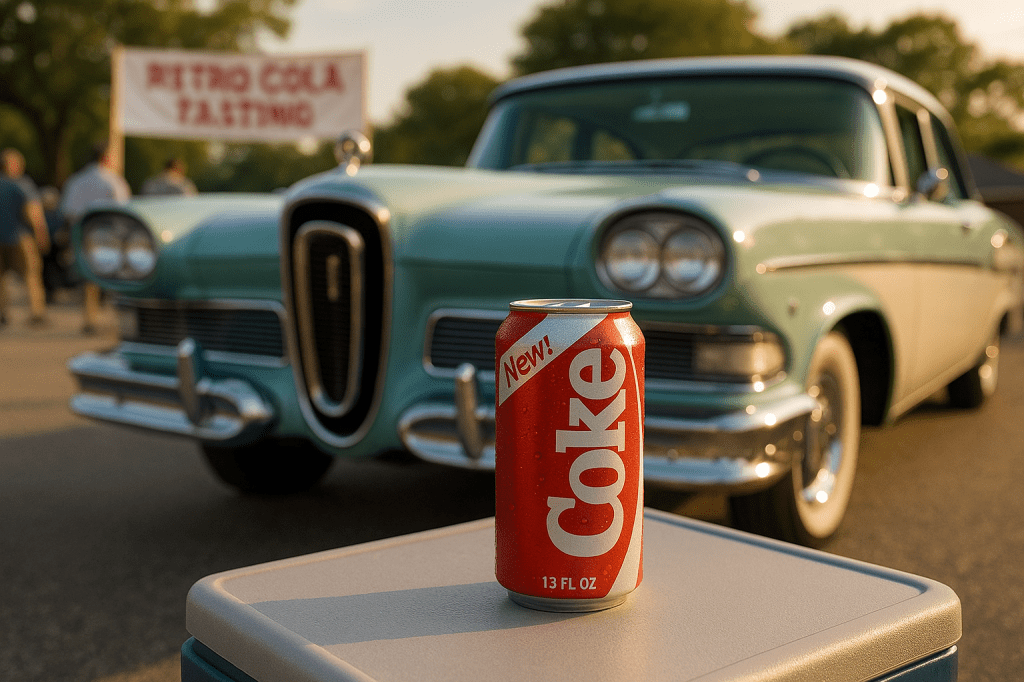
Image created by GPT

Most large firms selling consumer goods continually evaluate which new products they should introduce. Managers of these firms are aware that if they fail to fill a market niche, their competitors or a new firm may develop a product to fill the niche. Similarly, firms search for ways to improve their existing products.

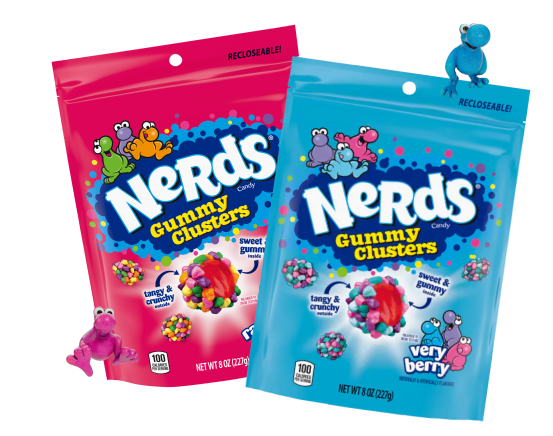
For example, Ferrara Candy, had introduced Nerds in 1983. Although Nerds experienced steady sales over the following years, company managers decided to devote resources to improving the brand. In 2020, they introduced Nerds Gummy Clusters, which an article in the Wall Street Journal describes as being “crunchy outside and gummy inside.” Over five years, sales of Nerds increased from $50 millions to $500 million. Although the company’s market research “suggested that Nerds Gummy Clusters would be a dud … executives at Ferrara Candy went with their guts—and the product became a smash.”

Image of Nerds Gummy Clusters from nerdscandy.com

Firms differ on the extent to which they rely on market research—such as focus groups or polls of consumers—when introducing a new product or overhauling an existing product. Henry Ford became the richest man in the United States by introducing the Model T, the first low-priced and reliable mass-produced automobile. But Ford once remarked that if before introducing the Model T he had asked people the best way to improve transportation they would probably have told him to develop a faster horse.  (Note that there’s a debate as to whether Ford ever actually made this observation.) Apple co-founder Steve Jobs took a similar view, once remaking in an interview that “it’s really hard to design products by focus groups. A lot of times, people don’t know what they want until you show it to them.” In another interview, Jobs stated: “We do no market research. We don’t hire consultants.”

Unsurprisingly, not all new products large firms introduce are successful—whether the products were developed as a result of market research or relied on the hunches of a company’s managers. To take two famous examples, consider the products shown in image at the beginning of this post—“New Coke” and the Ford Edsel.

Pepsi and Coke have been in an intense rivalry for decades. In the 1980s, Pepsi began to gain market share at Coke’s expense as a result of television commercials showcasing the “Pepsi Challenge.” The Pepsi Challenge had consumers choose from colas in two unlabeled cups. Consumers overwhelming chose the cup containing Pepsi. Coke’s management came to believe that Pepsi was winning the blind taste tests because Pepsi was sweeter than Coke and consumers tend to favor sweeter colas. In 1985, Coke’s managers decided to replace the existing Coke formula—which had been largely unchanged for almost 100 years—with New Coke, which had a sweeter taste. Unfortunately for Coke’s managers, consumers’ reaction to New Coke was strongly negative. Less than three months later, the company reintroduced the original Coke, now labeled “Coke Classic.” Although Coke produced both versions of the cola for a number of years, eventually they stopped selling New Coke.

Through the 1920s, the Ford Motor Company produced only two car models—the low-priced Model T and the high-priced Lincoln. That strategy left an opening for General Motors during the 1920s to introduce a variety of car models at a number of price levels. Ford scrambled during the 1930s and after the end of World War II in 1945 to add new models that would compete directly with some of GM’s models. After a major investment in new capacity and an elaborate marketing campaign, Ford introduced the Edsel in September 1957 to compete against GM’s mid-priced models: Pontiac, Oldsmobile, and Buick.

Unfortunately, the Edsel was introduced during a sharp, although relatively short, economic recession. As we discuss in Macroeconomics, Chapter 13 (Economics, Chapter 23), consumers typically cut back on purchases of consumer durables like automobiles during a recession. In addition, the Edsel suffered from reliability problems and many consumers disliked the unusual design, particularly of the front of the car. Consumers were also puzzled by the name Edsel. Ford CEO Henry Ford II was the grandson of Henry Ford and the son of Edsel Ford, who had died in 1943. Henry Ford II named in the car in honor of his father but the unusual name didn’t appeal to consumers. Ford ceased production of the car in November 1959 after losing $250 million, which was one of the largest losses in business history to that point. The name “Edsel” has lived on as a synonym for a disastrous product launch.

Screenshot

Image of iPhone Air from apple.com

Apple earns about half of its revenue and more than half of its profit from iPhone sales. Making sure that it is able to match or exceed the smartphone features offered by competitors is a top priority for CEO Tim Cook and other Apple managers. Because Apple’s iPhones are higher-priced than many other smartphones, Apple has tried various approaches to competing in the market for lower-priced smartphones.

In 2013, Apple was successful in introducing the iPad Air, a thinner, lower-priced version of its popular iPad. Apple introduced the iPhone Air in September 2025, hoping to duplicate the success of the iPad Air. The iPhone Air has a titanium frame and is lighter than the regular iPhone model. The Air is also thinner, which means that its camera, speaker, and its battery are all a step down from the regular iPhone 17 model. In addition, while the iPhone Air’s price is $100 lower than the iPhone 17 Pro, it’s $200 higher than the base model iPhone 17.

Unlike with the iPad Air, Apple doesn’t seem to have aimed the iPhone Air at consumers looking for a lower-priced alternative. Instead, Apple appears to have targeted consumers who value a thinner, lighter phone that appears more stylish, because of its titanium frame, and who are willing to sacrifice some camera and sound quality, as well as battery life. An article in the Wall Street Journal declared that: “The Air is the company’s most innovative smartphone design since the iPhone X in 2017.”  As it has turned out, there are apparently fewer consumers who value this mix of features in a smartphone than Apple had expected.

Sales were sufficiently disappointing that within a month of its introduction, Apple ordered suppliers to cut back production of iPhone Air components by more than 80 percent. Apple was expected to produce 1 million fewer iPhone Airs during 2025 than the company had initially planned. An article in the Wall Street Journal labeled the iPhone Air “a marketing win and a sales flop.” According to a survey by the KeyBanc investment firm there was “virtually no demand for [the] iPhone Air.”

Was Apple having its New Coke moment? There seems little doubt that the iPhone Air has been a very disappointing new product launch. But its very slow sales haven’t inflicted nearly the damage that New Coke caused Coca-Cola or that the Edsel caused Ford. A particularly damaging aspect of New Coke was that was meant as a replacement for the existing Coke, which was being pulled from production. The result was a larger decline in sales than if New Coke had been offered for sale alongside the existing Coke. Similarly, Ford set up a whole new division of the company to produce and sell the Edsel. When Edsel production had to be stopped after only two years, the losses were much greater than they would have been if Edsel production hadn’t been planned to be such a large fraction of Ford’s total production of automobiles.

Although very slow iPhone Air sales have caused Apple to incur losses on the model, the Air was meant to be one of several iPhone models and not the only iPhone model. Clearly investors don’t believe that problems with the Air will matter much to Apple’s profits in the long run. The following graphic from the Wall Street Journal shows that Apple’s stock price has kept rising even after news of serious problems with Air sales became public in late October.


So, while the iPhone Air will likely go down as a failed product launch, it won’t achieve the legendary status of New Coke or the Edsel.

Kooba Cola: The Worst Business Strategy Ever?

One of the key lessons of economics is that competition serves to push firms toward serving the interests of consumers. When existing firms in an industry are making an economic profit, new firms will enter the industry, which increases the quantity of the good produced and lowers the good’s price. Entry is the essential mechanism that drives a competitive market economy towards achieving allocative efficiency—with the mix of goods and services produced matching consumer preferences—and productive efficiency—with goods and services being produced at the lowest possible cost. (We discuss allocative efficiency and productive efficiency in Chapter 1, Section 1.2.)

For entry to occur requires the efforts of entrepreneurs, who constantly search for opportunities to make a profit. (We discuss the role of entrepreneurs in a market economy in Chapter 2, Section 2.3.)  Although, not well remembered today, Victor S. Fox was one of the more flamboyant entrepreneurs in U.S. business history. Fox was born in England in 1893 and moved with his family to Massachusetts three years later. As a young man, he started a firm to manufacture women’s clothing. In 1917, with the entry of the United States into World War I, Fox’s firm switched to producing military uniforms. In 1920, after the end of the war, Fox founded Consolidated Maritime Lines to buy from the U.S. government confiscated German and Austrian cargo ships. Fox also purchased a coal mine in Virginia to provide fuel for the ships. This effort ended in bankruptcy.

In 1929, Fox founded Allied Capital Corporation to invest in the stock market. This firm also failed amid accusations that Fox had broken securities laws. (Most of the information on Fox’s early career is from this site, which relies primarily on mentions of Fox in newspapers.) In 1936, Fox founded Fox Feature Syndicate to produce magazines. At that point, very few comic books were being published. That changed in April 1938, when National Allied Publications released Action Comics, featuring Superman—generally considered the first superhero to appear in comic books.  Sales of Superman comic books soared and Fox responded by entering the comic book industry, publishing a comic book starring Wonder Man. Wonder Man was an obvious copy of Superman, which led Superman’s publisher to file a lawsuit against Fox for copyright infringement. Fox agreed to stop publishing Wonder Man, but continued to publish comic books starring superheroes who weren’t such obvious copies of Superman.

As this summary of Fox’s career indicates, he was an entrepreneur who was willing to enter a new industry whenever he saw a profit opportunity, even if he lacked previous experience in the industry. In 1941, the continuing success of Coca-Cola and Pepsi-Cola led Fox to attempt to enter the cola industry in what was his most audacious entrepreneurial effort.  The high sales of his comic books gave Fox a platform to advertise his new soft drink —Kooba cola.  The following are some of Fox’s advertisements for Kooba cola.

Fox also advertised Kooba on a radio program featurning the Blue Beetle, one of his comic book superheroes. In the print advertisements for Kooba, Fox seems to have focused on two points in an attempt to differentiate his cola from existing colas, particularly Coke and Pepsi. (We discuss the role product differentiation plays in competition among firms in Microeconomics and Economics, Chapter 13.) First, to help overcome the belief among some consumers that colas were an unhealthy drink, Fox emphasized that Kooba cola would contain vitamin B1. In 1941, vitamin B1 had only recently become available and was the subject of newspaper stories. Second, at 12 ounces, bottles of Kooba were nearly twice as large as the standard 6.5 ounce Coke bottle but would sell for the same 5 cent price. One of the advertisements above notes that a six-pack of Kooba had a price of only 25 cents.

How was Fox able to sell his new cola for about half the price per ounce of Coke or Pepsi? That’s unclear because—amazingly—at the time Fox was running these advertisements, not only was Kooba not “available everywhere,” as the advertisements claimed, it wasn’t available anywhere. Fox was heavily advertising a product that didn’t actually exist.

How did Fox hope to earn a profit selling a nonexistent product? Fox’s strategy was apparently to begin by heavily advertising Kooba in the hopes of sparking a demand for it. He seems to have believed that if enough people were inspired by his advertisements to ask for the cola at grocery stores and newsstands, he could approach an existing soft drink company and offer to license the Kooba name. He seems never to have intended to actually manufacture the cola, relying instead on royalties paid by the soft drink company he hoped to license the name to.

Perhaps unsurprisingly, Fox’s strategy failed. To capitalize on Fox’s advertising, a firm licensing the Kooba name would have had to find a way to make a profit despite selling the cola at a price about half the price charged by competitors. Because Fox had no experience in manufacturing colas, he presumably had no advice to give on how production costs could be reduced sufficiently to allow Kooba to be sold at a profit.

Fox engaged in other entrepreneurial efforts before passing away in 1957. Over the years, Fox pursued a number of business strategies, some of which were successful, at least for a time. But his attempt to make a profit by promoting a nonexistent cola ranks among the the most dubious strategies in U.S. business history. A strategy that likely left some consumers puzzled that a cola that appeared in advertisements was never available in store.

Cheesecake Factory Adopts a New Strategy

The restaurant industry was hit hard by the Covid-19 pandemic. Fast food restaurants like McDonalds and Taco Bell had their revenues hold up the best because many of their customers were experienced in using their drive-through windows, which typically remained open except during the worst of the pandemic in the Spring of 2020. Restaurants that rely on table service suffered steeper declines in revenue because even when local governments allowed them to be open, they were typically required to operate at reduced capacity. In addition, through most of 2021, some consumers were reluctant to spend an hour or more eating indoors for fear of contracting the virus.

In the years leading up to the pandemic, fast-casual restaurants like Chipotle, Panera Bread, and Cheesecake Factory had been increasing in popularity, drawing customers from both more formal table service restaurants and from fast food-food restaurants. But because of their reliance on indoor dining, many fast-casual restaurants suffered sharp declines in revenue. For instance, in the spring of 2020, Cheesecake Factory was losing $6 million per week and at one point had less than $100 million remaining on hand to meet its costs.

As we discuss in Chapter 13, Section 13.3, firms in a monopolistically competitive like restaurants have difficulty earning an economic profit in the long run. Normally, economic profit is eliminated by entry of new firms. But during the pandemic, the process was speeded up as what had been profitable business strategies suddenly no longer were.

Cheesecake Factory had been earning an economic profit by following a strategy that differentiated it from similar restaurant chains. At 10,000 square feet, the dining rooms in its restaurants are much larger than in other fast-casual restaurants and Cheesecake Factory has many more items on its menus.  Both these features turned into liabilities during the pandemic because before the pandemic Cheesecake Factory’s revenue would exceed its costs only if its restaurants were operated close to their capacity. In many cities, well into 2021, government restrictions required restaurants to operate at reduced capacity. In addition, like most other restaurants, as it reopened Cheesecake Factory had trouble attracting enough servers and cooks—a particular problem given the large number of items on its menus.

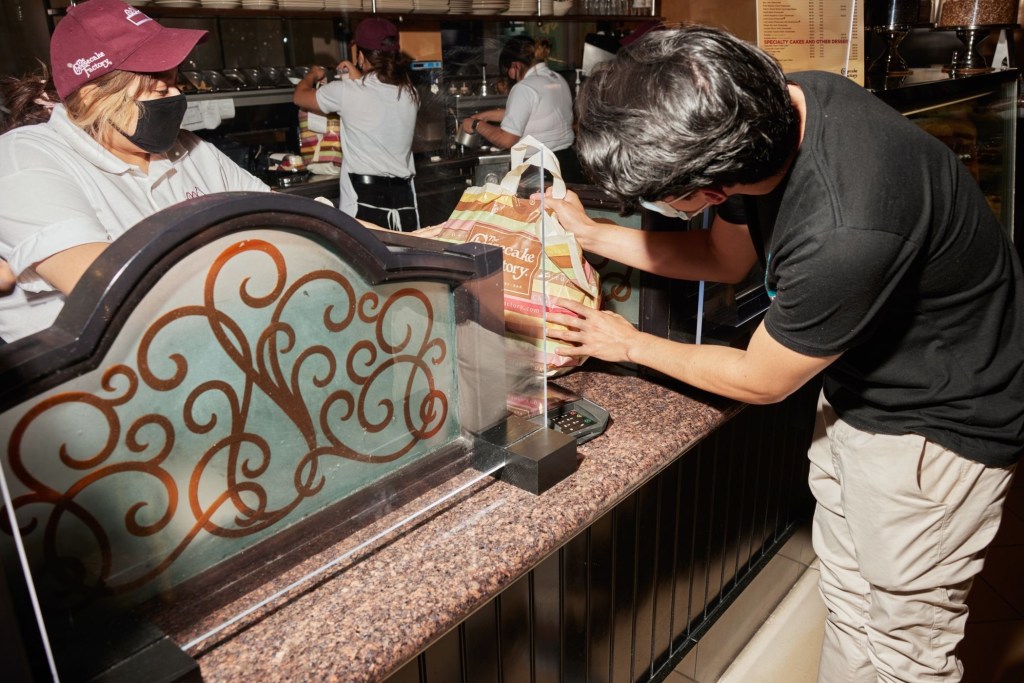
Cheesecake Factory returned to profitability in 2021 by adopting a new strategy of emphasizing delivering orders and having orders available for pickup at its restaurants (“to-go” orders). This strategy was successful in part because Cheesecake Factory executives made the decision during 2020 to continue to pay its 3,000 managers during the period when most of its restaurants were closed. Doing so meant having to raise $200 million from investors to pay the managers’ salaries. Keeping managers on payroll meant that the firm had the staff on hand to successfully manage the increase in to-go and delivery orders.

The success of the strategy was helped by the fact that cheesecake turned out to be a more popular delivery item than the firm had expected. An article in the Wall Street Journal quoted the firm’s president as saying that people were ordering it for a delivery throughout the day, including people “who are just getting slices at nine o’clock at night delivered to their house.” The firm has doubled its to-go orders compared with before the pandemic and its overall sales per restaurant have increased from an average of $11 million before the pandemic to $12 million in 2021.

Is Cheesecake Factory’s recent success sustainable? In emphasizing to-go and delivery orders, Cheesecake Factory initially had an advantage over its competitors because it had retained thousands of managers who could implement this new strategy. But this advantage may not last long for two reasons: 1) as the effects of the pandemic lessen, consumers may want to return to indoor dining, so the volume of to-go and delivery orders may decline; and 2) to the extent that consumers have permanently reduced their demand for indoor dining, competitors can copy Cheesecake Factory’s approach. Many competitors in fact have devoted more resources to to-go and delivery orders and the market for this type of dining is becoming as competitive as the market for in-door dining.

Cheesecake Factory has one other advantage: Cheesecake turned out to be a particularly popular food for delivery and cheesecake sales have become a larger percentage of the firm’s revenues since the beginning of the pandemic. Although, because the word “cheesecake” is in the firm’s name, it may retain some advantage among consumers who want to order a delivery of cheesecake, competitors can easily also add cheesecake to their delivery menus.

So, our general conclusion holds that it is very difficult for firms in a monopolistically competitive industry to earn an economic profit in the long run. 

Sources:  Heather Haddon, “How Cheesecake to Go Saved the Cheesecake Factory,” wsj.com, October 29, 2021; Teresa Rivas, “Cheesecake Factory Stock Is Falling Because Sales Took a Nose Dive,” barrons.com, July 29, 2020; Rick Clough, “Cheesecake Factory Settles SEC Charges over Covid Statements,” bloomberg.com, December 4, 2020; Tomi Kilgore, “Cheesecake Factory Stock Jumps after Upbeat Sales Update,” marketwatch.com, June 2, 2021.

COVID-19 Update – Can Mom and Pop Businesses Survive the Coronavirus Pandemic?

Supports:  Econ & Micro: Chapter 11, Technology, Production, and Costs (Section 11.6); Chapter 13, Monopolistic Competition; Chapter 14, Oligopoly (Section 14.1); Essentials: Chapter 9, Technology, Production, and Costs; Chapter 11, Monopolistic Competition and Oligopoly

Can Mom and Pop Businesses Survive the Coronavirus Pandemic?

By early April 2020, because of the coronavirus pandemic, all 50 state governments had issued declarations of emergency and had closed schools and some or all businesses considered to be non-essential.  A survey by Alexander Bartik of the University of Illinois and colleagues indicated that about 43 percent of small businesses in the Unites States had closed, causing most of their revenue to disappear.  As a result, those businesses had laid off about 40 percent of their employees.

In March 2020, Congress and President Donald Trump enacted the Coronavirus Aid, Relief, and Economic Security (CARES) Act. The act included the Paycheck Protection Program (PPP), which provided loans to businesses with 500 or fewer employees to pay for up to eight weeks of payroll expenses and certain other costs. The government would forgive the loans if business owners used 75 percent of the funds for payroll expenses.

            The PPP was administered by the federal Small Business Administration with the loans being made primarily by local banks. Many small businesses have trouble borrowing from banks, particularly if they lack collateral, such as owning the building they operate in, or if they don’t have a long-term relationship with a bank by having borrowed from them in the past or having maintained a business checking account with them. In a survey by the Federal Reserve conducted in 2019, before the coronavirus pandemic, 64 percent of small businesses had faced financial challenges, such as paying operating expenses or purchasing inventories, during the previous year.  Of those firms, 69 percent had relied on the owner’s personal funds to meet the financial challenge. 

            In mid-April 2020, it was unclear whether Congress might change the PPP to make it easier for small businesses to borrow through credit unions and other lenders that are not commercial banks. News reports indicated that a significant number of small businesses had exhausted the funds their owners had available and intended to permanently close.  It’s not unusual for a small firm to fail. In a typical year, even when the economy is expanding, hundreds of thousands of businesses fail (and a similar number open).  But some economists and policymakers were concerned that the effects of the pandemic might lead to a permanent reduction in the number of small firms, particularly so-called “Mom and Pop businesses”—sole proprietorships that employ fewer than 20 workers.  (We discuss the differences between sole proprietorships and other ways of organizing a business in Chapter 8, Section 8.1)

The pandemic posed particular challenges for these businesses.  Many small retailers, such as clothing stores, shoe stores, card shops, and toy stores, had already been hurt before the pandemic as consumers shopped at online sites such as Amazon. This trend increased during the pandemic. In addition, as many consumers shifted from eating in restaurants to buying groceries from supermarkets or online, the future of some small restaurants seemed in doubt.

Even as states and cities began to allow nonessential businesses to reopen, many consumers were reluctant to return to eating in restaurants, staying in hotels, and shopping in brick-and-mortar stores in the absence of a vaccine against the coronavirus.  The shift to online buying was evident during March and April 2020 when, as many small businesses were laying off workers, Amazon was hiring an additional 175,000 workers and Walmart was hiring an additional 150,000.  Some public health authorities and epidemiologists were suggesting that businesses take certain steps to reassure consumers, although doing so would raise the businesses’ costs of operating. For instance, Scott Gottlieb, former Food and Drug Administration commissioner, suggested that “businesses … should look at trying to bring testing on-site at the place of employment” to reassure customers that the businesses’ workers did not have the virus. He also suggested that restaurants print their menus on paper that could be thrown away after each use and commit to more frequent disinfecting. Clearly, the revenue earned by larger businesses would be better able to cover these costs while still at least breaking even.

            If the world is entering a new period with more frequent epidemics of viruses to which most people lack immunity, small businesses will be at a further disadvantage. Although Congress and the president responded to the coronavirus with the PPP program, whether they would have funds to do so during future epidemics remained unclear. As a result, it may be of increased importance that firms have the resources to finance periods of closure without having to rely on government payments, loans from banks for which they may lack the necessary collateral, or running balances on high-interest rate credit cards. The survey by Alexander Bartik and colleagues referred to earlier indicated that the average small business has $10,000 in monthly costs and less than that amount readily available to use to pay those costs.  In other words, many small businesses are dependent on paying their current costs from their current revenues.

            Most small business owners are resourceful enough to respond to changing conditions, but the challenges posed by the coronavirus seemed likely to reshape the structure of some industries, including restaurants, small retail stores, gyms, non-chain hotels, and small medical and dental practices. When discussing the role that barriers to entry play in determining the level of competition and the size of firms in an industry, we emphasized the role played by physical economies of scale. For instance, we noted that:

A music streaming firm has the following high fixed costs:  very large server capacity, large research and development costs for its app, and the cost of the complex accounting necessary to keep track of the payments to the musicians and other copyright holders whose songs are being streamed.  A large streaming firm such as Spotify has much lower average costs than would a small music streaming firm, partly because a large firm can spread its fixed costs over a much larger quantity of subscriptions sold.

We also noted that economies of scale of this type did not exist in the restaurant industry. Prior to the pandemic, it was reasonable to argue that large restaurants were typically unable to serve meals at a lower average cost than smaller restaurants and that even if smaller restaurants faced higher average costs, by differentiating the meals they served, smaller restaurants could still attract customers despite charging a higher price than larger restaurants. But if small restaurants lack the ability to finance periods of closure during epidemics and have trouble breaking even due to the higher costs of printing paper menus, testing their employees onsite, and more frequent cleaning, they may struggle to survive. Larger restaurants can spread these costs over a larger number of meals, reducing the average cost of one meal compared with smaller restaurants. As more consumers avoid restaurants and eat more frequently at home, smaller restaurants may be pushed further up their average cost curves by being able to sell only a smaller quantity of meals.

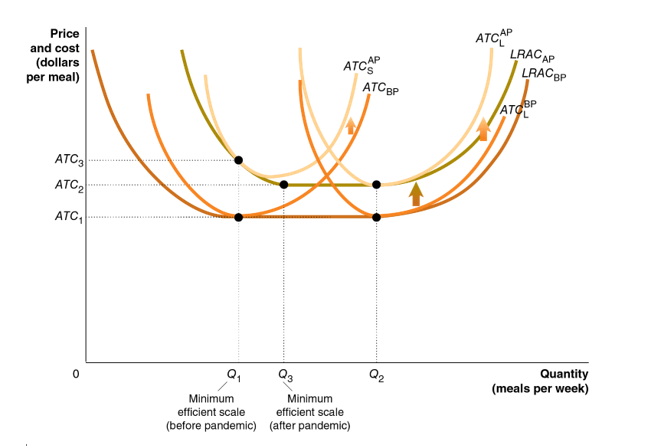
The following figure illustrates how the pandemic may affect the costs of a typical restaurant.  The long-run average cost curve LRACBP shows the situation before the pandemic. The higher costs necessary to operate after the pandemic, including printing paper menus and more frequent cleaning, shifts up the long-run average cost curve to LRACAP.  Before the pandemic, the average total cost curve for the small restaurant is  and for the large restaurant is .  Notice that even though the large restaurant serves Q2 meals per week and the small restaurant serves Q1 meals per week, they both have the same average total cost per meal, ATC1.

Also notice that before the pandemic, serving Q1 meals per week was the minimum efficient scale for a restaurant.  Minimum efficient scale is the level of output at which all economies of scale are exhausted.  The pandemic increases the costs of the small restaurant from  to is , and the costs of the large restaurant from to .  Minimum efficient scale increases to Q3, which is more meals per week than a small restaurant can sell. As a result, the average total cost of small restaurant increases to ATC3. A larger restaurant is still selling a quantity of meals that is beyond minimum efficient scale, so its average cost only rises to ATC2.  With higher average costs, smaller restaurants are less able to successfully compete with larger restaurants.  

Small firms in other industries are likely to face similar challenges. The result could be a contraction in the number of firms in some industries.  For instance, we may see franchised firms replacing Mom and Pop businesses—more Domino’s and Pizza Hut outlets and fewer independent pizza restaurants.  Although it’s too early to tell the full effects of the coronavirus pandemic on U.S. businesses, the effects are likely to be far-reaching.

Sources: Ruth Simon, “For These Companies, Stimulus Was No Solution; ‘We Decided to Cut Our Losses,’” Wall Street Journal, April 15, 2020; Amara Omeokwe, “Small-Business Funding Dispute Challenges Community Lenders,” Wall Street Journal, April 14, 2020; Alexander W. Bartik, Marianne Bertrand, Zoë B. Cullen, Edward L. Glaeser, Michael Luca, and Christopher T. Stanton, “How Are Small Businesses Adjusting to Covid-19? Early Evidence from a Survey,” National Bureua of Economic Research, Working Paper 26989, April 2020 (https://www.nber.org/papers/w26989.pdf); Board of Governors of the Federal Reserve System, 2019 Report on Employer Firms: Small Business Credit Survey, https://www.fedsmallbusiness.org/medialibrary/fedsmallbusiness/files/2019/sbcs-employer-firms-report.pdf, 2019; Norah O’Donnell And Margaret Hynds, “5 Things to Know about Reopening the Country from Dr. Scott Gottlieb,” cbsnews.com, April 14, 2020.

Question: 

Sendhil Mullainathann of the University of Chicago wrote an opinion column in the New York Times describing the situation facing the owner of a small restaurant:

She has little money in cash reserve; operating margins are thin … and her savings had already been spent on expanding the cramped kitchen. What was a thriving enterprise before the pandemic will emerge—if it emerges at all—as a hobbled business, which may well fail shortly thereafter.

A) What does Mullainathan mean by the restaurant’s “operating margins are thin”? Why would we expect the operating margins of a small restaurant to be thin?

B) If this restaurant was a “thriving enterprise” before the pandemic, why might it be likely to fail after the pandemic?

For Economics Instructors that would like the approved answers to the above questions, please email Christopher DeJohn from Pearson at christopher.dejohn@pearson.com and list your Institution and Course Number.