

Image created by ChatGPT
The real incomes of U.S. workers can fluctuate in the short run, but over the long run, incomes have steadily increased. We usually think of income as the wages and salaries that people receive, but as we discuss in Microeconomics, Chapter 7, Section 7.4, when workers choose among jobs, they take into account not just the wages they will receive but also other compensation, such as employer contributions to retirement accounts and employer-provided health insurance.
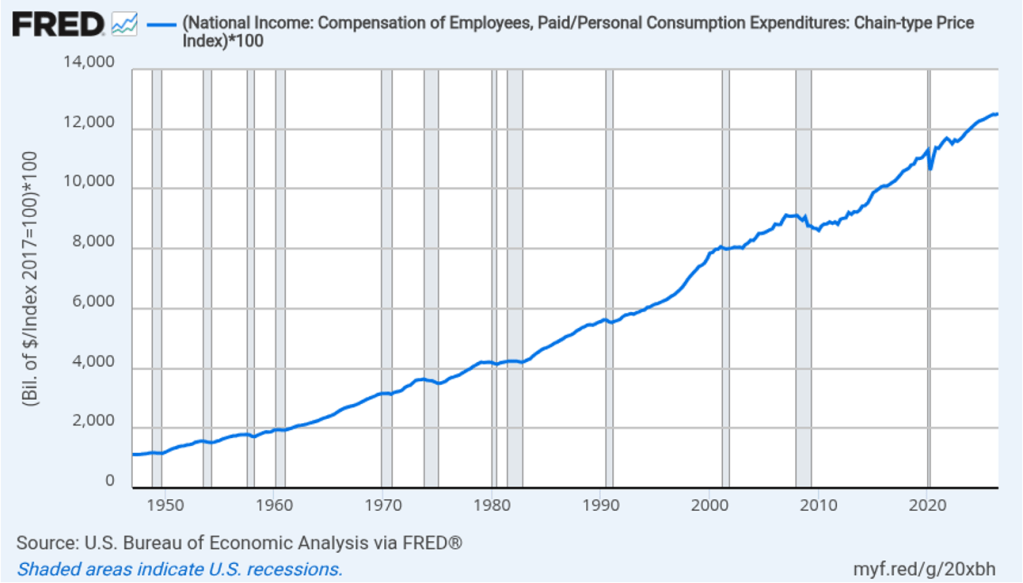
The following figure shows total compensation paid by employers as presented in the National Income and Product Accounts, corrected for inflation using the personal consumption expenditures (PCE) price index. (The result using the consumer price index (CPI) rather than the PCE is very similar.)
The BEA also compiles data on “supplements to wages and salaries,” which is the part of employee compensation comprised of “employer contributions for employee pension and insurance funds and of employer contributions for government social insurance.” These supplements are sometimes called fringe benefits, although the BEA includes some benefits, such as paid holidays, vacations, sick leave, in wages and salaries. Employer contributions for government social insurance are payments firms make on behalf of employees to mandatory government programs, the most important of which are Social Security and Medicare.
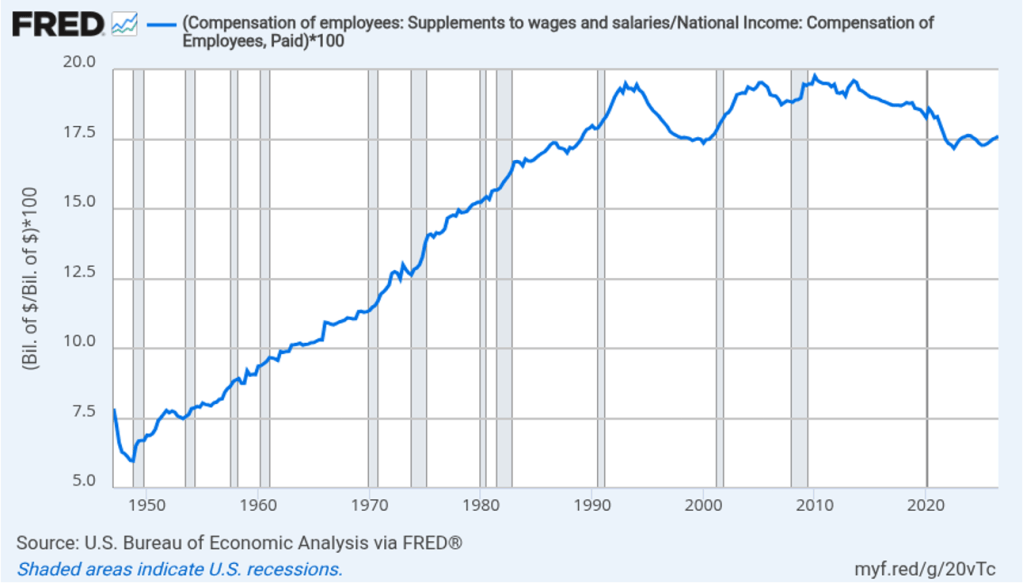
As the following figure shows, supplements to wages and salaries increased as percentage of compensation from 1949 to 1993, rising from 6 percent of total compensation in 1949 to over 19 percent in 1993. There were several factors causing this increase, including: 1. The increase in the Social Security tax rate that employers pay on behalf of employees from 1.5 percent of wages and salaries in 1950 to 6.2 percent in 1990; 2. the imposition beginning in 1966 of an employer-paid tax of 1.45 percent of wages and salaries to fund the Medicare system; 3. the increase in employer contributions to worker pension plans; and 4. the increase in employer contributions to employee health insurance from 0.51 percent of wages and salaries in 1950 to 6.14 percent in 1993.
The growth in employer contributions to health insurance plans for their employees was facilitated by a decision by the U.S. Treasury in 1943 during World War II. That ruling excluded the payments firms made to health insurance plans from the taxable income of employees. At that time, the federal government had put a legal ceiling on wages, which caused employers to search for an alternative way to increase employee compensation. In 1956, Congress amended the Internal Revenue Code to ratify the Treasury’s earlier decision. As a result, the total tax that employees pay on their compensation is reduced when the compensation takes the form of non-taxable employer contributions to health insurance plans. That fact helps explain why the majority of people in the United States with private health insurance receive the insurance through their employers.
The above figure shows that fringe benefits as percentage of total compensation fluctuated between 1993 and 2013 and have trended gradually down in the years since. The gradual decrease since 2013 has been mainly due to small decreases in employer contributions to employee pension and health insurance plans.

Image created by ChatGPT
As employer contributions to employee health insurance plans have declined somewhat, the amount that employees have to contribute to those plans and the amount of medical expenses that they have to pay for themselves, so-called out-of-pocket spending, have increased. Has this increased spending on health care offset the increases in wages and salaries employees receive from firms? The Centers for Medicare and Medicaid Services (CMS) provide data for the period from 1987 to 2024 on spending by households on employer-provided health insurance and household out-of-pocket medical spending. The following figure shows the BEA measure of supplements (or fringe benefits) to wages and salaries (the blue line) and supplements plus the CMS measure of household health spending (the brown line) as percentages of the compensation of employees.
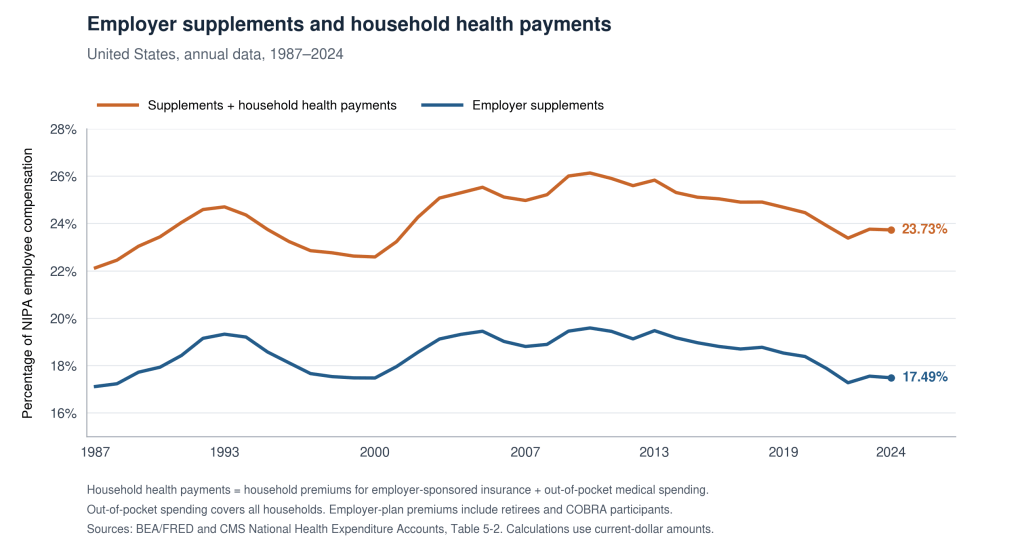
During the period from 1987 to 2024, real employee compensation increased about 130 percent. Employer supplements increased only from 17.1 percent of compensation in 1987 to 17.4 percent in 2024, while supplements plus household health spending increased from 22.1 percent of compensation to 23.7 percent.
Medical expenses haven’t increased as a percentage of employee compensation. So in that sense, employees’ significant real income gains weren’t eaten up by increasing medical expenses. It’s important to note, however, that this observation does not mean that there aren’t reforms that would increase the efficiency of the U.S. health care system. We discuss the debate over health care reforms in Microeconomics, Chapter 7.

