
Yesterday at the Fed Something Happened That Was Unusual … or Was It?

Photo of Michael Barr from federalreserve.gov

President-elect Donald Trump has stated that he believes that presidents should have more say in monetary policy. There had been some speculation that once in office Trump would try to replace Federal Reserve Chair Jerome Powell, although Trump later indicated that he would not attempt to replace Powell until Powell’s term as chair ends in May 2026. Can the president remove the Fed Chair or another member of the Board of Governors? The relevant section of the Federal Reserve Act States that: “each member [of the Board of Governors] shall hold office for a term of fourteen years from the expiration of the term of his predecessor, unless sooner removed for cause by the President.”

“Removed for cause” has generally been interpreted by lawyers inside and outside of the Fed as not authorizing the president to remove a member of the Board of Governors because of a disagreement over monetary policy. The following flat statement appears on a page of the web site of the Federal Reserve Bank of St. Louis: “Federal Reserve officials cannot be fired simply because the president or a member of Congress disagrees with Federal Reserve decisions about interest rates.”

At his press conference following the November 7 meeting of the Federal Open Market Committee (FOMC), Powell was asked by a reporter: “do you believe the President has the power to fire or demote you, and has the Fed determined the legality of a President demoting at will any of the other Governors with leadership positions?” Powell replied: “Not permitted under the law.” Despite Powell’s definitive statement, because no president has attempted to remove a member of the Board of Governors, the federal courts have never been asked to decide what the “removed for cause” language in the Federal Reserve Act means.

The president is free to remove the members of most agencies of the federal government, so why shouldn’t he or she be able to remove the Fed Chair? When Congress passed the Federal Reserve Act in 1913, it intended the central bank to be able set policy independently of the president and Congress. The president and members of Congress may take a short-term view of policy, focusing on conditions at the time that they run for reelection. Expansionary monetary policies can temporarily boost employment and output in the short run, but cause inflation to increase in the long run.

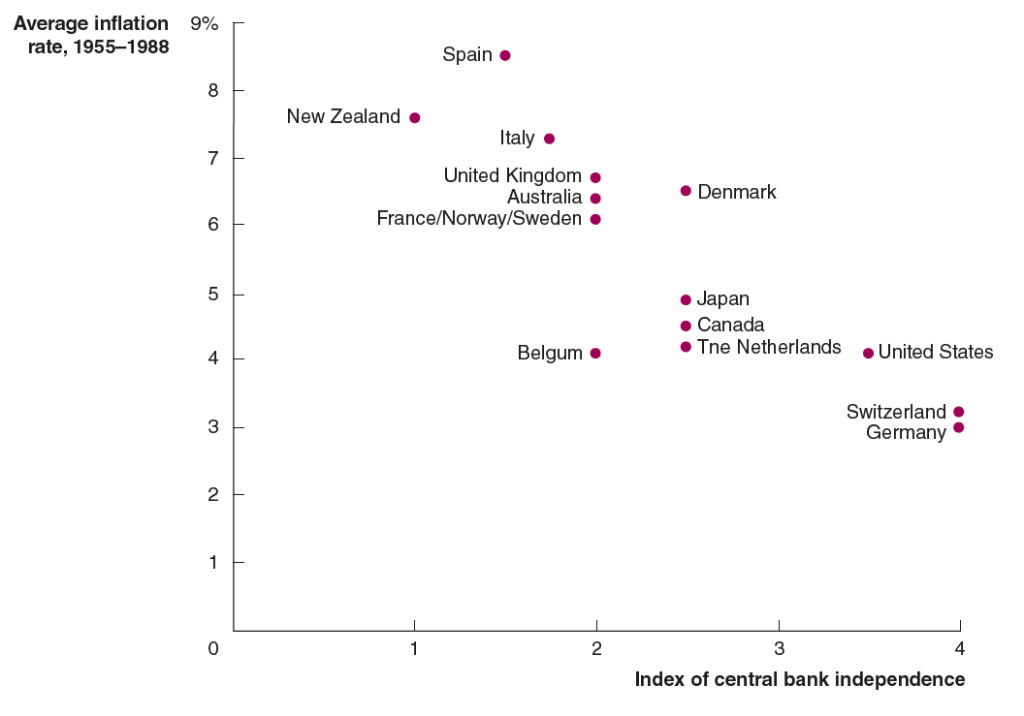
As we discuss in Macroeconomics, Chapter 17, Section 17.4 (Economics, Chapter 27, Section 27.4), in a classic study, Alberto Alesina and Lawrence Summers compared the degree of central bank independence and the inflation rate for 16 high-income countries during the years from 1955 to 1988. As the following figure shows, countries with highly independent central banks, such as the United States, Switzerland, and Germany, had lower inflation rates than countries whose central banks had little independence, such as New Zealand, Italy, and Spain.
Yesterday, something unusual happened that might seem to undermine Fed independence. Michael Barr, a member of the Board of Governors and the Board’s Vice Chair for Supervision, said that on February 28 he will step down from his position as Vice Chair, but will remain on the Board. His term as Vice Chair was scheduled to end in July 2026. His term on the Board is scheduled to end in January 2032.

Barr has been an advocate for stricter regulation of banks, including higher capital requirements for large banks. These positions have come in for criticism from banks, from some policymakers, and from advisers to Trump. Barr stated that he was stepping down because: “The risk of a dispute over the position could be a distraction from our mission. In the current environment, I’ve determined that I would be more effective in serving the American people from my role as governor.” Trump will nominate someone to assume the position of vice chair, but because there are no openings on the Board of Governors he will have to choose from among the current members.

Does this episode indicate that Fed independence is eroding? Not necessarily because the Fed’s regulatory role is distinct from its monetary policy role. As financial journalist Neil Irwin points out, “top [Fed] bank supervision officials view their role as more explicitly carrying out the regulatory agenda of the president who appointed them—and that a new president is entitled, in reasonable time, to their own choices.” In the past, other members of the Board who have held positions similar to the one Barr holds have resigned following the election of a new president.

So, it’s unclear at this point whether Barr’s resignation as vice chair indicates that the incoming Trump Administration will be taking steps to influence the Fed’s monetary policy actions or how the Fed’s leadership will react if it does.


Panel Discussion on Macroeconomics at the American Economic Association Meetings

On January 5, 2025 at the American Economic Association meetings in San Francisco, Jason Furman of Harvard’s Kennedy School, former Federal Reserve Chair Ben Bernanke (now of the Brookings Institution), former Council of Economic Advisers Chair Christina Romer of the University of California, Berkeley, and John Cochrane of Stanford’s Hoover Institition participated in a panel on “Inflation and the Macroeconomy.”

The discussion provides an interesting overview of a number of macroeconomic topics including:

  1. The roles of aggregate demand shocks and aggregate supply shocks in explaining the sharp increase of inflation beginning in the spring of 2021.
  2. The reasons for the Fed’s delay in responding to the increase in inflation.
  3. Why macroeconomic forecasting models and most economists failed to anticipate the rise in inflation.
  4. The role of the Fed’s 2020 monetary policy framework, how the Fed should revise the framework as a result of the review currently underway, and whether the Fed should change its inflation target. (We discuss the Fed’s monetary policy framework in several blog posts, including this one.)
  5. The likely future course of inflation and the potential effects of the Trump Administration’s policies.
  6. The likely consequences of large federal budget deficits.
  7. Threats to Fed independence.

The discussion is fairly long at two hours, but most of it is nontechnical and should be understandable by students who have reached the monetary and fiscal policy chapters of a macroeconomic principles course (Chapters 15 and 16 of Macroeconomics; Chapters 25 and 26 of Economics).

Link

Is the United States Entering a Period of Higher Growth in Labor Productivity?

Image generated by GTP-4o illustrating labor productivity

Several articles in the business press have discussed the recent increases in labor productivity. For instance, this article appeared in this morning’s Wall Street Journal (a subscription may be required).

The most widely used measure of labor productivity is output per hour of work in the nonfarm business sector. The BLS calculates output in the nonfarm business sector by subtracting from GDP production in the agricultural, government, and nonprofit sectors. (The definitions used by the Bureau of Labor Statistics (BLS) in estimating labor productivity are discussed in the “Technical Notes” that appear at the end of the BLS’s quarterly “Productivity and Costs” releases.) The blue line in the following figure shows the annual growth rate in labor productivity in the nonfarm business sector as measured by the percentage change from the same quarter in the previous year. The green line shows labor productivity growth in manufacturing.

As the figure shows, both labor productivity growth in the nonfarm business sector and labor productivity growth in manufacturing are volatile. The business press has focused on the growth of productivity in the nonfarm business sector during the period from the third quarter of 2023 through the third quarter of 2024. During this time, labor productivity has grown at an average annual rate of 2.5 percent. That growth rate is notably higher than the growth rate that many economists are expecting over the next 10 years. For instance, the Congressional Budget Office (CBO) has forecast that labor productivity will grow at an average annual rate of only 1.6 percent over the period from 2025 to 2034.

The CBO forecasts that the total numbers of hours worked in the economy will grow at an average annual rate of 0.5 percent. Combining that estimate with a 2.5 percent annual rate of growth of labor productivity results in output per person—a measure of the standard of living—increasing by 34 percent by 2034. If labor productivity increases at a rate of only 1.6 percent, then output per person will have increased by only 23 percent by 2034.

The standard of living of the average person in United States increasing 11 percent more would make a noticeable difference in people’s lives by allowing them to consume and save more. Higher rates of labor productivity growth leading to a faster growth rate of income and output would also increase the federal government’s tax revenues, helping to decrease federal budget deficits that are currently forecast to be historically large. (We discuss the components of long-run economic growth in Macroeconomics, Chapter 16, Section 16.7; Economics, Chapter 26, Section 26.7, and the economics of long-run growth in Macroeconomics, Chapter 11; Economics, Chapter 21.)

Can the recent growth rates in labor productivity be maintained over the next 10 years? There is an historical precedent. Labor productivity in the nonfarm business sector grew at an average annual rate of 2.6 percent between 1950 and 1973. But growth rates that high have proven difficult to achieve in more recent years. For instance, from 2008 to 2023, labor productivity grew at an average annual rate of only 1.5 percent. (We discuss the debate over future growth rates in Macroeconomics, Chapter 11, Section 11.3; Economics, Chapter 21, Section 21.3.)

The Wall Street Journal article we cited earlier provides an overview of some of the factors that may account for the recent increase in labor productivity growth rates. The 2020 Covid pandemic may have led to some increases in labor productivity. Workers who temporarily or permanently lost their jobs as businesses closed during the height of the pandemic may have found new jobs that better matched their skills, making them more productive. Similarly, businesses that were forced to operate with fewer workers, may have found ways to restore their previous levels of output with lower levels of employment. These changes may have led to one-time increases in labor productivity at some firms, but are unlikely to result in increased rates of labor productivity growth in the future.

Some businesses have used newly available generative artificial intelligence (AI) software to increase labor productivity by, for instance, using software to replace workers who previously produced marketing materials or responded to customer questions or complaints. It will take at least several years before generative AI software spreads throughout the economy, so it seems too early for it to have had a broad enough effect on the economy to be visible in the productivity data.

Note also that, as the green line in the figure above shows, manufacturing productivity has been lagging recently. From the third quarter of 2023 to the third quarter of 2024, labor productivity in manufacturing has increased at an annual average rate of only 0.4 percent. This slowdown is surprising given that over the long run productivity in manufacturing has typically increased faster than has productivity in the overall economy. It seems unlikely that labor productivity in the overall economy can sustain its recent growth rates if labor productivity growth in manufacturing continues to lag.

Finally, the productivity data are subject to revision as better estimates of output and of hours worked become available. It’s possible that what appear to be rapid rates of productivity growth during the last five quarters may turn out to have been less rapid following data revisions.

So, while the recent increase in the growth rate of labor productivity is an encouraging sign of the strength of the U.S. economy, it’s too soon to tell whether we have entered a sustained period of higher productivity growth.