What Are “Principal Federal Economic Indicators?”

Image generated by GTP-4o “illustrating the concept of federal economic statistics.”

Government economic statistics help guide the actions of policymakers, firms, households, workers, and investors. As a recent report from the American Statistical Association expressed it:

“Official statistics from the federal government are a critically important source of needed information in the United States for policymakers and the public, providing information that meets the highest professional standards of relevance, accuracy, timeliness, credibility, and objectivity.”

Government agencies consider some of these statistics to be of particular importance. The Office of Management and Budget (OMB) has designated 36 data series as being principal federal economic indicators (PFEIs). Many of these are key macroeconomic data series, such as the consumer price index (CPI), gross domestic product (GDP), and unemployment. Others, such as housing vacancies and natural gas storage, are less familiar although important in assessing conditions in specific sectors of the economy.

Since 1985, the preparation and release of PFEIs has been governed by OMB Statistical Policy Directive No. 3. Among other things, Directive No. 3 is intended to ‘‘preserve the distinction between the policy-neutral release of data by statistical agencies and their interpretation by policy officials.’’ Although some politicians and commentators claim otherwise, federal government statistical agencies, such as the Bureau of Labor Statistics (BLS) and the Bureau of Economic Analysis (BEA), are largely staffed by career government employees whose sole objective is to gather and release the most accurate data possible with the funds that Congress allocates to them.

Directive No. 3 also requires the statistical agencies to act so as to ‘‘prevent early access to information that may affect financial and commodity markets.’’ Unfortunately, several times recently the BLS has been subject to criticism for releasing data early or releasing data to financial firms before the official public release of the data. For instance, on August 21, 2o24 the BLS was scheduled to release at 10:00 a.m. its annual benchmark revision of employment estimates from the establishment survey. (We discuss this release in this blog post.) Because of technical problems, the public release was delayed until 10:30. During that half hour, analysts at some financial firms called the BLS and were given the data over the phone. Doing so was contraty to Directive No. 3 because the employment data are a PFEI, which obliges the BLS to take special care that the data aren’t made available to anyone before their public release.

The New York Times filed a Freedom of Information Act (FOIA) request with the BLS in order to investigate the cause of several instances of the agency releasing data early. In an article summarizing the information the paper received as a result of its FOIA request, the reporters concluded that “the information [the BLS] has provided [about the reasons for the early data releases] has at times proved inaccurate or incomplete.” The BLS has pledged to take steps to ensure that in the future it will comply fully with Directive No. 3.

In a report discussing the difficulties federal agencies statistical have in meeting their obligations responsibilities, the American Statistical Association singled out two problems: the declining reponse rate to surveys—particularly notable with respect to the establishment employment survey—and tight budget constraints, which are hampering the ability of some agencies to hire the staff and to obtain the other resources necessary to collect and report data in an accurate and timely manner.

Rent Control in Europe

Image generated by GTP-4o of “an apartment building in Amersterdam.”

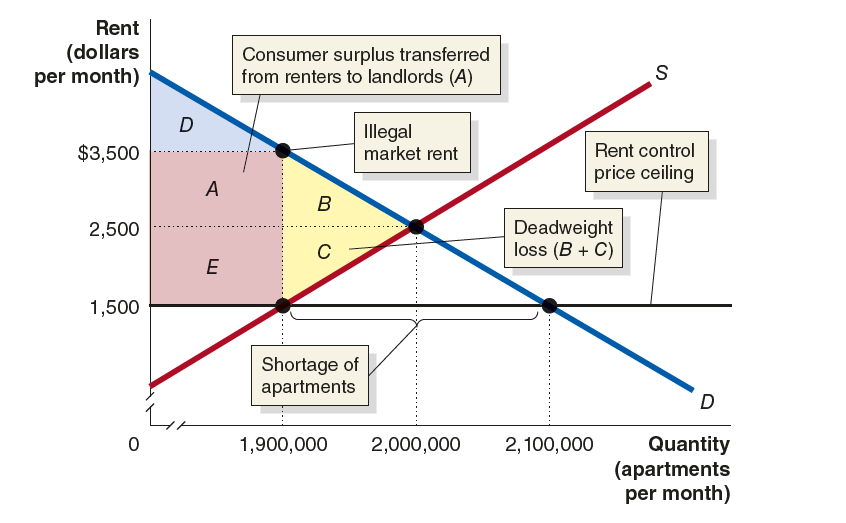
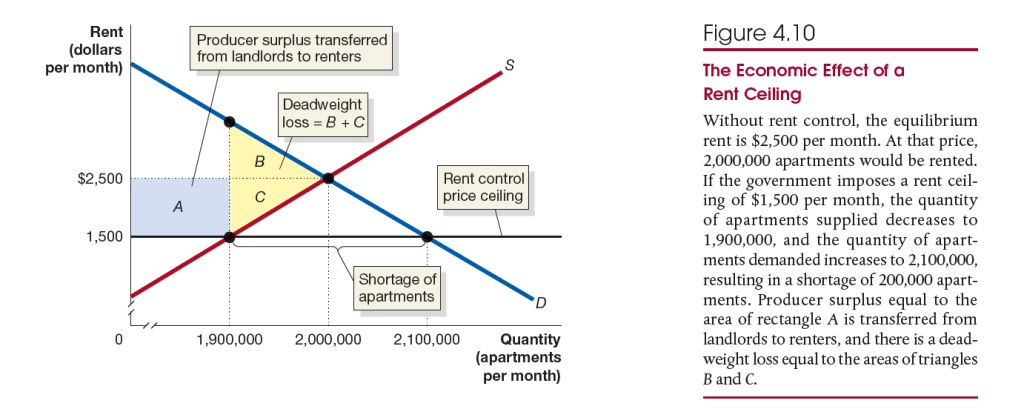
Recent articles in the media discussed the effects of rent control on the market for apartments in the Netherlands and in Stockholm, the capital of Sweden. The articles describe a situation that is consistent with the analysis in Chapter 4, Section 4.3. Figure 4.10 shows the expected results from the imposition of a rent control law. Some renters gain by living in apartments at below the equilibirum market rent, but the shortage of apartments resulting from the price ceiling means that some renters are unable to find apartments. As with other price controls, rent ceilings impose a deadweight loss on the economy, shown in the figure as the areas B + C.

An article on bloomberg.com discusses the effect on the market for apartments in the Netherlands of the passage in June of the Affordable Rent Act. The act raised the fraction of apartments covered by rent control from about 80 percent to 96 percent. The expansion of rent control appears to have led to an increased shortage of apartments. The article quotes one teacher who has been unable to find an apartment for her family as saying: “The cost isn’t the problem, but a real shortage of housing is.”

The article indicates that some landlords who doubt they can earn a profit under the new law are selling their buildings. If the buildings are converted to other uses, the shortage of apartments will be increased. The article mentions another unintended change to the apartment market from the provision of the new law that requires leases to be open-ended. Some landlords fear that as a result they may find themselves unable to evict tenants, however troublesome the tenants may be. In response, these landlords are giving priority to foreigners, who they believe are likely to move more often.

An article in the Economist looks at another aspect of rent control. The following figure is reproduced from Solved Problem 4.3. It shows that because rent control leads to a shortage of apartments it creates an incentive for tenants and landlords to agree to a rent that is higher than the legal rent ceiling. In this example, renters who are unable to find an apartment at the rent control ceiling of $1,500 may bid up the rent to $3,500—which in this example is $1,000 higher than the market equilibrium rent in the absence of rent control—rather than not be able to rent an apartment. Clearly, renters paying this illegal rent are worse off than they would be if there were no rent control law.

According to the article in the Economist, the average time on a waiting list for a rent controlled apartment is 20 years. Not surprisingly, “Young Swedes often have to put up with expensive sublets agreed to under the table,” for which they typically pay rents above both the rent control ceiling and the market equilibrium rent. Most economists agree that expanding the quantity of available housing by making it easier to build homes and apartments is a better way of reducing housing costs than is imposing rent controls.

Has the United States Won the War on Poverty?

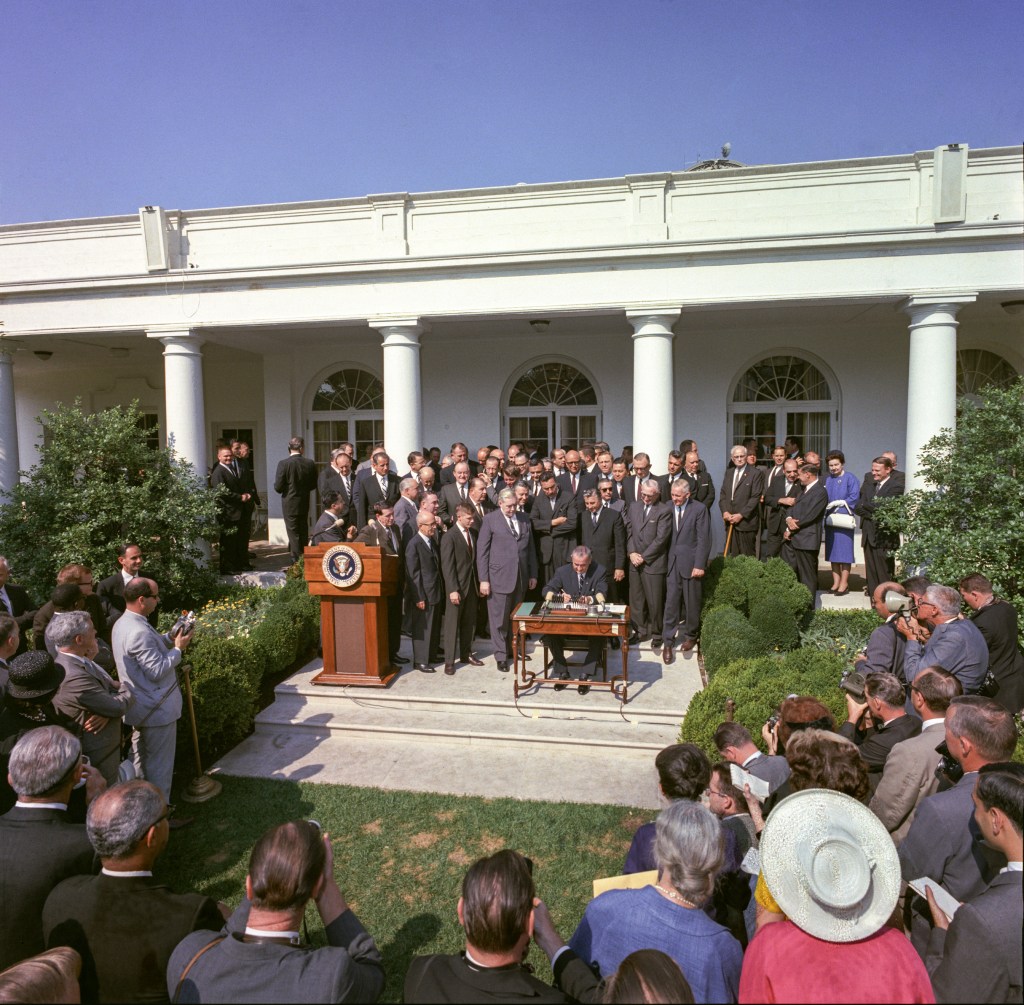
President Lyndon Johnson signing the Economic Opportunity Act in 1964. (Photo from Wikipedia)

In 1964, President Lyndon Johnson announced that the federal government would launch a “War on Povery.” In 1988, President Ronald Regan remarked that “some years ago, the Federal Government declared war on poverty, and poverty won.” Regan was exaggerating because, however you measure poverty, it has declined substantially since 1964, although the official poverty rate has remained stubbornly high since the early 1970s.

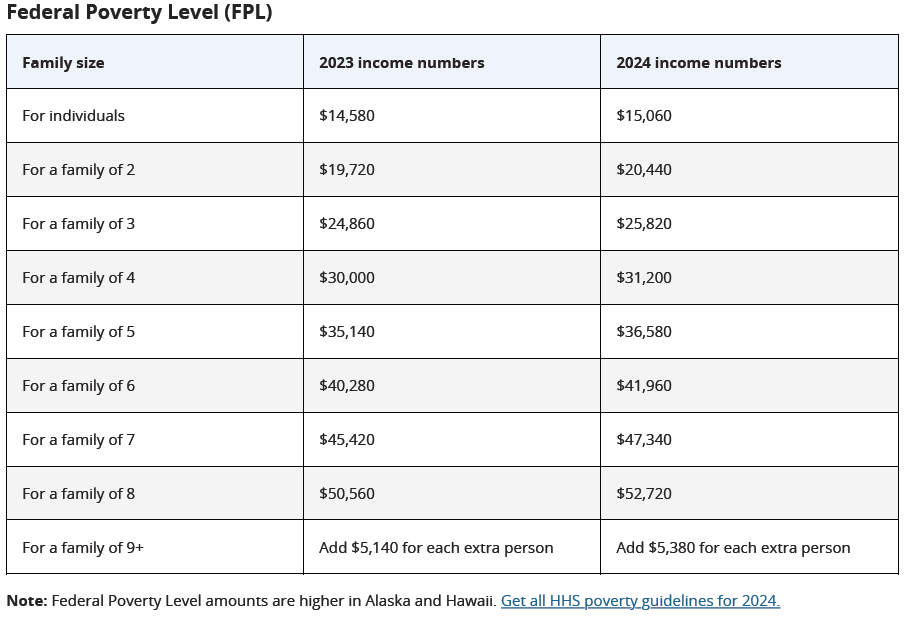
Each year the U.S. Census Bureau calculates the official poverty rate—the fraction of the population with incomes below the federal poverty level, often called the poverty line. The following table shows the poverty line for the years 2023 and 2024 illustrating how it varies with the size of a household:

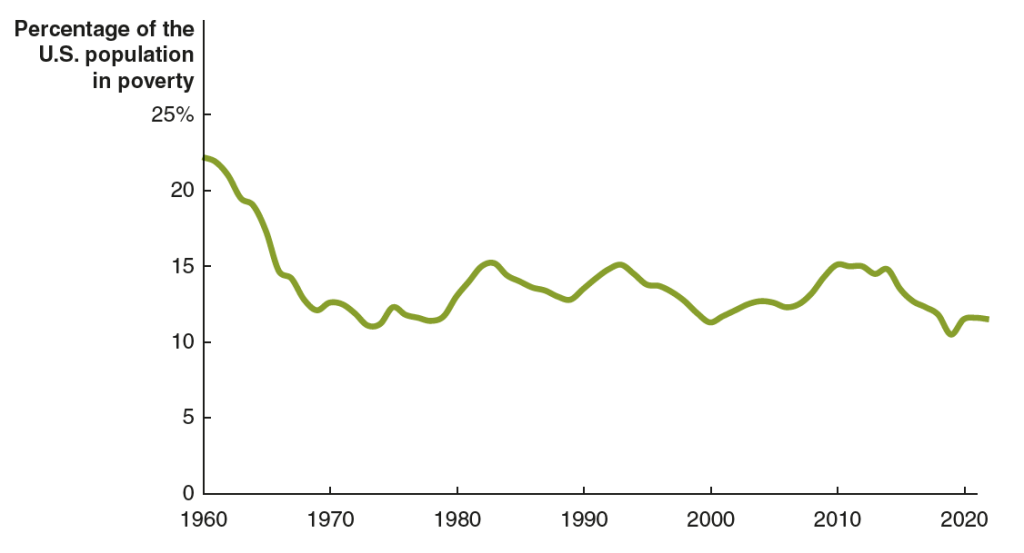
The following figure shows the official poverty rate for the years from 1960 to 2022. The poverty rate in 1960 was 22.2 percent. By 1973, it had been cut in half to 11.1 percent. The decline in the poverty rate largely stopped at that point. In the following years the official poverty rate fluctuated but stopped trending down. In 2022, the poverty rate was 11.5 percent—actually higher than in 1973. (The Census Bureau will release the poverty rate for 2023 later this month.)

But is the official poverty rate the best way to measure poverty? In Microeconomics, Chapter 17, Section 17.4 (Economics, Chapter 27, Section 27.4), we discuss some of the issues involved in measuring poverty. One key issue is how income should be measured for purposes of calculating the poverty rate. In an academic paper, Richard Burkhauser, of the University of Texas, Kevin Corinth, of the American Enterprise Institute, James Elwell, of the Congressional Joint Committee on Taxastion, and Jeff Larimore, of the Federal Reserve Board, carefully consider this issue. (The paper can be found here, although you may need a subscription or access through your library.)

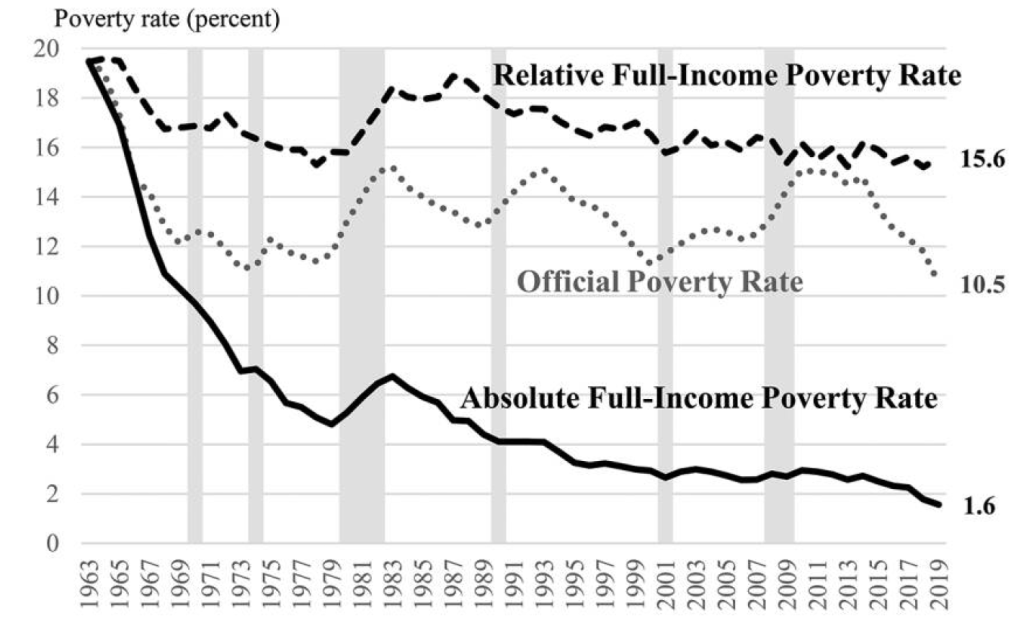
They find that using an adjusted measure of the poverty line and a fuller measure of income results in the poverty rate falling from 19.5 percent in 1963 to 1.9 percent in 2019. In other words, rather than the poverty rate stagnating at around 11 percent—as indicated using the official poverty numbers—it actually fell dramatically.  Rather than progress in the War on Poverty having stopped in the early 1970s, these results indicate that the war has largely been won. The authors, though, provide some important qualifications to this conclusion, including the fact that even 1.9 percent of the population represents millions of people.

Discussions of poverty distinguish between absolute poverty—the ability of a person or family to buy essential goods and services—and relative poverty—the ability to buy goods and services similar to those that can be purchased by individuals and families with the median income. The authors of this study argue that in launching the War on Povery, President Johnson intended to combat absolute poverty. Therefore, the authors start with the poverty line as it was in 1963 and increase the line each year by the rate of inflation, as measured by changes in the personal consumption expenditures (PCE) price index.

To calculate what they call “the absolute full-income poverty measure (FPM)” they include in income both cash income and “in-kind programs designed to fight poverty, including food stamps (now the Supplemental Nutrition Assistance Program [SNAP]), the schoollunch program, housing assistance, and health insurance.” As noted earlier, using this new definition, the overall poverty rate declined from 19.5 percent in 1963 to 1.9 percent in 2019. The Black poverty rate declined from 50.8 percent in 1963 to 2.9 percent in 2019.

The author’s find that the War on Poverty has been less successful in reducing relative poverty. Linking increases in the poverty line to increases in median income results in the poverty rate having decreased only from 19.5 percent in 1963 to 15.6 percent in 2019. The authors also note that not as much progress has been made in fulfilling President Johnson’s intention that: “The War on Poverty is not a struggle simply to support people, to make them dependent on the generosity of others.” They find that the fraction of working-age people who receive less than half their income from working has increased from 4.7 percent in 1967 to 11.0 percent in 2019.

The following figure from the authors’ paper shows the offical poverty rate, the absolute full-income poverty rate—which the authors believe does the best job of representing President Johnson’s intentions when he launched the War on Poverty—and the relative poverty rate. 

Because of disagreements on how to define poverty and because of the difficulty of constructing comprehensive measures of income—difficulties that the authors discuss at length in the paper—this paper won’t be the last word in assessing the results of the War on Poverty. But the paper provides an important new discussion of the issues involved in measuring poverty.