The Curious Case of the GE Refrigerators

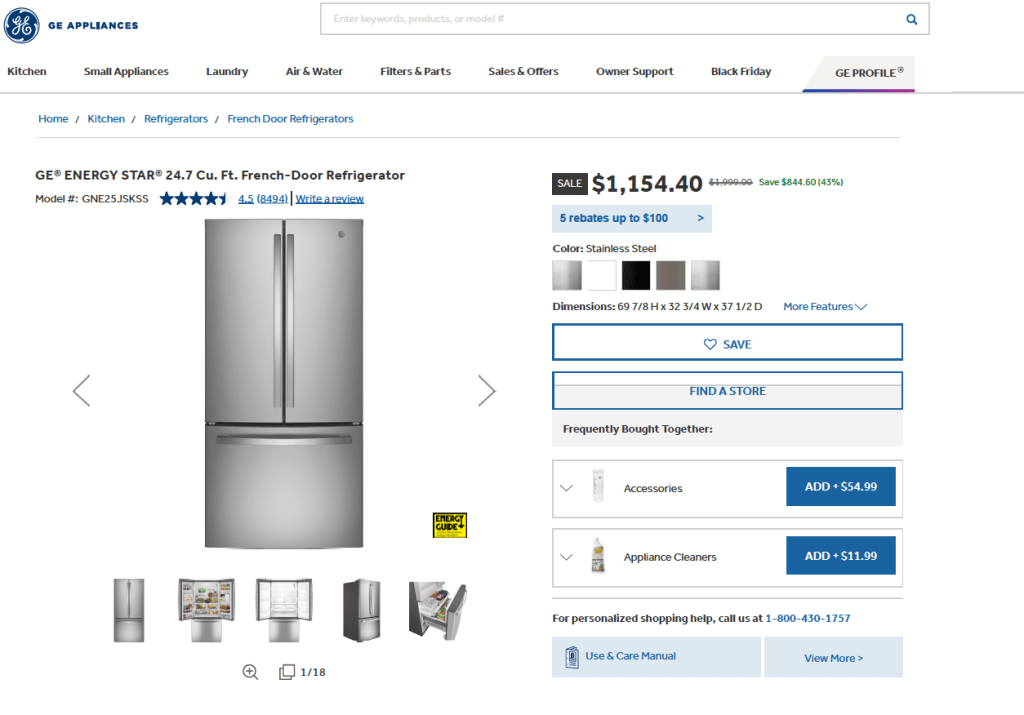
Is the refrigerator above different from the refrigerator below?
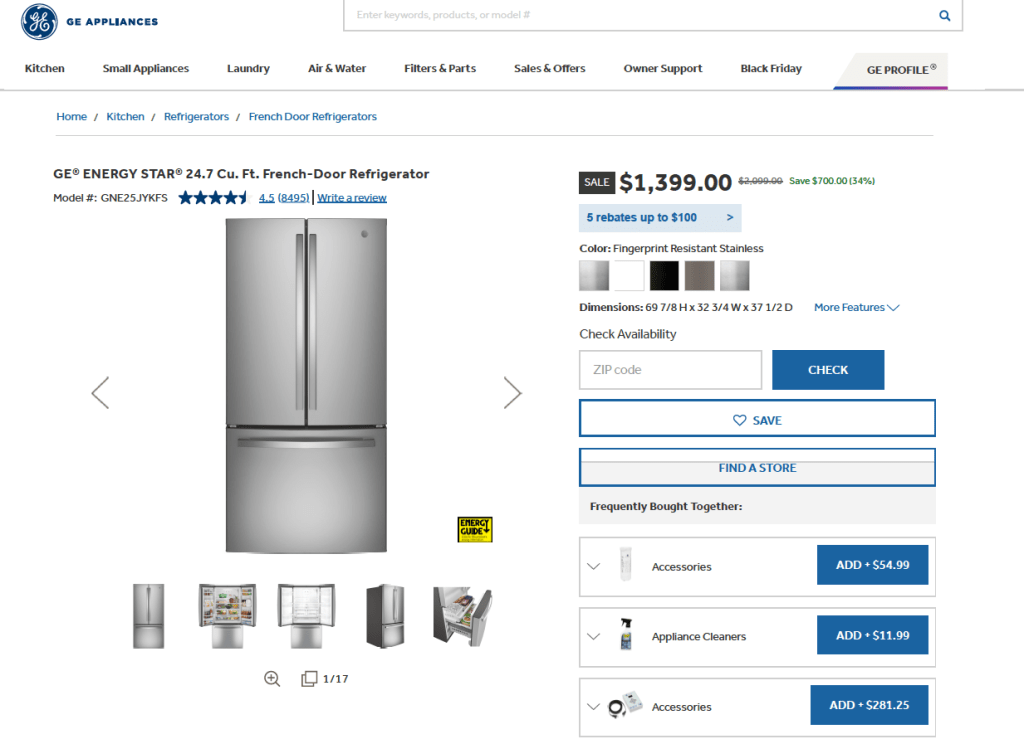
Consumer Reports is a magazine and web site devoted to product reviews. Their November-December 2024 issue noted something unusual about the two GE refrigerators shown above. (The images are from the geappliances.com web site.) At the time the issue was printed, the first refrigator above had a price of $2,300 and the second refrigerator had a price of $1,300: Consumer Reports notes that:

“These look-alike fridges offer equally impressive performance, have the same interior features … and are from the same brand. So why the $1,000 price difference? We don’t know.”

(Note: GE referigators, and many other products branded with the GE name are no longer produced by the General Electric company, which dates back to 1892 and was co-founded by Thomas Edison. Today, GE is primarily an aerospace company and GE appliances are produced by the Chinese-owned Haier Smart Home Company.)

If we assume that Consumer Reports is correct and the two refrigerators are identical, what strategy is the firm pursuing by charging different prices for the same product? As we discuss in Microeconomics, Chapter 15, Section 15.5 firms can increase their profits by practicing price discrimination—charging different prices to different customers. To pursue a strategy of price discrimination the firm needs to be able to divide up—or segment—the market for its refrigerators.

Firms sometimes use a high price to signal quality. The old saying “you get what you pay for” can lead some consumers to expect that when comparing two similar goods, such as two models of refrigerators, the one with the higher price also has higher quality. In the appliance section of a large store, such as Lowe’s or the Home Depot, or online at Amazon or another site, you will have a wide variety of refrigerators to choose from. You may have trouble evaluating the features each model offers and be unable to tell whether a particular model is likely to be more or less reliable. So, if you are choosing between the two GE models shown above, you may decide to choose the one with the higher price because the higher price may indicate that the components used are of higher quality.

In this case, GE may be relying on a segmentation in the market between consumers who carefully research the features and the quality of the refrigerators that different firms offer for sale and those consumers don’t. The consumers who do careful research and are aware of all the features of each model may be more sensitive to the price and, therefore, have a high price elasticity of demand. The consumers who haven’t done the research may be relying on the price as a signal of quality and, therefore, have a lower price elasticty of demand.

If what we have just outlined was the firm’s strategy for increasing profit by charging different prices for two models that are, apparently, either identical or very similar, it doesn’t seem to have worked. Note that the model shown in the first photo above is the one that had a price of $2,300 when Consumer Reports wrote about it, but now has a price of $1,154.40. The model shown in the second photo had a price of $1,300, but now has a price of $1,399.00. In other words, the model that had the lower price now has the higher price and the model that had the higher price now has the lower price.

What happened between the time the issue of Consumer Reports published and now? We might conjecture that there are few consumers who would be likely to pay $1,000 more for a refrigator that seems to have the same features as another model from the same company. In other words, segmenting consumers in this way seems unlikely to succeed. Why, though, the firm decided to make its formerly higher-price model its lower-price model, is difficult to explain without knowing more about the firm’s pricing strategy.

At Wendy’s Price Discrimination Encountered Behavioral Economics

Wendy’s management intends to begin using dynamic pricings in its fast-food restaurants.  As we discuss in Microeconomics and Economics, Chapter 15, Section 15.5 (Essentials of Economics, Chapter 10, Section 10.5), dynamic pricing is a form of price discrimination, which is the business practice of charging different prices to different customers for the same good or service. The ability of firms to analyze customer data using machine learning models has increased the ability to price discriminate.

One form of price discrimination involves charging customers different prices at different times, as, for instance, when movie theaters charge a lower price during afternoon showings than during evening showings. As a group, people who can choose whether to attend either an afternoon or an evening showing are more sensitive to changes in the price of a ticket—that is, their demand for tickets is more price elastic—than are people who can only attend an evening showing. Price discrimination with respect to movie tickets results in movie theaters earning a greater profit than if they charged the same price for all showings.

In a conference call with investors in February, Wendy’s CEO Kirk Tanner indicated that next year the firm would begin using dynamic pricing of its hamburgers and other menu items by charging different prices at different times of the day. Tanner didn’t provide details on how prices would differ in high demand times, such as during lunch and dinner, and low demand times, such as the middle of the afternoon. Some business commentators, though, assumed that Wendy’s dynamic pricing strategy would resemble Uber’s surge pricing strategy. As we discuss in Microeconomics, Economics, and Essentials of Economics, Chapter 4, Section 4.1, Uber increases prices during periods of high demand, such as on New Year’s Eve.

The idea that Wendy’s would increase prices at peak times sparked a strong reaction on social media with many people criticizing the firm for “price gouging.” Rival fast-food restaurants joined the criticism. Burger King posted on X (formerly Twitter) that “we don’t believe in charging people more when they’re hungry.” As we note in Microeconomics and Economics, Chapter 10, Section 10.3 (Essentials of Econmics, Chapter 7, Section 7.3), surveys indicate that many people believe that it is fair for firms to raise prices following an increase in the firms’ costs, but unfair to raise prices following an increase in demand.

One way for firms to avoid this reaction from consumers while still price discriminating is to frame the issue by stating that they charge regular prices during times of peak demand and discount prices during times of low demand. For example, recently one AMC theater was charging $13.99 for a 7:15 PM showing of Dune: Part Two, but a “Matinee Discount Price” of $10.39 for a 1:oo PM showing of the film. Note that there is no real economic difference between AMC calling the evening price the normal price and the afternoon price the discoung price and the firm calling the afternoon price the normal price and the evening price a “surge price.” But one of the lessons of behavioral economics is that firms should pay attention to how consumers intepret a policy. Many consumers clearly see the two pricing strategies as different even though economically they aren’t. (We discuss behavioral economics in Microeconomics and Economics, Chapter 10, Section 10.4, and in Essentials of Economics, Chapter 7, Section 7.4.)

Not surprisingly, following the adverse reaction to its annoucement that it would begin using dynamic pricing, Wendy’s responded with a blog post in which it stated that its new pricing strategy was “misconstrued in some media reports as an intent to raise prices when demand is highest at our restaurants. We have no plans to do that and would not raise prices when our customers are visiting us most.” And that: “Digital menuboards could allow us to change the menu offerings at different times of day and offer discounts and value offers to our customers more easily, particularly in the slower times of day.” In effect, Wendy’s was framing its pricing strategy the way movie theaters do rather than the way Uber does.

Wendy’s CEO probably realizes now that how a pricing strategy is presented to consumers can affect how successful the strategy will be.